
The content of the page is updated daily. To provide you with the best and most accurate solutions, we are consulting with experts, so this will take time. The post will be completed by tonight, hopefully!
There is an interactive element for Q16; play with it to understand the concept deeper.
Exercise Set 5.1
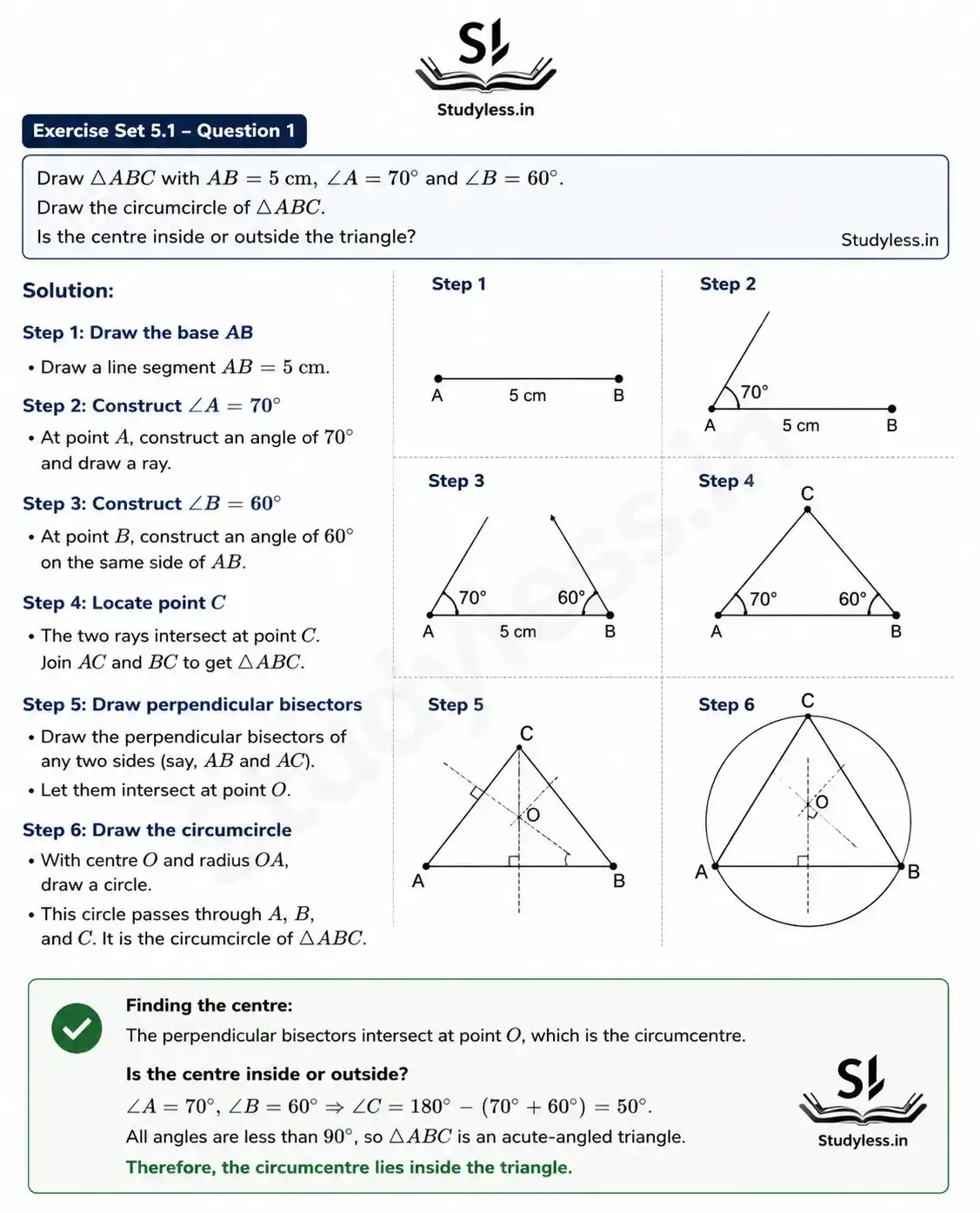
Q1. Draw ΔABC with AB = 5 cm, ∠A = 70°, and ∠B = 60°. Draw the
circumcircle of ΔABC. Is the centre inside or outside the triangle?
Solution:
This question is based on Section 5.3 (Page 96–97) of your textbook. The key idea is:
“There is a unique circle passing through three non-collinear points.” — Theorem 1, Page 96
The centre of this circle is called the circumcentre, and the circle is called the circumcircle. To find the circumcentre, you draw the perpendicular bisectors of the sides of the triangle — they all meet at one point.
Step 1 — Find the Missing Angle ∠C
Using the angle sum property of triangles.
∠A + ∠B + ∠C = 180°
70° + 60° + ∠C = 180°
∠C = 180° − 130° = 50°
All three angles — 70°, 60°, and 50° — are less than 90°. This means ΔABC is an acute-angled triangle.
Step 2 — Construct Triangle ABC
- Draw a line segment AB = 5 cm on your page. Mark point A on the left and point B on the right.
- Place your protractor at point A and mark an angle of 70° above line AB. Draw a ray from A in that direction.
- Place your protractor at point B and mark an angle of 60° above line AB. Draw a ray from B in that direction.
- The two rays will cross each other at a point — label this point C.
- Your triangle ABC is now complete, with AB = 5 cm, ∠A = 70°, ∠B = 60°, and ∠C = 50°.
Step 3 — Draw the Perpendicular Bisectors
The circumcentre O is found where the perpendicular bisectors of the sides meet. You only need two bisectors — the third will automatically pass through the same point.
For side AB:
- Open your compass to more than half the length of AB.
- Place the compass tip at A and draw arcs above and below AB.
- Without changing the compass width, place the tip at B and draw arcs that cross the first arcs.
- Connect the two crossing points with a line. This is the perpendicular bisector of AB.
For side BC:
- Repeat the same process with the compass tip at B and then at C.
- Draw the perpendicular bisector of BC.
Mark the point where these two bisectors cross as O. This is your circumcentre.
Step 4 — Draw the Circumcircle
- Place the compass tip at O.
- Open the compass until the pencil touches point A.
- Draw a full circle.
The circle will pass exactly through A, B, and C. This is the circumcircle of ΔABC. You can verify by checking that the compass also reaches B and C without adjusting — since OA = OB = OC (all equal to the circumradius).
Is the circumcentre O inside or outside the triangle?
Answer: The circumcentre O lies INSIDE the triangle.
This is confirmed by the rule stated on Page 97 of your textbook:
“For an acute-angled triangle, the circumcentre lies inside the triangle.”
Since all three angles of ΔABC are less than 90°, the triangle is acute. So the circumcentre will always fall inside — and your construction will show exactly that.
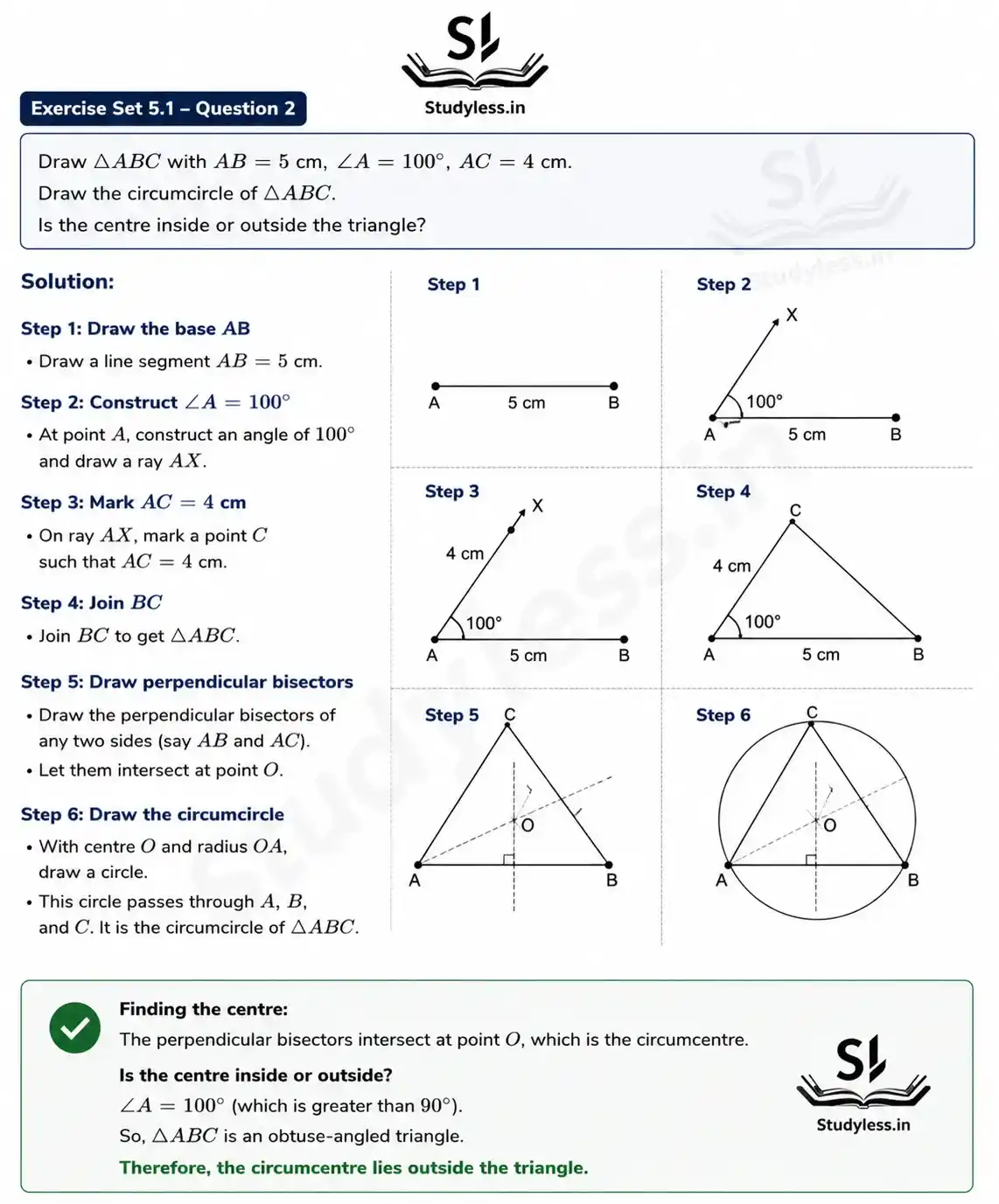
Q2. Draw ΔABC with AB = 5 cm, ∠A = 100°, AC = 4 cm. Draw the
circumcircle of ΔABC. Is the centre inside or outside the triangle?
Solution:
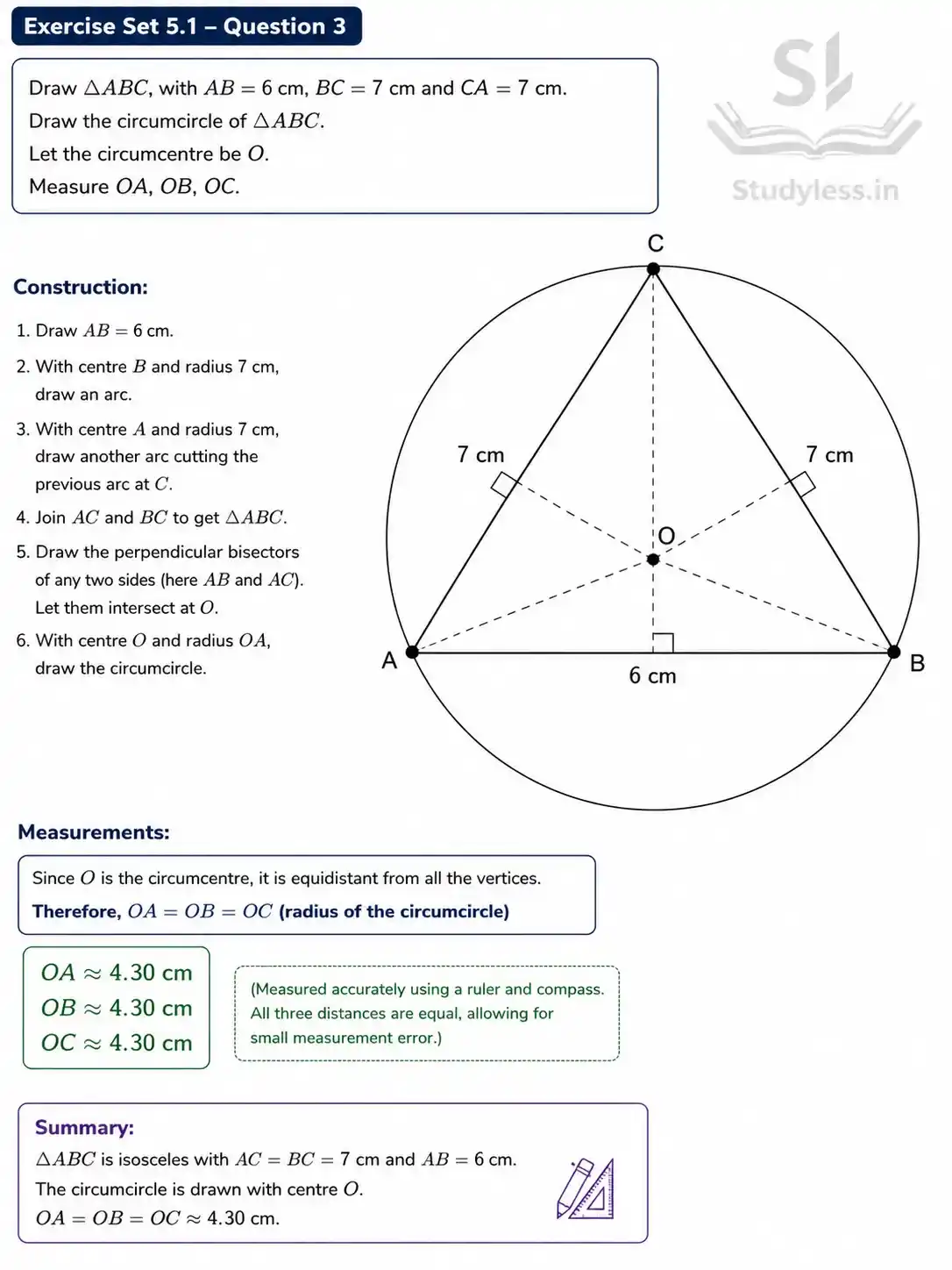
Q3. Draw ΔABC, with AB = 6 cm, BC = 7 cm, and CA = 7 cm. Draw
the circumcircle of ΔABC. Let the circumcentre be O. Measure OA, OB, OC.
Solution:
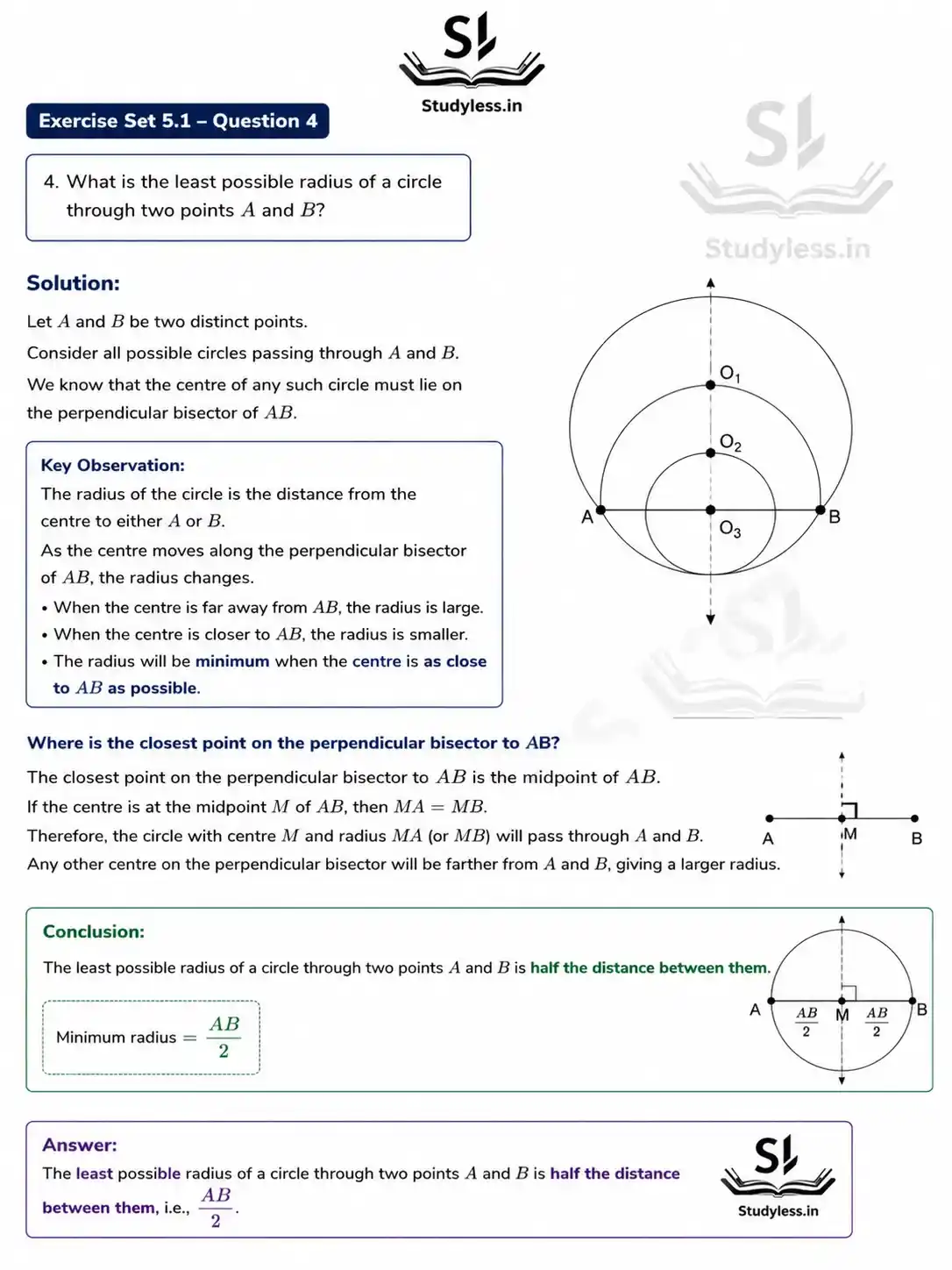
Q4. What is the least possible radius of a circle through two points A and B?
Solution:
Exercise Set 5.2
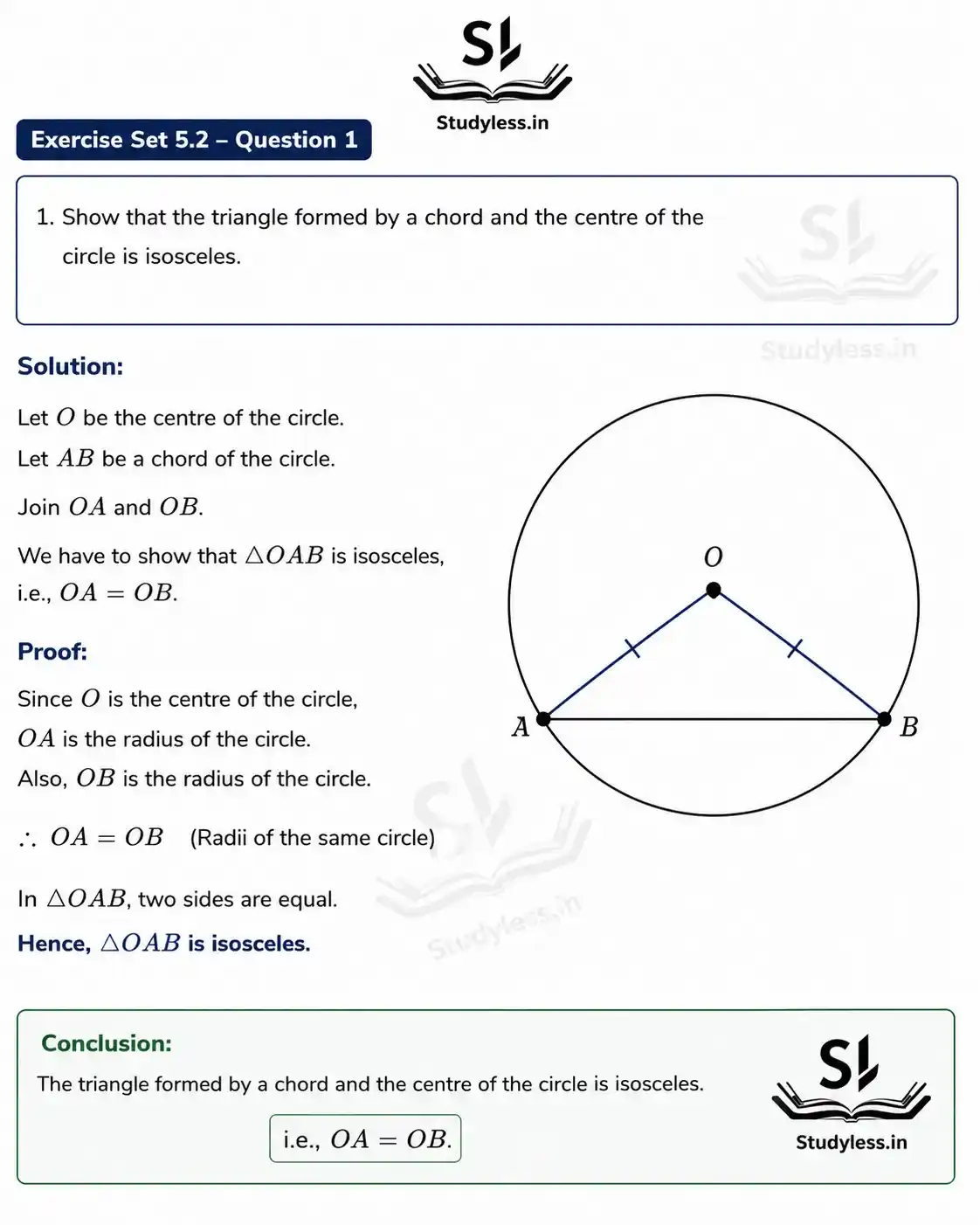
Q1. Show that the triangle formed by a chord and the centre of the
circle is isosceles.
Solution:
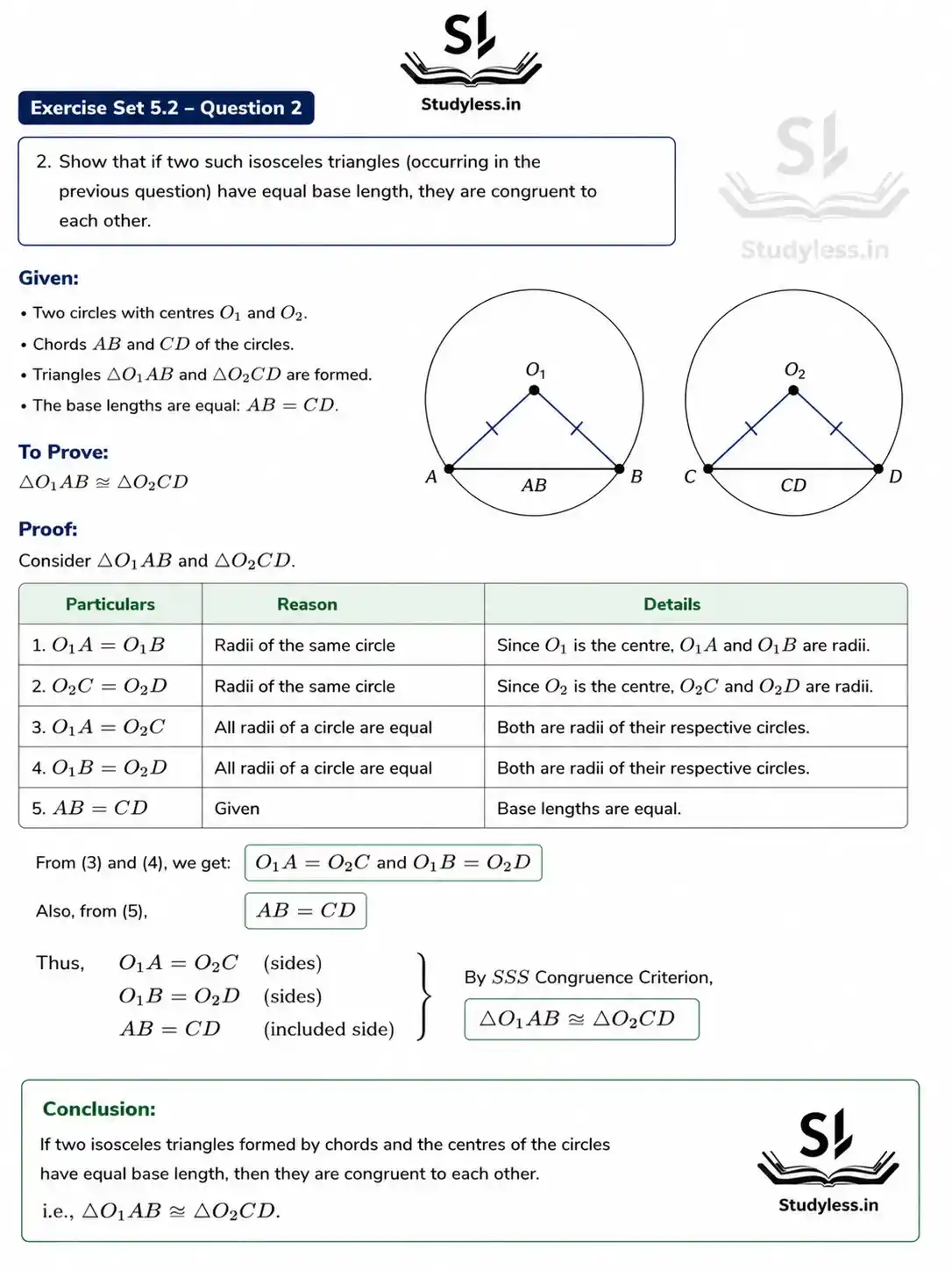
Q2. Show that if two such isosceles triangles (occurring in the previous question)
have equal base length, they are congruent to each other.
Solution:
Exercise Set 5.3
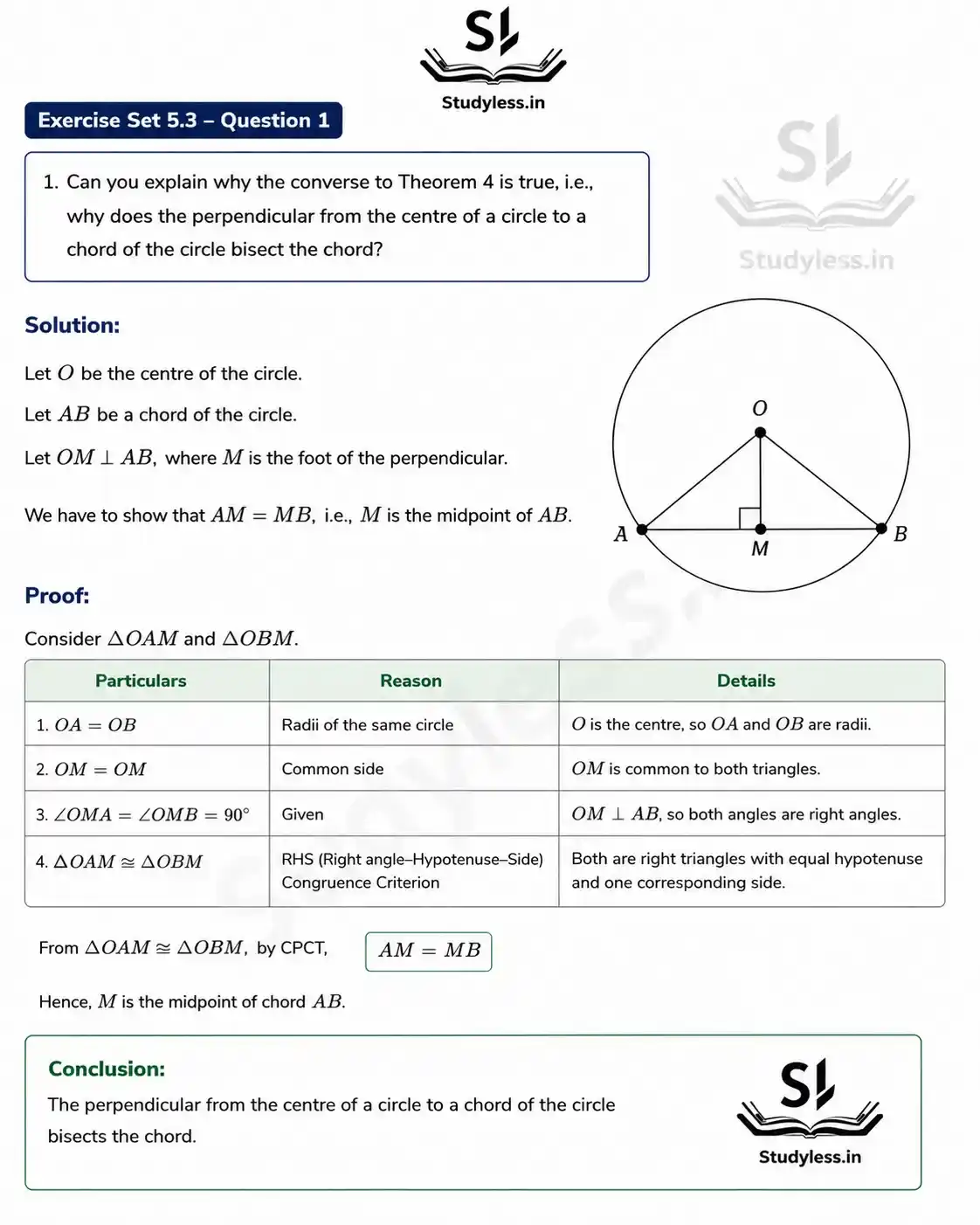
Q1. Can you explain why the converse to Theorem 4 is true, i.e., why
does the perpendicular from the centre of a circle to a chord of the circle bisect the chord?
(Hint: Use Fig. 5.12. You are told that ∠CMA = ∠CMB = 90°. You need to show that AM = BM.)
Solution:
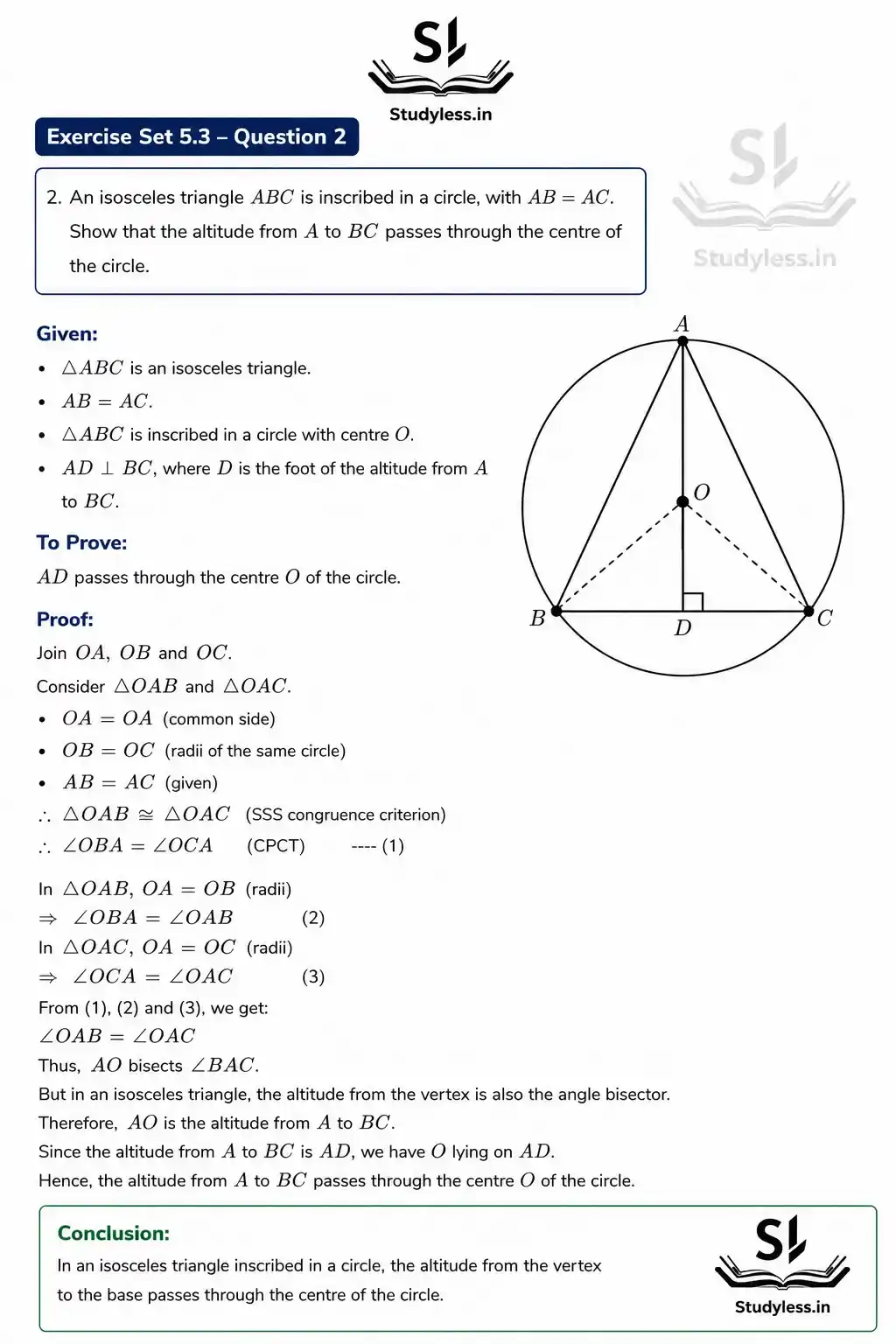
Q2. An isosceles triangle ABC is inscribed in a circle, with AB = AC.
Show that the altitude from A to BC passes through the centre of
the circle.
Solution:
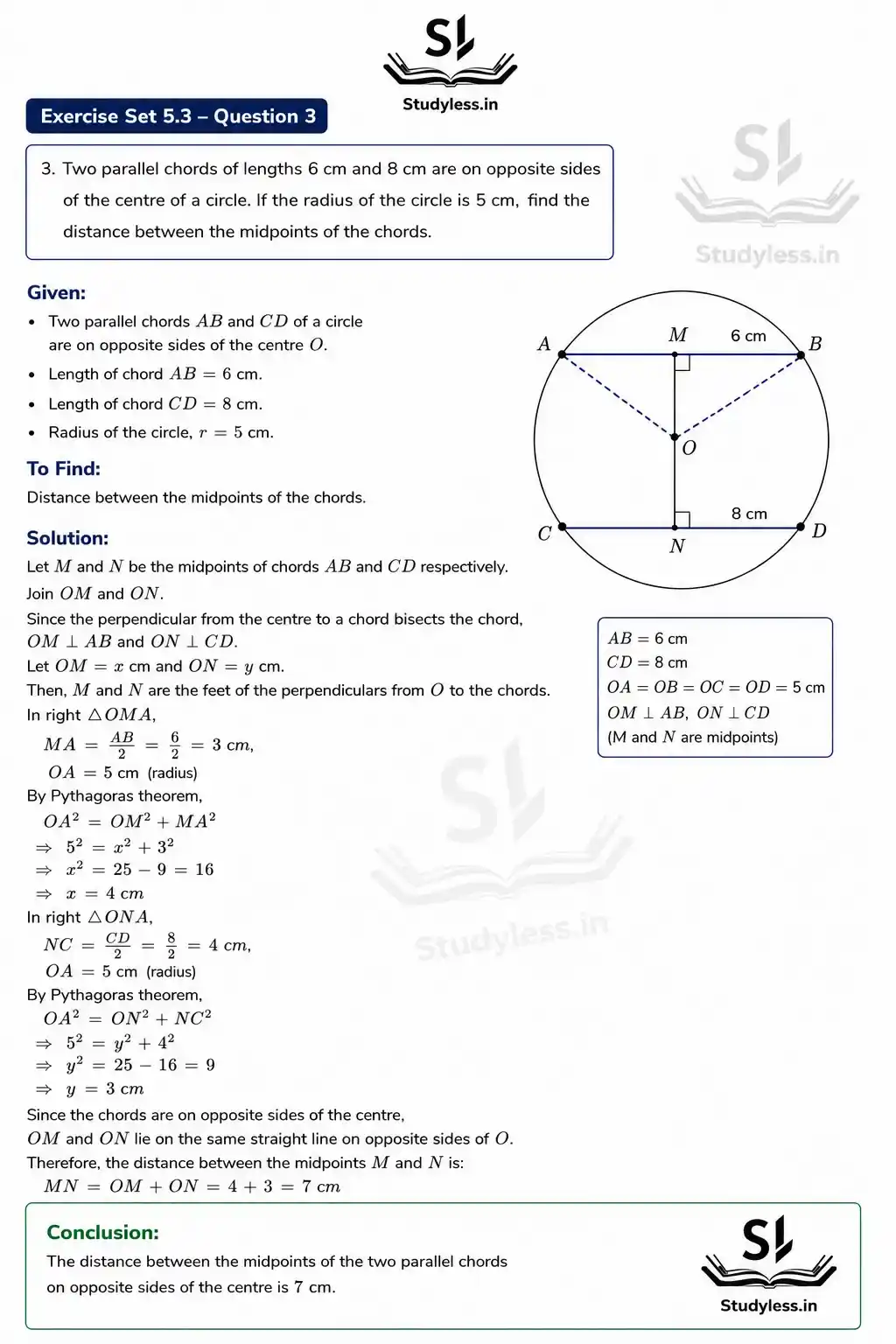
Q3. Two parallel chords of lengths 6 cm and 8 cm are on opposite sides
of the centre of a circle. If the radius of the circle is 5 cm, find the
distance between the midpoints of the chords.
Solution:
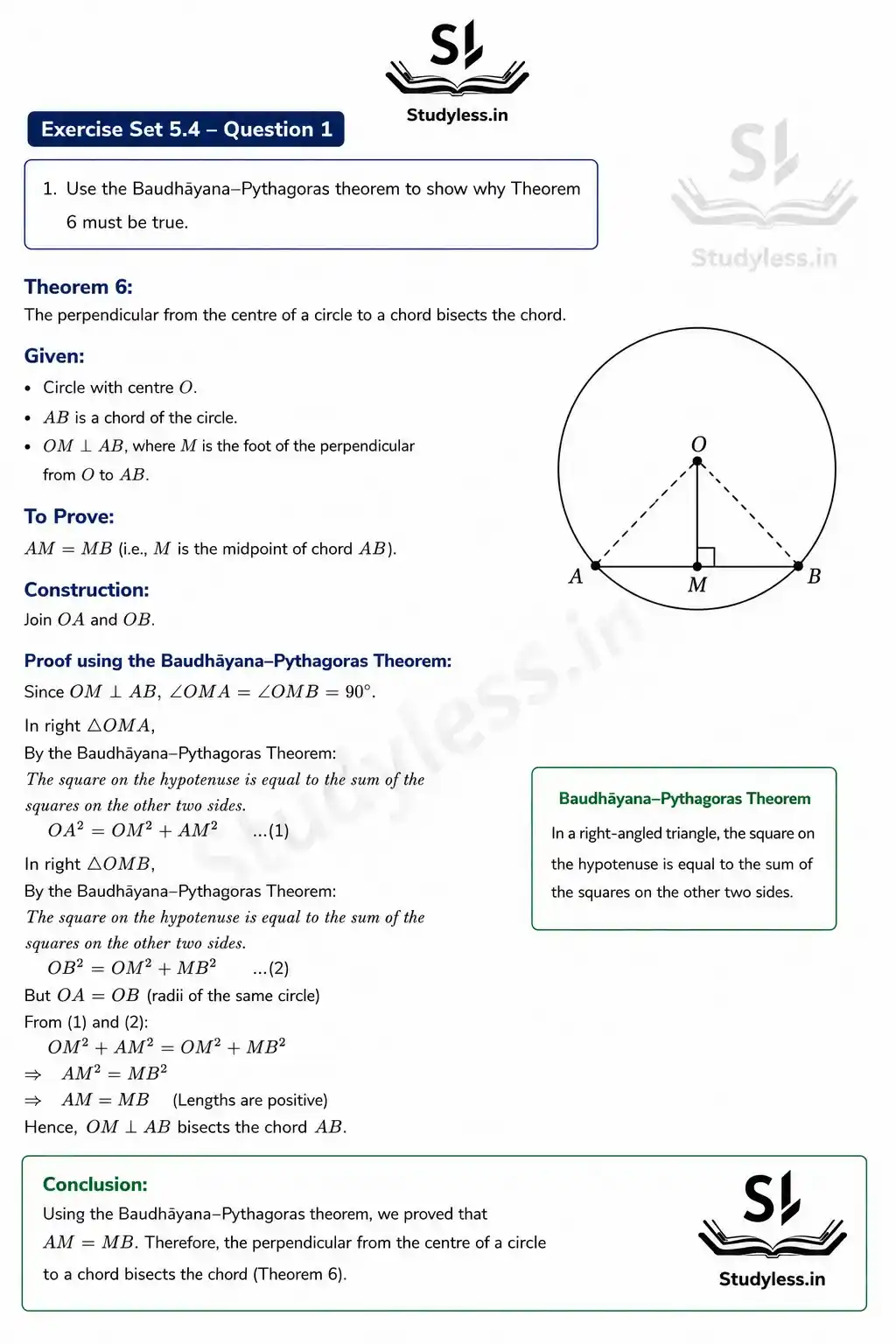
Exercise Set 5.4
Q1. Use the Baudhāyana–Pythagoras theorem to show why the Theorem
6 must be true.
Solution:
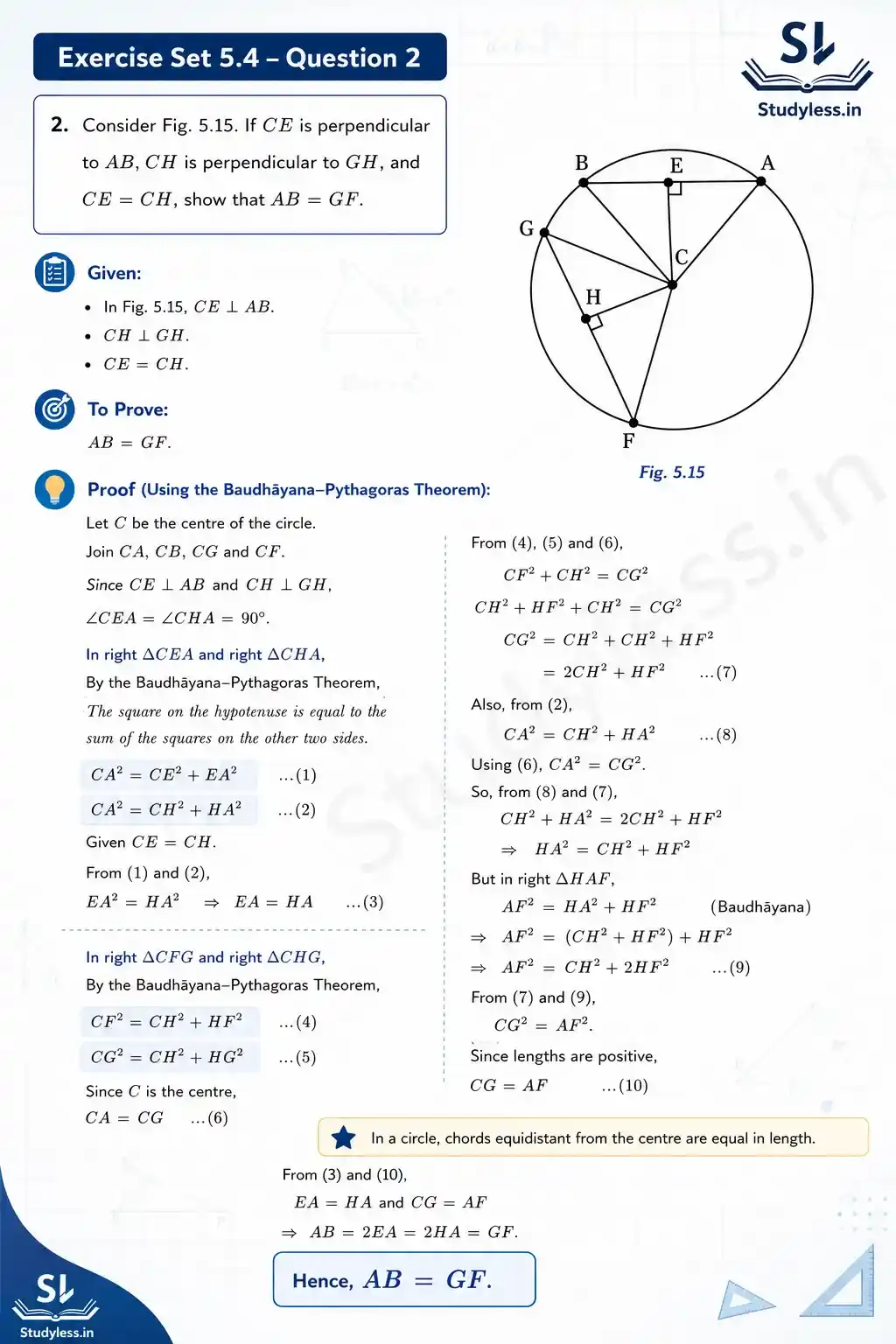
Q2. Consider Fig. 5.15. If CE is perpendicular to AB, CH is perpendicular to GH,
and CE= CH, show that AB = GF.
Solution:
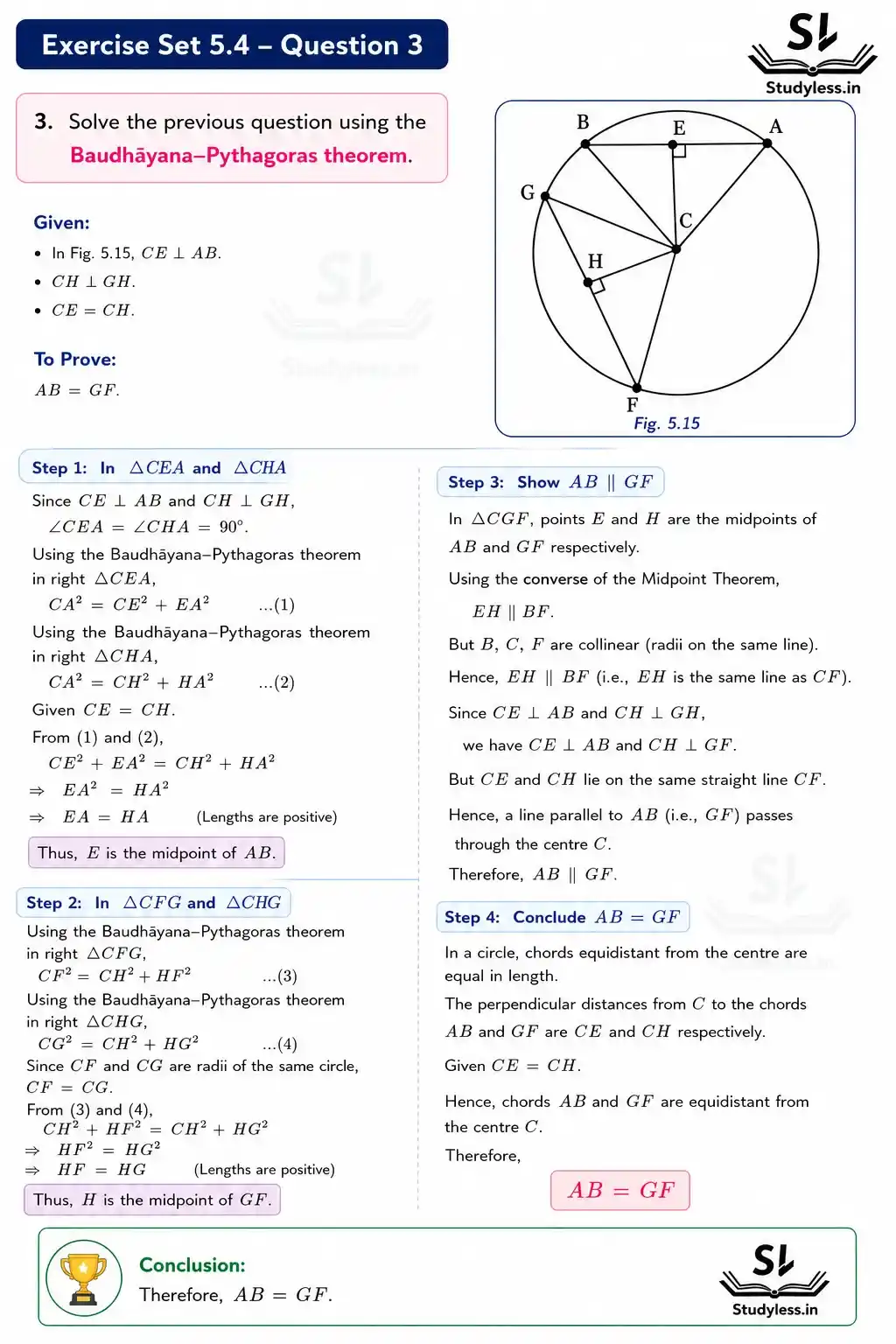
Q3. Solve the previous question using the Baudhāyana–Pythagoras theorem.
Solution:
Exercise Set 5.5
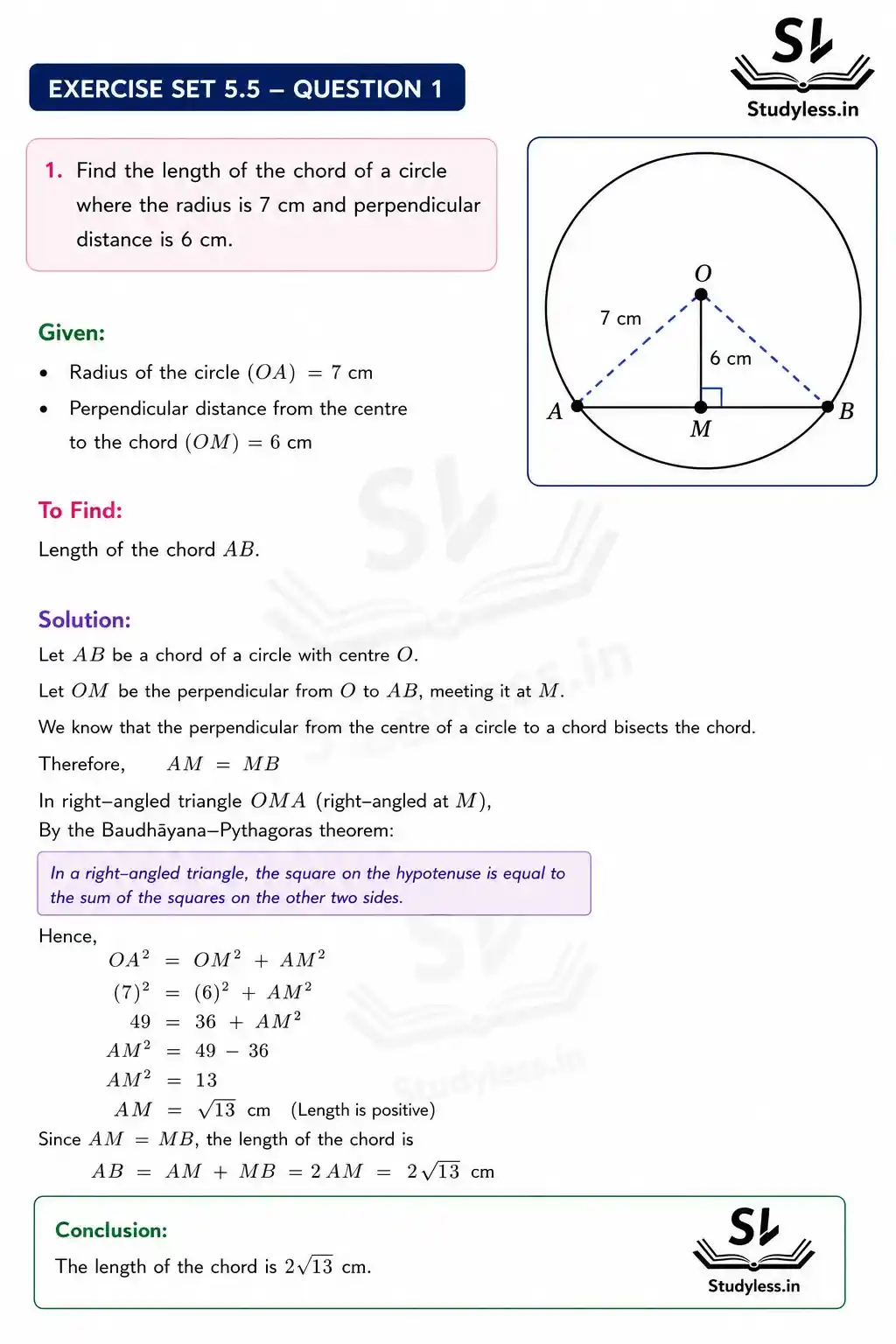
Q1. Find the length of the chord of a circle where the radius is 7 cm
and the perpendicular distance is 6 cm.
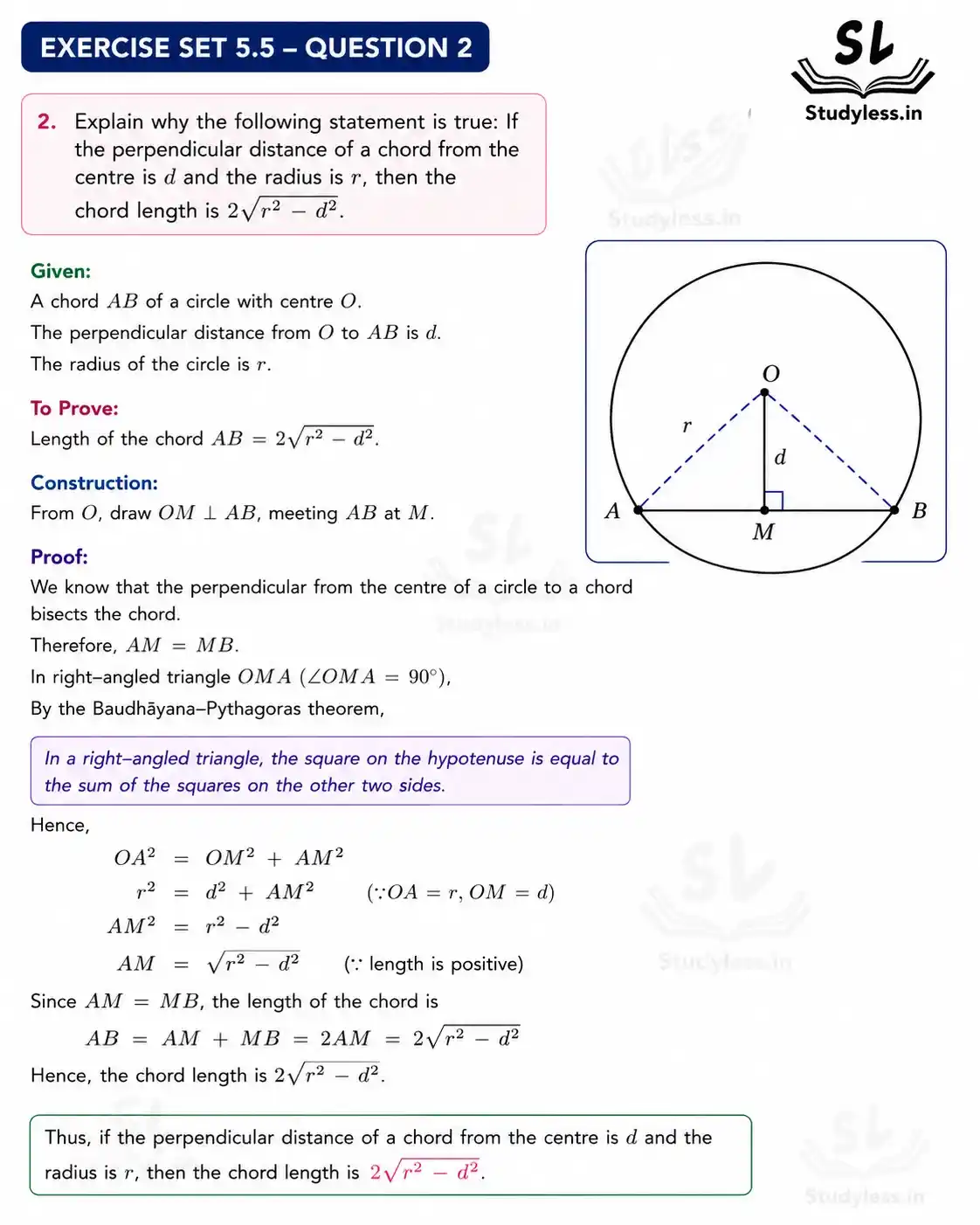
Q2. Explain why the following statement is true: If the perpendicular
distance of a chord from the centre is d and the radius is r, then the
chord length is
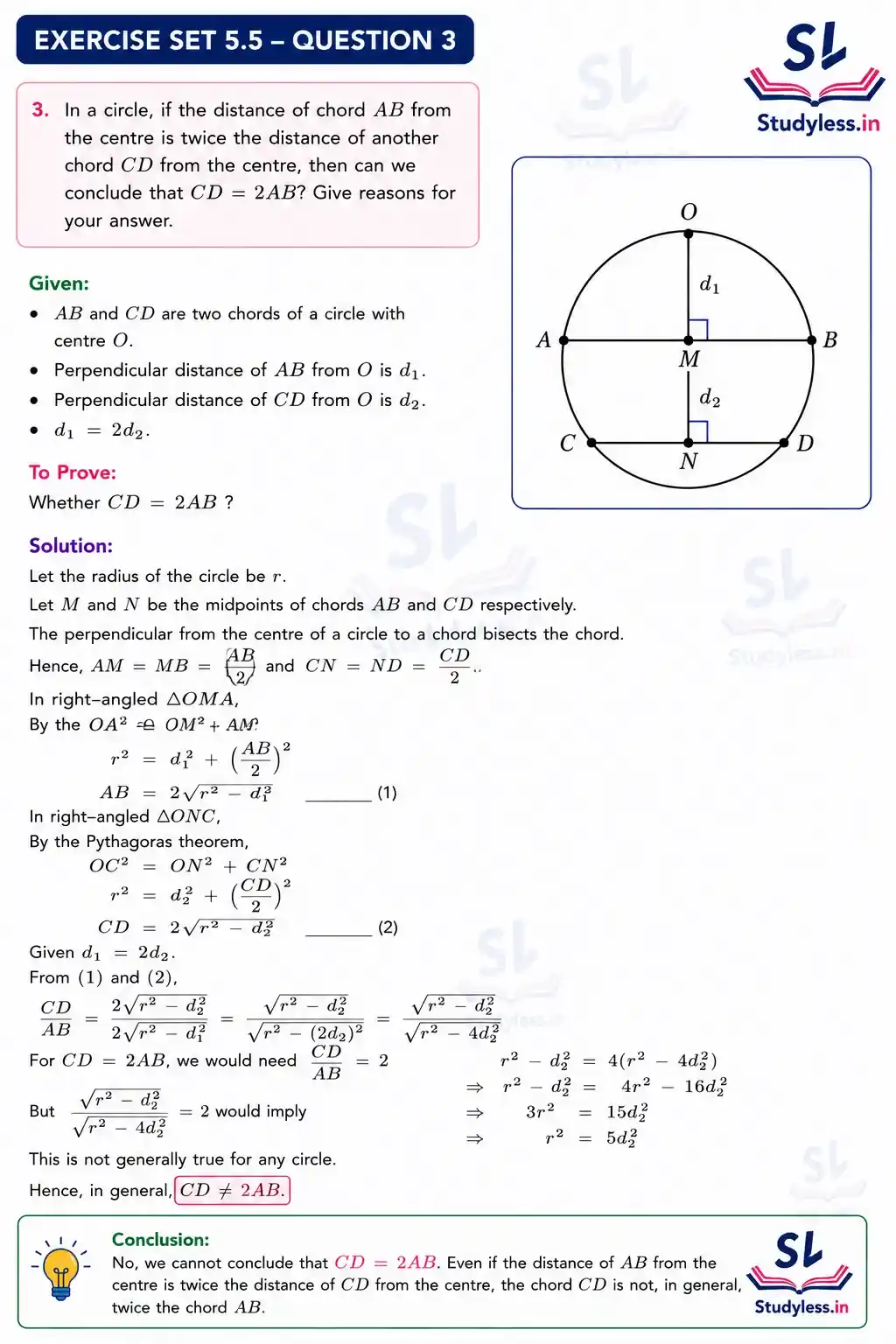
Q3. In a circle, if the distance of chord AB from the centre is twice
the distance of another chord CD from the centre, then can we
conclude that CD = 2 AB? Give reasons for your answer
Exercise Set 5.6
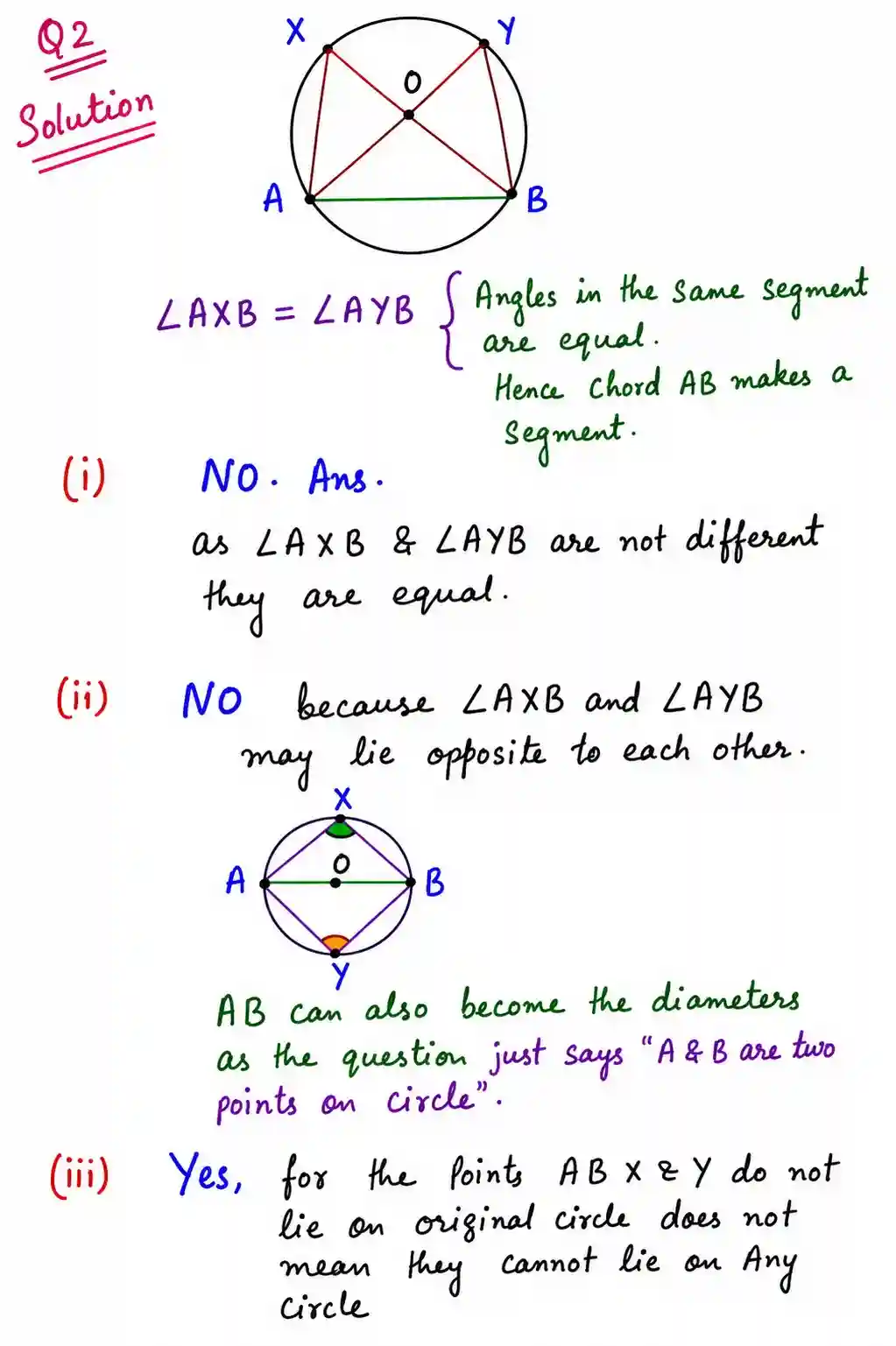
Q2. In a circle with centre O, the central angle AOB is 60°. If the radius
of the circle is 12 cm, what is the length of the chord AB?
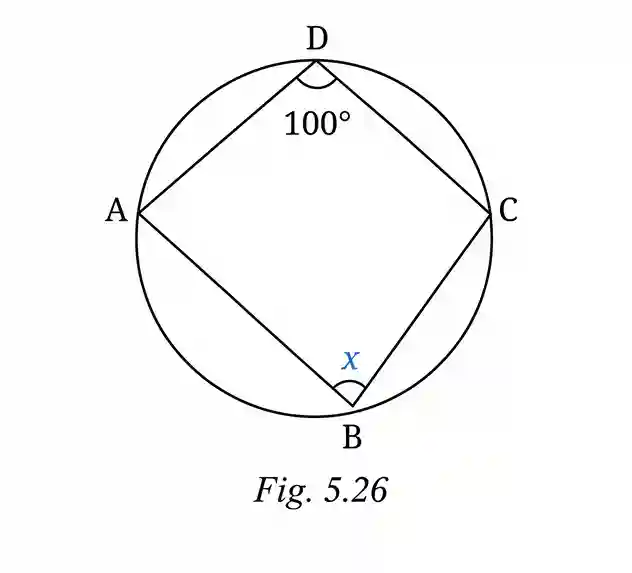
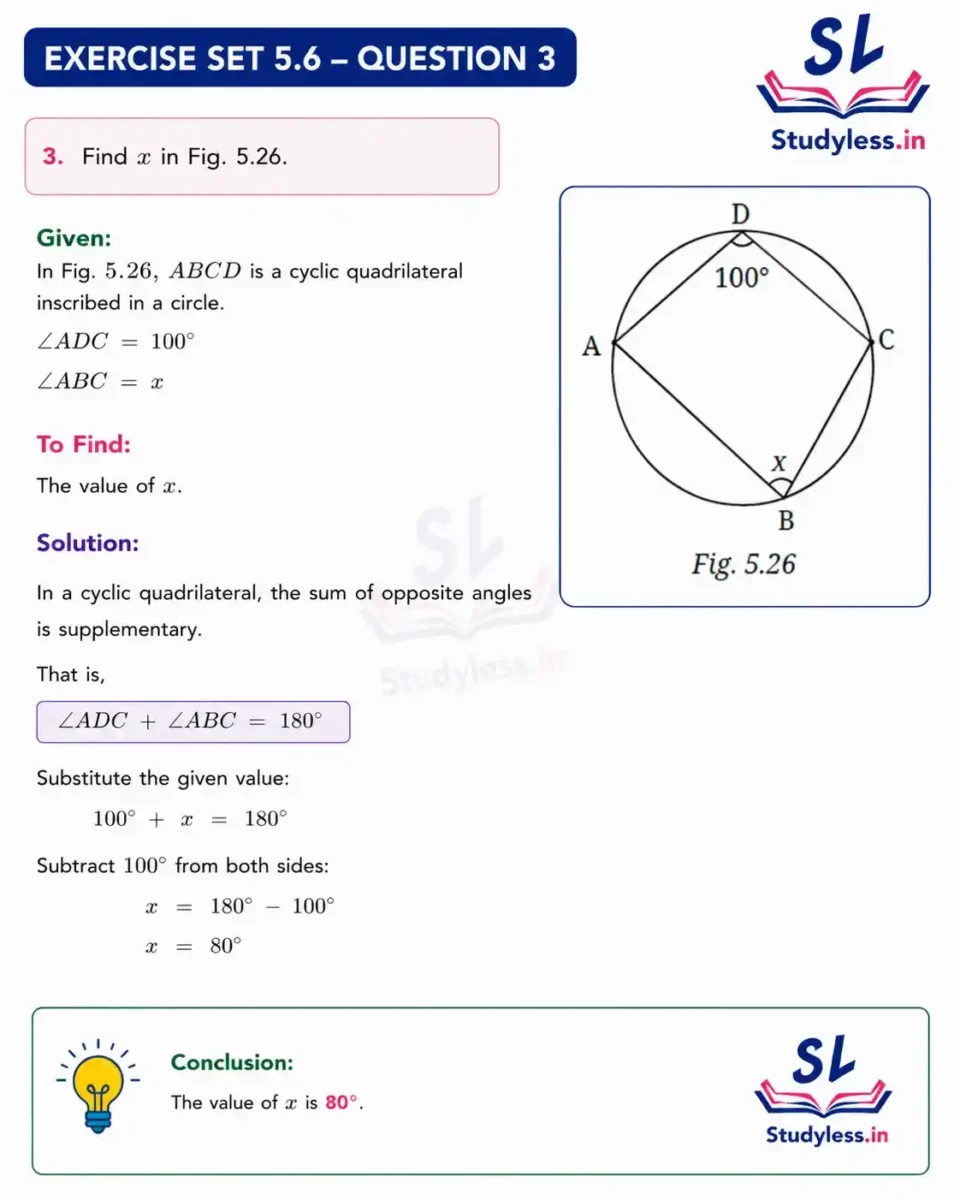
Q3. Find x in Fig. 5.26.
End-of-Chapter Exercises
Q1. In a circle, a chord is 5 cm away from the centre. If the radius of the circle is 13 cm, what is the length of the chord?
Given
- Radius of the circle
- Perpendicular distance of chord from centre
We know:
Substitute the values:
24 cm Ans
Q2. An arc of a circle subtends an angle of 70° at the centre. What is
The measure of the angle subtended by the arc at a point on the circle?
Solution:
Given
The angle subtended by the arc at the centre is:
We know the theorem:
Let the angle subtended at a point on the circle be
Then,
Divide both sides by 2:
35. Ans
Q3. The diameter of a circle is 26 cm. A chord of length 24 cm is
drawn in the circle. Find the distance from the centre of the circle
to the chord.
Solution:
Given
- Diameter of the circle
So, radius:
- Length of the chord
Half of the chord:
Let:
- be the centre of the circle
- be the chord
- be the midpoint of the chord
The perpendicular from the centre to a chord bisects the chord.
Therefore,
In right triangle
Using the Baudhāyana–Pythagoras theorem:
Substituting the values:
5 cm. Ans
Q4. A circle has a radius of 15 cm. A chord is drawn. The distance
from the centre of the circle to the chord is 9 cm. What is the
length of the chord?
Solution:
Given
- Radius of the circle:
- Distance from the centre to the chord:
Let:
- be the chord
- be the centre of the circle
- be the midpoint of the chord AB
The perpendicular from the centre to a chord bisects the chord.
Therefore,
In right triangle ,
Using the Baudhāyana–Pythagoras theorem:
Substituting the values:
Since
AB = 24 cm. Ans
Q5. Prove that the perpendicular bisector of a chord passes through
the centre of the circle.
Solution:
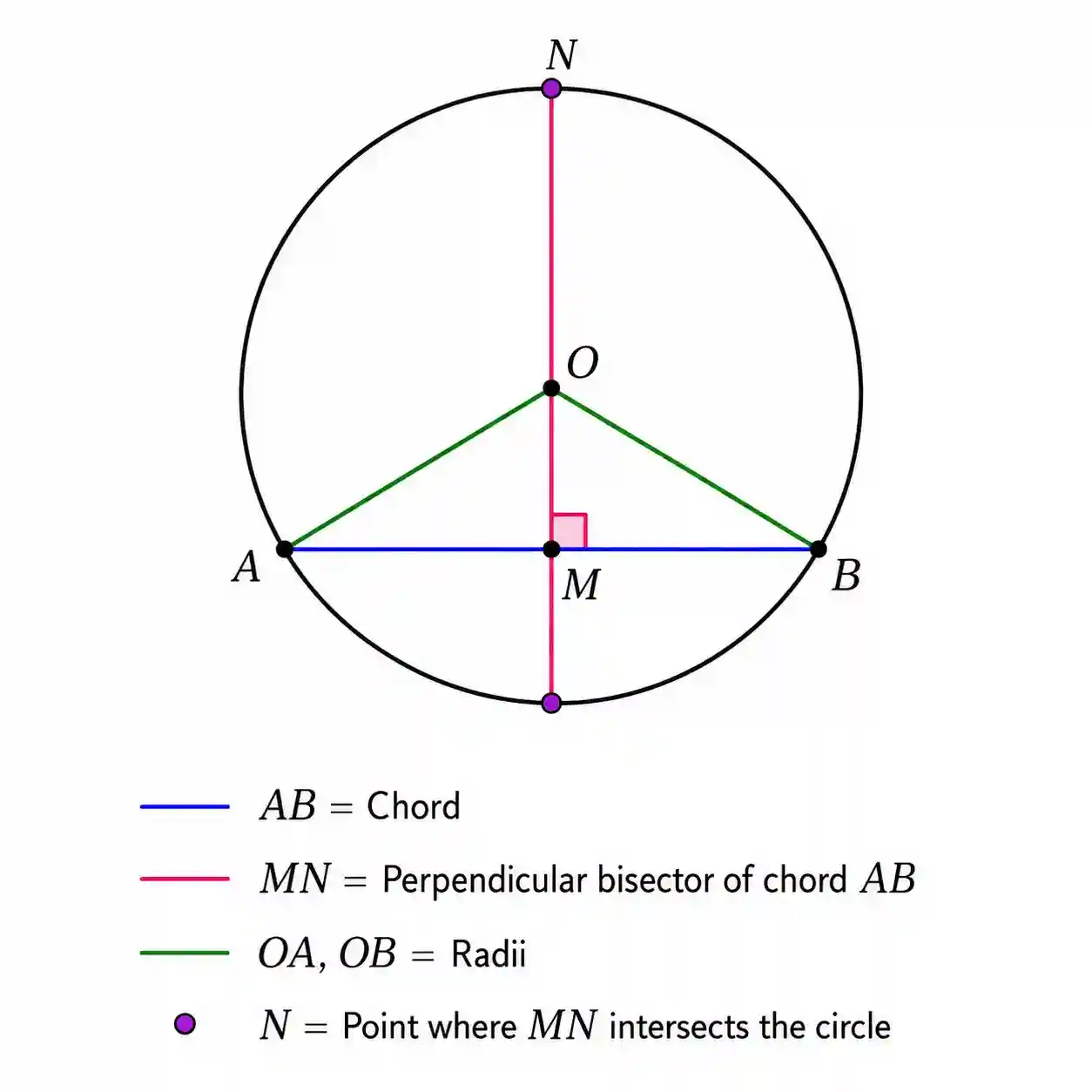
Given
- is a chord of a circle.
- is the centre of the circle.
- is the perpendicular bisector of chord .
To Prove:
The perpendicular bisector of chord passes through the centre .
Construction
Join and .
Let the perpendicular bisector meet chord at point .
Then,
and
Proof
In triangles and :
(Radii of the same circle)
( is the midpoint of )
and
(Common side)
Therefore,
by SSS congruence.
Hence,
But these two angles form a linear pair.
So,
Thus, is perpendicular to chord at its midpoint.
Therefore, the perpendicular bisector of the chord passes through the centre .
Hence Proved.
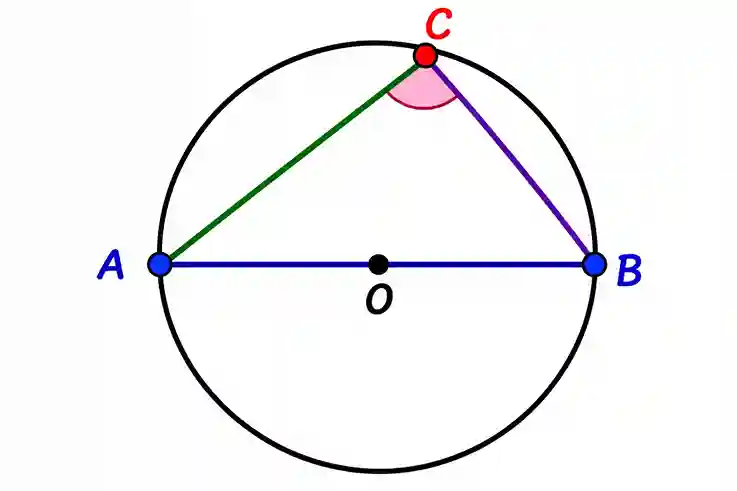
Q6. The diameter of a circle is AB. Point C is on the circumference.
What is the measure of the ∠ACB? Explain your reasoning
Solution :
Given
- is the diameter of the circle.
- is a point on the circumference.
We need to find:
Reasoning
The angle subtended by a diameter at the circumference is always a right angle.
This is called the theorem:
Since is the diameter, the arc forms a semicircle.
Therefore, the angle subtended by at point is:
Q7. ABCD is a cyclic quadrilateral inscribed in a circle. If ∠A
measures 75°, what is the measure of ∠C? If ∠B measures 110°,
What is the measure of ∠D?
Solution:
Given
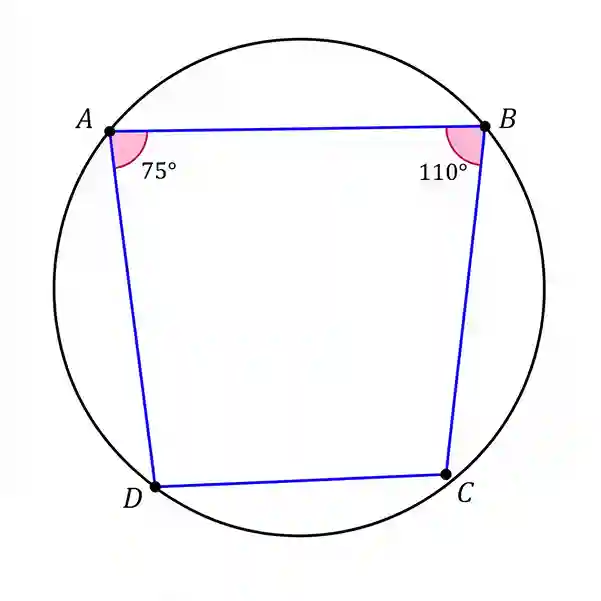
ABCD is a cyclic quadrilateral.
In a cyclic quadrilateral, opposite angles are supplementary.
That means:
and
Finding
Given:
So,
Finding
Given:
So,
Ans.
Q8. Quadrilateral PQRS is inscribed in a circle. If ∠P = (2x + 10)°
and ∠R = (3x − 20)°, find the value of x and the measures of
∠P and ∠R.
Solution:
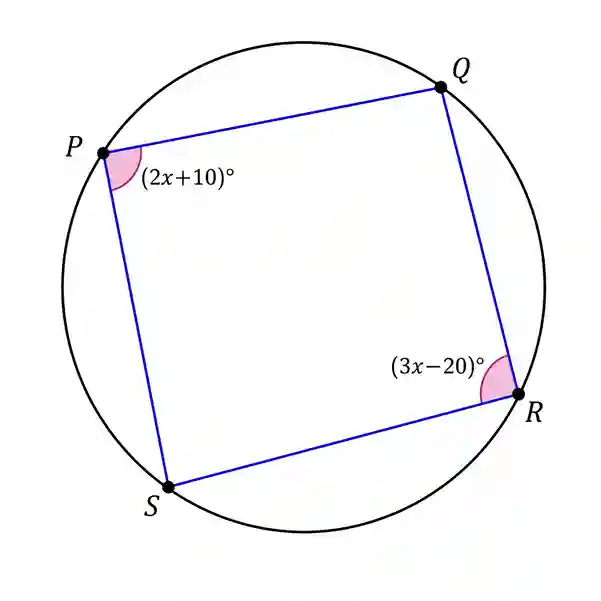
Given
Quadrilateral is a cyclic quadrilateral.
In a cyclic quadrilateral, opposite angles are supplementary.
So,
Substituting the values:
Finding
Finding
Ans.
Q9. The distance of a chord of length 16 cm from the centre of a
circle is 6 cm. Find the radius of the circle.
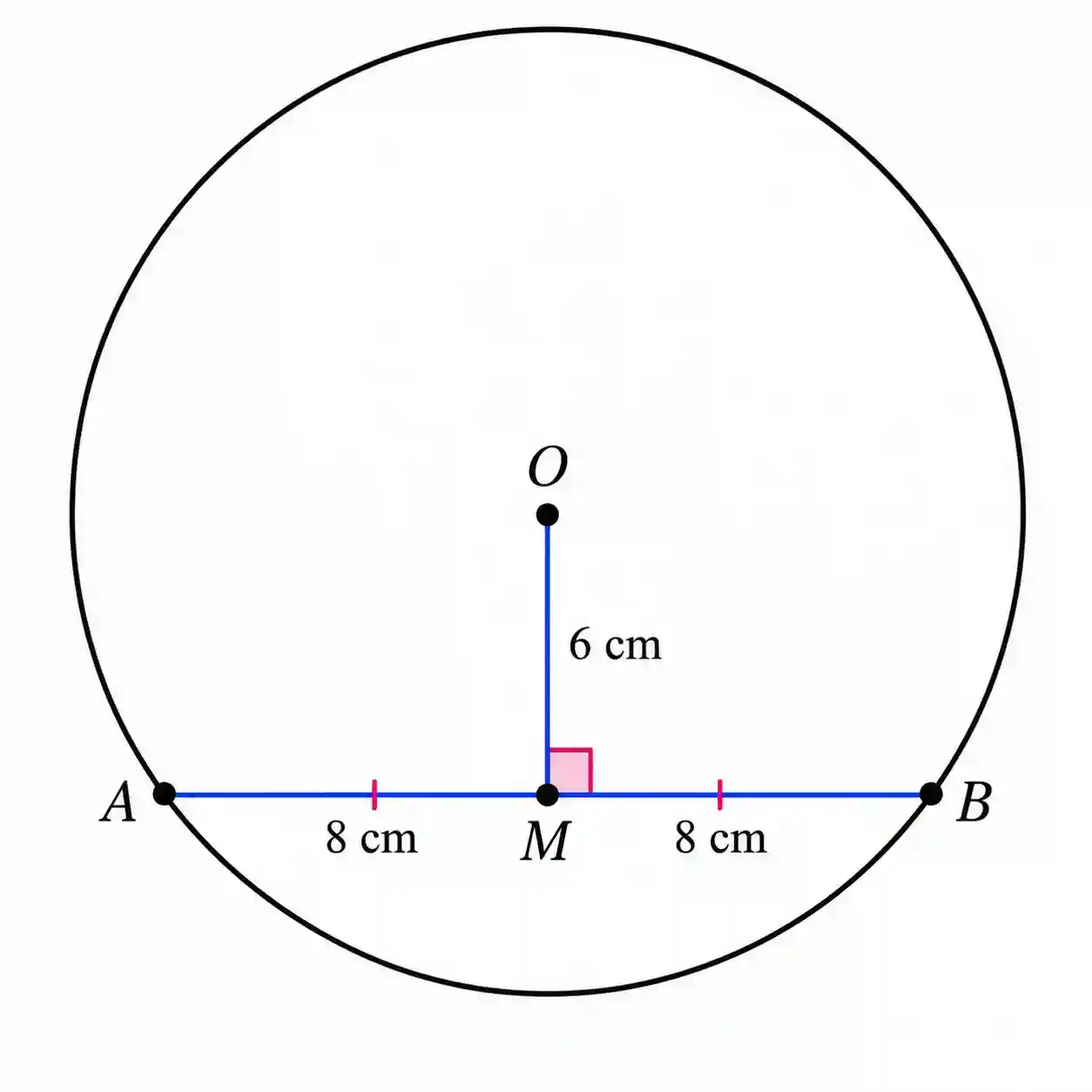
Solutions:
Given
- Length of the chord
Half of the chord:
- Distance of the chord from the centre:
Let:
- be the centre of the circle
- be the chord
- be the midpoint of the chord
Since the perpendicular from the centre to a chord bisects the chord,
In right triangle ,
Using the Baudhāyana–Pythagoras theorem:
Substituting the values:
Ans.
Q10. A cyclic quadrilateral has sides 5, 5, 12, 12 units. Find its area.
Solution:
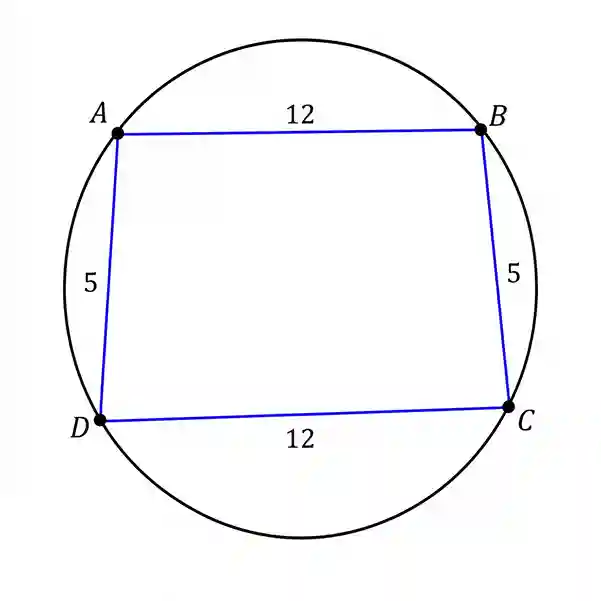
Given
A cyclic quadrilateral has sides:
Since opposite sides are equal,
The quadrilateral is a rectangle.
So,
Area of rectangle:
Substituting the values:
Ans.
Q11. Consider a cyclic quadrilateral. Without drawing its circumcircle,
how can we find out whether the centre of the circumcircle lies inside the quadrilateral or outside? What is the best way of
finding out?
Solution:
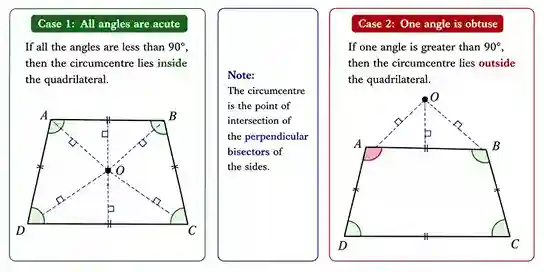
The position of the circumcentre depends on the type of angles in the cyclic quadrilateral.
The circumcentre is formed by the intersection of the perpendicular bisectors of the sides.
Best Method
Observe the angles of the cyclic quadrilateral.
Case 1: All angles are acute
If all the angles are less than ,
then the circumcentre lies inside the quadrilateral.
Case 2: One angle is obtuse
If one angle is greater than ,
then the circumcentre lies outside the quadrilateral.
Why?
In a cyclic quadrilateral:
So if one angle becomes obtuse, the geometry of the perpendicular bisectors shifts the circumcentre outside the figure.
Best Practical Way
The easiest way is:
- Check whether the quadrilateral has an obtuse angle.
- If yes → circumcentre lies outside.
- If all angles are acute → circumcentre lies inside.
Conclusion
- All acute angles ⇒ circumcentre inside.
- At least one obtuse angle ⇒ circumcentre outside.
Q12. When two chords intersect, each of them is divided into two
line segments. Show that if the intersecting chords are of equal
length, then the line segments of one chord are equal to the
corresponding line segments of the other chord.
Solution:
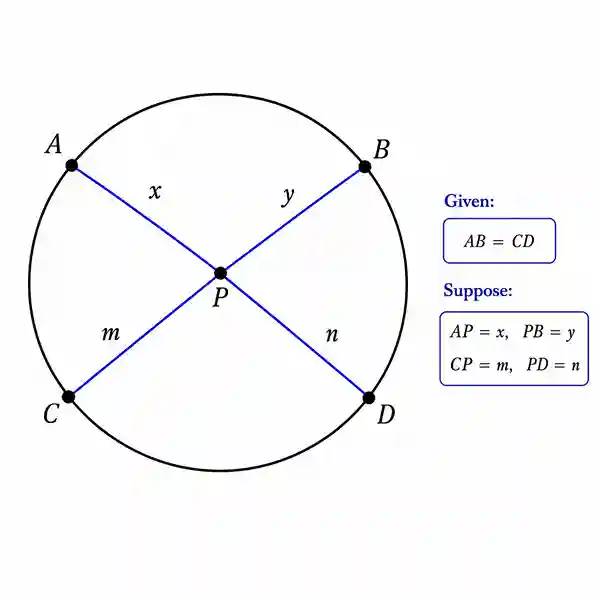
Given
Two chords intersect inside a circle.
Let the chords and intersect at point .
Given:
Suppose:
and
Since the whole chords are equal,
So,
Also, by the intersecting chords theorem:
Therefore,
Now we have:
and
Two numbers with the same sum and the same product must be equal.
Hence,
and
That is,
and
Therefore,
The line segments of one chord are equal to the corresponding line segments of the other chord.
Hence Proved.
Q13. Draw a circle in which a chord of 6 cm length stands at a
distance of 3 cm from the centre. (Hint: Is it a circumcircle of a suitable triangle?)
Solution:
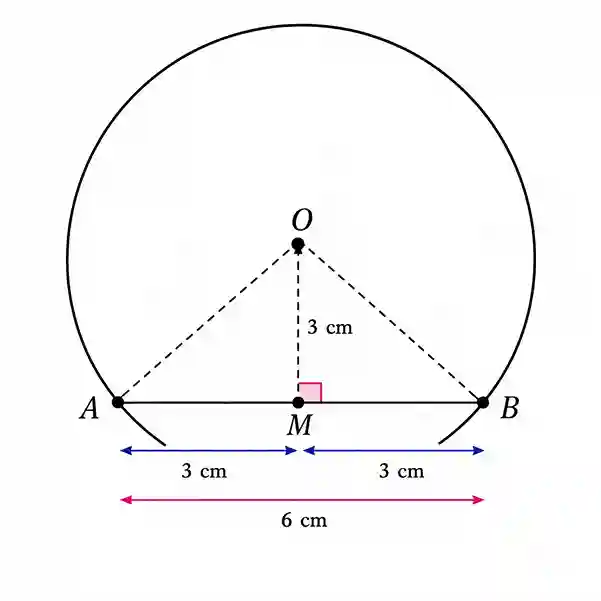
Construction
A chord of length stands at a distance from the centre.
The perpendicular from the centre to the chord bisects the chord.
So half of the chord is:
Now we get a right triangle where:
- One side
- Other side
Using the Baudhāyana–Pythagoras theorem:
Steps of Construction
- Draw a line segment
- Find the midpoint of
- Draw a perpendicular line at .
- On the perpendicular line, mark a point such that:
- Join and .
- With centre and radius , draw the circle.
This is the required circle
Q14. Show that a rectangle is the only parallelogram that can be
inscribed in a circle.
Solution :
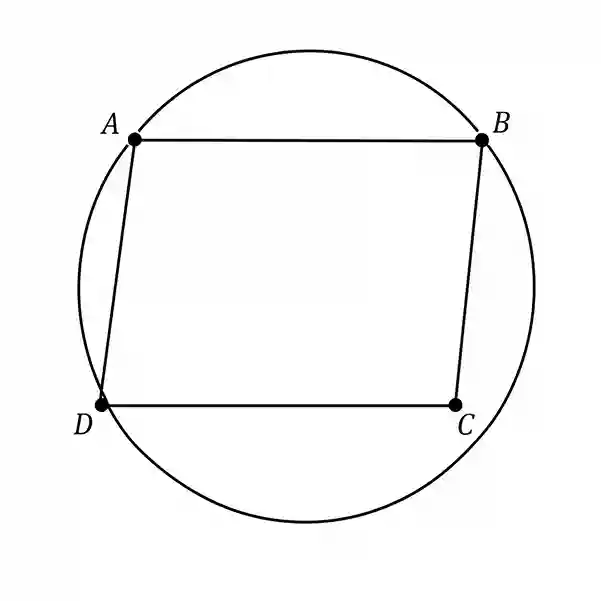
Given
ABCD is a parallelogram inscribed in a circle.
To Prove:
The parallelogram must be a rectangle.
Proof
In a parallelogram:
and
But in a cyclic quadrilateral:
Since ,
Similarly,∠B=90∘
Therefore, all the angles of the parallelogram are right angles.
Hence, the parallelogram is a rectangle.
Therefore, a rectangle is the only parallelogram that can be inscribed in a circle.
Hence Proved.
Q15. Show that if a rectangle is inscribed in a circle, then the point of the
intersection of its diagonals must lie at the centre of the circle.
Solution:‘
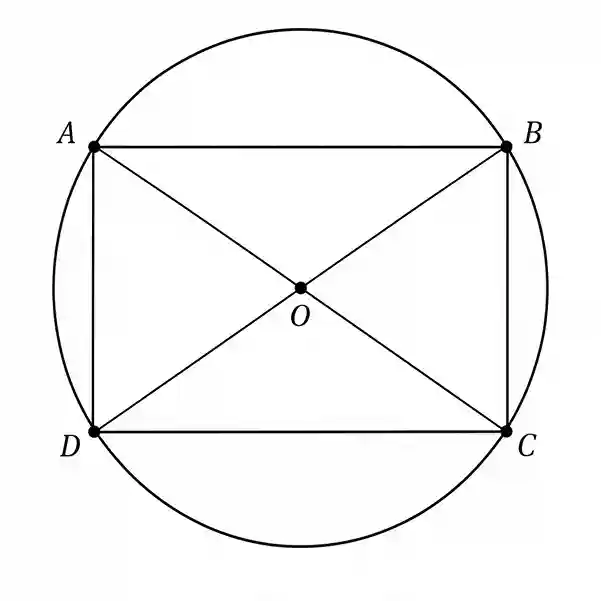
Proof
In a rectangle:
and the diagonals bisect each other.
So,
and
Since diagonals are equal,
Therefore,
Thus, point O is equidistant from all four vertices .
A point equidistant from all points on a circle is the centre of the circle.
Hence, is the centre of the circle.
Hence Proved
Q16. Consider all chords of a circle of a fixed length. What is the
shape formed by the midpoints of all these chords?
Solution:
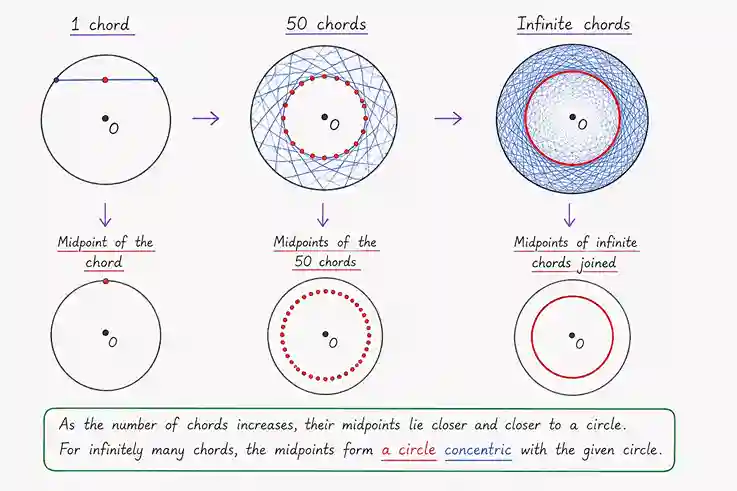
All chords have the same length.
In a circle:
- Equal chords are equidistant from the centre.
- The perpendicular from the centre to a chord passes through its midpoint.
So, the midpoint of every such chord lies at the same fixed distance from the centre.
All the midpoints form another circle having the same centre as the original circle.
This smaller circle is concentric with the original circle.
Ans.
The shape formed by the midpoints is:
Q17. In a circle with centre O, chords AB and AC are congruent. Explain
why this statement is true: “The centre of the circle lies on the angle bisector of ∠BAC”.
Solution:
Given
In a circle with centre ,
To Prove:
lies on the angle bisector of .
Proof:
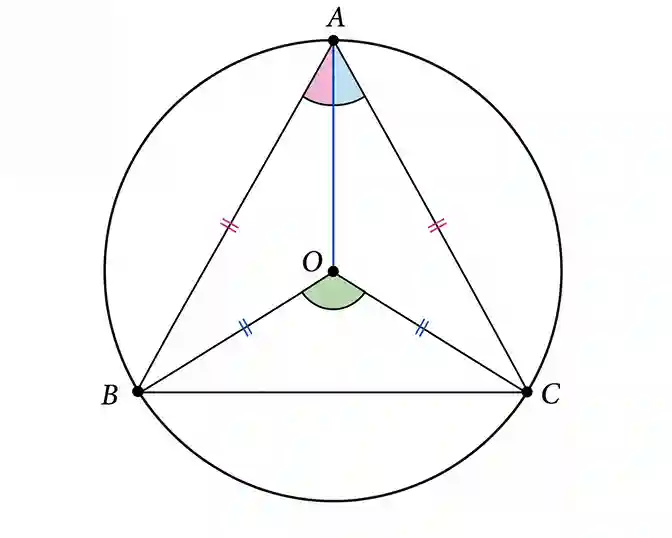
Join:
Since and are radii of the same circle,
Given:
Also,
(Common side)
Therefore, in triangles and :
Hence,
by SSS congruence.
Therefore,
So, line bisects .
Hence, the centre lies on the angle bisector of .
Hence Proved.
Q18. Two parallel chords of lengths 10 cm and 24 cm are on the same
side of the centre of a circle. The distance between the chords is 7 cm. Find the radius of the circle.
Solution:
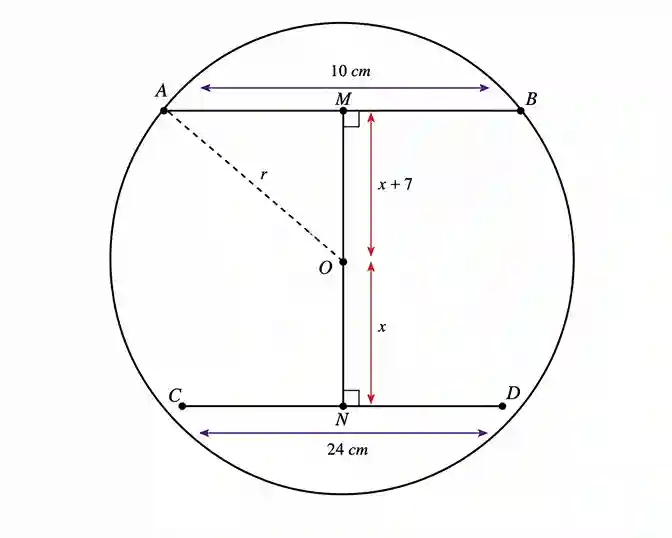
Given
Two parallel chords are on the same side of the centre.
- Length of first chord
- Length of second chord
- Distance between the chords
Let:
- be the radius of the circle
- Distance of the longer chord from the centre
- Distance of the smaller chord from the centre
Since the perpendicular from the centre bisects a chord:
Half of chord:
Half of chord:
Using the Baudhāyana–Pythagoras theorem for the larger chord:
For the smaller chord:
Since both are equal to ,
Now,
Ans.
Q19. A regular hexagon is inscribed in a circle of radius r. Find the
length of the sides of the hexagon and the distance of each side
from the centre of the circle.
Given
A regular hexagon is inscribed in a circle of radius .
To Find:
- Length of each side of the hexagon.
- Distance of each side from the centre of the circle.
Construction
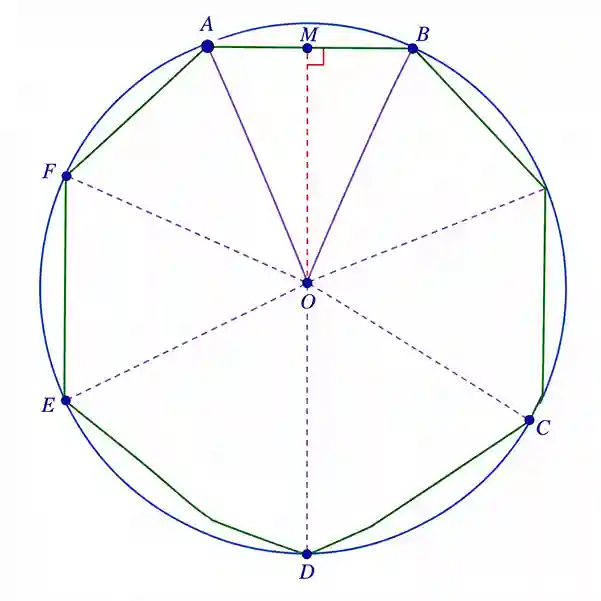
Let be the regular hexagon inscribed in a circle with centre and radius .
Join and .
Draw , where is the midpoint of side .
Solution:
Since is a regular hexagon,
Also,
Thus, in ,
Hence, is an equilateral triangle.
Therefore,
So, the length of each side of the hexagon is:
Now, is perpendicular to the chord AB from the centre.
Therefore, it bisects the chord .
In right-angled ,
By Pythagoras' theorem,
Hence, the distance of each side from the centre is
Answer
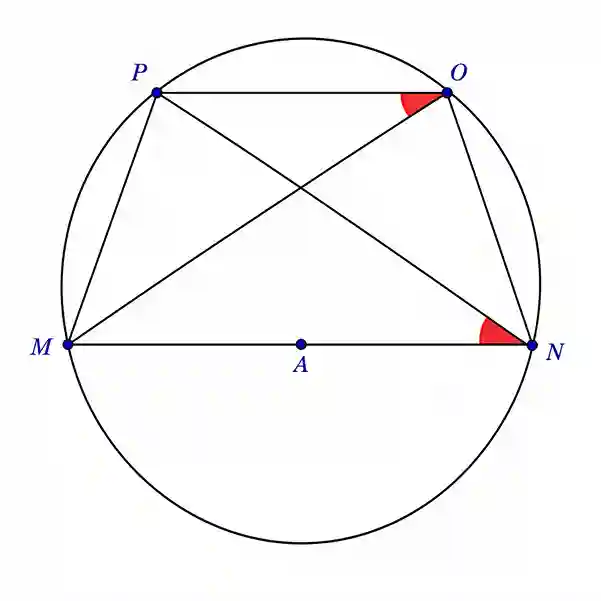
Q20. A quadrilateral MNOP is inscribed in a circle. If MN is a
diameter, what can you say about ∠MOP and ∠MNP? Explain
your reasoning.
Given
A quadrilateral is inscribed in a circle.
is the diameter of the circle.
To Find
The values of:
and explain the reasoning.
Solution:
Since is a diameter, any angle subtended by at a point on the circle is a right angle.
Therefore, in quadrilateral ,
(by the theorem: Angle in a semicircle is a right angle)
Now consider the angles and .
Both angles subtend the same chord :
is formed by chords and .
is formed by chords and .
Since angles standing on the same chord of a circle are equal,
Reasoning
Both and intercept the same chord .
According to the theorem:
Angles in the same segment of a circle are equal.
Hence,
Answer
∠MOP =∠MNP because both angles stand on the same chord of the circle.
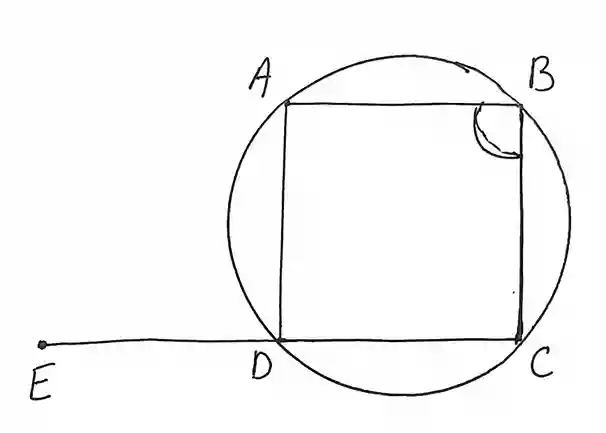
Q21. Let ABCD be a cyclic quadrilateral. Explain why the exterior
angle at any vertex is equal to the interior opposite angle
(e.g., ∠CDE = ∠ABC, where E is a point on the extension of side CD).
Solution:
Given
is a cyclic quadrilateral, and is the extension of side .
To Prove
Proof
Since is an extension of ,
(Linear Pair) ...................................(1)
Since is a cyclic quadrilateral,
...................................(2)
(Opposite angles of a cyclic quadrilateral are supplementary)
From (1) and (2),
Subtracting from both sides,
Hence proved.
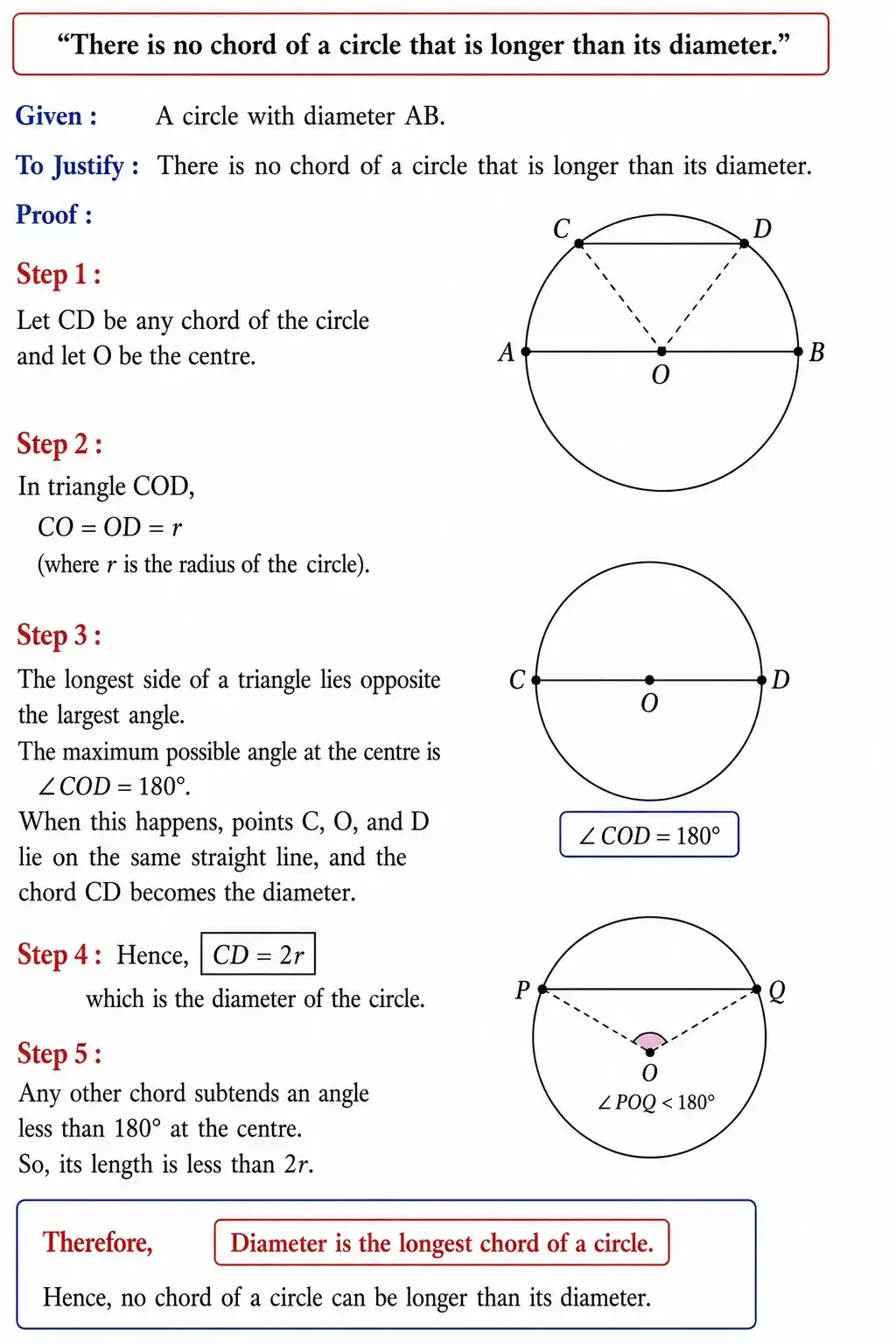
Q22. “There is no chord of a circle that is longer than its diameter.”
How do you justify this statement?
Solution :
![When Will The New Class 9 Social Science [SST] NCERT be available Online](https://studyless.in/wp-content/uploads/2026/05/When-Will-The-New-Class-9-Social-Science-SST-NCERT-be-available-Online-1200x675.webp)