Earth as a System: Energy, Matter, and Life is the last chapter of your NCERT science textbook. And like the other chapters, we have also created nice, well-curated short notes.
“Notes Ch 13 Earth as a System Energy matter and life” is created with your need for short, crisp, and concise notes in mind.
In “Notes Ch 13 Earth as a System Energy, matter, and life,” we have included only the important points and concepts that are asked in the examinations.
Therefore, you should also read the chapter in the NCERT book to understand it.
“Notes Ch 13 Earth as a System Energy matter and life.” is only for quick revision and preparation for examination purposes, and for getting good marks only.
Happy reading!
Introduction: Notes Ch 13 Earth as a System Energy, matter, and life
What Powers Life on Earth?
➢ Sun — main source of energy
➢ Earth’s hot interior + chemical reactions in air, water, and rocks
In Simple Words:
The Sun and Earth themselves keep energy and matter moving.
What is the “Earth System”?
➢ Earth is one system made of interacting parts called spheres
➢ A change in one sphere affects all others
What are the 5 Spheres?
| Sphere | What it includes | Example |
|---|---|---|
| Geosphere | Solid rocks, soil, landforms, Earth’s interior | Deccan Plateau, Thar Desert |
| Hydrosphere | Liquid water — oceans, rivers, lakes, groundwater | Ganga–Brahmaputra river system |
| Cryosphere | Solid water — ice and snow | Himalayan glaciers, Ladakh snow, polar ice caps |
| Atmosphere | Air surrounding Earth | Mountain and forest air |
| Biosphere | All living organisms + their habitats | Mangroves, coral reefs, ocean plankton, farms |
In Simple Words:
Earth is divided into 5 spheres: rock, liquid water, ice, air, and life.
How Do the Spheres Connect?
1. Natural processes link all spheres:
●Solar radiation (heating)
●Movement of air and water
●Nutrient cycling
2. These keep the spheres in a delicate balance.
In simple words:
heat, wind, water, and nutrients are the threads connecting all spheres.
What Happens When One Sphere is Disturbed?
Small-Scale Example
Less snowfall in winter ➜ less lake water in summer ➜ less grass growth
(Cryosphere ➜ Hydrosphere ➜ Biosphere)
Large-Scale Example
Warmer Arabian Sea ➜ more evaporation:
➜ southwest monsoon fluctuations
➜ floods in some regions, drought in others
➜ Hydrosphere disrupted
Rising atmospheric temperature ➜ glaciers and polar ice melt faster
➜ low-lying regions flood
➜ sea levels rise ➜ coastal cities threatened
➜ habitat loss ➜ Biosphere disturbed
In Simple Words:
One change sets off a chain reaction across all spheres.
Does Solar Radiation Heat Earth Evenly?
No — heating varies:
●Equator to poles
●Oceans to mountains
This uneven heating drives:
Winds
●Ocean currents
●Water cycle
In Simple Words:
Uneven heating by the Sun is what keeps wind, water, and weather moving.
Uneven Heating of the Earth
What is Solar Radiation?
Solar radiation — the main energy source on Earth
➢ Travels as electromagnetic (EM) waves through vacuum at the speed of light (3 × 10⁸ ms⁻¹)
➢ EM waves ≠ sound waves — sound needs a medium; EM waves do not
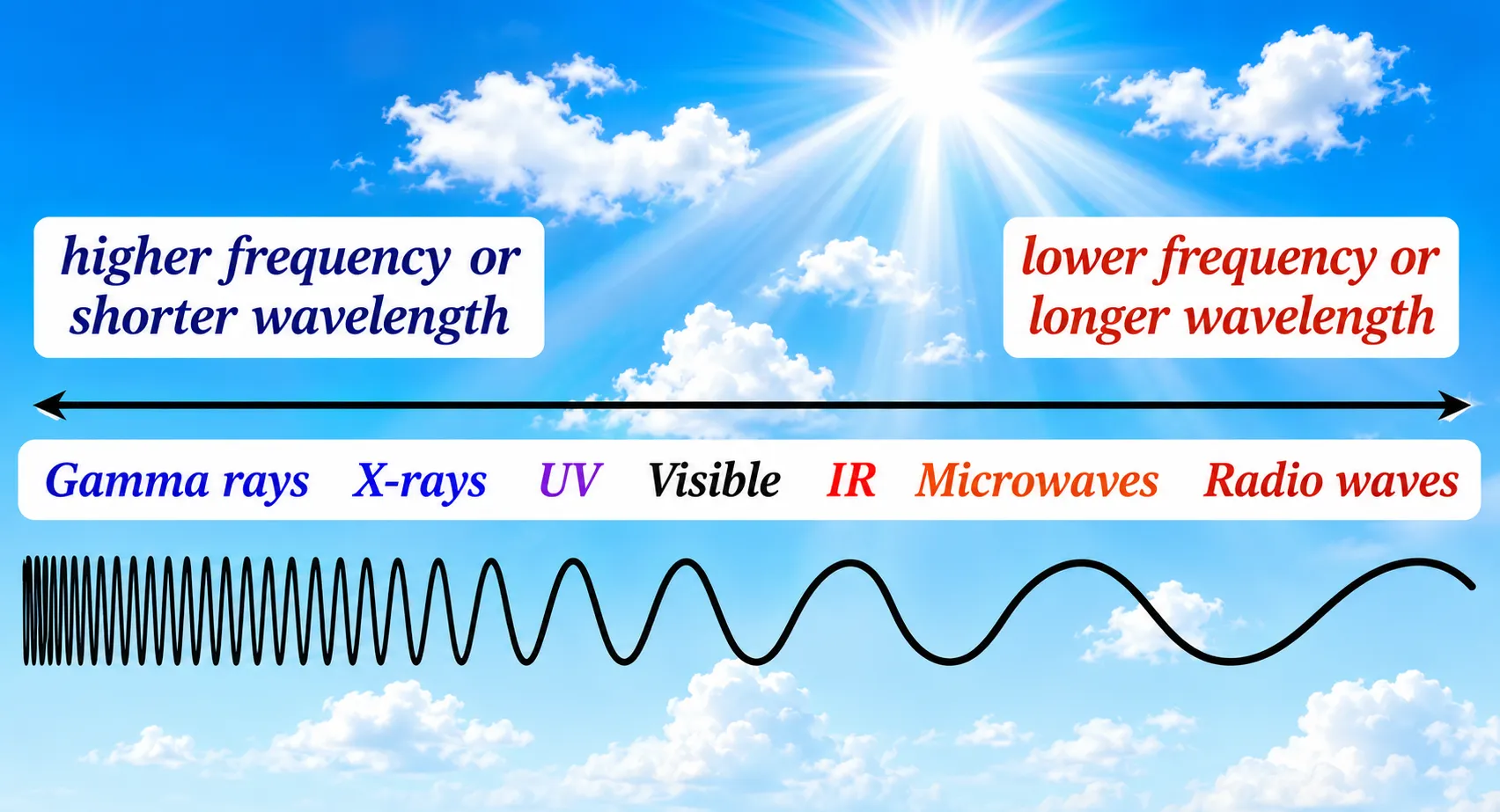
What is the Electromagnetic Spectrum?
EM waves range from:
Short wavelength
●high frequency
●high energy
Short wavelength ➜ gamma rays,
X-rays — harmful to life
Long wavelength
●low frequency
●low energy
Long wavelength ➜ infrared, radio waves
What part of solar radiation reaches Earth?
➢ 99% of Sun’s energy = UV + visible + infrared (IR) range
➢ These three shape Earth’s climate and support life
➢ Gamma rays and X-rays — filtered by the upper atmosphere
➢ Microwaves and radio waves — carry too little energy to warm the Earth
What does each type do?
➢ UV radiation — mostly absorbed by the ozone layer ➜ protects life + heats atmosphere
➢ Visible light — reaches surface ➜ drives photosynthesis ➜ warms land and water
➢ Infrared radiation — warms the surface ➜ surface re-radiates heat ➜ greenhouse gases trap it
In Simple Words:The
Sun sends different types of rays — only UV, visible, and IR matter for Earth’s climate.
What is Insolation and the Solar Constant?
Insolation — amount of Sun’s radiation reaching Earth’s surface
Solar constant — average solar energy per unit time per unit area at the top of atmosphere:
Value: 1.4 kWm⁻² (≈ 1400 Js⁻¹m⁻²)
Measured before any absorption, scattering, or reflection
Why is solar constant important?
➢ Helps understand energy balance, climate, and weather patterns
➢ Gases, clouds, dust absorb and scatter some energy before it reaches surface
➢ Maximum insolation at surface ≈ 1 kWm⁻² (clear sky)
Why does this matter for India?
➢ India lies in tropical and sub-tropical regions ➜ receives abundant sunlight year-round
➢ Drives the southwest monsoon ➜ influences climate and agriculture
➢ Huge potential for solar energy as a renewable and sustainable source
In Simple Words:
Not all sunlight reaches Earth’s surface — atmosphere filters some out.
What reaches is called insolation.
Interaction of solar radiation on the Earth’s surface
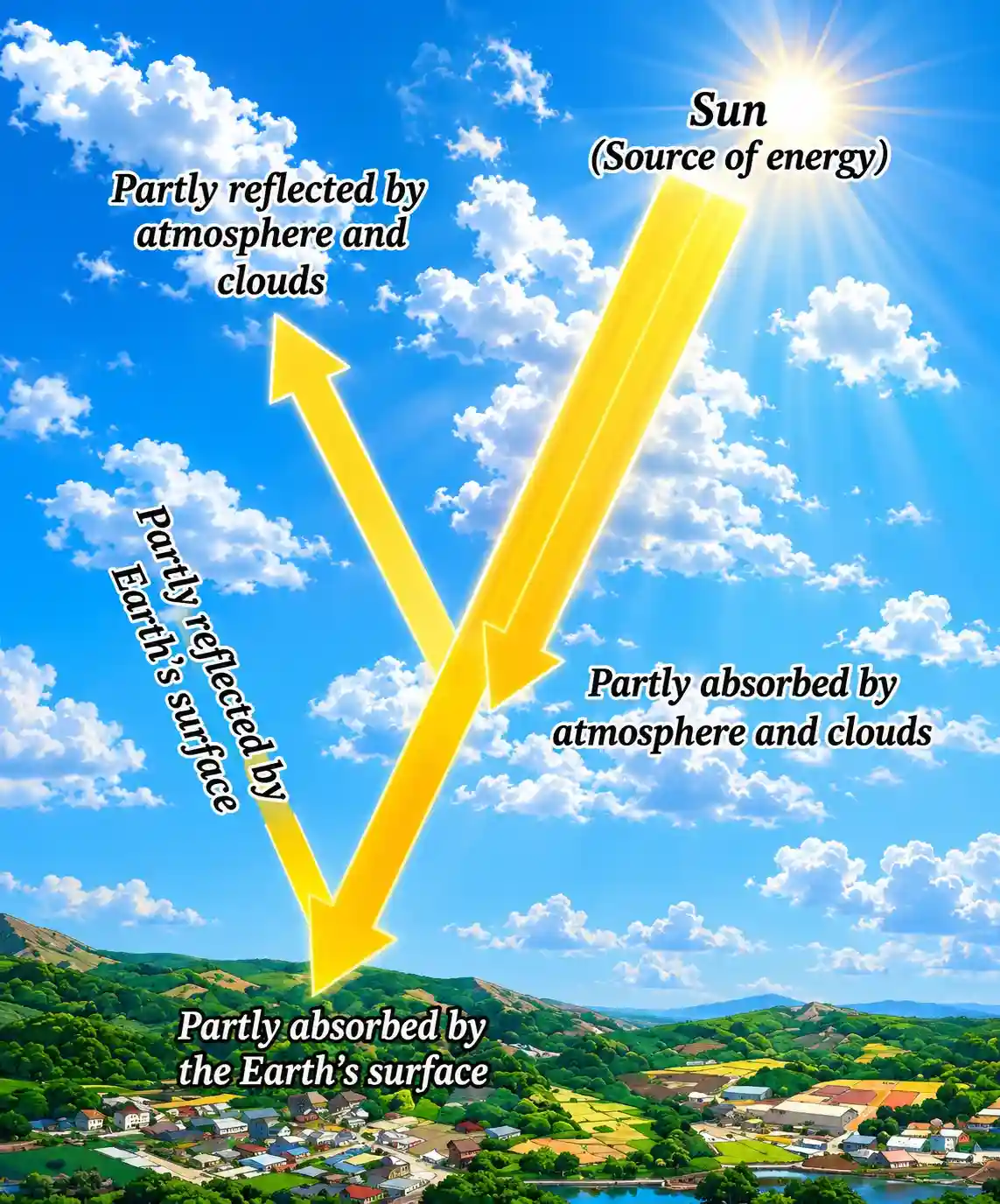
Why do different surfaces heat up differently?
➢ Dark surfaces — absorb more sunlight ➜ heat up faster
➢ Light-coloured surfaces — reflect more ➜ stay cooler
Example:
Dark roads heat faster; white clothes are cooler than dark ones in summer
What is Albedo?
Albedo — fraction of solar radiation reflected by a surface
➢ High albedo ➜ reflects more ➜ stays cool (e.g., snow, ice)
➢ Low albedo ➜ absorbs more ➜ heats more (e.g., black soil, ocean water)
| Surface | Albedo | Effect |
|---|---|---|
| Snow and ice | High | Reflects most radiation ➜ polar regions very cold |
| Black soil | Low | Absorbs more radiation ➜ relatively warmer |
| Ocean water | Low | Absorbs more ➜ relatively warmer |
| Light-coloured surfaces | High | Reflects more ➜ cooler |
What about re-radiation?
➢ All objects re-radiate heat after absorbing it
➢ Concrete houses ➜ hot at night due to re-radiation
➢ Thick mud and wooden walls ➜ less re-radiation ➜ stay cool in summer
In Simple Words:
The colour and material of a surface decide how much heat it absorbs or reflects.
Latitude and Earth’s shape
How Does Latitude Affect Heating?
➢ Earth is spherical ➜ Sun’s rays hit different latitudes at different angles
➢ Equatorial regions — rays hit a smaller area ➜ concentrated ➜ warmer year-round
➢ Polar regions — rays spread over a larger area ➜ less intense ➜ much colder
➢ Earth’s tilt ➜ causes seasons and changes in daytime length
➢ Result: uneven heating across the globe ➜ drives global winds and ocean currents
In Simple Words:
The equator gets direct sunlight, poles get slanted sunlight — that’s why poles are colder.
Role of the atmosphere
What is the Atmosphere and What Does it Do?
Atmosphere — air surrounding the Earth, held by Earth’s gravity
Composition:
➢ Nitrogen — 78%
➢ Oxygen — 21%
➢ Small amounts: argon, carbon dioxide, water vapour, other gases
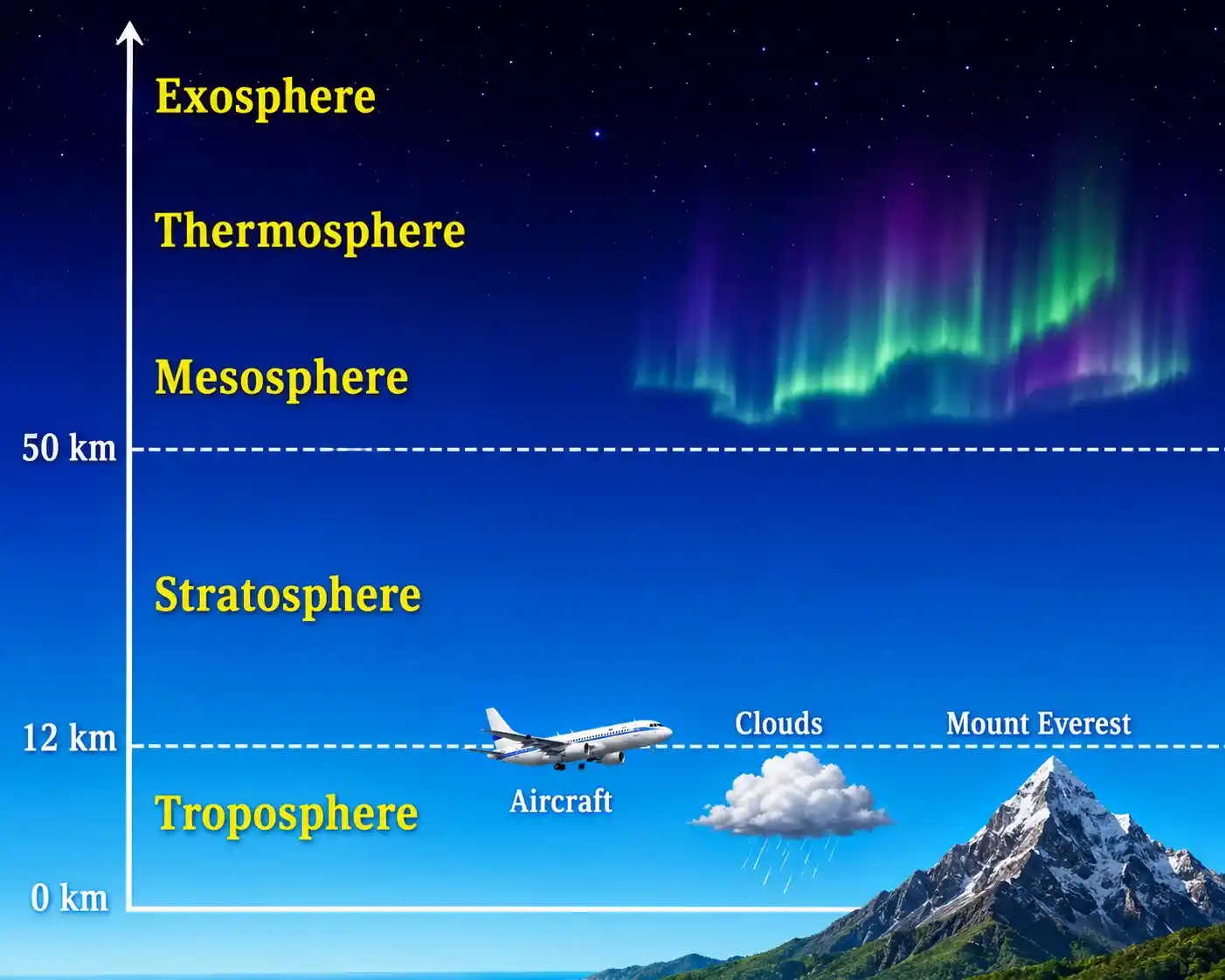
What are the Layers of the Atmosphere?
| Layer | Altitude | Key Feature |
|---|---|---|
| Troposphere | 0 – 12 km | Weather forms here; temp decreases with height (~6.5°C/km) |
| Stratosphere | 12 – 50 km | Ozone layer absorbs UV; temp increases with height |
| Mesosphere, Thermosphere, Exosphere | Above 50 km | Minor role in surface climate |
➢ Outer space begins at ~100 km
➢ Troposphere height: maximum above equator, minimum above poles
➢ Warm air rising in troposphere ➜ drives winds and storms
➢ Stratosphere is calm — no vertical mixing of air ➜ weather stays in troposphere
How Does the Atmosphere Protect Life?
Two crucial roles:
➢ Absorbs incoming radiation — ozone blocks harmful UV; clouds and gases absorb some sunlight
➢ Traps outgoing heat — greenhouse gases (CO₂, CH₄, water vapour) absorb re-radiated infrared heat ➜ prevent it from escaping
What is the Greenhouse Effect?
➢ Without atmosphere ➜ Earth is too cold for life
➢ Excess CO₂ from human activities ➜ enhanced greenhouse effect ➜ global warming
➢ If unchecked ➜ Earth could become uninhabitable
Venus vs Mercury — Why is Venus hotter?
➢ Mercury is closer to the Sun, yet cooler than Venus
➢ Venus has a thick atmosphere ➜ uncontrolled greenhouse effect ➜ far hotter
Uneven Heating Causes Wind and Ocean Currents
What Causes Wind?
➢ Wind — movement of air from high pressure to low pressure
➢ Uneven heating of Earth’s surface ➜ pressure differences ➜ wind
In Simple Words:
Wind is just air rushing from a high-pressure zone to a low-pressure zone.
Local winds
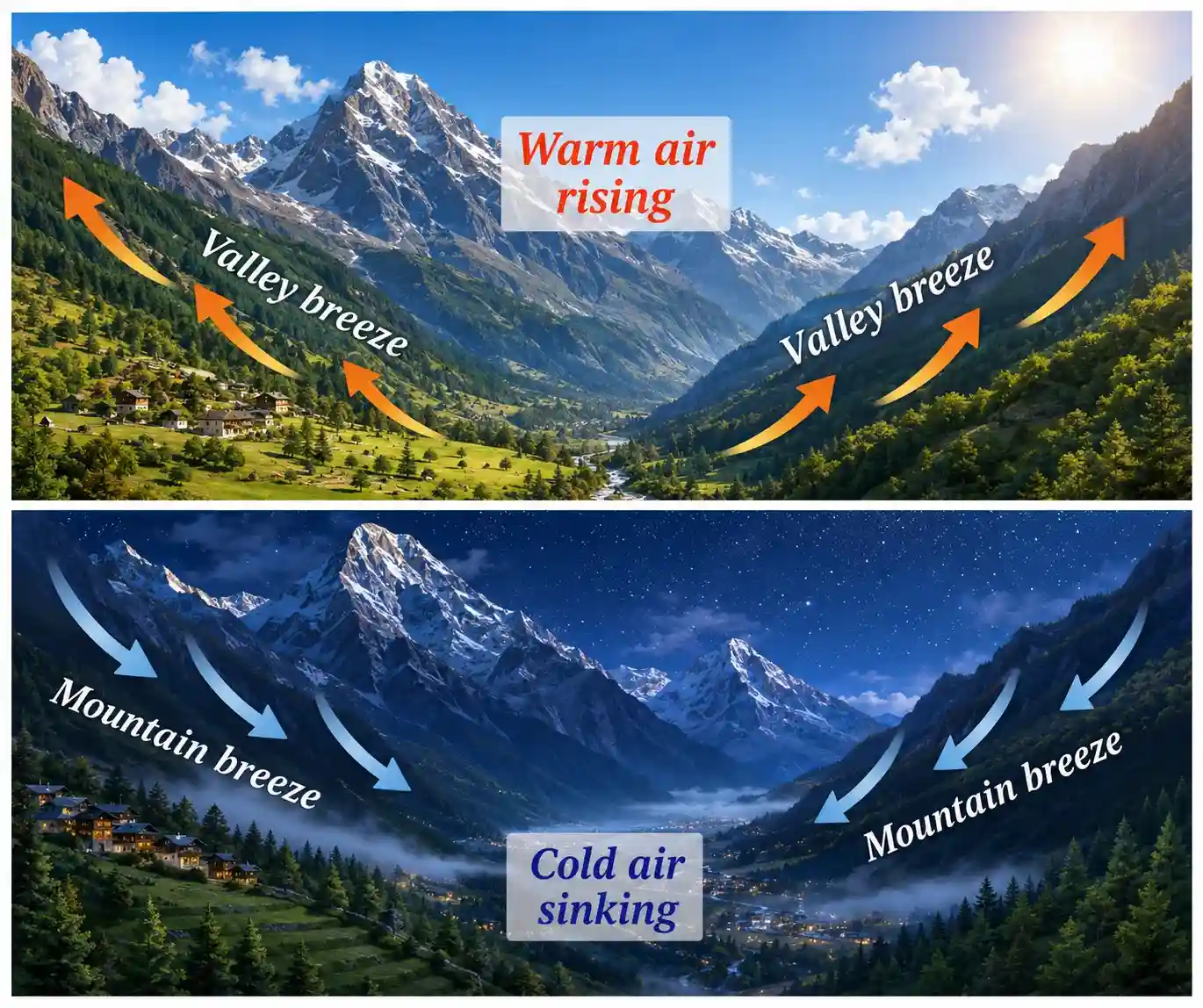
What are
Local Winds?
- Valley Breeze?
- Mountain Breeze?
What is a Valley Breeze?
Daytime — mountain slopes heat up faster than the valley floor
➢ Warm air over slopes rises ➜ creates low pressure
➢ Cooler valley air moves up the slopes ➜ called valley breeze
What is a Mountain Breeze?
➢ After sunset — slopes lose heat faster ➜ become cooler and denser
➢ Cool air flows down into the valley ➜ called the mountain breeze
Effects of local winds:
➢ Regulate temperature and moisture
➢ Support soil and crop health
➢ Influence weather, agriculture, and daily life
Planetary winds
“Continuous air currents that blow across the Earth in the same direction all year”
Also known as Permanent or Prevailing winds
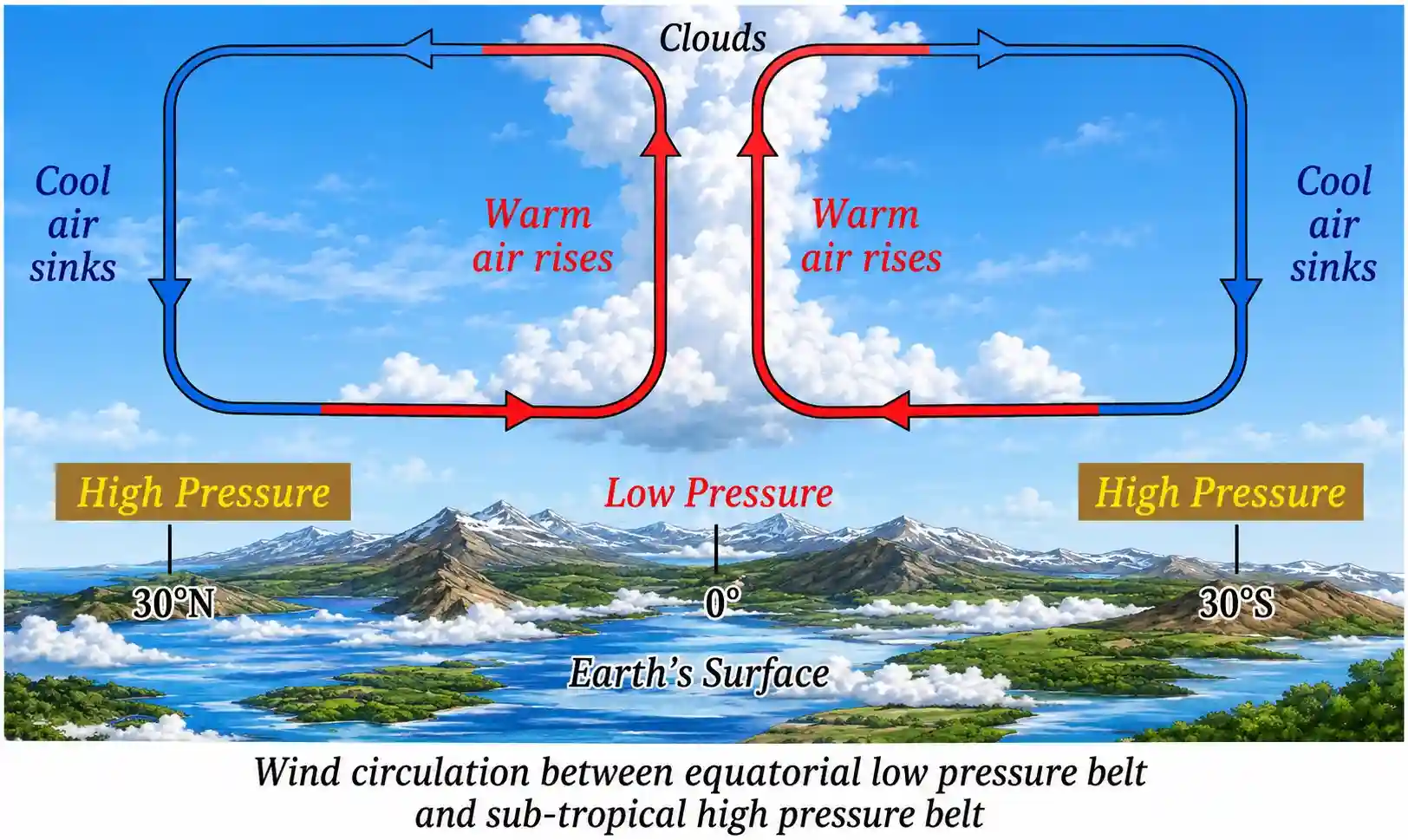
What Creates Planetary Pressure Belts?
Uneven heating between equator and poles ➜ large-scale pressure differences ➜ planetary winds
How the air circulation works:
➢ Equator — intense heating ➜ warm air rises ➜ equatorial low-pressure belt
➢ Rising air moves poleward at higher altitudes ➜ cools ➜ sinks at 30° N and S ➜ sub-tropical high pressure belts
➢ Some air flows back to the equator; the rest moves poleward ➜ rises at 60° N and S ➜ sub-polar low-pressure belts
➢ Poles (90° N and S) — very cold ➜ air sinks ➜ polar high pressure belts ➜ air flows toward sub-polar belts
Why Do Planetary Winds Follow Curved Paths?
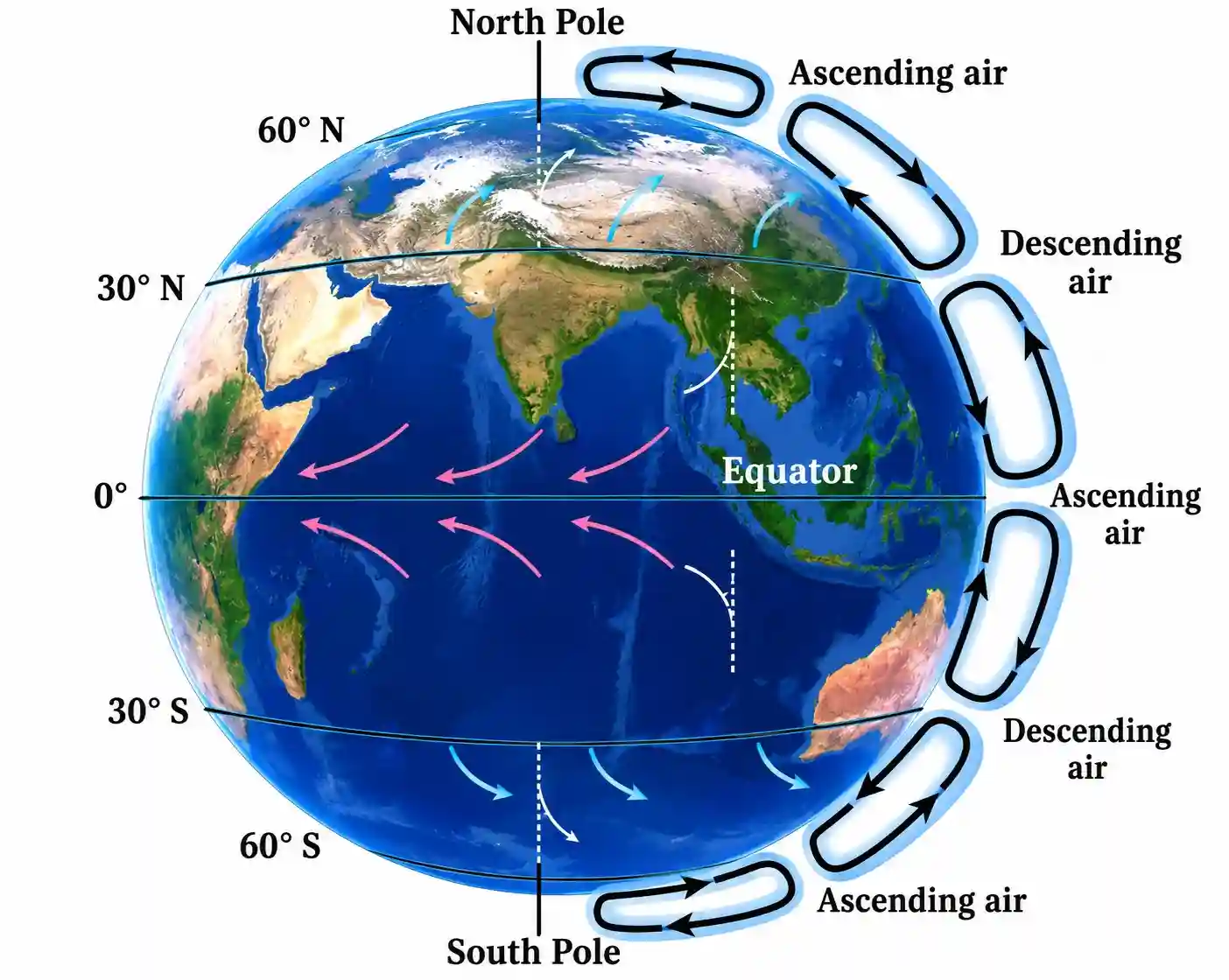
➢ Earth’s rotation deflects winds from straight paths
➢ Northern Hemisphere ➜ deflected to the right
➢ Southern Hemisphere ➜ deflected to the left
In Simple Words:
Pressure differences between the equator and poles set huge belts of wind in motion — Earth’s spin then curves them.
Ocean currents
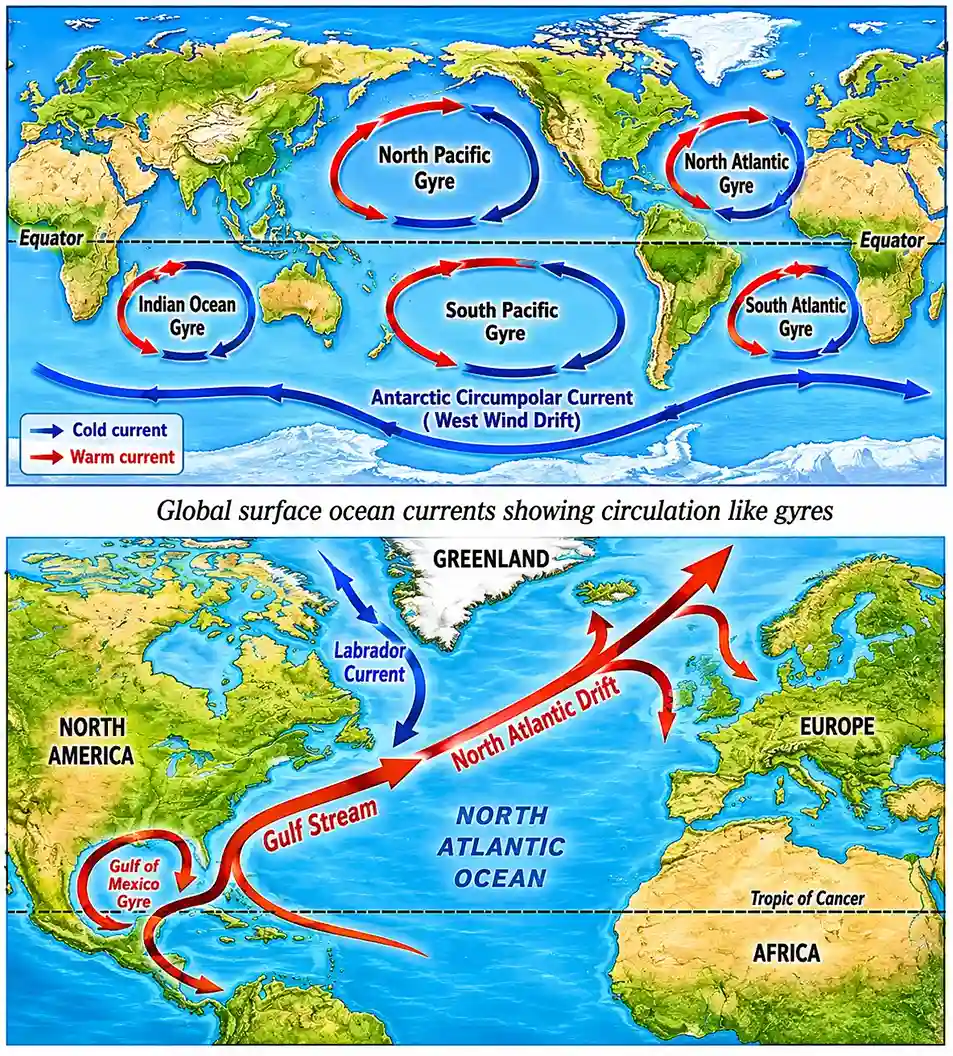
What are Ocean Currents?
Ocean currents — continuous movement of large masses of ocean water
What Drives Ocean Currents?
➢ Planetary winds drag surface water ➜ set surface currents in motion
➢ Also driven by:
●Differences in temperature and salinity
● Earth’s rotation
● Distribution of landmasses
How do Temperature and Salinity Affect Currents?
➢ Warm equatorial water travels over the surface toward the poles
➢ Cold polar water — denser ➜ flows back toward the equator through deeper ocean levels
➢ Lower salinity water — less dense ➜ stays near the surface
➢ Higher salinity water — denser ➜ sinks and moves at deeper levels
What are Gyres?
➢ Earth’s rotation deflects moving water ➜ forms large circular patterns called gyres
➢ Northern Hemisphere ➜ gyres rotate clockwise
➢ Southern Hemisphere ➜ gyres rotate counter-clockwise
➢ Continents block and redirect currents further
What Do Ocean Currents Do?
➢ Regulate Earth’s climate — transport heat from equator toward poles ➜ reduce temperature differences
➢ Support ecosystems — transport nutrients
➢ Human activity supports trade and commerce
Example:
➢ North Atlantic Drift (extension of the Gulf Stream) — warm current
➢ Flows toward northwestern Europe
➢ Keeps many ports ice-free in winter, even at high latitudes
In Simple Words:
Ocean currents are like rivers inside the ocean — they move heat, nutrients, and even shape the climate of entire countries.
Biogeochemical Cycles
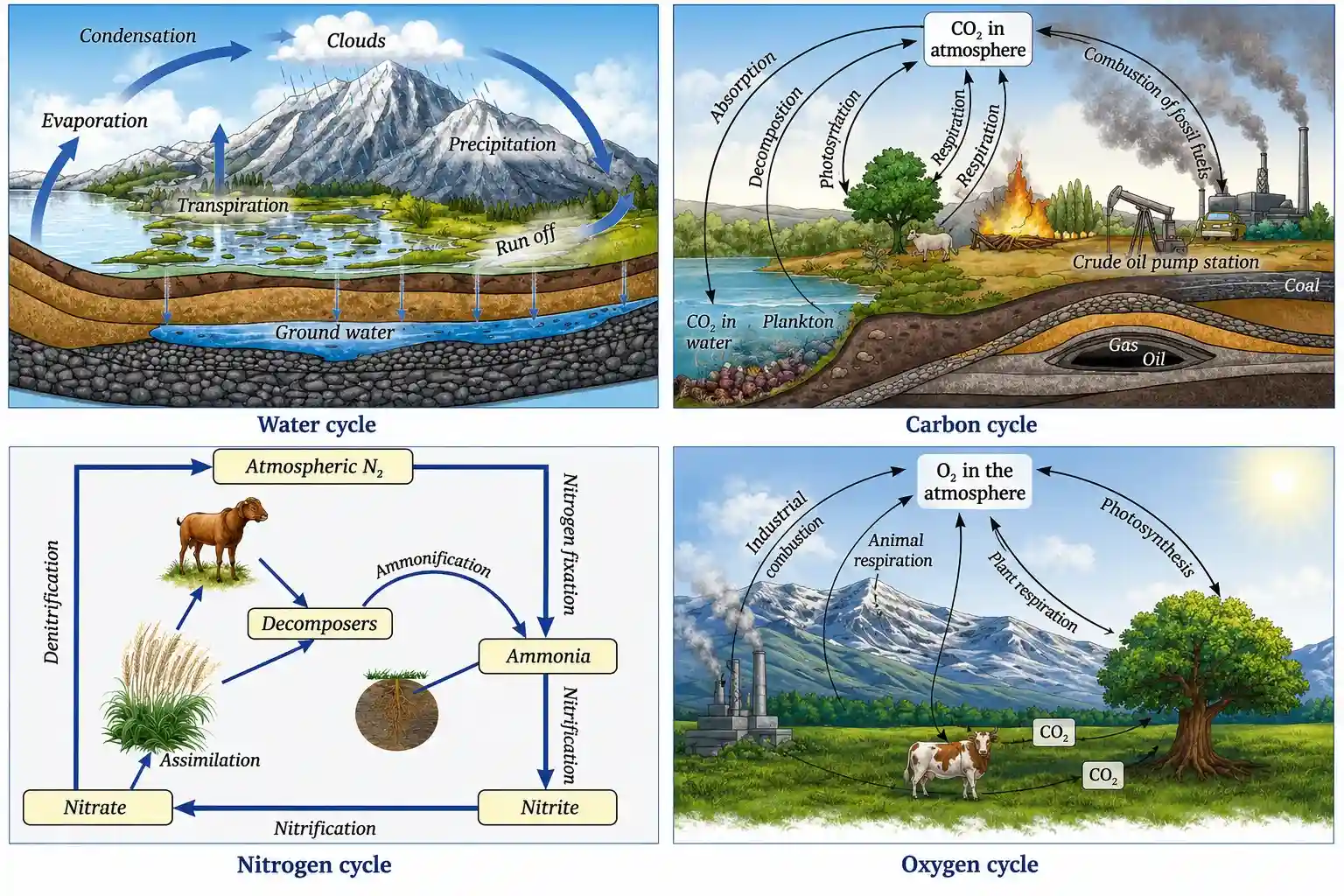
What is a Biogeochemical Cycle?
The cyclic movement of matter and energy between the abiotic and biotic components is called the biogeochemical cycle.
➢ Living organisms constantly exchange matter and energy with air, water, soil, and rocks
➢ This interaction between abiotic (non-living) and biotic (living) components transfers matter and energy across Earth’s spheres
➢ Essential nutrients — carbon, nitrogen, oxygen — are recycled and kept available for life
In Simple Words:
Nature has its own recycling system — the same matter is reused again and again between living and non-living things
Water cycle
What is the Water Cycle?
Evaporation ➜ Condensation ➜ Precipitation ➜ Infiltration ➜ Groundwater
How it works:
➢ Water evaporates from rivers, lakes, and oceans
➢ Condenses ➜ forms clouds
➢ Returns as precipitation — rain, hail, or snow
➢ Some seeps into soil and rocks (infiltration) ➜ becomes groundwater
➢ Water dissolves minerals from soil and rocks ➜ transports nutrients to oceans ➜ supports marine life
How is Climate Change Affecting the Water Cycle?
➢ Warmer atmosphere holds more moisture ➜ heavier rains in some areas, droughts elsewhere
➢ Melting glaciers ➜ more water in rivers ➜ rising sea levels ➜ threatens coastal cities (Mumbai, Chennai)
➢ Intense rainfall ➜ more runoff ➜ soil erosion
➢ Less infiltration ➜ less groundwater recharge ➜ difficult to sustain agriculture in dry months
Spheres affected:
➢ Biosphere — crops, fisheries
➢ Cryosphere — melting glaciers
➢ Hydrosphere — rivers, oceans
➢ Atmosphere — moisture levels
➢ Geosphere — soil erosion, reduced infiltration
In Simple Words:
The water cycle links all 5 spheres — and global warming is throwing it off balance.
Carbon cycle
What is the Carbon Cycle?
Circulation of carbon between:
●Atmosphere (CO₂), biosphere (plants, animals), geosphere (rocks, fossil fuels), ●hydrosphere (dissolved CO₂, marine shells) = Carbon cycle
Carbon
Backbone of every protein, carbohydrate, fat, and DNA molecule
Fast Cycle vs Slow Cycle — What is the Difference?
| Fast Cycle | Slow Cycle | |
|---|---|---|
| Time scale | Days to years | Millions of years |
| Process | Photosynthesis, respiration, decomposition | Burial ➜ fossil fuel formation ➜ combustion |
| Carbon movement | CO₂ ↔ plants ↔ animals ↔ atmosphere | Dead organisms ➜ coal/oil/gas ➜ CO₂ (when burnt) |
Ocean’s role in the carbon cycle:
➢ Ocean absorbs atmospheric CO₂ ➜ forms carbonate and bicarbonate ions
➢ Phytoplankton use them for photosynthesis
➢ Marine organisms form shells from them
➢ Dead organisms sink ➜ carbon stored on ocean floor for long periods
What is the Human Impact on the Carbon Cycle?
➢ Burning fossil fuels + deforestation ➜ atmospheric CO₂ raised by ~35% since 1960 (315 ppm ➜ 420 ppm)
➢ Excess CO₂ ➜ intensified greenhouse effect ➜ global warming
➢ Effects: melting glaciers, rising sea levels, extreme weather
➢ India: more intense monsoons, threats to agriculture
➢ India is rapidly increasing its renewable energy to reduce carbon release
Nitrogen cycle
What is the Nitrogen Cycle?
The overall movement of nitrogen between air, soil, water and organisms is called the nitrogen cycle.
➢ Nitrogen — essential for the synthesis of proteins and nucleic acids
➢ Largest reservoir: atmosphere (N₂ gas)
➢ Problem: N₂ is non-reactive — cannot be directly used by plants and animals
➢ Must first be converted to soluble compounds
What are the Steps of the Nitrogen Cycle?
| Step | Process | Organisms involved |
|---|---|---|
| Nitrogen fixation | N₂ ➜ ammonia (NH₃) | Rhizobium (root nodules of legumes), Azotobacter (soil); also lightning |
| Nitrification | NH₃ ➜ nitrite (NO₂⁻) ➜ nitrate (NO₃⁻) | Nitrosomonas (NH₃ ➜ NO₂⁻), Nitrobacter (NO₂⁻ ➜ NO₃⁻) |
| Assimilation | Plants absorb nitrates from soil; animals get nitrogen by eating plants/animals | Plants, animals |
| Ammonification | Dead organisms/waste ➜ ammonia returned to soil | Bacteria, fungi (decomposers) |
| Denitrification | Nitrates ➜ N₂ released back to the atmosphere | Pseudomonas |
Oxygen cycle
What is the Oxygen Cycle?
The natural biogeochemical process that moves oxygen through the Earth’s atmosphere, biosphere, and lithosphere.
➢ ~21% of atmosphere is free oxygen gas (O₂)
➢ Essential component of carbohydrates, proteins, nucleic acids, and fats
➢ Also exists in combined forms — in Earth’s crust as carbon dioxide
Two sides of the oxygen cycle:
➢ Consumption — respiration (plants and animals) + combustion (fuels) ➜ uses O₂, releases CO₂
➢ Production — photosynthesis (plants) ➜ uses sunlight, water, CO₂ ➜ releases O₂
➢ This balance between consumption and production circulates oxygen between atmosphere, land, oceans, and living organisms
In Simple Words:
Plants produce oxygen through photosynthesis; living things and burning fuels consume it — this back-and-forth keeps oxygen levels stable.
Human Impact on Earth’s Processes
How Does Excess CO₂ Harm the Oceans?
➢ Excess atmospheric CO₂ ➜ oceans absorb more ➜ seawater becomes more acidic
➢ Threatens plankton and coral reefs ➜ disrupts marine ecosystems
➢ Warmer ocean water ➜ reduces the ocean’s ability to absorb CO₂ ➜ weakens it as a carbon sink
In Simple Words:
Too much CO₂ makes oceans acidic and warmer — both damage marine life and reduce the ocean’s ability to absorb carbon.
What are Carbon Sinks and Why are They Failing?
➢ Natural carbon sinks — forests and oceans absorb CO₂
➢ Burning fossil fuels + deforestation ➜ carbon sinks get saturated (overloaded)
➢ Excess CO₂ ➜ intensifies greenhouse warming ➜ disrupts the carbon cycle
➢ In India: fossil fuels still generate a significant part of electricity ➜ harmful emissions
➢ Growth of solar energy — offers hope
What is Eutrophication?
A process where a water body becomes overly enriched with minerals and nutrients
➢ Overuse of fertilizers ➜ excess nitrates enter rivers and lakes
➢ Nitrates cause widespread algal blooms (algal growth)
➢ Algae deplete oxygen ➜ kills fish
➢ Threatens water bodies and coastal fisheries
In Simple Words:
Too much fertilizer runs into water ➜ algae explodes ➜ oxygen drops ➜ fish die.
What Does Deforestation Do to Earth’s Spheres?
➢ Less photosynthesis + less transpiration ➜ decline in local rainfall
➢ Alters surface albedo
➢ No tree roots ➜ soil erosion increases
➢ Habitats destroyed ➜ biodiversity loss — species lose their natural homes
Spheres affected:
➢ Atmosphere — less rainfall, altered moisture
➢ Geosphere — soil erosion
➢ Biosphere — habitat and biodiversity loss
➢ Hydrosphere — reduced transpiration affects the water cycle
In Simple Words:
Cutting forests sets off a chain reaction — less rain, more erosion, and species losing their homes.
What Do Vehicular Emissions Do?
➢ Vehicular emissions + sunlight ➜ ground-level smog
➢ Also forms ground-level ozone — harmful to health
➢ Important: Ground-level ozone = harmful; Stratospheric ozone = protective (blocks UV)
➢ These pollutants make city air unhealthy
Don’t Confuse Stratospheric ozone — protective, blocks UV rays
Ground-level ozone — formed by pollution, harmful to health
What are the Global Solutions?
| Agreement / Action | Purpose | Result |
|---|---|---|
| Montreal Protocol | Recover the ozone layer | Successful — ozone layer recovering |
| Kyoto Protocol | Reduce CO₂ emissions | Less successful |
| Paris Agreement | Reduce CO₂ emissions (countries) | Less successful |
Individual
and local actions:
- Conserve energy — reduce consumption
- Switch to renewable energy — solar, wind
- Plant trees
- Save water
- Practice sustainable farming
- Reduce, reuse, recycle — cut waste
India’s efforts:
- Planted billions of trees
- Expanded solar and renewable energy significantly
- Promoted sustainable farming
In Simple Words:
Global agreements help, but individual and national actions — planting trees, using solar energy, reducing waste — are just as important.
–End of Short Notes Ch 13 Earth as a System Energy, matter and life.–