Chapter 2, Reshaping India’s Political Map, Class 8, is 40 page lengthy chapter and searching for the answers to the end-of-chapter questions is a huge task. Hence, we thought of helping you out.
“Answers: Ch 2 Reshaping India’s Political Map” is your one-stop for end-of-chapter answers to Questions and activities.
We have made the answer to the point and very easy to read, understand and remember. We have also mentioned the page numbers and paragraph numbers of the answers.
You can visit that page and paragraph numbers to get an idea about how the questions are created and from where the answer’s points are picked up.
But before directly munching on the questions’ answers, prepare the chapter from our short notes. Click the link below.
Short Notes | Ch 2 Reshaping India’s Political Map
1. Compare the political strategies of the Delhi Sultanate and the Mughals. What similarities and differences existed between them?
The following Pages and Paragraphs are used to answer the question
●Page 25 — Paragraphs 1–2
●Page 26 — Paragraphs 2–4
●Page 28 — Paragraphs 2–3
●Page 38 — Paragraphs 1–3
●Page 39 — Last paragraph ● Page 40 — Paragraph 1
Answer
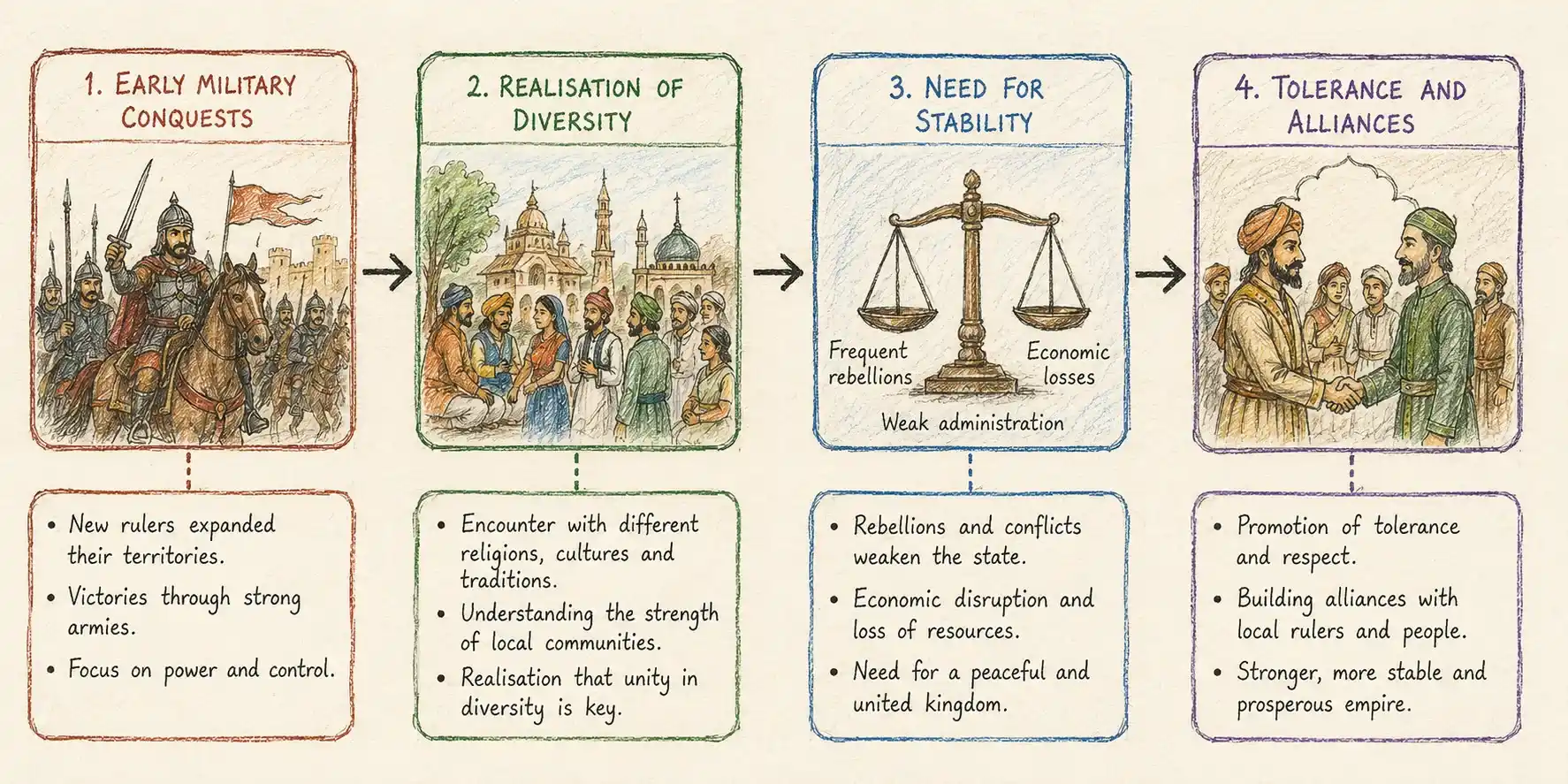
The Delhi Sultanate and the Mughal Empire both expanded their territories through warfare, military campaigns, and conquest. Both maintained large armies and collected taxes from the people, and conquered regions.
However, their political strategies were different in many ways.
The Delhi Sultanate mainly depended on military force and territorial expansion. The period was politically unstable, and successions were often violent. Military campaigns frequently involved raids, plunder, and the destruction of cities and temples. Some rulers imposed the jizya tax on non-Muslims and followed policies based mainly on military domination.
The Mughals, especially Akbar, combined military strength with diplomacy and administration. Akbar entered into marriage alliances with Rajput kingdoms, included Hindu and Rajput leaders in his court, abolished the jizya tax, and promoted the idea of sulh-i-kul or “peace with all.” He used both conquest and political cooperation to stabilise the empire.
Thus, while the Delhi Sultanate relied mostly on military power, the Mughals used a mixture of military expansion, alliances, religious tolerance, and administrative reforms.
2. Why did kingdoms like the Vijayanagara Empire and the Ahom Kingdom manage to resist conquest for a longer time compared to others? What geographical, military, and social factors contributed to their success?
The following Pages and Paragraphs are used to answer the question
●Page 29 — Paragraphs 1–2
●Page 30 — Paragraphs 1–3
●Page 31 — Paragraph 2
●Page 32 — Paragraph 2
●Page 34 — Paragraph 1
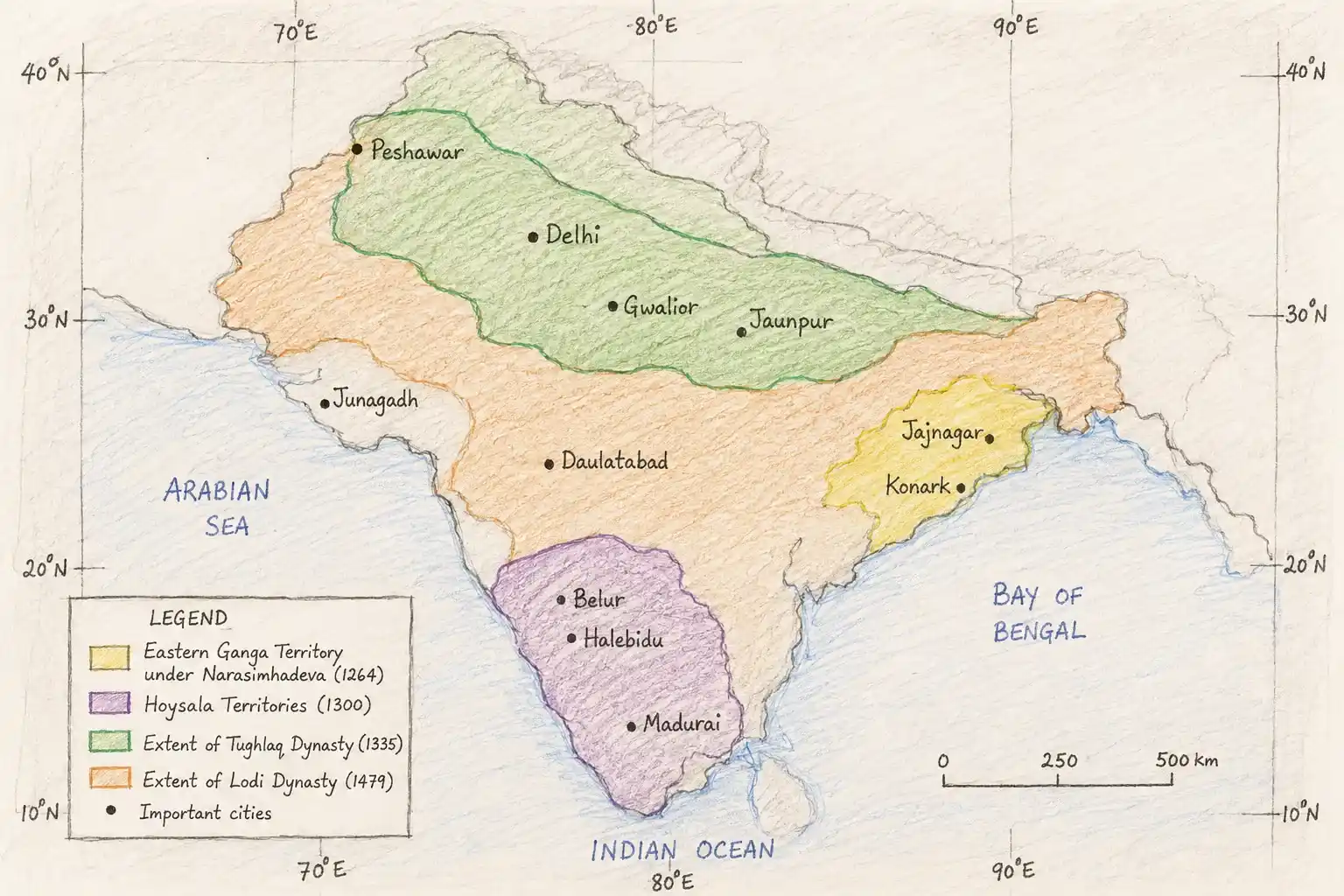
●Page 39 — Fig. 2.16 and map details
Answer
Kingdoms such as the Vijayanagara Empire and the Ahom Kingdom managed to resist conquest for a long time because of strong leadership, geographical advantages, military strength, and local support.
Harihara and Bukka established the Vijayanagara Empire after rejecting the Delhi Sultanate’s authority. It later became a powerful kingdom under Krishnadevaraya, who expanded and secured the empire through military campaigns and strong administration.
Geography played an important role in resistance. Forests, hills, rivers, and difficult terrain protected these kingdoms from invading armies. Southern India was also far from Delhi, making it difficult for northern rulers to maintain military control.
Military strength was another important factor. Vijayanagara maintained a powerful army and fought continuously against the Bahmani Sultanate and Deccan Sultanates.
Social and economic prosperity also helped. Trade flourished in Vijayanagara, and the kingdom received support from local people and regional leaders.
Similarly, the Ahom Kingdom successfully resisted Mughal expansion in Assam. The difficult terrain of Assam and the military skills of the Ahoms helped them defend their kingdom successfully.
3. Imagine you are a scholar in the court of Akbar or Krishnadevaraya. Write a letter to a friend describing the politics, trade, culture, and society you are witnessing.
The following Pages and Paragraphs are used to answer the question
● Page 34 — Entire paragraph under “Krishnadevaraya”
● Page 35 — Paragraphs 1–2
● Page 39 — Last paragraph
● Page 41 — Paragraph 2
● Page 42 — Paragraph 1
Answer
Dear Friend,
I hope you are well. I am writing to you from the magnificent court of Emperor Akbar. The empire is vast and powerful, and the emperor is working to bring stability and peace across the land.
The politics of the empire are very interesting. Akbar has formed alliances with Rajput rulers and included leaders from different regions in his administration. He promotes harmony among different religions through the policy of sulh-i-kul.
Trade is flourishing in the empire. Merchants from many lands visit Indian cities and ports. Markets are crowded with traders, craftsmen, animals carrying goods, and travellers from distant regions.
The cultural life here is extraordinary. Scholars from different faiths gather in the emperor’s court. Sanskrit texts such as the Mahabharata and Ramayana are being translated into Persian. Music, architecture, painting, and literature are flourishing.
The society is lively and prosperous. People from different communities interact freely, and cities are filled with gardens, markets, temples, and grand buildings.
Your friend,
A Scholar in Akbar’s Court
4. How come Akbar, a ruthless conqueror in his young days, grew tolerant and benevolent after some years? What could have led to such a change?
The following Pages and Paragraphs are used to answer the question
●Page 38 — Paragraphs 1–3
●Page 39 — Last paragraph
●Page 40 — Paragraph 1
●Page 41 — Paragraph 2
Answer
Akbar was initially a harsh conqueror. During the siege of Chittorgarh, thousands of civilians were massacred, and many women and children were enslaved. He also declared victory in religious terms.
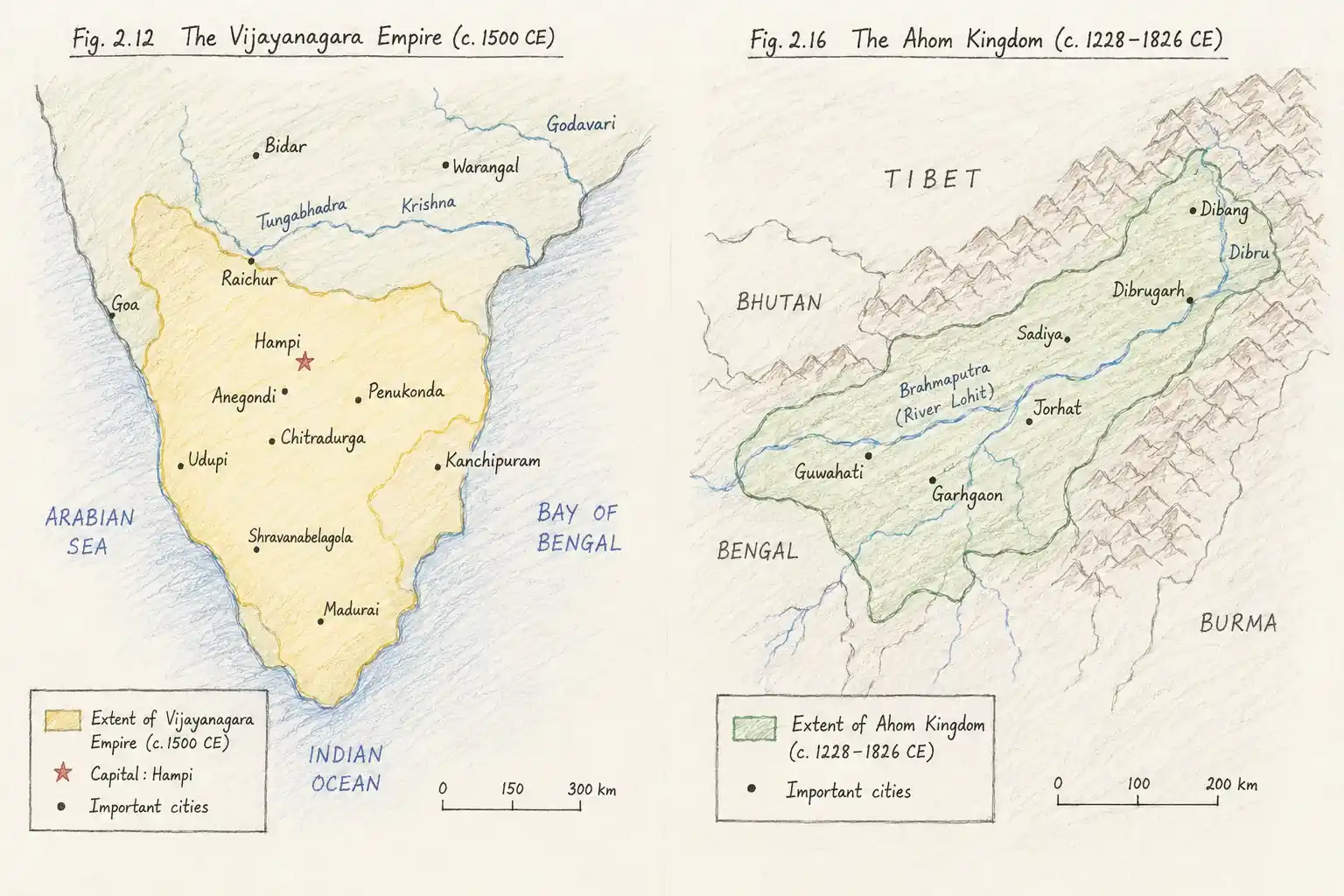
Over time, however, Akbar changed his policies. As his empire expanded, he understood that ruling such a large and diverse population required cooperation and tolerance rather than fear alone.
He therefore:
- formed marriage alliances with Rajput kingdoms,
- included Hindu officials and Rajput rulers in the administration,
- abolished the jizya tax,
- promoted sulh-i-kul or peace with all religions.
Akbar also developed a strong interest in learning and discussions with scholars of different faiths. He encouraged translations of Sanskrit texts into Persian and held interfaith discussions in his court.
His own statement, recorded by Abul Fazl, shows that he later believed forcing religion on others was wrong.
Thus, political understanding, intellectual growth, and interaction with diverse communities likely transformed Akbar into a more tolerant ruler.
5. What might have happened if the Vijayanagara Empire had won the Battle of Talikota? Imagine and describe how it could have changed the political and cultural history of South India.
The following Pages and Paragraphs are used to answer the question
● Page 34
Entire paragraph
● Page 35
Paragraphs 1–2
● Page 36
Paragraph 1
Answer
If the Vijayanagara Empire had won the Battle of Talikota in 1565, South Indian history may have developed very differently.
The empire would probably have remained the strongest political power in southern India for a longer time. Its military victories could have weakened the Deccan Sultanates and increased Vijayanagara’s influence.
The destruction of Vijayanagara city might not have occurred. The grand temples, markets, palaces, and cultural centres could have continued to flourish.
Trade with foreign merchants, especially the Portuguese, may have expanded further. Literature, architecture, music, and temple construction in Telugu, Kannada, and Sanskrit traditions would likely have received even greater royal support.
Politically, southern India may have enjoyed greater stability under a strong Vijayanagara Empire.
6. Many values promoted by early Sikhism, including equality, seva, and justice, remain relevant today. Select one of these values and discuss how it remains relevant in contemporary society.
The following Pages and Paragraphs are used to answer the question
● Reference to Sikh history from the timeline on Page 23
● Broader context of social harmony and justice from Pages 39–45
Answer
One important value promoted by early Sikhism is seva or selfless service. This value remains highly relevant in today’s society.
Seva teaches people to help others without expecting rewards. In modern times, many people face poverty, disasters, illness, and inequality. Community kitchens, helping disaster victims, teaching poor children, and voluntary social service all reflect the spirit of seva.
Seva also promotes equality because people from different religions, castes, and backgrounds work together to help society.
This value encourages compassion, unity, and responsibility toward others, making it extremely important even today.
7. Imagine you are a trader in a port city (Surat, Calicut or Hooghly). Describe the scenes you see as regards goods, people you trade with, movement of ships, etc.
The following Pages and Paragraphs are used to answer the question
● Page 35
Paragraphs 1–2
● Page 41
Paragraph 2
● Map references from Fig. 2.12 and Fig. 2.16
Answer
I am a trader in the busy port city of Calicut. Every day, ships arrive from Arabia, Persia, and distant lands carrying goods and merchants.
The markets are crowded with traders, labourers, sailors, craftsmen, and travellers. Horses, spices, textiles, precious goods, and many handmade products are bought and sold in large quantities.
Foreign merchants speak different languages and wear different styles of clothing. Oxen loaded with goods move through busy streets and markets.
The harbour is always active. Ships continuously arrive and depart across the Arabian Sea and the Bay of Bengal. The prosperity of trade has made the city wealthy and culturally diverse.