
Looking for reliable Ch 3 The World of Numbers Solutions? This comprehensive guide provides step-by-step answers for the latest NCERT [Ganita Manjari] textbook, specifically designed to help Class 9 students master complex concepts with ease.
Whether you are preparing for school exams or competitive tests, these solutions follow the updated CBSE curriculum to ensure you stay ahead in your studies.
Why Use These Solutions?
- Accuracy: Every exercise is solved with precision, from basic counting to complex rational number proofs.
- Clarity: Clear explanations for historical concepts like the Ishango bone and Brahmagupta’s laws.
- Exam Ready: Perfectly aligned with the NCERT pattern to help you score higher.
Also Read| Orienting Yourself: The Use of Coordinates NCERT Solutions Ch 1 Class 9
Exercise Set 3.1
Q1. A merchant in the port city of Lothal is exchanging bags of spices for copper ingots. He receives 15 ingots for every 2 bags of spices. If he brings 12 bags of spices to the market. How many copper ingots will he leave with?
Solution 1
Given:
- Rate of exchange: 15 copper ingots for every 2 bags of spices.
- Number of spice bags brought: 12 bags.
Step-by-step Calculation:
First, let’s find out how many times the merchant can exchange the 2-bag sets:
Number of sets = 12 bags ÷ 2 bags/set = 6 setsNext, calculate the total number of copper ingots received for these 6 sets:
Total ingots = 6 sets × 15 ingots/set = 90 ingotsFinal Answer: The merchant will leave with 90 copper ingots.
Q2. Look at the sequence of numbers on one column of the Ishango bone: 11, 13, 17, 19. What do these numbers have in common?
List the next three numbers that fit this pattern.
Solution 2
Analysis of the Sequence:
The given sequence is: 11, 13, 17, 19
- These numbers cannot be divided by any integer other than 1 and themselves.
- Therefore, the common property is that they are all consecutive prime numbers (specifically, the primes between 10 and 20).
Finding the Next Numbers:
We need to find the next three prime numbers following 19:
- The number 20 is divisible by 2, 4, 5, 10.
- The number 21 is divisible by 3, 7.
- The number 22 is divisible by 2, 11.
- 23 is a prime number.
- Continuing this elimination process, the subsequent prime numbers are 29 and 31.
Final Answer: The numbers are consecutive prime numbers. The next three numbers in the pattern are 23, 29, and 31.
Q3. We know that Natural Numbers are closed under addition (The sum of any two natural numbers is always a natural number)
Are they closed under subtraction? Provide a couple of examples to justify your answer.
Solution 3
Concept Evaluation:
Closure under subtraction means that subtracting any natural number from another natural number should always result in a natural number. Let’s verify this using examples.
Example 1:
5 - 8 = -3Here, both 5 and 8 are natural numbers, but the result -3 is a negative integer, which is not a natural number.
Example 2:
4 - 4 = 0Here, 4 is a natural number, but the result 0 is considered a whole number, not a natural number.
Final Answer: No, Natural Numbers are not closed under subtraction.
Q4. Ancient Indians used the joints of their fingers to count, a practice still seen today. Each finger has 3 joints, and the thumb is used to count them. How many can you count on one hand? How does this relate to the ancient base-12 counting systems?
Solution 4
Counting the Joints:
- There are 4 fingers on one hand (when excluding the thumb, which acts as the counter).
- Each finger has exactly 3 joints.
Calculation:
Total joints = 4 fingers × 3 joints/finger = 12 jointsBy pointing the thumb at each individual joint, a person can easily count sequentially up to 12 using just a single hand.
Relation to Base-12 System:
Because humans could so naturally count to 12 using this physical bodily method, it led to the historical development of counting systems based on groups of 12. This is formally known as the base-12 or duodecimal counting system, heavily used in ancient times for trade, timekeeping (e.g., 12 months, 12 hours), and astronomy.
Final Answer: You can count 12 joints on one hand. This practice is the natural bodily origin of ancient base-12 counting systems.
Exercise Set 3.2
Q1. The temperature in the high-altitude desert of Ladakh is recorded as 4 °C at noon. By midnight, it drops by 15 °C. What is the midnight temperature?
Solution 1
Given:
- Temperature at noon = 4 °C
- Temperature drop by midnight = 15 °C
Step-by-step Calculation:
To find the midnight temperature, we subtract the drop in temperature from the noon temperature:
Midnight Temperature = 4 °C - 15 °C = -11 °CFinal Answer: The midnight temperature in Ladakh is -11 °C.
Q2. A spice trader takes a loan (debt) of Rs 850. The next day, he makes a profit (fortune) of Rs 1,200. The following week, he incurred a loss of Rs 450. Write this sequence as an equation using integers and calculate his final financial standing.
Solution 2
Formulating the Equation:
We can represent debts (loans/losses) as negative integers and fortunes (profits) as positive integers:
- Loan (Debt) = -850
- Profit (Fortune) = +1200
- Loss (Debt) = -450
The sequence as an equation using integers is:
Final Standing = (-850) + 1200 + (-450)Step-by-step Calculation:
Step 1: (-850) + 1200 = 350
Step 2: 350 + (-450) = -100
Final Answer: The trader’s final financial standing is a debt of ₹100 (represented as -100).
Q3. Calculate the following using Brahmagupta’s laws:
(i) (–12) × 5 (ii) (– 8) × (–7)
(iii) 0 – (–14) (iv) (–20) ÷ 4
Solution 3
Using Brahmagupta’s laws of integers (Fortunes and Debts), we calculate the following:
(i) (-12) × 5
- Rule: The product of a debt and a fortune is a debt.
- Answer: -60
(ii) (-8) × (-7)
- Rule: The product of two debts is a fortune.
- Answer: 56 (or +56)
(iii) 0 – (-14)
- Rule: Zero minus a debt is a fortune.
- Answer: 14 (or +14)
(iv) (-20) ÷ 4
- Rule: Dividing a debt by a fortune is a debt.
- Answer: -5
Q4. Explain, using a real-world example of debt, why subtracting A negative number is the same as adding a positive number
(e.g., 10 – (–5) = 15).
Solution 4
Real-World Example Explanation:
Let’s explain why 10 - (-5) = 15 using the concept of debt.
- Imagine you have 10 coins in your pocket, but you owe a friend 5 coins (this is a debt of -5).
- Your actual net wealth right now is 5 coins (because 10 – 5 = 5).
- Now, imagine your friend is kind and says, “Don’t worry, you don’t have to pay me back.” They are effectively taking away (subtracting) your debt of 5.
The Math Translates to:
10 coins (Wealth) - (-5 coins Debt)Because the debt was removed, you get to keep all 10 coins. You are now 5 coins richer than your previous net wealth of 5 coins. Therefore, subtracting a negative (removing a debt) is mathematically identical to adding a positive (receiving a fortune).
Final Answer: Subtracting a debt (-5) removes a financial burden from your wealth, making you effectively richer by that exact amount. Thus, 10 – (-5) = 10 + 5 = 15.
Exercise Set 3.3
Q1. Prove that the following rational numbers are equal:
Solution 1
Proving the Rational Numbers are Equal:
We can prove equality by simplifying the larger fractions to their lowest terms.
(i) 4/6 = (4 ÷ 2) / (6 ÷ 2) = 2/3

(ii) 10/8 = (10 ÷ 2) / (8 ÷ 2) = 5/4

(iii) -6/10 = (-6 ÷ 2) / (10 ÷ 2) = -3/5

(iv) 9/3 = (9 ÷ 3) / (3 ÷ 3) = 3/1 = 3
Final Answer: In all four cases, simplifying the second fraction yields the exact same value as the first, proving they are equal.
Q2. Find the sum:
Solution 2
Step-by-step Calculation for Sums:
(i) 2/5 + 3/10

Make denominators equal (LCM is 10): (2 × 2)/(5 × 2) + 3/10

= 4/10 + 3/10 = 7/10


(ii) 7/12 + 5/8

Make denominators equal (LCM of 12 and 8 is 24):

= (7 × 2)/(12 × 2) + (5 × 3)/(8 × 3)

= 14/24 + 15/24 = 29/24


(iii) -4/7 + 3/14

Make denominators equal (LCM is 14): (-4 × 2)/(7 × 2) + 3/14

= -8/14 + 3/14 = -5/14
Final Answers: (i) 7/10, (ii) 29/24, (iii) -5/14
Q3. Find the difference:
Solution 3
Step-by-step Calculation for Differences:
(i) 5/6 - 1/4

Make denominators equal (LCM of 6 and 4 is 12):

= (5 × 2)/(6 × 2) - (1 × 3)/(4 × 3)

= 10/12 - 3/12 = 7/12


(ii) 11/8 - 3/4

Make denominators equal (LCM is 8): 11/8 - (3 × 2)/(4 × 2)

= 11/8 - 6/8 = 5/8


(iii) -7/9 - (-2/3)

Subtracting a negative is adding a positive: -7/9 + 2/3

= -7/9 + (2 × 3)/(3 × 3)

= -7/9 + 6/9 = -1/9
Final Answers: (i) 7/12, (ii) 5/8, (iii) -1/9
Q4. Find the product:
Solution 4
Step-by-step Calculation for Products:
(i) 2/3 × 3/10

Multiply numerators and denominators:

= (2 × 3) / (3 × 10) = 6/30

Simplify: 6/30 = 1/5


(ii) 7/11 × 5/8

= (7 × 5) / (11 × 8) = 35/88


(iii) (-4/7) × 5/14

= (-4 × 5) / (7 × 14) = -20/98

Simplify by dividing by 2: -10/49
Final Answers: (i) 1/5, (ii) 35/88, (iii) -10/49
Q5. Find the quotient:
Solution 5
Step-by-step Calculation for Quotients:
Rule: Dividing by a fraction is the same as multiplying by its reciprocal.
(i) 2/3 ÷ 3/10

= 2/3 × 10/3 = (2 × 10) / (3 × 3) = 20/9


(ii) 7/11 ÷ 5/8

= 7/11 × 8/5 = (7 × 8) / (11 × 5) = 56/55


(iii) (-4/7) ÷ 5/14

= (-4/7) × 14/5 = (-4 × 14) / (7 × 5) = -56/35

Simplify by dividing by 7: -8/5
Final Answers: (i) 20/9, (ii) 56/55, (iii) -8/5
Q6. Show that:
Solution 6
Equation to Prove:
1/2 × (3/4 + 8/3) = 1/2 × 3/4 + 1/2 × 8/3
Evaluating the Left Hand Side (LHS):
LHS = 1/2 × (3/4 + 8/3)

Make inner denominators equal (LCM is 12):

LHS = 1/2 × (9/12 + 32/12)

LHS = 1/2 × (41/12) = 41/24
Evaluating the Right Hand Side (RHS):
RHS = (1/2 × 3/4) + (1/2 × 8/3)

RHS = 3/8 + 8/6

Make denominators equal (LCM of 8 and 6 is 24):

RHS = (3 × 3)/(8 × 3) + (8 × 4)/(6 × 4)

RHS = 9/24 + 32/24 = 41/24
Final Answer: Since LHS (41/24) = RHS (41/24), the equation is proven true. This successfully demonstrates the distributive property of multiplication over addition.
Q7. Simplify the following using the distributive property:
Solution 7
Expression:
7/9 × (6/7 - 3/4)
Step-by-step Calculation (Using Distributive Property):
Distribute the 7/9 to both terms inside the bracket:

= (7/9 × 6/7) - (7/9 × 3/4)

= (42/63) - (21/36)


Simplify the resulting fractions:

42/63 = 2/3 (divided by 21)

21/36 = 7/12 (divided by 3)


Now solve the subtraction: 2/3 - 7/12

Make denominators equal (LCM is 12):

= 8/12 - 7/12 = 1/12
Final Answer: The simplified value is 1/12.
Q8. Find the rational number x such that:
Solution 8
Given Equation:
5/6 × (3/5 + x) = 5/6 × 3/5 + 5/6 × 1/2
Analysis using Distributive Property:
The distributive property of multiplication over addition states that:
a × (b + c) = a × b + a × c
By directly comparing the left side to the right side of our equation, we can map the values directly without needing to compute the fractions:
a = 5/6b = 3/5c = x(on the left side of the equation)c = 1/2(on the right side of the equation)
Final Answer: By the distributive property, the value of x is 1/2.
Exercise Set 3.4
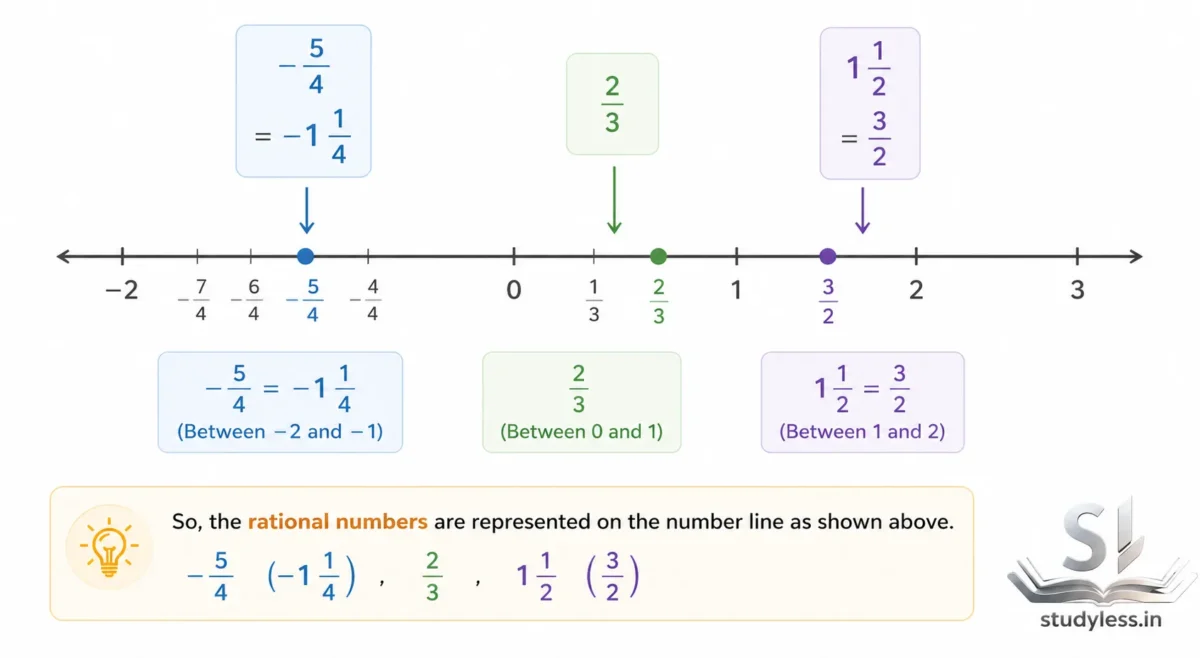
Q1. Represent the rational numbers on a single number line.
Solution 1
Step-by-step Process for Number Line Plotting:
To accurately plot 2/3, -5/4, and 1 ½ (or 3/2) on the same number line, follow these steps:
- Step 1: Find the Least Common Multiple (LCM) of the denominators 3, 4, and 2. The LCM is 12.
- Step 2: Convert all three rational numbers into equivalent fractions with 12 as the common denominator.
2/3 = (2 × 4) / (3 × 4) = 8/12-5/4 = (-5 × 3) / (4 × 3) = -15/121 ½ = 3/2 = (3 × 6) / (2 × 6) = 18/12
- Step 3: Draw a number line and mark the main integer points (… -2, -1, 0, 1, 2 …).
- Step 4: Divide the gap between each integer into exactly 12 equal smaller segments.
- Step 5: Plot the points:
- For 2/3 (or 8/12), move 8 segments to the right of 0.
- For -5/4 (or -15/12), move 15 segments to the left of 0 (this will be 3 segments past -1).
- For 1 ½ (or 18/12), move 18 segments to the right of 0 (this will be exactly halfway between 1 and 2).
Final Answer: The points are plotted at 8 units right, 15 units left, and 18 units right from the origin on a number line subdivided into 12ths.
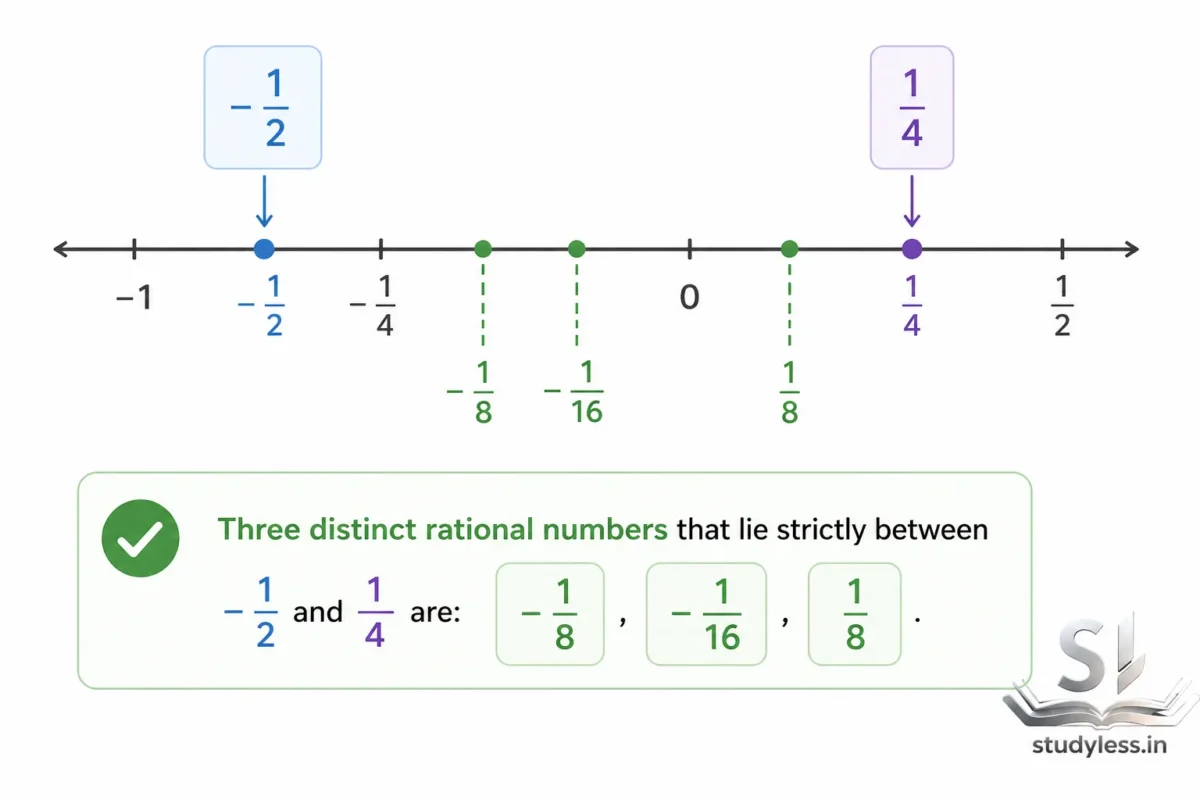
Q2. Find three distinct rational numbers that lie strictly between
Solution 2
Finding Rational Numbers Between -1/2 and 1/4:
First, convert the fractions to have a common denominator. The normal LCM of 2 and 4 is 4, but using a larger denominator like 8 gives us a wider gap so we can find more integers strictly between them.
-1/2 = (-1 × 4) / (2 × 4) = -4/8

1/4 = (1 × 2) / (4 × 2) = 2/8
Now, identify the integer numerators that lie strictly between -4 and 2. These are -3, -2, -1, 0, and 1.
We can pick any three of these integers as numerators and place them over the denominator 8.
Final Answer: Three distinct rational numbers are -3/8, 0 (or 0/8), and 1/8. (Other correct options include -2/8 and -1/8).
Q3.Simplify the expression:
Solution 3
Given Expression:
(-1/4) + (5/12)Step-by-step Simplification:
Find the LCM of 4 and 12, which is 12.

Convert -1/4 to an equivalent fraction: (-1 × 3) / (4 × 3) = -3/12

Add the fractions:

= -3/12 + 5/12

= (-3 + 5) / 12

= 2/12
Simplify 2/12 by dividing both the numerator and denominator by their greatest common divisor (which is 2):
Final Answer: The simplified expression is 1/6.
Q4.A tailor has metres of fine silk. If making one kurta requires
metres of silk, exactly how many kurtas can he make?
Solution 4
Given:
- Total length of fine silk = 15 ¾ metres
- Silk required per kurta = 2 ¼ metres
Step-by-step Calculation:
Convert the mixed numbers into improper fractions:

15 ¾ = (15 × 4 + 3) / 4 = 63/4

2 ¼ = (2 × 4 + 1) / 4 = 9/4


Number of kurtas = Total Silk ÷ Silk per Kurta

= (63/4) ÷ (9/4)

= (63/4) × (4/9)

= 63/9

= 7
Final Answer: The tailor can make exactly 7 kurtas.
Q5.Find three rational numbers between 3.1415 and 3.1416.
Solution 5
Finding Numbers Between 3.1415 and 3.1416:
To easily find numbers between these two decimal values, we can append a zero to the end of each decimal. This does not change their value but makes the gap much more apparent.
3.1415 becomes 3.14150

3.1416 becomes 3.14160
Now, it is clear that any number ending strictly between 50 and 60 will be in between the two boundaries.
Final Answer: Three rational numbers strictly between 3.1415 and 3.1416 are 3.14151, 3.14152, and 3.14158.
Q6.Can you think of other ways to find a rational number between
Any two rational numbers?
Solution 6
Alternative Methods to Find Rational Numbers Between Two Numbers:
Besides taking the mathematical average (a + b) / 2, there are two other highly effective ways to find a rational number between any two given rational numbers.
Method 1: Equivalent Fractions Method
- Convert the two rational numbers into fractions with a common denominator.
- If there is no integer between the new numerators, multiply both the numerator and denominator of both fractions by a constant factor (like 10).
- This scales up the fraction and expands the gap between the numerators, allowing you to easily pick intermediate fractions (e.g., between 20/50 and 30/50, you can choose 21/50).
Method 2: Decimal Conversion Method
- Convert both rational numbers into their decimal forms.
- Simply write down a terminating decimal that visually falls between the two decimal values.
- This generated decimal is guaranteed to be a rational number itself.
Final Answer: Yes, you can use the Equivalent Fractions method (scaling up the denominator) or the Decimal Conversion method to efficiently locate intermediate rational numbers.
Exercise Set 3.5
Q1. Without performing long division, determine which of the following rational numbers will have terminating decimals and which will be repeating:
Then check your answers by explicitly performing the long divisions and expressing these rational numbers as decimals.
Solution 1
Predicting Decimal Types:
A rational number in its lowest terms will have a terminating decimal if the prime factors of its denominator consist only of 2 and/or 5. Otherwise, it will be a repeating decimal.
- 7/20: The denominator is 20. Its prime factorization is 20 = 2² × 5. Since it only contains 2 and 5, it is terminating.
- 4/15: The denominator is 15. Its prime factorization is 15 = 3 × 5. Since it contains a prime factor other than 2 or 5 (the number 3), it is repeating.
- 13/250: The denominator is 250. Its prime factorization is 250 = 2 × 5³. Since it only contains 2 and 5, it is terminating.
Verification by Long Division:
7 ÷ 20 = 0.35 (Terminates)

4 ÷ 15 = 0.2666... (Repeats the digit 6)

13 ÷ 250 = 0.052 (Terminates)
Final Answer: 7/20 and 13/250 are terminating decimals. 4/15 is a repeating decimal.
Q2. Perform the long division for Identify the repeating block of digits. Does it show cyclic properties if you evaluate ?
Now compute :
etc. What do you notice?
Solution 2
Long Division and Repeating Blocks:
1/13 = 0.076923 076923... (Repeating block is 076923)

2/13 = 0.153846 153846... (Repeating block is 153846)

3/13 = 0.230769 230769...

4/13 = 0.307692 307692...
Analysis of Cyclic Properties:
- When evaluating 2/13, we get the block 153846. This uses a completely different set of digits, meaning the original 1/13 block (076923) does not loop cyclically to form 2/13.
- However, when evaluating 3/13 and 4/13, their repeating blocks are 230769 and 307692. Notice that these are exact cyclic shifts of the original 1/13 block (076923).
Final Answer: Unlike 1/7, the multiples of 1/13 split into two distinct cyclic groups (076923 and 153846). Fractions like 3/13 show the cyclic properties of the 1/13 block, while others like 2/13 belong to the second cyclic group.
Q3. Classify the following numbers as rational or irrational:
(i)
(ii)
(iii) 0.33333 …
(iv) 0.123451234512345 …
(v) 1.01001000100001 … (Notice the pattern: Is it repeating a single
block?)
(vi) 23.560185612239874790120
Find the explicit fractions in case they are rational.
Solution 3
Classification and Fraction Conversion:
- (i) √81:
√81 = 9. This is a whole number, making it Rational. Explicit fraction: 9/1. - (ii) √12:
√12 = 2√3. Since √3 cannot be expressed as a fraction, this number is Irrational. - (iii) 0.33333…: This is a non-terminating repeating decimal, making it Rational.
Let x = 0.333… ⇒ 10x = 3.333… ⇒ 9x = 3. Explicit fraction: 1/3. - (iv) 0.1234512345…: This decimal has a continuous repeating block of digits, so it is Rational.
Let x = 0.12345… ⇒ 100000x = 12345.12345… ⇒ 99999x = 12345. Explicit fraction: 12345/99999 (which simplifies to 4115/33333). - (v) 1.01001000100001…: Notice the pattern adds an extra zero between every ‘1’. Because there is no single finite block of digits that repeats infinitely, it is non-terminating and non-repeating. It is Irrational.
- (vi) 23.560185612239874790120: Because this decimal abruptly terminates, it is Rational. Explicit fraction: Remove the decimal and place the number over a power of 10 equal to its decimal places: 23560185612239874790120 / 1000000000000000000000.
Final Answer: (i), (iii), (iv), and (vi) are rational and can be written as fractions. (ii) and (v) are irrational.
Q4. The number 0.9 bar (which means 0.99999 … ) is rational. Using algebra (let x = 0.9bar, multiply by 10, and subtract), explain why 0.9bar is exactly equal to 1.
Solution 4
Algebraic Proof:
We can use algebra to convert the repeating decimal into a fraction form (p/q format):
Step 1: Set a variable (x) equal to the repeating decimal.

x = 0.99999...


Step 2: Multiply both sides by 10 (since 1 digit repeats).

10x = 9.99999...


Step 3: Subtract the original equation (Step 1) from the new equation (Step 2).

10x - x = 9.99999... - 0.99999...

9x = 9


Step 4: Solve for x.

x = 9/9

x = 1
Final Answer: Through algebraic manipulation, the infinite repeating sequence reduces flawlessly to the fraction 9/9, which equals 1. Therefore, 0.999… and 1 are exactly the same number.
Q5. We have seen that the repeating block of 17 is a cyclic number. Try to find more numbers (n) whose reciprocals ( 1 / n ) produce decimals with repeating cyclic blocks.
Solution 5
Finding Cyclic Repeating Blocks:
Cyclic numbers are generated by the reciprocals of certain prime numbers where the decimal expansion reaches its maximum possible length before looping back (specifically, p - 1 repeating digits for a prime p).
- n = 7: 1/7 = 0.142857… (Block length is 6. Evaluating 2/7, 3/7, etc., reveals perfect cyclic shifts).
- n = 17: 1/17 = 0.0588235294117647… (Block length is 16. Multiples like 2/17 are exact cyclic shifts of this block).
- n = 19: 1/19 = 0.052631578947368421… (Block length is 18).
- n = 23: 1/23 = 0.0434782608695652173913… (Block length is 22).
Final Answer: Other numbers whose reciprocals produce large, purely cyclic repeating blocks are primes such as 17, 19, 23, and 29.
End-of-Chapter Exercises
Question
Convert the following rational numbers in the form of a terminating decimal or non-terminating and repeating decimal, whichever the case may be, by the process of long division:
(i) 3/50 (ii) 2/9
Solution
(i) 3/50
By long division, 3 ÷ 50 = 0.06.
The division leaves no remainder. Thus, it is a terminating decimal.
(ii) 2/9
By long division, 2 ÷ 9 = 0.2222…
The digit 2 continuously repeats forever. Thus, it is a non-terminating and repeating decimal.
Question
Prove that √5 is an irrational number.
Solution
We use Proof by Contradiction.
Step 1: Assume √5 is a rational number. Therefore, it can be written as √5 = p/q, where p and q are coprime integers (they share no common factors other than 1), and q ≠ 0.
Step 2: Square both sides: 5 = p² / q² ⇒ p² = 5q².
Step 3: This means p² is a multiple of 5, which implies p must also be divisible by 5. Let p = 5k.
Step 4: Substitute p = 5k back into our equation: (5k)² = 5q² ⇒ 25k² = 5q² ⇒ q² = 5k².
Step 5: This means q² is a multiple of 5, which implies q must also be divisible by 5.
Conclusion: If both p and q are divisible by 5, they are not coprime. This contradicts our initial assumption. Therefore, √5 cannot be written as a fraction and is an irrational number.
Question
Convert the following decimal numbers in the form of p/q.
(i) 12.6 (ii) 0.0120 (iii) 3.052 (iv) 1.235 (v) 0.2323… (vi) 2.055…
(vii) 2.125125… (viii) 3.1255… (ix) 2.1625625…
Solution
- (i) 12.6: 126 / 10 = 63 / 5
- (ii) 0.0120: 120 / 10000 = 3 / 250
- (iii) 3.052: 3052 / 1000 = 763 / 250
- (iv) 1.235: 1235 / 1000 = 247 / 200
- (v) 0.2323…: Let x = 0.23… ⇒ 100x = 23.23… ⇒ 99x = 23 ⇒ 23 / 99
- (vi) 2.055…: Let x = 2.05… ⇒ 10x = 20.5… ⇒ 100x = 205.5… ⇒ 90x = 185 ⇒ 37 / 18
- (vii) 2.125125…: Let x = 2.125… ⇒ 1000x = 2125.125… ⇒ 999x = 2123 ⇒ 2123 / 999
- (viii) 3.1255…: Let x = 3.125… ⇒ 100x = 312.5… ⇒ 1000x = 3125.5… ⇒ 900x = 2813 ⇒ 2813 / 900
- (ix) 2.1625625…: Let x = 2.1625… ⇒ 10x = 21.625… ⇒ 10000x = 21625.625… ⇒ 9990x = 21604 ⇒ 10802 / 4995
Question
Locate the following rational numbers on the number line.
(i) 0.532 (ii) 1.15
Solution
(i) 0.532: This value is positive and lies between 0 and 1. More specifically, using successive magnification, it lies between 0.5 and 0.6, then between 0.53 and 0.54, placed slightly closer to 0.53.
(ii) 1.15: This value lies between the integers 1 and 2. On a number line divided into tenths, it falls exactly halfway between 1.1 and 1.2.
Question
Find 6 rational numbers between 3 and 4.
Solution
To find 6 numbers, multiply the numerator and denominator of both integers by (6 + 1) = 7.
3 = (3 × 7) / 7 = 21 / 7
4 = (4 × 7) / 7 = 28 / 7
The 6 rational numbers exactly between them are:
22/7, 23/7, 24/7, 25/7, 26/7, 27/7
Question
Find 5 rational numbers between 2/5 and 3/5.
Solution
To find 5 numbers, we scale up the fractions by multiplying the numerator and denominator by (5 + 1) = 6.
2/5 = (2 × 6) / (5 × 6) = 12 / 30
3/5 = (3 × 6) / (5 × 6) = 18 / 30
The 5 rational numbers exactly between them are:
13/30, 14/30, 15/30, 16/30, 17/30
Question
Find 5 rational numbers between 1/6 and 2/5.
Solution
First, establish a common denominator. The LCM of 6 and 5 is 30.
1/6 = (1 × 5) / (6 × 5) = 5 / 30
2/5 = (2 × 6) / (5 × 6) = 12 / 30
We can choose 5 consecutive integers between 5 and 12 for our numerators:
6/30, 7/30, 8/30, 9/30, 10/30
Question
If x/3 + x/5 = 16/15, find the rational number x.
Solution
First, find a common denominator for the left side of the equation (LCM of 3 and 5 is 15):
(5x / 15) + (3x / 15) = 16 / 15
Combine the numerators:
8x / 15 = 16 / 15
Since both sides share the same denominator, multiply both sides by 15 to eliminate it:
8x = 16
x = 16 / 8
x = 2
Question
Let a and b be two non-zero rational numbers such that a + b = 0. Without assigning any numerical values, determine whether the product ab is positive or negative. Justify your answer.
Solution
From the equation a + b = 0, subtract ‘a’ from both sides to get b = -a.
Now, substitute this into the product expression (ab):
ab = a × (-a) = -a²
Because the square of any non-zero rational number is strictly positive (a² > 0), placing a negative sign in front makes the result strictly negative.
Conclusion: The product ab is definitively negative.
Question
A rational number has a terminating decimal expansion whose last non-zero digit occurs in the 4th decimal place. Show that such a number can be written in the form p/10⁴, where p is an integer not divisible by 10. Is it necessary that the denominator of this rational number, when written in its lowest form, is divisible by 2⁴ or 5⁴? Give reasons.
Solution
Part 1: A terminating decimal up to 4 places can be written as 0.abcd. Mathematically, this converts to abcd / 10000, or p / 10⁴. Because ‘d’ (the last digit) is strictly non-zero, the integer ‘p’ does not end in 0, meaning ‘p’ is not divisible by 10.
Part 2: 10⁴ breaks down into prime factors as 2⁴ × 5⁴. Because ‘p’ is not divisible by 10, it cannot share both a factor of 2 and a factor of 5 simultaneously. Therefore, when we simplify p / (2⁴ × 5⁴) into its lowest form, at most one set of factors can cancel out.
Conclusion: Yes, it is mathematically necessary. At least one of the full powers (2⁴ or 5⁴) must remain intact. The lowest form denominator must be divisible by either 2⁴ or 5⁴ (or both).
Question
Without performing division, determine whether the decimal expansion of 18/125 is terminating or non-terminating. If it terminates, state the number of decimal places.
Solution
Find the prime factorization of the denominator.
125 = 5³.
Since the prime factors consist strictly of powers of 5, it is a terminating decimal.
The number of decimal places is equal to the highest exponent of 2 or 5 in the denominator. Here, the highest exponent is 3. Therefore, it will terminate after exactly 3 decimal places.
Question
A rational number in its lowest form has denominator 2³ × 5. How many decimal places will its decimal expansion have? Explain your answer.
Solution
The number of decimal places in a terminating rational number is dictated solely by the highest power of 2 or 5 in its denominator’s prime factorization.
Looking at the denominator 2³ × 5¹, the power of 2 is ‘3’, and the power of 5 is ‘1’. The maximum exponent is 3.
Explanation: To turn the denominator into a perfect power of 10, we must multiply by 5² (making it 2³ × 5³ = 10³). Dividing by 10³ creates exactly 3 decimal places.
Question
Let a = 7/12 and b = 5/6. Express both a and b in the form k₁/m and k₂/m where k₁, k₂ and m are integers and k₂ – k₁ > 6. Using the same denominator m, write exactly five distinct rational numbers lying between a and b keeping an integer numerator. Explain why the condition k₂ – k₁ > n + 1 is necessary…
Solution
First, equalize denominators natively: 5/6 = 10/12. We have 7/12 and 10/12. The difference between numerators is 3. We need a difference > 6.
Multiply the numerator and denominator by 3:
a = (7 × 3) / (12 × 3) = 21 / 36 (k₁ = 21)
b = (10 × 3) / (12 × 3) = 30 / 36 (k₂ = 30)
Now, m = 36. The difference k₂ – k₁ = 30 – 21 = 9, which satisfies 9 > 6.
Five distinct rational numbers between them are:
22/36, 23/36, 24/36, 25/36, 26/36
Explanation: To place ‘n’ distinct integers strictly between two bounds, the total mathematical distance between those bounds must be at least n + 1. Otherwise, there physically aren’t enough integer gaps to pick from.
Question
Three rational numbers x, y, z satisfy x + y + z = 0 and xy + yz + zx = 0. Show that all the rational numbers x, y, z must be simultaneously zero.
Solution
We use the standard algebraic expansion identity:(x + y + z)² = x² + y² + z² + 2(xy + yz + zx)
Substitute the given conditions (x + y + z = 0) and (xy + yz + zx = 0):(0)² = x² + y² + z² + 2(0)0 = x² + y² + z²
The square of any rational number is strictly non-negative. Therefore, adding three non-negative squared numbers can only ever result in 0 if every individual component is exactly 0.
Thus, x = 0, y = 0, and z = 0 simultaneously.
Question
Show that the rational number (a+b)/2 lies strictly between the rational numbers a and b.
Solution
Assume without loss of generality that a < b.
Subtract ‘a’ from the midpoint value:(a+b)/2 - a = (a+b)/2 - 2a/2 = (b-a)/2
Because b > a, the numerator is positive. Thus, (a+b)/2 > a.
Subtract the midpoint value from ‘b’:b - (a+b)/2 = 2b/2 - (a+b)/2 = (b-a)/2
Because b > a, this is positive. Thus, b > (a+b)/2.
Combining both inequalities proves that a < (a+b)/2 < b, safely confirming the value is wedged perfectly between them.
Question
Find the lengths of the hypotenuses of all the right triangles in Fig 3.14 which is referred to as the square root spiral.
Solution
A square root spiral geometrically constructs the roots of positive integers using the Pythagorean theorem (a² + b² = c²).
First Triangle
Base = 1, Height = 1.
Hypotenuse = √(1² + 1²) = √2
Second Triangle
Base = √2, Height = 1.
Hypotenuse = √((√2)² + 1²) = √(2 + 1) = √3
Third Triangle
Base = √3, Height = 1.
Hypotenuse = √((√3)² + 1²) = √(3 + 1) = √4 (or 2)
Fourth Triangle
Base = √4, Height = 1.
Hypotenuse = √5
Final Answer
This sequence permanently continues. The lengths of the hypotenuses are the square roots of consecutive natural numbers:
√2, √3, √4, √5, √6…



Thank you
Expecting more related higher order questions
Thanks!
we will soon publish such questions