
In this “[Exploration]Solutions Ch 2 Cell: The Building Block of Life NCERT Class 9”, you will get to the point and accurate solutions or answers to the questions of Revise, Reflect, Refine from chapter 2 Cell: The Building Block of Life.
The answers to the questions are strictly from your new science textbook, Exploration for class 9.
We suggest that you read – Short Notes Ch 2, Cell: The Building Block of Life, NCERT
Q1.
Differentiate between the following pairs of terms based on the clues given in parentheses:
(i) Cell membrane and cell wall (permeability)
(ii) RER and SER (structure)
(iii) Chloroplasts and chromoplasts (pigments)
Answers:
(i) Cell membrane and cell wall (permeability)
Cell Membrane
● The cell membrane is selectively permeable.
● This means it allows only some substances to pass through.
● It blocks other substances from entering or leaving the cell.
Cell Wall
● The cell wall is simply permeable.
● This means water and some dissolved minerals can pass through it freely.
● It does not filter substances the way the cell membrane does.
(ii) RER and SER (structure)
Rough Endoplasmic Reticulum (RER)
● It looks rough under an electron microscope.
● This is because it has ribosomes attached to its surface.
Smooth Endoplasmic Reticulum (SER)
● It looks smooth under an electron microscope.
● This is because it has no ribosomes on its surface.
(iii) Chloroplasts and chromoplasts (pigments)
Chloroplasts
● Chloroplasts contain a green pigment called chlorophyll.
● This pigment absorbs sunlight for photosynthesis.
● They are found in the green parts of plants.
Chromoplasts
● Chromoplasts contain pigments that are yellow, orange, or red.
● They do not contain chlorophyll.
● They give bright colours to flowers and fruits to attract pollinators and animals.
Q2.
Two similar animal cells are placed in two different solutions:
y Cell X is placed in pure water.
y Cell Y is placed in a concentrated salt solution.
Cells are observed after some time. Cell X swells, and Cell Y shrinks.
Which statement provides the correct explanation for the above
observations?
(i) Salt molecules moved into Cell Y, causing it to shrink.
(ii) Water moved into Cell X, and more water moved out of Cell Y than
the salt solution entered in it.
(iii) Water moved into Cell X and moved out of Cell Y through the cell membrane
(iv) Solute movement caused osmosis in both cells.
Answers
✔ The Correct Answer is (iii)
Water moved into Cell X and moved out of Cell Y through the cell membrane.
Why is (iii) Correct?
The chapter explains (Page 1, 4th line ) that the cell membrane allows water to move in and out of the cell, but not sugar or salt molecules.
Water always moves from an area of more water (dilute solution) to an area of less water (concentrated solution). This movement is called osmosis.
● Cell X is in pure water. Pure water has more water than the cell inside. So water moves into Cell X. This causes it to swell.
● Cell Y is in a concentrated salt solution. The salt solution has less water than the cell inside. So water moves out of Cell Y through the cell membrane. This causes it to shrink.
Why are the Others Wrong?
(i) The cell membrane does not allow salt molecules to pass through. So salt did not move into Cell Y.
(ii) This is partially correct but misleading. No salt solution actually “entered” the cell. Only water moved out.
(iv) Osmosis is the movement of water, not solutes. Solute movement did not cause osmosis here.
Q3.
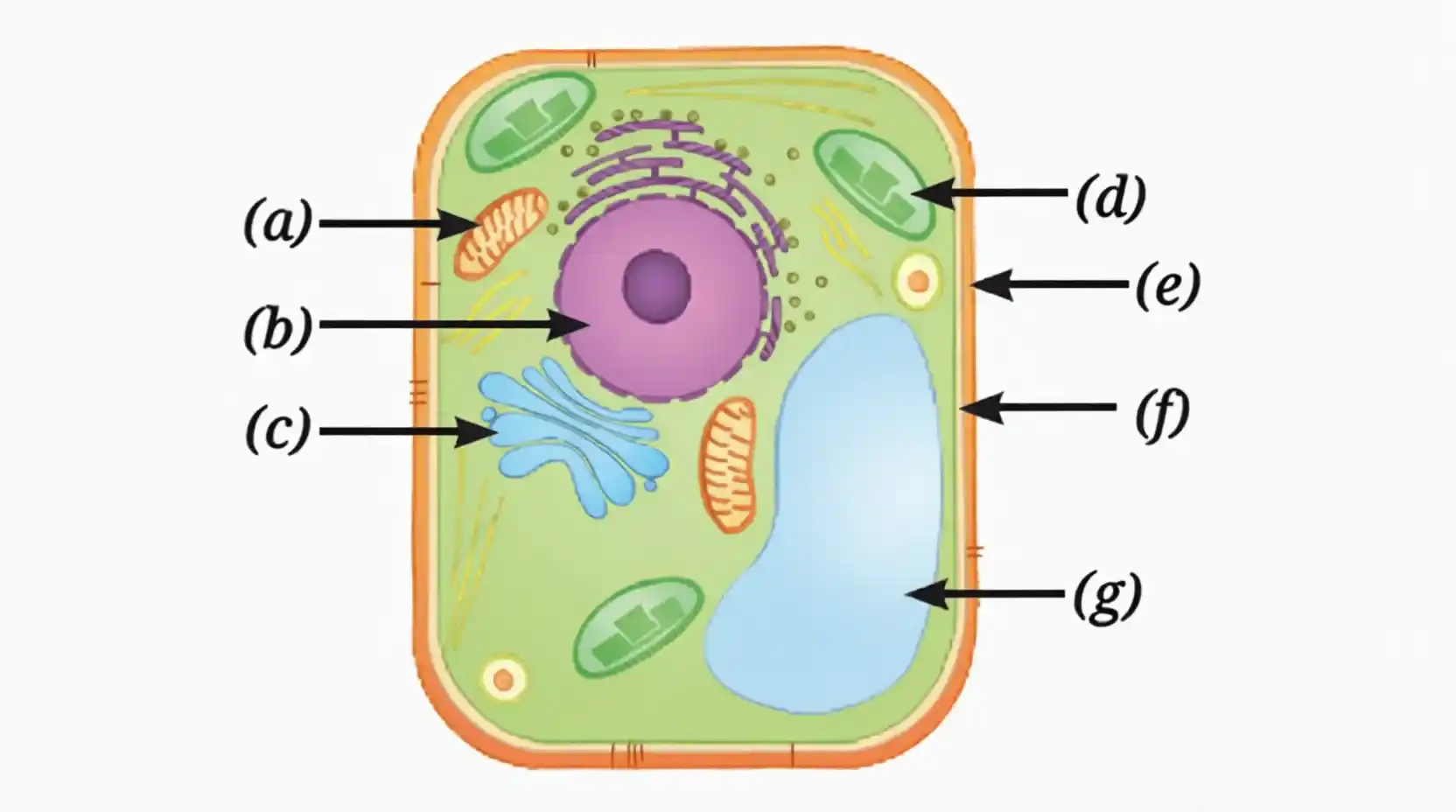
Look at the diagram of a cell in Fig. 2.20. Identify the parts labelled from
(a) to (g) and correctly match them with their functions given below:
(i) Controlling all the activities of a cell.
(ii) Site of cellular respiration.
(iii) A storage organelle that also provides rigidity to the
cell.
(iv) Separates the cell contents from the surroundings.
(v) Provides structural rigidity to the cell.
(vi) Packs and stores materials received from ER.
(vii) Helps in manufacturing food.
Answers
Labels and Their Identification
| Label | Cell Part |
|---|---|
| (a) | Mitochondria |
| (b) | Nucleus |
| (c) | Golgi Apparatus |
| (d) | Chloroplast |
| (e) | Cell Wall |
| (f) | Cell Membrane |
| (g) | Vacuole |
Matching with Functions
(a) Mitochondria → Function (ii)
Site of cellular respiration.
Mitochondria break down glucose to release energy. This energy is stored as ATP and used for most cellular activities.
(b) Nucleus → Function (i)
Controlling all the activities of a cell.
The nucleus contains DNA and chromosomes. It carries all the genetic instructions that control how the cell works.
(c) Golgi Apparatus → Function (vi)
Packs and stores materials received from ER.
The Golgi apparatus acts like the cell’s post office. It modifies, sorts, and packages proteins and lipids received from the ER into vesicles.
(d) Chloroplast → Function (vii)
Helps in manufacturing food.
Chloroplasts contain chlorophyll, a green pigment. It absorbs sunlight and uses it to prepare food through photosynthesis.
(e) Cell Membrane → Function (iv)
Separates the cell contents from the surroundings.
The cell membrane is a thin boundary that surrounds the cell. It is selectively permeable and controls what enters and leaves the cell.
(f) Vacuole → Function (iii)
A storage organelle that also provides rigidity to the cell.
The vacuole stores water, minerals, sugars, and waste. By storing large amounts of water, it maintains pressure that keeps the plant cell firm.
(g) Cell Wall → Function (v)
Provides structural rigidity to the cell.
The cell wall is made of cellulose. It is rigid and helps plant cells maintain their shape and stay upright against environmental stresses like wind and rain.
Q4.
Which of the following options of the pairs of cell organelles are correctly placed under the given categories?
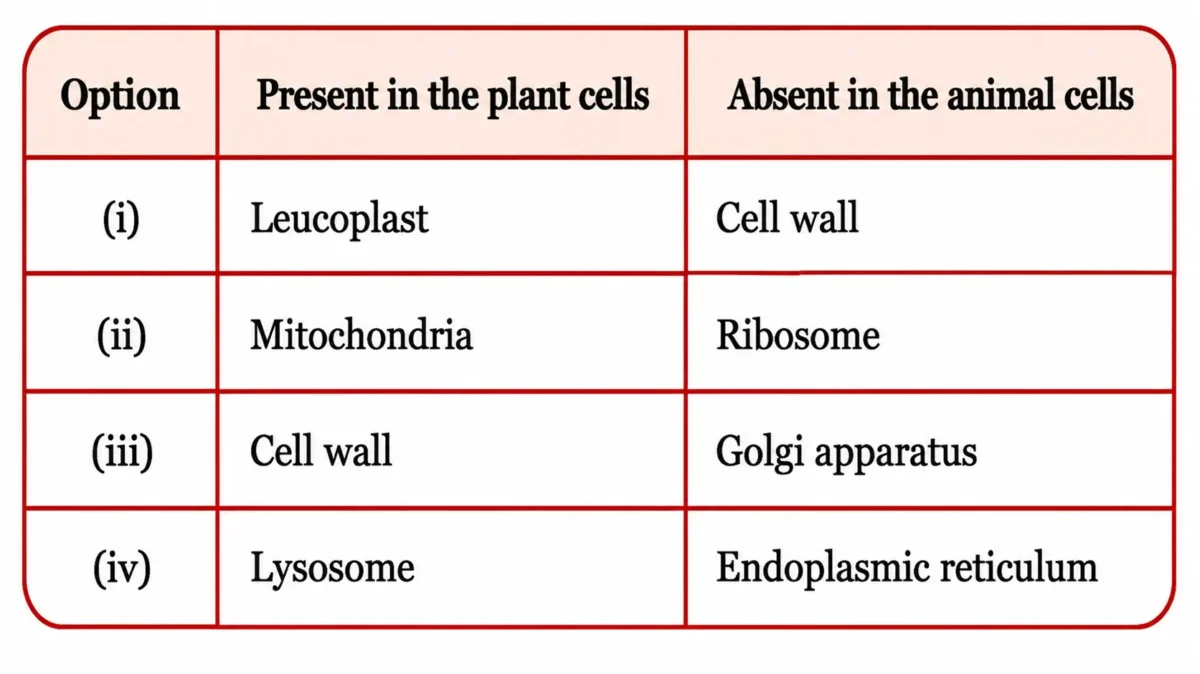
Answers
✔ The Correct Answer is (i)
Leucoplast — Present in plant cells | Cell wall — Absent in animal cells
Q5.
Two students, Renu and Rohit, were having a discussion on the plastids. Renu emphasised that all parts of the plants, even roots, contain plastids. However, Rohit did not agree with the statement and told her
that plastids are absent in plant roots since the roots are underground and do not need to perform photosynthesis. Who is correct? Justify your answer.
Answer:
✔ Renu is Correct
Why Rohit is Wrong:
Rohit confused chloroplasts with all plastids. Not all plastids perform photosynthesis.
Why Renu is Right:
The chapter (pages 18 and 19 ) tells us there are three types of plastids — chloroplasts, chromoplasts, and leucoplasts.
Leucoplasts are colourless plastids. They do not need sunlight. Their only job is to store food like starch, oils, and proteins.
The chapter (page 19) clearly states that potato and taro (Colocasia) cells contain leucoplasts that store starch, and that these are found underground, just like roots.
Q6.
Mitochondria and chloroplasts are two important organelles in a plant cell. Discuss how these two organelles are structurally and functionally similar to each other, and different from each other
Answer:
Similarities: Structure and Function
Structure:
● Both are double membrane-bound organelles.
● Both have their own DNA and ribosomes.
● So both can make some of their own proteins.
Function:
● Both are involved in energy-related processes in the cell.
● Both share an evolutionary history with single-celled organisms (bacteria).
Differences: Structure and Function
Structure
| Mitochondria | Chloroplasts |
|---|---|
| Inner membrane is folded into cristae | Has a semi-fluid substance called stroma inside |
| Cristae increase surface area for reactions | Cristae increase the surface area for reactions |
Function
| Mitochondria | Chloroplasts |
|---|---|
| Performs cellular respiration | Performs photosynthesis |
| Breaks down glucose to release energy | Produces glucose using sunlight |
| Energy stored as ATP | Sugars and starch stored in stroma |
| Found in both plant and animal cells | Found in plant cells only |
| Called the powerhouse of the cell | Sugars and starch are stored in the stroma |
Q7.
Which of the following pairs of cell organelles contains DNA?
(i) Chloroplasts, Ribosomes
(ii) Mitochondria, Nucleus
(iii) Golgi bodies, Ribosomes
(iv) Nucleus, Lysosomes
Answer:
✔ Correct Answer is (ii)
Mitochondria and Nucleus
Q8.
A researcher carried out an experiment in which she took two carrots of similar size. She placed one carrot in plain water and the other carrot in concentrated salt solution (Fig. 2.21). After 24 hours, she recorded her observations.
(i) What hypothesis does she want to test through this experiment?
(ii) What would you suggest for the improvement of this experiment?
(iii) Why does the carrot in plain water stay stiff and crunchy, but the
carrot in concentrated salt solution become rubbery and limp?
Answers:
(i) Hypothesis
The researcher wants to test whether the concentration of a solution affects the movement of water across the cell membrane through osmosis.
In other words, does a carrot lose or gain water depending on whether it is placed in plain water or a concentrated salt solution?
(ii) Improvements to the Experiment
Based on Activity 2.2 (the potato experiment), the following improvements can be suggested:
● Measure and record the initial weight of both carrots before placing them in the solutions. This gives a proper starting point for comparison.
● Cut both carrots to the same size so that the experiment is fair and the results can be compared accurately.
● Measure the final weight after 24 hours to calculate the exact difference in weight.
iii) Why Does One Stay Stiff and the Other Become Limp?
Carrot in plain water — stays stiff and crunchy.
Plain water has more water and fewer solutes than the carrot cells inside. So water moves into the carrot cells through osmosis. This fills up the vacuoles and increases pressure inside the cells. The cells become firm, keeping the carrot stiff and crunchy.
Carrot in concentrated salt solution — becomes rubbery and limp.
The salt solution has less water and more solutes than the carrot cells inside. So water moves out of the carrot cells through osmosis. The vacuoles lose water, the cells lose pressure, and the carrot becomes soft and limp.
Q 9.
Indicate the presence or absence of the following structures in bacterial and animal cells:
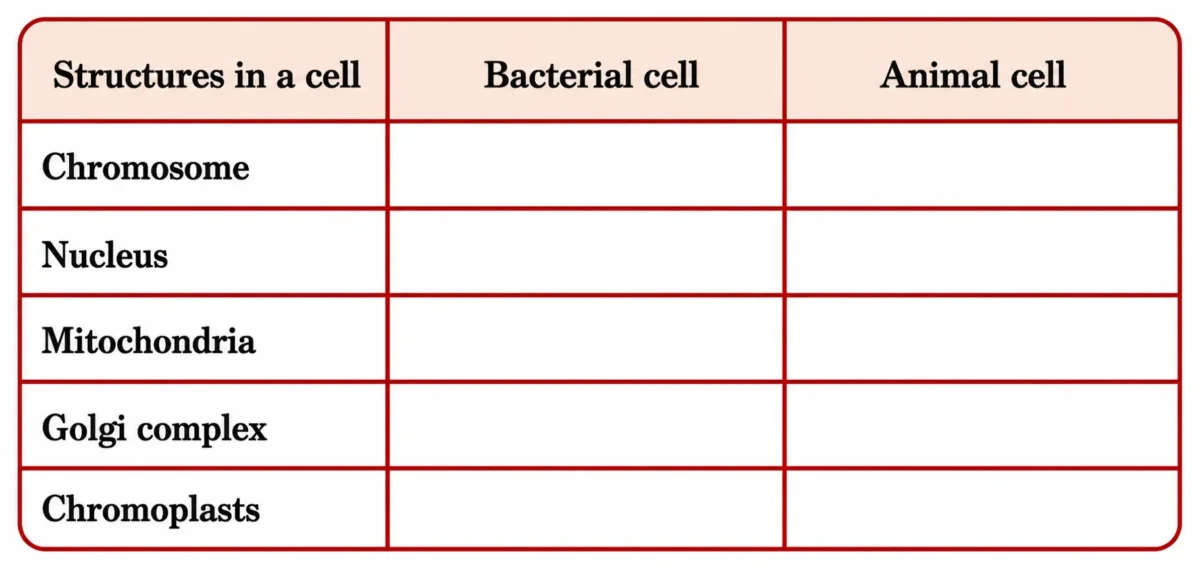
Answer Table
| Structures | Bacterial Cell | Animal Cell |
|---|---|---|
| Chromosome | Present | Present |
| Nucleus | Absent | Present |
| Mitochondria | Absent | Present |
| Golgi complex | Absent | Present |
| Chromoplasts | Absent | Absent |
Chromosome
●Bacterial cell — Present, but as a single circular DNA molecule. It has no membrane around it. This region is called the nucleoid.
●Animal cell — Present inside the nucleus, made of DNA and specific proteins.
Nucleus
●Bacterial cell — Absent. Bacteria are prokaryotic cells and do not have a well-defined nucleus.
●Animal cell — Present. Animal cells are eukaryotic cells and have a proper nucleus with a nuclear membrane.
Mitochondria
●Bacterial cell — Absent. The chapter states that prokaryotic cells have no membrane-bound organelles.
●Animal cell — Present. Mitochondria are the powerhouse of the cell, producing energy through cellular respiration.
Golgi Complex
●Bacterial cell — Absent. Again, bacteria lack all membrane-bound organelles.
●Animal cell — Present. It packs and ships proteins and lipids in the cell.
Chromoplasts
● Bacterial cell — Absent. Chromoplasts are a type of plastid found only in plant cells.
● Animal cell — Absent. Animal cells do not contain any plastids at all.
Q10.
Carry out the following experiment:
Take four peeled potato halves and scoop each one out to make potato cups. One of these potato cups should be made from a boiled potato. Place each of the potato cups in a beaker containing water (Fig. 2.22). Now, set up the experiment as follows:
(a) Keep Cup A empty.
(b) Add one teaspoon of sugar in Cup B.
(c) Add one teaspoon of salt in Cup C.
(d) Add one teaspoon of sugar to the boiled potato in Cup D.
Observe the four potato cups for at least two hours and answer the following
questions:
(i) Explain why water gathers in the hollowed portion of Cup B and
Cup C.
(ii) Why is Cup A necessary for this experiment?
(iii) Explain why water does not gather in the hollowed portions of
Cups A and D.
Answers:
(i) Why Does Water Gather in Cup B and Cup C?
Cup B has sugar, and Cup C has salt inside. These make the solution inside the cup concentrated.
The potato cells around the cup have more water. So water moves from the potato cells into the hollow cup through the selectively permeable cell membrane. This is called osmosis.
That is why water gathers in both cups.
(ii) Why is Cup A Necessary?
Cup A is the control of the experiment. It has no solute inside, so no osmosis takes place and no water gathers. It helps us compare results and confirms that water gathered in other cups only because of osmosis — and not for any other reason.
(iii) Why Does Water NOT Gather in Cup A and Cup D?
Cup A — There is no solute inside. So there is no concentration difference, and no osmosis takes place.
Cup D — The potato is boiled, so its cells are dead. Boiling destroys the cell membrane. Since osmosis requires a selectively permeable membrane, it cannot occur in Cup D — even though sugar is present.
Q11.
Identify the pair that incorrectly matches the cell organelle with its function.
(i) Ribosome — Protein synthesis
(ii) SER — Lipid and cellulose synthesis
(iii) Lysosome — Digestion of foreign agents
Answers:
❌The Incorrect Pair is (ii)
SER — Lipid and cellulose synthesis
Q12.
What outcome do you expect if all the mitochondria are removed from a eukaryotic cell?
Answer:
The Cell Would Lose Its Energy Supply
If all mitochondria are removed from a eukaryotic cell:
● The cell would stop producing ATP.
● Without ATP, the cell would have no energy to carry out its activities.
● The cell would be unable to grow, divide, or function.
● Eventually, the cell would die.
Q13.
Which phenomenon inhibits the formation of tumours in the human body? Can plants also develop tumours? Explain.
Answer:
The phenomenon is called Contact Inhibition.
The chapter (page 23 ) states that in many animal cells, cell division stops when cells come in contact with neighbouring cells. This prevents uncontrolled growth and keeps cell division in check — thus inhibiting the formation of tumours.
What Happens When Contact Inhibition Fails?
Cancer cells lose this control. They keep dividing uncontrollably even after coming in contact with neighbouring cells. This leads to the formation of tumours.
Can Plants Also Develop Tumours?
Yes, but differently.
The chapter (page 23 ) states that plant cells do not show contact inhibition because of their rigid cell walls. Plant cells follow a different pattern of growth.
However, errors in mitosis can lead to uncontrolled cell divisions and abnormal growth in organisms.
Q14.
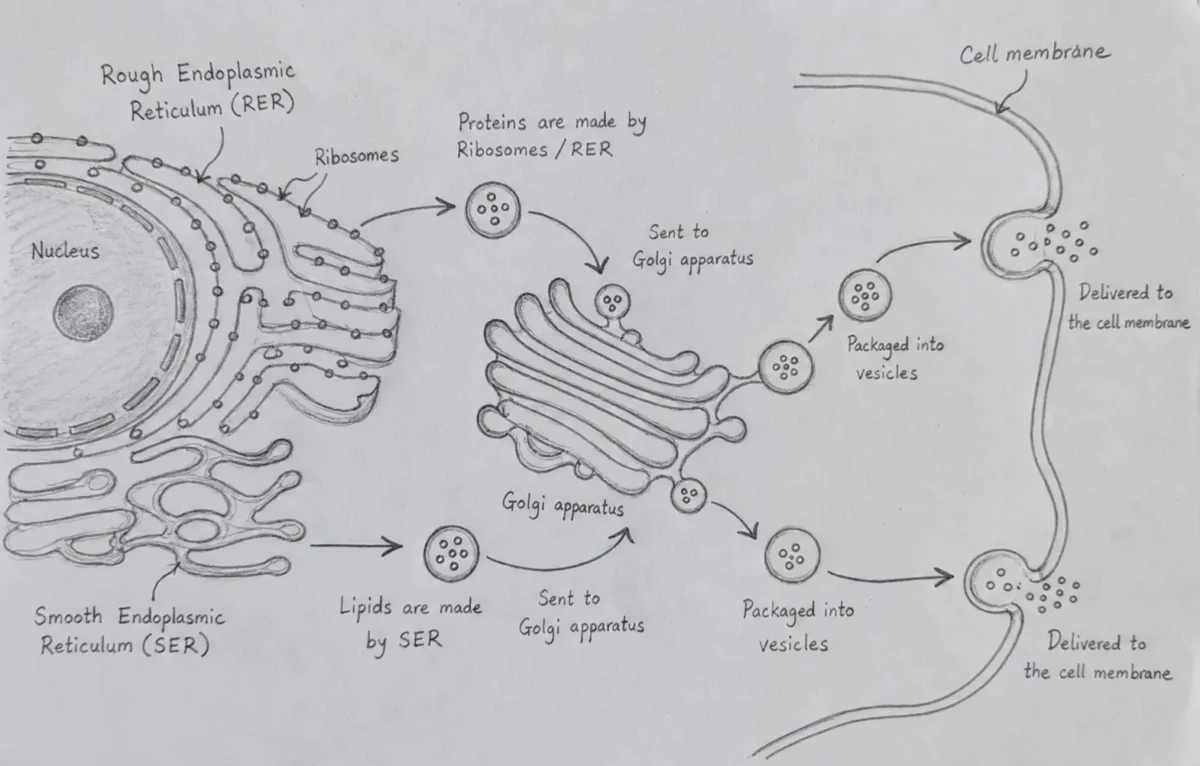
The cell membrane of a cell is made up of proteins and lipids. Which cell organelles help in the synthesis of cell membrane? Write the path of these compounds from their site of synthesis to the cell membrane and show this through a labelled diagram.
Answers:
The cell membrane is made of proteins and lipids.
Two organelles are responsible for their synthesis:
- Ribosomes / RER — for protein synthesis
- SER — for lipid synthesis
Path of Proteins to Cell Membrane
Ribosomes on the RER synthesise proteins.
● These proteins are then sent to the Golgi apparatus.
● The Golgi apparatus modifies, sorts, and packages them into vesicles.
● These vesicles then move to the cell membrane and deliver the proteins.
Path of Lipids to Cell Membrane
SER synthesises and stores lipids.
●These lipids are then sent to the Golgi apparatus.
●The Golgi apparatus packages them into vesicles.
●The Golgi apparatus packages them into vesicles.
●These vesicles then fuse with the cell membrane and deliver the lipids.
Q15.
What would happen if gametes are formed by mitotic divisions?
Answer:
Mitosis produces daughter cells with the same number of chromosomes as the parent cell.
So if gametes were formed by mitosis, each gamete would have the full set of 46 chromosomes instead of 23.
When two such gametes fused during fertilisation, the offspring would have 46 + 46 = 92 chromosomes.
In the next generation, it would become 184 chromosomes, and so on.
The Result
Every generation, the chromosome number would keep doubling.
This would lead to:
● Completely abnormal cells with too many chromosomes.
● The organism would not develop normally.
● Eventually, this would make reproduction impossible, and the species would not survive.
Q16.
A farmer, Deepa, was very happy with the harvest of amla (Indian Gooseberries and lemons on her farm. However, she could sell only one-fourth of the produce in the local market. Recognising that a significant amount of produce may be lost post-harvest, she employed a traditional yet scientifically sound method to extend the shelf life of amla and lemons. She turned perishable produce into profitable products, such as pickles and sharbat. She used the excess produce to prepare pickles, murabbas, and sharbat by adding appropriate amounts of salt, sugar, or jaggery to small pieces of fruit and their juices. These were then stored in small glass bottles for sale, helping her prevent the wastage of post-harvest produce. This shift from farming to agro-processing would strengthen food security and boost the local economy, creating a sustainable model that cuts waste while increasing her income. Based on the above passage, answer the following questions:
(i) Which scientific concept has the farmer applied in the preservation
of the farm produce?
(ii) How does the addition of high concentrations of salt and sugar
create an environment that prevents the growth of spoilage-causing
bacteria and fungi?
(iii) Suggest a healthy recipe of this kind for food preservation.
(iv) What are the scientific values addressed in this case?
Answers:
(i) Which Scientific Concept Did She Apply?
Deepa applied the concept of Osmosis.
When a cell is placed in a concentrated solution, water moves out of the cell through the selectively permeable membrane. This process is called osmosis.
By adding high amounts of salt, sugar, or jaggery to fruits and juices, Deepa created a highly concentrated solution around the microorganisms, causing them to lose water and die.
(ii) How do salt and Sugar Prevent Bacterial and Fungal Growth?
When bacteria or fungi come in contact with a highly concentrated salt or sugar solution, the solution outside has less water than inside the microbial cells.
Due to osmosis, water moves out of the bacterial or fungal cells. This causes the cells to shrink and shrivel up — a process called plasmolysis.
Without water, the microorganisms cannot survive or reproduce. This prevents the spoilage of food.
(iii) A Healthy Recipe for Food Preservation
Amla Murabba
● Take fresh amla and prick them with a fork.
● Boil them lightly in water.
● Prepare a thick sugar or jaggery syrup.
● Soak the amla pieces in the syrup for several days.
● Store in clean glass bottles.
The high concentration of sugar creates an osmotic environment that prevents the growth of bacteria and fungi, preserving the amla for months.
(iv) Scientific Values Addressed
The following scientific values are seen in this case:
● Observation and application — Deepa observed that excess produce was being wasted and applied scientific knowledge of osmosis to solve a real problem.
● Sustainability — She reduced post-harvest waste by converting perishable food into long-lasting products.
● Innovation — She used a traditional method backed by science to create new products like pickles, murabbas, and sharbat.
● Food security — By preserving food, she ensured that nutritious produce remained available even after the harvest season.
● Economic thinking — She turned potential losses into profitable products, boosting her income and the local economy.

Mujhe schand book class 9ka physics aur chemistry ka notes aur pa 1 ka paper
Mujhe schand book ka notes aur paper chahiye pa 1ka physics or chemistry chapter motion and mixture and compounds
schand book ke contents leaving some questions NCERT textbook se hi banaye jate hai aut NCERT exploration ke notes ke liye please click the link ahead. https://studyless.in/exploring-mixtures-and-their-separation-ch-5-notes/
aur questions paper jald hi website par upload honge