Need to ace your exams without spending hours on textbooks? These Keeping Time With The Skies Ch 11 Short Notes offer a streamlined way to master Class 8 Chapter 11 of the curiosity textbook.
We’ve distilled complex topics—like the phases of the Moon, the science of calendars, and why festivals shift dates—into easy-to-memorize points.
Whether you’re revising the difference between Lunar and Solar calendars or learning about ISRO’s artificial satellites, these Keeping Time With The Skies Ch 11 Short Notes provide everything you need for a quick and effective study session.
Click Here for other chapter notes
How Does the Moon’s Appearance Change and Why?
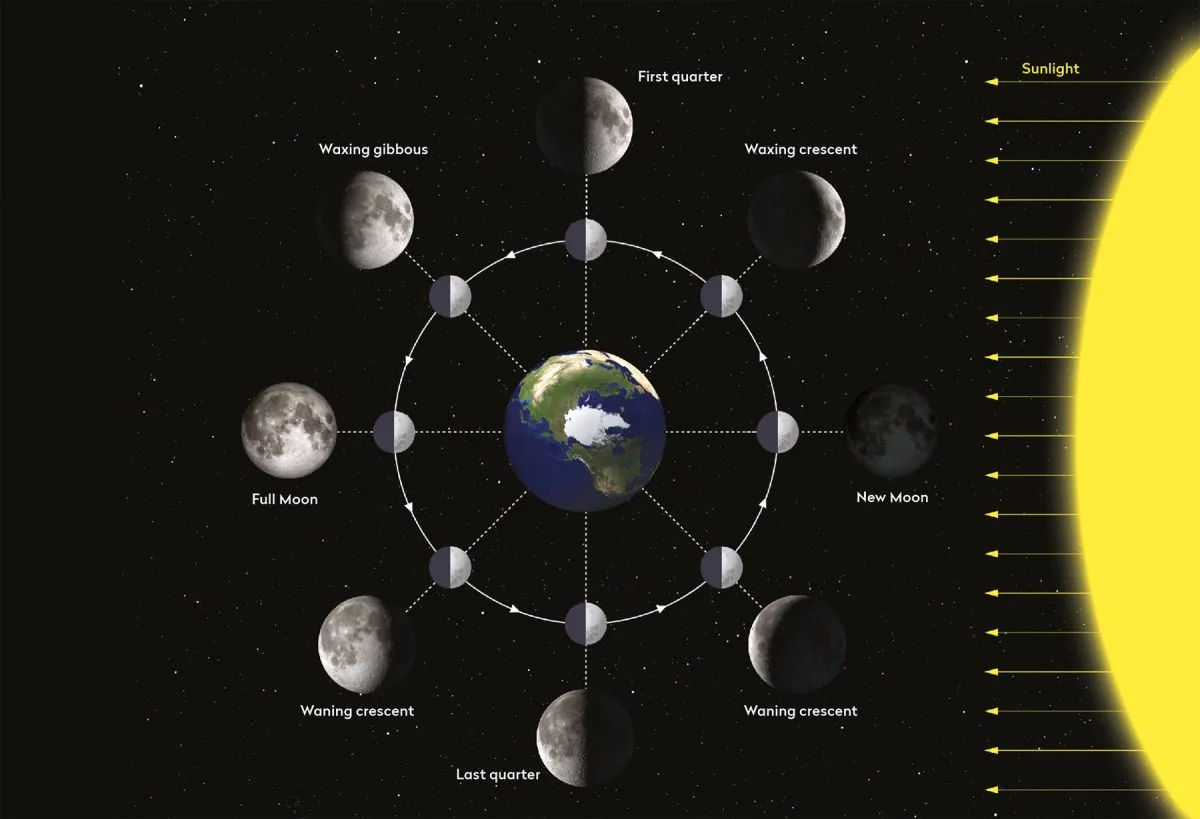
1. PHASES OF THE MOON
Changing shapes of the Moon’s bright portion as seen from Earth from one day to the next.
Important Terms
| Term | Meaning |
|---|---|
| Full Moon (Purnima) | Moon appears as a full bright circle |
| New Moon (Amavasya) | Moon is not visible |
| Waning period | Bright part decreases — ~2 weeks |
| Waxing period | Bright part increases — ~2 weeks |
| Krishna Paksha | Waning period |
| Shukla Paksha | Waxing period |
The Cycle of
the Moon
- Full Moon → bright circle
- Week 1 → shrinks to a half circle
- Week 2 → disappears (New Moon)
- Week 3 → grows back to a half circle
- Week 4 → back to Full Moon
●Waning + Waxing together = ~1 month
●Full Moon to next Full Moon = ~1 month
2. LOCATING THE MOON
The Moon’s position in the sky relative to the Sun changes daily, depending on its phase.
Moon’s Position at Sunrise (Waning Phase)
| Phase | Position at Sunrise |
|---|---|
| Full Moon | Nearly opposite the Sun — Moon setting in the west, The sun rising in the east |
| Half circle (quarter) | Overhead |
| Crescent | Close to the Sun in the sky |
When to Spot the Moon
| Moon | Best time to spot |
|---|---|
| Waxing Moon | Sunset |
| Waning Moon | Sunrise |
Important Points
- Moon appears in a different part of the sky each day at the same time
- During waning, the Moon appears to move closer to the Sun each morning
- Moon always rises and sets at different times from the Sun
More observations on the moon
Why the Moon
Shines
- Moon has no light of its own
- It reflects sunlight
- Half facing the Sun = illuminated
- Half facing away = non-illuminated
Why We See Different Phases
▶ Only one half of the Moon always faces Earth
▶ Only one half of the Moon always faces Earth
▶ That half is not always the illuminated half
▶ The fraction of the illuminated portion visible to us
changes as the Moon revolves around Earth, → causes phases
Phases Explained:
| Fully illuminated portion | Phase |
|---|---|
| Full illuminated portion | Full Moon |
| More than half illuminated | Gibbous phase |
| Less than half illuminated | Crescent phase |
| None of illuminated portion | None of the illuminated portion |
New Moon vs Full Moon Position
| Day | Moon’s position relative to the Sun |
|---|---|
| New Moon | Closest to the Sun |
| Full Moon | Moon’s position relative to the Sun |
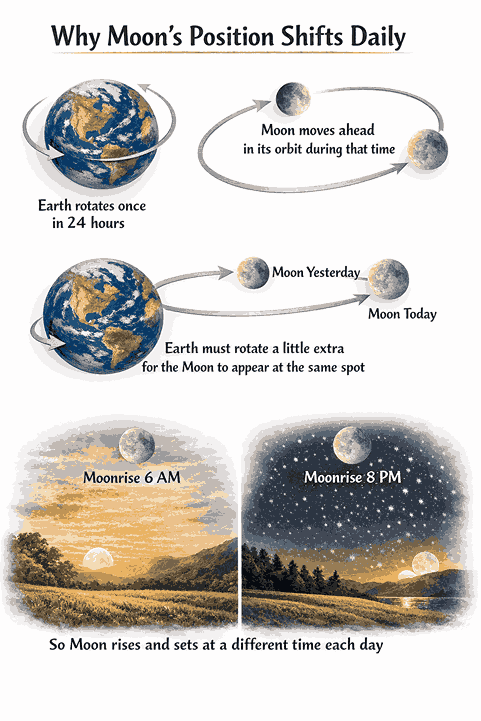
People across different parts of Earth see nearly the same phase on a given day because Earth’s rotation period (1 day) is much shorter than the Moon’s orbital period (~1 month).
How Did Calendars Come into Existence
NATURAL CYCLES & UNITS OF TIME
The Three Natural Cycles
| Unit | Based on | Duration |
|---|---|---|
| Day | Earth’s rotation on its own axis | 24 hours |
| Month | Moon’s cycle through all phases | ~29.5 days |
| Year | Earth’s revolution around the Sun | ~365¼ days |
The Day:
▶ Sun appears to rise in the East, set in the West
— due to Earth’s rotation
▶ Mean solar day = 24 hours, the average time from the
Sun’s highest point from one day to the next
The Month:
▶ Based on the cycle of the Moon’s phases
▶ The Moon takes ~29.5 days to complete all phases
The Year
(Solar Year)
▶ Based on the cycle of seasons
▶ Earth takes ~365¼ days to complete one revolution
around the Sun
▶ One full cycle of seasons = one solar year
CALENDARS
Types of Calendars
| Type | Based on | Example |
|---|---|---|
| Lunar | Moon’s phases | Lunar calendar |
| Solar | Earth’s revolution around Sun | Gregorian, Indian National |
| Luni-solar | Both Moon’s phases + seasons | Many Indian calendars |
Lunar Calendar
- 1 lunar month = ~29.5 days
- 1 lunar year = 12 lunar months = 354 days
- Problem: seasons shift every year — not in sync with solar year (365 days)
- Difference = ~11 days per year
Solar Calendar (Gregorian)
- Based on Earth’s revolution = ~365¼ days
- Months adjusted to add up to 365 days (hence 30/31 day months, Feb = 28)
- Leap year: every 4 years, 1 extra day added → Feb has 29 days
- Rule: year divisible by 4 = leap year
- Purpose: stays in sync with seasons
Luni-Solar Calendar
- Uses Moon’s phases for days & months
- But adds an extra month (Adhika Maasa / intercalary month) every 2–3 years
- Why: 11 days/year shortfall accumulates to ~1 full month every 2–3 years
- Used in many parts of India
Indian National Calendar
| 22 March (the day after the spring equinox) | Detail |
|---|---|
| Type | Solar |
| Days in year | 365 |
| Year begins | 22 March (day after spring equinox) |
| Month lengths | 30 or 31 days only |
| Months with 31 days | 2nd to 6th months |
| Months with 30 days | Remaining months |
| Leap year | An extra day has been added to Chaitra (1st month) → year begins 21 March |
| Month names | Taken from traditional Indian calendars |
Are Festivals Related to Astronomical Phenomena?
Festival — Moon Phase Link
| Festival | Occasion | Month |
|---|---|---|
| Diwali | New Moon | Kartika |
| Holi | Full Moon | Phalguna |
| Buddha Purnima | Full Moon | Vaisakha |
| Dussehra | 10th day | Ashwina |
| Eid-ul-Fitr | Sighting of crescent Moon | End of Ramazan |
Why These Festivals Fall on Different Gregorian Dates Each Year
- These festivals follow lunar or luni-solar calendars
- Lunar year (354 days) ≠ Gregorian year (365 days)
- So the Gregorian date shifts every year
How Much Does the Date Shift?
| Calendar type | Gregorian date shift |
|---|---|
| Luni-solar | Less than a month (intercalary month corrects the difference every few years) |
| Purely lunar | Can shift across different months year after year (no correction made) |
Why Do We Launch Artificial Satellites In space?
ARTIFICIAL SATELLITES
Important Points
| Feature | Detail |
|---|---|
| Typical orbit height | ~800 km above Earth’s surface |
| Time for one orbit | ~100 minutes |
| Launched by (India) | ISRO |
Uses of
Artificial Satellites
- Communication
- Navigation
- Weather monitoring
- Disaster management
- Scientific research
FAQs: Keeping Time With The Skies Ch 11 Short Notes
1. What is the difference between a Lunar calendar and a Solar calendar?
The main difference lies in what they track. A Solar calendar (like the Gregorian calendar) is based on the Earth’s revolution around the Sun, lasting approximately 365.25 days. A Lunar calendar is based on the Moon’s phases, where a year consists of 12 lunar months, totaling about 354 days. Because of this 11-day difference, lunar calendars often fall out of sync with the seasons unless adjusted.
2. Why does the Moon change its shape every day?
The Moon does not actually change its shape; rather, our view of it changes. As the Moon revolves around the Earth, different portions of its side facing the Sun become visible to us. These are called Phases of the Moon. When we see the entire illuminated side, it is a Full Moon (Purnima), and when the illuminated side faces away from Earth, it is a New Moon (Amavasya).
3. What are Shukla Paksha and Krishna Paksha?
These terms describe the two fortnights of a lunar month in the Indian calendar:
- Shukla Paksha (Waxing Phase): The period from the New Moon to the Full Moon when the visible bright portion increases.
- Krishna Paksha (Waning Phase): The period from the Full Moon to the New Moon when the visible bright portion decreases.
4. Why do festivals like Diwali and Eid fall on different dates every year?
These festivals are based on lunar or luni-solar calendars rather than the solar-based Gregorian calendar. Since a lunar year is about 11 days shorter than a solar year, the dates shift backward annually. Luni-solar calendars (used for Diwali) occasionally add an extra month (Adhika Maasa) to bring the festival back in sync with the seasons, while purely lunar calendars (used for Eid) allow the dates to rotate through all seasons over time
5. How do artificial satellites stay in orbit around the Earth?
Artificial satellites, launched by agencies like ISRO, are placed in orbit at specific heights (typically around 800 km for low-earth orbit). They travel at a very high speed—taking about 100 minutes to circle the Earth. The balance between the satellite’s forward momentum and the Earth’s gravitational pull keeps it “falling” around the Earth in a continuous loop, allowing it to be used for communication, weather monitoring, and GPS.