
These Light: Mirrors and Lenses Notes Class 8 Chapter 10 are designed to help students master the fundamental concepts of reflection and refraction effectively.
Also, “Light: Mirrors and Lenses Notes Class 8” helps you to revise your chapter quickly and effectively.
To get the maximum out of the notes of Light: Mirrors and Lenses class 8, you need to read and understand the chapter from your NCERT textbook.
After that, revise again from the notes of Light: Mirrors and Lenses.
What Are Spherical Mirrors?
Definition
Mirrors, whose reflecting surfaces are spherical, are called spherical mirrors.
Types of Spherical Mirrors
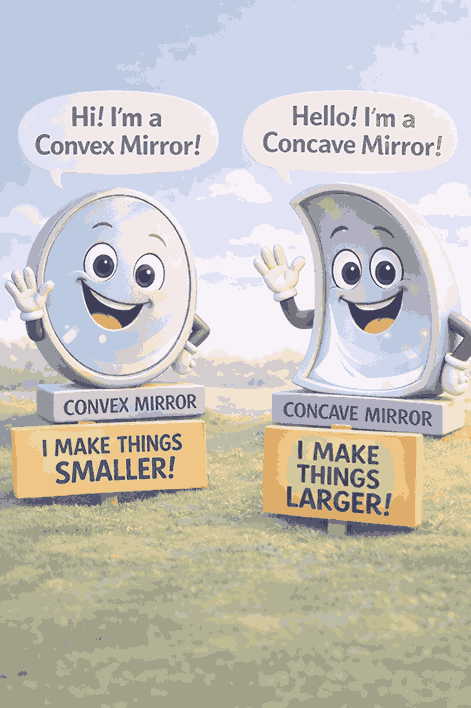
Concave Mirror:
Reflecting surface curves inwards
Convex Mirror:
Reflecting surface curves outwards
What Are the Characteristics of Images Formed by Spherical Mirrors?
Concave Mirror
Image Features
- Object close → image erect & enlarged
- Object moved farther → image becomes inverted
- Image size: enlarged → smaller as distance increases
Applications
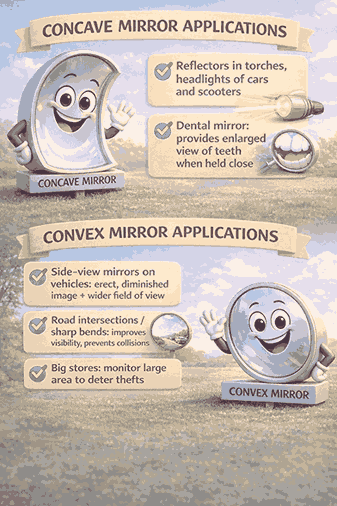
Concave Mirror
- Reflectors in torches, headlights of cars,
and scooters - Dental mirror: Enlarged the view of
teeth when held close
Convex Mirror
Image Features
- The image is always erect and
smaller(diminished) than the object - Image size decreases slightly
as the object moves away
Applications Convex Mirror
- Side-view mirrors on vehicles: erect, diminished image + wider field of view
- Road intersections / sharp bends: improve visibility, prevent collisions
- Big stores: monitor a large area to deter thefts
Plane Mirror
Image Features
- Always forms an erect image of the same size
as the object - Lateral inversion of the image
(is seen in all three types of mirrors)
What Are the Laws of Reflection?
Key Terms
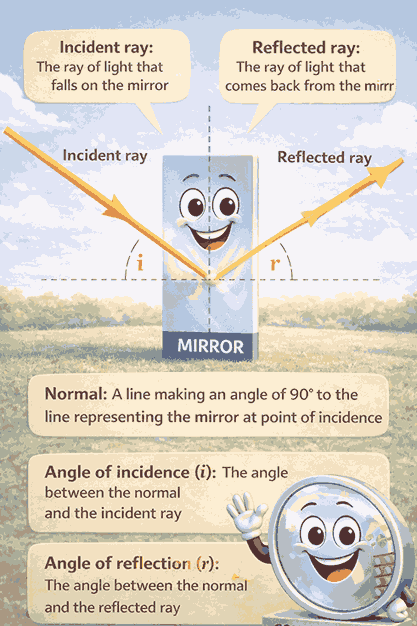
Incident ray:
The ray of light that falls on the mirror
Reflected ray:
The ray of light that comes back from the mirror
Angle of incidence (i):
The angle between the normal and the incident ray
Angle of reflection(r):
The angle between the normal and the reflected ray
Normal:
A line making an angle of 90° to the line representing the mirror at the point of incidence
Laws of Reflection
- The angle of incidence (i) is equal to the angle of reflection (r)
- The incident ray, the normal to the mirror at the point of incidence, and the reflected ray all lie in the same plane
The laws of reflection are valid for all kinds of mirrors — plane and spherical.
| Mirror Type | Reflected Rays | Effect |
|---|---|---|
| Plane | Remain parallel | No convergence/divergence |
| Concave | Converge (get closer) | Focuses light |
| Convex | Diverge (spread out) | Disperses light |
Concave:
Inward curve → Converges rays.
Convex:
Outward curve → Diverges rays.
Concave mirror + sunlight → light concentrates at a point → produces sufficient heat → can ignite paper
What Is a Lens?
A lens is a piece of transparent material, usually made of glass or plastic, which has curved surfaces
Types of Lenses
Convex Lens
●A lens that is thicker in the middle than at the edges is called a convex lens
●Also called a converging lens
●converges the light falling on it
Image Characteristics of a convex lens:
→Object close → image erect and enlarged
→Object moved farther → image becomes inverted
→Size: enlarged → diminishes as distance increases
Concave Lens
●A lens that is thicker at the edges than in the middle is called a concave lens
●Also called a diverging lens
●diverges the light falling on it
Image Characteristics of a concave lens:
→An object placed behind a concave lens and seen through the lens always appears erect and diminished in size.
Applications of lenses
●Eyeglasses: correct vision
●Cameras, telescopes, microscopes: focus light to form images
●Human eye: contains a convex lens that changes shape to focus on near/far objects
Lenses Vs Mirrors
●Lenses allow light to pass through them; mirrors don’t
●We can see through the lenses but not through mirrors
FAQs : Light: Mirrors and Lenses Notes Class 8
What are spherical mirrors and their types?
Mirrors, whose reflecting surfaces are spherical, are called spherical mirrors.
Concave mirror: A spherical mirror, which has a reflecting surface that curves inwards, is called a concave mirror
Convex mirror: A spherical mirror that has a reflecting surface that curves outwards is called a convex mirrorWhat are the two laws of reflection?
The angle of incidence (i) is equal to the angle of reflection (r).
The incident ray, the normal to the mirror at the point of incidence, and the reflected ray, all lie in the same plane.
Valid for all mirrors: plane, concave, and convexHow do lenses differ from mirrors in image formation?
Unlike mirrors, lenses allow light to pass through them, and we see things through a lens rather than in a lens.
Mirrors: image formed by reflection; Lenses: image formed by refraction
Mirrors: shaded side = non-reflecting; Lenses: transparent throughout
Both follow similar curvature rules: concave = inward/thick edges, convex = outward/thick middle
4. What is the difference between concave and convex mirrors?
| Feature | Concave Mirror | Convex Mirror |
|---|---|---|
| Curvature | Curves inwards | Curves outwards |
| Image (close object) | Erect and enlarged | Erect and diminished |
| Image (far object) | Inverted | Always erect and diminished |
| Light behaviour | Converges parallel rays | Diverges parallel rays |
| Common use | Torches, dental mirrors | Vehicle side mirrors, road safety |
5. What is the difference between convex and concave lenses?
| Feature | Convex Lens | Concave Lens |
|---|---|---|
| Shape | Thicker at middle | Thicker at edges |
| Also called | Converging lens | Diverging lens |
| Image (close object) | Erect and enlarged | Always erect and diminished |
| Image (far object) | Inverted | Always erect and diminished |
| Light behaviour | Converges light | Diverges light |
We hope these Light: Mirrors and Lenses Notes Class 8 helped you understand how light interacts with different surfaces. For more science notes, keep visiting our site!