“Chapter 7 Elections Notes Class 9“ is based on the chapter 7 of NCERT class 9 textbook, Understanding Society: India and Beyond Grade 9 – Part 1
We have structured the notes by making use of tables, flow charts and bullet points. This will help you to prepare the chapter quickly and remember for longer.
CHAPTER WISE NOTES: Understanding Society: India and Beyond Grade 9 – Part 1
Why do Elections Matter?
An election:
is a process through which we exercise the right to vote
and fulfil our responsibility as citizens.
Elections give people the power to choose, change, and hold their representatives accountable.
People
↓
Vote
↓
Choose Representatives
↓
Form Government
↓
Governments need fresh mandate
through periodic elections.
↓
Representatives Accountable to People
Types of Elections
| Direct Election | Indirect Election |
|---|---|
| Citizens vote directly | Representatives vote |
| Lok Sabha | President |
| Vidhan Sabha | Vice President |
| Panchayats | Rajya Sabha |
| Every 5 years | Indirect voting process |
Why Elections are Important
Election
├── Gives Citizens a Choice
├── Enables Formation of Government
├── Ensures Accountability
├── Renews People’s Mandate
└── Strengthens Democracy
Don’t Confuse
| Direct Election | Indirect Election |
|---|---|
| Citizens elect representatives | Representatives elect leaders |
| Public votes directly | Public does not vote directly |
Inside India’s Election Machinery
Free, fair elections in India run through
laws, coordinated systems, and key stakeholders at all levels.
Constitution & Laws
↓
Define Powers & Functions
↓
Stakeholders (ECI, Parties, Civil Society, Media, Voters)
↓
Free, Fair & Transparent Elections
Stakeholders
| Stakeholder | Role |
|---|---|
| ECI | Conducts & manages elections |
| Political Parties | Contest elections |
| Civil Society | Promotes awareness & fairness |
| Media | Informs & monitors process |
| Voters | Exercise right to vote |
The Electoral System
An electoral system converts votes into legislative seats.
India uses FPTP for Lok Sabha & Vidhan Sabha, and Proportional Representation for Rajya Sabha, President, VP & Vidhan Parishad.
Votes Cast
↓
Electoral System Applied
↓
FPTP ──► Lok Sabha, Vidhan Sabha
Proportional Representation ──► Rajya Sabha, President, VP, Vidhan Parishad
↓
Seats Allocated
Types of Electoral Systems
| FPTP | Proportional Representation |
|---|---|
| Lok Sabha | Rajya Sabha |
| Vidhan Sabha | President & Vice President |
| Direct election | Vidhan Parishad (via Single Transferable Vote) |
Vidhan Parishad
Vidhan Parishad (Upper House)
Members are
├── Elected by Vidhan Sabha members
├── Elected by Local Bodies
├── Elected by Graduates & Teachers
└── Nominated by Governor (Art, Science, Literature, Social Service, Co-operatives)
Bicameral States – 6 states
State Legislature
|
┌────── |──────┐
Vidhan Vidhan
Sabha Parishad
(Lower) (Upper)
States: Andhra Pradesh, Bihar, Karnataka, Maharashtra, Telangana, Uttar Pradesh
Don’t Confuse
| Vidhan Sabha | Vidhan Parishad |
|---|---|
| Lower House | Upper House |
| Directly elected (FPTP) | Indirectly elected + nominated (PR) |
| Exists in all states | Exists only in 6 bicameral states |
Single transferable vote system
- Voters mark their preference.
- First preference votes are counted for all candidates. Those who receive the minimum votes required to win (quota) are declared elected.
- The candidate who receives the lowest votes is eliminated. Their votes are transferred to those who are mentioned as second preference on those ballot papers.
- Process continues till the required number of candidates are elected.
Electoral SystemsFeature First Past The Post (FPTP) Majority System Proportional Representation (PR)
Name of the Country (Imaginary) Haritbhumi Ratnadweep Swarnalok
Seats in the Parliament 25 seats 25 seats 100 seats
(nationwide list)
Main Political Parties - Party A
- Party B
- Party C
- Party X
- Party Y
- Party Z
- Party M
- Party N
- Party O
- Party P
How Voting Works? Each voter votes for one candidate in their constituency. The candidate with the most votes wins, even if the votes are less than 50% of total votes polled. Each voter votes for one candidate. To win, a candidate must receive more than 50% of the votes. If not, the top two candidates compete again in the second round. Voters vote for a party, not a person. Seats in the Parliament are allotted in proportion to the total votes received by each party.
Sample Results (Vote Percentage) Party A: 40%Party B: 35%Party C: 25% Party X: 45%Party Y: 40%Party Z: 15% Party M: 40%Party N: 35%Party O: 15%Party P: 10%
Who forms the Government? Party A forms the government. No one got 50% in Round 1. In Round 2, Party Y wins with 55%, and forms the government. Seats distributed:
M: 40; N: 35;
O: 15; P: 10
Power is shared proportionately.
| Feature | First Past The Post (FPTP) | Majority System | Proportional Representation (PR) |
|---|---|---|---|
| Name of the Country (Imaginary) | Haritbhumi | Ratnadweep | Swarnalok |
| Seats in the Parliament | 25 seats | 25 seats | 100 seats (nationwide list) |
| Main Political Parties |
|
|
|
| How Voting Works? | Each voter votes for one candidate in their constituency. The candidate with the most votes wins, even if the votes are less than 50% of total votes polled. | Each voter votes for one candidate. To win, a candidate must receive more than 50% of the votes. If not, the top two candidates compete again in the second round. | Voters vote for a party, not a person. Seats in the Parliament are allotted in proportion to the total votes received by each party. |
| Sample Results (Vote Percentage) | Party A: 40% Party B: 35% Party C: 25% | Party X: 45% Party Y: 40% Party Z: 15% | Party M: 40% Party N: 35% Party O: 15% Party P: 10% |
| Who forms the Government? | Party A forms the government. | No one got 50% in Round 1. In Round 2, Party Y wins with 55%, and forms the government. | Seats distributed: M: 40; N: 35; O: 15; P: 10 Power is shared proportionately. |
The Laws
Elections in India are governed by:
two Representation of the People Acts and the Presidential and Vice-Presidential Act, 1952.
Representation of the People Acts
1. Representation of the People
Act, 1950
RPA, 1950
Deals With
│
├── Allocation of Seats
├── Delimitation of Constituencies
├── Electoral Rolls
├── Revision of Electoral Rolls
└── Voting Rights (18+ Citizens)
Main focus = Rolls & Constituencies.
2. Representation of the People
Act, 1951
RPA, 1951
Deals With
│
├── Nomination of Candidates
├── Election Campaigns
├── Voting Procedures
├── Conduct of Elections
└── Election Disputes
Main focus = Conduct & Disputes’
3. Presidential & Vice-Presidential Elections Act, 1952
Elections of President & Vice President
Voting age = 18 years and above
- Offer: Gift, offer, or promise by a candidate to influence voting, withdrawal, or contest.
- Appeal: Appealing for votes based on religion, caste, race, community, or language.
- Assistance: Taking help from government personnel (judges, police, armed forces, excise officers).
Delimitation Commission
Delimitation ensures equal representation
by adjusting constituencies according to population changes.
What is Delimitation?
Delimitation
│
├── Determines Number of Seats
└── Fixes Constituency Boundaries
For elections to:
Lok Sabha
Vidhan Sabha
Why is Delimitation Needed?
Population Shifts
↓
Delimitation Process
↓
Redraw Constituency Boundaries + Fix Seats
↓
Equal Seat-to-Population Ratio
Problem Without Delimitation
| Constituency A | Constituency B |
|---|---|
| 5 Lakh People | 25 Lakh People |
| 1 MP | 1 MP |
Result:
Unequal representation
Don’t Confuse
| Without Delimitation | With Delimitation |
|---|---|
| Unequal population per MP (e.g. 5 lakh vs 25 lakh) | Balanced seat-to-population ratio |
Election Commission of India (ECI)
ECI is the constitutional body controlling India’s entire election process — rolls, schedules, parties, and fairness.
What is the Election Administration Structure
Election Commission of India (ECI)
↓
Chief Electoral Officer (State)
↓
District Election Officers
(District Magistrates)
Returning Officers
(Sub-Divisional Magistrates)
Electoral Registration Officers
(Tahsildars)
↓
Conduct Elections
What is the function of ECI
ECI Functions
├── Prepares & Revises Electoral Rolls (SIR)
├── Decides Election Schedule & Dates
├── Registers Political Parties & Allots Symbols
└── Ensures Free, Fair & Inclusive Elections
1. ECI creates the electoral roll:
Prepare the list of eligible voters.
Process
Household Survey by Enumerators
↓
Data Collection
↓
Electoral Roll Preparation
↓
Claims & Objections
↓
Final Electoral Roll
SIR Process
SIR (Special Intensive Revision)
├── Adds: New 18+ voters, missed-out eligible citizens
├── Deletes: Deceased, shifted residence, duplicates, untraceable
├── Claims/Objections Window
└── Final Electoral Roll Published
2. ECI decides the schedule and date for the election
Legislature Term Ends (5 yrs) Or Dissolved Early
↓
ECI Activates Election Machinery
↓
Considers: Weather, Agriculture, Exams, Festivals
↓
Election Schedule & Dates Fixed
Factors Considered before announcing election dates:
● Weather
● Agricultural Cycle
● Festivals School/University Exams
● Local Conditions
3. ECI registers political parties and allocates symbols:
ECI registers parties, ensures inner party democracy, classifies parties, and allots election symbols.
Process
Political Party
↓
Registers with ECI
↓
ECI Classifies Party
↓
National / State / Registered-Unrecognised
↓
Symbol Allotted (National & State Parties)
Party Classification
| National Party | State/Regional Party | Registered-Unrecognised |
|---|---|---|
| Recognised by ECI | Recognised by ECI | Registered only |
| Gets symbol | Gets symbol | No fixed symbol |
| Who can contest | Registered parties + Independents |
| ECI’s role in disputes | Quasi-judicial body(Settles symbol disputes) |
| Party requirement | Periodic organisational elections (inner party democracy) |
Don’t Confuse
| Party Candidate | Independent Candidate |
|---|---|
| Affiliated to a political party | No party affiliation |
| Contests under party symbol | Contests without a fixed party symbol |
4. Ensuring free and fair elections
Elections must be fair, inclusive & transparent — ECI uses inclusive initiatives and technology to ensure this.
Fair Election Process
↓
Impartial + Inclusive + Trustworthy
↓
Public Confidence in Institutions
↓
Meaningful Democracy
Threats to Fairness
Unfair Practices
├── Candidates influenced by personal favours
├── Inaccurate vote counting
└── Accessibility barriers to voting
↓
Reduces Democratic Value of Elections
Inclusive Initiatives
| Group | Initiative |
|---|---|
| Senior Citizens (85+) | Voting from home |
| PwDs (40%+ disability) | Voting from home |
| Transgender Persons | Infrastructure & tech-assisted inclusion |
| PVTGs | Infrastructure & tech-assisted inclusion |
ECI Portals & Apps
- Nomination forms & live status updates.
- Apply permissions: meetings, rallies, vehicles, loudspeakers.
- Real-time track of permission approvals.
- Seamless processing of forms & database handling.
- Efficient form processing & simplified dashboards.
- Role-based access & E-Roll maintenance.
- Web application managing vehicle requisition for election tasks.
- Tracks department info, registration numbers, driver logs.
- Monitors fuel allotments periodically.
- System dedicated for Service Voters.
- Receive postal ballots electronically.
- Cast votes securely from outside constituencies.
- Voter registration, transposition, & verification.
- View information related to ongoing elections.
- Real-time results updates & alerts.
- Customized features easing ID & registration for PwDs.
- Assistance for PwD voters finding polling stations.
- Specialized accessibility services built-in.
- Report Model Code of Conduct violations instantly.
- Report field misconducts within minutes.
- Flying squads dispatched via automatic geo-location tracking.
Political Parties
Political Parties connect citizens, candidates, and government,
helping democracy function effectively.
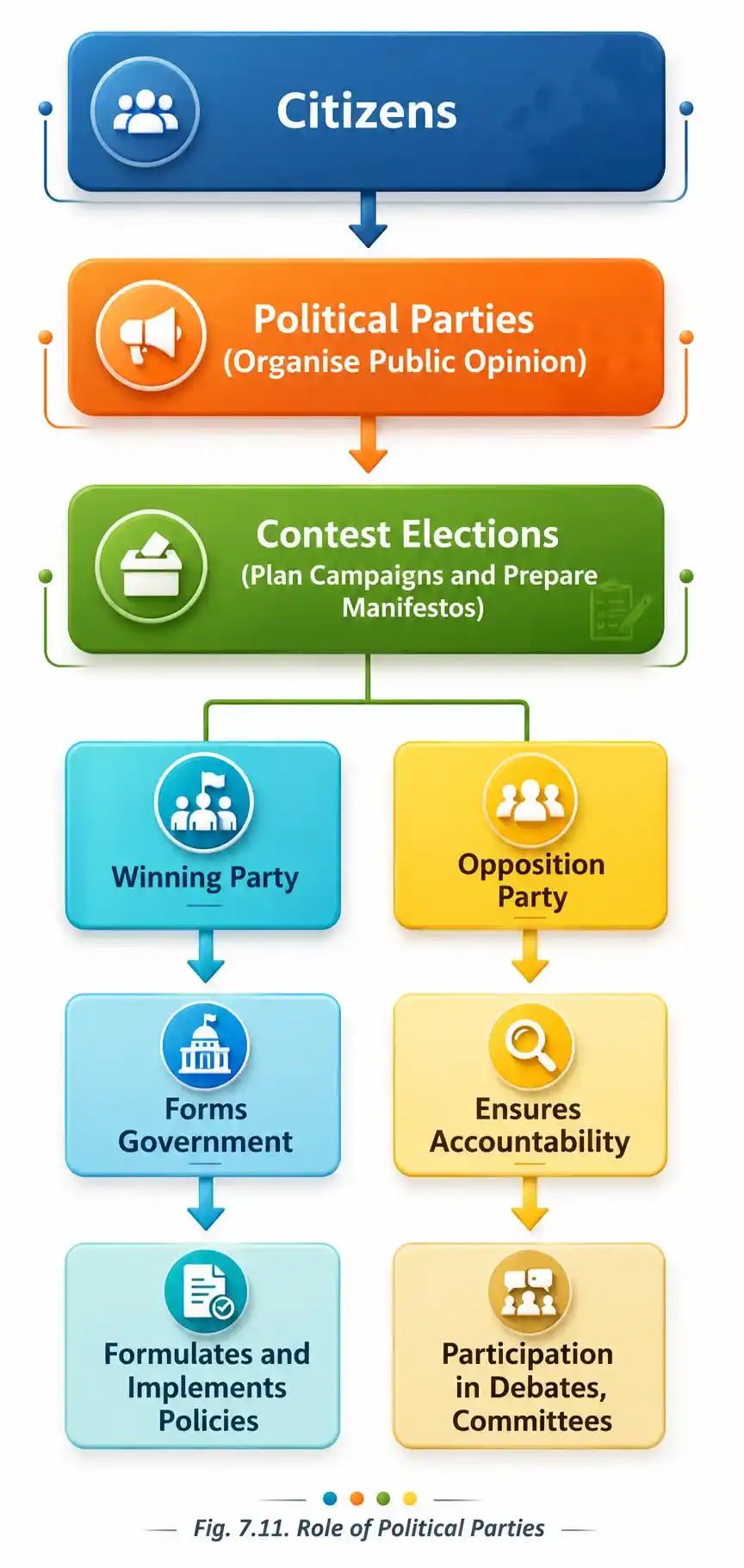
Role of Political Parties
Political Parties
↓
Set Agenda + Present Promises
↓
Inform Voters (Rallies, Media, Debates)
↓
Contest Elections
↓
Voters Choose Candidates
↓
Winning Party Form Government
↓
Implement Policies
↓
Democracy Functions (Governance, Accountability, Representation)
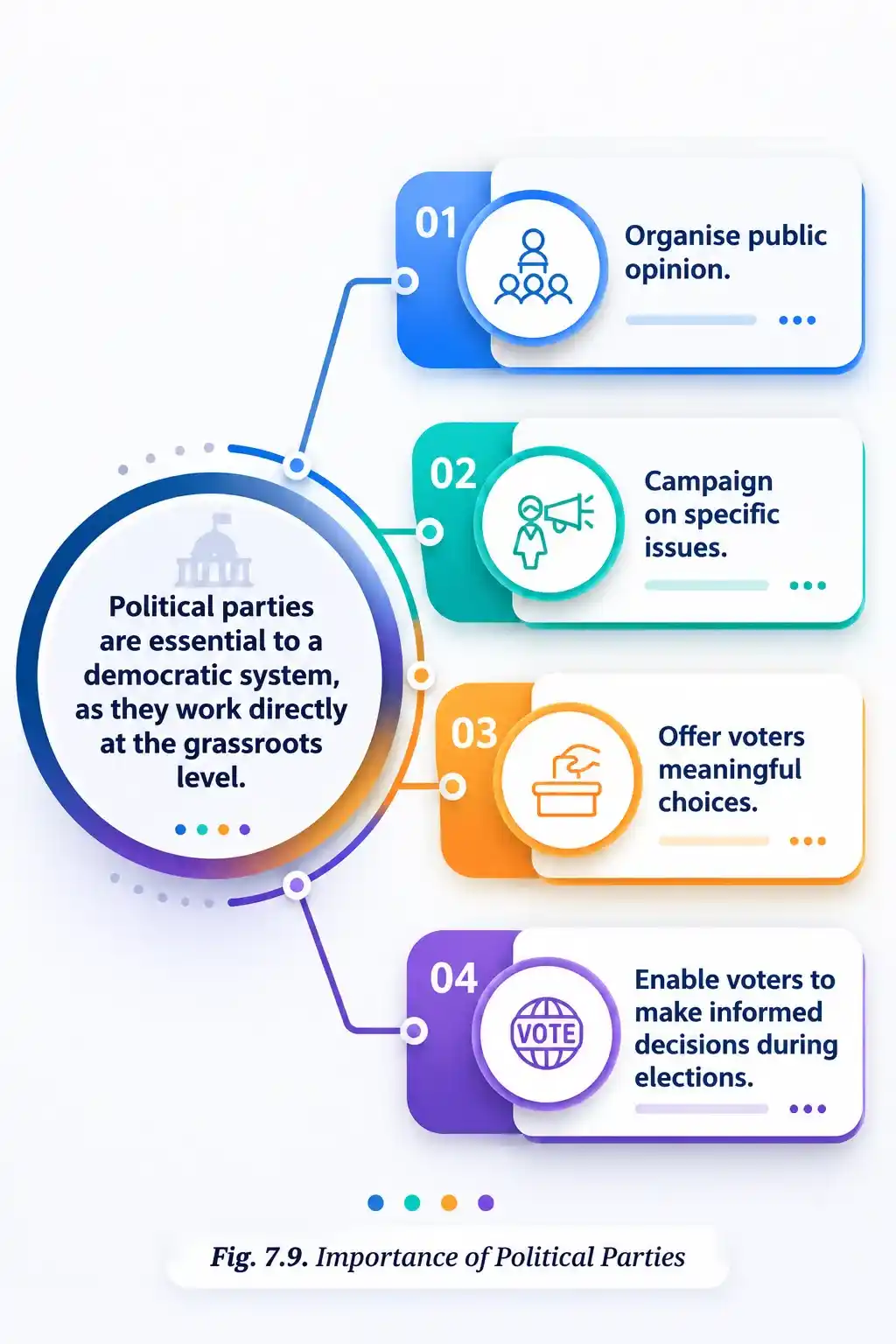
Why are Political Parties Important?
Because Political Parties
│
├── Organize Public Opinion
├── Present Policies
├── Offer Choices to Voters
├── Ensure Representation
├── Provide Governance
└── Ensure Accountability
How Voters Learn About Candidates
Political Party
↓
Manifesto(Party’s promises & policies)
↓
Campaigns & Rallies
↓
Media Discussions
↓
Informed Voters
Functions of Political Parties
| Function | Purpose |
|---|---|
| Contest Elections | Compete for power |
| Present Manifestos | Explain promises & policies |
| Organise Public Opinion | Raise public issues |
| Form Government | Run administration |
| Act as Opposition | Ensure accountability |
Multi-Party System
Meaning
India’s Diversity (Language, Culture, Religion, Region)
↓
Multi-Party System
↓
Many Parties Compete in Elections
Significance of multi party system
● Reflects India’s diversity
● Represents different regions
● Represents different languages
● Represents different cultures
● Represents different interests
Defection
Meaning
A member elected on a party ticket leaves the party or acts against party decisions.
Defection Process
Elected on Party Ticket
↓
Leaves Party
OR
Votes Against Party
↓
Defection
Two views on Defection
| Political Opportunism View | Conscience/Public Interest View |
|---|---|
| Breaks party discipline | Upholds personal conscience |
| Threatens political stability | Responds to changing public expectations |
Don’t Confuse
| Independent Candidate | Party Candidate |
|---|---|
| No party affiliation | Contests on party’s ticket |
| No defection issue | Can be accused of defection |
Criteria for National and State Party Recognition
Parties gain National or State recognition by meeting vote-share or seat-based criteria set by ECI.
National Party Recognition (any ONE condition)
| No. | Condition |
|---|---|
| 1 | 6% votes in 4+ states (Lok Sabha/Assembly) + 4 Lok Sabha seats |
| 2 | 2% Lok Sabha seats, won from at least 3 states |
| 3 | Recognised as State Party in 4 states |
State Party Recognition (any ONE condition)
| # | Condition |
|---|---|
| 1 | 6% votes (State Assembly) + 2 Assembly seats |
| 2 | 6% votes (Lok Sabha, from state) + 1 Lok Sabha seat |
| 3 | 3% Assembly seats, or 3 seats — whichever is more |
| 4 | 1 Lok Sabha seat per 25 seats (or part) allotted to the state |
| 5 | 8% valid votes in the state (Lok Sabha or Assembly election) |
Registered Unrecognised Political Parties (RUPP)
RUPP
├── Did not secure required vote % in elections
└── Never contested any election since registration
Challenges to Free and Fair Elections
Challenges (Misinformation, Fake News, Intimidation)
↓
ECI Countermeasures
↓
RPA 1950/1951 + Model Code of Conduct + EVM + VVPAT + Awareness Campaigns
↓
Representative & Robust Democracy
| Challenge | Impact |
|---|---|
| Misinformation | Misleads voters |
| Fake News | Spreads false information |
| Intimidation | Influences voter choice |
Measures Taken
| Measure | Purpose |
|---|---|
| RPA 1950 & 1951 | Legal framework |
| Model Code of Conduct (MCC) | Regulates campaign behaviour |
| EVMs | Secure voting process |
| VVPAT | Vote verification |
| Voter Awareness Campaigns | Informed voting |
Remember
| MCC | Model Code of Conduct |
|---|---|
| EVM | Electronic Voting Machine |
| VVPAT | Voter Verifiable Paper Audit Trail |