
“Ch 3 Atmosphere And Climate Notes Class 9” is the outcome of our rigorous classroom discussion and many reading sessions with the students.
After consultations with the students on the parameters of :
1. Easy to read
2. Easy to scan
3. Easy to learn
4. Easy to retain
We have prepared these notes of chapter 3 of your new NCERT – Understanding Society: India and Beyond Grade 9 – Part 1
Click here for other chapter notes of Social science class 9
What Is the Atmosphere?
The atmosphere is the blanket of air surrounding the Earth.
It is held in place by gravity.
It is a mixture of gases.
Importance Of Atmosphere
1. Essential for all living beings.
2. Protects from harmful UV radiation.
3. Regulates Earth’s temperature by trapping heat.
4. Prevents excessive heat loss to space.
5. Controls weather and climate by influencing:
▮Temperature ▮Humidity ▮Air pressure
Composition and Structure of the Atmosphere
Composition Of Atmosphere
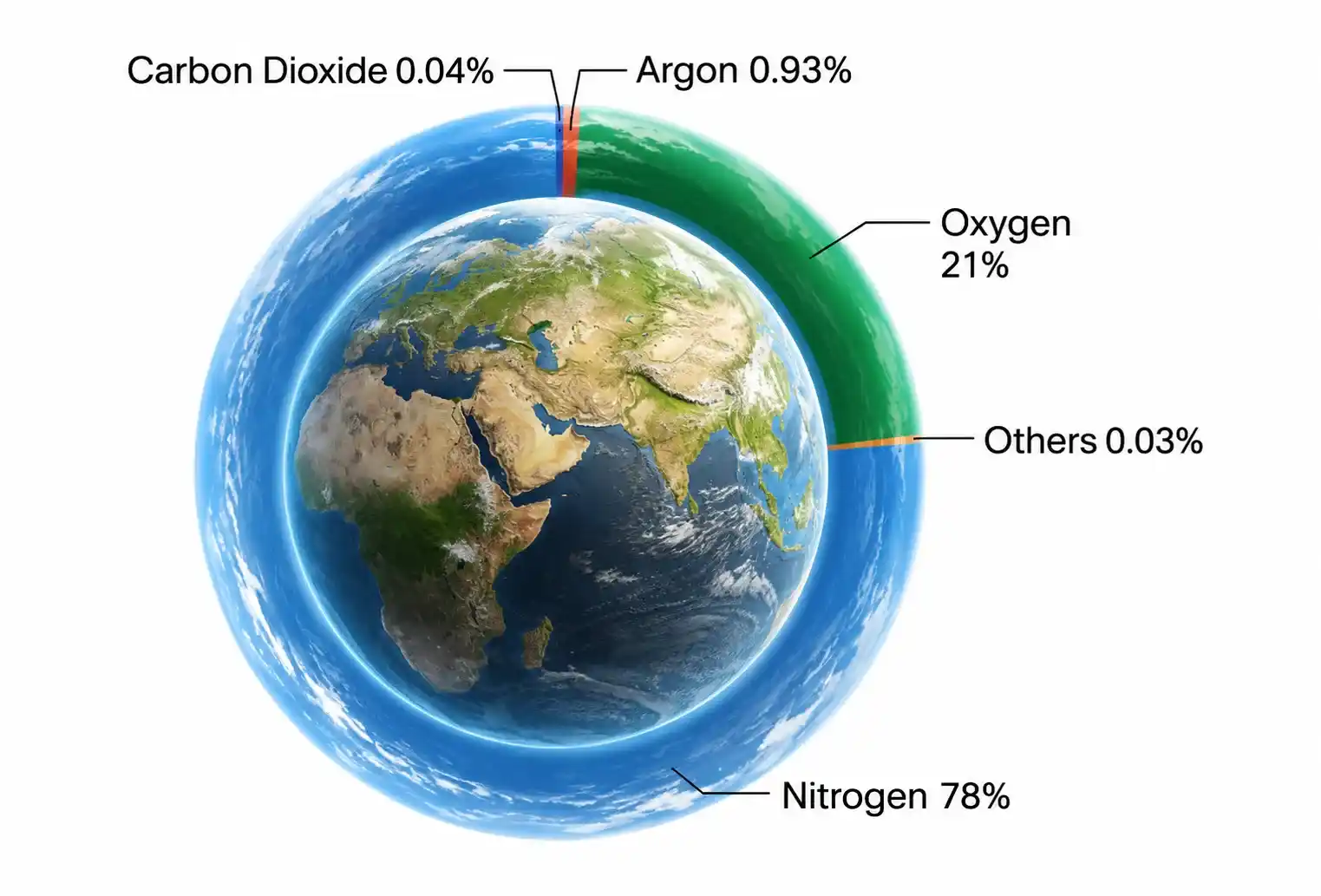
What Is the Atmosphere Made Of?
- The atmosphere is a mixture of gases.
- Nitrogen and oxygen are the major gases and are essential for life.
Other gases present in small amounts include:
▮Carbon dioxide
▮Argon
▮Helium
▮Neon
▮Krypton
▮Krypton
▮Ozone
▮Hydrogen
Other Components
- Water vapour and dust particles.
- Water vapour varies from 0.1% to 0.4%.
- It plays a key role in cloud formation and precipitation.
Variation with Altitude
- The composition of the atmosphere changes with altitude.
| Gas | Percentage |
|---|---|
| Nitrogen | 78% |
| Oxygen | 21% |
| Argon | 0.93% |
| Carbon Dioxide | 0.04% |
| Others | 0.03% |
What Is the Structure of the Atmosphere?
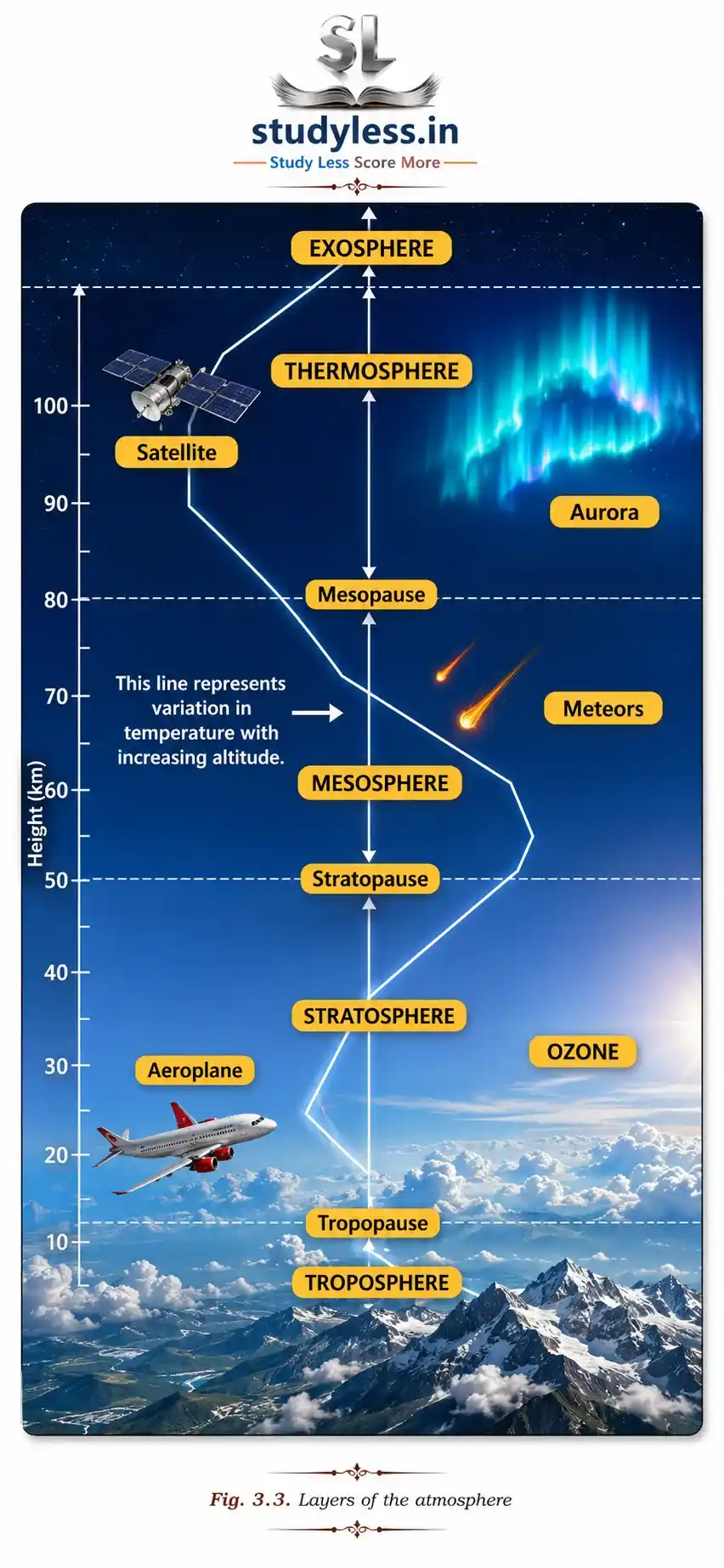
Layered Structure
- The atmosphere is divided into different layers.
- These layers are based on changes in temperature and air density with altitude.
Change in Air Density
- Air density is highest near the Earth’s surface.
- It decreases with increasing altitude.
What are the Layers of the Atmosphere?
| Layer | Height | Key Feature |
|---|---|---|
| Troposphere | Up to 12 km | Most important layer; weather occurs here; temperature decreases with height |
| Stratosphere | Up to 50 km | Contains ozone layer; ideal for aeroplanes; no clouds |
| Mesosphere | Up to 80 km | Meteorites burn up here; temperature decreases with height |
| Thermosphere | 80–700 km | Temperature rises fast; has ionosphere; auroras occur here |
| Exosphere | Beyond 700 km | Uppermost layer; very thin air; gases escape to space |
Troposphere
- Average height: about 12 km.
- Temperature decreases with increasing altitude.
- Contains the air we breathe.
- Most water vapour and clouds.
- All weather phenomena (rainfall, fog, hail) occur here.
- Separated from stratosphere by the tropopause.
Stratosphere
- Extends up to 50 km.
- Free of clouds — ideal for flying aeroplanes.
- Contains the ozone layer.
- Ozone filters harmful UV radiation from the Sun.
- Separated from mesosphere by the stratopause.
Mesosphere — Key Points
- Extends up to 80 km.
- Temperature decreases with increasing altitude.
- Meteorites burn up.
Don’t Miss:
Temperature decreases with altitude only in the Troposphere and Mesosphere.
Thermosphere
- Extends from 80 km to 700 km.
- Temperature rises rapidly with altitude.
- Gas molecules absorb X-rays and UV radiation.
- Helps in radio transmission by reflecting radio waves.
- Ionosphere.
- Auroras (northern and southern lights).
Exosphere
- The uppermost layer of the atmosphere.
- Has very thin air.
- Light gases like helium and hydrogen escape into space due to weak gravity.
Quick Recall — Layers:
Troposphere (weather) → Stratosphere (ozone) → Mesosphere (meteors burn) → Thermosphere (auroras) → Exosphere (thinnest, gases escape).
Weather and Climate
What is Weather and Climate?
What is Weather?
Weather refers to the hour-to-hour and day-to-day conditions of the atmosphere.
- Vary significantly from day to day.
- Hot or humid weather = irritable.
- Pleasant or breezy weather = cheerful.
What is Climate?
Climate is the average weather conditions of a place over a longer period of time.
- It is the sum total of weather conditions and variations over a large area.
- Climate is measured over an extended period, usually 30 years or more.
| Weather | Climate |
|---|---|
| Hour-to-hour and day-to-day conditions | Average conditions over a long period |
| Changes quickly | Stays fairly stable |
| Studied for a short time | Studied for 30 years or more |
| Applies to a small area | Applies to a large area |
Elements of Weather and Climate
What are the Elements of Weather and Climate?
Major elements:
Temperature, precipitation, humidity, wind, atmospheric pressure.
These elements change under varying conditions.
What Is Temperature?
Degree of hotness or coldness = Temperature.
Variation in Temperature
Temperature varies between day and night.
It also changes with the seasons—summers are hotter than winters.
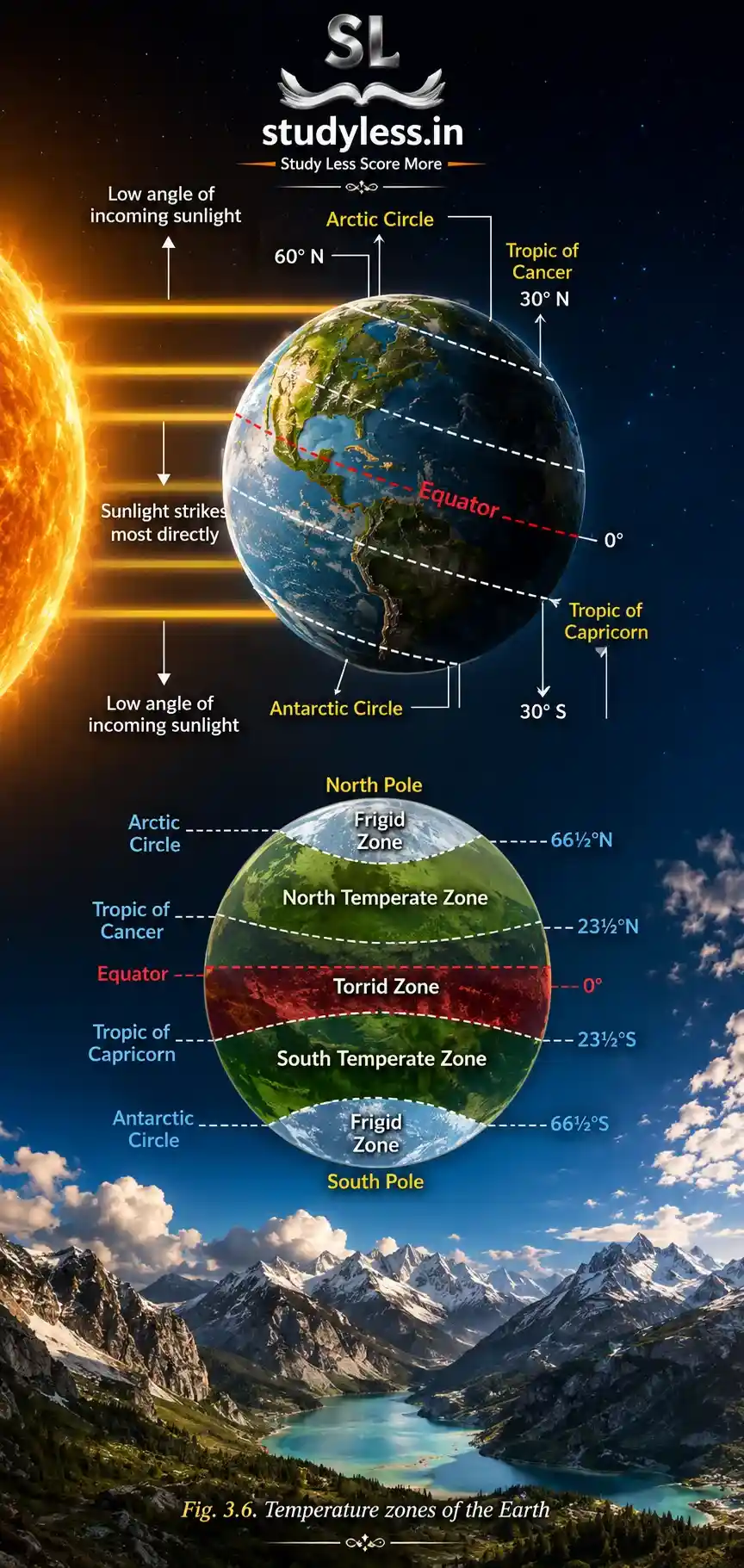
Effect of Insolation
Insolation:
The incoming solar energy from the Sun that is intercepted by the Earth.
Insolation is a major factor controlling temperature distribution.
It decreases from the Equator to the Poles.
Therefore, temperature also decreases from the Equator to the Poles.
What Is Humidity?
● Humidity is the amount of water vapour present in the air.
● It gives the air its moisture.
How It Forms
● Water evaporates from land and water bodies to form water vapour.
● Warmer air can hold more water vapour, increasing humidity.
Effects of High Humidity
● Clothes take longer to dry.
● Sweat evaporates slowly, making us feel hot and uncomfortable.
What Is Precipitation?
● Precipitation occurs when the atmosphere becomes saturated with water vapour.
● The vapour condenses and falls to the Earth under the force of gravity.
Forms of Precipitation
- Drizzle
- Rain
- Snow
- Sleet
- Hail
Factors Affecting Precipitation
- Prevailing winds
- Mountains
- Seasons
Importance of Rain
● Rain is the most common form of precipitation.
● It lowers the temperature of a place.
● Lack of rain leads to a dry climate.
● Most groundwater is replenished by rainwater.
What Is Atmospheric Pressure?
Atmospheric pressure is the force exerted by the weight of air on the Earth’s surface.
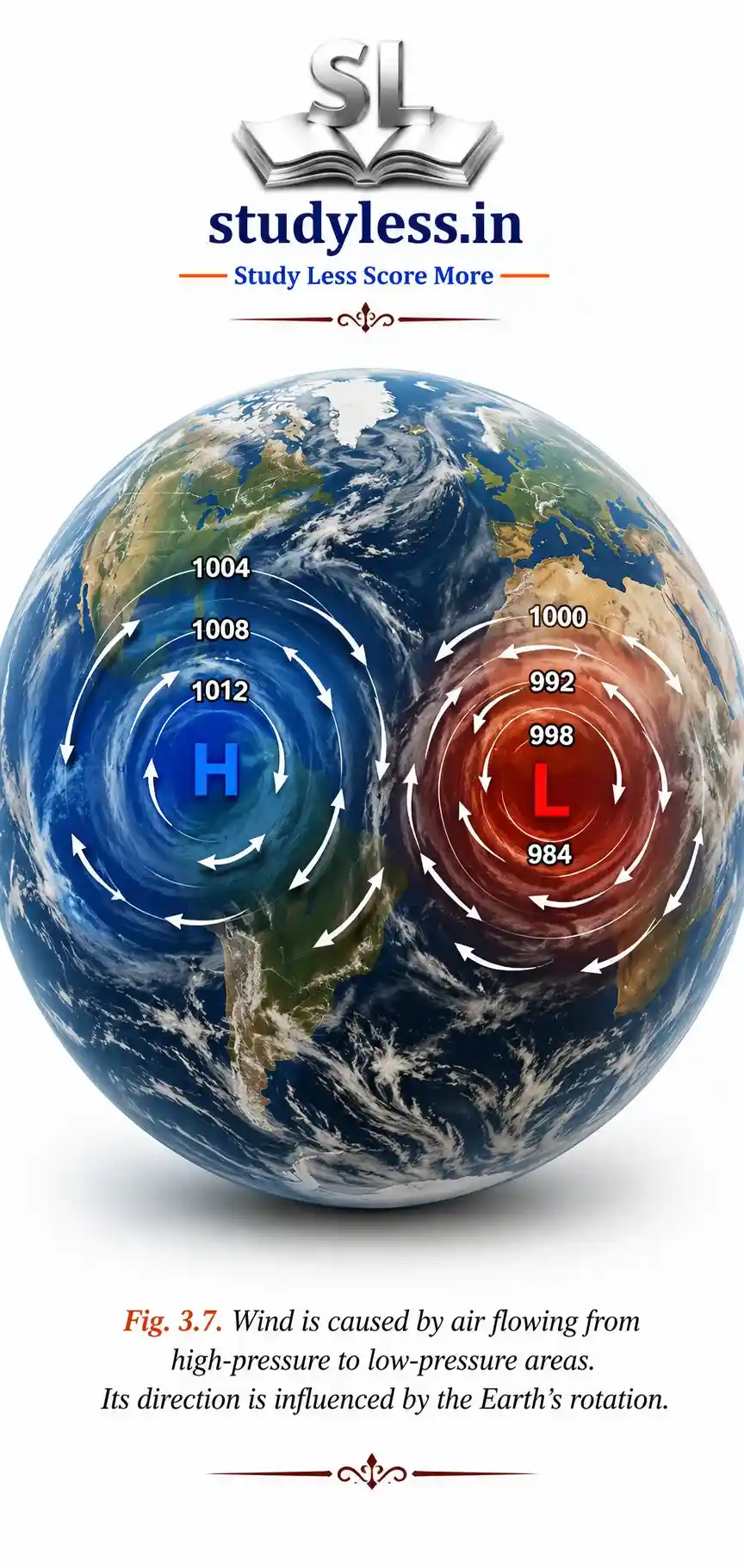
Variation with Altitude
● Air pressure is highest at sea level.
● It decreases rapidly with increasing altitude.
Effect of Temperature
● Warm air rises, creating a low-pressure area.
● Low pressure brings cloudy and wet weather.
● Cold air sinks, creating a high-pressure area.
● High pressure brings clear and sunny weather.
Movement of Air
Air always moves from high-pressure areas to low-pressure areas.
What is Wind?
Wind is the movement of air from a high-pressure area to a low-pressure area.
Calm, smoke rises vertically.
Wind felt on face.
Leaves rustle.
Vane moves.
Large branches sway.
Umbrellas difficult to use.
Very rarely experienced.
Widespread damage.
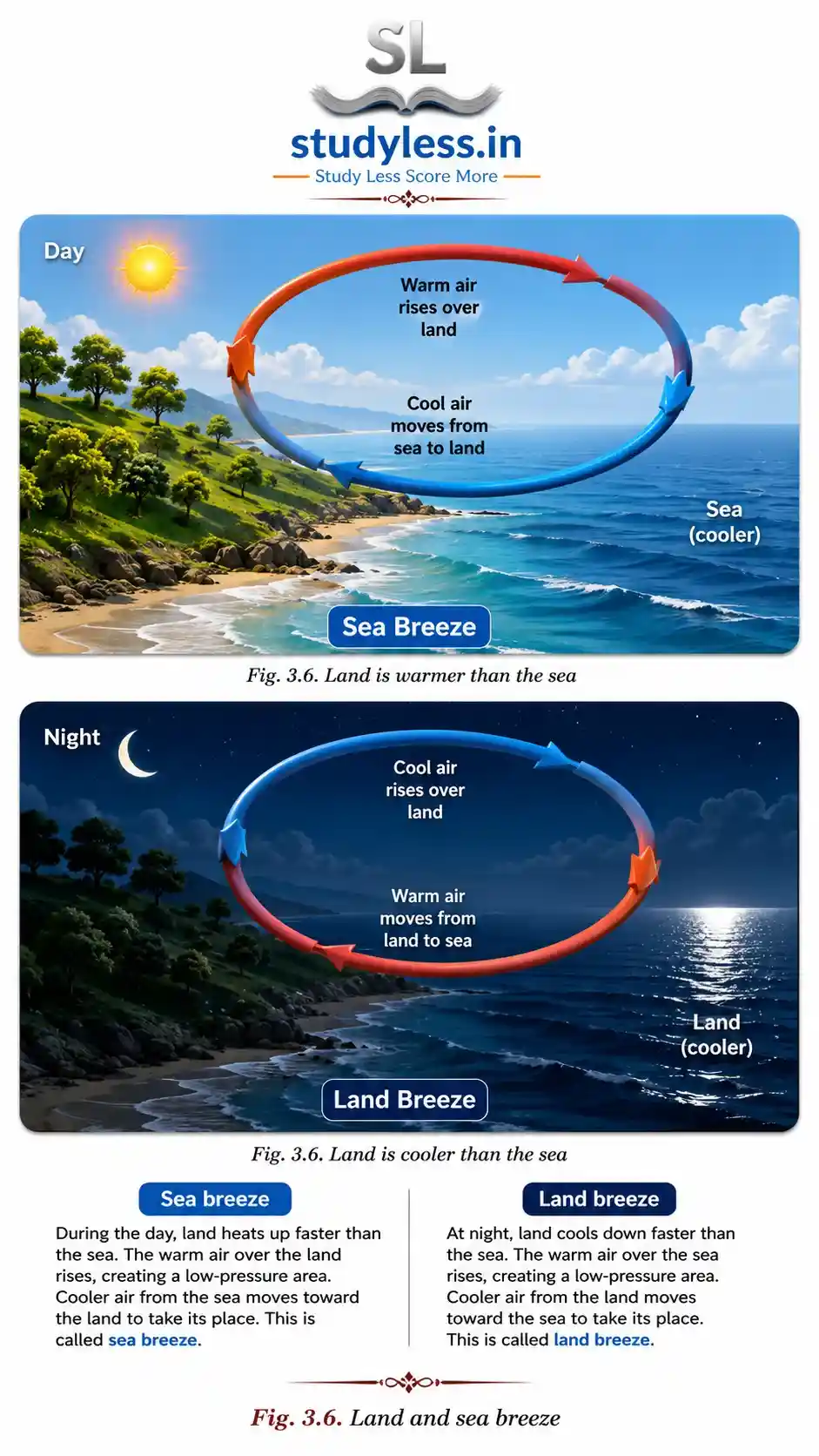
Local Winds:
● Land breeze and sea breeze are local winds.
● They affect weather and climate of coastal regions.
● They create moderate climatic conditions in coastal areas.
Seasons in India
What are the Seasons in India?
- India’s climate is broadly classified as tropical monsoon.
- Indian Meteorological Department (IMD) recognises four distinct seasons in India.
| Season | Months | Characteristics |
|---|---|---|
| Winter | December to early April | Coldest months: Dec-Jan; temp 10-15°C in north-west, 20-25°C in south-east |
| Summer/Pre-monsoon | April to June (up to July in NW India) | Hottest month: April (west/south), May (north); temp 32-40°C |
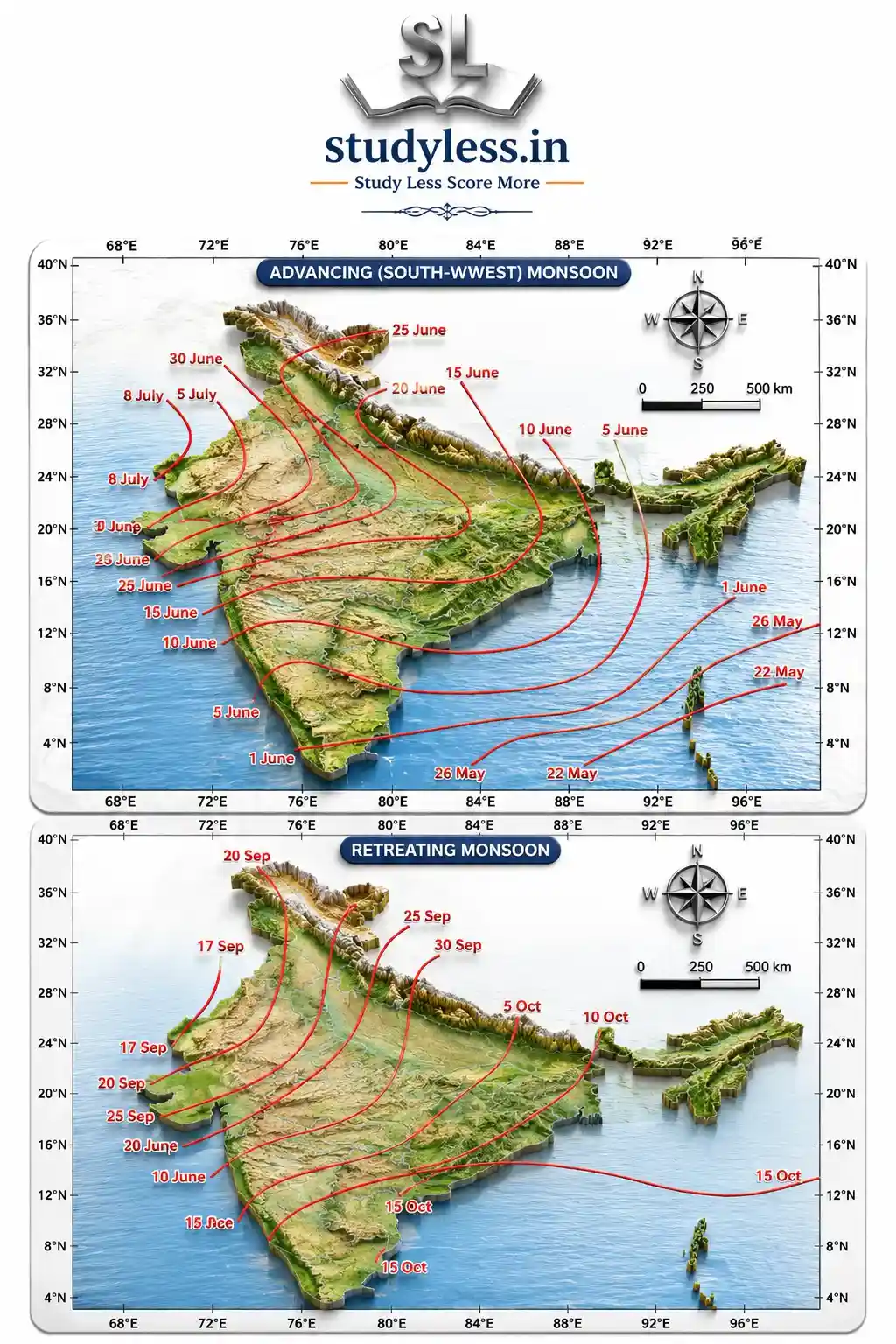
| Monsoon/Rainy (Advancing) | June to September | Dominated by south-west monsoon; rain recedes from north India by October |
| Post-monsoon (Retreating) | October to December | North-west India usually cloudless in Oct-Nov |
Himalayan states experience two extra seasons: autumn and spring (due to more temperate climate).
March – April
May – June
July – August
September – October
November – December
January – February
What Is Monsoon?
Monsoon = Wind
● Monsoon is the seasonal reversal of winds.
● It has a major influence on India’s climate.
Origin of the Name
● Ancient sailors first observed the seasonal wind reversal.
● They used these winds to navigate sailing ships.
● The Arabs named this phenomenon “Monsoon.”
● The word comes from the Arabic word mausim, meaning “season.”
What are the Types of Monsoon Winds?
- South-West Monsoon
- North-East Monsoon.
What Is the South-West Monsoon?
● The South-West Monsoon is also called the Summer Monsoon.
● Winds blow from the sea towards the land.
● It occurs from June to September.
● It covers the Indian Ocean, Arabian Sea, and Bay of Bengal.
How It Forms
● During summer, the Indian landmass heats up faster than the ocean.
● This creates a low-pressure area over India.
● The Indian Ocean remains cooler, forming a high-pressure area.
● Winds move from high pressure (sea) to low pressure (land).
● These moisture-laden winds bring rainfall over India.
Importance
The South-West Monsoon provides most of India’s annual rainfall.
What Is the North-East Monsoon?
● The North-East Monsoon is also called the Winter Monsoon.
● It occurs from October to February.
● Winds blow from the land towards the sea.
How It Forms
● During winter, the Indian landmass cools faster than the ocean.
● This creates a high-pressure area over the land.
● A low-pressure area develops over the sea.
● As a result, cold and dry winds blow from land to sea.
Rainfall Pattern
● These winds bring little or no rainfall to most parts of India.
● After crossing the Bay of Bengal, they pick up moisture.
This causes rainfall along the eastern coast, especially in:
- Tamil Nadu
- Andhra Pradesh
- Parts of Karnataka
So, the winter monsoon is important for south-eastern India’s rainfall.
| Monsoon Type | Direction | Months | Rainfall Areas |
|---|---|---|---|
| South-West (Summer) | Sea to land | June-September | Most of India |
| North-East (Winter) | Land to sea | October-February | Tamil Nadu, Andhra Pradesh, parts of Karnataka |
Why Is the Monsoon Important for India?
Importance in Agriculture
● Most of India’s agriculture depends on monsoon rainfall.
● Farmers rely on it for sowing and growing crops.
● A good monsoon ensures adequate food production.
Importance in Daily Life
● Replenishes rivers, reservoirs, and wells.
● Influences daily life, transport, festivals, and employment.
● Replenishes rivers, reservoirs, and wells.
● Influences daily life, transport, festivals, and employment.
● It is especially important in rural areas.
Effects of an Uneven Monsoon
● Excessive rainfall can cause floods.
● A weak monsoon can lead to droughts.
Overall Significance
The monsoon has a major impact on India’s economy, lifestyle, and livelihoods.
Climate Change
What is Climate Change?
Climate change refers to long-term changes in weather patterns.
● Changes occur in temperature, rainfall, and wind.
● Caused mainly by human activities.
What Causes Climate Change?
● Burning of fossil fuels.
● Deforestation.
● Industrial pollution releasing gases like carbon dioxide.
● These activities increase greenhouse gases: carbon dioxide, methane, nitrous oxide, water vapour.
● Greenhouse gases trap heat and raise global temperatures.
What are the Effects of Climate Change?
● More frequent
floods and droughts.
● Melting of glaciers.
● Rising sea levels.
● Loss of biodiversity.
● Threatens ecosystems.
● Impacts human health,
agriculture, and livelihoods.
● Affects almost all sections of population,
including women and children.
How Can We Reduce Climate Change?
● Reducing carbon footprints.
● Using renewable energy.
● Protecting forests.
● Adopting sustainable lifestyles.
● Tackling climate change needs collective efforts.
● Every human being plays a vital role in a greener future.
Punjab Floods 2025: A Case Study
Case Study: Punjab Floods (2025)
What Happened?
- Punjab experienced severe floods in 2025.
- The floods were caused by heavy monsoon rainfall.
- The Satluj, Beas, and Ravi rivers overflowed.
Impact
- Floods damaged:
- Villages
- Agricultural fields
- Houses
- Roads and bridges
- Caused economic losses, social disruption, and environmental damage.
Relief and Lessons
- Relief operations began as floodwaters receded.
- The disaster highlighted the need for better flood management and preparedness.
What were the Causes of the Punjab Floods?
Natural Causes:
- Heavy monsoon rains in 2025.
- Intensified by western disturbances bringing extra moisture.
- Rain also occurred in Himachal Pradesh and Jammu & Kashmir.
- Rivers Satluj, Beas, Ravi, Ghaggar were already flowing high.
- Extra rain + hill water + local rainfall → rivers overflowed.
Human-made Causes:
- Weak and old river embankments (dhūsī bāndh) failed to stop water.
- Houses and farms built too close to rivers.
- This reduced natural space for floodwater to spread.
- Silt and mud had collected in rivers and dams over time.
- This reduced their capacity to hold and carry water.
- Flood warnings came late or were unclear in some areas.
- People were left unprepared.
| Natural Causes | Human-made Causes |
|---|---|
| Heavy monsoon rains | Weak, old embankments (dhūsī bāndh) |
| Western disturbances | Houses/farms built too close to rivers |
| Rivers already flowing high | Silt/mud reduced river-dam capacity |
| Rain in HP & J&K too | Late/unclear flood warnings |
What were the Effects of the Punjab Floods?
- Many people lost their lives.
- Thousands moved to relief camps.
- Farmland flooded; paddy crops severely damaged.
- Poultry and dairy farms destroyed; animals got sick or died.
- Roads, bridges, border fences, public buildings damaged.
- Standing water caused waterborne diseases and sanitation problems.

![Latest Class 9 NCERT Textbooks [PDF]](https://studyless.in/wp-content/uploads/2026/04/Latest-Class-9-NCERT-Textbooks-PDF-1200x675.webp)
Notes are so much lengthy
Thanks for the feedback! The chapter itself is 22 page long with so many condensed concept. And If we make it too short, which is possible, then it will be difficult for you to make sense of it. First read the topic from the textbook and then read the same topic from the notes, you will find it helpful. Keep revising it again and again and you will master the chapter.
For any customize help please contact through the WhatsApp(number at the bottom of the post ) or through mail – info@studyless.in