
Updated
Chapter 6 Democracy is a 24 page concept dense chapter. Reading it from the textbook to note the important points is long and toiling task.
Hence, We have created “Chapter 6 Democracy Notes Class 9“ to help you out.
“Chapter 6| Democracy Notes Class 9“ in packed with:
- Exam Booster section
- Flow charts section
- Terms Meaning section
- Smart Connections
- Do Not Confuse
These will help you to retain the concepts and important points. Also we have broke the large topics into heads and subheads for easy comprehension. Many times a head or subhead is directly asked as question.
Click on the table of contents to go directly to the desired topic.
Introduction Chapter
Why is India Called the World’s Largest Democracy?
Because the most people choose their government here.
Why is the Constitution Important for Democracy?
It protects people’s rights + makes democracy work fairly.
Constitution of India
↓
Adopted: 26 November 1949
↓
Enforced: 26 January 1950
↓
Guarantees Fundamental Rights
↓
No discrimination (religion, race, caste, sex, place of birth)
↓
Encourages participation (national, state, local elections)
Tracing Democratic Traditions from Early Times
Roots of Democracy in India
Early Democratic Traditions
- Democracy part of Indian ethos since ancient times.
- Sabha, Samiti, Vidhata encouraged collective decisions.
- Early republics called ganas and sanghas.
- Kings consulted assemblies, ministers, and officers.
- Rig Veda (Aikyamatya Sūktam) promotes:
- Collective thinking
- Discussion
- Unity
- Shows roots of consultation, consensus, and shared responsibility.
Democratic Values
Bauddha Sanghas
- Members elected leaders.
- Decisions through voting.
Foreign Rule and Revival
- Foreign invasions weakened India’s political system.
- India came under British rule.
- People’s role in governance became limited.
- Freedom struggle revived and strengthened democratic ideals.
How Was the Constitution of India Drafted?
Making of the Indian Constitution
Constituent Assembly
- Constituent Assembly formed in 1946.
- Drafted the world’s longest written Constitution.
- Took 2 years, 11 months, 18 days.
Foundations
- Based on Indian democratic traditions.
- Also drew from global democratic values.
- Reflected in the Constituent Assembly Debates (CAD).
- Created a robust, flexible, transformative, and responsive Constitution.
- Reflected in the Constituent Assembly Debates (CAD).
Why Does the Constitution Allow Amendments?
The Constitution can change over time
through Article 368, so it stays useful and fair.
Why Is the Constitution Flexible?
Dynamic Constitution
- Constitution not meant to be rigid.
- Designed to evolve through amendments.
- Core values remain unchanged.
Democratic Values
- Upholds:
- Liberty
- Equality
- Justice
- Fraternity
Constitutional Amendments
- Article 368 provides for amendments.
- Keeps the Constitution flexible and responsive to changing needs.
Exam Booster
- Article 368 ➽ allows amendment of the Constitution.
- 4 core values: liberty, equality, justice, fraternity.
CAD Members’ Belief
↓
Constitution ≠ Rigid legal code
↓
Constitution = Dynamic, evolving document
↓
Upholds liberty, equality, justice, fraternity
↓
Provides for amendments (Article 368)
↓
Remains flexible and responsive to change
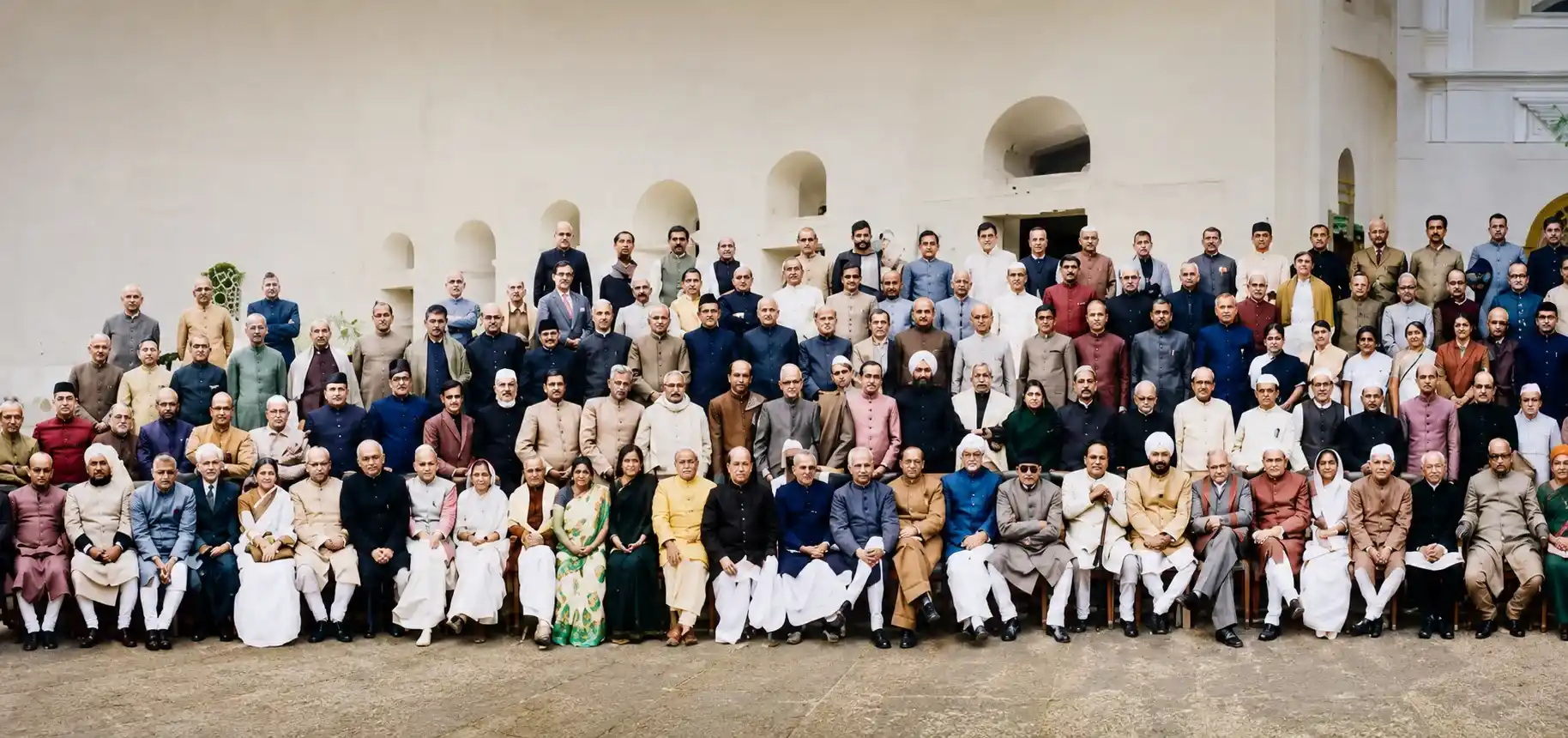
Principles of Democracy
A democracy survives only when
it follows certain non-negotiable principles.
Democracy
↓
Rests on essential principles
↓
Upheld by the Constitution of India
↓
(Popular Sovereignty, Rule of Law, Fundamental Rights,
Separation of Powers, Accountability, etc.)
1. Popular Sovereignty
What is Popular Sovereignty?
Popular sovereignty means the state derives its authority from the people ➽ the ultimate source of power lies with the people
People’s Power
- People = ultimate source of power.
- Popular sovereignty means state authority comes from the people.
Democratic Government
- Elected through free and fair elections.
- Makes policies and implements laws.
Universal Adult Franchise
- Citizens elect governments and representatives.
- 18 years or above has right to vote.
- This right is called Universal Adult Franchise
- Voting by secret ballot..
People
↓
Ultimate source of power
↓
Free and fair elections
↓
Government elected
↓
Government formulates policies and implements laws
2. Rule of Law
What is the Rule of Law?
Rule of Law means everyone, is subject to the law ➽ no one is above the law.
Basic Principle
- Rule of Law is foundation of democracy.
- Ensures equality before the law.
- Provides equal protection of the law.
- No one is above the law.
Justice Through Law
- Disputes settled in courts of law.
- Follow legal procedures.
- Not by force or personal influence.
Importance of rule of law
- Prevents misuse of power.
- Protects citizens’ rights.
- No punishment without due process.
- Ensures a fair chance to defend rights.
- Promotes justice, accountability, and trust.
Definitions:
● Rule of Law ➽ the law applies equally to everyone; no one is above it.
● Equality before Law ➽ every person is treated the same under the law.
● Equal Protection of Law ➽ the law protects everyone equally, without discrimination.
● Due Process ➽ a fair, established legal procedure that must be followed.
Do Not Confuse
| Equality Before Law | Equal Protection of Law |
|---|---|
| No one is above the law; all treated alike | Law protects everyone equally, no discrimination |
| Focuses on treatment under law | Focuses on protection by law |
Rule of Law
↓
Equality before Law
+
Equal Protection of Law
↓
No one is above the law
↓
Disputes resolved by courts
↓
No punishment without due process
↓
Fair chance to defend rights
↯
Justice + Accountability + Trust
3. Fundamental Rights
Fundamental Rights are rights enshrined in the Constitution
that protect citizens’ rights, freedom, and dignity,
and are enforceable in courts of law.
Why are Fundamental Rights Essential?
Fundamental Rights protect every citizen’s freedom and dignity, and courts can enforce them.
Purpose of fundamental rights
- Protect rights, freedom, and dignity of citizens.
- India has six Fundamental Rights.
Legal Protection
- Rights are enforceable in courts.
- Violations can lead to legal action.
- Remedies available under Articles 32 and 226.
Features
- Indivisible and inalienable.
- Subject to reasonable restrictions under law.
Fundamental Rights (Indian Constitution)
↓
6 Rights
├── Right to Equality (Art. 14–18)
├── Right to Freedom (Art. 19–22)
├── Right Against Exploitation (Art. 23–24)
├── Right to Freedom of Religion (Art. 25–28)
├── Cultural and Educational Rights (Art. 29–30)
└── Right to Constitutional Remedies (Art. 32)
Terms Meaning:
Constitutional Remedies ➽ legal ways to enforce Fundamental Rights when violated.
Indivisible ➽ rights cannot be separated or split from one another.
Inalienable ➽ rights cannot be taken away or given up.
Exam Booster
- Article 32
- Right to Constitutional Remedies (also called the “heart and soul” of the Constitution
- ➽ Used for enforcing rights.
- Right to Constitutional Remedies (also called the “heart and soul” of the Constitution
- Article 226 ➽ power of High Courts to issue remedies.
- Rights are enforceable in courts, indivisible, and inalienable.
Smart connection
Fundamental Rights
↓
Article 32 (Supreme Court) + Article 226 (High Courts)
↓
Judiciary enforces Rights
↯
Rule of Law
4. Separation of Powers
Power is split into three organs
so no single organ becomes too powerful.
What is Separation of Powers?
Separation of Powers means dividing government functions among the legislature, executive, and judiciary, each with distinct responsibilities.
Separation of Powers
- Power divided among:
- Legislature ➽ makes laws.
- Executive ➽ implements laws.
- Judiciary ➽ interprets laws
- These are the organs of govt.
Purpose of Separation of Powers
- Prevents concentration of power.
- Checks and balances.
Checks and Balances
- Parliament can amend the Constitution.
- Judiciary can review amendments.
- Executive works under laws made by Parliament.
- Courts can review executive actions.
- Judiciary can strike down unconstitutional laws.
How separation of power works
Legislature
↓ Makes Laws
Executive
↓ Implements Laws
Judiciary
↓ Interprets Laws
↯
Checks and Balance
Important
Checks and balances prevent misuse of power.
Judiciary can review constitutional amendments made by Parliament.
Smart Connections
Separation of Powers
↓
Checks and Balances
↓
Judicial Review
↓
Rule of Law
Why is the Judiciary Important in a Democracy?
The judiciary protects :
the Constitution
citizens’ rights
and access to justice for all.
Role of the Judiciary
Constitutional Role
- Upholds the Constitution.
- Protects democratic values and citizens’ rights.
- Ensures laws follow the Constitution.
Independence
- Judiciary is independent and impartial.
- Safeguards the spirit of the Constitution.
Access to Justice
- Introduced Public Interest Litigation (PIL).
- PIL helps ensure justice for all.
Judiciary
↓
Upholds the Constitution
↓
Protects democratic values and rights of all sections
↓
Checks laws of Parliament & State Assemblies against Constitution
↓
Impartial and Independent
↓
Safeguards citizens’ rights
↓
Initiatives like PIL → Access to Justice for All
Terms Meaning:
Public Interest Litigation (PIL) ➽ a legal case filed in court for the benefit of the public, not just an individual.
Impartial Judiciary ➽ a judiciary that treats all parties fairly, without bias.
Do Not Confuse
| RTI | PIL |
|---|---|
| Right to Information ➽ citizen asks government for information | Public Interest Litigation ➽ case filed in court for public benefit |
| Tool of transparency | Tool of justice |
5. Accountability and Transparency
Accountability means the government must answer to citizens
for its actions and decisions.
Why is Accountability Necessary?
Democratic governments must answer to the people, and transparency builds trust.
Democratic Government
↓
Accountable to Citizens
↓
Through: Elections + Public Debates + Civil Society Engagement
↓
Citizens evaluate government actions
↓
Continuous Public Involvement
↓
Strengthens Democracy + Builds Trust
↓
Institutional/Policy Frameworks (e.g. RTI Act, 2005)
Democratic Accountability
Citizen Participation
- Government accountable to citizens.
- Citizens evaluate it through:
- Elections
- Public debates
- Civil society participation
- Continuous participation strengthens democracy.
Transparency
- RTI Act, 2005 lets citizens seek government information.
- Builds trust between government and people.
- India has laws ensuring accountability and transparency.
Terms Meaning:
Accountability ➽ government must explain and justify its actions to citizens.
Civil Society ➽ organisations and groups (outside government) that represent citizens’ interests.
Right to Information (RTI) ➽ citizens’ right to request information from government bodies.
Smart connections:
Accountability
↓
Elections + Civil Society + Public Debate
↓
RTI Act 2005
↓
Transparency
↓
Trust in Democracy
6. Multi-Party System
Many parties compete so people get real choices
representing different views.
What is multi-party system
A multi-party system is one where several political parties contest elections, representing diverse voices and interests.
Multi-Party System
Political Parties
- Represent different voices and interests.
- Give people a choice of government.
- Each party follows its own ideas, values, and principles.
Government Formation
- Party or coalition with more than 50% seats forms the government.
- Other parties become the opposition.
Importance of political parties
- Represent social, cultural, political, ideological, and regional interests.
- Reflect India’s diversity.
- Function under the Representation of the People Act, 1951.
Multi-Party System
↓
Several parties contest elections
↓
Represent diverse voices and interests
↓
People choose most suitable party
↓
Party/Coalition with >50% seats → Forms Government
↓
Party/Coalition with fewer seats → Opposition
↓
Governed by Representation of the People Act, 1951
Terms Meaning:
Multi-Party System ➽ many parties compete in elections.
Coalition ➽ group of parties joining together to form government.
Opposition ➽ party/parties with fewer seats, opposing the ruling government
7. Safeguarding the Rights of Vulnerable Groups
The government must protect weaker sections
and ensure resources are shared fairly.
Terms Meaning:
Vulnerable Groups ➽ sections of society disadvantaged due to historical or social factors.
Scheduled Castes (SC) / Scheduled Tribes (ST) ➽ communities given special constitutional protection due to historical discrimination.
Article 46 ➽ directs the State to protect the educational and economic interests of weaker sections, SCs, and STs.
Civil Society ➽ Refers to the voluntary groups, NGOs and community associations that function interdependently within society.
How are Vulnerable Groups Protected?
1. Social Justice and Equality
Government’s Responsibility
- Protect all communities.
- No discrimination based on caste, gender, religion, or region.
- Ensure fair distribution of opportunities and resources.
- Give special support to vulnerable sections.
2. Constitutional Provision
- Article 46 directs the State to promote the educational and economic interests of weaker sections.
- Gives special protection to Scheduled Castes (SCs) and Scheduled Tribes (STs).
- Protects them from social injustice and exploitation.
Smart connections
Article 46
↓
Fundamental Rights (Equality)
↓
Protection of Vulnerable Groups
↓
Social Justice
How do Democratic Processes, Institutions, and Values Connect?
Democracy
↓
Processes
↓
Institutions (carry out the processes)
↓
Democratic Values (upheld by each process)
Terms Meaning
CAG ➽ Comptroller and Auditor General; audits government accounts.
CIC ➽ Central Information Commission; oversees RTI implementation.
Lokpal ➽ anti-corruption ombudsman institution.
CVC ➽ Central Vigilance Commission; monitors corruption in government.
Civil Society ➽ voluntary groups, NGOs, and community associations that function interdependently within society.
Devolution of Power ➽ transfer of power from central authority to state/local levels.
Table: Processes, Institutions, and Democratic Values
| Process | Institutions | Democratic Values |
|---|---|---|
| Legislative Process | Legislature (Parliament, State Legislature, Local Bodies) | Representation, Deliberation, Dissent |
| Electoral Process | Election Commission of India | Participation, Equality |
| Judicial Process | Courts | Rule of Law, Equality, Justice |
| Participatory Processes | Media, Civil Society | Debate and discussion, Freedom of expression |
| Accountability Mechanisms | CAG, CIC, Lokpal, CVC | Transparency |
| Decentralisation | Rural and Urban Local Bodies | People’s participation at grassroots level |
| Checks and Balances | Division of powers between centre and states (guaranteed by written constitution) | Devolution of power |
Key Democratic Processes
Legislative Process
- Legislature (Parliament, State Legislatures, Local Bodies).
- Values:
- Representation
- Deliberation
- Dissent
Electoral Process
- Election Commission of India.
- Values:
- Participation
- Equality
Judicial Process
- Courts.
- Values:
- Rule of Law
- Equality
- Justice
Participatory Process
- Media and Civil Society.
- Values:
- Debate & Discussion
- Freedom of Expression
Accountability
- CAG, CIC, Lokpal, CVC.
- Value:
- Transparency
Decentralisation
- Rural and Urban Local Bodies.
- Value:
- People’s participation at the grassroots.
Checks and Balances
- Division of powers between Centre and States.
- Based on the Written Constitution.
- Value:
- Devolution of power
Smart connections
Legislative + Electoral + Judicial Processes
↓
Institutions (Legislature, ECI, Courts)
↓
Accountability Mechanisms (CAG, CIC, Lokpal, CVC)
↓
Decentralisation (Local Bodies)
↓
Checks and Balances (Centre–State)
↓
Strong Democracy
What is the Role of Media in Democracy?
Media informs people and voices public concerns,
so it is called the “fourth pillar of democracy.”
Role of the Media
Importance
- Important part of daily life.
- Give information about events.
- Acts as the voice of the people.
Forms of Media
- Newspapers
- News channels
- Social media
Role in Democracy
● Called the “Fourth Pillar of Democracy.”
● Raises public issues.
● Helps resolve issues through proper mechanisms.
● Protects people’s voices.
● Upholds democratic values.
Smart connections
Media
↓
Freedom of Expression
↓
Participatory Processes
↓
Accountability and Transparency
Types of Democracy
Democracies differ based on who governs directly and
how the executive relates to the legislature.
Classification:
Types of Democracy
├── Based on Participation
│ ├── Direct Democracy (e.g. Switzerland)
│ └── Representative / Indirect Democracy (e.g. India)
│
└── Based on Executive–Legislature Relationship
├── Parliamentary Democracy (e.g. India, Canada)
└── Presidential Democracy (e.g. USA)
What is Direct Democracy?
Direct Democracy is a system where citizens directly participate in most decision-making processes.
Features:
- Citizens directly participate in most decision-making.
- Some features of representative democracy also exist.
- Difficult to follow in large countries.
- Example: Switzerland.
What is Representative (Indirect) Democracy?
Representative Democracy is a system where people elect representatives to govern on their behalf.
Features:
- People elect their representatives.
- People do not directly govern.
- Periodic elections are held.
- Government is accountable to the people.
- Example: India.
What is Parliamentary Democracy?
Parliamentary Democracy is a system where members of the Executive are also part of the Legislature.
Features:
- Members of the Executive are also part of the legislature.
- The Executive is accountable to the legislature.
- People elect the legislature, but not the executive directly.
- Example: India and Canada.
What is Presidential Democracy?
Presidential Democracy is a system where the Executive is independent of the legislature.
Features:
- The Executive is independent of the legislature.
- President is elected by the people directly.
- President is accountable to the people.
- Example: United States of America.
Direct vs Representative Democracy
| Direct Democracy | Representative Democracy |
|---|---|
| Citizens directly participate in decisions | People elect representatives to govern |
| Hard to follow in large countries | Practical for large populations |
| Example: Switzerland | Example: India |
Parliamentary vs Presidential Democracy
| Parliamentary Democracy | Presidential Democracy |
|---|---|
| Executive is part of legislature | Executive is independent of legislature |
| Executive accountable to legislature | President accountable to people |
| People elect legislature, not executive directly | People elect President directly |
| Example: India, Canada | Example: USA |
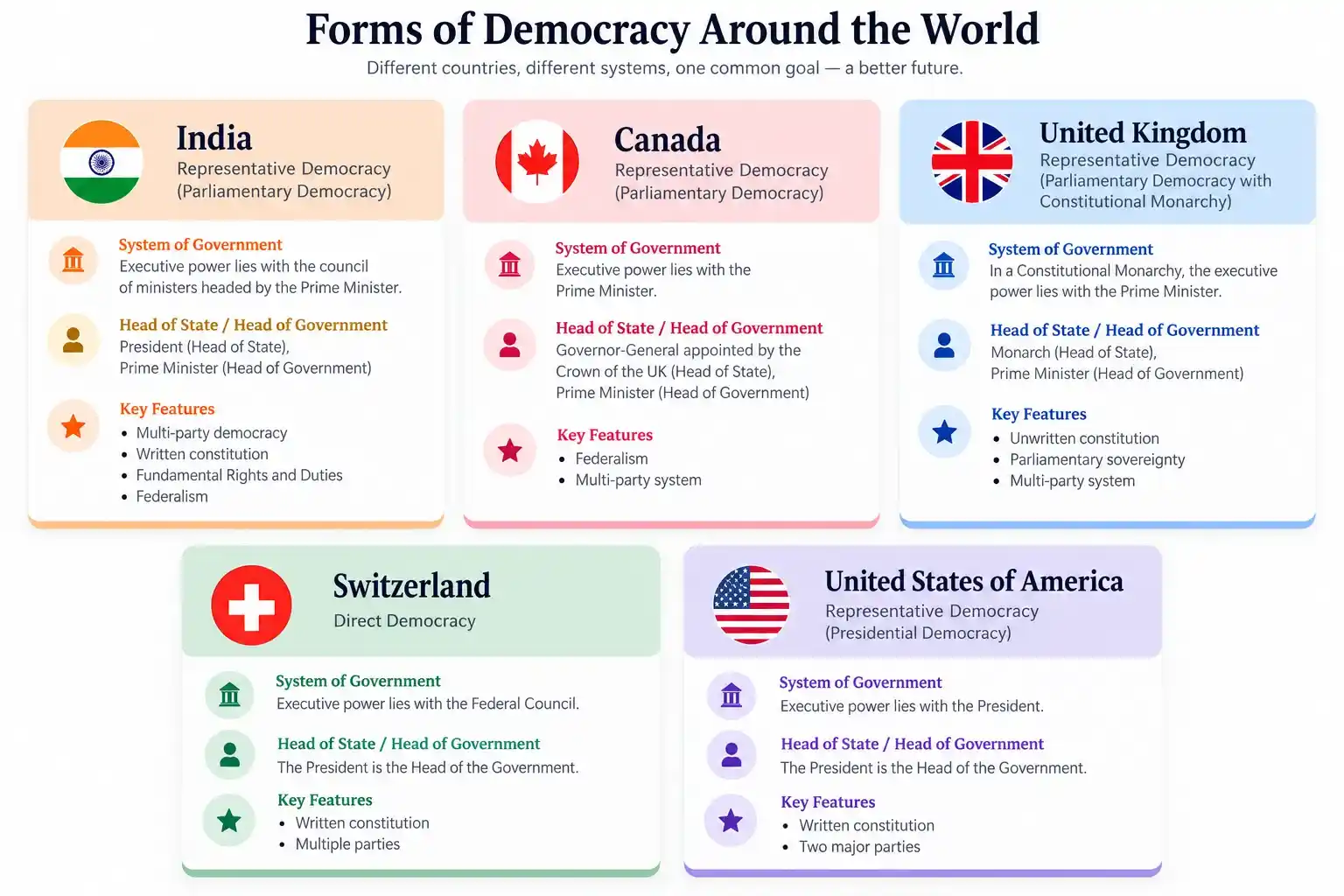
Democracy in Practice: India’s Living Democracy
Indian democracy is “living” because of its :
huge scale, deep diversity, and active citizen participation.
Why Is Indian Democracy Unique?
1. Scale and Participation
- World’s largest democracy.
- Nearly 100 crore voters.
- Massive public participation.
- Reflects India’s diversity.
2. Strength of Democracy
- Regular nationwide elections.
- Covers a large and diverse population.
- Shows strong democratic institutions.
3. Living Democracy
- People from different languages, religions, and backgrounds vote.
- Elections give every region and community a voice.
- Continuous participation keeps democracy strong and vibrant.
What is Participatory Democracy?
Participatory Democracy emphasises greater citizen involvement ➽ not just through elections, but in shaping policies and governance.
Citizen Participation
- Citizens participate beyond elections.
- Help shape policies and governance.
Ways to Participate
- Local councils
- Public consultations
- Community initiatives
How is India’s Governance Structured Across Levels?
India’s Constitution divides governance into three levels: Union, State, and Local.
Constitutional Framework of India
↓
Three-Tier System
├── Union Government
├── State Government
└── Local Government
↓
Administrative efficiency + Democratic participation
This structure ensures both efficiency and democratic participation.
How Does the Constitution Protect Tribal Heritage?
Special bodies like ADCs and laws like
PESA protect tribal self-governance and customs.
Protection of Tribal Heritage
├── Autonomous District Councils (ADCs)
│ ↓
│ North-eastern regions
│ ↓
│ Legislative + Judicial authority
│ ↓
│ Preserve tribal customs
│
└── PESA Act, 1996
↓
Applies to tribal areas in other states
↓
Empowers Gram Sabha as primary decision-making body
Special Local Governance
1. Tribal Self-Governance
- Constitution protects tribal heritage.
- Autonomous District Councils (ADCs) function in parts of the North-East.
- ADCs have legislative and judicial powers.
2. PESA Act, 1996
- Applies to Scheduled Areas in other states.
- Empowers the Gram Sabha as the main decision-making body.
Importance
- Balances Union, State, and Local authority.
- Preserves the traditions of diverse communities.
Terms Meaning:
ADC (Autonomous District Council) ➽ body in north-eastern India with legislative and judicial power to preserve tribal customs.
PESA Act, 1996 ➽ law extending Panchayat provisions to Scheduled Areas, empowering Gram Sabha.
Gram Sabha ➽ village assembly; primary decision-making body under PESA.
How Does Democracy Extend Beyond Government Institutions?
Democratic Spirit
- Democracy extends beyond government institutions.
- It is part of everyday social life.
Role of Civil Society
- Civil society, community organisations, cooperatives, and trade unions use democratic decision-making.
- Civil society acts as a bridge between citizens and the State.
Importance
- Uses PILs, campaigns, and community initiatives.
- Makes democracy more inclusive and responsive.
Terms Meaning:
Cooperatives ➽ member-owned organisations working for mutual benefit, often run democratically.
Trade Unions ➽ worker organisations that use democratic processes to represent members.
Smart connections:
Civil Society
↓
PIL + Campaigns + Community Organizations
↓
Bridge: Citizens ↔ State
↓
Inclusive and Responsive Democracy
Challenges to Democratic Practices in India
Citizen’s Responsibility
- Democracy needs active citizen participation.
- Rights must be exercised responsibly.
- Democracy goes beyond elections into daily life.
Threats to Democracy
- Damaging public property
- Spreading misinformation
- Breaking public rules
- Ignoring public issues
Ongoing Challenges
- Illiteracy
- Misinformation
- Inequality
- Fake news
- Poverty
- Regionalism
- Gender inequality
- Social discrimination
Impact
- Fake news misleads people and creates conflict.
- Weak implementation of laws and policies reduces public trust.
- Weakens Public Trust in Institutions
Terms Meaning:
Civic Responsibility ➽ a citizen’s duty to act responsibly for the good of society and democracy.
Misinformation ➽ false or misleading information spread, often unintentionally.
Regionalism ➽ excessive attachment to one’s own region, which can divide national unity.
Democracy and You
Being informed and civically active makes a
young citizen a strong pillar of democracy.
Responsible Citizenship
Stay Informed
- Be well-informed.
- Use newspapers, news programmes, and the internet responsibly.
- Authentic information helps form informed opinions.
- Helps understand how democracy works.
- Build:
- Civic responsibility
- Social awareness
- Respect for democratic values
NSS and NCC
Learning Through Service
- Community activities teach:
- Participation
- Responsibility
- Service to the nation
Terms Meaning:
NSS (National Service Scheme) ➽ programme promoting community service and civic responsibility among students.
NCC (National Cadet Corps) ➽ programme instilling discipline, civic awareness, and national service values
What is the Final Takeaway About Democracy?
Democracy is a continuous, living process ➽
strong only when citizens are informed and active.
Democracy
↓
NOT just a system of government
↓
A continuous process (institutions + active citizenship)
↓
Evolved from collective decision-making → Constitutional Republic
↓
Ensures authority with accountability
↓
India Democracy : scale + diversity + resilience
↓
Functions via: Elections + Constitutional Values + Everyday Civic Practices
↓
Challenges exist, but participation keeps it vibrant
↓
Strength of Democracy = Institutions + Laws + Informed, Responsible Citizens
**********End Of Notes**********
Your Feedback| Chapter 6 Democracy Notes Class 9
We created this short notes for the general readers, but you are special and different with your special needs.
We will be very happy if you share your feedback and what you need from us. We are always ready to serve you.
Please ask for anything that can be provided on StudyLess
and our team will try to deliver
![Class 9 New NCERT Social Science[SST] Textbook 2026-2027](https://studyless.in/wp-content/uploads/2026/06/Class-9-New-NCERT-Social-ScienceSST-Textbook-2026-2027-2.webp)
Question answer of this chapter
OK Will publish today
Notes
Quiz le lijiye please