“Ch 5 State and Society up to 1000 CE Notes“ is the outcome of our rigorus and dedicated attempt to bring for you a short notes that will help you to master the chapter in a minimum time possible.
Chapter 5 State and Society up to 1000 CE, is a 42 page long and hence you need well structured and easy to read learn and memorise notes.
Special feature of Ch 5 State and Society up to 1000 CE Notes are :
- Tables
- Remember section
- Quick revision
- Exam fact
- etc.
Understanding Early Indian State and Society
What is a Society?
Society is a system of social relationships among individuals who share a common territory, culture, and a shared sense of belonging.
Characteristics of society
- Made up of structural units like families/households.
- Includes institutions such as marriage and customs.
- Society is mainly regulated by customs and practices, not formal laws.
What is a State?
A ‘State’ refers to an organised political system based on rules and laws.
Features of a state
- Includes well-defined rights and duties of rulers and subjects.
- Has mechanisms of governance.
- Has institutions for enforcing law and order.
- Political systems developed gradually as societies grew larger and more complex.
Do Not Confuse
| Term | Meaning |
|---|---|
| Society | System of relationships, regulated by customs |
| State | Organised political system, regulated by rules and laws |
State and Administration
The Vedic Period
What are the Four Vedas?
The Four Vedas
The earliest veda, containing some of the world’s oldest-surviving poetic compositions. It consists of 1,028 hymns (sūktas), some in praise of various deities while others reflect on universal thoughts, such as creation and cessation, birth and death, and so on.
Elaborates the performative aspects of yajnās and the hymns referred to in the Ṛig Veda. It includes explanations in prose.
Comprises hymns drawn from the Ṛig Veda, carefully arranged for musical recitation. Its chanting tradition forms an important foundation for the system of the seven svaras (notes) that lie at the heart of Indian music.
Contains a wide range of hymns—some intended to ward off evil, and others related to the treatment of physical and mental ailments.
Each text of the Veda has the following four parts:
saṃhitā, brāhmaṇa, āraṇyaka, and upaniṣhad.
Saṃhitās primarily contain hymns used for invoking the deity and for offering oblations in the yajña.
The Āraṇyakas (araṇya = forest) expand on philosophical speculations of sages living in forests.
The Brāhmaṇa, composed in prose, offer explanations for ritual performances.
The Upaniṣhads delve into issues like the Self (Ātman) and the Ultimate Universal Being (Brāhman).
Note that while Brāhman is a concept, Brāhmaṇas are texts and Brāhmaṇas/Brahmins is a varṇa category.
| Veda | Key Facts |
|---|---|
| Rig Veda | Earliest Veda; 1,028 hymns (sūktas); some praise deities, others reflect on creation, cessation, birth, death |
| Yajur Veda | Explains performative aspects of yajñās; includes hymns from Rig Veda; has prose explanations |
| Sāma Veda | Hymns from Rig Veda arranged for musical recitation; basis of the seven swaras of Indian music |
| Atharva Veda | Hymns to ward off evil; hymns on treatment of physical and mental ailments |
What are the Four Parts of Each Veda?
Every Vedic text has: Samhitā, Brāhmaṇa, Āraṇyaka, Upaniṣhad.
| Part | Content |
|---|---|
| Samhitā | Hymns for invoking deity, offering oblations in yajña |
| Brāhmaṇa | Composed in prose; explains ritual performances |
| Āraṇyaka (aranya = forest) | Philosophical speculations of sages living in forests |
| Upaniṣhad | Deals with Self (Ātman) and Ultimate Universal Being (Brāhman) |
Remember
- Brāhman = a concept.
- Brāhmaṇas = texts.
- Brāhmaṇas/Brahmins = a varna category.
Exam Facts
- The earliest Rig Veda was composed in the Sapta-Sindhu region.
- Sapta-Sindhu included the Indus River, its five tributaries, and the Sarasvatī River.
- Vedic texts provide information about:
- Social life
- Political system
- Economy
- Religious practices
Political Institutions in the Vedic Period
What Was a Jana?
Jana
- A jana was a clan in Early Vedic society.
- It was a group of people connected by kinship (family) ties.
Exam Facts
- The Rig Veda mentions about 30 janas (clans).
- The five major janas were called Pañchajana (Five Peoples):
- Yadu
- Turvaśa
- Puru
- Anu
- Druhyu
Who Was the Rājā?
Rājā
- The Rājā was the chief of a jana (clan).
- He led the clan in wars.
- He protected its members.
What Were the Three Assemblies?
Assemblies
The Rig Veda and Atharva Veda mention three assemblies:
- Sabhā
- Samiti
- Vidhata
| Assembly | Role |
|---|---|
| Sabhā | Smaller body; mainly judicial function; composed of select elites |
| Samiti | Larger assembly; focused on policy decisions and political affairs; represented broader population |
| Vidhata | Popular gathering of community (janas); forum for warfare and political discussions |
Early Kingdoms and Republics
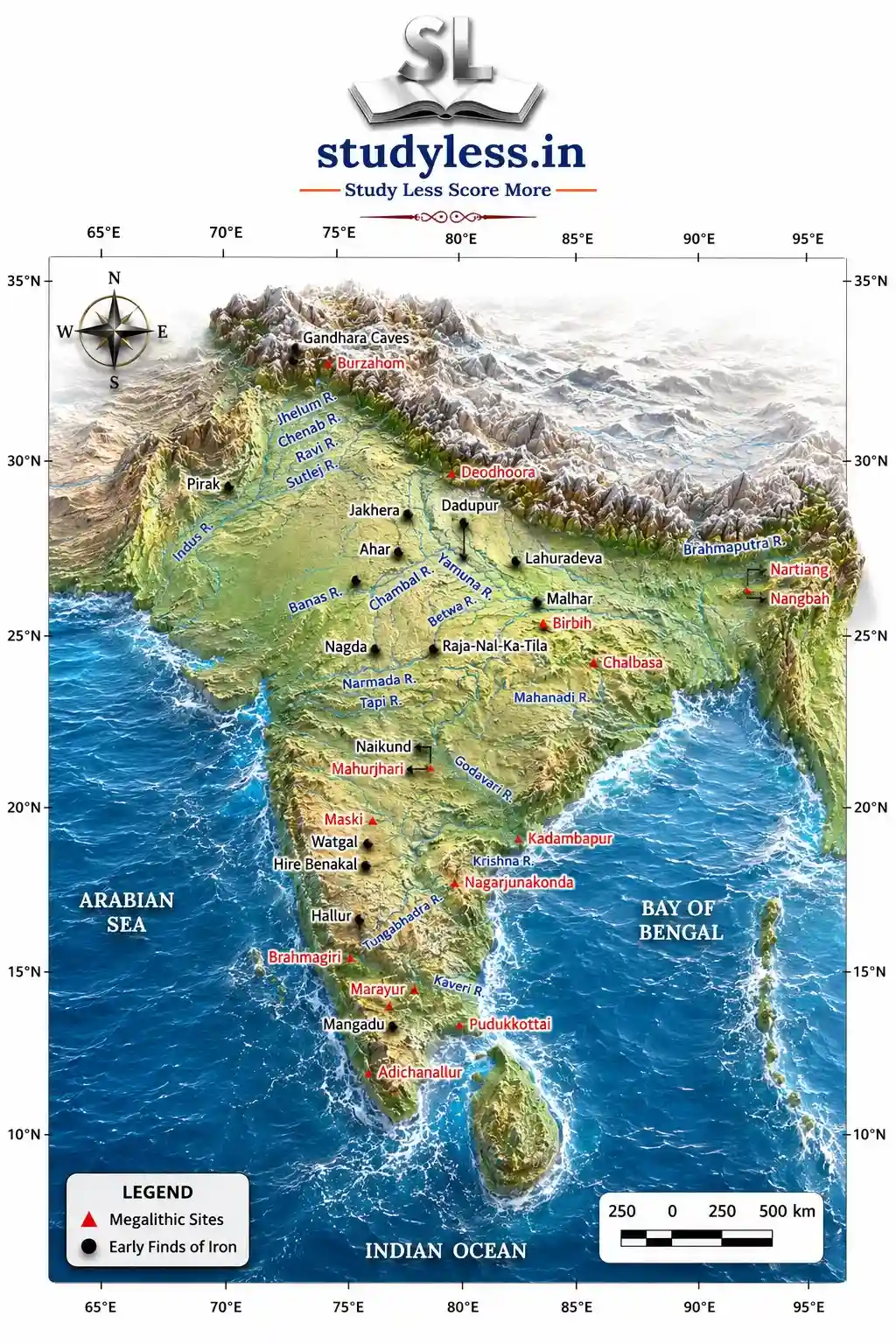
What Is a Janapada?
Janapada
- Janapada means “where a jana first set its feet.”
- It marked the shift from a kinship-based society to a territorial identity.
- happened between 1000 BCE and 600 BCE.
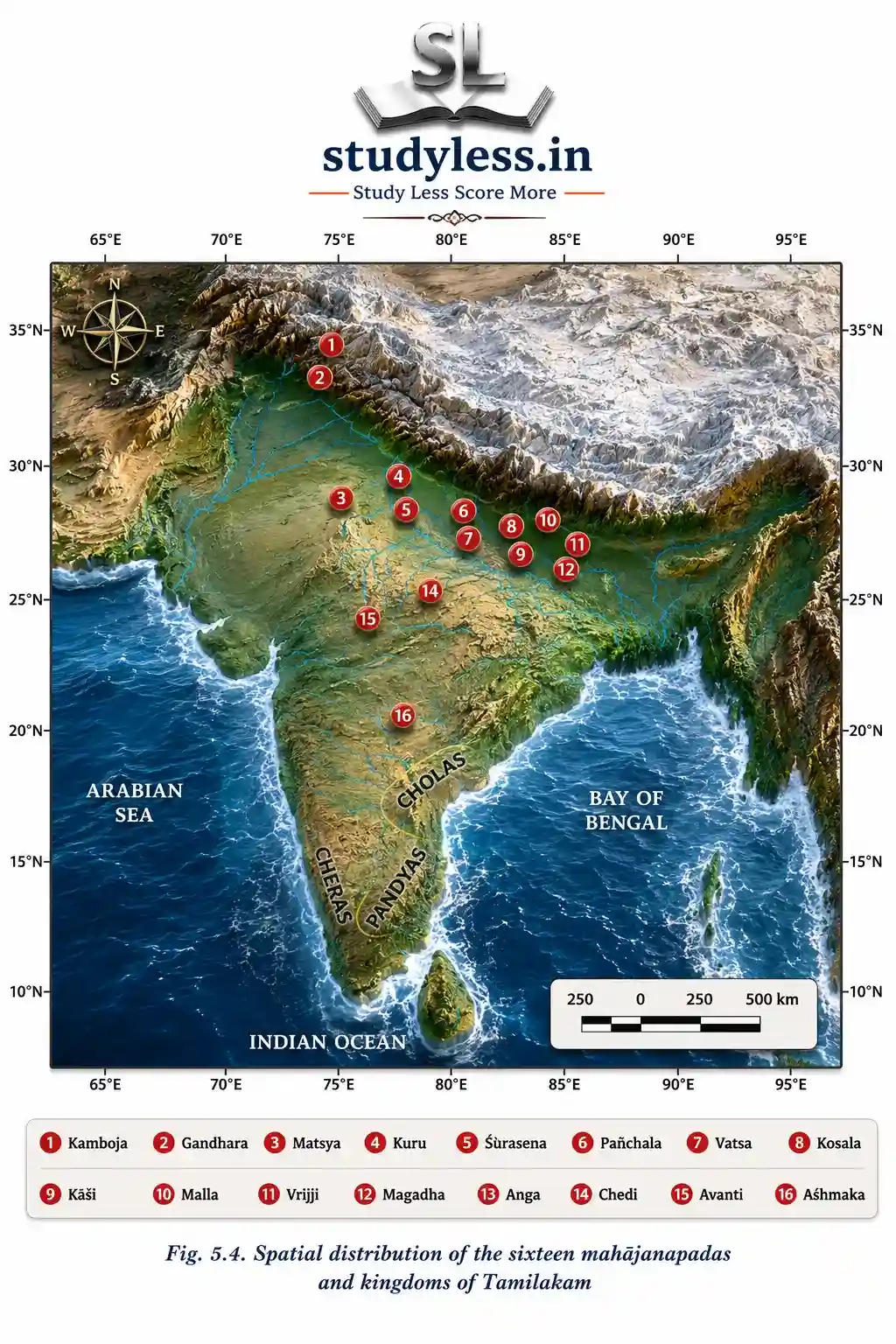
What are Mahājanapadas?
Bigger political units than janapadas, arising approximately from 600 BCE to 300 CE.
Important Points
- Ancient sources mention 16 Mahājanapadas.
- Magadha (present-day Bihar) became the most powerful.
- Reasons for Magadha’s success:
- Strategic location
- Fertile plains
- Strong rulers
- Magadha’s expansion led to the rise of the Mauryan Empire.
What Happened in the Ganga Plains?
Shift of Vedic Culture
- Early Vedic culture flourished in the Indus and Sarasvati valleys.
- During the Later Vedic Period, the Ganga Plains became the main centre.
By 600 BCE
- Agriculture expanded.
- Larger kingdoms emerged.
- Social institutions became more complex.
What Types of Political Organisation Existed?
| Type | Term Used |
|---|---|
| Monarchical states | Rājyas |
| Republican states | Gaṇas or Saṅghas |
Which Polities Existed in the South?
| Region | Ruling Polity |
|---|---|
| Deccan | Sātavāhana Empire (succeeded Mauryan Empire) |
| Lower Kaveri River valley | Cholas |
| Tamraparni & Vaigai river valleys | Pandyas |
| Kerala | Keralaputras (identified with Cheras) |
| Northern Tamil Nadu | Satiyaputras |
Exam Facts
- Sātavāhana Empire lasted nearly 500 years — 2nd century BCE to 3rd century CE.
- These southern polities are mentioned in Aśhokan inscriptions.
Timeline
| Period | Development |
|---|---|
| 1000 BCE – 600 BCE | Shift from janapadas (kinship) to territorial identity |
| 600 BCE | Ganga plains: growth of agriculture, larger political units |
| 600 BCE onwards | Rulers titled rājā, mahārāja, samrāṭ across regions |
| 600 BCE – 300 CE | Rise of the mahājanapadas; Magadha becomes most powerful |
| 2nd century BCE – 3rd century CE | Sātavāhana Empire rules the Deccan (~500 years) |
| 11th century CE | Chola ruler Rajendra I adopts title Gangaikonda |
Ruler → Achievement Table
| Ruler | Achievement |
|---|---|
| Aśhoka (Mauryan ruler) | In an edict, states his “energetic exertions” (paḷakama) led to “significant changes in the spiritual life in Jambudvīpa” |
| Nedunjeral Adan (Chera king, Sangam period) | Won the rank of adhirāja; extended conquests up to the Himalayas |
| Rajendra I (Chola ruler, 11th century CE) | Adopted title Gangaikonda to commemorate conquest of regions along the Ganga |
Duties and Ideals of the King
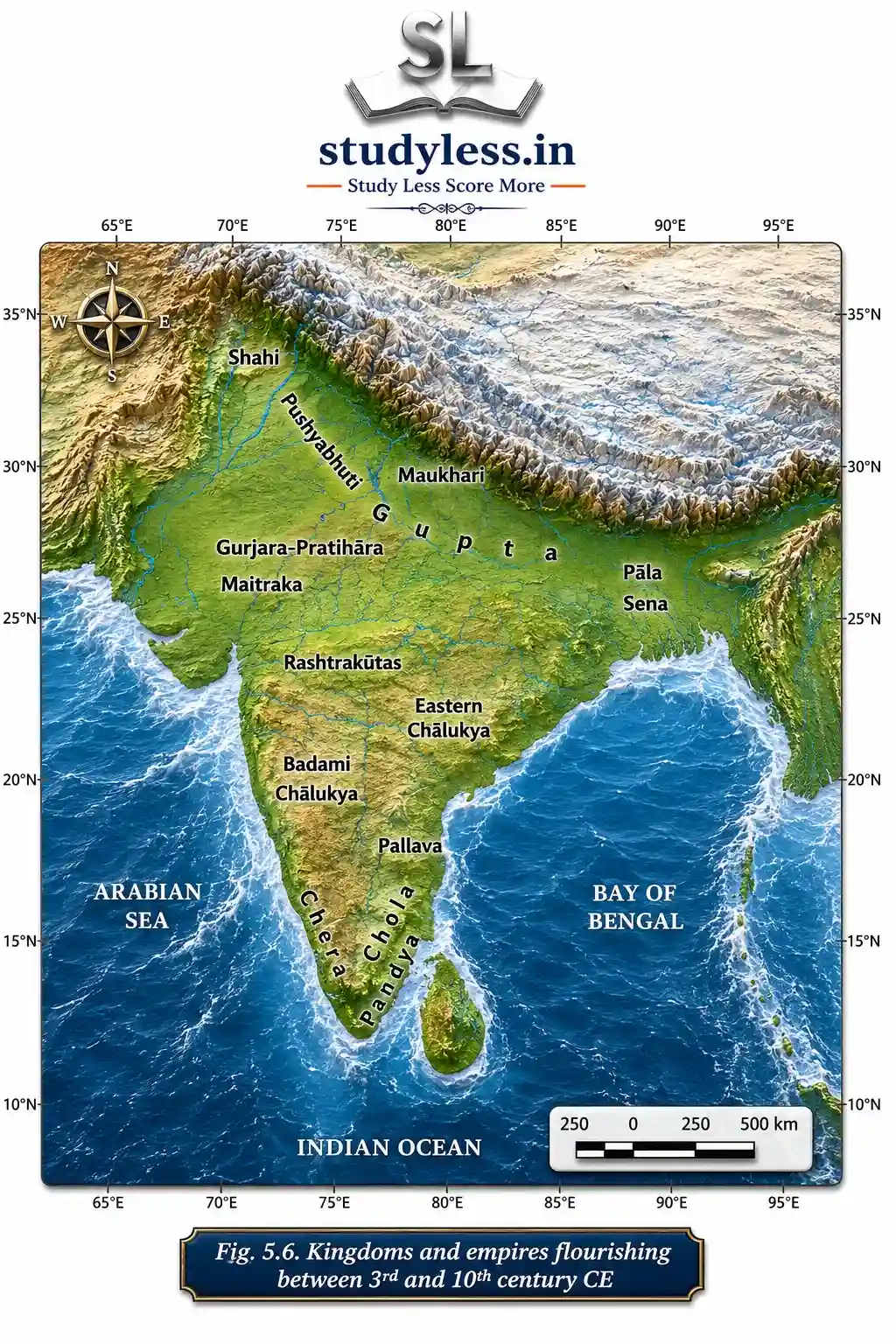
What Titles Did Rulers Use?
- From the 6th century BCE, rulers used titles such as:
- Rājā
- Mahārāja
- Samrāṭ
- Titles varied across different regions.
What Does the Arthaśāstra Say?
- Kauṭilya states:“Only if a king is himself energetically active, do his officers follow him energetically.”
What Does the Yajur Veda Say?
At the coronation oath, the king was expected to:
- Judge the strong and weak impartially.
- Protect the country from calamities.
- Work for the welfare of the people.
What Does the Śānti Parva Say?
The Śānti Parva of the Mahābhārata guides rulers on:
- Ethical conduct
- Justice
- Duties towards subjects
What Were the King’s Duties?
- Protect the kingdom from external threats and internal disorder.
- Deliver justice in cases of:
- Abduction
- Robbery
- Theft
- Adultery
What Punishments Existed?
Serious Offences
- Killing a cow
- Treachery
- Drinking intoxicating liquor
Punishment
- Punishments were severe, including capital punishment.
Was Kingship Always Hereditary?
- Kingship was generally hereditary.
- Some kings were elected or expelled.
- This shows royal authority was not always absolute.
What Was the Pan-Indian Geopolitical Awareness?
Early Indian monarchs’ awareness extended to the whole Indian subcontinent, expressed through terms:
| Term | Meaning/Use |
|---|---|
| Jambudvīpa | Used by Aśhoka in edicts |
| Bhāratavarṣha | Pan-Indian identity term |
| Aśhvamedha and Rājasūya yajña | Sacrifices asserting sovereignty |
| Prithivī (paṭhvi in Prakrit) | Defined in Arthaśāstra as “area lying between the Himavat (Himalayas) and the sea” |
| Chakravarti kshetra | Equated with prithivī; means “domain of a universal paramount ruler” |
Quick Revision
- Society = relationships regulated by customs; State = system regulated by rules and laws.
- Four Vedas: Rig, Yajur, Sāma, Atharva — each has 4 parts: Samhitā, Brāhmaṇa, Āraṇyaka, Upaniṣhad.
- Vedic assemblies: Sabhā (judicial), Samiti (policy), Vidhata (popular forum).
- Janapadas → Mahājanapadas: territorial identity replaces kinship; Magadha becomes strongest, leads to Mauryan Empire.
- King’s duties: protect subjects, give justice, punish serious crimes; kingship mostly hereditary but sometimes elected/expelled.
- Kings expressed subcontinent-wide authority through terms like Jambudvīpa and chakravarti kshetra.
Council of Ministers
The Saptāṅga Theory
- Kauṭilya described the state as an organic whole with seven constituents (Saptāṅga).
Seven Constituents of the State
- King
- Ministers
- Territory
- Forts
- Treasury
- Army
- Allies
Key Idea
- A state functions effectively only when all seven constituents remain well integrated.
How were Empires Administered?
What Was the Satavahana Administration System?
Administrative Divisions
- The kingdom was divided into:
- Provinces
- Divisions
- Districts
- The Satavahana Empire was divided into āharas, each governed by amātyas (ministers).
- Below the āharas were villages, headed by a grāmika (village headman).
Who Held Administrative Power?
Central Administration
- The king held the supreme authority.
- Administration was carried out by provincial and local officers.
District Administration
- Pradeśhikas (district governors) managed administration and justice.
- Before taking decisions, they consulted:
- Bankers
- Caravan leaders
- Artisans
- Scribes
City Administration
- Each city had its own governor.
- The governor was responsible for:
- Revenue collection
- Law and order
What Changed Between 300 CE and 800 CE?
This period saw decentralisation of power. The rājya (kingdom) was divided into smaller units for administrative convenience.
Administrative Units: North vs South
| Level | North India Term | South India Term |
|---|---|---|
| Province | Bhuktis | Maṇḍalas / Maṇḍalams |
| Division | Vishaya / Bhoga | Koṭṭams / Valanāḍu |
| District | Adhiṣhṭhāna / Paṭṭana | Nāḍu |
| Group of villages (tahsil) | Vithis | Paṭṭalā / Kūṛram |
| Village | Lowest unit | Lowest unit |
Exam Facts
- Villages were the lowest administrative units.
- Administration was managed by provincial governors and district officers.
How Was the Gupta Empire Administered?
Administration
- The Guptas followed much of Kauṭilya’s Arthaśāstra.
- Mantri headed the civil administration.
- Other key officers:
- Commander-in-chief
- General
- Chief of palace guards
What Was New in Gupta Administration?
New Offices
- Sāndhivigrahika served as the Minister of Peace and War.
- Amātyas expanded to include Kumārāmātyas, who administered provinces and local areas.
What Do the Damodarpur Copper Plates Show?
During the reign of Kumaragupta I, the district administration included:
- Head district officer
- Chief banker
- Chief caravan trader
- Chief artisan
- Chief revenue officer
How Did the Pallavas Administer Their Kingdom?
Administration
- The Pallavas (c. 275–897 CE) combined centralised monarchy with decentralised local governance.
- The king was the supreme ruler.
- The kingdom was divided into:
- Provinces
- Districts
- Taluks
- Villages
What Were Brahmadeya Villages?
- Brahmadeyas were tax-free land grants.
- They were one of the distinctive features of Pallava administration.
How Did Village Assemblies Function?
- Villages functioned with considerable autonomy.
- Village assemblies formed Variyams (committees).
- Variyams managed:
- Irrigation
- Gardens
- Temple administration
How Did the Chālukyas Administer Their Kingdom?
Administration
- The Chālukyas of Badami (c. 543–753 CE) followed a monarchical system with decentralised administration.
- Their administrative divisions and the king’s duties were similar to those of the Pallavas.
- Village assemblies functioned autonomously.
What Were Agrahārams?
- Agrahārams were land grants given to Brahmin settlements.
- They replaced the Pallava Brahmadeya villages.
- Examples:
- Aihole
- Badami
Remember
- Some Agrahārams later became important centres of learning.
Do Not Confuse
| Dynasty | Land Grant Term |
|---|---|
| Pallavas | Brahmadeya villages |
| Chālukyas | Agrahārams |
Who Were the Gurjara-Pratīhāras?
Key Points
- Ruled Northern and Western India from the 8th–10th centuries CE.
- Their capital was Kannauj (present-day Uttar Pradesh).
- Kannauj was a highly coveted political centre.
What Was the Tripartite Struggle?
- The Tripartite Struggle was fought to control Kannauj.
- It involved:
- Gurjara–Pratīhāras
- Pālas
- Rāṣhṭrakūṭas
Exam Facts
- All three kingdoms followed a monarchical system with decentralised administration.
- The village was the smallest administrative unit.
- Villages were largely self-reliant in:
- Infrastructure
- Social welfare
- Education
How Were the Later (Imperial) Cholas Administered?
The Later (Imperial) Cholas (9th–11th century CE) were known for their efficient administration and revenue system.
Administrative Hierarchy of the Cholas
| Level | Term |
|---|---|
| Province | Maṇḍalams |
| District | Valanāḍus |
| Group of villages | Nāḍus |
| Individual village | Ūrs |
Key Points
- The village was the smallest administrative unit.
- Village assemblies played a key role in local administration and dispute settlement.
What Did Chola Village Assemblies Do?
Village assemblies managed:
- Revenue collection
- Land management
- Irrigation
- Road construction
- Record maintenance
Exam Facts
- Village assemblies were independent and self-reliant.
- They functioned without government patronage.
Timeline
| Period | Development |
|---|---|
| c. 275–897 CE | Pallava dynasty administers south India; Brahmadeya villages |
| c. 300 CE – 800 CE | Decentralisation of power; bhuktis/maṇḍalas system develops |
| c. 543–753 CE | Chālukyas of Badami; agrahāram land grants |
| 8th – 10th century CE | Gurjara–Pratīhāras rule north/west India; tripartite struggle over Kannauj |
| 9th – 11th century CE | Later (Imperial) Cholas; efficient administration and revenue system |
Ruler → Achievement Table
| Ruler / Dynasty | Achievement |
|---|---|
| Kumaragupta I (Gupta period) | Damodarpur copper plates record a 5-member district office |
| Pallavas | Introduced Brahmadeya (tax-free) village land grants |
| Chālukyas | Introduced agrahāram land grants; Aihole and Badami became centres of learning |
| Gurjara–Pratīhāras, Pālas, Rāṣhṭrakūṭas | Fought the tripartite struggle to control Kannauj |
| Later/Imperial Cholas | Developed efficient administrative and revenue systems; strong village assembly governance |
Do Not Confuse
| Term | Meaning |
|---|---|
| Bhukti | Province (North India) |
| Maṇḍala/Maṇḍalam | Province (South India) |
| Vishaya/Bhoga | Division (North India) |
| Koṭṭam/Valanāḍu | Division (South India) |
| Nāḍu | District (South India) — not the same as Chola’s “nāḍus” (group of villages) |
Quick Revision
- Satavahanas: āharas (divisions) → villages (headman = grāmika); pradeśhikas = district governors.
- 300–800 CE: Kingdoms decentralised into bhuktis/maṇḍalas → vishaya/koṭṭams → adhiṣhṭhāna/nāḍu → vithis/paṭṭalā → villages.
- Guptas: retained Kauṭilya’s system; added sāndhivigrahika and kumārāmātyas.
- Pallavas gave Brahmadeya grants; Chālukyas gave agrahāram grants — both had autonomous village assemblies (variyams).
- Gurjara–Pratīhāras, Pālas, Rāṣhṭrakūṭas fought the tripartite struggle over Kannauj.
- Later Cholas: Maṇḍalams → Valanāḍus → Nāḍus → Ūrs; village assemblies were self-reliant, handled revenue, irrigation, roads, records.
Ethics: The Foundation of Law and Life
What Is the Basis of Ethics in Indian History?
Key Points
- Ethics form the basis of law and life.
- The Vedas and epics discuss:
- Reality
- Right conduct
- Origin of creation
- Nature of the universe
- The Vedas describe the ideal way of life.
- The Bhagavad Gītā emphasises:
- Knowledge
- Faith
- Action
- Virtue
- Ethical living
Exam Facts
- India has a long tradition of ethical thought.
- These moral principles guided both the state and society.
What Is Samatva?
Meaning
- Samatva means the principle of sameness.
The Nature of Samatva
- All bodies are made of the same matter.
- All consciousness is a manifestation of one supreme consciousness.
- The Vedas describe this supreme consciousness as:
- Satya (Truth)
- Ṛita (Right Order)
- It is also called the “invisible origin of all things.”
Exam Facts
- The Mahābhārata includes characters from all varṇas who uphold Samatva.
- The epics oppose discrimination and promote the good of all.
- The ideal person and ruler works for the welfare of all beings.
What Is Ṛita?
Meaning
- Ṛita is the cosmic order described in the Ṛig Veda.
- It represents harmony and balance in nature and human society.
Its Functions
- Regulates the forces of nature.
- Upholds moral values.
- Maintains the balance and order of the universe.
What Is Dharma?
Meaning
- Dharma means duty, obligation, righteousness, and moral conduct.
- It does not mean religion.
What Dharma Encompasses
- Dharma is an ethical way of life.
- It teaches people to perform their duties according to their roles and responsibilities.
- The idea of justice is closely linked to Dharma.
Exam Facts
- In Buddhism, the Pāli term Dhamma is the equivalent of the Sanskrit word Dharma.
Do Not Confuse
| Term | Meaning |
|---|---|
| Dharma (as commonly assumed) | Often mistaken for “religion” |
| Dharma (actual meaning) | Duty, obligation, righteousness, moral conduct |
How Were Ethics Connected to Politics and Governance?
Historical Evidence
- Politics and ethics were closely connected in ancient India.
- This is evident from the Mauryan to the Chola periods.
- Aśhoka’s edicts promoted Dharma through:
- Moral conduct
- Respect within the family
- Ethical behaviour
- Non-violence
- Compassion
What Does the Uttaramerur Inscription Show?
The 10th-century CE Uttaramerur inscription states that village assembly candidates should:
- Have honest earnings.
- Be pure in mind.
Which Literary Works Reflect Ethics in Governance?
| Work | Author | Significance |
|---|---|---|
| Nītiśāra | Kāmandaka | Contains advice on kingship and governance |
| Kādambarī | Bāṇabhaṭa | Widely celebrated as one of the world’s first novels; contains reflections on kingship and governance |
Exam Facts
- These works reinforce the enduring connection between ethics and political authority in Indian history.
Timeline
| Period | Development |
|---|---|
| Vedic period | Vedas describe ideal way of life; concepts of samatva and ṛita established |
| Mauryan period | Aśhoka’s edicts promote dharma in governance |
| 10th century CE | Uttaramerur inscription lays down ethical conditions for village assembly candidates |
Social Structures and Everyday Life
Do Not Confuse
| Term | Meaning |
|---|---|
| Varṇa | Fixed at four categories. Based on function/role, not birth. |
| Jāti | No fixed number. Grew from intermarriage, migration, and territory. |
Varṇa and Jāti
What is Varṇa?
Varṇa system had four groups: brāhmaṇas, kṣhatriyas, vaiśhyas, and śhūdras.
What Was Early Vedic Society Like?
Social Identity
- No fixed social status by birth.
- Identity depended on:
- Occupation
- Region
- Language
- Gotra (kinship group)
- Ethnicity and subgroups
Occupational Flexibility
- Occupations were flexible and not hereditary.
- People were connected through social, economic, and cultural life.
Evidence from the Ṛig Veda
- A Ṛig Veda verse describes one family with different occupations:
- Poet
- Physician
- Corn-grinder
- This shows that occupations were not fixed by birth.
Exam Facts
- Earliest reference to four varṇas: Puruṣhasūkta, a hymn in Book 10 of the Ṛig Veda.
Quick Revision
- Varṇa = 4 fixed categories
- Based on function, not birth (in early stage)
- Identity shaped by many overlapping factors
- Occupation was flexible, not hereditary at first
What were the Roles of the Four Varṇas?
| Varṇa | Main Role |
|---|---|
| Brāhmaṇas | Study and teach Vedas, perform yajñas, give and receive dāna (gifts) |
| Rajanya (Kṣhatriyas) | Warfare, protect people, administer justice, study scriptures, sponsor yajñas, make donations |
| Vaiśhyas | Agriculture, pastoralism, trade; also scriptural study, rituals, charity |
| Śhūdras | Expected to assist other varṇas; practically also did agriculture, animal husbandry, trade, arts and crafts |
Exam Facts
- Varṇa system ranked knowledge highest, then political power, then wealth.
- Division of var�has was functional, not birth-based.
Remember Sutta Nipāta (Buddhist text) states: “No brāhmaṇa is such by birth. No outcaste is such by birth but only by his deeds. A brāhmaṇa is such by his deeds.”
Quick Revision
- Brāhmaṇas → knowledge and rituals
- Kṣhatriyas → protection and justice
- Vaiśhyas → economy and trade
- Śhūdras → assistance + real economic roles too
- Order of value: knowledge > power > wealth
What is Jāti and How Did It Emerge?
Jāti is a distinct social structure that emerged gradually, separate from varṇa.
Factors Behind the Emergence of Jāti
- Jāti formed due to:
- Intermarriage among varṇas
- Migrating communities becoming endogamous
- Territorial differences
- Varṇas were fixed at four, but jātis had no fixed number.
- New jātis kept forming as new social groups and occupations developed.
Quick Revision
- Jāti ≠ Varṇa
- Jāti = unlimited, grew over time
- Caused by intermarriage + migration + territory
What is Social Mobility in Varṇa and Jāti?
Social mobility means varṇa and jāti were not always rigid; movement within and across categories was possible.
Evidence of Social Mobility
- Several ruling dynasties came from diverse social backgrounds: Nandas, Mauryas, Śhuṅgas, Satavāhanas, Vākāṭakas, Guptas, and Puṣhyabhūtis.
- Occupational mobility also existed within social groups.
Exam Facts — Inscriptions Showing Mobility
| Inscription | Period | What It Shows |
|---|---|---|
| Mandsaur Stone Inscription | 473 CE | A guild of silk weavers migrated from Lata (Gujarat) to Dashapura (Madhya Pradesh) during Gupta period; skilled in weaving, archery, and astrology too |
| Karitalai Copper Plate Inscriptions of Mahārāja Jayanātha | Late 5th century CE | Record brāhmaṇas as land managers |
Quick Revision
- Varṇa/jāti were not rigid; mobility existed
- Rulers came from many social backgrounds
- Mandsaur Inscription = silk weavers’ guild mobility
- Karitalai Inscription = brāhmaṇas as land managers
What Does Sangam Literature Tell Us About Social Groups?
Social Structure in Sangam Literature
- Tolkappiyam (Sangam text) refers to a four-fold division of society:
- Arasar – kings
- Vanigar – traders/merchants
- Velar – farmers
- Antanar – brāhmaṇas, often patronised by rulers
- This varṇa classification in the Tolkappiyam was based mainly on occupation, and it was marked by fluidity (not rigid).
- Pattinappalai describes a prosperous, trade-based society with merchants, salt-makers, fishermen, artisans, agriculturists, and warriors all interacting actively.
Exam Facts
- Sangam-period society was organised more on occupation and economic function than on rigid varṇa classification.
Quick Revision
- Tolkappiyam → 4 groups: Arasar, Vanigar, Velar, Antanar
- Antanar = brāhmaṇas, patronised by kings
- Pattinappalai → shows active, trade-based, occupation-driven society
- Southern varṇa system = occupation-based, fluid, not rigid
Family and Society
What was the Basic Social Unit in Vedic Society?
The kula (family) was the smallest and most basic social unit in Vedic society.
From Family to Kingdom: The Social-Political Ladder
- Kula (family) → smallest unit
- Grāma (village) → group of several kulas
- Viśha → group of several grāmas, headed by a viśhapati
- Jana → highest level, protected by the rājā
Exam Facts
- The rājā acted as the chief protector of the jana (people).
- The family (kula) was inseparable from the jana.
- In the later Vedic period, kula came to mean a household of several members bound by kinship.
Quick Revision
- Kula → Grāma → Viśha → Jana (smallest to largest)
- Rājā = protector of the jana
- Kula and jana were closely linked, not separate
What is Gotra and Why Did It Matter?
Gotra refers to a patrilineal lineage or clan traced to a common ancestor, traditionally linked to a Vedic sage (ṛiṣhi).
Where Gotra Mattered
- Gotra affiliation helped regulate marriage practices.
- Everyone was expected to perform duties suited to their varṇa and their stage of life (āśhrama).
Quick Revision
- Gotra = clan/lineage traced to a common Vedic sage
- Passed through the male line (patrilineal)
- Used to regulate marriage
Do Not Confuse
| Term | Meaning |
|---|---|
| Varṇa | Duty based on social category (brāhmaṇa, kṣhatriya, etc.) |
| Āśhrama | Duty based on stage of life (student, householder, etc.) |
What are the Four Āśhramas of Life?
The four āśhramas divide a person’s life into stages, each with its own dharma (duty).
| Āśhrama | Stage |
|---|---|
| Brahmacharya | Stage of studentship |
| Gṛihastha | Stage of the householder |
| Vānaprastha | Life in the forest |
| Saṁnyāsa | Renunciation |
Exam Facts
- The four āśhramas aim to give a person social, moral, and spiritual fulfilment, leading to harmony and balance in society.
Remember
All life stages were marked by rituals called the ṣhoḍaśha saṁskāras (“sixteen rites of passage“), covering:
▸birth, ▸initiation into education, ▸completion of studies, ▸engagement, ▸marriage, ▸birth of children, ▸marriage of children, ▸death rites for parents and memorial ceremonies, and ▸one’s own death.
Quick Revision
- 4 āśhramas: Brahmacharya → Gṛihastha → Vānaprastha → Saṁnyāsa
- Each linked to its own dharma
- 16 rites of passage = ṣhoḍaśha saṁskāras
What are the Four Puruṣhārthas (Goals of Life)?
Puruṣhārthas are the four goals of human life.
| Puruṣhārtha | Meaning |
|---|---|
| Dharma | Righteousness |
| Artha | Material well-being |
| Kāma | Fulfilment of desires |
| Mokṣha | Liberation from worldly ties |
Exam Facts
- Dharma and mokṣha hold special ethical importance since they give direction and purpose to life.
- Pursuit of artha (wealth) is acceptable only if guided by dharma — that is, aligned with the welfare of society.
Quick Revision
- 4 Puruṣhārthas: Dharma, Artha, Kāma, Mokṣha
- Dharma + Mokṣha = ethically most significant
- Artha must be guided by Dharma
Role of Women
What was the Position of Women in the Vedic Period?
The Vedic period is often described as a time when women held a high and respectful position in society.
Role of Women
- Participated in scholarly learning.
- Performed religious rituals alongside men in certain contexts.
- Took part in chariot races and attended the sabhā (assembly).
Evidence
- Several Ṛig Veda hymns were composed by women sages.
- Goddesses held a high and respected position in Vedic culture.
Exam Facts
Notable Vedic Women and Goddesses
| Name | Identity |
|---|---|
| Apālā | Woman sage (Ṛig Veda hymn attributed to her) |
| Viśhvavārā | Woman sage |
| Ghoṣhā | Woman sage |
| Lopāmudrā | Woman sage |
| Uṣha | Goddess of dawn |
| Aditi | Mother of the gods |
Quick Revision
- Women in Vedic period = respected, active in rituals and learning
- 4 women sages: Apālā, Viśhvavārā, Ghoṣhā, Lopāmudrā
- Uṣha and Aditi = important goddesses
How Was Respect for Women Reflected in Later Texts?
The tradition of respecting women continued in texts composed after the Vedic period too.
Remember Manu-smriti (3.56) states:
“Where women, verily, are honored, there gods rejoice; where, however, they are not honored, there all sacred rites prove fruitless.”
Quick Revision
- Respect for women is a value continued beyond the Vedic period
- Key source: Manu-smṛiti 3.56
How Did the Role of Women Change Over Time?
Key Change
The position and roles of women fluctuated, even declined, as social and political conditions changed.
Continuing Contributions Despite this decline, women continued to contribute to:
- Household management
- Agriculture
- Crafts
- Religious practices
Quick Revision
- Women’s status was not constant — it changed with time.
- Contribution to household, agriculture, crafts, and religion continued.
What Do Gupta–Vākāṭaka and Later Records Tell Us About Women?
Literary and historical records from the Gupta–Vākāṭaka period (4th–6th centuries CE) and after show women in prominent roles.
What Evidence Shows the Status of Women?
Literary Evidence
Literary works portray women as highly educated and skilled in the arts.
Political and Religious Role
Queens and royal women played important roles in governance and religious patronage.
Inscriptional Evidence
Women are recorded as donors in several post-Mauryan votive inscriptions.
Exam Facts
Notable Women in Governance and Patronage
| Name | Role/Contribution |
|---|---|
| Prabhāvatī Gupta | Daughter of Gupta ruler Chandragupta II; ruled as regent in the Vākāṭaka kingdom; issued land grants in her own name |
| Sembiyan Mahādevī | Chola-period royal woman; supported temple building and religious institutions |
Quick Revision
- Gupta–Vākāṭaka literature → educated, skilled women characters
- Prabhāvatī Gupta = regent, issued land grants in her own name
- Women also appear as donors on votive inscriptions
What Does Sangam Literature Tell Us About Women?
Sangam literature portrays women as active participants in both society and the economy.
Economic and Social Roles Women were involved in:
- Planting, weeding, husking, winnowing paddy
- Cattle rearing
- Spinning
- Fishing
- Salt production
- Garland selling
Exam Facts — Notable Women in Sangam Society
| Name | Identity |
|---|---|
| Avvaiyar | Celebrated poetess |
| Vennikuyattiyar | Poetess (woman potter) |
| Sembiyan Mahādevī | Chola-period patron of temples (see above) |
Common Exceptions Women bards and dancers, like their male counterparts, also contributed to the cultural, literary, and social life of early historic southern India.
Quick Revision
- Sangam women = active in agriculture, fishing, salt production, spinning
- Avvaiyar and Vennikuyattiyar = notable poetesses
- Women bards/dancers contributed alongside men
Religious Life and the Emergence of Bhakti
What Was the Nature of the Vedic Pantheon?
The Vedic pantheon did not follow a rigid hierarchical structure — different deities are praised as supreme in different hymns.
How Did Vedic Worship Work?
Forms of Worship
- Deities were worshipped through prayers and yajñas (sacrificial rituals).
- Offerings were mainly made into the sacred fire.
Nature Worship
- Vedic religion was closely connected with nature.
- Each deity was associated with a natural force, such as:
- Sun
- Rain
- Fire
- Earth
- Dawn
Living Continuity
Some ancient nature-worship practices continue today as festivals, e.g., sun worship during Chhath and Makar Sankranti.
Exam Facts
- Early societies depended on nature for survival, so nature was seen as sacred and powerful, not just a resource.
- The Vedic worldview reflected an early sense of respect for, and responsibility towards, nature.
Quick Revision
- Vedic pantheon = no fixed hierarchy among gods
- Worship = through yajñas and offerings to sacred fire
- Each deity linked to a nature element
- Continuity today: Chhath, Makar Sankranti
How Did Bhakti Emerge as a New Path of Worship?
Bhakti is a devotional path offering a direct connection with the gods, without needing elaborate Vedic rituals.
Rise of Personal Deities
- Vedic worship gradually centred on Viṣhṇu, Śhiva, and Śhakti.
- This marked the beginning of Bhakti (devotional) worship.
Bhakti Tradition
- Bhakti was open to all people, regardless of class or gender.
- Early references to Bhakti are found in the Mahābhārata.
Quick Revision
- Bhakti = direct, ritual-free connection with god
- Open to all classes and genders
- Early reference: Mahābhārata
- Rose from worship of personal deities (Viṣhṇu, Śhiva, Śhakti)
Do Not Confuse
| Term | Meaning |
|---|---|
| Āḻvārs | 12 saint-poets, devoted to Lord Viṣhṇu |
| Nāyanmārs | 63 saint-poets, devoted to Lord Śhiva (Śhaiva) |
Where Did the Organised Bhakti Tradition Begin?
The organised, widespread Bhakti tradition gained prominence in the 6th century in the Tamil region, through the Āḻvārs and Nāyanmārs.
Who Were the Āḻvārs and Nāyanmārs?
Āḻvārs
- The 12 Āḻvārs were Vaishnava saint-poets.
- They composed devotional hymns in praise of Lord Viṣhṇu.
Nāyanmārs
- The 63 Nāyanmārs were Shaiva saint-poets.
- They composed devotional hymns in praise of Lord Śhiva.
Contribution
Together, they created a rich body of Tamil Bhakti literature.
Quick Revision
- Organised Bhakti tradition began: 6th century CE, Tamil region
- Āḻvārs (12) → Viṣhṇu
- Nāyanmārs (63) → Śhiva
- Together → large body of Tamil Bhakti literature
The Quest for Knowledge
What Was the Purpose of Education in Early India?
Education in early India was an integral part of life, serving a holistic purpose — not just career preparation.
Inner Values Cultivated by Education
● Truth
● Regularity
● Control of senses
● Cognition of the underlying unity of life, nature, and environment
● Patience
● Humility
● Purity of self (sattvaśhuddhi)
● Reverence for all beings
Exam Facts
Role of Dharma
Students were taught to live according to dharma.
Dharma guided the individual, family, and society.
Duties of Students
Students were expected to fulfil their duties towards:
- Parents
- Teachers
- Gods
Importance
Good character and moral conduct were considered the foundation of society.
Quick Revision
- Education = holistic, not just career-focused
- Core value: living by dharma
- Duties: towards parents, teachers, gods
- Good character = foundation of society
What Subjects and Skills Did Students Learn?
Academic Subjects
Vedas, grammar, logic, philosophy, ethics, mathematics, science, medicine, astronomy
Arts, Crafts, and Physical Training
Music, dance, painting, physical education, martial arts (e.g. archery)
Personal Discipline
Yoga, meditation, and service to the guru
Exam Facts
Education = academics, arts, physical training, and personal discipline
= complete preparation for life.
Quick Revision
- Academic + arts/crafts + physical + spiritual training, all combined
- Goal: complete life preparation, not just a career
What Was the Guru–Shishya Relationship?
The guru-śhiṣhya paramparā (teacher-student relationship) was regarded as sacred.
What Was the Guru–Shishya Relationship?
The guru-śhiṣhya paramparā (teacher-student relationship) was regarded as sacred.
What Was the Role of the Guru?
Position of the Guru
- The guru (āchārya) was highly respected.
- The guru guided students from ignorance to knowledge.
Gurukula
- The teacher’s home was the centre of the gurukula.
- Students lived and learned under the guru’s guidance.
Guru–Student Relationship
- The relationship was close and supportive.
- Students were treated as members of the teacher’s family.
Quick Revision
- Guru-shishya relationship = sacred bond
- Guru = guide from ignorance to knowledge
- Student treated as family member in the gurukula
What Was Life Like for Students in a Gurukula?
Students living in the gurukula followed a disciplined life marked by:
- Self-control
- Obedience
- Devotion
Exam Facts
Education was treated as a critical, holistic part of life.
Quick Revision
- Gurukula life = disciplined, self-controlled, devoted
- Education = holistic life training, not just schooling
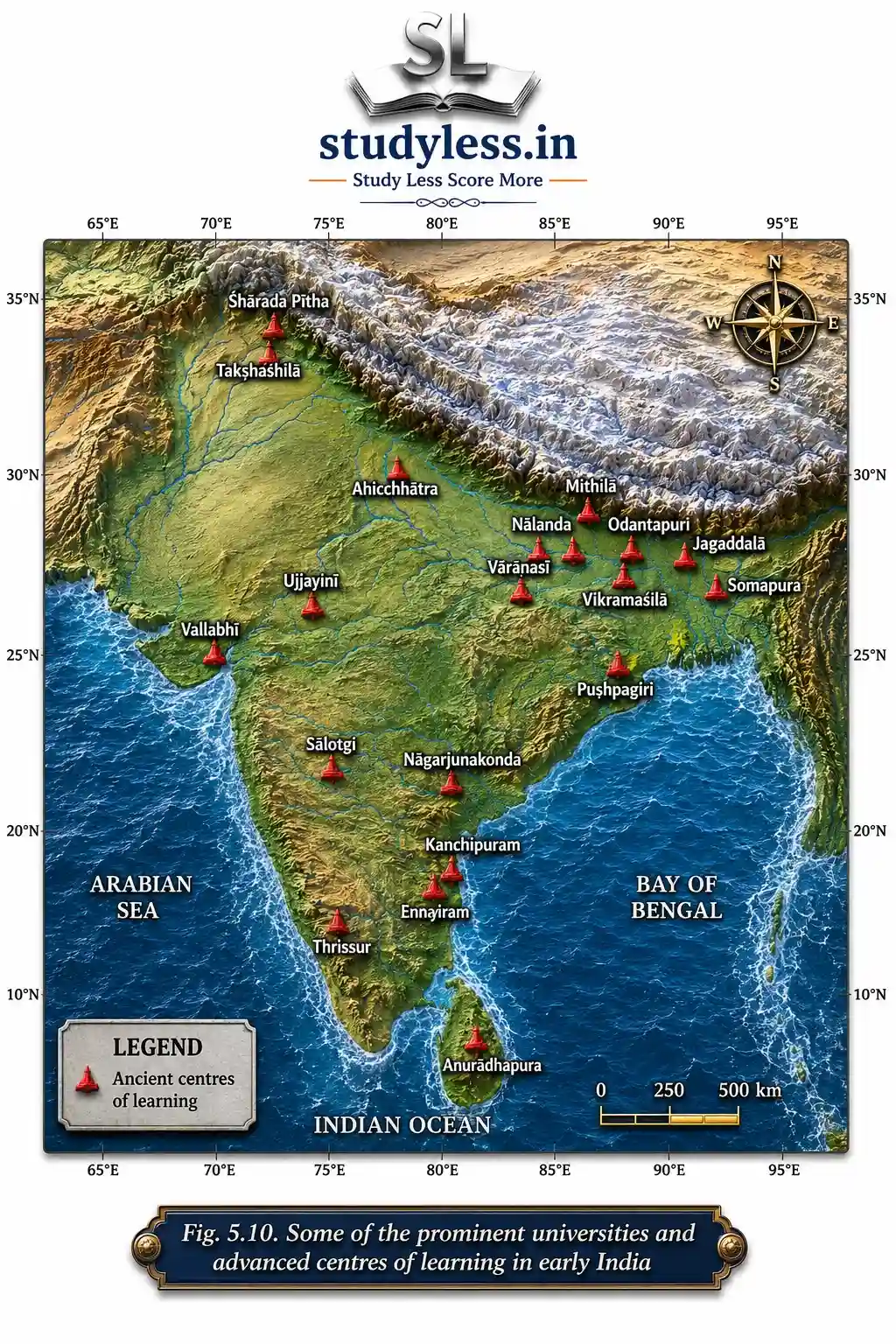
What Was India’s Legacy of Learning?
Centres of Learning
- India established many centres of education before the second millennium CE.
- These institutions attracted students from India and abroad
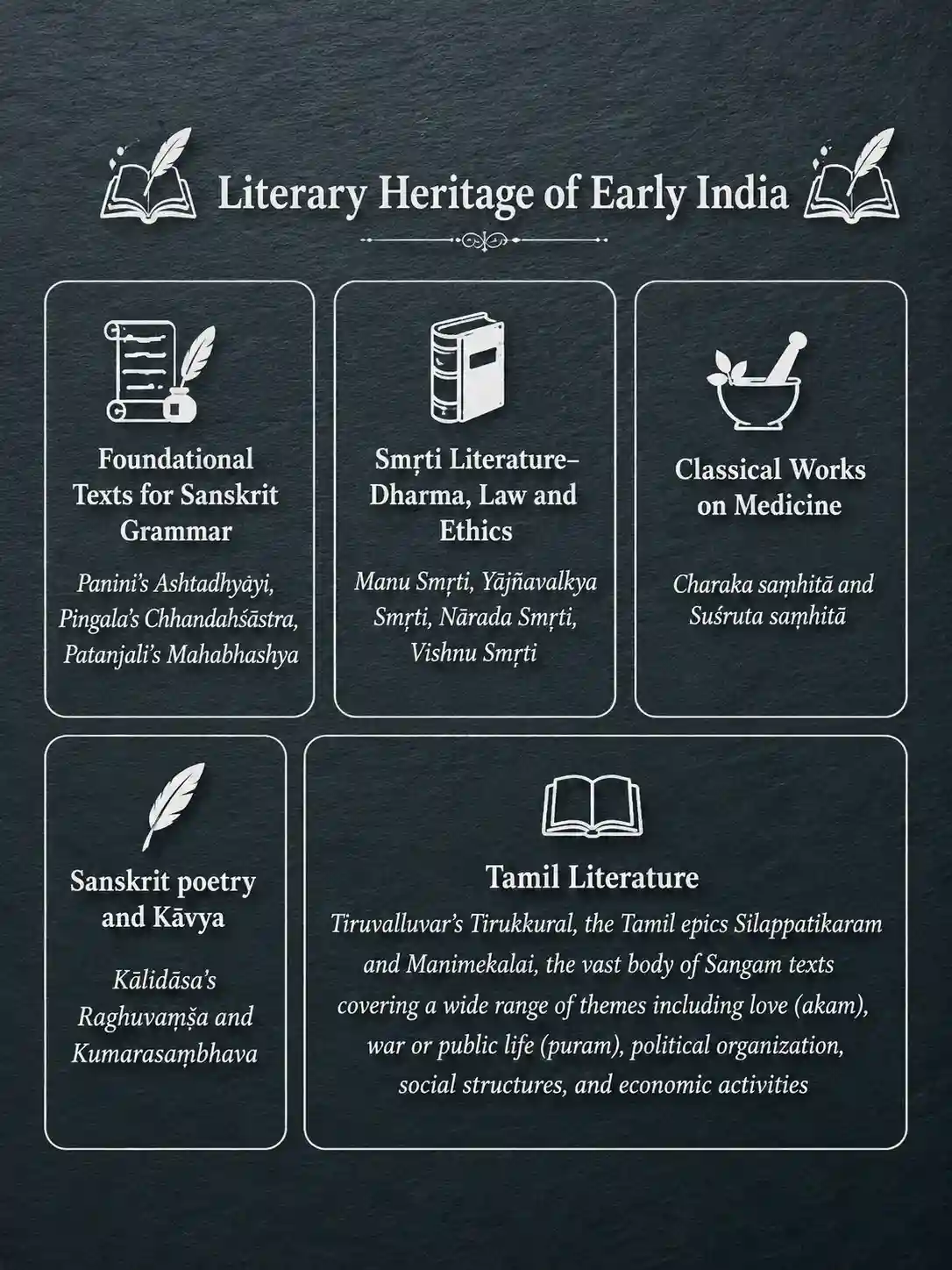
Contributions to Knowledge
India produced a vast body of literature on:
- Philosophy
- Grammar
- Medicine
- Astronomy
- Mathematics
- Agriculture
- Architecture
- Culinary practices
- Everyday life
Economy
Agriculture and land revenue
How Did the Mauryan State Manage Agriculture and Land Revenue?
The Mauryan state built an elaborate administrative system to regulate and supervise economic activities, especially agriculture.
What Was the Village Land Structure?
Land Use
- Agricultural land was divided into individual holdings.
- Pastures were kept as common grazing land for cattle.
- Villages also had groves on their outskirts.
Forests and Farming
- The state encouraged the expansion of agriculture by clearing forests.
- However, certain forests were protected by law.
Land Tax and Classification
Land Tax
- The basic land tax was usually one-sixth of the agricultural produce.
Types of Land
According to Kauṭilya, village land included:
- Cultivated land
- Wasteland/Fallow land
- High and dry land
- Sown fields
- Groves
Exam Facts
- Crops cultivated: several varieties of
rice, pulses, wheat, linseed, mustard, saffron, sugarcane, vegetables, fruits.
Quick Revision
- Mauryan land tax = 1/6th of produce
- Land classified into cultivated, wasteland, high/dry, sown, groves
- Wide crop variety across regions
How Did Agriculture Develop After the Mauryan Period?
Importance of Agriculture
- Agriculture remained the backbone of the economy.
- It supported rural life and state revenue.
Agricultural Practices
- The Milindapañho describes eight stages of farming, from field preparation to harvesting and winnowing.
Agricultural Expansion
- Farming expanded in the Deccan, encouraging cotton cultivation.
- The region’s black soil was ideal for growing cotton.
Literary Evidence
- The Amarakoṣha includes a chapter on forests, crops, plants, and manure.
Exam Facts — Agriculture in Sangam Literature
- Sangam texts highlight the fertility of southern land and abundance of produce.
- The Chera region is described as rich in jackfruit, pepper, turmeric.
- Crops like ragi and sugarcane are vividly described.
Quick Revision
- Milindapañho → 8 stages of farming (Nāgasena)
- Deccan black soil → cotton cultivation
- Amarakoṣha → chapter on crops/plants/manure
- Sangam texts → Chera region rich in jackfruit, pepper, turmeric, ragi, sugarcane
Irrigation
Why Was Irrigation Important, and How Was It Developed?
Agriculture depended closely on irrigation — reservoirs, canals, and dams were built and maintained with great importance.
Remember
The Junagadh Inscription of Rudradaman I records that Puṣhyagupta, a governor appointed by Chandragupta Maurya, built a dam on Sudarshana Lake near Girnar in Saurāṣhṭra (Kathiawad, Gujarat).
Exam Facts
- This inscription shows the active role of the Mauryan state in developing irrigation infrastructure.
- Facilitating agriculture stayed a major state priority since it was a key source of revenue.
Quick Revision
- Irrigation = reservoirs, canals, dams
- Junagadh Inscription (Rudradaman I) → Puṣhyagupta built Sudarshana Lake dam (Girnar, Gujarat)
- State prioritised irrigation for revenue
Trade: Trade Routes and Ports
How Did Trade Routes and Ports Support Economic Growth?
The expansion of trade and commerce was a major feature of economic development, supported by well-structured states.
What the Arthaśhāstra Tells Us
- Trade was a major economic activity.
- Magadha traded textiles, gems, coral, pearls, metals, minerals with northern, central, and southern India.
- State strictly regulated salt production.
- State secured trade, stopped adulteration, protected consumers.
Major Land Trade Routes (from 6th century BCE)
| Route | Direction |
|---|---|
| Dakṣhiṇāpatha | Southern route |
| Uttarāpatha | Northern route |
- These routes were maintained/expanded by successive dynasties, linking inland regions with coastal ports and integrating overland and maritime trade.
Exam Facts — Major Ports
| Port | Significance |
|---|---|
| Muziris | Major west-coast port |
| Kāveripaṭṭinam | Major trade port |
| Arikameḍu | Major trade port |
| Masulipaṭnam | Major trade port |
- Trade links between the Harappans and Mesopotamians already existed via western coast ports and the Persian Gulf.
- By the early centuries CE, India’s trade with Rome expanded significantly, via both sea routes and overland routes through Central Asia.
Quick Revision
- Dakṣhiṇāpatha (south) and Uttarāpatha (north) = key land routes since 6th century BCE
- Key ports: Muziris, Kāveripaṭṭinam, Arikameḍu, Masulipaṭnam
- Rome trade expanded via sea + Central Asia land routes
Guilds
What Role Did Guilds Play in the Economy?
Guilds (śhreṇīs) were collective organisations of traders, artisans, and merchants engaged in the same profession, craft, or occupation.
Growth of Guilds
- Guilds grew after the rise of the mahājanapadas (6th century BCE).
- Silver punch-marked coins came into use.
Functions of Guilds
- Regulated quality of goods.
- Fixed prices.
- Ran guild courts.
- Enforced professional standards.
- Worked as banks, financiers, and trustees.
Remember The Jātaka literature refers to eighteen types of guilds, showing how well-established and influential they were.
Quick Revision
- Guilds = śhreṇīs, organised by profession/craft
- Grew with rise of mahājanapadas
- Jātaka literature → 18 types of guilds
- Functions: fix prices, ensure quality, guild courts, banking/financing
How Did Textile Industries Reflect Economic Prosperity?
Economic Growth
- Pre-Gupta prosperity supported later economic and cultural growth.
- Industries expanded with raw materials and skilled artisans.
Textile Industry
- Textiles included silk, cotton, wool, and linen.
- Used different weaving techniques.
Exam Facts — Textile Production Hubs
| Centre | Known For |
|---|---|
| Mathurā | Textile production |
| Kāśhī | Textile production |
| Kāmarūpa | Textile production |
- References to silk weaver guilds show how organised the textile industry was.
- Merchants of various categories are prominent in literary and epigraphical sources.
Quick Revision
- Textiles: silk, cotton, wool, linen
- Key textile hubs: Mathurā, Kāśhī, Kāmarūpa
- Silk weaver guilds = evidence of organised industry