
We created “Ch 4 Early Humans and Beginning of Civilisation Notes Class 9″ not just as another short-note resource. It is designed specially for you to ensure :
- Prevents Exam Mistakes: Side-by-side comparison tables clear up common confusions.
- Speeds Up Revision: “Quick Revision” boxes allow for rapid, last-minute cramming right before tests.
- Reduces mental pressure: Bulleted, scannable layouts make dense history topics effortless to read and memorize.
“Early Humans and Beginning of Civilisation Notes Class 9” are being created after multiple readings of Chapter 4, Early Humans and Beginning of Civilisation, and wider consultations and discussions with our students in the class.
For other Class 9 social science chapter notes – Class 9 social science chapter-wise notes
Introduction
How Do We Know About the Period Before Writing?
Main Source
Archaeological evidence.
Development of Writing
Writing systems emerged at :
Different times in:
Different parts of the world.
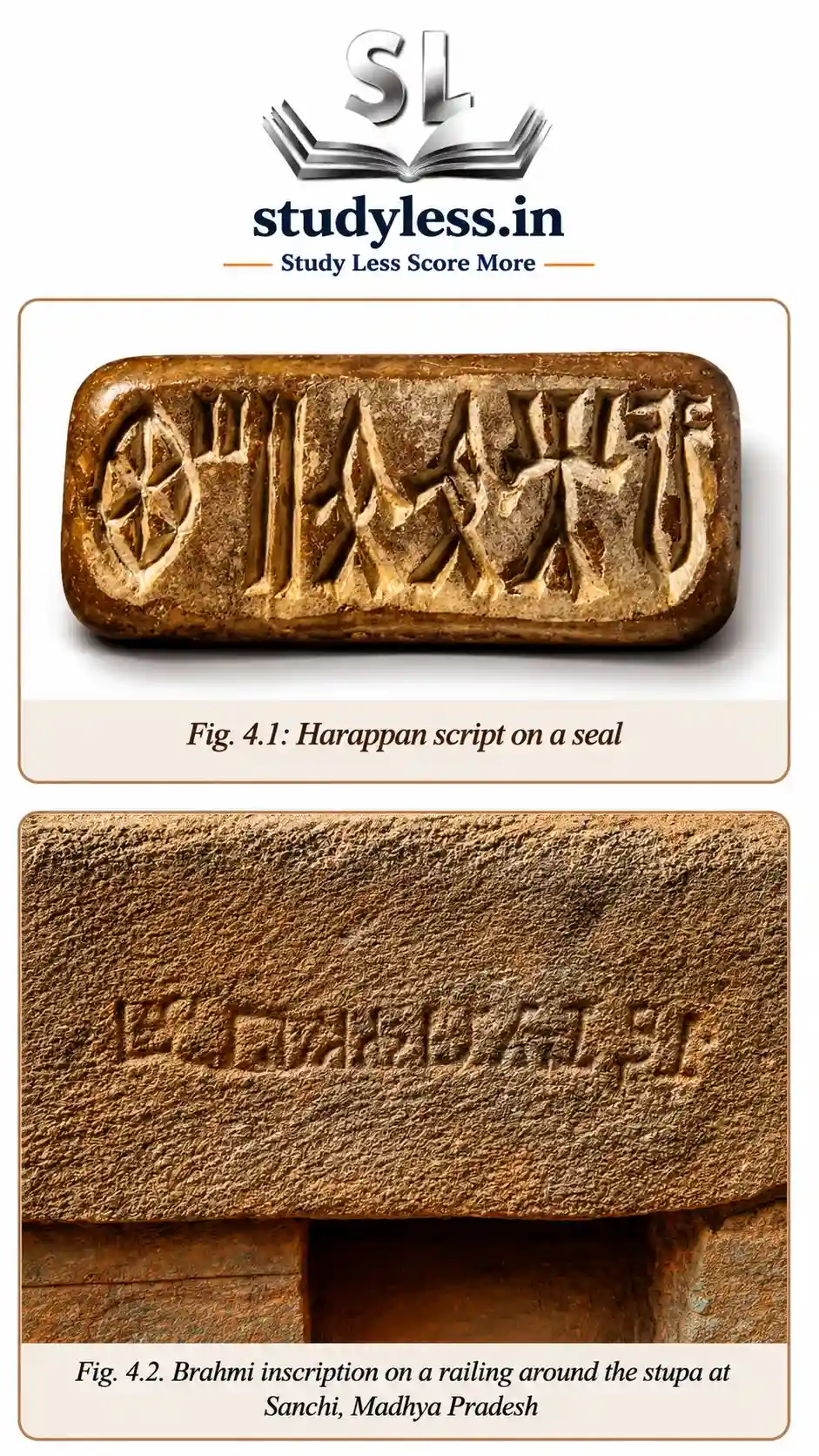
What Was the Harappan Writing System?
- Seals and pottery show the Harappans used a pictographic script for writing.
- This script has not yet been deciphered.
- It is also referred to as Sindhu lipi.
What Other Early Writing Systems Existed?
Major Writing Systems
- Cuneiform was used by the Sumerians in Mesopotamia.
- Hieroglyphics were used in ancient Egypt.
- Both flourished around the time of the Harappan Civilisation.
Significance
- Cuneiform and Hieroglyphics have been deciphered.
- The Harappan script remains undeciphered.
- Their decipherment marks the beginning of the historical period about 5,000 years ago.
Do Not Confuse
| Script | Region | Deciphered? |
|---|---|---|
| Pictographic (Sindhu lipi) | Harappan Civilisation | No |
| Cuneiform | Mesopotamia (Sumerians) | Yes |
| Hieroglyphic | Ancient Egypt | Yes |
Timeline
400 BCE → Brahmi script used in southern India and the Ganga Valley
3rd century BCE → Formalised by Emperor Ashoka
What Was the Brahmi Script?
Origin
- Brahmi was used from about 400 BCE.
- It was used in the Ganga Valley and parts of southern India.
Development
- Emperor Ashoka formalised the Brahmi script in the 3rd century BCE.
- Used by Iron Age communities across southern India.
Remember
- Harappan script is still not deciphered.
- Cuneiform and Hieroglyphic scripts are deciphered
Quick Revision Box
No writing = study through archaeology.
● Harappan script = pictographic.
● Found on seals and pottery.
● Still undeciphered.
● Also called Sindhu lipi.
● Cuneiform = Sumerians, Mesopotamia.
● Hieroglyphic = Ancient Egypt.
● Both deciphered
● Decipherment = start of historical period (~5000 years ago).
● Brahmi script began ~400 BCE.
● Used in southern India and the Ganga Valley.
● Formalised by Ashoka, 3rd century BCE.
● Linked to Iron Age people in southern India.
2-Minute Revision
- Archaeological evidence → studies the period before writing
- Harappan script → pictographic, undeciphered, also called Sindhu lipi
- Cuneiform script → Sumerians, Mesopotamia, deciphered
- Hieroglyphic script → Ancient Egypt, deciphered
- The historical period begins ~5000 years ago (after decipherment)
- Brahmi script → from 400 BCE, southern India and the Ganga Valley
- Ashoka, 3rd century BCE, formalised Brahmi
The Invention of Writing:
Before and After
Click on the initial headers below to reveal the content
More than 99 per cent of human history falls under this period (from about 3 million years ago to 5000 years ago).
Less than 1 per cent of human history falls under this period, the last 5000 years, including the present.
Tools, implements, and other material objects made by humans (artefacts) are the major sources for reconstructing people’s ways of living.
Both material remains and written documents are sources for reconstructing the lives of people and society.
It is generally difficult to understand the thoughts and ideas of people.
Literature (written documents) provides information about names; events; and social, political, and cultural life.
Measurement of time is approximate, that is, dating events and cultures is only approximate.
Dating of cultures and events becomes relatively accurate because written documents mention specific dates of events such as coronation, wars, etc.
Why Should We Study Early
Human History?
Why Should We Study Early Human History?
To understand humankind’s biological and cultural evolution
Its relation to changes in climate and the environment.
What Is Biological Evolution?
The gradual physical and genetic change of humans over time.
Early human ancestors = Australopithecines
Australopithecines evolved into Homo sapiens (modern humans).
What Is Cultural Evolution?
How humans adapted to their environment during the Quaternary Period (last 26 lakh years).
Adaptation
- Humans developed tools, techniques, and technology.
- These helped them survive changing climates and use natural resources effectively.
How Did Human Ways of Life Change?
Changing Lifestyle
Humans shifted :
From hunting and gathering
To agriculture and food production.
Significance
Surplus food supported a larger population.
Led to the production of material goods.
These developments laid the foundation of civilisation.
Remember Like This:
Hunting and Gathering
↓
Agriculture and Food Production
↓
Surplus Food and Goods
↓
Civilisation
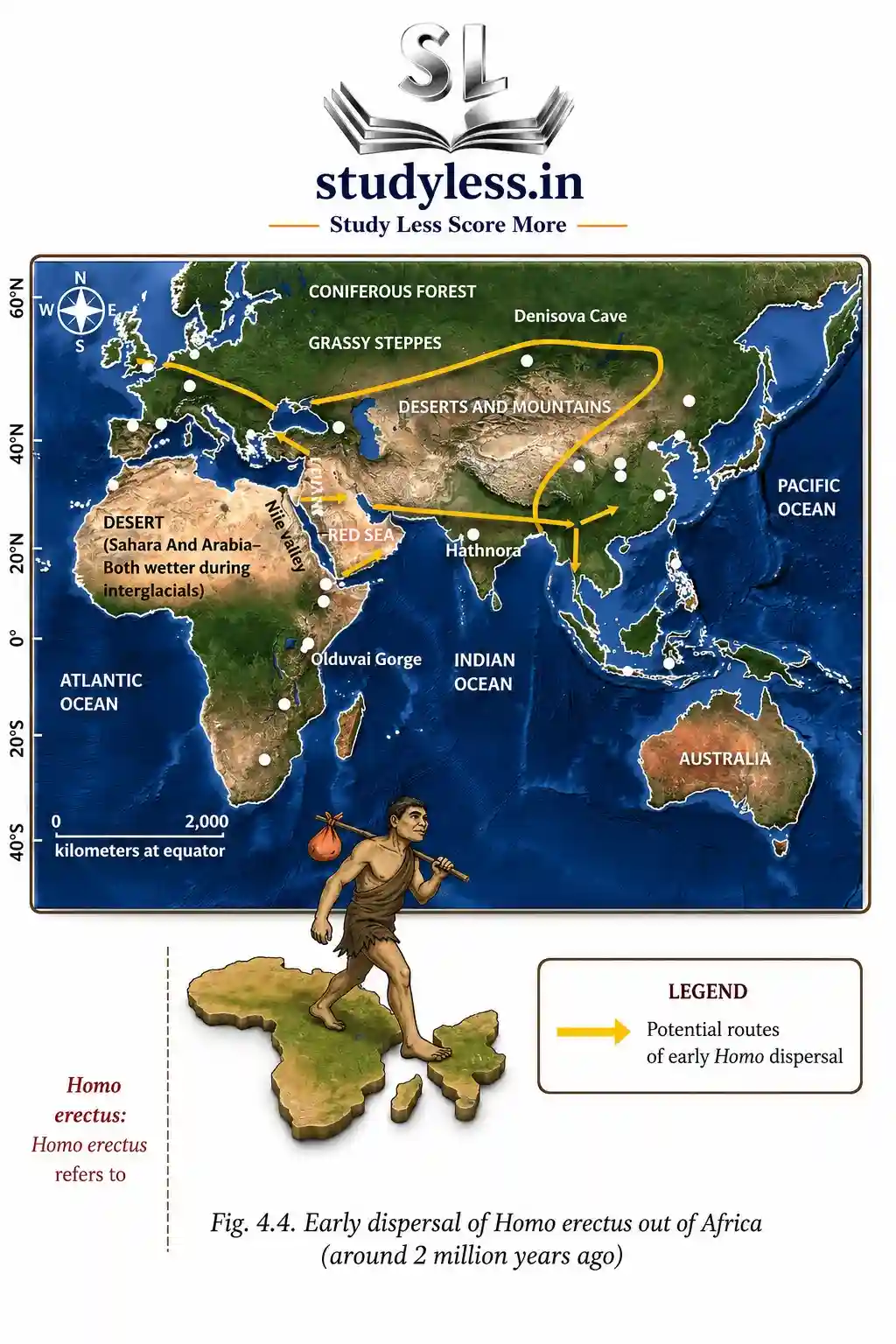
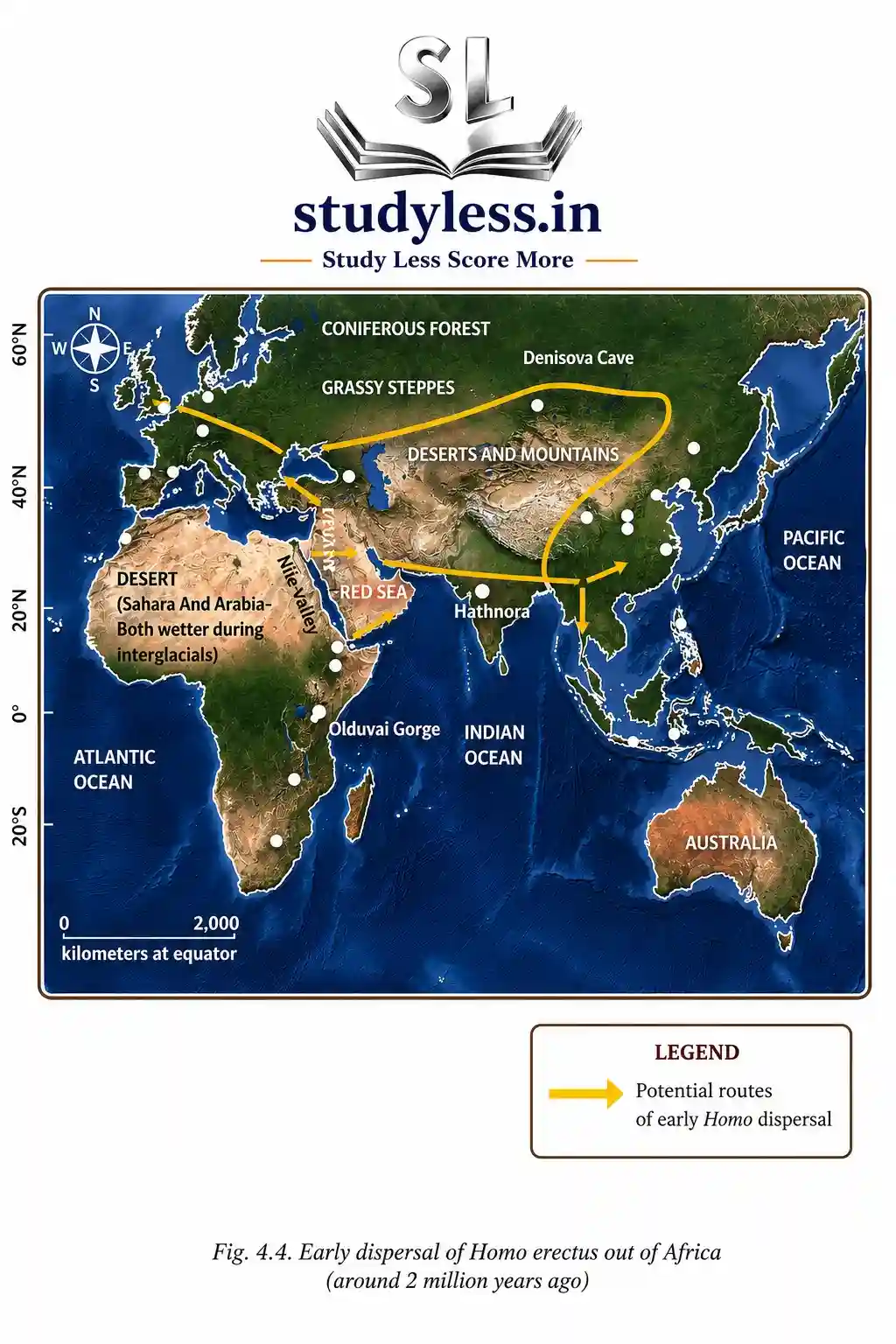
Where Did Our Earliest Ancestors Evolve and Move?
Origin of Humans
- The earliest human ancestors evolved in Africa.
- Homo sapiens evolved there about 300,000 years ago.
Migration Out of Africa
- The first migration began about 2 million years ago.
- Homo erectus was the first hominin to leave Africa.
- Second migration about 125,000 years ago (early Homo sapiens.)
Evidence
- Homo erectus used hand axes and cleavers.
- These tools have been found across Asia and Europe, showing their spread beyond Africa.
Present Day
- Homo sapiens are now found across the world.
Timeline
300,000 years ago → Homo sapiens evolve in Africa
2 million years ago → Homo erectus begins to exit Africa
2 to 0.5 million years ago → Homo erectus tools spread to Asia and Europe
125,000 years ago → Major wave of Homo sapiens migration out of Africa
★★★★★ Must Remember: Homo erectus = first hominin to exit Africa; Homo sapiens evolved in Africa ~300,000 years ago.
How Do We Know About Our Ancestors?
Archaeological Evidence
- Archaeologists study tools, bones, and other remains left by early humans.
- These discoveries help reconstruct early human life.
Experimental Archaeology
- Archaeologists make and use similar tools.
- This helps them understand how early humans made, used, and depended on these tools.
Do Not Confuse
| Term | Meaning |
|---|---|
| Archaeology | Study of clues like tools, bones, objects |
| Experimental Archaeology | Making and using similar tools to understand early human life |
Quick Revision
● Early human history shows biological + cultural evolution with climate change.
● Biological evolution: australopithecines → Homo sapiens.
● Cultural evolution: tools and technology to survive the Quaternary Period.
● Life changed from hunting and gathering to agriculture, leading to civilisation.
● Africa = origin of human ancestors; Homo erectus existed first (~2 mya); Homo sapiens existed later (~125,000 years ago).
Who Were Our Human Ancestors?
Early Settlements
- The earliest humans lived in Africa, Asia, and Europe = Old World.
- Several human ancestors coexisted during this period.
Beginning of Human Technology
- 3.3 million years ago, the first stone tools were made.
- This marked the beginning of human behaviour and technological development.
Why Are Humans Called Hominins?
Humans are called hominins because they made and used tools.
Hominins are a group that includes modern humans and our early human-like ancestors
Tools as Extensions
- Tools acted as extra-corporeal limbs—extensions of the human body.
- They enabled humans to perform tasks beyond the ability of bare hands.
Human Intelligence
Unlike animals, early humans had the cognitive ability to design and make tools.
Tools and Fossils: Windows to the Past
Stone Tools
- Early humans made, used, and discarded stone tools.
- These tools were buried beneath the earth
Fossils
- The remains of early humans were buried deep underground.
- Over thousands or even millions of years, these remains turned into fossils.
Importance for Archaeologists
Stone tools and fossils are the two most important sources of evidence that help archaeologists reconstruct the history and lifestyle of early humans.
Who Were Homo habilis and Homo erectus?
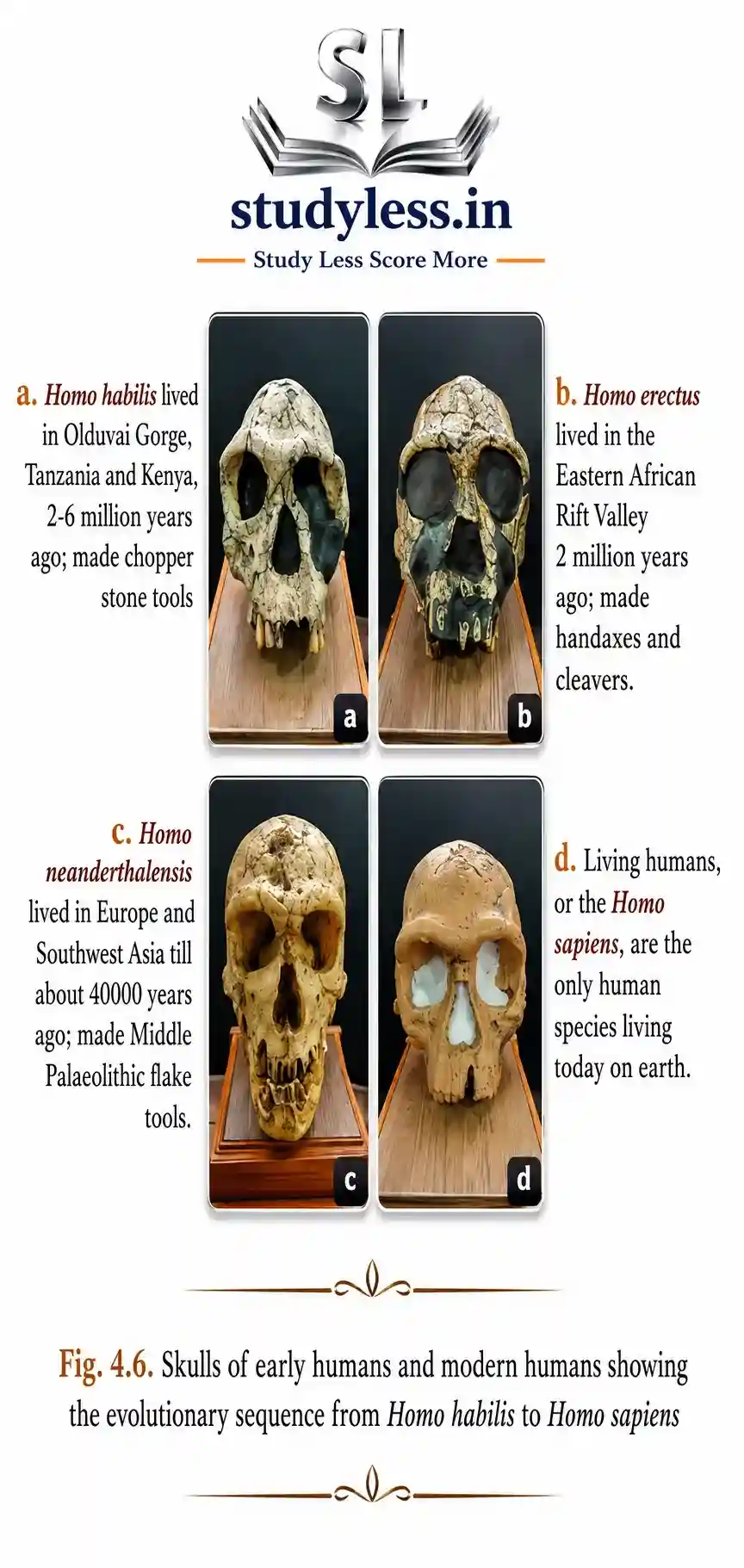
Homo habilis
- Homo habilis (“handy man“) lived mainly in Africa.
- Important sites include Olduvai Gorge (Tanzania) and Kenya.
Homo erectus
Homo erectus refers to an upright or bipedal human ancestor.
- Homo erectus succeeded Homo habilis.
- They invented handaxes and cleavers.
- They were among the first hominins to migrate to Europe and Asia.
Significance
- All early human ancestors were tool makers.
- Homo sapiens later developed more complex technologies.
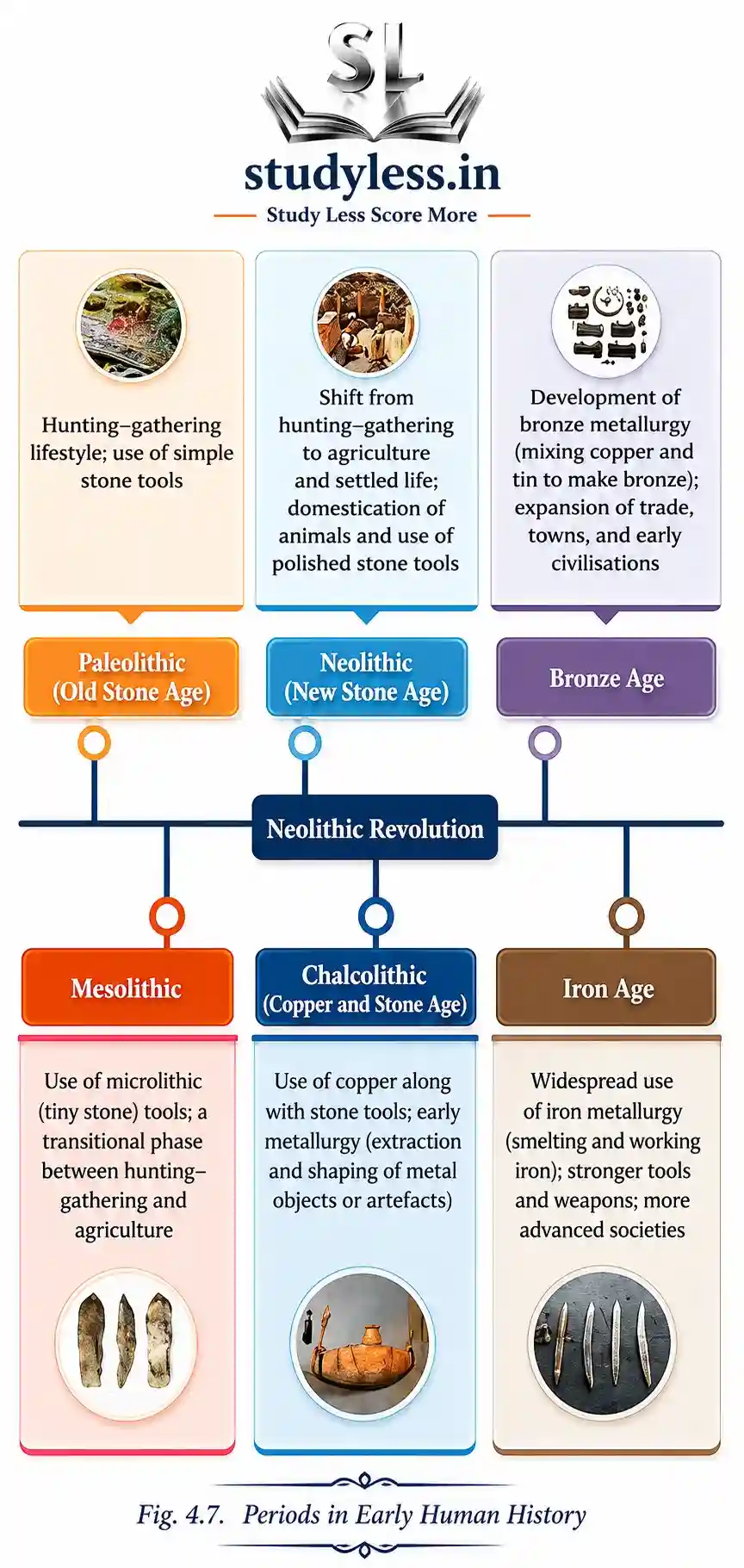
How Is Early Human History Divided?
Divided into distinct periods based on technological progress:
Development and use of tools,
Beginning of agriculture,
Changes in lifestyle and settlement patterns.
The Stone Age is broadly divided into three stages:
1. Palaeolithic 2. Mesolithic 3. Neolithic.
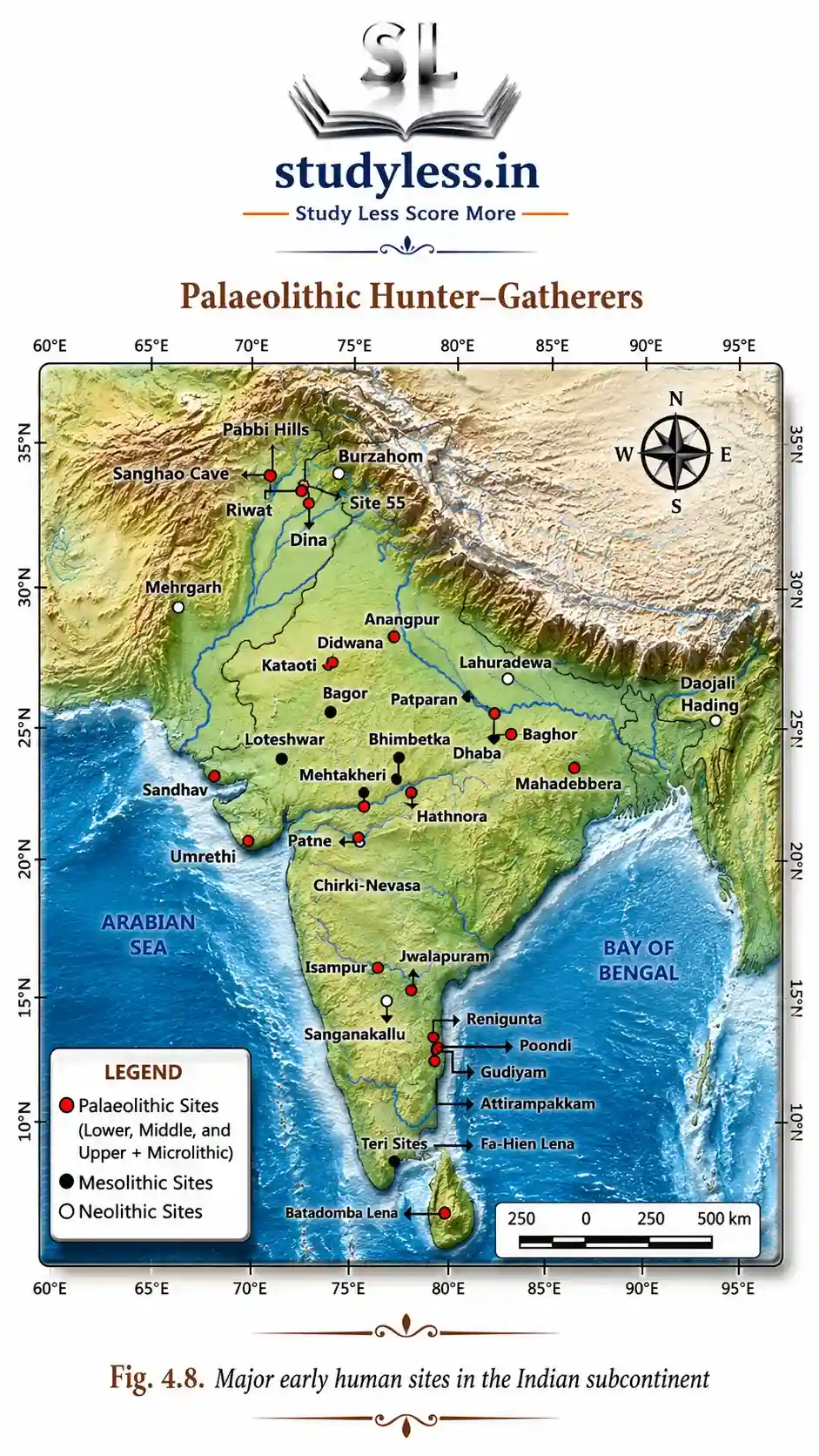
Palaeolithic Hunter–Gatherers
Palaeolithic Hunter–Gatherers
- Palaeo means ‘old’, lithic means ‘stone’.
- Palaeolithic period is also known as the Old Stone Age.
What Evidence Exists in the Indian Subcontinent?
Earliest Human Settlements
- The oldest human settlement in the Indian subcontinent dates back to about 2 million years ago.
- Attirampakkam (Tamil Nadu): 1.5–1.7 million years old
- Isampur (Karnataka): 1.2 million years old
Archaeological Discoveries
Fossils
- Animal fossils have been discovered at these sites.
Stone Tools
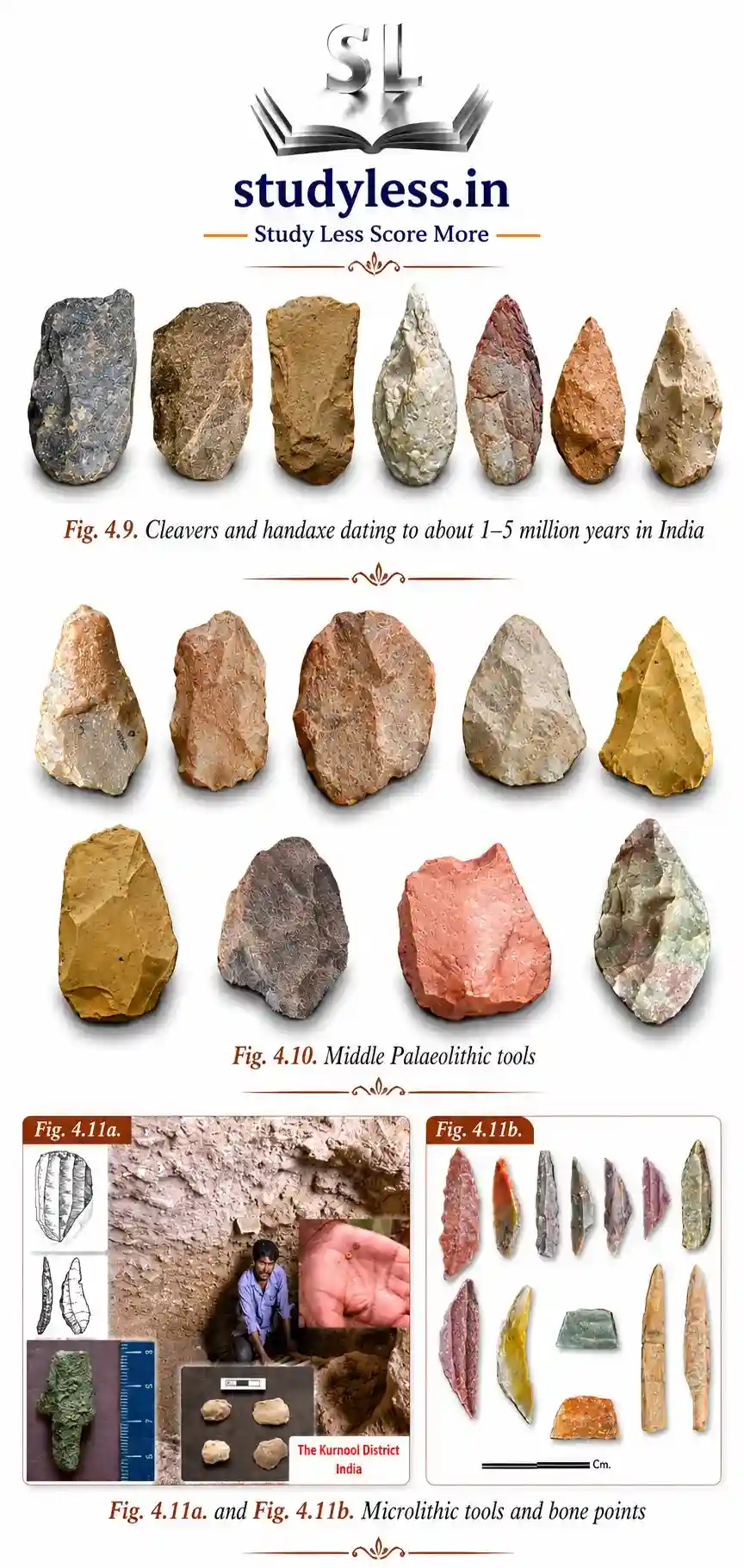
- Large cutting tools such as handaxes and cleavers.
- Other tools included stone scrapers (made of quartzite) and choppers (made of limestone).
Uses of Stone Tools
Early humans used these tools to:
- Chop animal meat.
- Dig out tubers.
- Scrape animal skin.
- Cleave bones to extract protein-rich marrow.
What Changes Came with Smaller Stone Tools?
Improved Stone Technology
- Early humans made smaller stone tools, improving hunting and gathering activities.
- Main types of tools:
- Scrapers
- Borers
- Points
Significance
- These tools made hunting more efficient.
- Sharp stone points were fitted to projectiles, making them more effective for hunting animals.
What Later Tool Inventions Took Place?
New Tools and Weapons
New Inventions
- Humans invented the bow and arrow.
- They also made parallel-sided blades and microblades from glassy rocks.
- These tools were extremely sharp when freshly made.
Importance
- These innovations made hunting small animals more effective.
Cultural Developments
Early humans also began to:
- Develop symbolic communication.
- Paint the walls of caves and rock shelters.
- Use pigments to decorate their bodies.
- Make the first beads from stone, bone, and shell.
What Was a Burin?
The Burin
- A burin (or engraver) was a distinctive stone tool.
- It was used to engrave symbolic designs on bones and shells, including ostrich eggshells.
Improved Tool Design
- Microblades were fitted into handles, making them easier and more efficient to use.
Connection with Homo sapiens
- These technological advances are associated with Homo sapiens, our immediate ancestors.
- Between 50,000 and 12,000 years ago, Homo sapiens spread across the world, including Australia and the Americas.
Chronology
Homo habilis (Olduvai Gorge, Africa)
↓
Homo erectus (handaxes, cleavers; first to leave Africa)
↓
Homo sapiens (complex technologies; spread worldwide 50,000–12,000 years ago)
Quick Revision
● Old World = Africa, Asia, Europe.
● Earliest stone tools made ~3.3 million years ago; humans = hominins (tool makers).
● Homo habilis = Olduvai Gorge; Homo erectus = handaxes/cleavers, first out of Africa.
● Stone Age = Palaeolithic, Mesolithic, Neolithic.
● Attirampakkam (1.5–1.7 mya), Isampur (1.2 mya) = key Indian sites.
● Later tools: bow and arrow, microblades, burin; beads and cave paintings appear.
● Homo sapiens spread worldwide between 50,000–12,000 years ago.
Mesolithic Hunter–Gatherers
Mesolithic is a historical cultural period that lies between the Paleolithic and the Neolithic period.
Climate Change
- Around 10,000 years ago, the Earth’s climate became warmer.
- Forests and grasslands expanded into ice sheet regions.
New Resources
- Small game animals
- Fish
- Edible wild grains
A Growing Population
- The availability of abundant resources led to the first population explosion in human history.
What Tools and Lifestyle Defined This Period?
Microlithic Tools
- Microlithic tools helped people gather aquatic food from both marine and freshwater sources.
Main Occupation
- Fishing became the mainstay of their subsistence economy.
Cultural Developments
- Art flourished during this period.
- People frequently lived in caves and rock shelters, which served as important habitats.
What Is Bhimbetka?
- Bhimbetka in Madhya Pradesh is a World Heritage Site.
- It contains hundreds of painted rock shelters with Mesolithic and earlier human occupation.
Quick Revision
● Climate warmed around 10,000 years ago; forests/grasslands expanded.
● New resources: small game, fish, edible wild grains.
● First-ever population explosion in human history.
● Microlithic tools used; fishing = mainstay of economy.
● Art flourished; caves and rock shelters occupied.
● Bhimbetka (Madhya Pradesh) = World Heritage Site with painted rock shelters.
The Neolithic Revolution
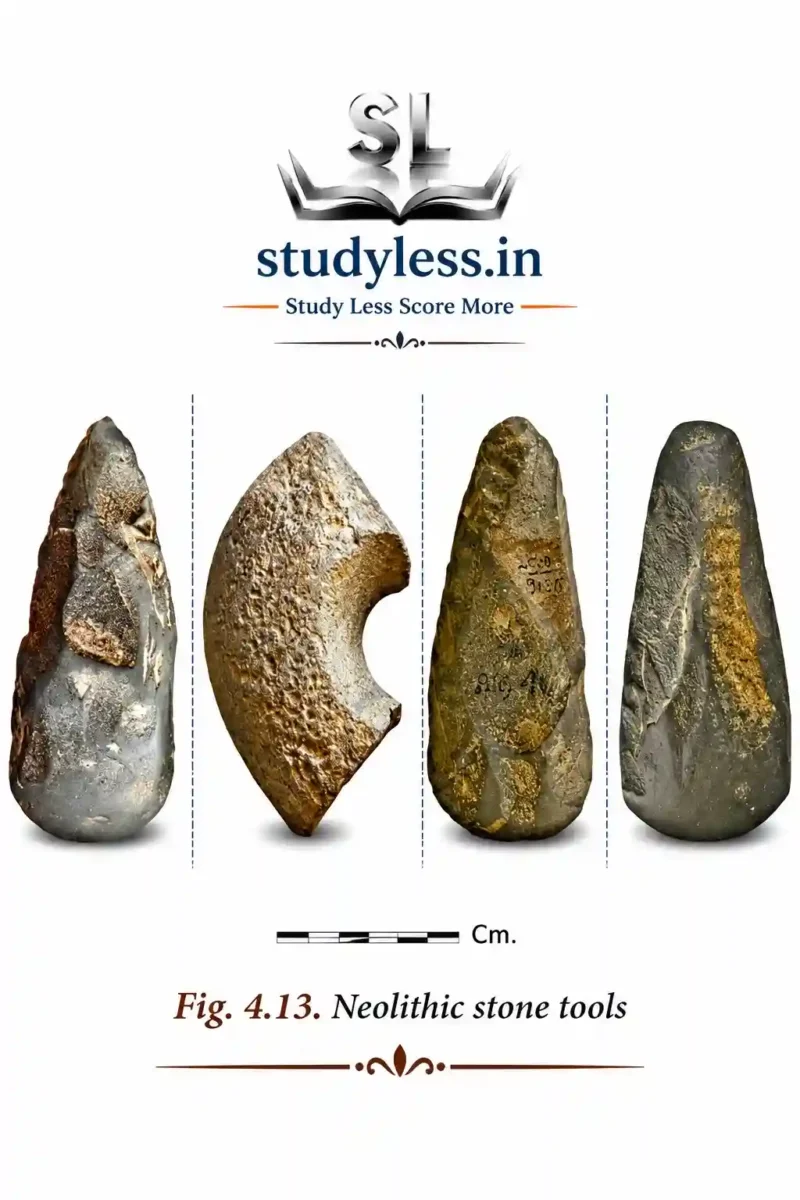
From Food Gathering to Food Production
The Neolithic Revolution
- Humans gradually shifted from hunting and gathering to food production.
- This change is known as the Neolithic Revolution.
Domestication
- Plants and animals were brought under human control.
- New breeds developed through cultivation and animal husbandry.
New Tools and Technology
- Hunter–gatherers made tools to obtain food.
- Neolithic farmers developed tools for farming and food processing.
- They also made earthenware pottery in different shapes and sizes.
Permanent Settlements
- People used a variety of natural resources.
- They established the first permanent villages.
Significance
- The Neolithic Revolution laid the foundation for the Urban Revolution.
Sequence
Hunting and Gathering
↓
Domestication of Plants and Animals
↓
Village Settlements
↓
Urban Revolution
Quick Revision
● Neolithic Revolution = shift from hunting-gathering to food production.
● Key feature: domestication of plants and animals.
● New tools for food production/processing; pottery developed.
● First village settlements → basis for urban revolution.
● Transition timing varied across world regions.
Neolithic Period in the Indian Subcontinent
When Did Agriculture Begin in India?
Regional Variation
- The beginning of agriculture varied across different regions of India.
Mehrgarh
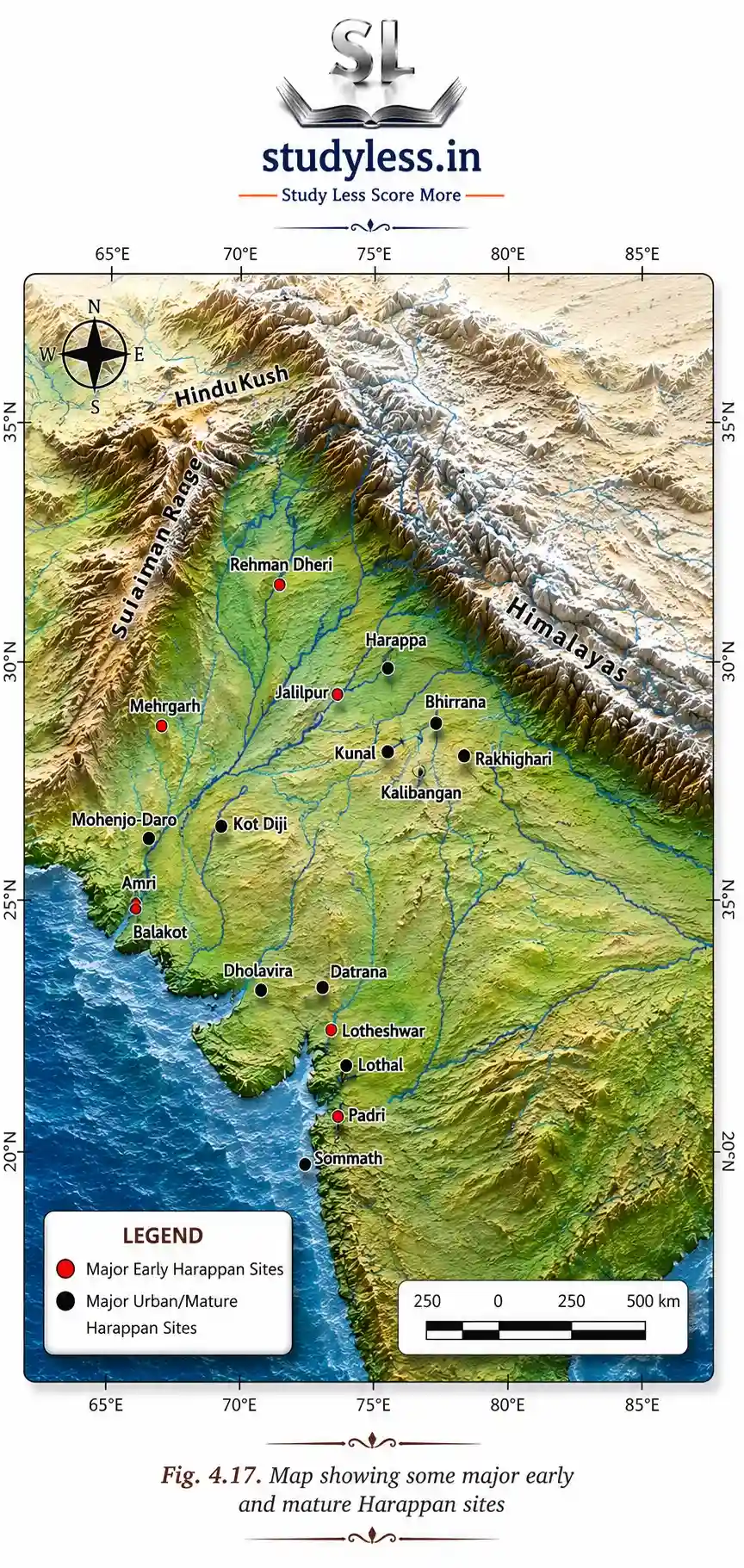
- Mehrgarh, on the Bolan River (present-day Pakistan), is the oldest Neolithic site in the northwestern Indian subcontinent.
- It was also the earliest agricultural village, dating to about 7000 BCE.
What Did Mehrgarh People Do?
Houses and Settlements
- Built handmade sun-dried brick houses and granaries.
- Buried their dead in graves.
Farming and Animal Husbandry
- Cultivated wheat and barley.
- Reared sheep, goats, and Indian cattle, especially the zebu (humped bull).
Crafts and Technology
- Made ornaments from lapis lazuli, carnelian, and shells.
- Became the first people to make copper objects, marking the beginning of the Metal Age.
Chalcolithic Culture
- By 4000 BCE, the people of Mehrgarh became known as the Chalcolithic people (Copper-Stone Age).
Significance
- Their advancements laid the foundation for the Bronze Age Sindhu–Sarasvati Civilisation around 3500 BCE.
What Happened by 2500 BCE?
- By 2500 BCE, most of the Indian subcontinent was occupied by Neolithic agricultural communities.
- Way of life: cattle, sheep, goat herding + cultivation of cereals, millets, pulses.
- Sometimes interacted with contemporary Chalcolithic cultures in parts of the country
Timeline
7000 BCE → Mehrgarh, earliest agricultural village
4000 BCE → Mehrgarh people become Chalcolithic (copper objects)
3500 BCE → Basis laid for Bronze Age Sindhu–Sarasvati civilisation
2500 BCE → Neolithic communities spread across most of the Indian subcontinent
★★★★★ Must Remember: Mehrgarh = oldest Neolithic site, 7000 BCE.
Quick Revision
● Mehrgarh (Bolan River, Pakistan) = oldest Neolithic/agricultural site, 7000 BCE.
● People: brick houses, granaries, graves, ornaments, wheat/barley, sheep/goats/zebu cattle.
● Copper objects by 4000 BCE → Chalcolithic people.
● Basis for Sindhu–Sarasvati civilisation, 3500 BCE.
● By 2500 BCE, the Neolithic spread across most of the Indian subcontinent
Sindhu–Sarasvatī Civilisation
Origin and Growth
- Neolithic life began around 7000 BCE at Mehrgarh (foothills of Baluchistan).
- It gradually spread to the middle and upper Indus Valley and further east.
Beginning of the Metal Age
- Around 4000 BCE, some settlements learned to extract copper from ores.
- These became the earliest Chalcolithic (Copper-Stone Age) sites, marking the beginning of the Bronze Age.
Emergence of Civilisation
- The Sindhu–Sarasvati Civilisation emerged by 2600 BCE.
What Led to Early Prosperity?
Copper Technology
- The introduction of copper tools in the fertile Indus and Ghaggar–Sarasvati alluvial plains increased agricultural productivity.
- This led to greater prosperity in these communities.
Growth of Pottery and Crafts
- Large-scale pottery production developed with diverse regional styles.
- Distinct pottery and craft traditions appeared in the Baluchistan, Indus, and Ghaggar–Sarasvati regions from 4000 BCE onwards.
What Is the Early Harappan Stage?
Beginning of the Early Harappan Phase
- Radiocarbon dating suggests the Pre-Harappan phase began between 7000 and 5500 BCE.
- Important early sites include Bhirrana and Kunal in the dried Sarasvati river belt.
Growth and Continuity
- Many regional cultural styles gradually evolved into the standard features of the Sindhu–Sarasvati Civilisation by 2500 BCE.
- This period of cultural continuity is known as the Early Harappan Stage.
Features of Continuity
The Early Harappan Stage is marked by continuity in:
- Pottery traditions
- Semi-precious stone beads
- Shell bangles
- Terracotta objects
- Copper working
New Developments
This stage also witnessed the beginning of:
- Perimeter walls
- Use of seals
- Harappan script
What Crafts Did the Harappans Practise?
Major Crafts
The Harappans were skilled artisans as well as farmers. Their important crafts included:
- Pottery
- Copper work
- Shell work
- Semi-precious stone bead making
Pottery
- Pottery was a major craft that strengthened the Harappan economy.
- It featured distinct regional shapes and painted designs.
Evidence of Bead Making
Early Harappan bead production has been found at:
- Harappa (Pakistan)
- Kunal (Haryana)
- Datrana (Gujarat)
What Were the Forerunners to the Harappan Script?
Early Writing Traditions
- Graffiti was extensively drawn on pottery.
- A few seals with geometric and simple animal motifs have been found at Harappa, Rehman Dheri, and Kunal.
Foundation of the Harappan Script
- These graffiti and seals are considered the forerunners of the Harappan script and the inscribed seals of the Sindhu–Sarasvati Civilisation.
Significance
- Technological advancements and economic integration during the Early Harappan Period paved the way for the emergence of urban centres of the Harappan Civilisation.
Timeline
7000–5500 BCE → Pre-Harappan phase begins (Bhirrana, Kunal)
4000 BCE → Copper extraction; early Chalcolithic sites in Baluchistan, Indus, Ghaggar-Sarasvati basins
2600 BCE → Emergence of Sindhu–Sarasvati civilisation
2500 BCE → Regional styles become standard features (Early Harappan stage)
Quick Revision
● Sindhu–Sarasvati civilisation emerged by 2600 BCE.
● Copper tools boosted productivity in Indus and Ghaggar-Sarasvati basins.
● Pre-Harappan phase: 7000–5500 BCE (Bhirrana, Kunal).
● Early Harappan stage (continuity): pottery, beads, shell bangles, copper working, perimeter walls, seals, script beginnings.
● Crafts: pottery, copper work, shell work, bead production (Harappa, Kunal, Datrana).
● Graffiti and simple seals = forerunners to Harappan script.
● Technological + economic growth in Early Harappan period → rise of urban Harappan centres.
Bronze Age Civilisations Outside India
Four Early World River Civilisations
Major River Civilisations
Four major civilisations developed in fertile river valleys:
| Civilisation | River System |
|---|---|
| Harappan | Sindhu (Indus) and Sarasvati Rivers |
| Mesopotamian | Euphrates and Tigris Rivers (West Asia) |
| Egyptian | Nile River |
| Chinese | Huang He Basin (Northern China) |
Contacts Between Civilisations
Trade and Cultural Links
- Mesopotamia and the Sindhu–Sarasvati Civilisation had strong trade and cultural contacts.
- Their geographical proximity encouraged these interactions.
Limited Contact
- There is little evidence of direct contact between the Egyptian or Chinese Civilisations and the Sindhu–Sarasvati Civilisation.
Mesopotamian Civilisation
Mesopotamian Civilisation
The First Urban Civilisation
- Mesopotamia was the world’s earliest urban civilisation.
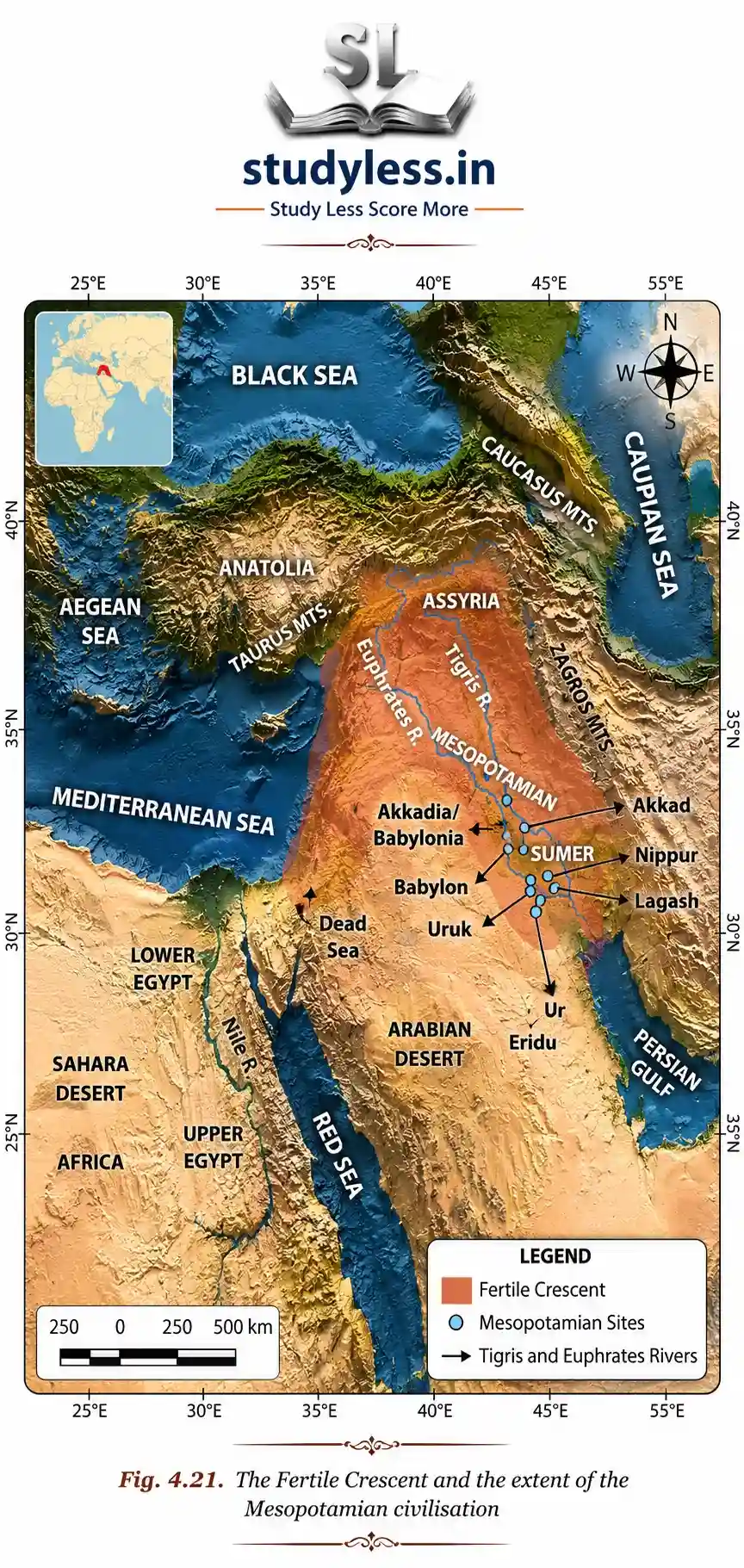
- It developed along the Euphrates and Tigris rivers in West Asia.
Meaning of Mesopotamia
- Mesopotamia is a Greek word meaning “land in between.”
- It refers to the land between the Euphrates and Tigris rivers.
Present-Day Location
Today, the Mesopotamian region includes:
- Iraq
- Kuwait
- Parts of Turkey
- Southwestern Iran
The Fertile Crescent
Location
- The Fertile Crescent is the crescent-shaped region between the Zagros and Taurus Mountains.
- It stretches from the Mediterranean Sea to the Persian Gulf.
Importance
- The region is known for its fertile land and high agricultural potential.
What Was the Timeline of Development?
Early Farming
- Farming began in Mesopotamia about 12,000 years before present.
Copper Age
- Around 4500 BCE, the introduction of copper tools improved:
- Agriculture
- Craft production
- Trade
Rise of City-States
- Over the next 2,000 years, large settlements developed into city-states with organised systems of governance.
Major Mesopotamian Civilisations
From 3500 BCE onwards, four major city-based civilisations flourished:
- Sumerian
- Akkadian
- Assyrian
- Babylonian
Timeline
12,000 years before present → Farming begins in Mesopotamia
4500 BCE → Copper tools arrive
3500 BCE → Sumerian, Akkadian, Assyrian, Babylonian civilisations flourish
Major Mesopotamian Civilisations
a. The Sumerians
The First City-Based Civilisation
Rise of the Sumerians
- The Sumerians established the world’s earliest city-based civilisation.
- Major cities included Ur and other cities of Sumer.
Location
- Sumer was located in southern Mesopotamia (present-day southern Iraq).
Innovations in Irrigation
- The Sumerians were the first to build dams and canals for irrigation, improving agricultural production.
Construction Techniques
- They were the first to use mud bricks and burnt bricks to build:
- Houses
- Defensive walls
- Other public structures
What Was a Ziggurat?
- A ziggurat was a tower-like, stepped pyramid-shaped temple with several floors.
- The main temple was located at the top.
Religious Importance
- The top of the ziggurat was considered a holy place.
Surrounding Area
- The area around the ziggurat contained:
- Palaces
- Royal storehouses
Other Functions
- The surrounding walls had only one entrance.
- Besides being a religious centre, the ziggurat also served as the city’s treasury.
What Role Did Religion and Temples Play?
Religious Beliefs
- The Sumerians worshipped many gods, who were believed to control natural forces such as floods and winds.
Temples and Ziggurats
- A temple was built for each god.
- Every city had a grand ziggurat dedicated to its chief god, and the city developed around it.
Centre of Economic Life
The temple authority controlled major economic activities, including:
- Agriculture
- Trade
- Transport of goods
Social Hierarchy
Social Structure
- Only high priests and priestesses could enter the sacred temple.
- They were likely part of the ruling class.
Significance
- This reflects a well-defined social hierarchy in Mesopotamian society.
What Was City Life Like?
- Kings lived in grand palaces; people lived in small brick houses.
- Life centred around farming.
- Crafts practised: metalworking, pottery, textiles.
- Other professionals: merchants and traders.
★★★★★ Must Remember: Ziggurat = stepped temple, holy site, also served as city treasury.
The Beginning of Writing
Origin of Writing
- The Sumerians were the first to develop writing, around 3300 BCE.
- Their writing system was called cuneiform.
Cuneiform Script
- Cuneiform was named after the wedge-shaped tool used by scribes.
- It consisted of hundreds of wedge-shaped marks pressed onto damp clay tablets using sharp reed styluses.
Role of Scribes
- Scribes held a high social status, comparable to priests and priestesses.
Spread of Writing
- By 3000 BCE, cuneiform was widely used across Mesopotamia by different city-states, even though they spoke different languages.
What Do Cuneiform Tablets Tell Us?
A Record of Mesopotamian Life
Cuneiform tablets provide valuable information about:
- Myths
- Epics
- Hymns
- Law codes
- Educational treatises
Economic Records
- They were also used to record farming and craft activities.
- Occupations mentioned include:
- Potters
- Seal cutters
- Shipbuilders
- Carpenters
- Farm workers
- And many other craftsmen.
Timeline
3300 BCE → Sumerians begin writing (cuneiform)
3000 BCE → Cuneiform widely used across Mesopotamia
b. The Akkadians
Rise of the Akkadian Empire
- In 2334 BCE, the Akkadians replaced the Sumerians as the dominant power.
- Their empire was centred on Akkad, in central Mesopotamia.
Language and Writing
- The people spoke Akkadian, a language different from Sumerian.
- However, both languages used the same cuneiform script.
Political Achievements
- Akkadian records describe the consolidation of power and the establishment of the world’s first dynastic empire.
Cultural Development
- The Akkadian period witnessed the growth of creative literature.
What Trade Did the Akkadians Have?
Trade Connections
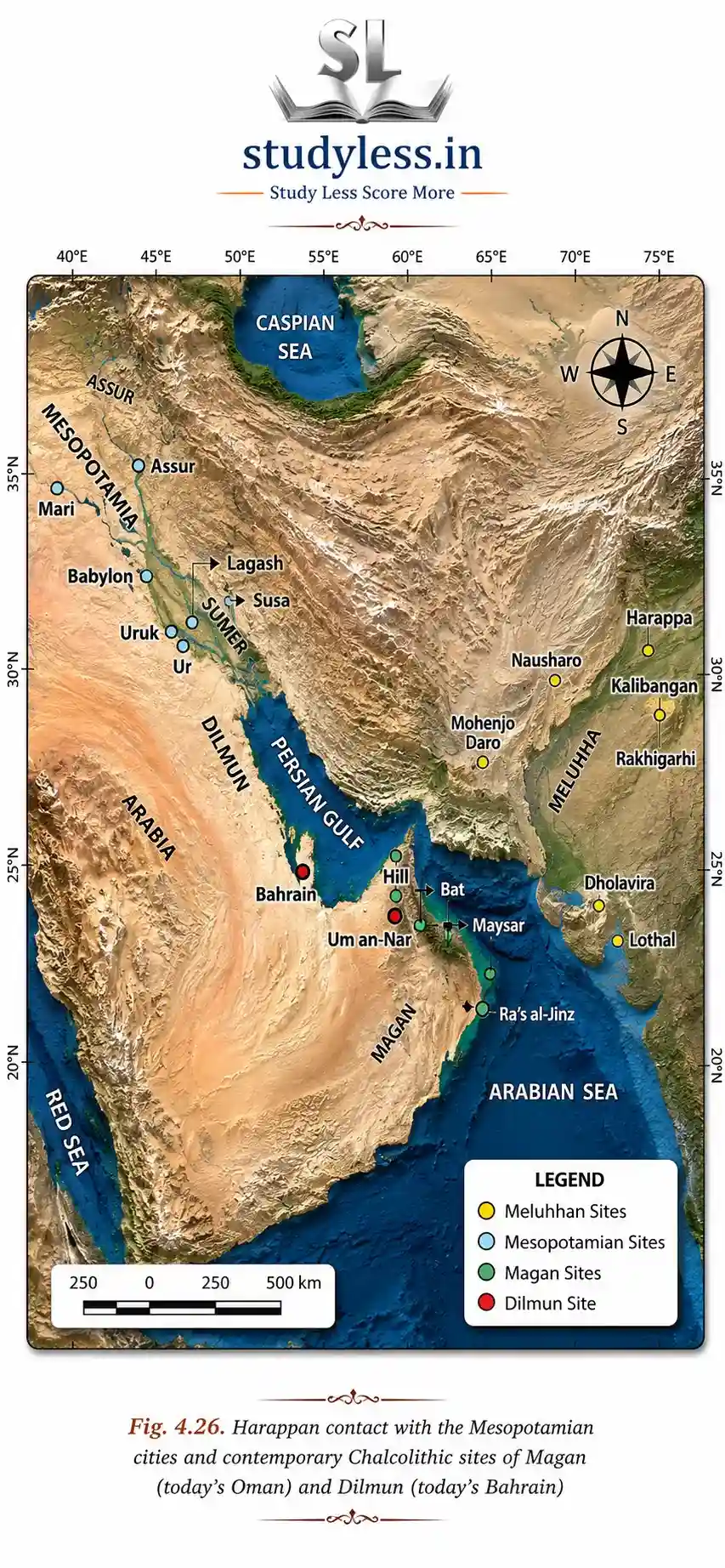
- Cuneiform tablets of King Sargon mention trade with:
- Dilmun
- Magan
- Meluhha
Important Regions
- Meluhha is generally identified with the Sindhu–Sarasvati Civilisation.
- Dilmun and Magan correspond to present-day Bahrain and the Oman Peninsula in the Persian Gulf.
Trade with the Harappans
The Akkadians traded with the Harappans, exchanging:
- Semi-precious stone beads
- Ivory
- Timber
- Gold dust
- Probably copper
★★★★★ Must Remember: Meluhha = Sindhu–Sarasvati civilisation (Mesopotamian trade link).
c. The Assyrians
Rise of the Assyrian Civilisation
- Around 2154 BCE, the Akkadian Empire lost its supremacy to Assur, a new city-state in northern Mesopotamia.
- This marked the rise of the Assyrian Civilisation.
Expansion of the Assyrians
- The Assyrian Civilisation flourished until the early 1700 BCE.
- Their dominance spread across Mesopotamia and into the neighbouring regions to the west and south.
d. The Babylonians
Rise of Babylonia
Emergence of Babylonia
- Babylonia became the leading power in central Mesopotamia from 1900 BCE.
- It rose while the Assyrians dominated the north.
Hammurabi’s Rule
- Hammurabi came to power in 1792 BCE.
- He conquered neighbouring regions and expanded Babylonia into a large empire.
Code of Hammurabi
- Hammurabi’s greatest achievement was the Code of Hammurabi.
- It laid down rules and regulations governing civil and social life.
- The Code became a foundation for many later legal systems.
What Led to Babylonian Decline?
External Challenges
- By the end of 1400 BCE, the Babylonians lost their dominance due to repeated attacks by the Hittites and other rising powers.
- These powers possessed advanced technologies and made better use of natural resources.
Internal Problems
Babylonia also weakened because of:
- Environmental degradation
- Pressure on agricultural land
- Political and economic problems
Result
- The decline of Babylonia paved the way for the rise of new powers in West Asia.
Timeline
1900 BCE → Babylonia gains dominance in central Mesopotamia
1792 BCE → Hammurabi’s ascendance; Code of Hammurabi compiled
1400 BCE (end) → Babylonians lose prominence to Hittites and others
★★★★★ Must Remember: Code of Hammurabi = foundational model for future legal systems.
Chronology
Sumerians (Ur, Sumer) — earliest city-based civilisation
↓
Akkadians (2334 BCE) — first dynastic empire
↓
Assyrians (2154 BCE) — Assur, northern Mesopotamia
↓
Babylonians (1900 BCE onwards) — Hammurabi, Code of Hammurabi
2-Minute Revision
- 4 river civilisations: Harappan (Sindhu-Sarasvati), Mesopotamian (Euphrates-Tigris), Egyptian (Nile), Chinese (Huang He).
- Mesopotamia = earliest city-based civilisation; “fertile crescent” region.
- Sumerians: earliest city-state (Ur); ziggurat; dams/canals; mud and burnt bricks.
- Writing began 3300 BCE (Sumerians); cuneiform script; widely used by 3000 BCE.
- Akkadians (2334 BCE): first dynastic empire; Sargon; traded with Meluhha (Sindhu-Sarasvati civilisation).
- Assyrians (2154 BCE): Assur, northern Mesopotamia.
- Babylonians (1900 BCE): Hammurabi (1792 BCE), Code of Hammurabi.
- Babylonian decline by 1400 BCE due to Hittites and internal problems.
Egyptian Civilisation
An Early Civilisation
- One of the world’s earliest civilisations.
- Famous for its rich records and lasting influence.
Historical Accounts
- Known to the Greeks and Romans.
- Herodotus described Egypt in the 5th century BCE.
Source of Information
- The 19th-century de l’Egypte collection provides valuable details about ancient Egyptian history.
How Is Egyptian History Reconstructed?
Main Source
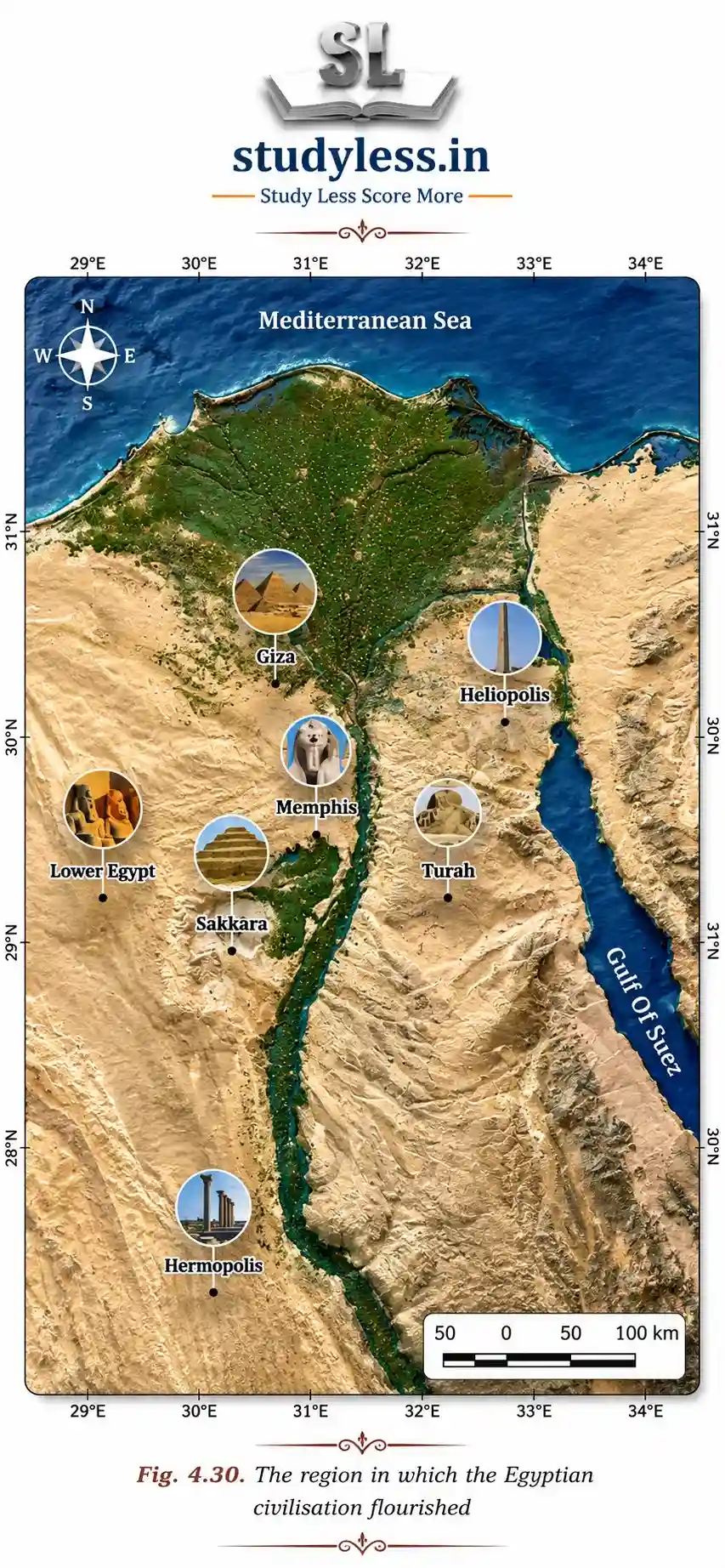
- Reconstructed mainly from papyrus records.
- These preserve stories and everyday life.
- They also reveal the Egyptians’ worldview.
What Did Egyptian Libraries Contain?
Ancient Libraries
- By 2000 BCE, libraries stored papyrus scrolls.
- Scrolls were kept in labelled jars on shelves.
Famous Works
- Included the oldest version of ‘Sindbad the Sailor’.
- Contained animal fables (linked to Aesop’s Fables).
- Also preserved tales of ghosts, miracles, romances, and the earliest known ‘Cinderella’ story.
Quick Revision
● Egyptian history is known from Herodotus (5th century BCE) and papyrus records.
● Libraries (2000 BCE) stored papyrus scrolls; stories include Sindbad, Aesop-linked fables, Cinderella. Calendar: 3 seasons (Inundation, Peret, Shemu), 365 days, based on Sirius.
● City-states emerged ~3000 BCE; Nile floods (kemet) enabled farming.
● Ditches, dams, reservoirs → collective effort → local government and administrative class.
● Pharaohs ruled; buried under a mastaba → pyramid (Saqqara); belief in ka and mummification.
● Leisure: swimming, board games, music; festivals like the Sed festival honoured gods and pharaohs.
The Chinese Civilisation
River Valley Civilisation
- Chinese civilisation grew along the Huang He (Yellow River) and Yangtze River.
- These valleys became centres of Neolithic culture around 7000 BCE.
How Did the Bronze Age Begin in China?
Beginning of the Bronze Age
- Around 2000 BCE, copper and bronze metallurgy began.
- Neolithic settlements, especially in the Yellow River basin, entered the Bronze Age.
Rise of Cities
- By 1600 BCE, the first urban centres emerged.
- Growth in agriculture, metallurgy, and crafts led to the first Chinese Bronze Age empire.
What Were the Major Chinese Dynasties?
Bronze Age Dynasties
- Chinese history is divided into dynasties.
- Shang Dynasty (1600–1046 BCE).
- Zhou Dynasty (1046–256 BCE).
Iron Age
- Iron became widely used by 600 BCE.
- This marked the beginning of the Chinese Iron Age.
Later Dynasties
- The name China likely comes from the Qin Dynasty (221–206 BCE), which unified the country.
- The Han Dynasty (206 BCE–220 CE) was another major Iron Age dynasty.
Timeline
7000 BCE → Chinese Neolithic cultures (Huang He, Yangtze)
2000 BCE → Copper/bronze metallurgy introduced
1600 BCE → Urban centres emerge; Shang dynasty begins
1600–1046 BCE → Shang dynasty
1046–256 BCE → Zhou dynasty
600 BCE → Iron Age begins
221–206 BCE → Qin dynasty (first imperial dynasty)
206 BCE–220 CE → Han dynasty
★★★★★ Must Remember: Qin dynasty = first imperial dynasty, gave China its name.
How do we know what we know about China?
Historical Sources
- China has abundant historical records.
- Official historiographers recorded important events.
Oracles
- The earliest records are oracles engraved on animal bones and tortoise shells.
- Bones were heated and the cracks interpreted to predict the future.
- Today, they reveal the beliefs, hopes, and fears of early Chinese people.
What Crafts Were Unique to Chinese Civilisation?
Jade Craft
- Jade was used to make ritual and prestige objects.
- As jade was imported, it was highly valuable.
Marble Craft
- Marble was carved into bird and animal ornaments.
- It was also used as bases for wooden pillars.
Bronze Craft
- The Chinese mastered bronze metallurgy.
- Bronze was used to make weapons, tools, and ritual vessels.
What Was the Great Wall of China?
Construction
- Built over nearly 2,000 years.
- The earliest walls were constructed from 680 BCE by the Zhou and other dynasties.
Purpose
- Built to protect against raids by nomadic tribes.
Expansion
- Separate walls were later joined together into a continuous defence system.
- Construction, expansion, and repairs continued until the 17th century CE.
Timeline
680 BCE → Initial walls built by Zhou and other dynasties
17th century CE → Expansion and repair of Great Wall continues
What Was the Importance of Silk?
Early Use
- Silk was known in China from the Neolithic Period (4000–3000 BCE).
- It became an important Bronze Age craft.
Silk Trade
- During the Han Dynasty (around the 2nd century BCE), silk became a major trade item.
- The famous trade network came to be known as the Silk Route.
★★★★★ Must Remember: Silk Route named after silk trade during Han dynasty (2nd century BCE).
What Was Chinese Society Like?
Social Structure
- By 1500 BCE, Chinese society was highly stratified.
- Ruling class, nobles, and aristocrats occupied the top.
- Farmers and labourers formed the lower groups.
- This became the foundation of China’s later social hierarchy.
How Did Bronze Age Civilisations Develop Overall?
Growth of Civilisations
- Bronze Age civilisations arose independently in fertile river valleys.
- Agriculture and new resources boosted economic growth.
- Prosperity led to the rise of urban centres.
Administration and Writing
- Civilisations developed social and administrative systems to manage growth.
- Writing systems recorded economic transactions and social activities.
- Later, writing gave rise to literature and creative works.
Legacy
- Many aspects of our culture and traditions have their roots in the Bronze Age civilisations.
Quick Revision
● Chinese civilisation grew along the Huang He and Yangtze rivers; Neolithic cultures from 7000 BCE.
● Bronze Age: Shang (1600–1046 BCE), Zhou (1046–256 BCE).
● Iron Age from 600 BCE; Qin dynasty (221–206 BCE) gave China its name; Han dynasty (206 BCE–220 CE).
● Oracles (bones/tortoise shells) = earliest source of Chinese historical information.
● Unique crafts: jade, marble, bronze ritual vessels.
● Great Wall: built from 680 BCE, expanded till 17th century CE.
● Silk known from the Neolithic period; Silk Route formed during the Han dynasty.
● Society stratified by 1500 BCE: rulers/nobles at top, farmers/labourers below.
● All Bronze Age civilisations: independent rise along rivers, urban growth, writing systems, lasting cultural influence.