The chapter 12 Patterns in [Exploration] Notes Ch 12 Patterns in Life: Diversity and Classification, is very lengthy and confusing.
Many different concepts were part of class 11 biology that are not included in your class 9 syllabus. And there are many closely related topics like Porifera, Cnidaria, etc.
Therefore, you need structured and to-the-point short notes for quick preparation and revision.
“Notes Ch 12 Patterns in Life Diversity and Classification” is what you need to master this chapter.
But these notes are neither a replacement nor a substitute for your NCERT textbook.
Happy reading!
India as a Biodiversity Hotspot.
What is Biodiversity?
Biodiversity is the immense variety of living organisms on Earth.
How does biodiversity keep nature running?
➢ Microscopic algae release most of the oxygen we breathe.
➢ Fungi and bacteria decompose waste and make soil fertile.
➢ Birds, bees, and bats pollinate flowers.
➢ Plants capture sunlight and produce food for nearly all life.
Why do humans need biodiversity?
Humans depend on biodiversity for food, shelter, medicines, and livelihoods.
➢ Farmers conserved diverse crop varieties for generations.
➢ Useful traits they preserved:
●Drought tolerance
●Pest resistance
➢ Ability to grow in nutrient-poor soils
➢ Diversity reduces crop failure risk and strengthens food security.
What Makes India a Biodiversity Hotspot?
➢ India’s landscape is highly diverse:
● North — Mountains
●West — Desert
●North East — Rainforests
●South — Plateaus
●Coastlines — Along the Arabian Sea and the Bay of Bengal
Each region has distinct soil types and different climatic conditions. These diverse habitats support a wide variety of species.
What are Endemic Species?
Endemic species are species restricted to a particular region and not found naturally anywhere else.
➢ Examples from India:
●Nilgiri tahr
●Lion-tailed macaque
●Nepenthes khasiana — Indian pitcher plant Neelakurinji
What are Biodiversity Hotspots?
Biodiversity hotspots are regions that support a large number of endemic species and have undergone significant habitat loss.
India’s major biodiversity hotspots:
➢ Western Ghats
➢ Indo-Burma (including North East India)
➢ Himalayas
➢ Sundaland (including Nicobar Islands)
How has the Biodiversity Evolved?
➢ Small differences among individuals affected their survival and reproduction.
➢ These differences helped organisms adapt to changing conditions.
➢ Changes accumulated over many generations.
➢ New forms of life arose from these accumulated changes.
Today’s biodiversity = result of continuous change over vast time, shaped by organism-environment interactions.
How to Classify Organisms?
Scientists first look at broad features, then study detailed features.
Some criteria to classify living organisms
What are the 7 Criteria for Classification?
| # | Criteria | What Scientists Look At |
|---|---|---|
| 1 | External features | Shape, size, body organisation |
| 2 | Mode of nutrition | Autotrophic or heterotrophic |
| 3 | Internal structures | Skeletal patterns, organs, tissues |
| 4 | Cell structure | Unicellular/multicellular, eukaryote/prokaryote, cell wall |
| 5 | Ecological role | Producer, consumer, decomposer |
| 6 | Reproduction | Asexual and/or sexual methods |
| 7 | Genetic similarity | Similarities in DNA |
Similar features in organisms suggest they evolved from common ancestors.
The Need for Classification
Biological classification is the scientific system of grouping living organisms based on their similarities and/or differences.
What are the benefits of biological classification?
➊ Makes a study of organisms organised and systematic.
➋ Helps understand similarities and differences among living beings.
➌ Shows how organisms relate and interact with one another.
➍ Helps identify and name newly discovered organisms.
➎ Supports biodiversity conservation — identifies species under threat of extinction.
➏ Let scientists worldwide use a common system for discussion.
Biological Classification
Systems Over Time
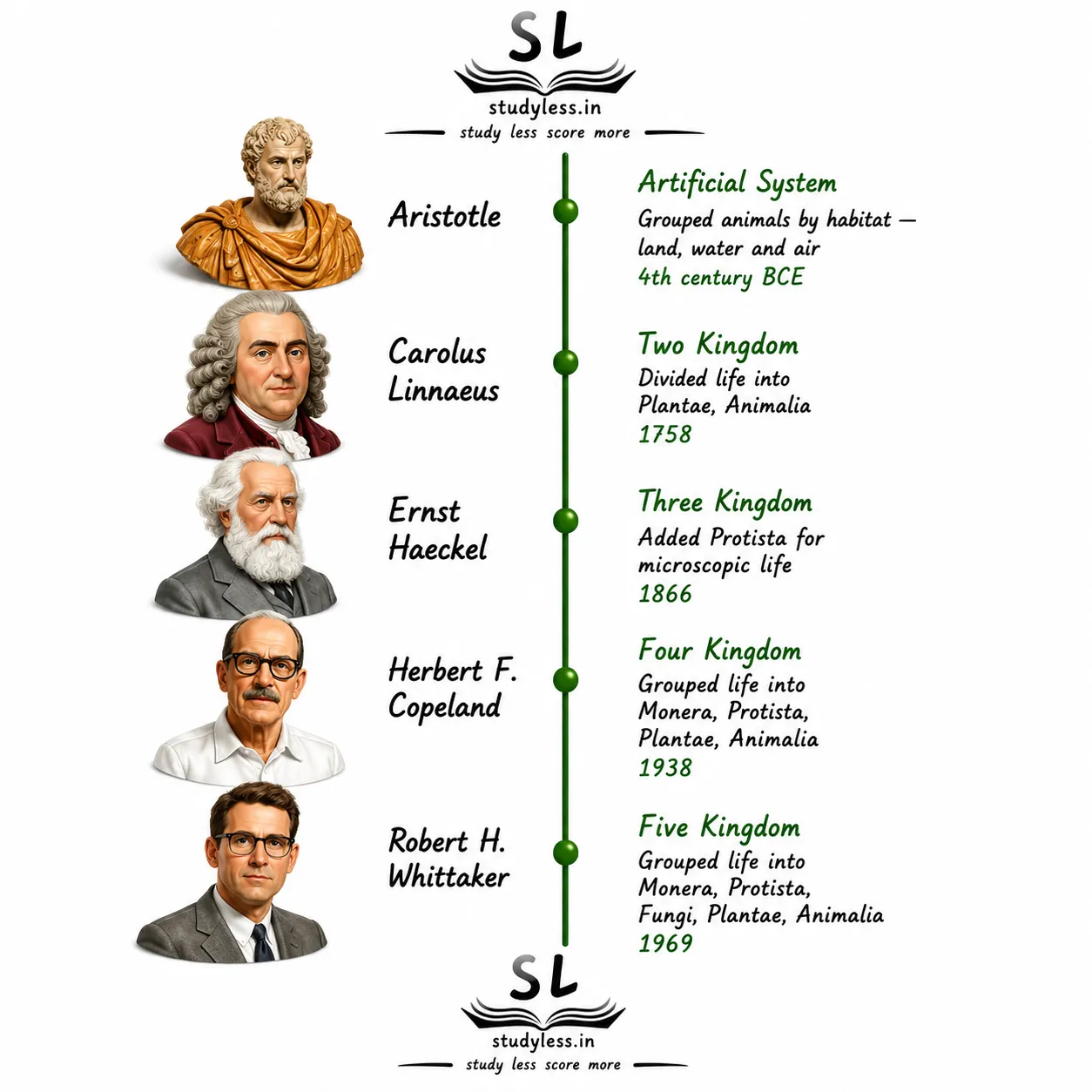
What did Aristotle propose?
➢ Classified animals based on their habitat — land, water, and air.
➢ He also grouped them by external appearances.
➢ Limitation — relied only on easily observable external characteristics.
What was the Two Kingdom System?
1. Plantae
Organisms that do not move and synthesise their own food.
2. Animalia
Organisms that move and depend on other organisms for food.
Problem — Where do Amoeba, Paramecium, and bacteria go?
➢ Amoeba and Paramecium move like animals but are unicellular and heterotrophic.
➢ Plants and animals are multicellular, so they didn’t fit.
Why was a Third Kingdom Added?
➢ Scientists added Protista to include unicellular microscopic organisms.
➢ This resolved the confusion around Amoeba and Paramecium.
Why was a Fourth Kingdom Added?
Improved microscopes revealed a key difference:
➢ Amoeba has a true nucleus (membrane-bound).
➢ Bacteria do not have a true nucleus.
Therefore, Bacteria were placed in a separate kingdom — Monera.
Four Kingdom System:
➊ Plantae,
➋ Animalia,
➌ Protista,
➍ Monera
➢ Protista — unicellular organisms with a true nucleus.
➢ Monera — unicellular organisms without a true nucleus.
Why was a Fifth Kingdom Added?
Scientists observed that fungi, like mushrooms:
➢ Do not move like animals.
➢ Have a heterotrophic mode of nutrition.
➢ Obtain nutrients by absorption — mostly from dead and decaying matter.
➢ Some are symbiotic, some are parasitic.
Fungi didn’t fit any existing kingdom, so a separate kingdom, Fungi, was created.
What is the Five Kingdom System?
| Kingdom | Key Feature |
|---|---|
| Monera | Unicellular, no true nucleus |
| Protista | Unicellular, true nucleus |
| Fungi | Heterotrophic, absorb nutrients |
| Plantae | Multicellular, autotrophic |
| Animalia | Multicellular, heterotrophic, move |
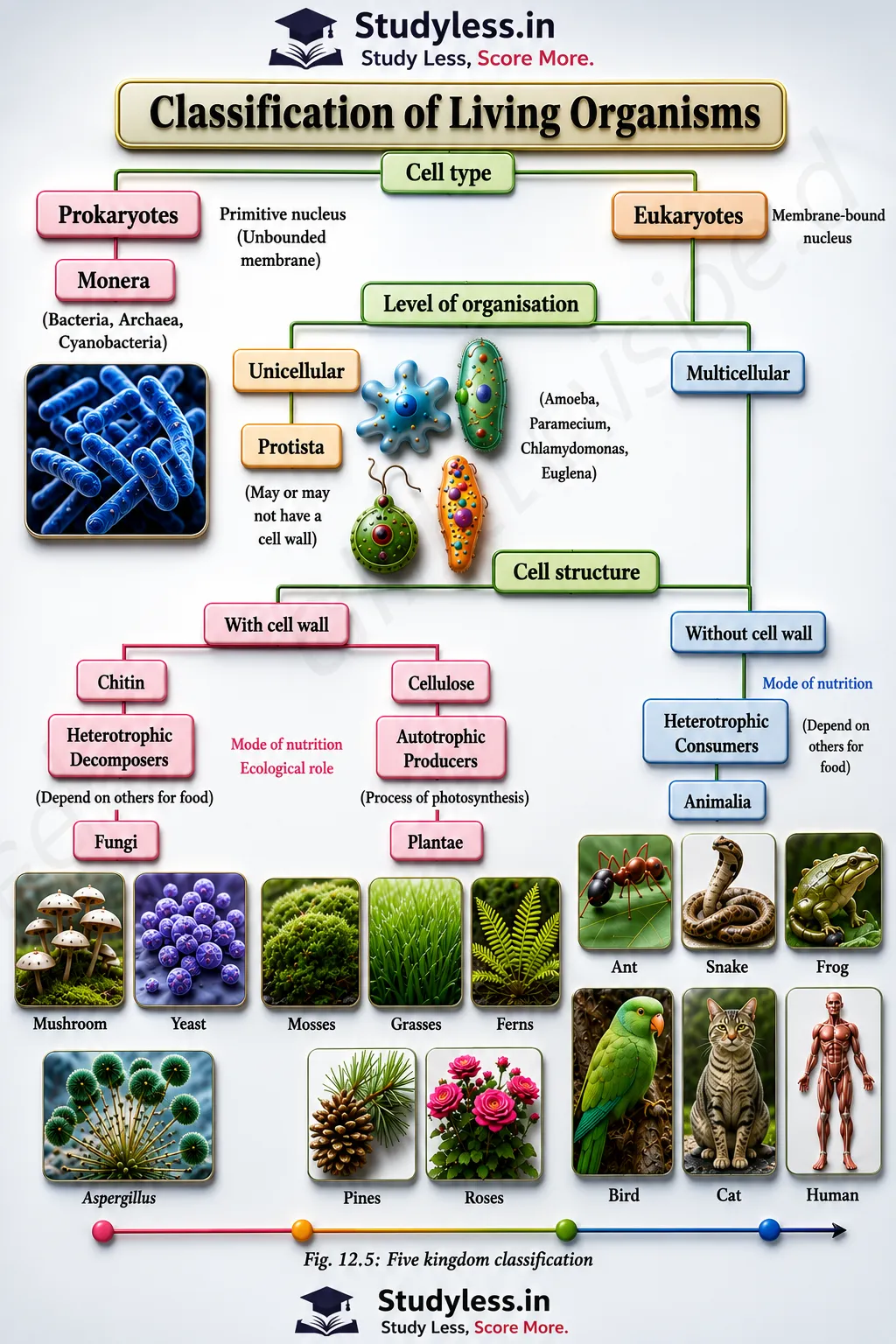
Five Kingdom Classification
All organisms are grouped according to common features.
Kingdom Monera — Unicellular prokaryotes
What is Kingdom Monera?
Kingdom Monera = Unicellular Prokaryotes
➢ Includes bacteria and cyanobacteria.
➢ They are single-celled prokaryotes — no true nucleus.
Where are bacteria found?
➢ Soil, water, air, hot springs, extreme environments, and inside human bodies.
➢ Found in the gut of ruminants.
➢ Responsible for biogas production from animal dung.
What roles do bacteria play?
➢ Harmful bacteria — called pathogens– cause diseases.
➢ Useful bacteria:
●Lactobacillus — used in making curd.
●Rhizobium — fixes nitrogen in soil.
➢ Cyanobacteria act as autotrophs and decomposers.
➢ Some bacteria break down pollutants like oil, pesticides, and sewage.
Kingdom Protista — Unicellular eukaryotes
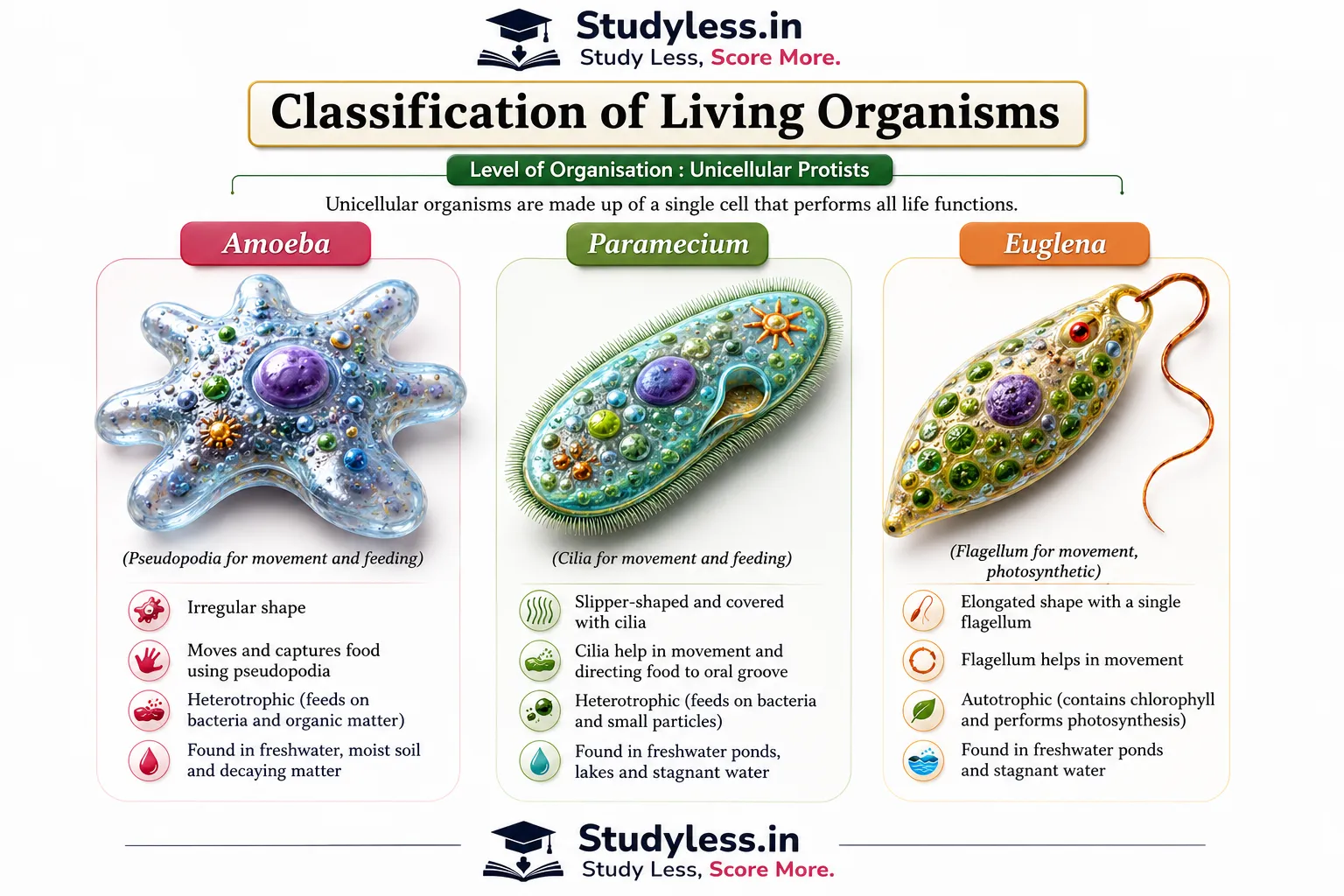
common protists| Microscopic illustration of common protists
What is Kingdom Protista?
Kingdom Protista — Unicellular Eukaryotes
➢ Includes all single-celled eukaryotes without a cell wall, or with a cell wall made of cellulose.
➢ They are microscopic and highly diverse.
➢ Live in water or moist places.
What roles do Protists play?
➢ Some are autotrophic, others are heterotrophic.
➢ They are an important link in aquatic food chains.
➢ Some produce oxygen, others serve as food for small animals.
➢ Some act as decomposers and help in nutrient cycling
Kingdom Fungi —Multicellular, heterotrophic
eukaryotes with a cell wall
What is Kingdom Fungi?
Kingdom Fungi — Multicellular Heterotrophic Eukaryotes with a Cell Wall
➢ Mostly multicellular eukaryotes with cell walls made of chitin.
➢ They do not make their own food.
➢ Absorb nutrients through fine filaments — together called mycelium.
What roles do Fungi play?
➢ Most fungi are saprophytes — feed on dead organic matter.
➢ They break down complex organic matter into simpler substances.
➢ They make minerals readily available in soil.
➢ Some form mutualistic (symbiotic) relationships with other organisms.
➢ Some are parasites — cause diseases in plants and animals.
How do Fungi reproduce?
➢ Reproduce both sexually and asexually.
➢ Often reproduce by forming spores.
➢ Grow best in warm and moist conditions.
Examples of Fungi :
Yeast
unicellular, but placed in Fungi due to a chitin cell wall.
Mushrooms
macroscopic fungi, reproduce by spores.
Bread mould
a common fungus.
Aspergillus and Penicillium
are used to make enzymes and antibiotics.
Why are Fungi ecologically important?
➢ Without fungi, decay of dead plants and animals would greatly reduce.
➢ This would adversely affect soil fertility and ecological balance.
Kingdom Plantae — Multicellular, autotrophic
eukaryotes with a cell wall
What is Kingdom Plantae?
Kingdom Plantae — Multicellular Autotrophic Eukaryotes with a Cell Wall
➢ Do photosynthesis.
➢ Cells have a rigid cell wall made of cellulose, which provides support and protection.
Why are plants important?
➢ The base of most food chains.
➢ release oxygen
Kingdom Plantae is divided into five classes.
- Thallophyta
- Bryophyta
- Pteridophyta
- Gymnosperm
- Angiosperm
Thallophyta (algae) — Primitive plants
What are Thallophytes?
Thallophyta — Primitive Plants (Algae)
➢ Thallos = undifferentiated body, phyton = plant.
➢ Simplest plant forms.
➢ Found in water or moist environments.
➢ Form a thallus — a simple, undifferentiated body.
➢ Thallus allows the direct exchange of gases, nutrients, and water.
➢ Adapted to aquatic habitats.
Example — Spirogyra
Bryophyta — First steps on land,
still need water
What are Bryophytes?
Bryophyta — First Steps on Land, Still Need Water
➢ Bryon = moss, phyton = plant.
➢ Represent the shift from water to land.
➢ More differentiated body than thallophytes.
➢ Possess root-like structures called rhizoids.
➢ May have simple stem-like and leaf-like structures.
➢ Survive in moist and shady places — grow as green mats.
➢ Seen on damp rocks, old walls, and soil during monsoons.
Examples — Marchantia, moss, liverworts.
Why are Bryophytes called the ‘amphibians’ of the plant kingdom?
➢ They require water for reproduction.
➢ They colonised land but remain dependent on moisture.
Pteridophyta — Adaptation to land and
having structural transport system
What are Pteridophytes?
Pteridophyta — Adapted to Land with a Transport System
➢ Pteris = feather, phyton = plant.
➢ Possess true roots, stems, and leaves.
➢ Have specialised vascular tissue for transport:
●Xylem — transports water.
●Phloem — transports food.
➢ Need aquatic conditions for reproduction.
➢ Do not produce seeds.
Example — ferns.
Gymnosperms — Reproduction without water
What are Gymnosperms?
Gymnosperms — Reproduction Without Water
➢ Gymnos = naked, spermos = seed.
➢ Adapted to cold and dry regions.
➢ Have needle-like or scale-like leaves — reduce water loss.
➢ Produce seeds – protect the embryo and contain stored food.
➢ Do not require water for fertilisation.
➢ Seeds are not enclosed in fruits — often exposed on cones.
Examples — pines, cycads.
Angiosperms —
Efficient reproduction and seed dispersal
What are Angiosperms?
Angiosperms — Most Efficient Reproduction and Seed Dispersal
➢ Angeion = vessel, spermos = seed.
➢ Also called flowering plants.
➢ Have the most complex body organisation among plants.
➢ Produce flowers and fruits.
● Flowers — attract pollinators, increase reproduction efficiency.
● Fruits — help spread seeds to new locations.
➢ These features allow angiosperms to occupy a wide range of environments.
➢ They are the most diverse plant group on Earth.
Kingdom Animalia — Multicellular, heterotrophic
eukaryotes
Kingdom Animalia — Multicellular Heterotrophic Eukaryotes
➢ Animals are multicellular and heterotrophic organisms.
➢ They depend on other organisms for food.
Key characteristics of animals:
●Locomotion — the ability to move.
●Rapid response to stimuli.
●Coordinated behaviour.
These abilities allow animals to:
●Actively search for food.
●Avoid predators.
●Interact dynamically with their surroundings.
How are Animals Classified?
The major criterion for classifying animals is the presence or absence of a notochord.
Notochord — a flexible, rod-shaped structure.
Based on the notochord, animals divide into two major groups:
| Group | Notochord | Also Called |
|---|---|---|
| Non-Chordata | Absent | Invertebrata |
| Chordata | Present | — |
In some chordates, the notochord acts as a precursor for the development of the vertebral column.
How is Chordata Further Divided?
Protochordata :
primitive chordates.
Vertebrata:
Have a well-developed vertebral column.
Invertebrates — Animals without a notochord
What are Invertebrates?
Invertebrates — animals that lack a notochord.
➢ Body organisation = simple to complex.
➢ Studying them shows a change of animal body over time
Porifera (pore-bearers) — Multicellularity without tissues
What are Porifera?
Porifera — Multicellular Without Tissues (pore-bearers)
➢ Sponges = simplest animal body plans.
➢ Multicellular but lacks tissues and organs.
➢ Numerous pores allow water to flow through the body.
➢ Water brings food particles and oxygen directly to individual cells.
➢ Water carries waste away.
➢ Sponges: fixed in one place.
➢ Found only in aquatic environments
Cnidaria — True tissues and active feeding
What are Cnidaria?
Cnidaria — True Tissues and Active Feeding
➢ Show tissue-level organisation.
➢ Use tentacles to capture prey — do not depend on water currents.
➢ Possess only a single opening for food intake and waste removal.
➢ Examples — Hydra, jellyfish, and corals.
Platyhelminthes (flatworms) — Bilateral symmetry and
directional movement
What are Platyhelminthes?
Platyhelminthes — Bilateral Symmetry and Directional Movement (Flatworms)
➢ Show bilateral symmetry — body divides into two halves along one plane.
➢ Have distinct head-tail and front-back regions.
➢ Bilateral symmetry allows better coordination of movement.
➢ Flattened bodies allow efficient gas diffusion — no respiratory organs needed.
➢ Still possesses only a single opening for food intake and waste removal.
➢ Many flatworms are parasitic.
➢ Parasitic forms have hooks and suckers — attach to host tissues.
Nematoda (roundworms) — Efficient body design with two
openings
What are Nematoda?
Have elongated, cylindrical bodies.
➢ Body structure allows efficient movement through soil, water, or host tissues.
➢ Possess two openings — mouth and anus.
➢ Have organ system level of body organisation.
➢ Organ systems are distinct in male and female worms.
Annelida (segmented worms) — segmentation and body cavities
What are Annelida?
Annelida — Segmentation and Body Cavities (Segmented Worms)
➢ Bodies are cylindrical and divided into segments.
➢ Possess organ system level of organisation.
➢ Muscles help in locomotion.
➢ Nerve cord helps in control and coordination.
➢ Segmentation allows greater flexibility and precise movement control.
➢ A body cavity is present.
Example — earthworm.
Arthropoda — Jointed appendages and an external skeleton
What are Arthropoda?
Arthropoda — Jointed Appendages and an External Skeleton
➢ Arthro = limbs, poda = appendages.
➢ Have segmented bodies — different segments specialised for different functions.
➢ Possess a hard external skeleton (rigid external covering).
➢ Allows survival in dry and exposed environments.
The external
skeleton:
Provides protection.
Reduces water loss.
Supports powerful muscles.
Examples — insects, crabs, spiders.
Mollusca — Organ system level organisation with soft bodies
What are Mollusca?
Mollusca — Organ System Level with Soft Bodies
➢ Show organ system level of organisation.
➢ Have soft bodies.
➢ Many molluscs develop a shell — provides protection.
The body has three
distinct parts:
Head
Muscular foot
Hump
Examples — snails, squids, octopuses.
Echinodermata — Internal support without a notochord
What are Echinodermata?
Echinodermata — Internal Support Without a Notochord
➢ Echinos = spiny, derma = skin.
➢ Possess a hard internal skeleton made of calcium carbonate.
➢ The internal skeleton provides protection and controlled movement.
➢ Lack a notochord — yet show body organisation similar to more complex animals.
➢ Represent a gradual shift towards internal skeletal support.
Examples — starfish, sea urchins.
Looking across invertebrates
Protochordates — The appearance of the notochord
What are Protochordates?
Protochordates — The Appearance of the Notochord
➢ Possess a notochord at least once during their life.
➢ The notochord provides internal support without restricting movement.
➢ They are primitive chordates.
➢ Help us understand how animals with a notochord arose from simpler forms.
Example — Amphioxus.
Vertebrates — Animals with a backbone
What are Vertebrates?
Vertebrates — Animals with a Backbone
➢ Vertebrates possess a vertebral column (backbone).
➢ The backbone is an internal skeletal structure.
➢ It supports the body and protects vital organs — the brain and spinal cord.
This framework allows:
➢ Larger body size.
➢ Efficient movement.
➢ Development of complex organ systems.
Vertebrates show advanced sensory abilities and coordinated behaviour.
How are Vertebrates Classified?
Vertebrates are classified into five groups based on habitat, body covering, and reproduction:
Fish, Amphibians, Reptiles, Birds and Mammals
Adaptations as Outcomes of Structural Change
The diversity in animals today results from changes in body structure over long periods.
➢ Fish — fins and gills allow movement and breathing in water.
➢ Birds — feathers and hollow bones make flight possible.
➢ Camels — fat storage supports survival in extreme heat.
➢ Polar bears — thick fur supports survival in extreme cold.
➢ Mammals — mammary glands improve survival of young ones.
The hierarchical nature of classification
What is the Hierarchical Nature of Classification?
Classification follows a step-by-step order — from broad groups to specific ones.
➢ At each lower level, organisms share more common features.
➢ Every lower group is part of the group above it.
The hierarchy:
Kingdom ➜ Phylum ➜ Class ➜ Order ➜ Family ➜ Genus ➜ Species
Scientific Naming — The Binomial System
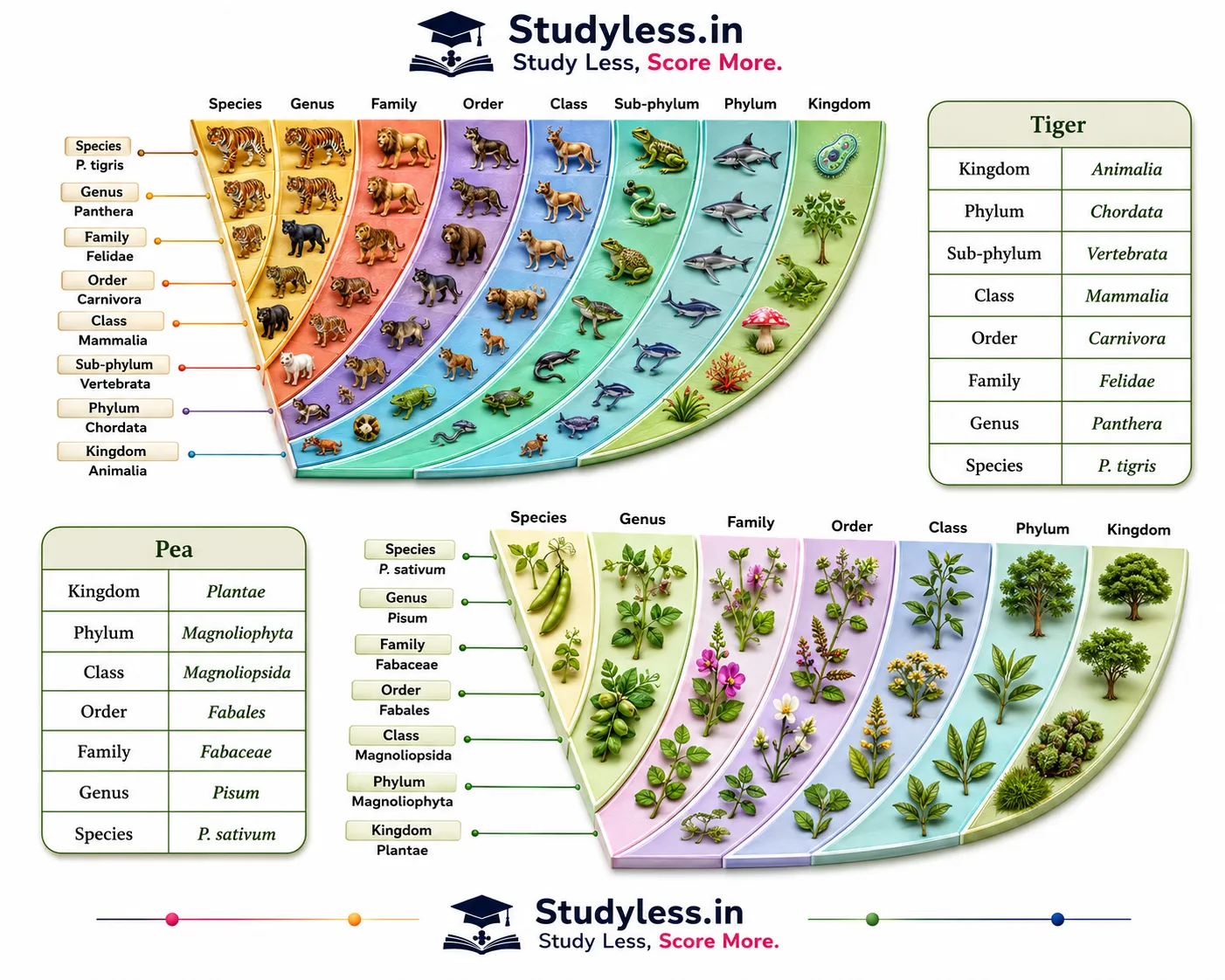
What is the Binomial System of Naming?
Binomial nomenclature — a universal system of naming living organisms.
➢ Introduced by Carolus Linnaeus in the 18th century.
➢ Every organism gets a scientific name with two parts, written in Latin or a Latinised form.
Examples:
| Common Name | Scientific Name |
|---|---|
| Tiger | Panthera tigris |
| Mango | Mangifera indica |
| Lion | Panthera leo |
➢ First word — Genus name (e.g., Panthera).
➢ Second word — Species name (e.g., tigris).
●A genus groups closely related species sharing common features.
●A species consists of similar individuals capable of interbreeding and producing offspring.
Rules for writing the scientific names
What are the Rules for Writing Scientific Names?
- The name has two parts — genus and species.
- The genus name begins with a capital letter and comes first.
- The species name is written in small (lower case) letters.
- The name is written in italics when printed.
- The name is underlined when handwritten.
Fossils as Evidence
What are Fossils and Why Do They Matter?
Fossils — preserved remains of plants and animals found in layers of rocks, sand, and mud.
➢ Older layers contain simpler organisms.
➢ Newer layers show more complex forms.
➢ Important fossils — giant dinosaurs, early humans, and ancient plants- were discovered in India.
➢ Fossils act as natural records that show how life changed over millions of years.
Biodiversity Under Threat
How is Biodiversity Under Threat?
➢ Every species — large or small — plays an important role in nature:
➢ Plants — produce food and oxygen.
➢ Animals — pollinate flowers and disperse seeds.
➢ Microorganisms — recycle nutrients.
Human activities are reducing biodiversity:
➢ Pollution
➢ Deforestation
➢ Overuse of resources
➢ Climate change
When one species disappears, others that depend on it may also decline and disappear.
…………….End Of Short Notes…………….