
“Cell: The Building Block of Life Ch 2 Notes Class 9” is created from your new NCERT science textbook – Exploration for class 9. We made these short notes to present to you the most important points and concepts.
These Cell: The Building Block of Life Ch 2 Notes Class 9 are specifically designed to act as your ultimate revision companion, condensing complex biological structures into high-impact, easy-to-remember points.
Why should you keep revising Cell: The Building Block of Life, Ch 2 Notes Class 9?
- Memory Consolidation: Frequent revision moves information from your short-term memory to long-term retention, making exam recall effortless.
- Clarity on Demand: Whether you’re stuck on the “Fluid-Mosaic Model” or the differences between Mitosis and Meiosis, these notes provide instant clarity.
- Time Efficiency: Instead of scanning through heavy textbooks, these short notes allow you to cover the entire chapter in a fraction of the time.
For more class 9-related study materials, Class 9 Science Notes.
Dive in, keep reviewing, and watch your confidence grow!
Introduction: “Did Life Begin in Hot Springs?”
Origin of Life
- Life likely began in water
- Helped by changing conditions
- Some scientists suggest
small water pools, not oceans- Example- Hot springs
- Example- Hot springs
Puga Valley Hot Springs
(Ladakh, India)
- Temperatures are nearly at the boiling point of water
- Conditions similar to early Earth (~3.5 billion years ago)
- Early Organisms
- Thermophiles
- Heat-loving,
- Unicellular bacteria
- Lives in hot springs
- Thermophiles
- Early Organisms
Role of Calcium Carbonate Deposits
Protective
Functions
- Calcium carbonate forms
quickly near hot springs - Protected early molecules
from radiation and harsh conditions - Helped form the first cell membrane
The Cell — Basic Unit of Life
● All living organisms are made up of cells
● Cell = the basic level at which life exists
| Cell Type | Description | Examples |
|---|---|---|
| Unicellular | Single cell | Bacteria, Yeast |
| Multicellular | Millions of cells working together | Plants, Fish, Humans |
Organisation of Life
Cells → Tissues → Organs → Organ Systems → Organism
● Tissue — a group of similar cells performing similar functions
● Organ — different tissues organised together
● Organ System — several organs working together
Example: Respiratory System
Nasal pores → Nasal cavity → Trachea → Lungs
How to Study Cells?
Limit of Resolution (Human Eye)
The ability to see two close objects as separate and distinct
- At 25 cm (near point), the eye can distinguish two points 0.1 mm apart
- Closer than that → appear as a single point
- Most cells are smaller than 0.1 mm
- Therefore, invisible to the naked eye
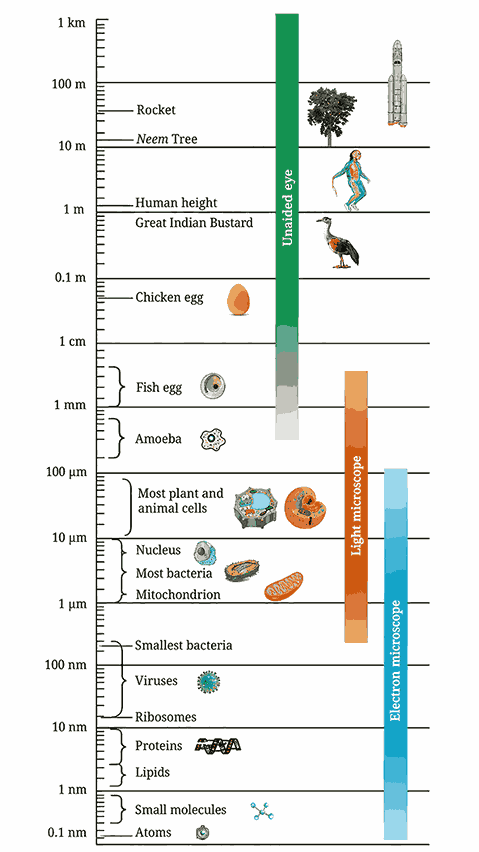
unaided to aided eye|Cell The Building Block of Life Ch 2 Notes Class 9
Microscope Basics
- Uses a convex lens (or a combination of lenses) to magnify objects
- Key lenses: Objective lens + Eyepiece
- Total Magnification = Eyepiece power × Objective lens power
- e.g., 10X eyepiece × 10X objective = 100X total
Robert Hooke (1665)
- First person to observe a cell
- Observed a thin slice of cork → saw box-like compartments → named them “cells.“
Light Microscope
- Used in school labs
- Common objective lenses: 10X, 40X
- Works under visible light
Parts of a Light Microscope
● Eyepiece → Body tube → Objective lens → Stage → Mirror
● Fine & Coarse adjustment knobs → Handle → Base
Estimating Cell Size
Formula:
Example:
● Field diameter = 5000 μm, cells seen = 25
● Cell size = 5000 ÷ 25 = 200 μm
Unit to remember:
1 mm = 1000 μm
Features of a Microscope
| Brightness difference between parts of an object | Meaning |
|---|---|
| Resolution | Clarity / ability to distinguish fine detail |
| Contrast | Brightness difference between parts of object |
| Magnification | Brightness difference between parts of an object |
Structure of a Cell For Class 9
Cell Membrane
Universal feature of all cells
● Thin boundary surrounding the cell → protects contents
● Also called the plasma membrane
● Selectively permeable → allows some substances in/out, blocks others
● Present in all living cells (including single-celled organisms)
Movement Across the Cell Membrane
1. Diffusion
Movement of particles from higher to lower concentration
● Occurs without a membrane
● Driven by a concentration gradient
2. Osmosis
Diffusion of water across a selectively permeable membrane
● Water moves from a dilute to a concentrated solution
● Continues until concentrations equalise
● Example: Water enters plant root cells from the soil
Types of Solutions (Effect on Cells)
| Water enters the cell | Condition | What Happens |
|---|---|---|
| Isotonic | External = Internal concentration | No net water movement |
| Hypotonic | External < Internal concentration | Water enters cell |
| Hypertonic | External > Internal concentration | Water leaves cell |
Structure of Cell Membrane For Class 9
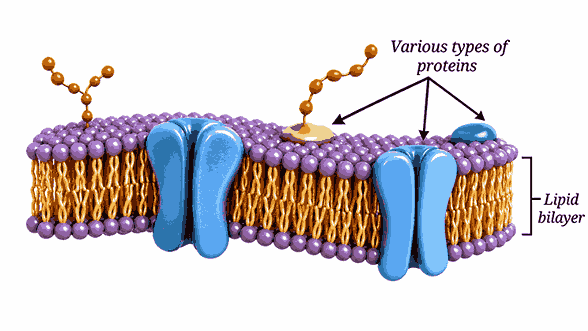
Fluid-Mosaic Model
- Thickness: 7–10 nm (1 nm = 0.000001 mm)
- Made of lipids + proteins
Key Features
- Lipid bilayer — two fat layers
- Heads face outward (water-attracting)
- Tails face inward (water-repelling)
- Proteins embedded → act as gatekeepers for substances
- Molecules can move, flip, rotate → hence “fluid.”
- Molecules arranged like tiles → hence “mosaic.”
Cell Wall For Class 9
Found in: Plants, Fungi, Bacteria — NOT in Animal cells
| Feature | Detail |
|---|---|
| Location | Outside the cell membrane |
| Nature | Rigid + fully permeable |
| Main material | Cellulose (a carbohydrate made of glucose units) |
| Function | Shape, support, protection from environmental stress |
Why Plants
Need It
- Plants are stationary → need rigid support
- Withstands wind, rain, and other stresses
- Keeps leaves and flowers firm and upright
Cell Wall vs No Cell Wall
| Cell membrane shrinks (plasmolysis), but cell shape is retained | Plant Cell (has a wall) | Animal Cell (no wall) |
|---|---|---|
| In hypertonic solution | Cell membrane shrinks (plasmolysis), but cell shape retained | Cell shrinks completely |
| Shape | Fixed, box-like (e.g., onion peel) | Irregular, flexible (e.g., cheek cells) |
| Flexibility | Low | Cell membrane shrinks (plasmolysis), but the cell shape is retained |
Cellulose from plant cell walls acts as dietary roughage in humans, aiding digestion.
The Cell Interior — A Coordinated Working System
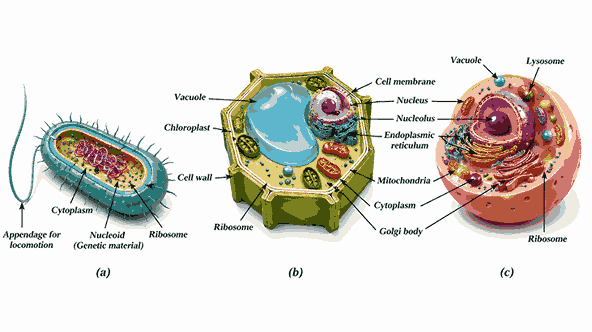
Three Basic Parts of a Cell
Plasma membrane
selectively permeable boundary
Cytoplasm
semi-fluid, jelly-like substance
Nucleus
prominent control centre
Cytoplasm also contains organelles — sub-cellular components, mostly visible only under an electron microscope
Cell Structures — Which Cell Has What?
| Structure | Bacterial | Plant | Animal |
|---|---|---|---|
| Cell membrane | ✔ | ✔ | ✔ |
| Cell wall | ✔ | ✔ | ❌ |
| Cytoplasm | ✔ | ✔ | ✔ |
| Well-defined nucleus | ❌ | ✔ | ✔ |
| Nucleoid (primitive nucleus) | ✔ | ❌ | ❌ |
| Membrane-bound organelles | ❌ | ✔ | ✔ |
Prokaryotic vs Eukaryotic Cells
| Occurs in the cytoplasm | Prokaryotic | Eukaryotic |
|---|---|---|
| Meaning | Pro = primitive, karyon = nucleus | Eu = true, karyon = nucleus |
| Nucleus | ❌ No defined nucleus (has nucleoid) | ✔ Well-defined, membrane-bound |
| Membrane-bound organelles | ❌ Absent | Occurs in the cytoplasm |
| Typical size | 1–10 μm | 10–100 μm |
| No. of cells | Usually unicellular | Unicellular or multicellular |
| Cellular activities | Occur in cytoplasm | Occur in organelles |
| Example | Bacterial cell | Occurs in the cytoplasm |
Why Do Eukaryotic Cells Need Organelles?
● To carry out multiple life processes simultaneously
● Each organelle does a specific job
● Together they: build materials, remove waste, provide energy
Think of a cell as a tiny living factory — each organelle is a department with its own role
Specialised structures present inside a cell | Cell Organelles
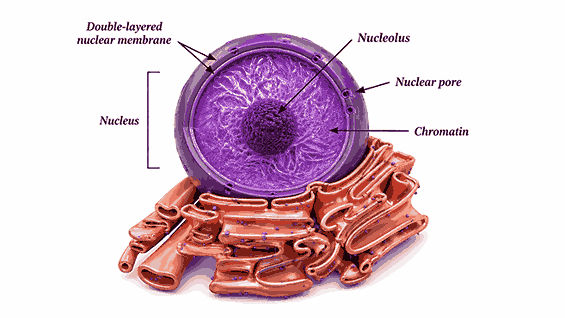
1. Nucleus — House of coded instructions
= Control centre of the cell
● Covered by a double-layered nuclear membrane with
● Has pores (allow material transfer to the cytoplasm)
● Contains nucleolus → site of ribosomal subunit synthesis
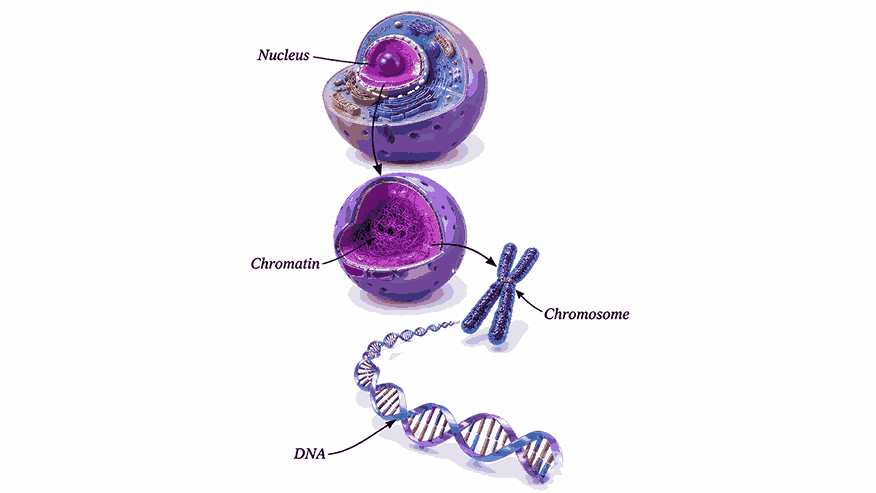
Genetic Material
| State | Form | Visible? |
|---|---|---|
| Non-dividing cell | Chromatin (tangled threads) | Barely |
| Dividing cell | Chromosomes (rod-shaped) | Yes |
● Chromosomes = DNA + proteins.
● DNA contains genes — functional segments carrying hereditary info
● Prokaryotes → DNA as a single circular molecule in a region called
the nucleoid (no membrane)
2. Ribosomes:
Protein Factories
- Tiny structures, found:
- Freely in the cytoplasm
- Attached to the Endoplasmic Reticulum
- Function: Protein synthesis
- Assembled in the cytoplasm from subunits made in the nucleolus
3. Endoplasmic Reticulum (ER) — Manufacturing Network
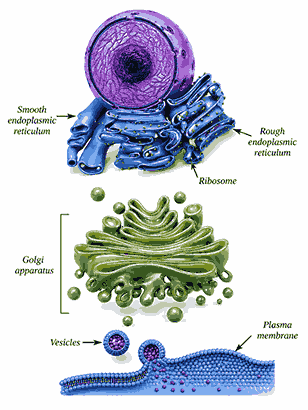
- Large network spreading through the cytoplasm
- Connected to the outer nuclear membrane
| Type | Appearance | Function |
|---|---|---|
| RER (Rough ER) | Has ribosomes → looks rough | Protein synthesis & secretion (e.g., pancreatic cells) |
| SER (Smooth ER) | No ribosomes → looks smooth | Synthesis & storage of fats & hormones |
4. Golgi Apparatus — Post Office of the Cell
- Stacks of flattened sac-like structures
- Linked to ER, cell membrane & other organelles
- Functions:
- Modifies proteins & lipids
- Sorts & packages them into vesicles
- Sends them for: transport, secretion, or lysosome formation
5. Lysosomes — Clean-Up Staff
- Single membrane-bound sacs filled with enzymes
- Break down: unwanted proteins, carbs, fats, damaged organelles
- Breakdown products → released into cytoplasm for reuse
6. Mitochondria — Powerhouse of the Cell
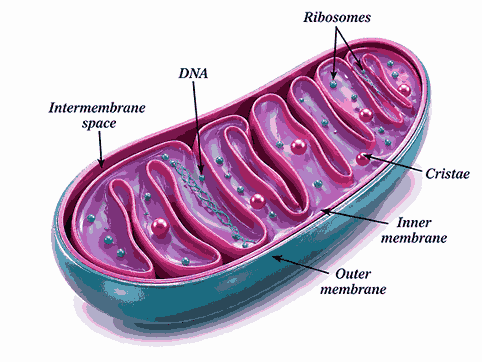
● Surrounded by two membranes, Outer → smooth & porous
● Inner → folded into cristae (↑ surface area for reactions)
● Site of cellular respiration → glucose is broken down to release energy
● Energy stored as ATP (Adenosine Triphosphate) — the cell’s energy currency
● Mitochondria have their own DNA & ribosomes → can make some of their own proteins → hints at evolutionary link with bacteria
7. Plastids — Plant Cell Specialists
Only in plant cells
| Type | Pigment | Function |
|---|---|---|
| Chloroplast | Chlorophyll (green) | Photosynthesis → makes & stores sugars/starch |
| Chromoplast | Yellow / Orange / Red | Gives colour to flowers & fruits → attracts pollinators & animals |
| Leucoplast | None (colourless) | Stores food — starch, oils, proteins (e.g., potato, taro) |
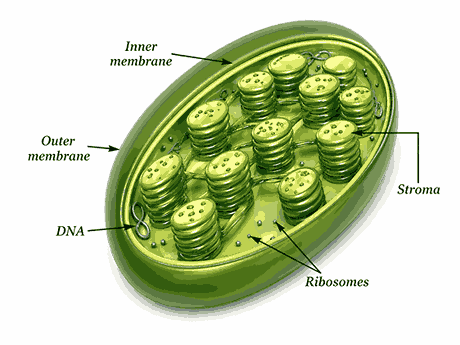
Inside a Chloroplast:
● Double membrane-bound (like mitochondria)
● Contains stroma (semi-fluid) → stores sugars & starch granules
● Disc-shaped structures in the stroma contain chlorophyll → absorb light
“💡 Like mitochondria, plastids also have their own DNA & ribosomes → evolutionary link with bacteria“
8. Vacuoles — Storage & Support
| Vacuoles Features | Plant Cell | Animal Cell |
|---|---|---|
| Size | Large, central | Small |
| Number | Usually one | Sometimes present |
| Membrane | Selectively permeable | — |
| Contents | Water, minerals, sugars, waste (cell sap) | Temporary materials |
| Role | Maintains cell pressure → keeps plant firm | Temporary storage |
💡 Plant wilts when the vacuole loses water → cells become less firm
How do Normal Cells Grow and Divide?
Why Do Cells
Divide?
- Cells can only grow to a certain size
- Body growth = cells dividing, not just getting bigger
- Cell division replaces old, dead, or damaged cells
- Examples: Skin healing after a cut, new hair growing back
Cell Division — The Basics For Class 9
- New cells always form from pre-existing cells
- Allows: growth, repair, and reproduction
- Both prokaryotes & eukaryotes divide
- Eukaryotes divide in a controlled way via the cell cycle
Two Major Types Of Cell Division
| Main Points | 1. Mitosis | 2. Meiosis |
|---|---|---|
| Purpose | Growth, repair, maintenance, asexual reproduction | Sexual reproduction, genetic diversity |
| Where | Body (somatic) cells | Reproductive organs only |
| Divisions | Growth, repair, maintenance, and asexual reproduction | 2 |
| Daughter cells produced | 2 | 4 |
| Chromosomes in daughter cells | Same as parent | Half of parent |
| Daughter cells identical? | ✅ Yes | ❌ No |
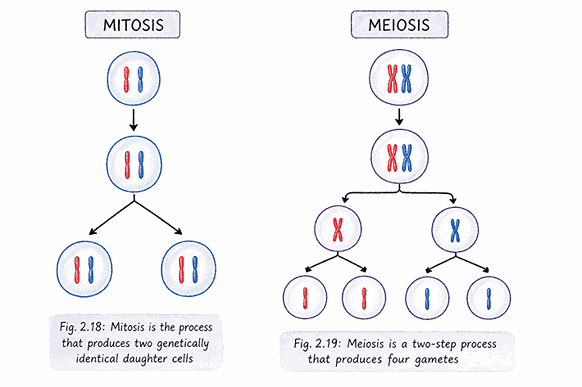
1. Mitosis
- The most common type of cell division
- One parent cell → 2 genetically identical daughter cells
- Each daughter cell gets:
- Same DNA
- Same number of chromosomes as the parent
- Ensures genetic consistency across all body cells
- Example: A single fertilised egg divides repeatedly → trillions of body cells
2. Meiosis
- Occurs only in reproductive organs
- Produces gametes (sperm & egg cells)
Where It Occurs
| Organism | Male | Female |
|---|---|---|
| Animals | Testes → sperm | Ovaries → eggs |
| Plants | Anthers → pollen | Ovaries → egg cells |
How It Works
Division 1
- Parent cell splits into 2.
- chromosomes are reduced to half
Division 2
- Each of those 2 cells splits again (like mitosis)
Result → 4 daughter cells, each with half the chromosomes
At fertilisation → two gametes combine → original chromosome number restored
This is why children resemble parents, but are not identical, because meiosis creates variation
What If Cell Division Goes Wrong?
| Error in | Consequence |
|---|---|
| Mitosis | Genetic disorders, developmental problems, early pregnancy loss, and reduced fertility |
| Meiosis | Genetic disorders, developmental problems, early pregnancy loss, reduced fertility |
Cell Theory — The Unifying Principle of Biology
Historical Development
| Year | Scientist | Contribution |
|---|---|---|
| 1838 | Matthias Schleiden (German botanist) | All plants are made of cells |
| 1839 | Theodor Schwann (German zoologist) | All animals are made of cells |
| 1855 | Rudolf Virchow (German scientist) | New cells arise only from pre-existing cells |
Classical Cell Theory: 3 Principles
- Organisms are made of one or more cells
- A cell is the basic unit of structure and function
- All cells arise from pre-existing cells
Do cells grow and reproduce forever?
● No — every cell has a definite lifespan
● Cells: grow → divide → function → die when no longer needed
● Dead cells → replaced by new cells with the same function
What Happens If This Goes Wrong?
| Problem | Result |
|---|---|
| Cells don’t die when they should | Uncontrolled growth → tumours |
| Cells die too early | Loss of function, tissue damage |
Contact Inhibition
- In most animal cells, division stops when cells touch neighbouring cells
- This is called contact inhibition
- Cancer cells lose this control → divide uncontrollably = tumours
- Plant cells do NOT show contact inhibition → rigid cell wall causes a different growth pattern
What Can a
Cell Do?
- Produce energy
- Synthesise & secrete substances
- Divide to form new cells
- Work together to maintain body functions
FAQs: Cell: The Building Block of Life Ch 2 Notes Class 9
1. Why is the cell called the structural and functional unit of life?
The cell is known as the structural unit because all living organisms are composed of cells, and the functional unit because all vital biological processes (like respiration and excretion) occur at the cellular level. These Cell: The Building Block of Life Ch 2 Notes Class 9 explain how organelles work together to sustain life.
2. What are the 3 main points of the Classical Cell Theory?
According to the Classical Cell Theory developed by Schleiden, Schwann, and Virchow:
- All living organisms are made of one or more cells.
- The cell is the basic unit of structure and function in organisms.
- All cells arise from pre-existing cells.
3. What is the difference between Prokaryotic and Eukaryotic cells?
Prokaryotic cells (like bacteria) lack a defined nucleus and membrane-bound organelles. In contrast, Eukaryotic cells (such as plant and animal cells) have a well-defined nucleus and specialised organelles, such as mitochondria and plastids.
4. Which organelle is known as the “Powerhouse of the Cell” and why?
The mitochondria are called the powerhouse of the cell because it is the site of cellular respiration, where glucose is broken down to release energy in the form of ATP (Adenosine Triphosphate).
5. How does Mitosis differ from Meiosis in cell division?
Mitosis is used for growth and repair, resulting in two identical daughter cells with the same number of chromosomes. Meiosis occurs only in reproductive organs to produce gametes, resulting in four daughter cells with half the number of chromosomes to ensure genetic diversity.
Devi ji thoda chota likh lata Himank from class 9th.
Jai baba ki
Pata nhi kaha kaha se aate he aaise log
Jai babe ki 🤬🤬
Rajasthan mount Abu st Mary’s school near sitavan
Bhai is jagah pe aise log kaha se prakat ho gye 😔✌️
Time bhi kam hai aur ye mujhe pura khatam karna hai 😭😭
Okok
Oh ho
This shi is legendary bro W notes keep it up also, when u gon release for english and maths and other subjects
Thanks, we will work on that very soon.
I want this solution Book pls