
Mastering Tissues in Action, Chapter 3, class 9, doesn’t have to be overwhelming.
These Notes: Tissues in Action Ch 3 Class 9 are specifically designed to simplify complex concepts into easy-to-digest segments.
Whether you are preparing for a weekly test or the final exams, having a structured guide is essential. Our notes follow the latest CBSE curriculum to ensure you stay on track with your studies.
Why These Notes are Best
- New Syllabus Aligned: Fully updated to match the current CBSE requirements and marking schemes.
- Quick Revision: Short, punchy sentences help you memorise definitions and functions faster.
- Exam Focused: Important keywords are highlighted, and frequently asked diagrams are included.
Using these Notes: Tissues in Action Ch 3 Class 9, you can save hours of reading time while ensuring total clarity
Check Out Other class 9-related free study resources
What Is Tissue
A group of similar cells working together for a specific function.
Different tissues → division of labour → increases efficiency & enables complex life processes.
Examples
In Animals
Muscle tissue ➜ movement
Nervous tissue ➜ carries messages
In Plants
Xylem ➜ transports water & minerals
Phloem ➜ transports food
Why are Plant and Animal Tissues Different?
Why Plant and Animal Tissues Differ
| Feature | Plants | Animals |
|---|---|---|
| Movement | Fixed/immobile | Can move |
| Cell wall | Present (rigid) | Absent (flexible) |
| Nutrition | Photosynthesis | Digest external food |
| Transport | Distinct tissues for food & water | Distinct tissues for food & water |
| Growth tissues | Differ in structure & function | Differ in structure & function |
1. Cell wall
Gives plants rigidity & support
2. No cell wall in animals
Cells change shape easily ➜ enables locomotion
3. Plants use solar energy
To make food
4. Animals have digestive tissues
To process food from external sources
Tissues for Growth in Plants
A Meristematic Tissue
➽ Made of actively dividing cells
➽ Responsible for all types of plant growth
Types of Plant Growth
| Type | What grows |
|---|---|
| Length | Stem height & root depth |
| Girth | Stem thickness |
| Regrowth | After cutting/grazing |
1. Apical Meristem — How do plants grow in length?
Apical Meristem
➽ Located at the tips of roots and shoots
➽ Cells divide continuously
➽ Function ➜ helps plants grow in length
Root tip & shoot tip = growth zones = Apical Meristems
2. Lateral meristem — How do plants grow in girth?
Lateral Meristem
➽ Responsible for the increase in girth (diameter) of stems
➽ Found in dicot plants
➽ Cells are arranged in a ring in the stem
➽ Divides to produce new cells inside & outside (concentric manner)
Annual Growth Rings
➽ Visible on the cut surface of the tree trunk
➽ Wide rings ➜ favourable growth conditions
➽ Narrow rings ➜ unfavourable growth conditions
➽ Used to estimate the age of a tree & understand past climate conditions
3. Intercalary meristem — How do plants grow after being cut?
Intercalary Meristem
➽ Located at the base of the internode / just above the node
➽ Helps plants regrow after cutting or grazing
➽ Example: grass regrows after mowing; hedges become bushy after cutting
Node = point where branches/leaves arise
Internode = part of the stem between two nodes
Types of Meristems
| Type | Location | Function |
|---|---|---|
| Apical | Root & shoot tips | Growth in length |
| Lateral | Along stem circumference | Growth in girth |
| Intercalary | Base of internode / above node | Regrowth after cutting |
Cell Structure of Meristematic Tissue
➽ Small cells, thin cell walls
➽ Large nucleus, dense cytoplasm
➽ No vacuoles (vacuoles store water/waste; absence allows more space for organelles needed for rapid division)
➽ Tightly packed, no intercellular space ➜ All these features allow continuous & rapid cell division
Differentiation
The process by which meristematic tissue that becomes specialised to perform specific functions is called differentiation.
➽ Some new cells remain meristematic
➽ Others lose the ability to divide ➜ change in structure & function → become permanent tissue
➽ Permanent tissues perform specific functions ➜ support, transport, storage
Meristematic tissue ➜ (differentiation) ➜ Permanent tissue
Permanent Tissues
➽ Formed by the differentiation of meristematic tissue
➽ Each tissue is specialised for a specific function
Types of Permanent tissues
| Type | Composition |
|---|---|
| Simple | One type of cell |
| Complex | More than one type of cell |
I. Protective Tissues
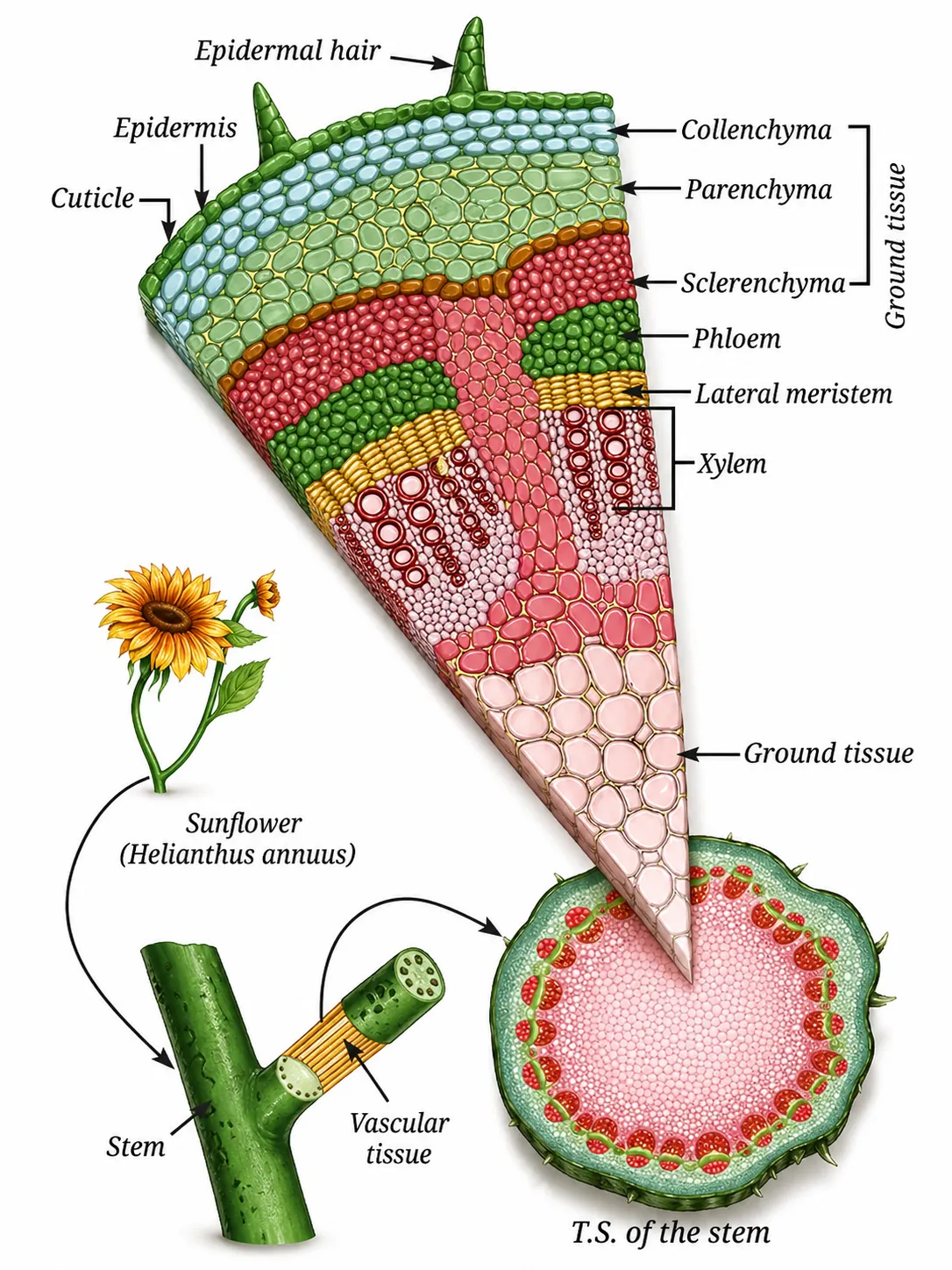
Epidermis — Protective tissue
➽ Outermost layer of the plant body
➽ Single layer of flat, rectangular, tightly packed cells
➽ Protects against: mechanical injury, water loss, microorganisms, extreme conditions
Cuticle
➽ A waxy layer of cutin covering epidermal cells
➽ Thick cuticle in dry habitat plants ➜ reduces water loss
➽ Also protects against mechanical injury & parasites
Key Structures of Epidermis
| Structure | Location | Function |
|---|---|---|
| Root hair | Roots | Increases surface area for absorption of water & minerals |
| Stomata | Leaves | Gaseous exchange & transpiration |
Stomata are the pores in leaves that help in gaseous exchange and transpiration
Transpiration (via Stomata)
➽ Evaporation of water vapour through stomata
➽ Creates transpiration pull in xylem ➜ aids water transport
➽ Also helps eliminate waste from the plant body
II. Supporting tissue — Simple permanent tissues
3 types
Parenchyma, Collenchyma, Sclerenchyma
Comparison
| Feature | Parenchyma | Collenchyma | Sclerenchyma |
|---|---|---|---|
| Cells | Living | Living | Mostly dead |
| Wall | Thin | Unevenly thickened (corners) | Thick |
| Material | — | Pectin | Lignin |
| Packing | Loosely packed | — | Tightly packed |
Functions of Supporting Tissue
Parenchyma
➽ Stores food
➽ Performs photosynthesis (in green parts)
➽ In aquatic plants ➜ forms air spaces ➜ helps them float
Collenchyma
➽ Provides support & flexibility
➽ Allows bending without breaking (stems, tendrils)
Sclerenchyma
➽ Makes plant parts hard & strong
➽ Found in stems, leaf veins, and seed coats
➽ Examples: coconut husk, walnut shell
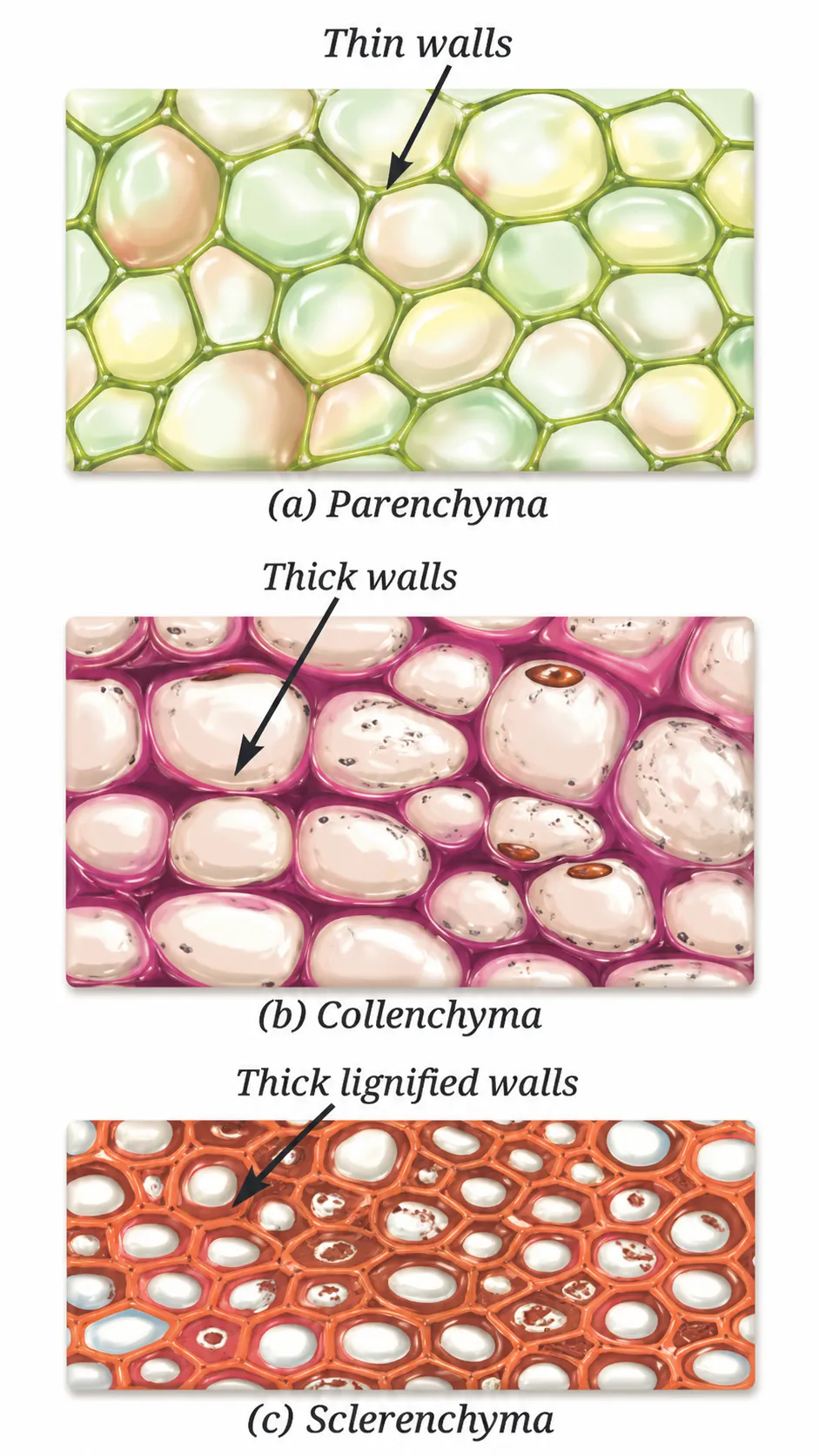
Simple permanent tissues| Notes: Tissues in Action Ch 3 Class 9
Fresh twig bends ➜ collenchyma (flexible) Dry twig breaks ➜ sclerenchyma (rigid/dead cells)
III. Conducting tissues — Complex permanent tissues
Made of different types of cells working together ➜ called complex
Xylem vs Phloem
| Feature | Xylem | Phloem |
|---|---|---|
| Function | Transports water & minerals (roots ➜ plant) | Transports food (leaves ➜ plant) |
| Living cells | Only xylem parenchyma | Most cells are living |
| Components | Tracheids, vessels, xylem parenchyma, xylem fibres | Sieve tubes, companion cells, phloem parenchyma, phloem fibres |
| Extra function | Provides strength | Stores food, resin, tannins, and latex |
Key Components of Xylem and Phloem
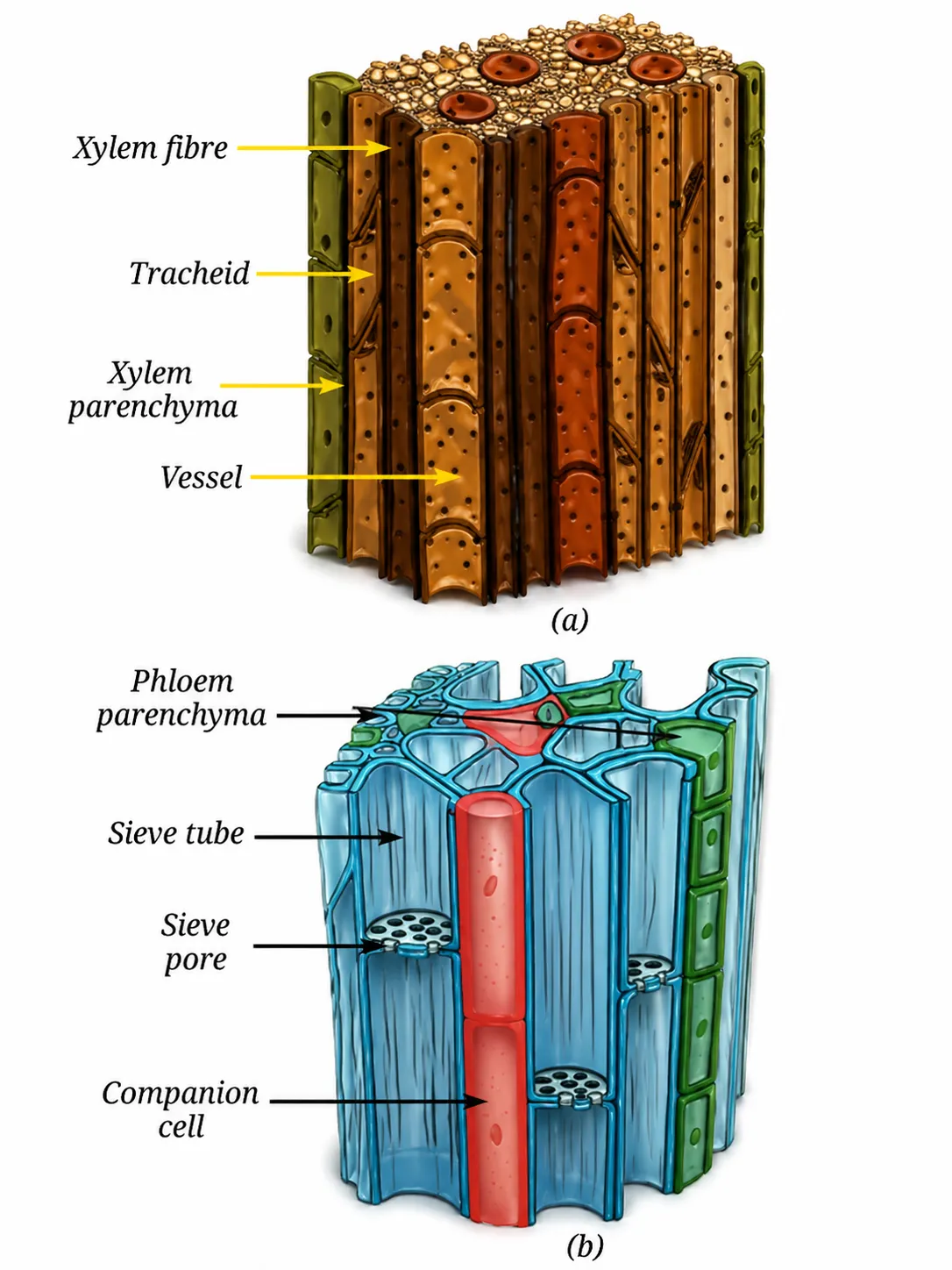
1. Xylem
➽ Tracheids & vessels ➜ tubular, thick-walled, dead (sclerenchymatous)
➽ Xylem parenchyma ➜ only living component
2. Phloem
➽ Sieve tubes ➜ long, tubular, joined end-to-end with perforated walls ➜ transport food
➽ Companion cells ➜ regulate sieve tube functions; monitor loading/unloading of sugars
➽ Phloem fibres ➜ sclerenchymatous ➜ provide strength
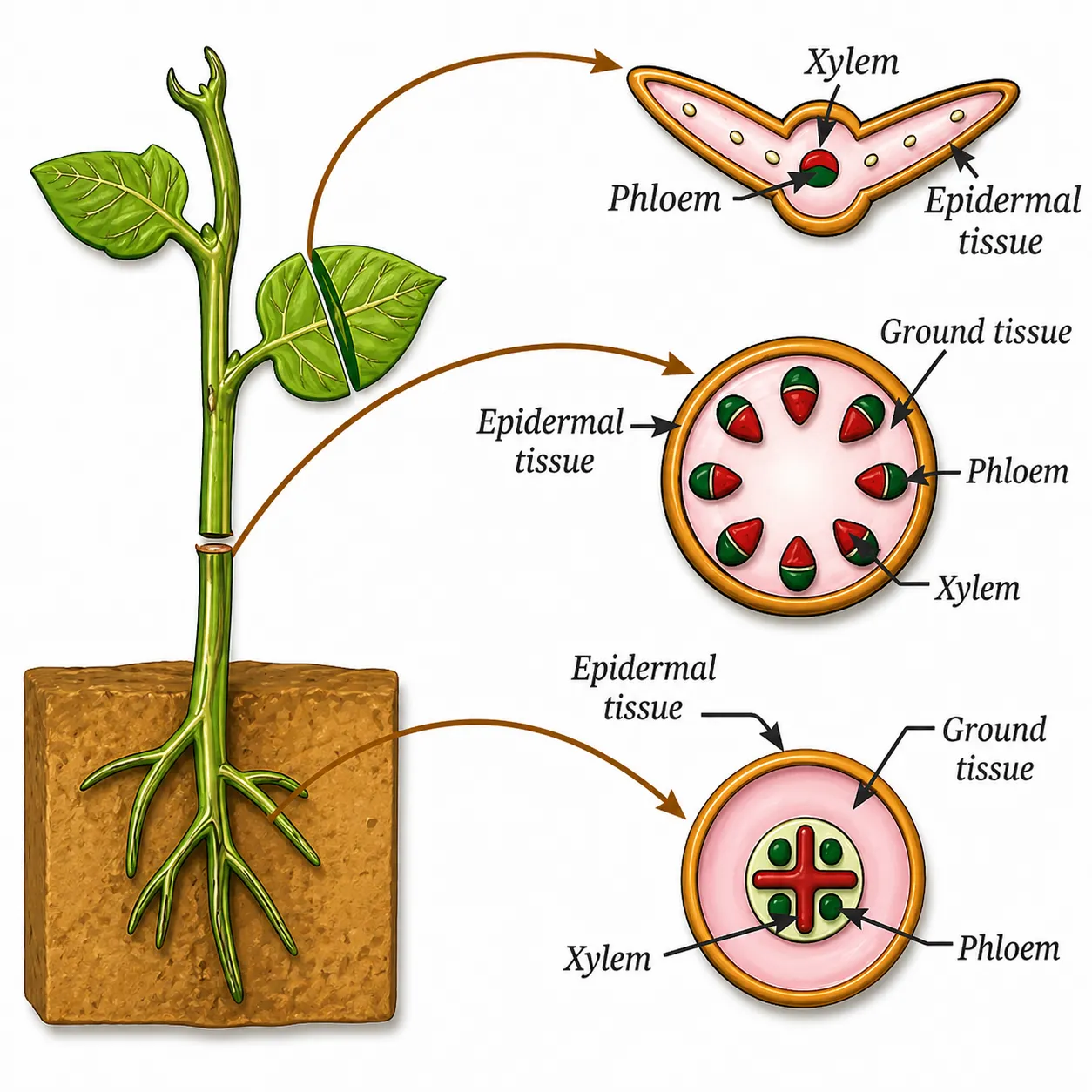
Plant tissues are organised into three tissue systems
| Forms the main body of the plant | Components | Function |
|---|---|---|
| Dermal | Epidermis | Outer covering, protection, reduces water loss |
| Ground | Parenchyma, Collenchyma, Sclerenchyma | Forms main body of plant |
| Vascular | Xylem & Phloem | Conduction of water & food |
Animal Tissues
Groups of similar cells specialised for different functions
1. Epithelial tissues — Structure and functions
➽ Forms the outer covering of the body (skin) & lines the internal organs
➽ Cells are closely packed with very little space
➽ Prevents germ entry, reduces water loss, aids absorption & secretion
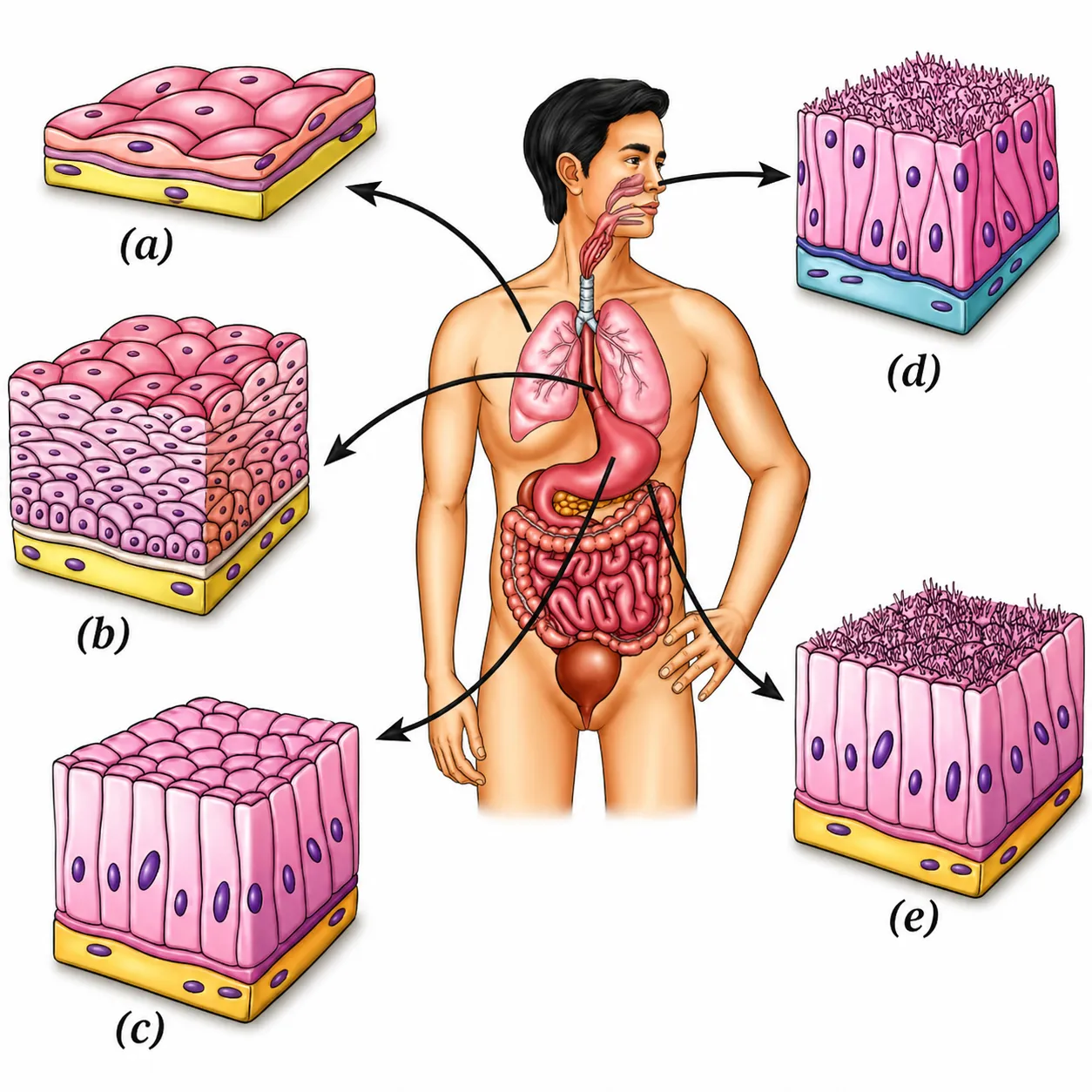
Types of Epithelial Tissue
| Function | Structure | Location |
|---|---|---|
| Exchange (diffusion of gases & liquids) | Single layer, thin, flat cells | Blood vessels, lungs |
| Protection (from injury, friction, microbes) | Many layers; outer cells flat & tightly packed | Skin, mouth, oesophagus |
| Secretion (mucus, enzymes, hormones, sweat) | Cuboidal or columnar cells | Salivary glands, sweat glands, stomach lining |
| Sensory (smell, taste, sound, balance) | Specialised receptor cells with hair-like cilia | Nostrils, taste buds, inner ear |
| Absorption (nutrients, water) | Single layer, tall pillar-like cells with hair-like structures | Single-layer, tall pillar-like cells with hair-like structures |
How are various parts connected in our body? – Connective Tissues
2. Connective Tissue
Connects and supports other tissues.
Key feature: matrix (determines consistency)
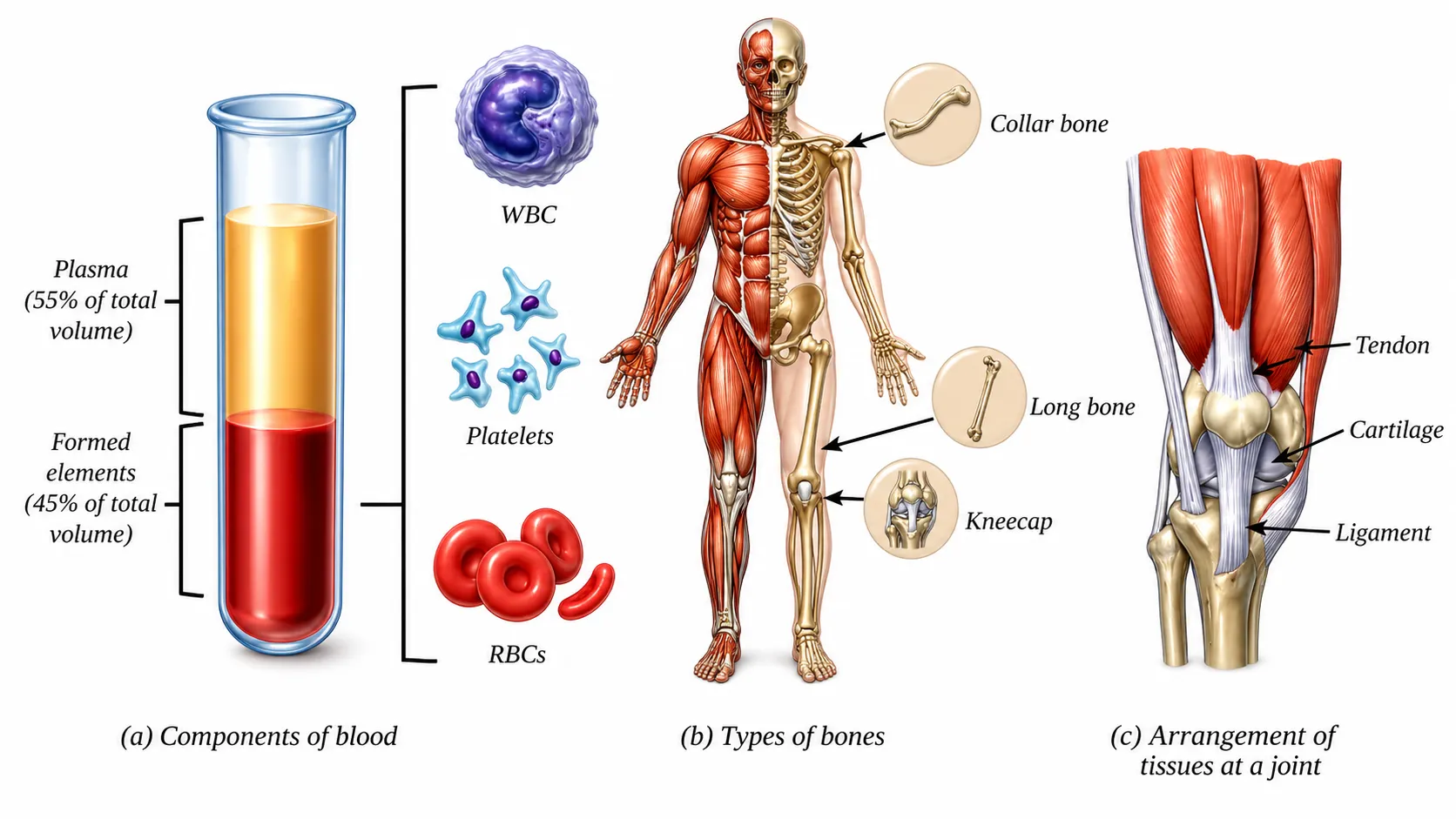
Blood
Matrix is watery/jelly-like → fluid consistency
Red colour → haemoglobin (iron-rich protein in RBCs)
| Component | Function |
|---|---|
| RBCs | Carry oxygen (live ~4 months) |
| WBCs | Blood clotting at the injury site |
| Platelets | Blood clotting at injury site |
Types of Connective Tissue
| Tissue | Matrix | Connects | Function |
|---|---|---|---|
| Bone | Hard, rigid (calcium & phosphorus) | — | Strength, support, protection |
| Cartilage | Soft, jelly-like | — | Flexibility, cushions bone ends, shock absorption |
| Tendon | — | Muscle ➜ Bone | Brings about movement |
| Ligament | — | Bone ➜ Bone | Stability, limits movement, prevents dislocation |
Key distinction:
Blood = fluid matrix ➜ flows Bone = rigid matrix ➜ hard & strong
Can we control movement in our body? – Muscle Tissue
Voluntary movements
Are under our conscious control, such as running, writing or lifting objects
Involuntary movements
Occur automatically without conscious control, for example
the movement of food in the intestine and the beating of the heart
3. Muscle Tissue
Muscle cells = muscle fibres
Responsible for movement in the body
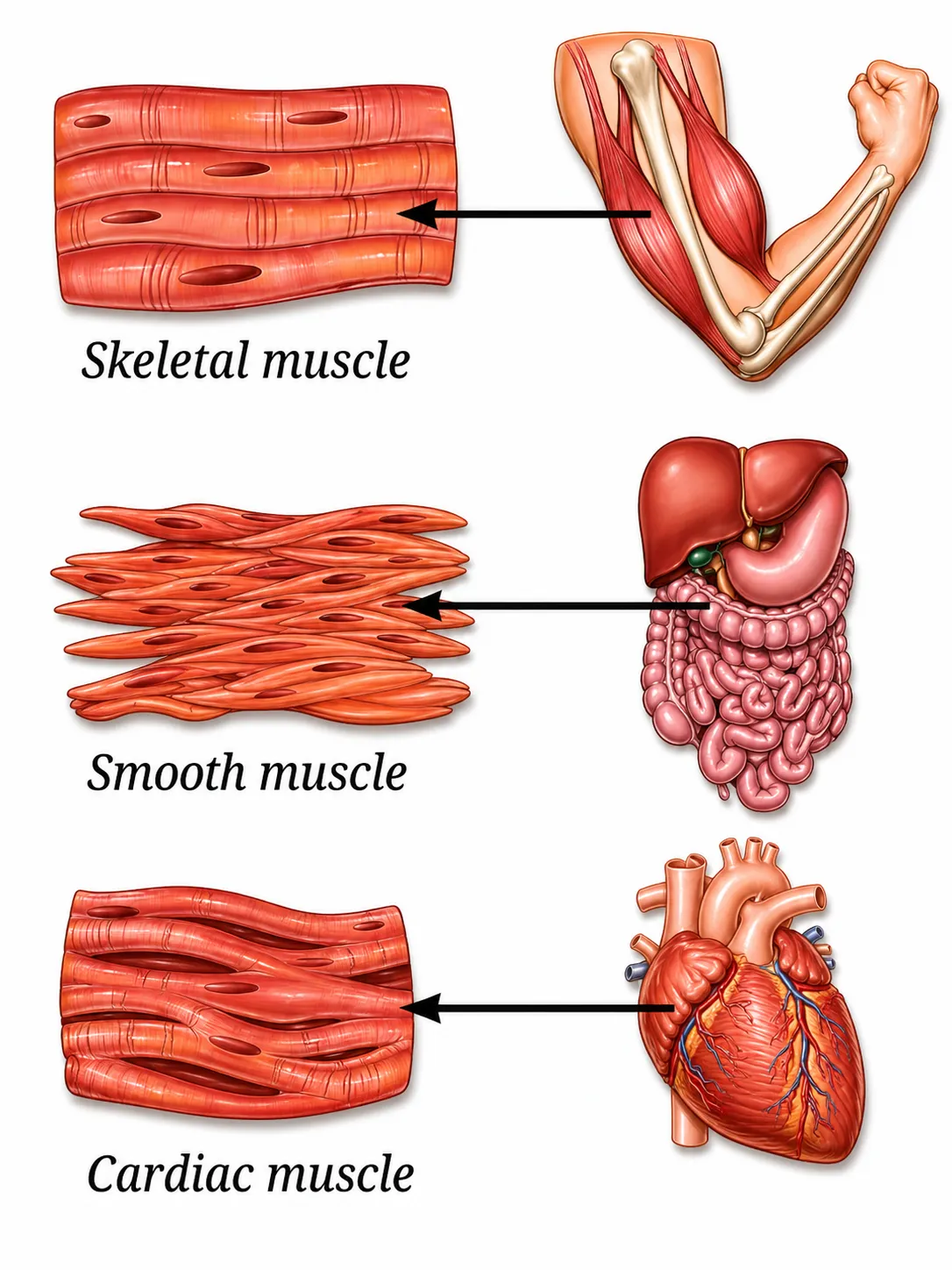
A. Skeletal Muscle
➽ Attached to the skeleton
➽ Controls voluntary movements ➽ (running, writing, lifting)
➽ Cells: long, cylindrical, unbranched
➽ Multinucleate (many nuclei)
➽ Striated (light & dark bands)
B. Smooth Muscle
➽ Found in internal organs (stomach, intestines)
➽ Controls involuntary movements (digestion, food movement)
➽ Cells: spindle-shaped, unbranched
➽ Single nucleus, no striations
Produces slow, continuous movements
C. Cardiac Muscle
➽ Found only in the heart
➽ Involuntary, works throughout life without fatigue
➽ Cells: cylindrical, branched
➽ Single nucleus, faint striations
➽ Contracts rhythmically
How does the body sense, communicate and respond?
4. Nervous Tissue
●The cells of nervous tissue are called neurons
●Forms the body’s control & coordination network
●Specialised to receive, process & transmit messages
Brain
➽ Acts as a control centre
➽ Coordinates activities, memory & responses
➽ Example:
During exercise ➜ brain signals the heart to beat faster for more oxygen
Structure of a Neuron
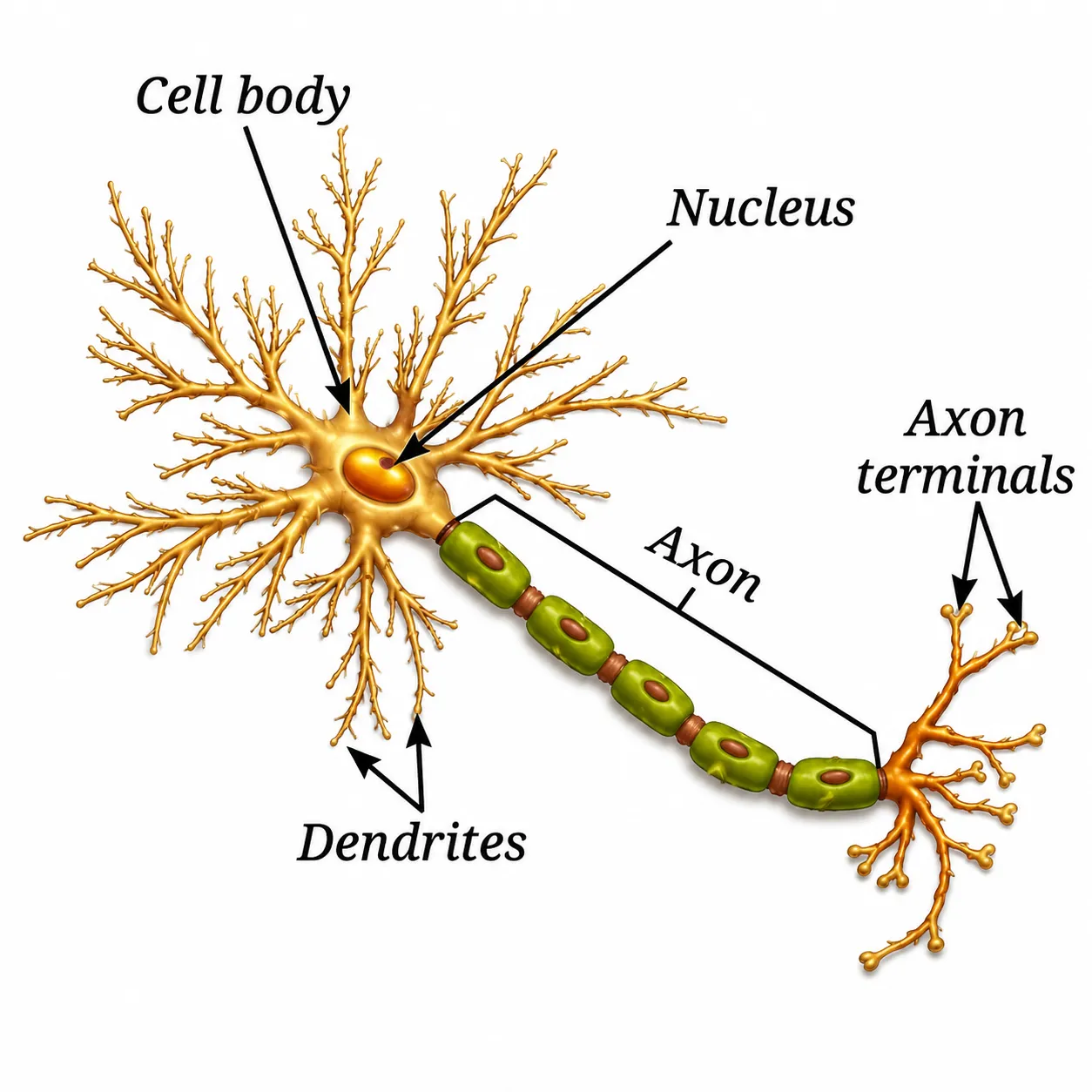
➽ Cell body
Contains nucleus, controls cell activities
➽ Dendrites
Receive signals from other neurons
➽ Axon
A long fibre that carries messages away from the cell body
➽ Axon terminals
Transmit messages to other cells
Signal flow: Dendrites ➜ Cell body ➜ Axon ➜ Axon terminals ➜ Next cell
● Muscles (voluntary & involuntary) cannot work independently
● They depend on instructions from nervous tissue
The Musculoskeletal System
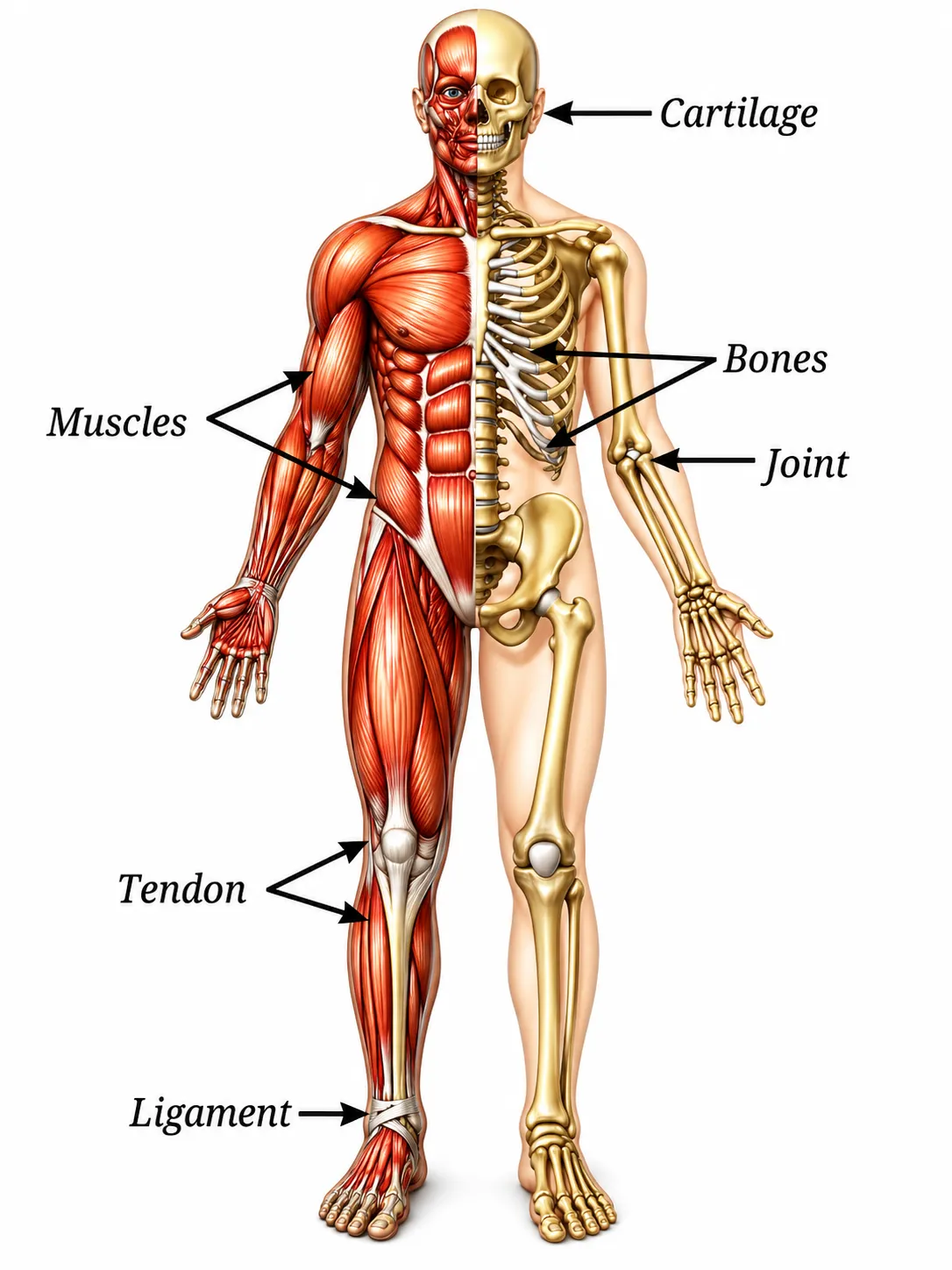
➽ Made of: bones, muscles, joints, cartilage, tendons & ligaments
➽ Works under the control of the nervous system
➽ Functions:
●Standing upright
●Movement
●Posture
●Protecting organs
How Movement Occurs
Muscle contracts ➜ Tendon transmits force ➜ Bone moves at the joint
➽ Muscles are attached to bones via tendons
➽ Joints = the junction between two or more bones
➽ Joints allow movement, but cannot move bones on their own ➜ muscles do
Body Composition
| Component | % of Body Weight |
|---|---|
| Skeleton (bones) | 12–15% (all adults) |
| Muscle (males) | 40–50% |
| Muscle (females) | 30–40% |
Types of Joints
A joint = a junction between two or more bones
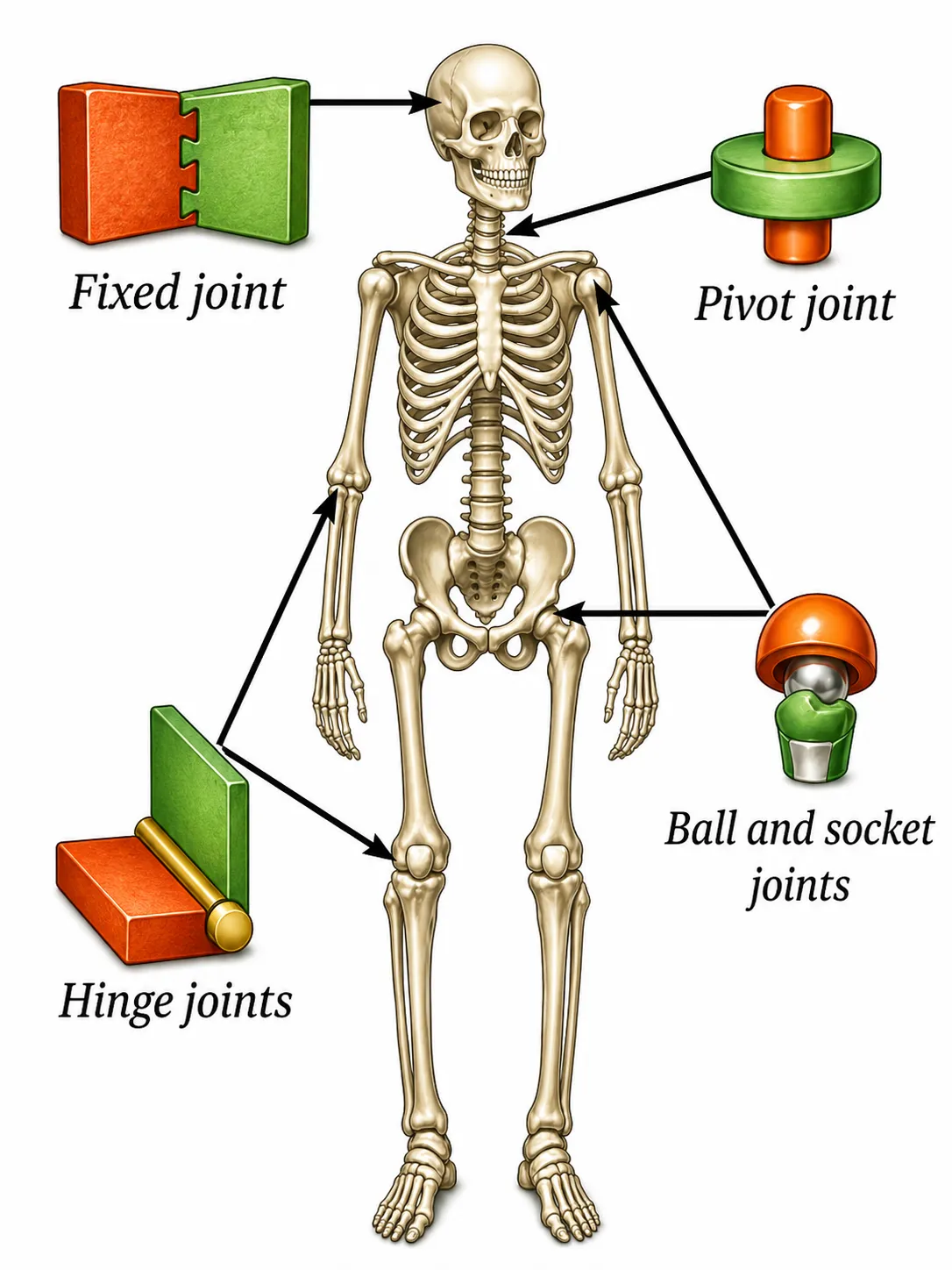
1. Ball & Socket Joint
➽ The round top of the upper arm fits into the shallow hollow of the shoulder bone
➽ Allows:
● Forward Movement
● Backwards Movement
● Sideways Movement
● Circular Movement
➽ Shoulder + collarbone = shoulder girdle (connects arm to skeleton)
➽ Location: shoulder, hip
2. Hinge Joint
➽ Works like a door hinge ➜ moves in one direction only
➽ The knee has a small kneecap bone that protects the joint
➽ Location: elbow, knee
3. Pivot Joint
➽ Allows side-to-side rotation
➽ Skull connected to the backbone through this joint
➽ Works like a doorknob turning in its socket
➽ Location: neck
4. Fixed Joint
➽ No movement at all
➽ Bones are fused/joined together
➽ Keeps brain, eyes & ears safe even when the body moves
➽ Location: skull bones
Skeletal System
A framework of bones that provides strength & protects internal organs.
Includes:
Skull
Vertebral column
Rib cage.
1. Vertebral Column (Backbone/Spine)
➽ Extends from the base of the skull
➽ Made of small bones called vertebrae
➽ Functions: supports the body, helps stand upright
➽ Between each vertebra ➜ cartilage disc
Cartilage disc
➽ Acts as a cushion
➽ Allows flexibility (bending & twisting)
➽ Protects the spinal cord
2. Rib Cage
➽ 12 pairs of ribs
➽ Protects vital organs ➜ heart & lungs
Structure of the Rib Cage
➽ Ribs are attached to the spine at the back
➽ Ribs are attached to the sternum (breastbone) at the front
➽ Joined by flexible cartilage
Function of the Rib Cage
➽ Cartilage allows the rib cage to expand & contract during breathing
➽ Expansion ➜ air moves into the lungs
➽ Contraction ➜ air moves out of lungs
Injury to ribs ➜ makes breathing painful & difficult
FAQs : Notes: Tissues in Action Ch 3 Class 9
How should I start preparing with these Notes: Tissues in Action Ch 3 Class 9?
The best way to approach this chapter is to first understand the “Division of Labour.” Start by comparing why plant and animal tissues differ based on their movement and energy needs. Use the NCERT tables provided in these notes to get a bird’s-eye view before diving into specific tissue types like Meristematic or Epithelial.
Which topics are most important for the CBSE Class 9 Ch 3 Tissues in action exam?
Based on the new syllabus, focus heavily on the differences between Parenchyma, Collenchyma, and Sclerenchyma. Additionally, the structure of a Neuron and the types of Muscular Tissues (Skeletal, Smooth, and Cardiac) are high-priority topics that frequently appear in CBSE board and school exams.
What is the best way to memorise the different types of animal tissues?
What is the best way to memorise the different types of animal tissues?
Are these short notes enough for a complete Chapter 3 revision?
These notes are specifically curated for quick revision and last-minute preparation. They cover all the essential terminologies and concepts from the NCERT textbook. While they are perfect for grasping the core ideas and scoring well, we recommend reading them alongside your textbook activities to ensure a 100% understanding of the new syllabus

create a mind map for better learning on different topics that are related to the chapter
Thanks for the suggestion, I have started working on that.
Please mail at info@studyless.in for how could we serve you better.
Sir you did well
Thanks mam, How could I help further….
Are good but long to write
Please email your requirements and needs regarding notes to info@studyless.in
Add mind map for better understanding
make all important diagrams on a page and labels organelles also
We already have all the important diagrams on the post. If you have any specific requirements then please mail us at info@studyless.in