
You have read and understood Chapter 11, Reproduction: How Life Continues.
Now you want something that helps you quickly revise the important points in an easy-to-read, easy-to-retain manner.
Therefore, we at StudyLess have created “Ch 11 Notes Reproduction: How Life Continues”. Yet another helpful resource for class 9 students of the CBSE board.
These notes are not just short notes but a complete revision weapon.
Here in “Ch 11 Notes Reproduction: How Life Continues”, we have divided the chapter into many headings and subheadings in question format.
You will find “What to Remember” and “In Simple Words” immensely helpful in retaining the important ideas and concepts.
Happy Reading!
Asexual Reproduction
What is Asexual Reproduction?
⁘ Involves only one parent
⁘ Produces genetically identical individuals
⁘ Found in unicellular organisms — bacteria, amoeba, yeast
⁘ Also found in simple multicellular organisms — hydra, sponge
What to Remember:
One parent ➜ identical offspring. No mixing of genes.
How is vegetative propagation in plants helpful in agriculture?
What is Vegetative Propagation?
New plants grow from the vegetative parts (growing parts) of a plant
No seeds are involved
Examples:
⁘ Potato, Ginger — fleshy underground stems sprout new plants
⁘ Money plant, Sugarcane — stem cuttings grow into new plants
⁘ Bryophyllum — leaves sprout tiny plantlets
In Simple Words:
A plant grows a new plant from its own parts — roots, stems, or leaves.
What to Remember:
Vegetative propagation = asexual reproduction in plants.
One parent ➜ genetically identical offspring.
How is Vegetative Propagation Useful in Agriculture?
⁘ Scientists and horticulturists have developed methods based on natural vegetative propagation
⁘ Widely used methods: cutting, grafting, layering, tissue culture
⁘ These methods help farmers cultivate desirable crops on a large scale
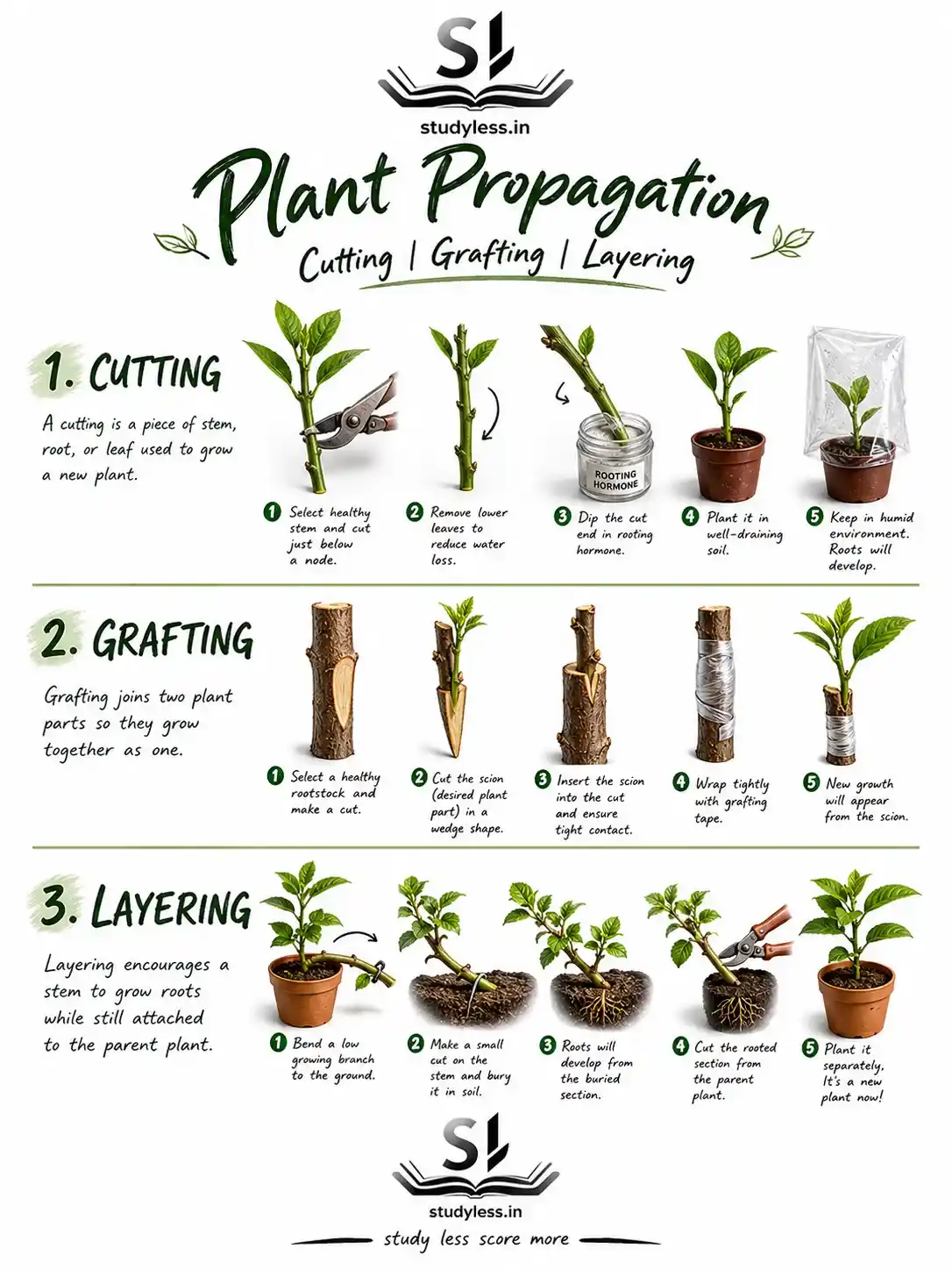
What are the Methods of Vegetative Propagation?
Cutting
What is Cutting?
⁘ A shoot is cut from a plant at the end of its growing season
⁘ Leaves are removed from the lower half of the cutting
⁘ The cutting is inserted half its length into soil mixed with compost
⁘ Angle of insertion: 45–60° from the soil surface
Grafting
What is Grafting?
⁘ Two plants are used — Plant A (healthy rooted plant) and Plant B (stem piece from another variety)
⁘ A slit or wound is made on a twig of Plant A
⁘ Plant B’s stem is inserted into the slit of Plant A
⁘ The wound is covered with cloth or film to keep out pests
⁘ Plant B grows using Plant A’s roots
Example: Wild rose (Plant A) + Yellow/Pink rose (Plant B)
Layering
What is Layering?
⁘ A flexible twig is selected from a tree or shrub (e.g., lemon)
⁘ The middle part of the twig is buried under the soil
⁘ Roots develop from the buried part in 10–15 days
⁘ Once roots form, the twig is cut from the parent and grows as a new plant
Comparison of Methods at a Glance
| The middle part is buried in soil | What is Used | Key Step | Outcome |
|---|---|---|---|
| Cutting | Shoot/stem piece | Inserted in soil at 45–60° | Grows into a new plant |
| Grafting | Two different plants | Twig of the parent plant | New variety grows on Plant A’s roots |
| Layering | Twig of parent plant | Middle part buried in soil | Roots form ➜ separated ➜ new plant |
What to Remember:
⁘ Cutting ➜ angle matters (45–60°), lower leaves removed
⁘ Grafting ➜ two plants combined, the wound must be protected
⁘ Layering ➜ roots form in 10–15 days before separation
How Do Other Organisms Reproduce Asexually?
What is Budding?
⁘ Seen in a hydra (multicellular animal)
⁘ The bud enlarges and separates from the parent to live independently
⁘ This process is called budding
⁘ Many buds can grow on the parent’s body at the same time
In Simple Words:
A small “baby” grows out of the parent’s body, then breaks off and lives on its own.
What to Remember:
Budding = cell division ➜ bud forms ➜ bud separates ➜ lives independently. Seen in Hydra.
How Do Fungi Reproduce? — Spore Formation
⁘ Fungi reproduce through spores
⁘ Spores are formed in a sac-like structure or on a swollen vesicle on long strips of fungal hyphae
Spores are:
Lightweight and usually
single-celled
Produced in huge numbers — millions from one mould colony
Spread easily through
air currents
Germinate quickly when
They find moisture and nutrients
Mould on bread comes from spores already present in the air that settle on moist bread
In simple words:
Spores are tiny particles that float in the air and grow into new fungi when they land on a moist, nutrient-rich surface.
⁘ Louis Pasteur proved that new life always comes from pre-existing life
⁘ His work led to the germ theory of disease and practices like the sterilisation of food and instruments
What to Remember:
⁘ Mould on bread ➜ spores from air ➜ moist surface ➜ rapid growth
⁘ Spores: lightweight, single-celled, spread by air, millions produced
What is the Central Process Behind Asexual Reproduction?
⁘ The central process is mitosis — a type of cell division
⁘ Mitosis produces two daughter cells, each having the same number of chromosomes as the parent cell
⁘ Offspring produced are genetically identical to the parent
⁘ Genetically identical organisms are called clones
⁘ Asexual reproduction is fast
⁘ Helps organisms increase their population quickly, especially when environmental conditions are favourable
In Simple Words:
Mitosis = exact copying. The parent copies itself to make identical offspring — no variation, just fast multiplication.
What to Remember:
⁘ Asexual reproduction ➜ mitosis ➜ clones
⁘ Fast process ➜ useful when the environment is favourable
⁘ All offspring = identical to the parent
Sexual Reproduction
What is Sexual Reproduction?
⁘ Involves two parents in the formation of a new individual
⁘ Both parents contribute to the genetic material of the offspring
⁘ Offspring are not genetically identical to either parent
In simple words:
Two parents combine their genetic material to create a new, unique individual.
What to Remember:
Sexual reproduction = two parents ➜ unique offspring. Unlike asexual reproduction, offspring are NOT identical to parents.
What is the Chromosome Problem in Sexual Reproduction?
⁘ If each parent passes on their full set of chromosomes, the chromosome number would double every generation
⁘ This biological problem is solved by a special cell division called meiosis
What are Chromosomes?
⁘ Chromosomes are thread-like structures present in the nucleus of a cell
⁘ They carry genetic information
⁘ Each species has a fixed number of chromosomes in its cells
⁘ Humans have 23 pairs = 46 chromosomes in total
⁘ Each pair has one chromosome from each parent
What to Remember:
Chromosomes carry genes. Humans = 23 pairs = 46 total.
How does meiosis help create variations in sexual reproduction?
What is Meiosis and How Does it Solve the Chromosome Problem?
⁘ Meiosis is a special type of cell division that forms gametes
⁘ In meiosis, the chromosome number of a parent cell is reduced:
| Cell Type | Chromosome Condition | Number in Humans |
|---|---|---|
| Parent cell | Diploid (full set) | 46 chromosomes |
| Gamete (daughter cell) | Haploid (half set) | 23 chromosomes |
⁘ During meiosis, the chromosomes of each pair separate
⁘ Each gamete receives only one chromosome from each pair
⁘ When two gametes fuse during reproduction, the full chromosome number is restored
In Simple Words:
Meiosis cuts the chromosome number in half. When two half-sets join, the correct full number is restored in the offspring.
What to Remember:
Meiosis: diploid ➜ haploid
Gametes always carry half the chromosome number
Fusion of gametes restores the full chromosome number
What are Gametes
Gametes are haploid cells used only for reproduction
They are the result of meiosis
| Male Gamete | Female Gamete | |
|---|---|---|
| In Animals | Sperm | Egg |
| In Plants | Pollen grain (contains male gamete) | Ovule (contains egg) |
What to Remember:
Gametes = haploid reproductive cells. Sperm + Egg in animals. Pollen + Ovule in plants.
How Does Sexual Reproduction Create Variation?
⁘ During meiosis, chromosomes are randomly mixed before separating into gametes
⁘ This means every gamete carries a unique combination of chromosomes
⁘ Each individual receives a unique combination of chromosomes from both parents
⁘ This makes children genetically different from their parents and also from their siblings
In Simple Words:
Random mixing of chromosomes means no two people (except identical twins) have the exact same genetic makeup.
Why is Variation Important?
⁘ Variation among individuals is important for the survival of a species
⁘ It helps some individuals adapt better to changing environments
⁘ Over time, this process contributes to evolution
Examples of variation:
⁘ Some people can tolerate low oxygen levels at high altitudes
⁘ Some people can digest milk in adulthood
What to Remember:
⁘ Sexual reproduction ➜ random chromosome mixing ➜ variation
⁘ Variation ➜ better adaptation ➜ evolution
⁘ This is why sexual reproduction is important for the long-term survival of species
Asexual vs Sexual Reproduction
| Feature | Asexual Reproduction | Sexual Reproduction |
|---|---|---|
| Number of parents | One | Two |
| Genetic outcome | Identical offspring (clones) | Unique offspring |
| Cell division involved | Mitosis | Meiosis |
| Gametes involved | No | Yes |
| Variation produced | No | Yes |
| Speed | Fast | Slower |
| Examples | Budding, spores, cutting | Humans, animals, and flowering plants |
Sexual reproduction in flowering plants
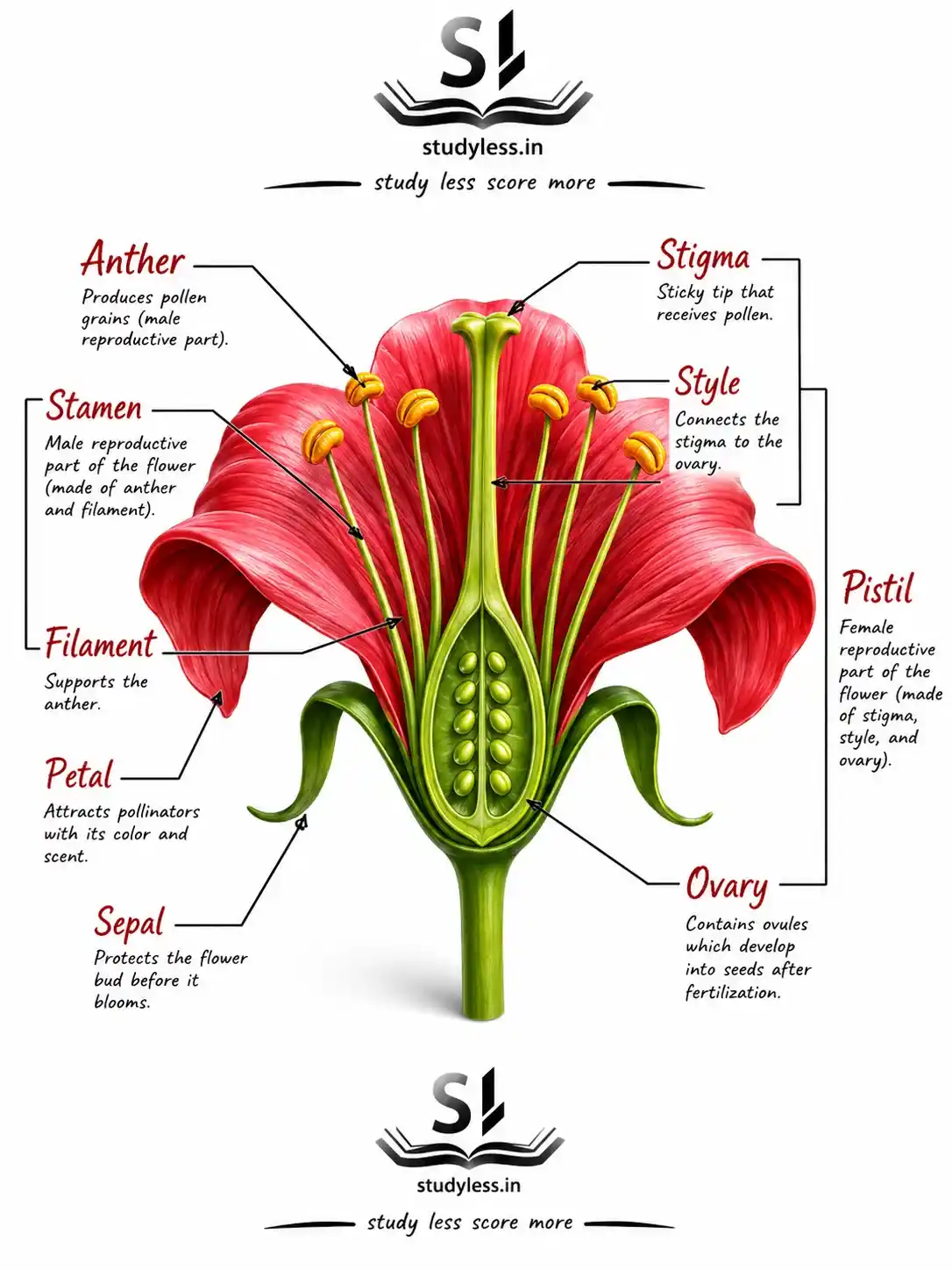
What are Flowering Plants?
⁘ Flowering plants are called angiosperms
⁘ They are the most diverse group of plants on Earth
⁘ Flowers serve as the reproductive organs in angiosperms
⁘ Non-flowering plants like pines also reproduce sexually
In Simple Words:
In flowering plants, the flower is not just for beauty — it is the reproductive organ.
What are the Parts of a Flower?
Sepals
●The outermost whorl of the flower
●Green covering that protects the flower in the bud stage
Petals
●Coloured projections of the flower
●Attract pollinators through colour and fragrance
Stamens —The Male Part
Consists of two parts:
●Filament — the stalk
●Anther — produces pollen grains containing male gametes
Pistil — The Female Part
Has three subparts:
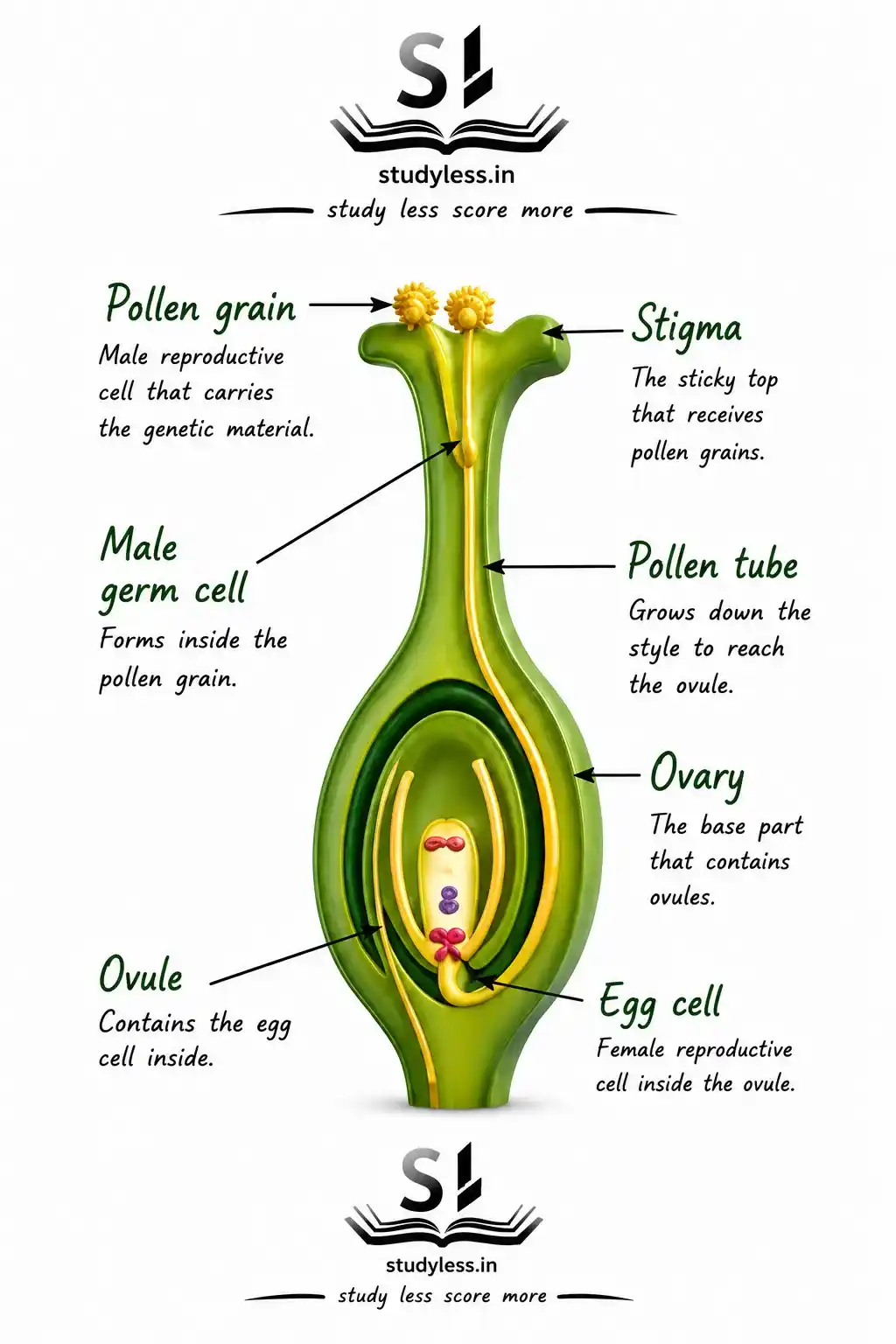
●Stigma — located at the tip, flat and/or sticky (receives pollen)
●Style — a thin, long tube connecting the stigma to the ovary
●Ovary — contains ovules, each ovule has an egg cell (female gamete)
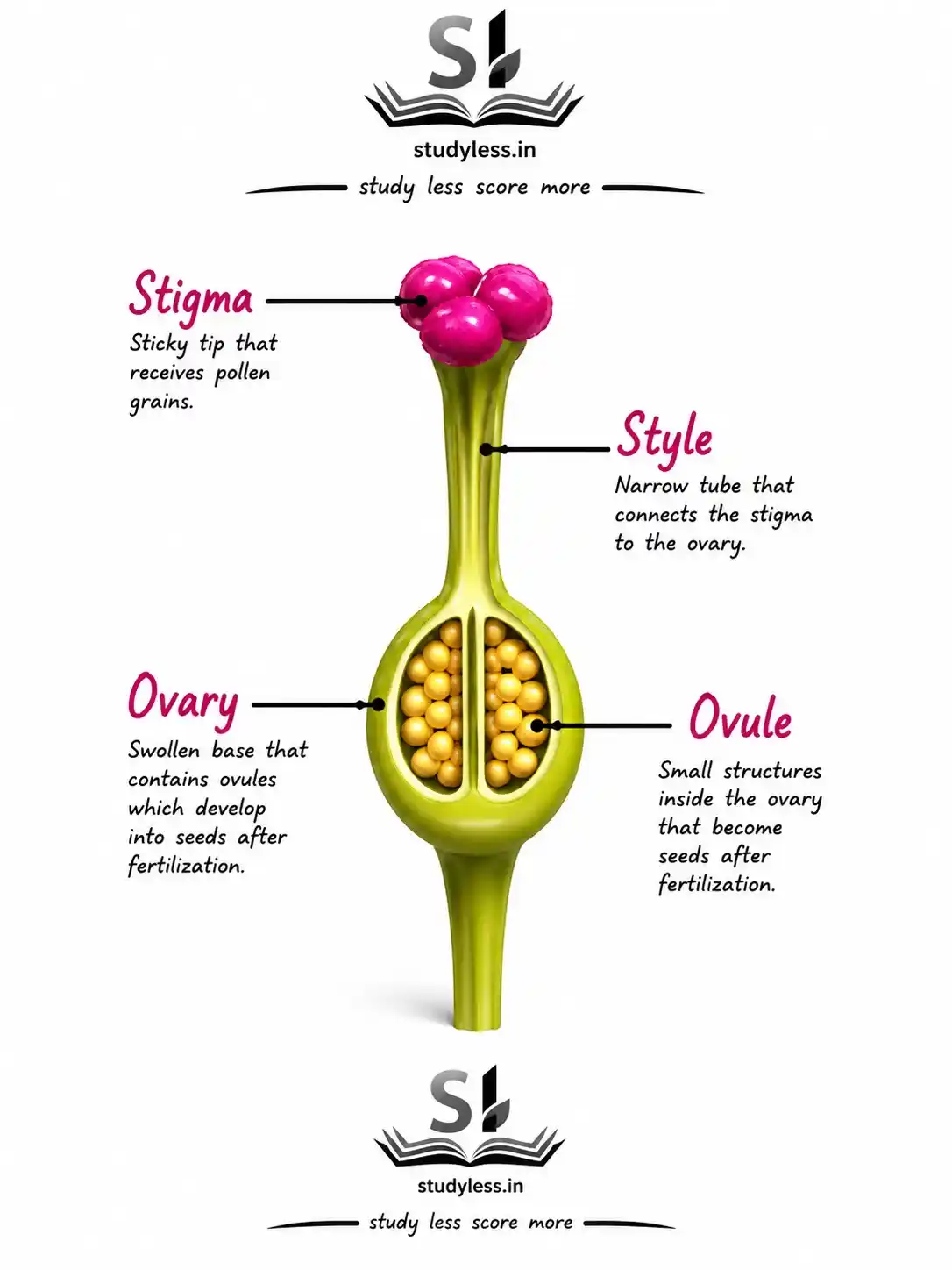
What to Remember:
⁘ Stamen = male ➜ Anther produces pollen
⁘ Pistil = female ➜ Ovary contains ovules ➜ each ovule has one egg cell
⁘ Stigma is sticky — designed to trap pollen
What is Pollination?
⁘ The transfer of pollen grains from the anther to the stigma of a flower is called pollination
⁘ Pollination is necessary for fruit and seed formation
⁘ Without pollination, no fruits or seeds are formed
How does the process of pollination occur in flowers?
What are the Types of Pollination?
Self-Pollination
Pollen is transferred to the stigma of the same flower or another flower of the same plant
Cross-Pollination
Pollen is transferred from the anther of one plant to the stigma of a flower of another plant of the same type
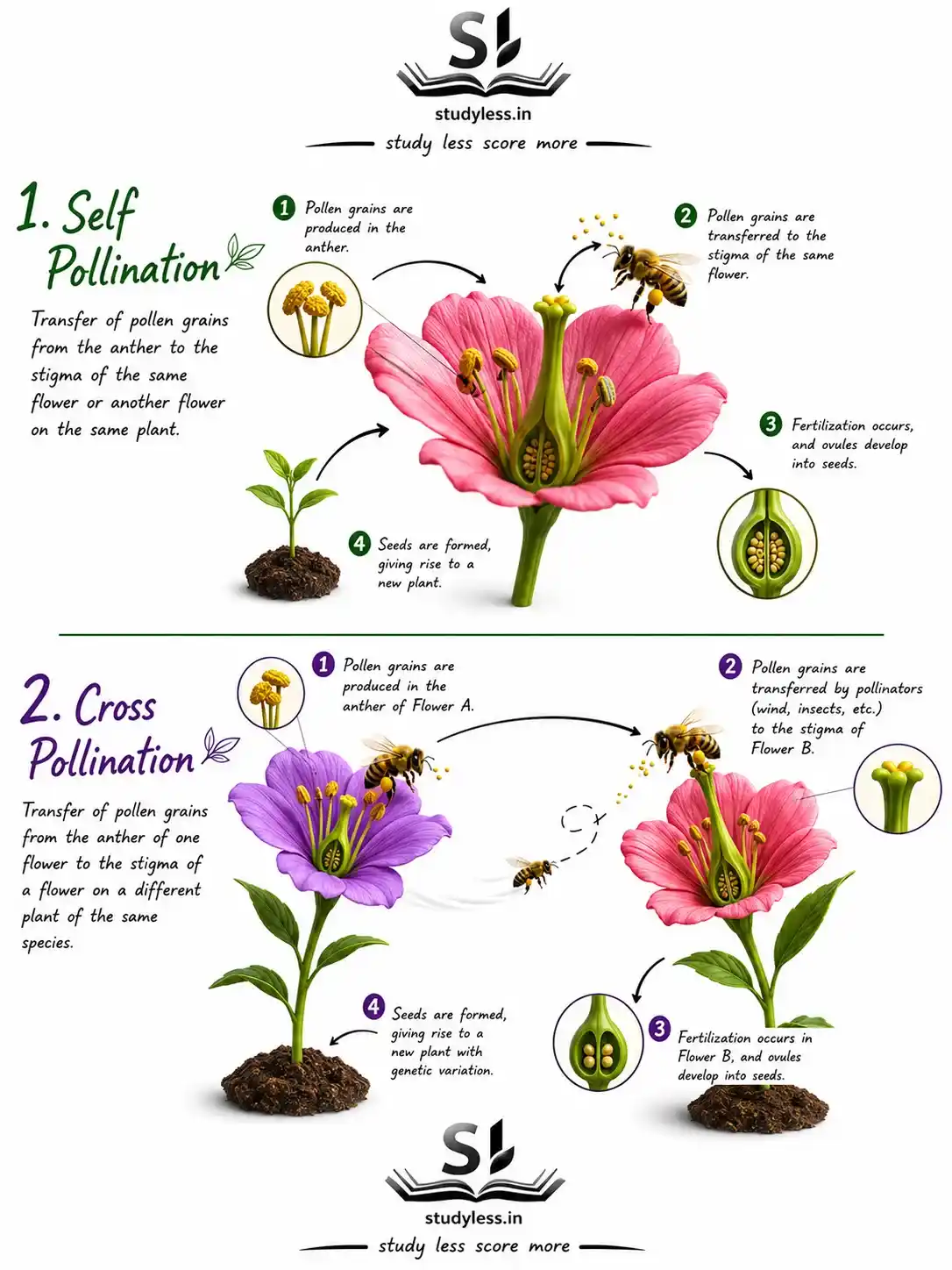
What to Remember:
⁘ Self-pollination = same plant
⁘ Cross-pollination = different plants of the same type
⁘ Cross-pollination leads to more variation in offspring
Pollination strategies and reproductive success
⁘ Pollination depends on external agents called pollinators
⁘ Pollinators include — wind, water, insects, and birds
Wind Pollination
⁘ Seen in — wheat, maize, rice
⁘ Pollen grains are light, small, and produced in large numbers
⁘ Stigma is long and feathery to trap pollen
Water Pollination
⁘ Seen in aquatic plants — Vallisneria, Hydrilla
⁘ Water currents carry pollen from one flower to another
Insect Pollination
⁘ Seen in — sunflower, hibiscus, marigold
⁘ Flowers are brightly coloured, produce nectar, give off fragrance
⁘ Pollen grains are large, sticky or spiny — attach to an insect’s body
⁘ Stigma is sticky to receive pollen
⁘ Pollinators — bees, butterflies
Bird Pollination
⁘ Seen in — coral tree, hibiscus
⁘ Pollinators — Indian white-eye, sunbirds
What to Remember:
⁘ Wind ➜ light pollen, feathery stigma
⁘ Water ➜ aquatic plants
⁘ Insects ➜ colourful, fragrant flowers, sticky pollen
⁘ Birds ➜ coral tree, hibiscus
Fertilisation and seed formation
What Happens After Pollination?
Once pollen reaches a compatible stigma, the following sequence occurs:
Step 1 — Pollen Tube Formation
⁘ Pollen grains produce a pollen tube
⁘ The tube grows down through the style into the ovary
Step 2 — Fertilisation
⁘ The male gamete travels through the pollen tube to the ovule
⁘ It fuses with the egg cell (female gamete)
⁘ This fusion of gametes is called fertilisation
⁘ Fertilisation marks the beginning of a new life
Step 3 — Zygote and Embryo Formation
⁘ The fertilised egg is called a zygote
⁘ The zygote later develops into an embryo
Step 4 — Fruit and Seed Formation
⁘ The ovary enlarges and develops into a fruit
⁘ The ovules develop into seeds inside the fruit
Step 5 — Seed Dispersal and Germination
⁘ Seeds are dispersed by wind, water or animals
⁘ When conditions — water, air, temperature — are favourable, the seed germinates and grows into a new plant
In Simple Words:
Pollen tube carries male gamete ➜ fuses with egg ➜ zygote ➜ embryo ➜ seed. Ovary ➜ fruit.
What to Remember:
⁘ Pollination ➜ Pollen tube ➜ Fertilisation ➜ Zygote ➜ Embryo
⁘ Ovules ➜ Seeds | Ovary ➜ Fruit
⁘ Fertilisation = fusion of male and female gametesw3w3
Sexual Reproduction in Animals
How Do Animals Reproduce?
⁘ Animals reproduce through asexual and/or sexual methods
⁘ In sexual reproduction, the challenge is uniting gametes and keeping offspring alive to reproduce.
What is External Fertilisation?
⁘ External fertilisation — fertilisation occurs outside the body of the female
⁘ The female releases eggs into the water
⁘ The male releases sperm over the eggs for fertilisation to take place
⁘ Seen in many aquatic animals — frogs and most fish
Large numbers of eggs are laid, but many are:
Destroyed by water currents
Eaten by other animals
What to Remember:
External fertilisation = water environment, large number of eggs, low survival rate. Examples — fish, frogs
What is Internal Fertilisation?
⁘ Internal fertilisation — fertilisation takes place inside the body of the female
⁘ Seen in reptiles, birds and mammals
⁘ The fertilised egg or embryo is better protected inside the female body
⁘ Chances of survival of young ones are generally higher
What to Remember
Internal fertilisation = better protection, higher survival. Examples — reptiles, birds, mammals
What is the Difference Between External and Internal Fertilisation?
| Feature | External Fertilisation | Internal Fertilisation |
|---|---|---|
| Location | Outside the female’s body | Inside the female’s body |
| Medium | Water | Inside body |
| Eggs produced | Very large numbers | Fewer |
| Survival rate | Low | Moderate to High |
| Examples | Fish, Frog | Lizard, Bird, Mammal |
Variations in Reproduction in Animals
How Do Reproductive Strategies Vary Among Animals?
| Animal | Habitat | Fertilisation | Eggs Produced | Survival of Young |
|---|---|---|---|---|
| Fish | Water | External | 100s–1000s at a time | Low |
| Frog | Water/Land | External | 5,000–50,000 at a time | Low |
| Lizard | Land | Internal | 2–20 at a time | Moderate |
| Bird | Water/Land | Internal | 1–15 at a time | Moderate to High |
What is the Role of Yolk in Eggs?
⁘ Fish, amphibians and insects produce hundreds to thousands of eggs at a time
⁘ Each egg contains a yolk = nutritive substances to nourish embryo
⁘ Yolk is only enough to produce a larva
⁘ The mother’s body cannot provide large quantities of yolk for so many eggs
In Simple Words:
Yolk = food packed inside the egg for the developing embryo.
What is a Larva and What Does it Do?
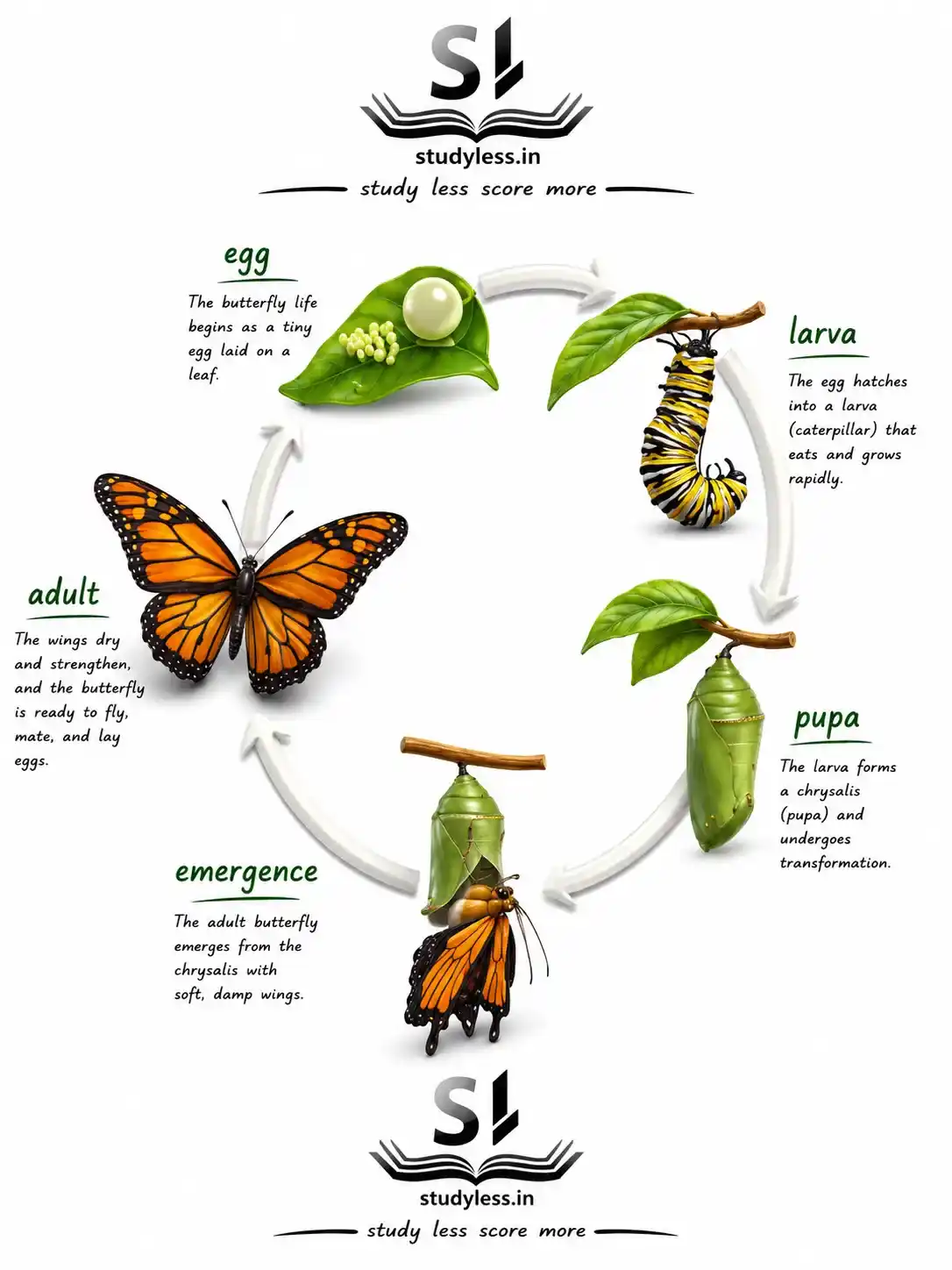
A larva is an intermediate stage in development — essentially a feeding stage
⁘ The larva hatches from the egg and gets nutrition by eating:
Organic wastes like rotten food, manure, etc.
⁘ Once enough nutrition is accumulated, a transformation takes place, and the adult body is formed
Examples of organisms with a larval stage:
⁘ Butterfly — larva (caterpillar) ➜ adult butterfly
⁘ Frog — larva (tadpole) ➜ adult frog
What to Remember:
⁘ Fish, amphibians, insects ➜ larva stage ➜ transformation ➜ adult
⁘ Larva = intermediate, feeding stage
How Do Reptiles and Birds Differ From Fish and Amphibians?
⁘ Reptiles and birds lay eggs, egg contains enough yolk to nourish the embryo until it hatches into a young one
⁘ No larva stage — the young one hatches in a more developed form
⁘ Mammals — the zygote grows and develops inside the female body
What Happens After Birth or Hatching?
⁘ In some species, young ones are ready to find their own food immediately after birth/hatching
⁘ In others, an extended period of care after hatching or birth is necessary
⁘ This depends on how long the embryo develops — inside an egg or inside the mother’s body
⁘ Mammals typically feed their young ones via breast milk for some duration after birth
What to Remember:
⁘ Mammals = internal development + post-birth feeding via breast milk
⁘ More development time inside = fewer eggs needed = higher survival
Reproduction in Human Beings
Reproductive maturity
What is the Human Reproductive System?
⁘ The human reproductive system consists of special organs that produce gametes (sperm in males, eggs in females)
⁘ When a sperm meets an egg inside the female body:
A zygote is formed
⁘ The zygote develops into an embryo
⁘ The embryo eventually develops into a foetus in the uterus
What are the parts of the male reproductive system?
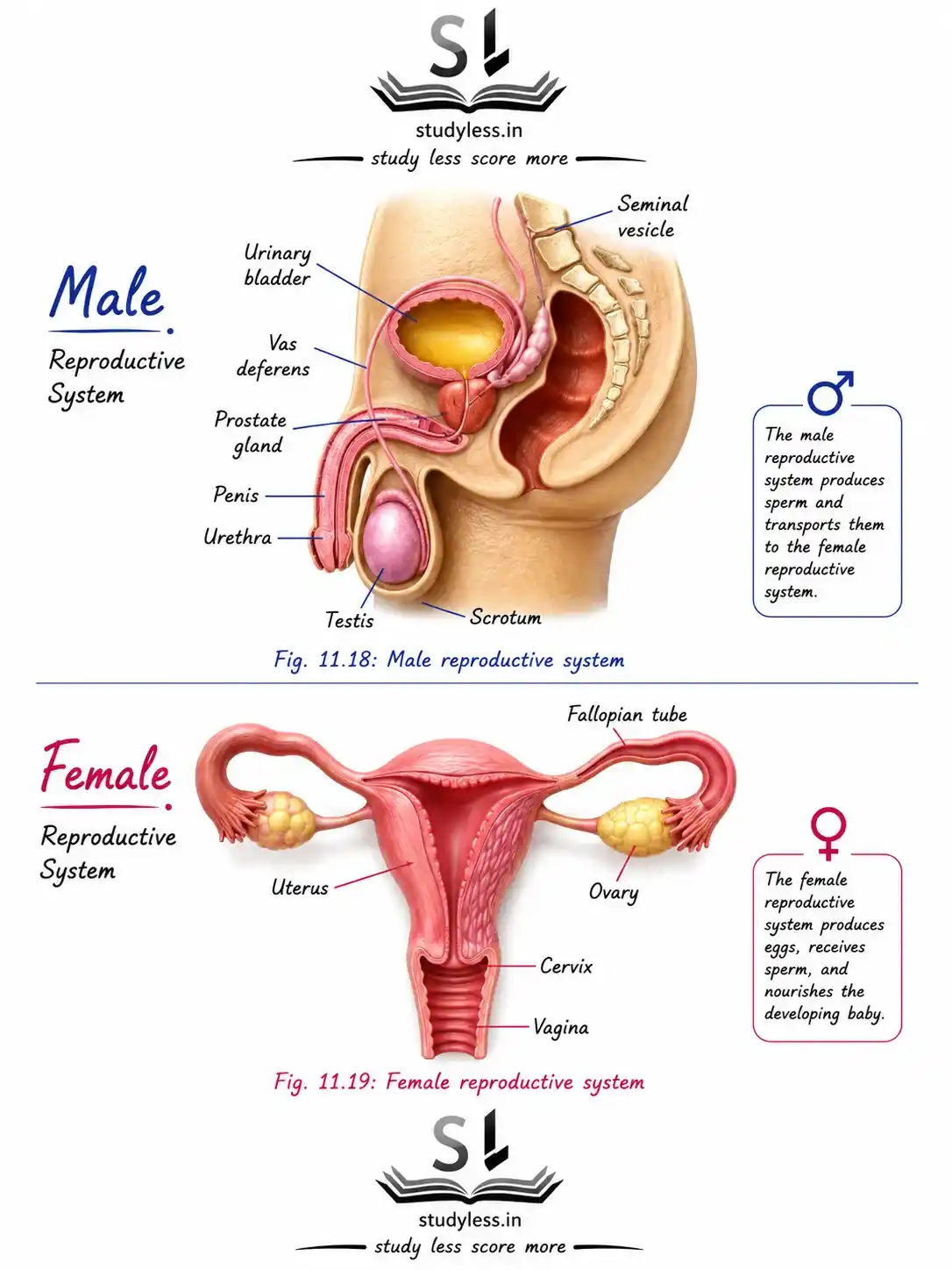
The male reproductive system produces sperm and helps transfer them to the female body
Key Organs and Their Functions:
Testes (singular: testis)
⁘ Two oval-shaped organs are present in a pouch of skin called the scrotum
⁘ Produce male germ cells called sperm
⁘ Also produces a hormone that controls sperm production and causes physical changes during puberty
⁘ The scrotum keeps the testes slightly cooler than body temperature, necessary for sperm formation
Vas Deferens
⁘ A long tube through which sperm travel from the testes
⁘ Opens into the urethra
Urethra
⁘ A common passage for both urine and sperm
Seminal Vesicles and Prostate Gland
⁘ Add fluids to nourish the sperm
⁘ Help sperm remain active and move
Structure of a Sperm:
Head
contains genetic material
Long tail
helps it swim towards the egg
What are the parts of the female reproductive system?
The female reproductive system produces eggs, receives sperm, and supports foetal development
Key Organs and Their Functions:
Ovaries
⁘ A pair of organs that produce female germ cells (eggs)
⁘ Also, release hormones that bring about changes during puberty
Oviducts (Fallopian Tubes)
⁘ Connect each ovary to the uterus
⁘ The site where fertilisation usually occurs
Uterus
⁘ A bag-like structure where the foetus develops
⁘ Has a thick inner lining that prepares for implantation
Cervix
A narrow passage connecting the uterus to the vagina
Vagina
⁘ The passage through which sperm enter the female body
⁘ Also, the birth canal
In Simple Words:
Ovaries make eggs ➜ eggs travel through oviducts ➜ uterus is where the baby grows ➜ vagina is the entry/exit point.
What to Remember:
⁘ Ovaries ➜ eggs + hormones
⁘ Oviducts ➜ pathway for egg + site of fertilisation
⁘ Uterus ➜ foetus develops here
⁘ Cervix ➜ connects the uterus to the vagina
How are reproductive cells made?
What is Gametogenesis?
⁘ Gametogenesis — the process of formation of gametes
⁘ Takes place in the testes (males) and ovaries (females)
⁘ Gametes are formed by meiosis — the chromosome number is reduced to half
⁘ Human body cells have 46 chromosomes
⁘ Sperm and eggs each have 23 chromosomes
⁘ When they combine ➜ zygote has 46 chromosomes — same as the parents
How Do Sperm and Eggs Differ?
| Feature | Sperm | Egg |
|---|---|---|
| Size | Very small | Large |
| Number produced | Millions | Few |
| Stored nutrients | Absent | Present |
| Motility | Actively motile | Non-motile |
⁘ In males ➜ gametogenesis produces numerous, tiny, motile sperm
⁘ In females ➜ gametogenesis produces a single, large egg
What happens when a sperm meets an egg?
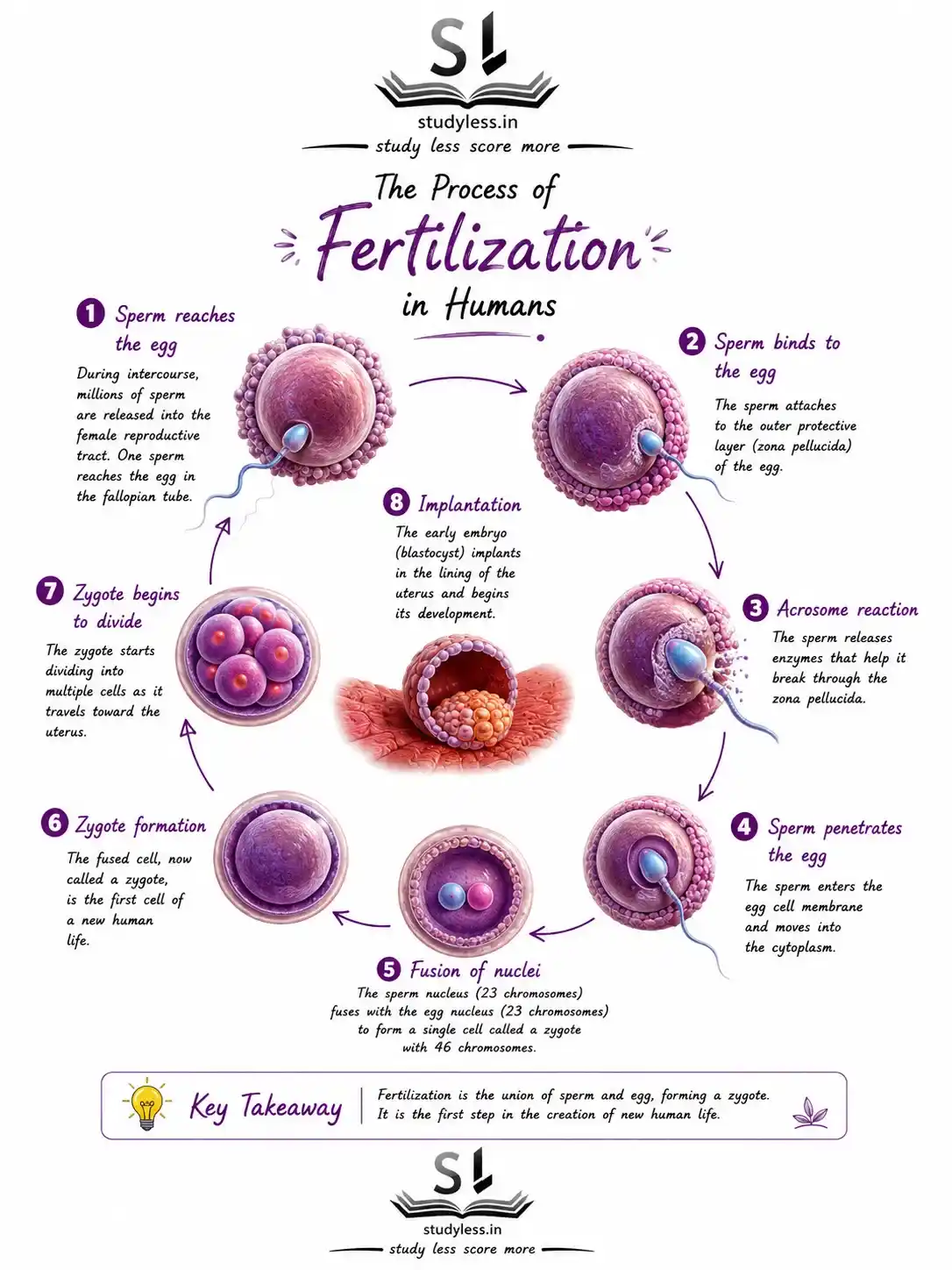
The step-by-step process is:
Step 1 — Ovulation
⁘ At birth, a girl’s ovaries already have millions of immature eggs
⁘ From puberty onwards, usually one mature egg is released every month from one ovary
⁘ This is called ovulation
Step 2 — Uterus Prepares
⁘ Before ovulation, the inner lining of the uterus becomes thick
⁘ It becomes richer in blood vessels — ready to receive a fertilised egg
Step 3 — Egg Travels
⁘ After ovulation, the egg travels from the ovary to the oviduct
Step 4 — Sperm Travel
⁘ During sexual intercourse, millions of sperm enter through the vagina
⁘ They swim through the reproductive tract and may reach the egg in the oviduct
Step 5 — Fertilisation
⁘ If a sperm fuses with the egg ➜ a zygote is formed
Step 6 — Zygote Travels and Divides
⁘ The zygote undergoes a series of mitotic divisions while travelling to the uterus
Step 7 — Implantation and Pregnancy
⁘ The zygote implants into the inner lining of the uterus to receive nourishment
⁘ This implantation marks the beginning of pregnancy
In Simple Words:
⁘ Egg is released ➜ sperm swim up ➜ one sperm fuses with the egg ➜ zygote forms ➜ zygote divides ➜ implants in the uterus ➜ pregnancy begins.
What to Remember:
⁘ Ovulation = release of one mature egg per month
⁘ Fertilisation occurs in the oviduct
⁘ Zygote divides by mitosis while travelling to the uterus
⁘ Implantation = zygote attaches to the uterus wall = start of pregnancy
The Complete Journey — From Gamete to Pregnancy
Ovulation ➜ Egg in oviduct ➜ Sperm enter ➜ Sperm swim to oviduct ➜ Fertilisation ➜ Zygote ➜ Mitotic divisions ➜ Travel to uterus ➜ Implantation ➜ Pregnancy
What happens when an egg is not fertilised?
⁘ An unfertilised egg remains viable for about one day, then degenerates
⁘ The thick uterine lining — prepared to receive a zygote — is no longer needed
⁘ The lining sheds along with some blood and leaves the body through the vagina
⁘ This process is called menstruation or a period
⁘ Menstruation usually lasts 3 to 7 days
In Simple Words:
No fertilisation ➜ uterus lining not needed ➜ it sheds ➜ menstruation occurs.
What to Remember:
⁘ Menstruation = shedding of the uterine lining + blood through the vagina
⁘ Lasts 3–7 days
⁘ Caused by the absence of fertilisation
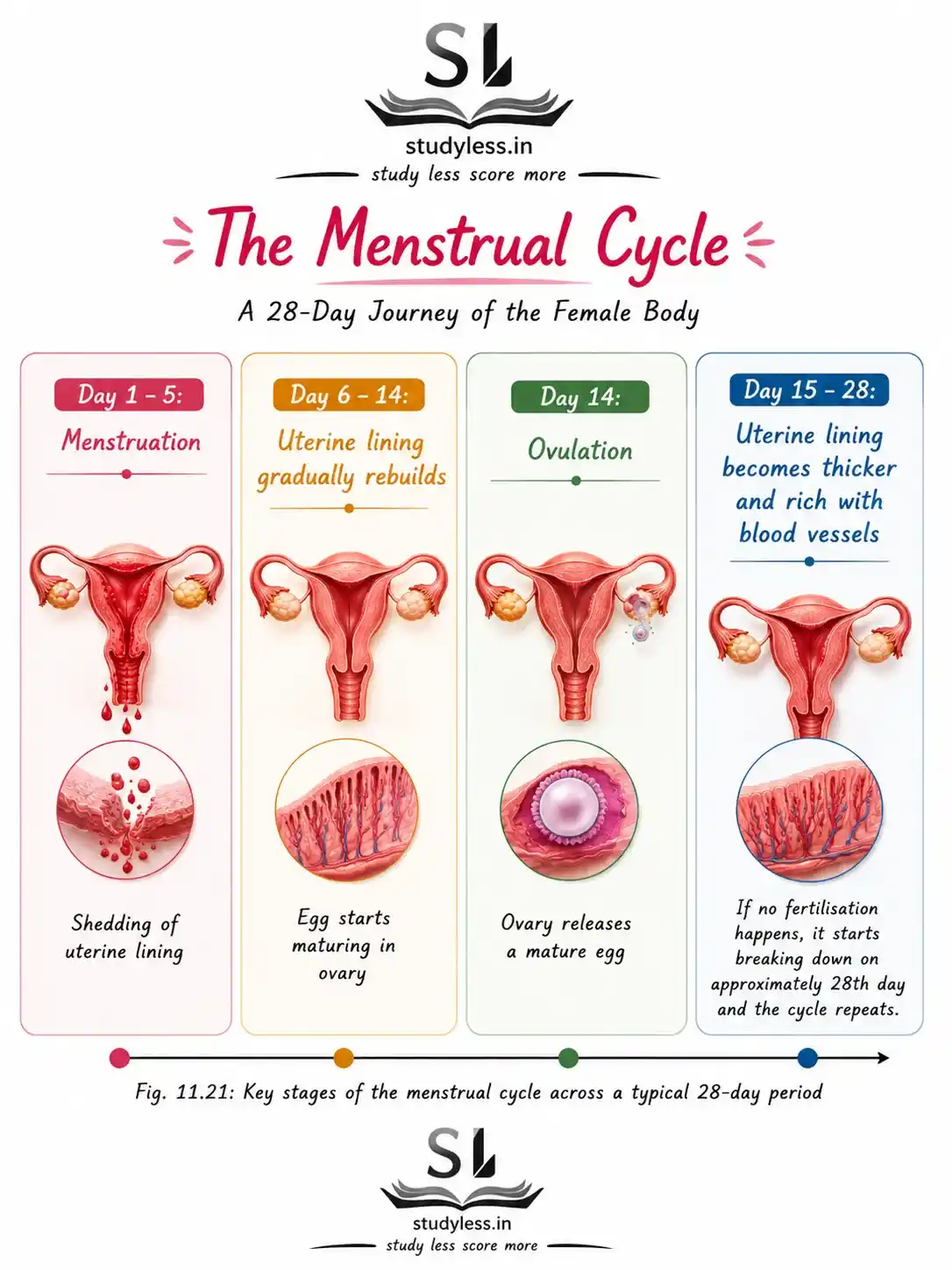
What is the Menstrual Cycle?
⁘ The cycle of ovulation ➜ uterus preparation ➜ menstruation repeats typically every ⁘ 21–35 days (often around 28 days)
⁘ Begins at puberty (ages 10–14 in girls)
⁘ Continues till menopause (around age 50)
What Happens at Each Stage of the Cycle?
| Days | Event |
|---|---|
| Day 1–5 | Menstruation — uterine lining sheds |
| Day 6–14 | Uterine lining rebuilds — The egg starts maturing in the ovary |
| Day 14 | Ovulation — The ovary releases a mature egg |
| Day 15–28 | Uterine lining becomes thicker and richer in blood vessels — If there is no fertilisation, the lining starts breaking down around Day 28, and the cycle repeats |
Pregnancy and childbirth
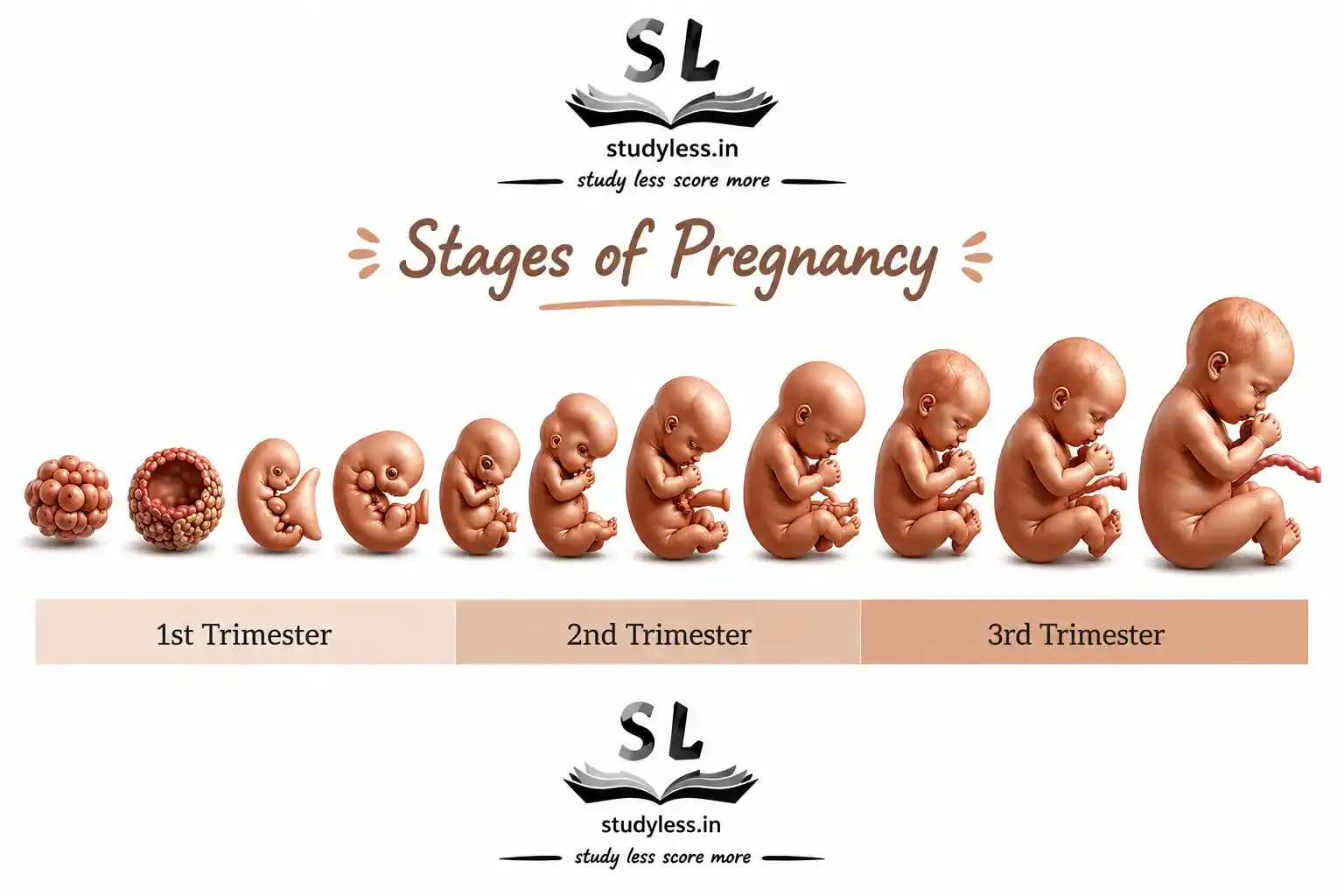
What are the Stages of Pregnancy?
⁘ Pregnancy in humans lasts about nine months
⁘ Divided into three stages called trimesters
| Trimester | Duration | Key Events |
|---|---|---|
| First | Months 1–3 | The foetus grows bigger and stronger. The mother can feel its movements |
| Second | Months 4–6 | Foetus grows bigger and stronger. Mother can feel its movements |
| Third | Months 7–9 | Baby grows rapidly, gets ready for life outside the womb |
The uterus protects and nourishes the baby throughout pregnancy
What to Remember:
⁘ Embryo ➜ called foetus from week 9
⁘ Three trimesters = organ formation ➜ growth ➜ birth preparation
How Does Childbirth Happen?
⁘ Strong contractions of the muscles of the uterus push the foetus out through the birth canal
⁘ If normal vaginal birth is not possible or safe, doctors use medical or surgical procedures to deliver the baby safely
What Care is Needed After Birth?
For the Baby:
Breastfeeding
mother’s milk = complete nutrition + protection from many diseases
Must be kept warm, vaccinated on time, and handled gently
For the Mother:
(Mother’s health
during pregnancy)
Nutritious food + adequate rest
No smoking, alcohol, or medicines without a doctor’s advice
Emotional well-being + family support
What does it mean to be sexually mature?
⁘ During adolescence, bodies change — this is called sexual maturation
⁘ Bodies become capable of reproduction, but this does not mean readiness for adult responsibilities
Examples of sexual maturity
⁘ Boys — production of sperm
⁘ Girls — menstrual cycles begin
⁘ Sexual maturity happens gradually alongside body growth
⁘ Emotional maturity — handling feelings, communicating clearly, making thoughtful decisions — takes longer
How can unwanted pregnancies and infections be prevented?
What are Sexually Transmitted Infections (STIs)?
S⁘ exual activity involves close physical contact — some infections can be transmitted this way
⁘ These are called Sexually Transmitted Infections (STIs)
Examples:
gonorrhoea, herpes, syphilis, genital warts, HIV (can lead to AIDS)
Some STIs are not yet curable
Condoms can prevent transmission of STIs and also prevent pregnancy
How Can Unwanted Pregnancies Be Prevented?
Contraceptive Methods:
⁘ Barrier Methods
Condoms or vaginal covers — stop sperm from reaching the egg
⁘ Hormonal Methods
Oral pills — change the release of eggs by altering hormones
May have some side effects
⁘ Intra-Uterine Devices (IUDs)
Example: Copper-T — placed inside the uterus to avoid pregnancy
May sometimes irritate the uterus
Surgical Methods
⁘ Blocking the vas deferens in males ➜ sperm cannot travel
⁘ Blocking the fallopian tubes in females ➜ egg and sperm cannot meet
Abortion
⁘ Removal of an unwanted pregnancy by surgery
⁘ Generally performed only within the first trimester when the embryo is very small
⁘ Prenatal sex determination is strictly prohibited by law in India to prevent sex-selective abortion and maintain a healthy sex ratio
FAQs: Ch 11 Notes Reproduction: How Life Continues
What is the main difference between asexual and sexual reproduction in Class 9 Biology?
Asexual reproduction involves a single parent and produces genetically identical offspring (clones) through mitosis. In contrast, sexual reproduction involves two parents and the fusion of male and female gametes through meiosis, leading to genetic variation, which is essential for the survival and evolution of a species.
How does the process of pollination lead to fertilisation in flowering plants?
Pollination is the transfer of pollen grains from the anther to the sticky stigma. Once a compatible pollen grain lands, it grows a pollen tube down the style to the ovary. The male gamete travels through this tube to fuse with the egg cell in the ovule, a process known as fertilisation, which eventually forms a seed.
What is the significance of the menstrual cycle in human reproduction?
The menstrual cycle is a monthly process (typically 28 days) that prepares the female body for potential pregnancy. It involves the maturation of an egg (ovulation) and the thickening of the uterine lining. If fertilisation does not occur, the lining sheds along with blood, a phase known as menstruation.
Why is variation important for the survival of a species?
Variation occurs during sexual reproduction due to the random mixing of chromosomes. It is crucial because it allows individuals within a population to adapt to changing environmental conditions, such as climate shifts or new diseases, ensuring the long-term survival and evolution of the species.
What are the common methods of contraception to prevent unwanted pregnancy?
Contraceptive methods are divided into several categories:
Barrier Methods: Condoms or diaphragms that physically block sperm.
Hormonal Methods: Oral pills that prevent ovulation.
IUDs: Devices like Copper-T placed in the uterus.
Surgical Methods: Vasectomy (males) or Tubal Ligation (females) for permanent prevention
It the best app not having a Books swag explosion cast is good as per the functions. The explanation explanation. Thank you. I wish you keep posting new notes every day. I use every day because it is much easy to learn at textbook. Explain in short things.