“Ch 4 Governance and Public Policy Notes Class 9 “ is based on:
Understanding Society: India And Beyond
Social Science Textbook
Grade 9| Part 2
Governance
⦿ Governance is based on :
● Transparency
● Accountability
● Participation
● Rule of law
⦿ Democratic governance is :
● People-centric
● Welfare-oriented
●●● ∴ Citizens is at the center of political process
Why Governance Is Needed
⦿ Solving public problems needs:
● [Govt + Institutions + citizens] Together they :
●●⁍ Make decisions
●●⁍ Implement decisions effectively
●●⁍ Remain accountable
●●●●●●➽ This process is called governance
[Government] vs [Governance]
| Government | Governance |
|---|---|
| Institutions that exercise political authority | Process of decision-making and implementation |
| Legislature, Executive, Judiciary | Government, citizens, media, civil society, private organisations |
| Who governs | How governing is carried out |
Government
● Institutions + Authorities
● Exercise political power
● Formulates and implements people-centric policies
Governance
● Process of decisions making
● Decisions are made, implemented, and monitored in the public interest
● Good governance makes policies transparent, accountable, effective, and responsive to people’s needs
Evolution of Governance in India
Colonial Legacy
● Pre colonial system of governance was local and organic
● Colonial rulers forced their governance and policy-making
Colonialism → foreign models imposed → independence → colonial institutions persist
Synthesis of Colonial Structures and Indigenous Values
● India kept:
●●⁍ Pre-colonial institutions
●●⁍ Governance traditions
And Formed Constitution on:
●●⁍ India’s values and ideals
Adaptation After Independenc
Traditional values and ideas of governance wire adapted to a modern democracy
Mottos: Colonial vs Indian
| Body | Motto | Source |
|---|---|---|
| Order of the Star of India (British) | Heaven’s Light, Our Guide | British |
| National motto | Satyamev Jayate (Truth alone triumphs) | Munḍaka Upaniṣhad |
| Supreme Court of India | Yato Dharmastato Jayaḥ (Where there is Dharma, there is victory) | Mahābhārata |
Rām Rājya
Mahatma Gandhi’s ideal model of governance
● Feature: based on five principles:
●●⁍ Probity
●●⁍ Transparency
●●⁍ Compassion
●●⁍ Welfare
●●⁍ People-centric orientation
● Significance:
●●⁍ Shows collective imagination of Indians
●●⁍ Good governance and a good collective life
●●⁍ Enshrined in Rāmāyaṇa and Rāmcharitamānas
Rājadharma
● Governance = sacred responsibility
● Rājadharma = foremost duty of an ideal king
●●⁍ Protect people by upholding Dharma
●●⁍ Promote welfare of society
● Measure of good governance with:
●●⁍ Ruler’s authority
●●⁍ Peace, prosperity, justice, and well-being in society
Good Governance
Partnership Between Government & Citizens
Rule of Law
Accountability
Effectiveness
Inclusiveness
Responsiveness
Transparency
Participation
Good Governance
How Governance Affects Daily Life
● law and order
● Safety and peacefulness
● Protects
●●⁍ Rights + freedom
● Access to public services:
●● ⁘ Education ⁘ Healthcare ⁘ Transport
⦿ Good governance:
● Promotes justice and fairness
● People are treated equally before the law
● Builds trust between citizens and government
Shared Responsibility
⦿ Good governance depends on two factors:
● How society and government fulfill their responsibilities
● How they work together
| Actor | Role |
|---|---|
| Government | Makes laws and policies; provides public services |
| Citizens | Elect representatives; follow the law; participate in public life |
| Media | Helps people understand public issues; brings important matters to public attention |
| Civil society organisations | Work with communities; raise awareness about social concerns |
| Private sector | Contributes through economic activity and innovation |
Features of Good Governance
⁘ Responsiveness ⁘ Transparency ⁘ Participation
⁘ Rule of law ⁘ Accountability ⁘ Effectiveness ⁘ Inclusiveness
People and institutions perform responsibilities honestly + work together → effective governance → public welfare
Challenges to Good Governance
Why Challenges Arise
Time passes → needs, desires, and aspirations of people evolve → New challenges
Main Challenges
● Weak coordination between institutions and departments
●●⁍ Effect: Bad implementation of government programmes
● Unequal access to public services
●●⁍ Effect: some groups left behind
∴ Affected groups face barriers:
●●⁍ Social
●●⁍ Economic
●●⁍ Geographical
● Malpractices and misuse of public offices
●●⁍ Effect: resources and benefits don’t reach people
● Misinformation and fake news
●●⁍ Most serious challenge
Addressing the Challenges
⦿ Need four things:
● Effective institutions
● Responsible officials
● Active citizens
● Commitment to principles of good governance
E-Governance: Technology for Better Governance
Meaning of E-Governance
E-governance = use of information and communication technology by governments
⦿ For :
●●● Provide public services
●●●Share information
●●●Communicate with citizens
●●●Receive feedback
●●●Improve administrative processes
⦿ Significance: Makes governance more
●●● Transparent
●●● Accessible
●●● Convenient
●●● Quick
Benefits of E- governence
● Reduces paperwork
● Access services online
● Delivery is more efficient, transparent, convenient, and quick
Condition for Effectiveness
⦿ E-governanconly when people have:
● Digital devices
● Reliable internet
● Skills to use them
● Governance needs instruments to better serve people
●●Public policy provides that link
⦿ Public policy:
Translates governance into planned action
Turns public concerns and government priorities into:
●●⁍ Programmes
●●⁍ Decisions
●●⁍ Solutions
Public Policy
The Meaning of Public Policy
A policy is a planned course of action that solves a problem
Public policy = result of a course of action adopted by the government
⦿ Public policy
● Promotes the welfare of society
● Solves public problems
● Meets people’s needs
Five Decisions in a Course of Action
● What should be done
● Why it should be done
● Who will do it
● How it will be implemented
● How its success will be measured
Public services made possible by public policies
⁘ Roads ⁘ Traffic signals ⁘ Clean drinking water
⁘ Electricity ⁘ Public parks ⁘ Waste collection
Effect: life becomes safer, healthier, convenient
Example:
⦿ Plastic-Free Campus Policy:
The problem:
Plastic use → large waste → dirty campus → long-term environmental degradation
Process:
1.Principal discusses the issue with teachers, students, and parents
2. Plastic-Free Campus Policy formed.
3. Five measures:
Reusable bottles, no plastic bags, segregation bins, awareness programmes, teacher monitoring
What is ‘Public’ about Public Policy?
Public = all the people living in a society or community
⦿ Policy = Public policy when:
● Made for the public benefit
● Implemented by public institutions
● Financed with public money
⦿ Public policies address issues that concern society as a whole
● Education ● Healthcare
● Transportation ● Sanitation ● Public safety
Role of People in Shaping Public Policy
Public policy responds to the needs and aspirations of the people
⦿ People take five actions:
●●⁍ Identify issues
●●⁍ Express concerns
●●⁍ Participate in consultations
●●⁍ Provide suggestions
●●⁍ Share feedback after implementation
Public Policy vs Other Policies
Not every policy is a public policy
| Point | Public policy | Other policies |
|---|---|---|
| Maker | Governments | Organisation or group |
| Scope | Issues that affect society on a larger scale | Only a particular organisation or limited group |
| Example | Policies on education, healthcare, sanitation | School mobile phone policy; company work-from-home policy; housing society parking rules |
Participants in the Public Policy Process
Click on the icon to reveal
Citizens
Elected Representatives
Government Officials, Departments, and Ministries
Civil Society Organisations, NGOs, Experts, Researchers, and the Media
Private Sector
International Organisations
The Making of a Public Policy
The process:
⦿ [Stage 1] Start
● Need for policy realised by:
●⁍ Citizens
●⁍ Government officials
●⁍ Researchers
●⁍ Civil society organisations
● Three triggers:
●⁍ A new need must be me
●⁍ An existing problem must be solve
●⁍ A facility must be made
⦿ [Stage 2] Study and Consultation
● Government
●⁍ Studies the issue
●⁍ Collects information
● Consults:
●⁍Experts
●⁍Stakeholders
●⁍The public
⦿ [Stage 3] Formulation
● Government authorities
●⁍Prepare a draft policy
●⁍Review the draft
●⁍Approve the draft
⦿ [Stage 4] Implementation
● The Policy is:
●⁍Approved
●⁍Made into programmes and schemes
●⁍A framework to take action by:
●●⁍Ministries
●●⁍Departments
●●⁍Local governments
⦿ [Stage 5] Monitoring and Evaluation
● Working of policy
● Evaluating achievement of objective
⦿ [Stage 6] Improvement
● Citizens + stakeholders give feedback
● Feedback used to improve the policy
Policy cycle · 7 stages
The Policy Process
01 — Policy Desirability
Swipe or use the arrows to move around the cycle.
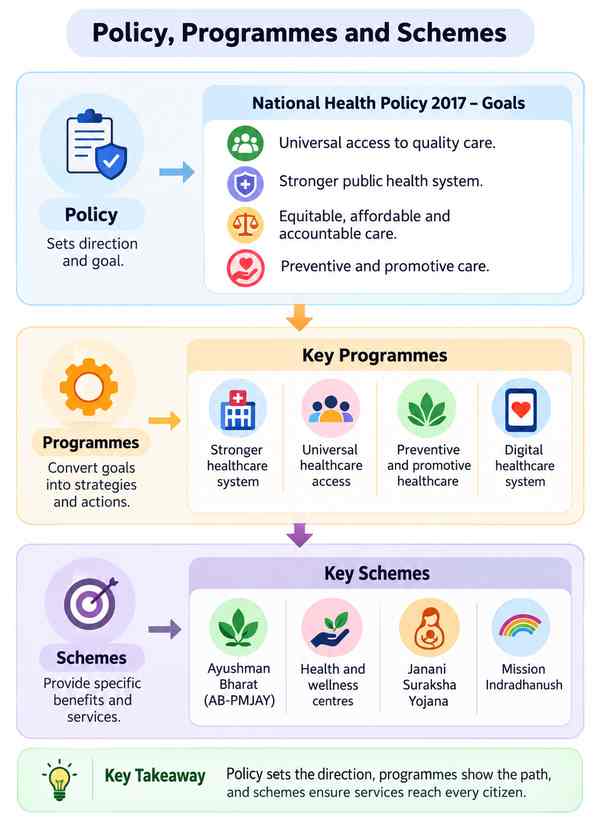
Policy, Programmes, and Schemes
Policy (direction) → programmes (plan) → schemes (action) → benefits reach the people
Policy
● Goal or direction
● Addresses public issue
Programme
● Plan or approach for the Goal
● Goals change into strategies and action
Scheme
● Specific action or initiative
● Provides benefits and services
Policy Coordination: Key to Good Governance
Need for Coordination
Public policymaking + implementation need planning+ decision-making
Example:
Khelo Bharat Niti 2025
Roles of Stakeholders
Families
▪ Support sports career
National and state governments
▪ Encourage take up sports
Local authorities
▪ Maintain sports grounds and parks
Scientists and innovators
▪ Research better nutrition + equipment
Central Government
Sports for :
▪ Holistic health
▪ International diplomacy
Roles by Government Level
Union
▪ Policy framework+ policy objectives
▪ Funding
State
▪ Model Sports State
▪ Host major national games
▪ Attract private investment
District
▪ Model Sports Districts
▪ Sports capabilities
Block
▪ Organise sporting programmes
▪ Attract mass participation and talent scouting
Roles of Private Organisations
▪ Sponsorsips
▪ Invest in scientific research
▪ Invest in better medical facilities