
Exploring Society: India and Beyond
——————————————
Social Science Textbook for
Grade 8 | Part 2
Notes
———
Chapter 2
“Ch 2 India’s Long Road To Independence Notes Class 8“ is created from your NCERT textbook.
We carefully studied the chapter multiple times and refined it with feedback from our offline classroom students.
The chapter is long and dense. We’ve shortened it and kept only the key exam-relevant points.
If you have any concerns and specific demands please contact us.
A Royal Proclamation
British Crown Takes Over
1858 → After Uprising of 1857, British Crown (Queen Victoria) took direct control of India from the East India Company
Governance Structure:
● Secretary of State for India — based in London
● Viceroy = Governor General(Queen’s representative ) — based in India
Royal Proclamation (1858)
● Promised to respect “rights, dignity and honour of native Princes”
● ~560 Indian princes to rule their states under British “Paramountcy”
● Indian subjects assured equal treatment with “all our other subjects”
● No imposition of Christianity
Paramountcy → British supremacy over princely states
Reality vs Promise
| Promise | Reality |
|---|---|
| Princely autonomy respected | Resident/Political Agent posted in almost every state, interfering in administration |
| No promotion of Christianity | Missionary activity continued with indirect state support (e.g., land concessions) |
| Peaceful rule | Economic exploitation & discrimination continued |
Continued Economic Exploitation:
● Heavy land taxes → severe famines
● Worst affected: peasants and tribals
● British goods destroyed local industry
Racial Discrimination:
● Indians treated as “inferior races”
● Lower pay for Indians in all govt services
● Juries mostly British → lenient on Europeans’ crimes
● Indians barred from clubs, trains, certain city areas, public spaces
Repressive Acts (1878):
| Act | Year | Purpose |
|---|---|---|
| Arms Act | 1878 | Banned Indians from keeping arms; British allowed |
| Vernacular Press Act | 1878 | Regulated & censored Indian-language press |
Reform Movements
Indian reformers challenged:
● Lack of formal education
● Child marriage
● Degraded status of widows
● Caste-based discrimination
Movements, Leader and Contributions
| Movement | Founder/Leader | Year & Place | Key Ideas & Contributions |
|---|---|---|---|
| Brahmo Samaj (earlier Brahmo Sabha) | Raja Ram Mohan Roy | 1828, Calcutta | Child marriage✗ Caste discrimination✗ Widow rights ✓ Girls’ education ✓ Monotheistic interpretation of Hinduism ✓ English education ✓ |
| Arya Samaj | Swami Dayananda Saraswati | 1875, Bombay | Return to the Vedas, Rational thinking quality Self-reliance. Ritualism & birth-based caste ✗ Women’s education ✓ Widow remarriage. ✓ Inspired freedom fighters |
| Shuddhi Movement | Arya Samaj leaders | Late 19th century | Reconvert who had left Hinduism. Promote social pride, debates, education |
| Other Reformers | Iswar Chandra Vidyasagar, Syed Ahmed Khan, Jyotirao & Savitribai Phule | 19th century | Modern education for all No caste-based discrimination & gender inequality. Opened schools, supported social reform |
Other Influences
Bankim Chandra Chattopadhyay
● 1860s → Sub-magistrate in a district of Bengal
● Wrote popular Bengali novels on romance & Indian history — among the first in any Indian language
● 1882 → Published Anandamath :
⁘ During Sannyasi Rebellion & the 1770 Bengal famine
⁘ For Sannyasi, motherland = divine mother
⁘ Contains the poem Bande Mataram
⁘ Invoked India’s heritage for freedom.
Swami Vivekananda
Disciple of Sri Ramakrishna.
Contributions:
● 1893 Chicago Speech at the Parliament of the World’s Religions.
● Spread Indian spirituality in India, America, and Europe
● Founded the Ramakrishna Mission:
⁘⁘⁘⁘⁘To combined spirituality with social service.
Ideas:
● Self-confidence and fearlessness.
● “Arise, awake…”
● Made Jamsetji Tata to establish the Indian Institute of Science.
● Blind imitation of the West ✗
● India’s spiritual heritage.
Legacy:
● Inspired freedom fighters.
● 12 January = National Youth Day.
The Rise of the Indian National Congress
Background:
●Allan Octavian Hume blamed British for poverty in India
●He resigned in 1882
●Brought together like-minded Indians
Formation of Indian National Congress (INC):
● 1885 → (INC) launched
● First session → Bombay
● 72 delegates present → mostly from Anglicised upper classes
Key Founders/Leaders:
● Womesh Chunder Bonnerjee → first president
● A.O. Hume — brought founders together
● Dadabhai Naoroji — prominent advocate, leading role
Early Approach of the Indian National Congress:
● Loyal to the British Crown.
● Believed in the benefits of British rule.
Method
● Held annual sessions in different cities.
● Passed resolutions.
● Preferred dialogue over confrontation towards British rule
Main Demands:
● Greater Indian participation in governance.
● Protection of civil rights.
● Social and economic reforms.
Belief Of INC:
● Reforms would reduce Indian discontent.
British Response:
● Ignored Congress resolutions
● Granted only minor concessions
● Denied Indians participation in governance
Growing Discontent
Kuka (Namdhari) Movement
● Led by Baba Ram Singh
● Namdhari = followers of God’s name.
● 1860s–1870s, Punjab.
● Called Kukas for their loud prayer chants.
Social Reforms:
● Female infanticide ✗
● Child marriage ✗
● Simplified marriages to discourage dowry.
Protest Against British Rule
● Boycotted foreign goods.
● Wore hand-spun white clothes.
● Started own postal system and private courts.
● Cow slaughter✗
British Response:
● 1872: Kukas attacked slaughterhouses.
● 65 Kukas executed without trial.
● Baba Ram Singh exiled to Burma, died there.
Kuka (Namdhari) Movement
Inspired self-reliance and boycott movements.
Chapekar Brothers
● 1896 → Severe famine + bubonic plague outbreak in Maharashtra
● Harsh British anti-epidemic = resentment
● 1897 → Three Chapekar brothers killed British Plague Commissioner of Poona & a British military officer
● Chapekar brothers arrested, and hanged
Bal Gangadhar Tilak
| Role | Nationalist leader, founding member of INC |
|---|---|
| Contribution | Found Congress too moderate. Criticized British policies in his Marathi paper, Kesari. Ganesh Chaturthi & Shivaji festival = mass patriotic events |
| Charge | Sedition (seditious articles inciting violence, no evidence) → 18 months rigorous imprisonment |
| Title | “Lokmanya” (revered by the people) |
| Work | Translated Bhagavad Gita to Marathi, published in English as The Gita Rahasya |
Revolutionary Secret Societies
Anushilan Samiti:
● 1902, Bengal.
● Centres → towns and villages
● Trained youth in intellectual, moral, and physical development
Leadership of Anushilan Samiti:
● Aurobindo Ghose coordinated its activities.
● Barindra Kumar Ghose (Barin) helped organise the movement.
➢ Tilak closely associated with V.D. Savarkar’s Abhinav Bharat.
Birsa Munda and Tribal Resistance
Birsa Munda:
● Munda tribe, Chota Nagpur.
● Opposed British rule, landlords, and missionary activities.
● Worked for tribal rights, faith, and dignity.
Ulgulaan (1899–1900):
● Led the Ulgulaan (Great Tumult).
● Urged tribals to reject colonial rule and reclaim land.
● Police stations + churches attacked.
British Response:
● Many Mundas were killed.
● Birsa arrested in 1900.
● Died in jail at 24.
Birsa Munda = Prophet of tribal revival
He is as a tribal hero in eastern India.
The 1905 Partition of Bengal and National Awakening
Partition of Bengal
Background:
● George Curzon (Viceroy) proposed partition of Bengal Presidency
● Bengal Presidency was = Bihar, Jharkhand, Odisha, Assam
● Official reason for partition → more efficient administration
● Real reason for partition → “Divide and Rule” policy — split largely Muslim East Bengal from largely Hindu West Bengal
Partition Announced:
● 1905 → by Curzon
● Provoked widespread outrage
● Leaders uniting people :
●●●●●●➢ Rabindranath Tagore,
●●●●●●➢ Surendranath Banerjee,
●●●●●●➢ Bipin Chandra Pal,
●●●●●●➢ Ashwini Kumar Dutt
● Bengal partition = attack on Bengal’s identity & Hindu-Muslim solidarity
2. Unplanned mass awakening
Two Results of Partition
1. Hindu–Muslim Divide
● Increased Hindu–Muslim tensions.
● Many Muslim leaders supported partition for development and government jobs.
2. Unplanned mass awakening:
● Meetings, processions, and protests spread across Bengal.
● Vande Mataram sung
● Vande Mataram banned in public
● Students joined.
● Rakhi-tying between Hindu and Muslims
● Movement spread beyond Bengal.
Swadeshi and Boycott Movements
Swadeshi:
Swadeshi = “of one’s own country” → promote Indian-made goods
● Promoted Indian-made goods.
● Strengthened Indian industries.
● Reduced dependence on British goods.
Boycott:
Boycott = reject foreign-made goods
● Rejected foreign goods.
● Bonfires of foreign cloth and other goods.
● Wore hand-spun Indian cloth as a symbol of self-reliance and national pride
Wider Boycott:
● Boycotted government schools, colleges, and courts.
● Limited success due to lack of Indian schools, colleges, etc.
Goal of Boycott :
● Strengthen Indian industries,
● Reduce economic dependence on British goods
Partition of Bengal (1905)
↓
Public Outrage & Protests
↓
Swadeshi + Boycott Movements
↓
National Awakening (spread beyond Bengal)
The Nationalist Agenda
◉ Swaraj — self-rule
◉ Swadeshi
◉ Boycott
◉ National Education — Indian-controlled education
◉ Passive Resistance — non-violent resistance method
Bande Mataram (English Newspaper):
● 1906 → launched by Bipin Chandra Pal
● Joined by Aurobindo Ghose
● Spread the idea of India’s freedom
National Education & Passive Resistance:
● Spelt out “doctrine of passive resistance” to resist colonial power
● To counter English education, National Education added to Swadeshi-Boycott.
Bengal National College:
● 1906 → National Council of Education created
● It launched Bengal National College → Indian education
● Aurobindo Ghose → first principal
● Taught Indian thoughts & values + modern disciplines
● Bengal National College integrated to Jadavpur University
Congress Declares Nationalist Programme:
● December 1906 → Calcutta Congress session
●●●●●●➢ President: Dadabhai Naoroji
●●●●●●➢ Declared Swaraj, Swadeshi, Boycott, National Education → Congress objectives
◉ Swaraj (self-rule) → not clearly defined
●●●●●●➢ Many meanings:
1. Self-rule within the British Empire to
2. Full independence
The All-India Muslim League
Formation:
● December 1906 → in Dhaka
● After Swadeshi Movement
Objective:
● Defend Muslim political interests
Reasons for the formation of the Muslim League:
● Growing distrust of Congress
● Fear → Muslims under represented in Hindu dominated congress
● Syed Ahmad Khan → talked against congress
●●●●●●➢ 1886 → Syed Ahmad Khan Founded “All India Muhammadan Educational Conference“= Muslim political platform
This Hindu-Muslim political division = Two-Nation Idea
The 1907 Surat Split
Background:
● Calcutta session + “Swaraj” → alarmed British
● Pressured moderate Congress leaders
● Next session → Surat (Gujarat), December 1907
The Moderates:
● Backed out of Calcutta decisions
● Demanded small administrative changes + gradual self-government
Imp. Moderates:
● Dadabhai Naoroji
● Gopal Krishna Gokhale — educationist, founder of Servants of India Society
● Pherozeshah Mehta — Bombay lawyer
● Surendranath Banerjee — journalist & political leader
● Rashbehari Ghosh — Calcutta lawyer
The Nationalists:
● Tilak prevented from speaking → chaos in the session
● Nationalist camp led by:
●●●●●●●●●➢ Bal Gangadhar Tilak
● ●●●●●●●●➢ Lala Lajpat Rai — known as “Lion of Punjab”
● ●●●●●●●●➢ Aurobindo Ghose
Outcome :
● Congress split into two camps at Surat (1907)
Moderate VS Nationalists
| Feature | Moderates | Nationalists |
|---|---|---|
| Objective | Gradual self-government within British Empire | Swaraj (full self-rule) |
| Method | Petitions, minor concessions | Mass action, assertive demands |
| British Rule | Cooperation | Resistance |
The Revolutionaries
Radical Press:
◉ Nationalist papers
●●●●➢ Kesari ➜ Tilak
●●●●➢ Bande Mataram
●●●●➢ Yugantar (“New Era”)
●●●●●●●●⁘ Run by revolutionaries led by Barindra Kumar Ghosh
●●●●●●●●⁘ Linked to Anushilan Samiti
●●●●●●●●⁘ Radical Bengali paper
●●●●●●●●⁘ Preaching open revolt & violent overthrow of British rule;
◉ Moderate papers
●●●●➢ Voice of India ➜ Dadabhai Naoroji
●●●●➢ The Bengalee ➜ Surendranath Banerjee
Khudiram Bose & Prafulla Chaki:
● April 1908 → Tried to assassinate British judge Douglas Kingsford
● Bombed wrong → But killed two British ladies by mistake
● Prafulla Chaki shot himself before capture
● Khudiram Bose (age 18) → captured, tried, hanged
Alipore Bomb Trial:
● Aurobindo Ghose jailed at Alipore jail
● British called Aurobindo “the most dangerous man”
● Aurobindo defended by Chittaranjan Das in court
Outcome:
● Aurobindo → acquitted
● Barindra & one other → death sentence, commuted to life imprisonment (Cellular Jail, Andaman)
Crackdown on Nationalists:
● Bande Mataram suppressed
● Tilak prosecuted for sedition (articles in Kesari)
●●●➢ Lawyer: Muhammad Ali Jinnah
●●●➢ Trial rushed & unfair → 6 years jail in Mandalay (Myanmar)
● 1911 → Partition of Bengal withdrawn
Other Revolutionary Attacks
| Year | Event | Revolutionaries | Outcome |
|---|---|---|---|
| 1909 | Bomb thrown at Viceroy Minto’s carriage, Ahmedabad | — | Missed target |
| 1909 | District magistrate shot at Nashik theatre | Anant Kanhere, Krishnaji Karve, Vinayak Deshpande (Abhinav Bharat, founded by V.D. Savarkar) | Caught & hanged (Kanhere was 18) |
| 1911 | District collector shot at railway station near Tirunelveli, Tamil Nadu | Vanchinathan | – |
| 1912 | Bomb thrown at Viceroy Charles Hardinge’s elephant procession, Delhi | — | Hardinge injured but survived |
Ghadar Movement (1914–15):
● Pan-Indian mutiny in British Indian Army during
● Ghadar Party founded by Lala Hardayal and Sohan Singh Bhakna
● Rash Behari Bose, Sachindra Nath Sanyal (Sachin Sanyal), Kartar Singh Sarabha tried to infiltrate the army
● British executed :
●●●➢ Kartar Singh Sarabha
●●●➢ Vishnu Ganesh Pingle
Rash Behari Bose escaped to Japan → later founded the Indian National Army
Bagha Jatin (Jatin Mukherjee):
● Leader of Anushilan Samiti
● Bagha + Rash Behari Bose on the “German Plot” = receiving a German arms shipment
German Plot discovered → Bagha died in gun fight
Home Rule Movement and the Lucknow Pact
Tilak’s Return (1914):
● 1914 → Tilak released from jail
● Set himself three tasks:
●●●➢Reconcile & reunite the two Congress factions
●●●➢Promote Hindu–Muslim cooperation
●●●➢Work towards the ideal of home rule
Lucknow Session (1916):
● Task 1 achieved → Congress factions reunited at Lucknow session
● Lucknow Pact → Agreement between Indian National Congress and All-India Muslim League :
●●●➢ Congress accepted separate electorates for Muslims in provincial & central legislative councils
Home Rule Movement (1916):
● Launched by Tilak with Annie Besant (Irish philosopher, reformer, political activist)
● Demanded self-government for India within the British Empire
● Not full independence
Home rule movement started the mass political mobilisation in the freedom struggle
Gandhi and the Non-Cooperation Movement
Early Life:
● Born 1869, Porbandar, Gujarat
● Studied in London
● Went to South Africa → Experienced racial discriminations + hardships
Developed method of Satyagraha
●●●➢ Based on: passive resistance, nonviolence (ahimsa), acceptance of suffering in quest for truth
Return to India:
● In 1915
● Joined Indian National Congress on advice of Gopal Krishna Gokhale
1918 → Applied Satyagraha to local grievances:
●●●➢ Indigo farmers, Bihar — exploitation
●●●➢ Mill workers, Ahmedabad — extremely low wages
●●●➢ Peasants of Kheda, Gujarat — excessive land revenue demands
Bardoli Movement:
● 1928 → Led by Vallabhbhai Patel — movement for peasant rights
most successful grassroots movements
Gandhi gave Patel title “Sardar” → became Sardar Vallabhbhai Patel
The Non-Cooperation Movement
Causes of Non-Cooperation Movement
● End of World War I (1914–1918) still no freedom
● Wartime food exports → food shortages in India
● Massive defence expenditure → rising prices
● 1919 → Rowlatt Act:
●●●➢ Allowed police to detain anyone without trial
●●●➢ Curtailed civil liberties
Launch Non-Cooperation Movement:
● Nationwide protest against Rowlatt Act
●●●➢ Day of prayer and fasting
●●●➢ Urged Hindu-Muslim unity in satyagraha
● Promoted Swadeshi goods as a “religious duty”
● Non-violent resistance: boycott of foreign goods, schools, courts
● Promised Swaraj within a year if nonviolence followed
Formal Launch of Non Cooperation Movement:
● August 1920 → Tilak’s death → Gandhi = mass leader of Congress
● December 1920 → Non-Cooperation Movement launched at Congress’s Nagpur session
● Many supported including Vallabhbhai Patel
● Mass participation across India
Launch Non-Cooperation Movement:
● Nationwide protest against Rowlatt Act
●●●➢ Day of prayer and fasting
●●●➢ Urged Hindu-Muslim unity in satyagraha
● Promoted Swadeshi goods as a “religious duty”
● Non-violent resistance: boycott of foreign goods, schools, courts
● Promised Swaraj within a year if nonviolence followed
Formal Launch of Non Cooperation Movement:
● August 1920 → Tilak’s death → Gandhi = mass leader of Congress
● December 1920 → Non-Cooperation Movement launched at Congress’s Nagpur session
● Many supported including Vallabhbhai Patel
● Mass participation across India
Launch Non-Cooperation Movement:
● Nationwide protest against Rowlatt Act
●●●➢ Day of prayer and fasting
●●●➢ Urged Hindu-Muslim unity in satyagraha
● Promoted Swadeshi goods as a “religious duty”
● Non-violent resistance: boycott of foreign goods, schools, courts
● Promised Swaraj within a year if nonviolence followed
Formal Launch of Non Cooperation Movement:
● August 1920 → Tilak’s death → Gandhi = mass leader of Congress
● December 1920 → Non-Cooperation Movement launched at Congress’s Nagpur session
● Many supported including Vallabhbhai Patel
● Mass participation across India
The Jallianwala Bagh Massacre and its Aftermath
The Massacre:
13 April 1919 → Jallianwala Bagh, Amritsar
● Thousands gathered for:
● Baisakhi festival
● Protesting arrest of local leaders + Rowlatt Act
● Brigadier-General Dyer sealed the main exit → ordered open fire on unarmed crowd
Impact:
● Public trust in British government ended
● United Indians for freedom
Dyer’s Aftermath:
● Known as “Butcher of Amritsar”
● His act was condemned but no penal action
● Removed from India
● British never apologised; called it “deeply shameful event in British history”
O’Dwyer & Udham Singh:
● O’Dwyer —
●●●➢ Punjab’s Lieutenant Governor,
●●●➢ Suppressed rights during his tenure;
●●●➢ Defended Dyer’s action
● Udham Singh (revolutionary, member of Ghadar Party) killed O’Dwyer in London
● Udham Singh arrested and hanged
The Khilafat Movement and its Aftermath
Background:
● Ottoman Empire —
●●●➢ Turkish-led empire
●●●➢ Rule – SE Europe, western Asia, north Africa
●●●➢ Head (Sultan), ruled from Constantinople
●●●➢ Sultan = Caliph/Khalifa = politico-religious leader of the Muslim world
● End of World War I (1914–1918) → Ottoman Empire dismembered; Caliph’s position became weak.
Launch of Khilafat Movement:
● 1919 → Khilafat Movement by:
●●●➢ Muhammad Ali & Shaukat Ali (“Ali brothers”)
●●●➢ Maulana Abul Kalam Azad
● Aim: preserve the Caliph’s religious authority
Khilafat Alliance with Congress:
● Gandhi saw an opportunity to unite Hindus & Muslims
● 1920 → Alliance between Khilafat leaders & Congress
●●●➢ Promised to fight together for Khilafat and Swaraj
●●●➢ Merged with Non-Cooperation Movement
Criticism of Khilafat + Congress:
● Turkey’s Caliph issue was not India’s concern
● Syed Ahmad Khan was Doubtful→ Indian Muslim loyalty to a foreign religious power (“territorial loyalty“)
● Jinnah left Congress at its 1920 session, for mixing independence movement with religion
Chauri Chaura Incident & End of Non-Cooperation:
● February 1922, Chauri Chaura (Uttar Pradesh)
●●●➢ Protesters killed policemen
●●●➢ Set police station on fire
● Gandhi called this “inhuman conduct”
●●●➢ called off Non-Cooperation Movement
●●●●●●➢Many Congress leaders disapproved:
⁘⁘⁘⁘⁘⁘⁘⁘⁘ Motilal Nehru, Jawaharlal Nehru, Chittaranjan Das, Subhas Chandra Bose
● Motilal Nehru & C.R. Das formed the Swaraj Party
End of Khilafat Movement:
● Mustafa Kemal abolished:
●●●➢ Turkish sultanate — 1922
●●●➢ The Caliphate itself — 1924
Impact of Khilafat Movement:
● Temporarily united Hindus & Muslims
● Reinforced separateness among Indian Muslims
● Radical Muslim leaders emerged
● Hindu-Muslim riots
Protests, Repression and Revenge
Simon Commission (1927):
● 1927 → Simon Commission came to India to study constitutional reform
●●●➢ No Indian member included
●●●➢ Slogan: “Simon Go Back!”
●●●➢ Protesters waved black flags
Lala Lajpat Rai:
● October 1928, Lahore → Led nonviolent march against Simon Commission
● Police lathi-charged → Rai badly injured
● He said – blows struck at him would hasten the end of British rule
● His death inflamed national sentiment
Significance of simon commission:
● Simon Commission exposed British refusal to talk Indians about their future
● Indians demanded → complete self-rule
More revolutionary actions
Hindustan Republican Association (HRA):
● Inspired by the earlier Ghadar Movement
● Kakori Train Robbery — government money (near Lucknow)
●●●➢ Led by Ram Prasad Bismil, Ashfaqulla Khan, Chandrashekhar Azad
●●●➢ British action → Bismil, Khan, and several others executed
Hindustan Socialist Republican Association (HSRA):
● HRA reorganised as HSRA
● Leaders: Chandrashekhar Azad, Bhagat Singh
● December 1928 → Aimed to avenge Lala Lajpat Rai’s death
●●●➢ Targeted the British officer who ordered the lathi-charge
Bhagat Singh — Central Assembly Bomb Case:
● 1929 →He dropped two low-intensity bombs in Delhi’s Central Legislative Assembly
● No death: “to make the deaf hear”
● Dropped pamphlets, slogans for revolution & justice
● Arrested
● Did long hunger strike for unjust treatment of Indian prisoners
Execution (1931):
● Bhagat Singh, Sukhdev Thapar, Shivaram Rajguru hanged in 1931
● Bhagat Singh = symbol → resistance against colonial oppression
● Subhas Chandra Bose called him a symbol → unconquerable spirit of revolt
Women Revolutionaries
| Revolutionary | Year | Action |
|---|---|---|
| Suniti Chowdhury & Shanti Ghosh (students, Comilla) | 1931 | Assassinated a District Magistrate |
| Bina Das (Calcutta University student) | 1931 (few months later) | Attempted to shoot the Governor of Bengal at a convocation; narrowly missed |
“free my country from “perpetual subjection to infinite shame and endless suffering” caused by British rule”
●●●➢ Bina Das
Purna Swaraj and Civil Disobedience
Nehru Report & Dominion Status (1928):
● 1928 → By Motilal Nehru (reaction to Simon Commission)
● Demanded “Dominion status” for India like Canada and Australia
●●●➢ Total internal autonomy
●●●➢ Britain control→ military & foreign policy
●●●➢ British king/queen → official head of state
Demand for Purna Swara:
● Jawaharlal Nehru, Subhas Chandra Bose demanded : “Purna Swaraj” (complete independence)
● Not a new demand — earlier voiced by:
●●●➢ Nationalist faction of Congress, two decades earlier
●●●➢ Aurobindo Ghose — 1908
●●●➢ Maulana Hasrat Mohani (member of both Congress & Muslim League) — 1921
●●●➢ V.D. Savarkar — 1925
● December 1929 → Congress’s Lahore session → Purna Swaraj resolution passed
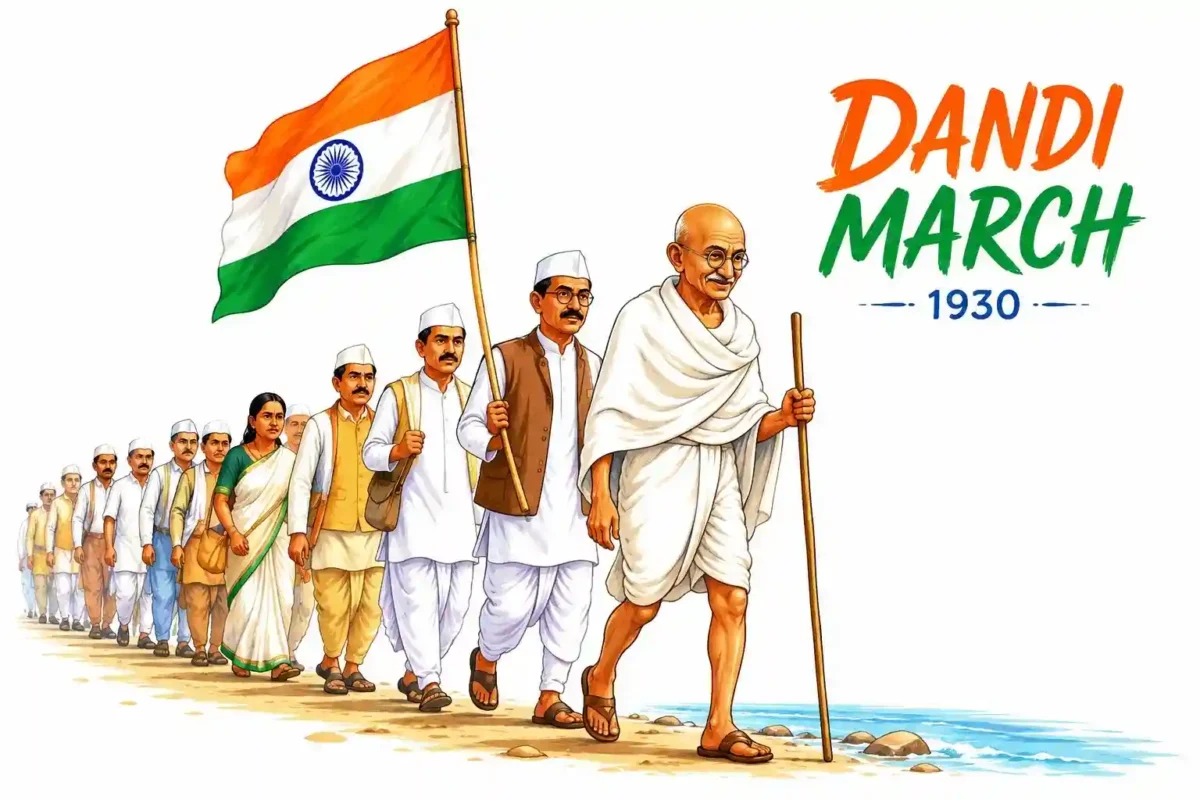
Civil Disobedience Movement — Salt March:
● By Mahatma Gandhi to implement Purna Swaraj demand
● March–April 1930 → Salt March (Dandi March)
●●●➢ 380-km march to Dandi (Gujarat)
●●●➢ Gandhi collected salt
⁘⁘⁘⁘⁘⁘⁘⁘⁘ Reason: British — monopoly on salt production + high salt tax → breaking this law = symbol against colonial rule
Spread of the Movement:
● Gandhi arrested
● Movement spread widely:
●●●➢ Salt marches in other regions
●●●➢ Boycott of foreign cloth
●●●➢ Refusal to pay taxes
●●●➢ Women :
⁘⁘⁘⁘⁘⁘⁘⁘⁘ Broke the salt law,
⁘⁘⁘⁘⁘⁘⁘⁘⁘ Joined processions,
⁘⁘⁘⁘⁘⁘⁘⁘⁘ Picketed liquor shops & foreign cloth shops
⁘⁘⁘⁘⁘⁘⁘⁘⁘ Stepped out of seclusion to join Congress demonstrations
Sarojini Naidu:
● Poet & Orator
● First Indian woman president of Congress — 1925
● Advocate of women’s voting rights
● Actively protested → arrested and imprisoned several times
Qissa Khwani Bazaar Massacre:
● 23 April 1930, Peshawar
● British troops fired on crowd protesting the arrest of Abdul Ghaffar Khan
● Two platoons of Royal Garhwal Rifles led by Chandra Singh Garhwali, refused to fire
The Gandhi-Irwin Pact
1931
British conceded:
● Released political prisoners not involved in violence
● Allowed limited private manufacture of salt
Congress conceded:
● Suspended Civil Disobedience Movement
● Agreed to attend the Round Table Conference in London
Significance of The Gandhi-Irwin Pact:
● First negotiation between British government & Congress as equals
Criticism & Aftermath The Gandhi-Irwin Pact:
● Younger Congress leaders criticised the pact — no guarantee of Purna Swaraj
● Gandhi resumed Civil Disobedience → British responded with massive arrests
● 1934 → Gandhi withdrew the Civil Disobedience Movement
● Congress shifted to constitutional methods
1935 Reform:
● British gave provincial autonomy
● Elected governments at provincial level
● British controlled: foreign affairs, defence, internal security
● British governors could take over provincial administration
Gandhi’s Campaign Against Untouchability:
● “Untouchables”:
●●●➢ Official term “Depressed Classes”
●●●➢ Constitution’s term “Scheduled Castes”
● B.R. Ambedkar wanted separate electorates for Depressed Classes
● Gandhi feared separate electorates would permanently divide Hindu society
● Gandhi began a “fast unto death” in protest
Poona Pact between Gandhi and Ambedkar:
● No separate electorates → increased reserved seats for Depressed Classes in legislatures
The Idea of Separate Nations
Muslims and Civil Disobedience:
● Muslims generally stayed away from the Civil Disobedience Movement
Muhammad Iqbal’s Proposal (1930):
● Muhammad Iqbal — Urdu philosopher & poet
● Presided → 1930 All-India Muslim League session at Allahabad
● Proposed separate territory for Muslims in northwestern India
●●●➢ Aim: preserve Muslim culture & religious identity
● Increased debate about separateness
Congress’s Position:
● Congress opposed the Two-Nation idea, Including Maulana Azad, Abdul Ghaffar Khan
◉ Jinnah endorsed the idea of Pakistan
Hindu Mahasabha’s Position:
● Hindu Mahasabha, under V.D. Savarkar
● Viewed Hindus and Muslims as two distinct nations living side by side
World War II and the Indian National Army
India and World War II:
● India pulled into the war without being consulted
● 2.5+ million Indian soldiers
Wartime Hardships:
● Shortages of food & goods, high taxes
● Indian grain sent abroad on orders of Winston Churchill (UK PM)
● 1943 → Bengal Famine — millions died
●●●➢ Initial support for British ended
●●●➢ Sacrifing for other
●●●➢ No freedom given
Subhas Chandra Bose:
● Congress leader; broke from Gandhi’s nonviolence
● Freedom will come through armed struggle
● Travelled to Germany for help from anti British forces.
Indian National Army (INA):
● Travelled to Indonesia, Japan, finally Singapore (1943)
● Formed the Indian National Army (INA) — from Indian POWs & volunteers
● Declared the Azad Hind government
INA’s Campaign:
● INA fought alongside Japanese army in:
●●●➢ Burma
●●●➢ Northeastern India — Manipur, Nagaland
● Militarily defeated; failed to establish a base in India
The Quit India Movement
Cripps Mission (1942):
● Churchill for India’s support in WWII, sent Stafford Cripps to India
● Cripps Mission (1942) offered:
●●●➢ Dominion status after the war
●●●➢ Provinces could opt out of India
● C. Rajagopalachari favored acceptance
● Gandhi rejected the offer
Launch of Quit India Movement:
● August 1942 → Gandhi launched the Quit India Movement
● Call: “Do or Die”
● Clear demand: British must leave India at once
Course of Quit India Movement:
● Congress leadership arrested
● Popular uprising:
●●●➢ Mass protests, rallies with “Quit India” banners
●●●➢ Workers’ strikes, students left schools
●●●➢ Attacks on government buildings, uprooted telegraph poles
● Ram Manohar Lohia & Jayaprakash Narayan kept the underground movement going
Viceroy Linlithgow called it the most serious rebellion since 1857
Brutally suppressed — many deaths & arrests across India
Message: British could no longer rule India without Indian consent
Kanaklata Barua:
● Teenage independence activist from Assam
● 1942 → Age 17, shot and killed by British police
● Trying hoisting the Indian flag at police station in Gohpur
● Known as “Birangana” (“heroic woman”)
Partition, Turmoil, and Independence
End of World War II:
● 1945 → WWII ended with victory of Allies (USA, UK, Soviet Union, China) over Axis (Germany, Italy, Japan)
● Era of decolonisation began
● Britain finally thought of giving India independence
Military Mutinies (1946):
● January 1946 → Royal Indian Air Force
● February 1946 → Royal Indian Navy, Bombay
●●●➢ Naval ratings (sailors) rebelled against ill-treatment
● Signal to British: can’t rely on Indian military to maintain their empire
Cabinet Mission (1946):
● Peaceful transfer of power
● Dividing India into three groups of provinces
●●●➢ With complete autonomy except in defense, foreign affairs, communication
● But deadlock between congress and Muslim league
‘Direct Action’
● Demand for a separate Muslim state grew intense
● Jinnah gave up constitutional methods
● Called for “Direct Action Day” — 16 August 1946
●●➢ Urged Muslims to demonstrate for Pakistan
●●➢ Warned → divided India or a destroyed India
● Communal violence in Calcutta
●●➢ Provocative speeches & pamphlets
●●➢ Muslim attacked Hindus, who retaliated
● Thousands killed, thousands displaced
Interim Government:
● September 1946 → Interim Government led by Jawaharlal Nehru took charge
The Partition of India
Background:
● British encouraged Hindu-Muslim differences
● Disagreement between two small communities → Partition
Radcliffe Line:
● July 1947 → Mountbatten (last Viceroy) chose Cyril Radcliffe
● Result: Radcliffe Line — split Punjab and Bengal
Two countries:
⁘⁘⁘ India
⁘⁘⁘ Pakistan — West Pakistan (now Pakistan) + East Pakistan
Independence (15 August 1947):
● New government: PM Jawaharlal Nehru, Governor-General Mountbatten
Historians’ Debate on Britain’s Exit:
● Earlier view: mainly due to Gandhi, nonviolence, Congress policies
● Later recognition of multiple factors:
●●➢ Popular uprisings
●●➢ Revolutionary attempts
●●➢ Royal Indian Air Force & Royal Indian Navy mutinies
●●➢ Britain’s diminished post-WWII status
●●➢ Worldwide trend of decolonisation
◈◈◈◈◈End Of Notes◈◈◈◈◈
FAQs| Ch 2 India’s Long Road To Independence Notes class 8
How to learn such a big chapter
You have to read it and revise multiple times. Learn a topic a day. Use table of contents at the beginning of the post to select the topic.
I want specific help on this chapter
Email us you requirements and needs to info@studyless.in


That’s the best website for taking notes! I love it!!
Thank you very much