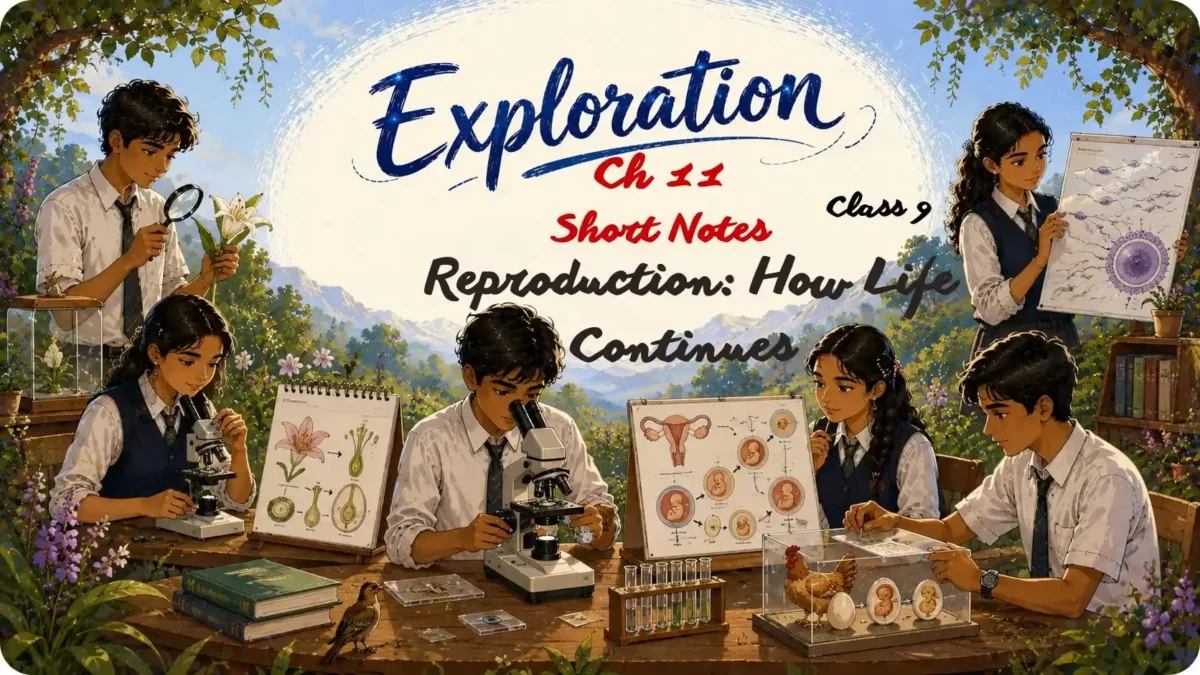
Class 9 | Chapter 11 | Reproduction: How Life Continues
Question Answer
In “Ch 11 Reproduction: How Life Continues Question Answer”, the following novel things are included.
- Quick Concept Table
- Source of the answer
- Flow charts in the form of images
- Detailed FAQs at the end
These things will help to better retain the answers. It will also help you to learn how the questions are framed, so that you can prepare the chapter in a much better way.
You may also like | Ch 11 Reproduction: How Life Continues Short Notes
Q1
A flower’s anthers are removed before it matures. Later, pollen from
another plant of the same species is dusted onto its stigma, and seeds
are produced. Which process has been ensured here?
(i) Self-pollination
(ii) Cross-pollination
(iii) Fertilisation
(iv) Tissue culture
Answers:
(ii) Cross-pollination
Why?
Removing the anthers prevents the flower from using its own pollen. Pollen then comes from a different plant of the same species. This exactly matches the definition of cross-pollination.
Page 216, Section 11.2.3, Paragraph 2:
“If the pollen is transferred from the anther of a flower of one plant to the stigma of a flower of another plant of the same type, the pollination is called cross-pollination.”
Quick Concept Table:
| Type | Pollen source | Same plant? |
|---|---|---|
| Self-pollination | Same flower / same plant | Yes |
| Cross-pollination | Different plant, same species | No |
| Fertilisation | After pollination — gametes fuse | N/A |
| Tissue culture | Lab-based, no pollination needed | N/A |
Q2
Arrange the following stages of sexual reproduction in plants in the correct order:
(i) Pollen germination on the stigma
(ii) Fertilisation
(iii) Pollination
(iv) Formation of the zygote
Answers:
(iii) ➜ (i) ➜ (ii) ➜ (iv)
Pollination ➜ Pollen germination on stigma ➜ Fertilization ➜ Formation of zygote
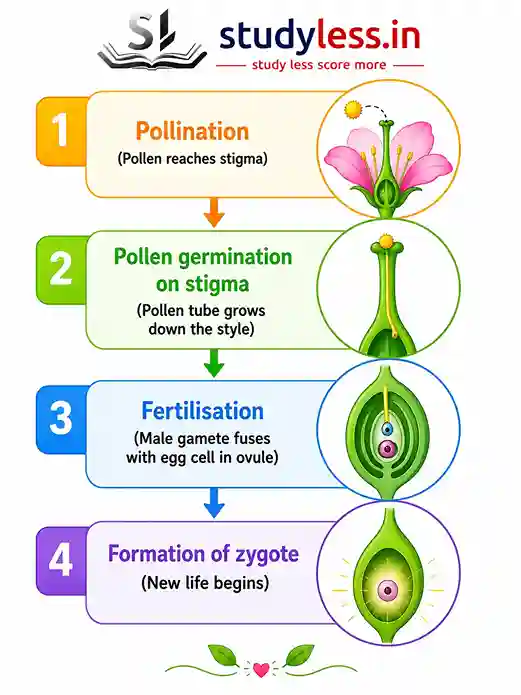
Page 216, Section 11.2.5, Paragraph 1:
“Pollen grains produce pollen tubes that grow down through the style into the ovary. The male gamete moves through this tube and arrives at the ovule, where it fuses with the egg cell… This fusion of gametes is referred to as fertilisation… The fertilised egg is called a zygote.”
Q3
Assertion (A): The zygote formed after fertilisation immediately
attaches to the uterus wall.
Reason (R): The uterus wall is always prepared to receive the zygote.
(i) Both A and R are true, and R is the correct explanation of A.
(ii) Both A and R are true, but R is not the correct explanation of A.
(iii) A is true, but R is false.
(iv) A is false, but R is true.
Answers:
(iii) A is true, but R is false.
Explanation:
Assertion A — TRUE:
The zygote does eventually attach to the uterus wall (implantation). However, it does not do so immediately. It first undergoes several mitotic divisions while travelling to the uterus.
Reason R — FALSE:
The uterus wall is NOT always prepared. It prepares itself only around the time of ovulation — the inner lining thickens and becomes rich with blood vessels specifically to receive the zygote. If no fertilisation occurs, this lining sheds (menstruation).
Timeline:
| Event | Timing |
|---|---|
| Uterus lining thickens | Around Day 6–14 (after menstruation) |
| Ovulation | Around Day 14 |
| Fertilisation (if it occurs) | After ovulation |
| Zygote divides and travels | During the journey to the uterus |
| Implantation | After travel — NOT immediate |
| Menstruation (if no fertilisation) | Around Day 28 |
Page 220, Section 11.5.5, Paragraph 1:
“The zygote undergoes a series of mitotic divisions while travelling to the uterus, and implants into the inner lining of the uterus… This implantation marks the beginning of pregnancy.”
Page 221, Section 11.5.6, Paragraph 1:
“The inner lining of the uterus, which became thick and rich with blood vessels to receive and nourish the developing zygote, is no longer needed. So, the lining sheds.”
Q4
Why does asexual reproduction produce offspring that are genetically
identical to the parent?
Answers:
Asexual reproduction uses only one parent. No mixing of genetic material from two individuals occurs. The key process behind it is mitosis — a cell division that produces daughter cells with the same number of chromosomes as the parent cell.
Because every chromosome is copied exactly, the offspring receive the same genetic information as the parent. Such genetically identical individuals are called clones.
Difference Table:
| Feature | Asexual Reproduction | Sexual Reproduction |
|---|---|---|
| Number of parents | One | Two |
| Type of cell division | Mitosis | Meiosis + Fertilisation |
| Genetic result | Identical (clones) | Varied (unique individuals) |
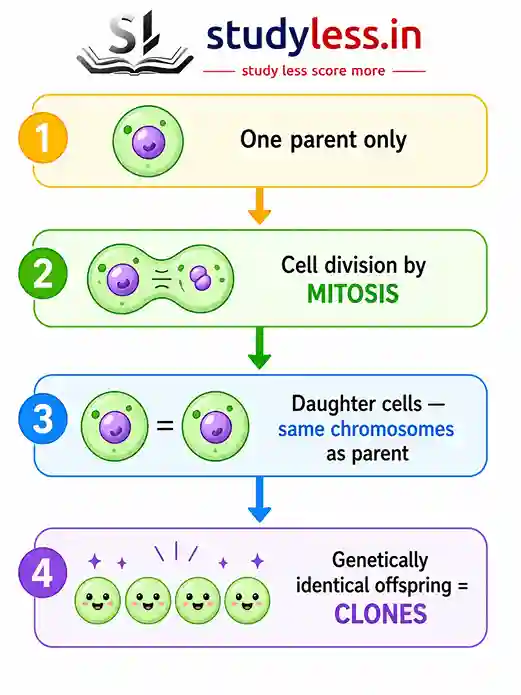
Page 212, Section 11.1 (end of asexual reproduction section), Paragraph 3:
“…the central process behind asexual reproduction is mitosis, a type of cell division that produces two daughter cells, each having the same number of chromosomes identical to the parent cell. Because of this, the offspring produced are genetically identical to the parent and are called clones.”
Q5
Explain why the menstrual cycle stops during pregnancy
Answers:
The menstrual cycle stops during pregnancy because the uterus lining is no longer shed — it is now needed to nourish the developing embryo.
Explanation:
Normally (no pregnancy):
The uterus lining thickens to prepare for a zygote. If no fertilisation occurs, the lining is not needed and sheds — this is menstruation.
During pregnancy:
A zygote forms and implants into the uterus lining. The lining must remain intact and keep thickening to support the growing embryo and fetus. Shedding it would harm the baby. So, menstruation stops for the entire duration of pregnancy (about 9 months).
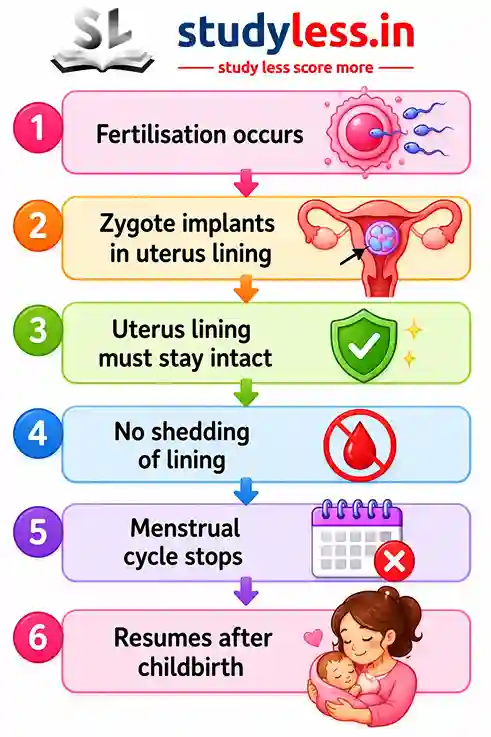
Page 221, Section 11.5.6, Paragraphs 1–2:
“If an egg is not fertilised… the lining sheds… This process is called menstruation.”
Page 220, Section 11.5.5:
“…implants into the inner lining of the uterus to receive nourishment for development. This implantation marks the beginning of pregnancy.”
Q6
Why are flowers that bloom at night white or light in colour as
compared to flowers that bloom during the day?
Answers:
Flowers attract pollinators using colour, fragrance, and nectar. Colour is useful only when light is available. At night, colours are harder to see, so bright colours offer no advantage.
White or light-coloured flowers reflect whatever little moonlight or starlight is available, making them more visible at night to pollinators like moths.
Additionally, night-blooming flowers often rely more on fragrance than on colour to attract pollinators.
Page 216, Section 11.2.4, Paragraph 1:
“Many plants… are pollinated by insects, such as bees and butterflies. Their flowers are often brightly coloured, produce nectar, and give off fragrance to attract pollinators.”
Q7
Why do vegetatively propagated plants tend to be more vulnerable to
diseases than sexually reproduced plants?
Answers:
Vegetative propagation produces genetically identical plants (clones) to the parent. This means:
- If the parent plant has no resistance to a particular disease, none of the offspring will either.
- A single disease can wipe out the entire population because all plants are equally vulnerable.
In contrast, sexually reproduced plants show genetic variation. Some individuals may carry genes that confer resistance to certain diseases. These survive and pass on their resistance.
Main differences
| Feature | Vegetative Propagation | Sexual Reproduction |
|---|---|---|
| Genetic makeup | Identical (clones) | Varied |
| Disease resistance | Same for all plants | Some may be resistant |
| Risk if disease strikes | The entire crop can be destroyed | Some plants may survive |
Page 212, Section 11.1.1, Paragraph 1:
“Asexual reproduction produces genetically identical individuals.”
Page 209, Section 11.1, Paragraph 2:
“The key point about this type of reproduction is that it involves only one parent and hence, produces genetically identical individuals.”
Page 214, Section 11.2.1 (end):
“This creates variation among individuals, which is important for the survival of a species. Variation helps some individuals adapt better to changing environments…”
Q8
If all flowers in a type of plant were only capable of self-pollination,
how would it affect the genetic diversity over several generations?
Explain.
Answers:
If only self-pollination occurred, genetic diversity would decrease sharply over generations.
Why:
In self-pollination, pollen from the same plant fertilises its own egg. No new genetic material enters from outside. Every generation would carry virtually the same combination of genes as the parent.
Over many generations:
- Variation reduces.
- All individuals become more and more similar.
- The population loses the ability to adapt to new diseases or environmental changes.
- The species becomes more vulnerable to extinction.
Sexual reproduction (cross-pollination) creates new combinations of chromosomes through meiosis and random mixing — leading to uniqueness in every individual.
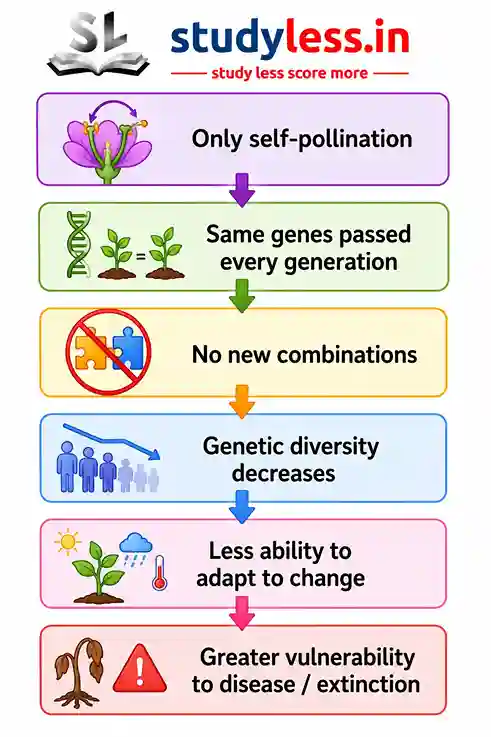
Page 208 (Introduction), Paragraph 2:
“…offspring inherit a mix of characteristics from the two individuals. This mixing of characteristics may lead to the small differences between parents and their young ones. Accumulated over many generations, such differences help living beings adapt to changing environments, and sometimes even give rise to new kinds of species.”
Page 213–214, Section 11.2.1:
“This random mixing provides many combinations, making children genetically different from their parents and also from their siblings.”
Q9
A farmer wants to produce a large number of genetically identical
plants quickly. Suggest suitable reproduction methods and explain
why they are effective.
Answers:
The farmer should use asexual (vegetative) reproduction methods. These are fast, use only one parent, and produce genetically identical plants (clones).
Best methods (from the chapter):
| Method | How it works | Example plants |
|---|---|---|
| Cutting | Stem pieces planted in soil at 45–60°; new roots grow | Money plant, sugarcane |
| Grafting | Stem of the desired plant joined to rooted plant | Rose varieties, mango |
| Layering | Middle of a live branch buried; roots grow; then cut and replanted | Lemon, shrubs |
| Tissue culture | Shoot tip grown in lab on nutrient media; mass production | Banana |
Why are these methods effective:
- Speed — no waiting for seeds to germinate; plants develop faster.
- Genetic identity — all plants carry the same desirable traits (high yield, disease resistance, taste).
- Scale — especially tissue culture allows mass production of thousands of identical plants quickly.
- Reliability — the farmer is sure of the characteristics of the crop.
Page 209, Section 11.1.1, Paragraph 1:
“Asexual reproduction produces genetically identical individuals. This natural process has been adapted by scientists and horticulturists to develop several methods of vegetative propagation, such as cutting, grafting, layering and tissue culture for growing plants.”
Page 210, Bridging Science and Society:
“Propagation of plants by the tissue culture technique has revolutionised farming practices like in banana farming. Farmers are now provided mass-produced healthy plantlets…”
Q10
Suresh prepares slides with pollen grains in different sugars
concentrations (0%, 2.5%, 5%, 7.5%, 10%) to study the germination of pollen.
(i) What are the different hypotheses which can be tested using this
set-up?
(ii) What parameters should be kept the same in this set-up?
Answers:
(i) Possible hypotheses:
- Pollen tube length increases with increasing sugar concentration up to a point.
- Higher sugar concentration promotes better pollen germination.
- There is an optimal sugar concentration for maximum pollen germination — too little or too much reduces germination.
- Pollen grains do not germinate without any sugar (0% concentration).
(ii)
| Parameter to keep constant | Why |
|---|---|
| Type of pollen (same plant species) | Different plants may germinate at different rates |
| Temperature | Temperature affects germination speed |
| Humidity / moisture | Pollen needs moisture to germinate |
| Time of observation | All slides must be observed at the same time interval |
| Amount of pollen used per slide | Ensures fair comparison |
| pH of solution | Acidity can affect germination |
Page 216, Section 11.2.5:
“Once the pollen reaches a compatible stigma, a remarkable process begins. Pollen grains produce pollen tubes that grow down through the style…”
(The chapter establishes that pollen germination requires suitable conditions — the activity applies this principle experimentally.)
Q11
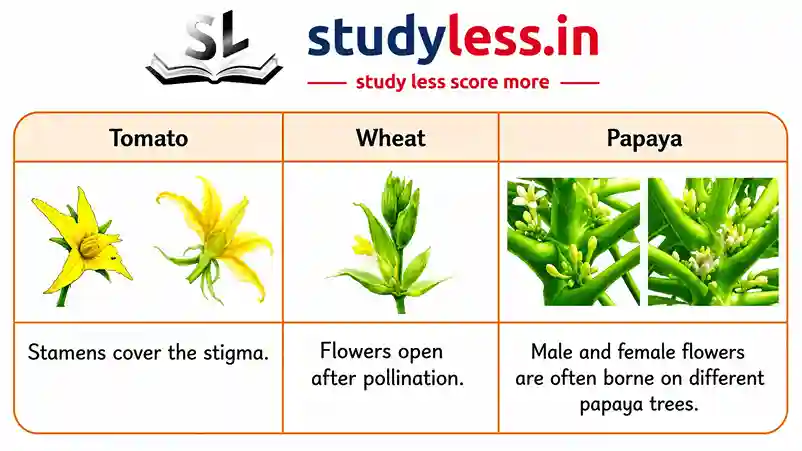
Look at the picture given below and think in line with the given prompts
and find out which type(s) of pollination might have been followed in
these flowers —
Answers:
Tomato → Self-pollination
The stamens surround and cover the stigma. Pollen easily falls directly onto the stigma of the same flower. No need for an external agent to transfer pollen to another plant.
Wheat → Self-pollination
Flowers open after pollination — meaning pollination has already occurred within the closed flower using its own pollen. This is a classic self-pollination strategy.
Papaya → Cross-pollination
Male and female flowers are on different trees. Pollen from the male tree must travel (via wind or insects) to the female tree. This is by definition cross-pollination.
In short
| Flower | Pollination type | Key reason |
|---|---|---|
| Tomato | Self-pollination | Stamens cover stigma; pollen falls on own stigma |
| Wheat | Self-pollination | Flower opens only after pollination is complete |
| Papaya | Cross-pollination | Male and female flowers on separate trees |
Page 216, Section 11.2.3:
“The transfer of pollen occurs to the stigma of the same flower or another flower of the same plant, is called self-pollination.”
“If the pollen is transferred from the anther of a flower of one plant to the stigma of a flower of another plant of the same type, the pollination is called cross-pollination.”
Q12
an important cash crop that contribute significantly to farmer’s
livelihoods. The fruit yield in apple cultivation is declining
continuously, associated with climate change and a significant decline
in the population of natural pollinators. A researcher-farmer group set
up two experimental apple orchards at two distinct locations: Places A
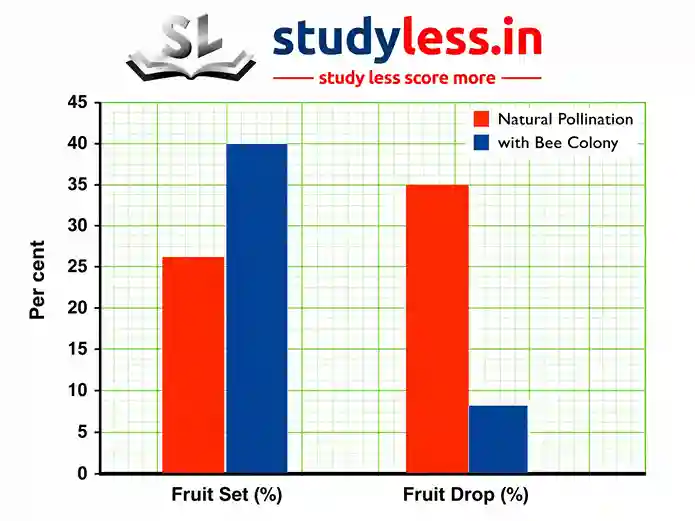
and B. In apple orchards at Place A, they allowed natural pollinators to pollinate the flowers of the apple. In apple orchards at Place B, they applied mixed farming techniques of beekeeping. Along with honey, the farmer yielded apples. The yield of apples is depicted in Fig. 11.24, in terms of fruit setting (number of fruits/the total number of corresponding fruit-bearing branches) and fruit drop (premature falling of developing fruits) in the two types of experimental places of apple orchards.
(i) What are the hypotheses the researcher farmers
group has thought of for this
investigation?
(ii) What are the different parameters in the
experiment?
(iii) Compare and analyse the data of two
experimental orchards Places A and B, in
terms of high yields of apple fruits.
(iv) Based on your analysis, what do you infer from the data?
Answers:
(i) Ans
- Introducing bee colonies increases fruit setting percentage in apple orchards.
- Orchards with bee colonies will have lower fruit drop compared to those with only natural pollinators.
- Managed bee pollination leads to a higher overall apple yield than relying on declining natural pollinators.
(ii) Ans
Different parameters in the experiment?
| Parameter type | Details |
|---|---|
| Independent variable (changed) | Pollination method — natural vs. bee colony |
| Dependent variables (measured) | Fruit setting (%), Fruit drop (%) |
| Controlled variables (kept the same) | Apple variety, location conditions, soil, irrigation, time of observation |
(iii) Ans
From the bar graph described in the chapter (Fig. 11.24):
| Outcome | Place A (Natural pollinators) | Place B (Bee colony) |
|---|---|---|
| Fruit Set % | Lower (~25%) | Higher (~40%) |
| Fruit Drop % | Higher (~35%) | Lower (~8%) |
- Place B shows significantly higher fruit setting — more flowers become fruits.
- Place B shows significantly lower fruit drop — fruits that form are more likely to survive to harvest.
(iv) Ans
Inference from the data
The data clearly shows that managed bee pollination (beekeeping) leads to better apple yields — more fruits set and fewer fruits drop prematurely.
This is because bee colonies provide more efficient and abundant cross-pollination compared to the declining population of natural pollinators. Better pollination leads to better fertilization, stronger fruit development, and reduced premature drop.
Page 216, Section 11.2.4:
“Pollination depends on external agents called pollinators, such as wind, water, insects (bees, butterflies), or birds.”
Page 226, Question 12 context:
“The fruit yield in apple cultivation is declining continuously, associated with climate change and a significant decline in the population of natural pollinators.”
Q13
A student claims, “In humans, ovulation always happens on day 14 of
the menstrual cycle”. Critically examine this claim and state whether
the claim is correct or not. Give at least two reasons for your answer.
Answers:
The claim is NOT fully correct.
Day 14 is an approximation, valid only for a standard 28-day cycle. It is not a universal rule.
Reason 1 — The menstrual cycle length varies:
The chapter states the cycle repeats “typically every 21–35 days (often around 28 days).” If a person’s cycle is 35 days, ovulation does not happen on day 14 — it happens later. Ovulation generally occurs roughly midway through a person’s individual cycle.
Reason 2 — Biological variability:
Hormonal changes, stress, health, age, and nutrition can shift the timing of ovulation. The chapter mentions that the cycle “usually begins at puberty… and continues till menopause” — throughout this long span, the cycle can be irregular, especially in early adolescence or around menopause.
In Short
| Aspect | Student’s claim | Accurate understanding |
|---|---|---|
| Day of ovulation | Always day 14 | Around day 14 only in a typical 28-day cycle |
| Cycle length | Assumed 28 days | Varies from 21 to 35 days |
| Consistency | Assumed fixed | Can vary due to age, health, stress |
Page 221, Section 11.5.6, Paragraph 2:
“The cycle of ovulation, preparation of the uterus and menstruation repeats typically every 21–35 days (often around 28 days), and usually begins at puberty, between the ages of 10–14 in girls and continues till menopause i.e., around age 50.”
Page 221, Fig. 11.21 caption:
“Key stages of the menstrual cycle across a typical 28-day period” — the word typical is key. It is not universal.
FAQs| Ch 11 Reproduction: How Life Continues Question Answer
Q1. What is the difference between asexual and sexual reproduction in living organisms?
Asexual reproduction uses one parent and produces genetically identical offspring (clones). Sexual reproduction uses two parents, combines genetic material through meiosis and fertilisation, and produces offspring with unique genetic combinations.
Reproduction is the biological process by which living organisms produce new individuals of the same species.
There are two main types:
Asexual Reproduction
● Involves only one parent
● New individuals are genetically identical to the parent
● The key cell division process is mitosis — chromosomes are copied exactly
● Offspring are called clones
● It is fast and helps populations grow quickly in favourable conditions
Methods of asexual reproduction:
Budding ➽ Yeast, Hydra
Spore formation ➽ Rhizopus (bread mould), Aspergillus
Vegetative propagation ➽ Potato, Bryophyllum, Sugarcane
Tissue culture ➽ Banana plants
Sexual Reproduction:
● Involves two parents
● Offspring receive a mix of genetic material from both parents
● Key process is meiosis — chromosome number is halved to form gametes
● When two gametes (sperm + egg) fuse during fertilisation, a zygote forms with the full chromosome number restored
● Creates variation — every individual is genetically unique
Why does this matter?
Genetic variation created by sexual reproduction helps species adapt to changing environments and sometimes gives rise to entirely new species. Asexual reproduction is efficient for rapid population growth but leaves organisms vulnerable — a single disease can wipe out an entire clonal population.
Asexual Vs Sexual
| Feature | Asexual | Sexual |
|---|---|---|
| Parents needed | One | Two |
| Cell division type | Mitosis | Meiosis + Fertilisation |
| Offspring genetics | Identical (clone) | Unique (varied) |
| Speed | Fast | Slower |
| Genetic diversity | None | High |
| Adaptability | Low | High |
| Example | Hydra budding | Human reproduction |
In Short :
Asexual reproduction = one parent + mitosis + genetically identical offspring
Sexual reproduction = two parents + meiosis + fertilisation + genetically unique offspring
Source: NCERT Exploration Grade 9, Chapter 11, Pages 208–212
Q2. How does pollination occur in flowering plants, and what is the difference between self-pollination and cross-pollination?
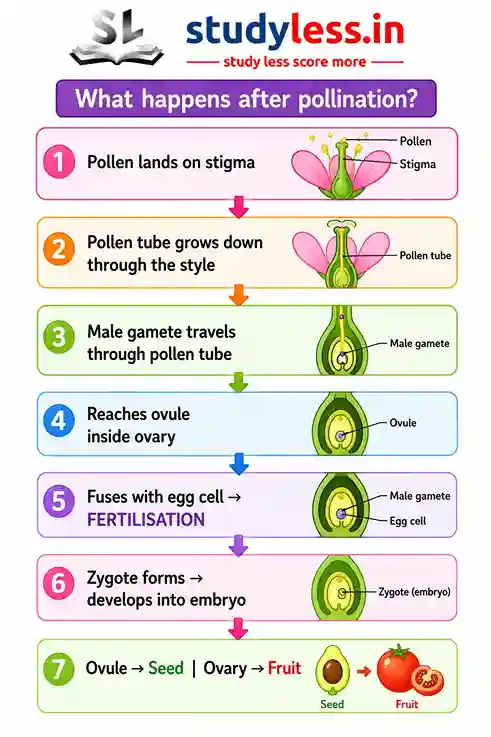
Pollination is the transfer of pollen grains from the anther (male part) to the stigma (female part) of a flower. When pollen transfers within the same plant, it is self-pollination. When it transfers between two different plants of the same species, it is cross-pollination.
What is pollination?
Pollination is the transfer of pollen from the anther to the stigma. It is essential for fruit and seed formation.
A complete flower has four main parts — sepals, petals, stamen (male), and pistil (female).
● The stamen consists of a filament and an anther — the anther produces pollen grains containing male gametes.
● The pistil has three parts: stigma (sticky tip), style (connecting tube), and ovary (contains ovules with egg cells).
Two types of pollination:
| Type | Definition | Example plants |
|---|---|---|
| Self-pollination | Pollen transfers to the stigma of the same flower or another flower on the same plant | Tomato, Wheat |
| Cross-pollination | Pollen transfers from one plant’s flower to another plant’s flower of the same species | Papaya, Maize |
How does pollen travel? — Pollination Agents (Pollinators):
| Pollinator | Plant examples | Special flower features |
|---|---|---|
| Wind | Wheat, Maize, Rice | Light pollen; long feathery stigma |
| Water | Vallisneria, Hydrilla | Aquatic; pollen floats |
| Insects (bees, butterflies) | Sunflower, Hibiscus, Marigold | Bright colours; nectar; fragrance; sticky pollen |
| Birds (sunbirds, Indian white-eye) | Coral tree, Hibiscus | Bright red/orange flowers |
Cross-pollination promotes genetic diversity by mixing genes from two different plants. Self-pollination is reliable (no pollinator needed) but produces less variation. This is why most complex flowering plants prefer cross-pollination strategies.
Source: NCERT Exploration Grade 9, Chapter 11, Pages 215–216, Sections 11.2.3 and 11.2.4
What is the menstrual cycle, and why does menstruation happen every month?
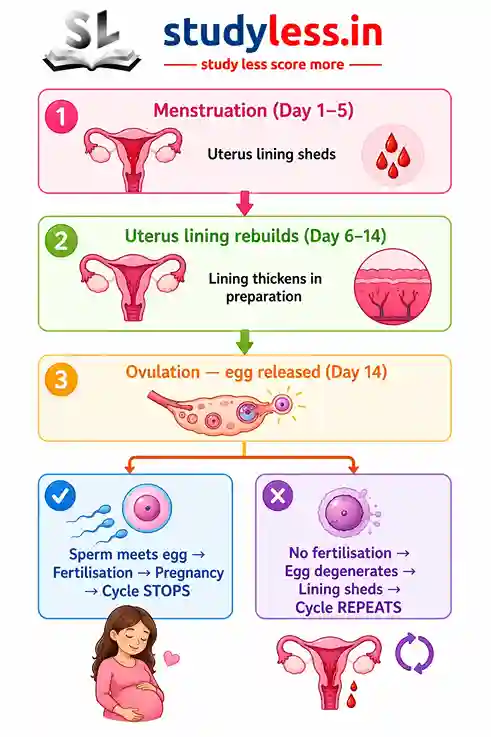
The menstrual cycle is a monthly biological cycle in females that prepares the uterus for a possible pregnancy. It typically lasts 21–35 days. Menstruation — the shedding of the uterus lining — happens when a released egg is not fertilised.
What triggers the menstrual cycle?
At puberty, a girl’s ovaries begin releasing one mature egg approximately every month. This is called ovulation. The body also prepares the uterus each month to receive a fertilised egg. This entire cycle is called the menstrual cycle.
If fertilisation occurs: The zygote implants in the uterus lining → pregnancy begins → menstrual cycle stops.
If fertilisation does NOT occur: The lining breaks down around Day 28 → menstruation begins → the cycle repeats.
Important facts for exams :
The cycle begins at puberty (ages 10–14) and continues until menopause (around age 50)
Cycle length varies from 21 to 35 days — Day 14 ovulation is for a typical 28-day cycle only
Menstruation is a sign of a healthy reproductive system — not something to be ashamed of (NCERT Chapter 11, Page 221)
During pregnancy, the cycle stops because the uterus lining must remain intact to nourish the embryo
Hygiene during menstruation (from NCERT Chapter 11, Page 221):
Use sanitary pads, tampons, or menstrual cups
Change pads every 4–6 hours
Wash your hands before and after changing products
Do not flush pads — dispose responsibly
Prefer biodegradable products
The 4 key stages of a typical 28-day menstrual cycle:
| Days | Stage | What happens |
|---|---|---|
| Day 1–5 | Menstruation | Uterus lining sheds; leaves body as blood through vagina; lasts 3–7 days |
| Day 6–14 | Rebuilding | Uterus lining gradually rebuilds; egg starts maturing in ovary |
| Day 14 | Ovulation | Ovary releases one mature egg |
| Day 15–28 | Preparation | Uterus lining thickens and fills with blood vessels to receive a zygote |
Source: NCERT Exploration Grade 9, Chapter 11, Pages 220–221, Sections 11.5.5 and 11.5.6
How does fertilisation occur in humans, and what happens from zygote to baby?
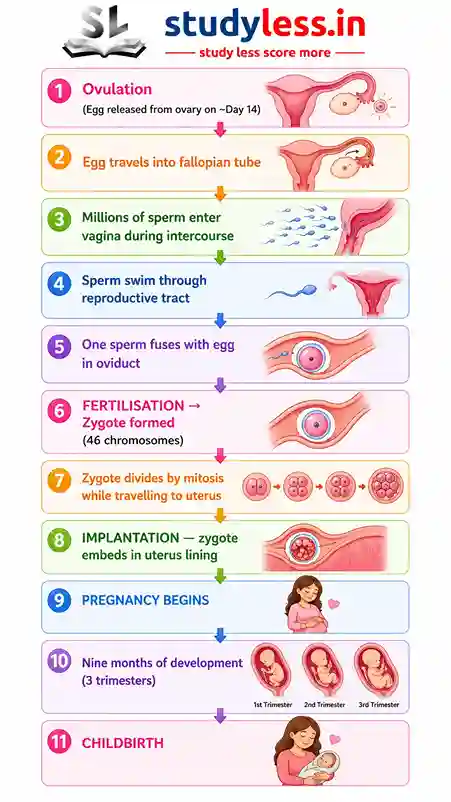
In humans, fertilisation occurs when a sperm fuses with an egg in the fallopian tube (oviduct), forming a zygote. The zygote divides, travels to the uterus, implants in its lining, and develops over nine months into a baby through three stages called trimesters
Step 1: The reproductive systems
Male reproductive system produces sperm in the testes (kept in the scrotum, slightly cooler than body temperature for healthy sperm production). Sperm travel through the vas deferens → mixed with fluids from seminal vesicles and prostate → exit through the urethra.
Each sperm has:
● A head — carries genetic material (23 chromosomes)
● A long tail — for swimming
The female reproductive system includes the ovaries (which produce eggs and hormones), the fallopian tubes/oviducts (which carry the egg from the ovary to the uterus), the uterus (where the baby develops), the cervix, and the vagina.
Step 2: From fertilisation to birth — the complete journey
Ovulation
(Egg released from the ovary
↓
The egg travels into the fallopian tube
↓
Millions of sperm enter the vagina during intercourse
↓
Sperm swim through the reproductive tract
↓
One sperm fuses with egg in the oviduct
↓
FERTILISATION → Zygote formed (46 chromosomes)
↓
The zygote divides by mitosis while travelling to the uterus
↓
IMPLANTATION — zygote embeds in the uterus lining
↓
PREGNANCY BEGINS
↓
Nine months of development (3 trimesters)
↓
CHILDBIRTH
The three trimesters of human pregnancy:
| Trimester | Duration | Key development |
|---|---|---|
| First | Months 1–3 | Fertilised egg → embryo; major organs begin forming; from week 9 called a foetus |
| Second | Months 4–6 | Foetus grows bigger and stronger; mother feels movements |
| Third | Months 7–9 | Baby grows rapidly; prepares for life outside the womb |
Why does the zygote have 46 chromosomes?
- Each parent contributes 23 chromosomes through their gametes (formed by meiosis)
- Sperm (23) + Egg (23) = Zygote (46) — same as every other human cell
- This is why meiosis is essential — without it, chromosome numbers would double every generation
Special case — IVF (Test Tube Baby):
In In-vitro Fertilisation (IVF), the egg and sperm are combined in a laboratory dish. The fertilised egg is then implanted in the uterus. India’s first IVF baby was Kanupriya Agarwal (nicknamed Durga), born in 1978, pioneered by Dr. Subhash Mukhopadhyay of Kolkata.
Source: NCERT Exploration Grade 9, Chapter 11, Pages 219–222, Sections 11.5.2 to 11.5.7
What are the methods of vegetative propagation in plants, and how are they used in agriculture?
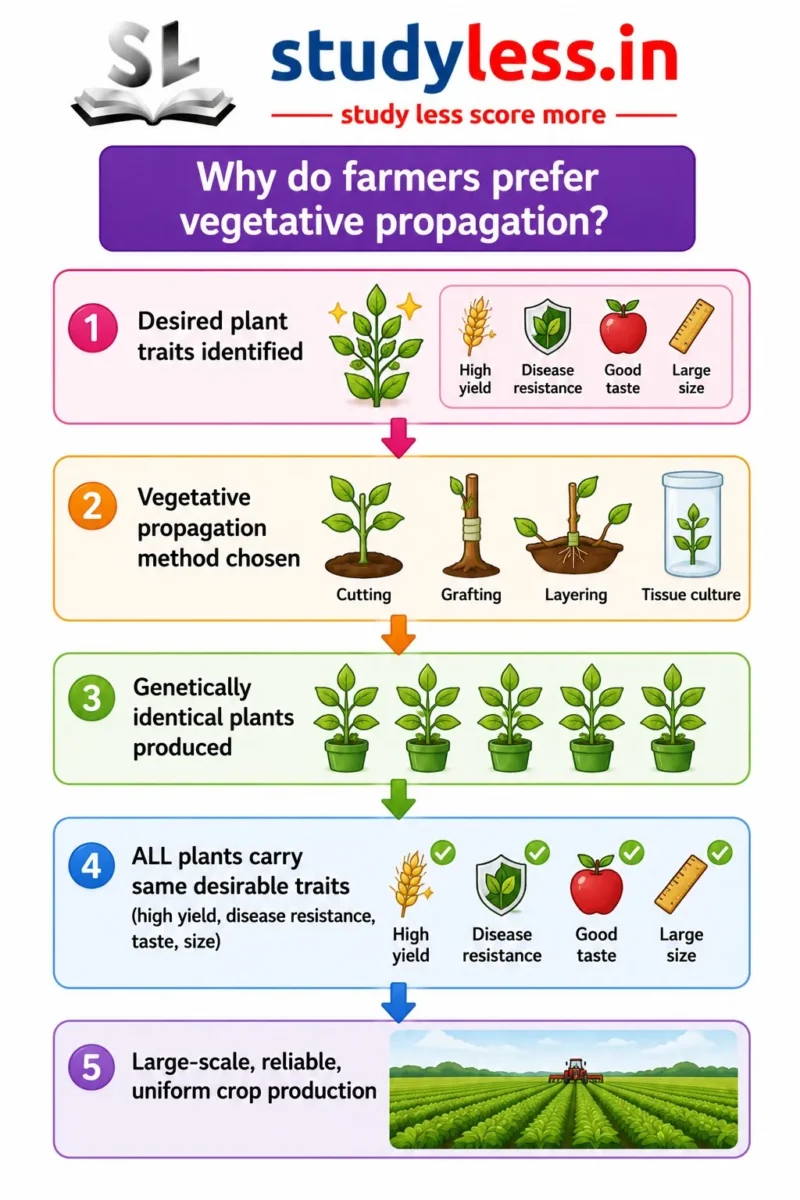
Vegetative propagation is a form of asexual reproduction where new plants grow from the vegetative parts of a parent plant — such as stems, leaves, or roots. Key methods include cutting, grafting, layering, and tissue culture. These methods are widely used in agriculture to produce genetically identical, high-quality plants quickly and at scale.
What is vegetative propagation?
It is the growth of new plants from existing vegetative (non-reproductive) parts — stems, leaves, or underground parts. No seeds are needed. Since only one parent is involved, all new plants are genetically identical to the parent.
Four main agricultural methods:
1. Cutting
● A stem piece (with nodes) is cut and inserted into moist compost soil at a 45–60° angle
● Leaves removed from the lower half
● Watered regularly until roots develop
● Best for: Money plant, rose, sugarcane
2. Grafting
● A rooted plant (Plant A) — the stock — has a slit made in its stem
● A stem piece from Plant B (the desired variety) is inserted into the slit
● The wound is wrapped with cotton cloth or film to protect it
● Plant B grows using Plant A’s roots
Best for: Roses (multiple colours on one plant), mango, fruit trees
Used by: Krishi Vigyan Kendras (KVKs) under ICAR to help farmers grow high-yield fruits
3. Layering
● A flexible branch is bent, and its middle portion is buried in soil
● After 10–15 days, roots develop from the buried section
● The branch is then cut from the parent and grows independently
Best for: Lemon, jasmine, shrubs
4. Tissue Culture
● Tiny pieces from the shoot tip (apical meristem) are grown on ● artificial nutrient media in a lab
● Produces thousands of identical, disease-free plantlets rapidly
● Has revolutionised banana farming in India
● Eliminates virus-infected plants and ensures high yields
● This is the most advanced and scalable method
Natural examples:
| Plant | Part used | How |
|---|---|---|
| Potato, Ginger | Underground stem | Sprout new plants from buds (eyes) |
| Bryophyllum | Leaves | Tiny plantlets grow along leaf edges |
| Money plant, Sugarcane | Stem cuttings | Planted in soil; roots and shoots develop |
Comparison Table:
| Method | Equipment needed | Scale | Speed | Best use case |
|---|---|---|---|---|
| Cutting | Minimal | Small–Medium | Fast | Home gardens, farms |
| Grafting | Basic tools | Medium | Moderate | Fruit orchards, flower varieties |
| Layering | Minimal | Small | Moderate | Shrubs, ornamental plants |
| Tissue culture | Laboratory | Very large (thousands) | Very fast | Commercial farming (banana, orchids) |
Source: NCERT Exploration Grade 9, Chapter 11, Pages 209–210, Sections 11.1 and 11.1.1