
” Ch 1 Understanding Social Science Notes Class 9 “ will help you in :
➽ Fast learning of the chapter
➽ Fast revision
➽ Long retention of the concepts
➽ Score good marks in the test
These notes are prepared from the New NCERT Class 9 Social Science textbook.
What Is Social Science?
Social Science is the systematic study of human society.
Social Science Explains:
1. What happened
2. Where things are located
3. Why events occur
4. How people live together
5. How the environment
shapes life
6. How governments work
7. How economies work
8. How past and present
shape the world
Difference from Science subjects:
Physics, Chemistry, and Biology:
study the natural world.
Social Science studies:
society, institutions, cultures, and human interactions.
It tells us what happens, why it happens, and how things connect.
Social Science in Everyday Life
Your daily life depends on many hidden systems:
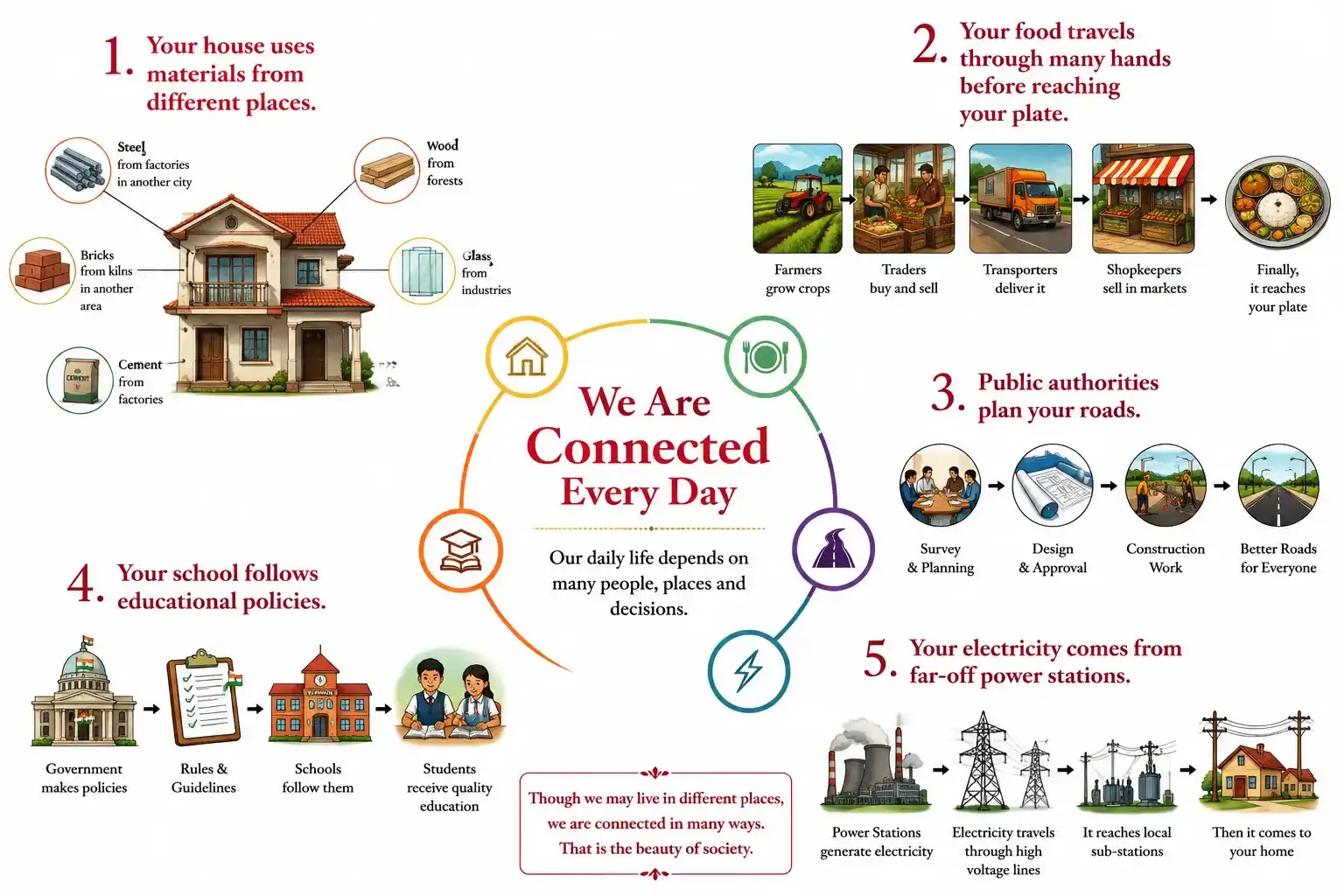
Even simple daily
activities depend on:
- Governance
- Economic production
- Social cooperation
- Natural environment
Big questions Social Science asks:
1. Why do some live in
cities, others in villages?
2. Why do communities
speak different languages?
3. Why do some
areas farm, others trade?
4. How do governments
decide for millions?
5. Why do floods hit
some regions more?
6. Why does farming succeed
in some places, not others?
7. How does climate change affect us?
Key idea:
Society does not work by chance. It is shaped by history, geography, institutions, resources, and human choices.
Social Science finds answers through observation, evidence, and logical reasoning.
Understanding Society through Time and Traditions
Society has changed a lot over thousands of years.
Early humans:
- Depended directly on nature
- Learnt to grow crops
- Domesticated animals
- Built settlements
- Made tools
- Exchanged goods
- Organised governance
Slowly, villages became towns, and towns became cities.
What Are India’s Knowledge Traditions?
Early Indian thinkers valued discussion, questioning, and logical reasoning.
Important ideas:
| Concept | Meaning |
|---|---|
| Pañcamahābhūtas | Describes nature as an interconnected system with human life embedded in it |
| Vasudhaiva Kutumbakam | Means ‘the world is one family’; shows interconnectedness of societies |
| Arthashastra (by Kautilya, ~2,300 years old) | Studied administration, economy, taxation, and duties of rulers |
These show that systematic thinking about society existed long before modern Social Science.
How Do Social Scientists Study Society?
They:
- Observe people’s lives
- Conduct interviews and surveys
- Examine documents
- Compare different times and places
This helps them build explanations supported by evidence.
Key idea:
Social Science shows how the past shapes the present, and how today shapes the future.
Social Science as a Study of Disciplines
Human society is complex. No single subject can explain it fully.
Example:
A drought affects:
- Environment (crops)
- Economy (farmers’ income)
- Politics (government relief)
- Society (migration to cities)
- Culture (traditional coping methods)
So, Social Science is not one subject. It is a group of related disciplines.
What Are the Four Core Disciplines?
In Grades 9–10, Social Science mainly uses four disciplines:
Geography –
studies the Earth, its environments, and the relationship
History –
studies the human past and how societies change over time
Political Science –
Studies governance, power, and citizens’ rights and duties
Economics –
studies how societies produce, distribute, and use resources
Other related disciplines
(studied in higher grades):
- Sociology
- Philosophy
- Anthropology
- Psychology
Key idea:
Each discipline asks different questions, but all are interconnected. Together, they give a complete picture of society.
Quick Revision Box
- Social Science = systematic study of human society
- Studies why, not just what and where
- Built on observation + evidence + reasoning
- Indian traditions: Pañcamahābhūtas, Vasudhaiva Kutumbakam, Arthashastra
- 4 core disciplines: Geography, History, Political Science, Economics
Geography, History, Political Science & Economics
Geography
Geography studies the location and distribution of places, objects, materials, and people.
It examines:
- Physical features of Earth’s surface
- Human communities and their environment
- How places influence human life
Key questions
Geography asks:
- Where are things located?
- Why are they found there?
- How do places affect each other over time?
Geography’s approach:
- Views the world as a system of interdependencies
- Combines spatial perspective (location and significance) with temporal perspective (change over time)
- Draws from natural sciences (Physics, Chemistry) and social sciences (Political Science, Economics, History)
Example: Geography explains why India has been a hub of global interaction — its long coastline connected it to Africa, Europe, and Southeast Asia.
Tools used in
Geography:
- Maps
- Globes
- Atlases
- Geographical Information System (GIS)
- Infographics
- Other instruments
What you’ll study over two years:
- Earth’s surface processes and landforms
- Atmosphere and climate
- Oceans
- Major biomes and India’s biosphere reserves
- Geospatial technologies
- Life in different regions of India and the world
- Socio-economic perspectives on issues
- History of geographical knowledge
History
History is the study of the human past.
It helps societies
understand:
- People’s experiences
- Values
- Changes over time
How Is the Past Preserved and Studied?
Itihasa Purana tradition —
one of the oldest traditions in Bharat for preserving cultural memory.
- Shares historical information through stories
- Gives cultural meaning to events and people
- Reinforces values and identity
Different traditions use different methods:
- Some stress, moral and philosophical insight
- Some offer documentary verification
- Modern historiography relies on empirical methods like:
- Human genetics
- Carbon-14 dating
- Archaeology
What Are the Sources of History?
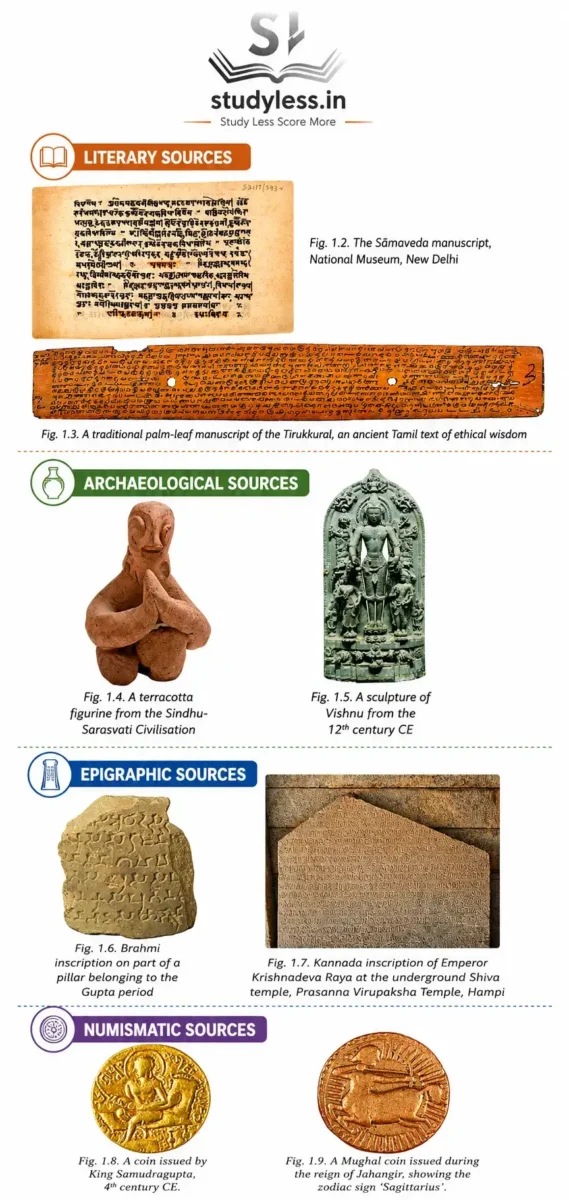
| Source Type | Examples |
|---|---|
| Literary sources | Travelogues, memoirs, correspondence, genealogical records, folklore, oral traditions, revenue documents |
| Archaeological sources | Monuments, architectural structures, excavated sites, artefacts, sculptures, paintings |
Archaeological sources are studied using scientific instruments and lab testing.
What you’ll study over two years:
- Early human history
- Major developments in India from the beginning to the present
- World history landmarks: Greco-Roman world, Reformation, Renaissance, Enlightenment, Industrial Revolution
- Colonialism, its global impact, and anti-colonial struggles
Political Science
Political Science is the study of governance.
It tells us:
- How and why power is distributed
- How decisions are made
- How policies are implemented
Political Science:
- Constitutions, governments, and institutions of the State
- Social movements
- Nation-building
- Foreign policy
- How power is exercised, shared, and regulated
Example: Panchayati Raj system —
Shows grassroots democracy, giving citizens a voice in local development. Power exists not just in formal institutions, but also in social relationships, customs, and ideas of legitimacy.
How Did Political Thought Develop in India?
Politics was linked
closely with:
- Dharma (moral duty)
- Artha (economic well-being)
- Rajadharma (duties of the ruler)
Key texts:
- Vedas, Upanisads, Puranas — discuss justice, authority, social order, duties of kings and citizens
- Mahabharata and Shukranti — address governance, law, and ethical leadership
- Arthashastra — foundational text on politics and administration; covers governance, taxation, army, and welfare
Key idea:
Indian political thought saw power as a responsibility, not just a privilege. This shaped modern institutions like the Panchayati Raj.
What you’ll
study over two years:
- Democracy
- Elections
- Authority
- Civil society
- Governance and public policy
- National security and its challenges
Economics
Economics studies how individuals and societies use limited resources to meet needs.
It examines:
- How goods and services are produced, exchanged, and distributed
- Decision-making by consumers, producers, and governments
| Decision-Maker | Role |
|---|---|
| Consumers | Decide what to buy |
| Producers | Decide what and how much to produce |
| Governments | Frame policies balancing growth, stability, efficiency, and fairness |
Key idea:
Economics is not just about numbers and markets — it is also about well-being, equity, and justice.
What Is India’s Economic History?
- India was once one of the world’s leading economies — a centre of trade, industry, and maritime activity.
- Colonial rule disrupted this, causing poverty, famines, and the decline of traditional industries.
- After independence, India rebuilt its economy.
- Recent progress: better infrastructure, education, technology, poverty reduction, and rising life expectancy.
- Challenges remain: raising incomes, sharing growth benefits fairly.
Key idea:
Economic development is a central national goal — using resources wisely, fairly, and sustainably.
What you’ll study
over two years:
- Foundations of the Indian economy
- Markets and prices
- Financial management and entrepreneurship
- Economic growth and GDP
- International trade
- Union Budget
Quick Revision Box
- Geography → location, distribution, environment-human relationship
- History → study of the human past through sources and traditions
- Political Science → governance, power, policies
- Economics → production, distribution, resource use
Why Should We Study Social Science?
The Reasons We Study Social Science?
Every day, systems around you
house, water, roads, school, markets, digital spaces
are all created and managed by society. Social Science helps us understand:
- How these systems developed
- How they function
- How they affect different groups
Why Do People Differ Within the Same Country?
People around you speak different languages,
follow different customs, and do different occupations.
Social Science explains
these differences as outcomes of:
- Geographical factors
- Historical factors
- Cultural factors
- Economic factors
Key idea:
This understanding builds respect and cooperation. It also shows how Indian culture binds diversity together through underlying unity, creating a sense of belonging and shared identity.
How Does It Help in Democratic Life?
In a democracy, citizens take an active role in public life.
- Laws, rights, and responsibilities guide how people live together.
- Understanding government functioning prepares you for responsible civic participation.
Social Science also helps
You think about shared
challenges, such as:
- Environmental protection
- Public health
- Employment
- Urban growth
You learn to ask informed questions about causes, effects, and solutions.
Key idea:
Social Science connects the past, present, and future. Understanding past decisions helps us make wiser future choices.
The Future of Social Science
As societies change fast, Social Science becomes more important.
Forces reshaping
how people live:
- New technologies
- Expanding cities
- Environmental concerns
- Migration
- Global connections
Skills needed to understand these changes:
- Careful observation
- Asking questions
- Examining evidence
- Recognising connections
What Will Social Science Help Address?
- Climate change
- Sustainable development
- Social harmony
- Equitable use of resources
- Responsible use of new technologies
Key idea:
Social Science prepares you to understand the world and take part in shaping it — while strengthening national unity and staying rooted in cultural traditions.
Secondary-Stage Social Science:
Your Two-Year Learning Journey (Grades 9–10)
Social Science is a window into the world around you.
You will study:
- How historical events shaped the modern world
- How geographical features influence human life and the economy
- How political systems and democratic institutions function
- How economies organise production, distribution, and development
Contemporary challenges covered:
- Environmental sustainability
- Social diversity
- Citizens’ rights and responsibilities
- Impact of technology and global connections
Skills you will build:
- Analysing evidence
- Comparing perspectives
- Linking past, present, and future
Key idea:
The Grade 9 textbook gives a balanced introduction to the four disciplines — Geography, History, Political Science, Economics — each offering a distinct perspective, together giving a complete understanding of the world.
What Is the Real Purpose of Social Science?
Social Science is not about memorising dates, maps, or definitions.
It is about
understanding:
- People
- Places
- Society
- Culture
- Power
Key idea:
It encourages you to:
- Learn from the past
- Analyse the present
- Imagine a better future
Goal: Develop the ability to think independently and act responsibly — growing into a responsible citizen of India and the world
Quick Revision Box
- Social Science explains diversity through geography, history, culture, and economy
- It builds civic participation in a democracy
- It connects past, present, and future
- Future focus: climate change, sustainable development, technology
- Grade 9–10 covers 4 disciplines: Geography, History, Political Science, Economics
- Core purpose: understand people, places, society, culture, and power
Nice explanation
Thank you Mr. Singh, any suggestions from your side for further improvements