“Ch 1 Oceans and Life NCERT Answers Class 9“
Understanding Society: India And Beyond
Social Science Textbook
Grade 9| Part 2
Answers are provided from in-text to the end of the chapter.
Use the table of contents to jump to specific questions.
The Big Questions | Page 1
Q1
What is the importance of ocean relief?
Answers:
Ocean relief means the different shapes and features of the ocean floor.
It is important because:
1. The continental shelf supports rich marine life and key fishing grounds
2. Mid-ocean ridges, seamounts and trenches reveal ocean structure
3. Ocean-floor features help locate marine resources
Topic: Ocean Relief
Page: 2, paragraph 1 – Meaning of ocean relief and examples.
Page: 3, section describing the continental shelf, mid-ocean ridges, trenches and seamounts.
Q2
How does ocean water movement impact life and environment?
Answers:
Ocean water moves as waves, tides, and currents. These movements affect the environment, marine life, and people.
1. Waves erode coasts and move sediment. Storm waves can damage coastal areas
2. Tides help ships enter and leave harbors. High tides bring fish nearer the shore
3. Currents change nearby coastal temperatures
4.Warm and cold currents can meet and form nutrient-rich fishing grounds
Topic: Waves – Page 4, paragraphs 1–3; Page 5, paragraph 1.
Topic: Tides – Page 5, paragraph 3; Page 7, paragraphs 1–2.
Topic: Ocean Currents – Page 8, paragraph 1; Page 9, paragraph 1.
Q3
Why are maritime zones important for a country?
Answers:
Maritime zones are important for a country because of the following reasons:
1. In territorial waters, a country controls the sea area near its coast
2. In the Exclusive Economic Zone (EEZ), a country has special rights to explore, use, and manage natural resources. The EEZ can extend up to 200 nautical miles
3. Other countries can pass through these waters peacefully. They must obey the rules
Topic: Maritime Zones – Page 16, paragraph 2.Topic: Maritime Zones – Page 17, paragraph beginning “Beyond the contiguous zone…”.
Topic: Innocent Passage – Page 17, “Don’t Miss Out” section.
Q4
How can we use ocean resources in a sustainable way?
Answers:
We can use ocean resources in a sustainable way in the following ways :
1. Keep marine resources for future generations
2. Protect marine biodiversity and ocean ecosystems
3. Support responsible fishing, trade, and tourism
4. Reduce activities that damage the ocean environment
5. Follow the Blue Economy approach
6. Support SDG 14
Topic: Marine Resources and Their Significance – Page 14, paragraphs 1–2.
Topic: Marine Resources – Page 15, Figure 1.18.
Topic: Blue Economy – Page 16, paragraph 1.
Q5
How do early warning systems help protect people from tsunamis and cyclones?
Answers:
Early warning systems help protect people from tsunamis and cyclones in the following ways
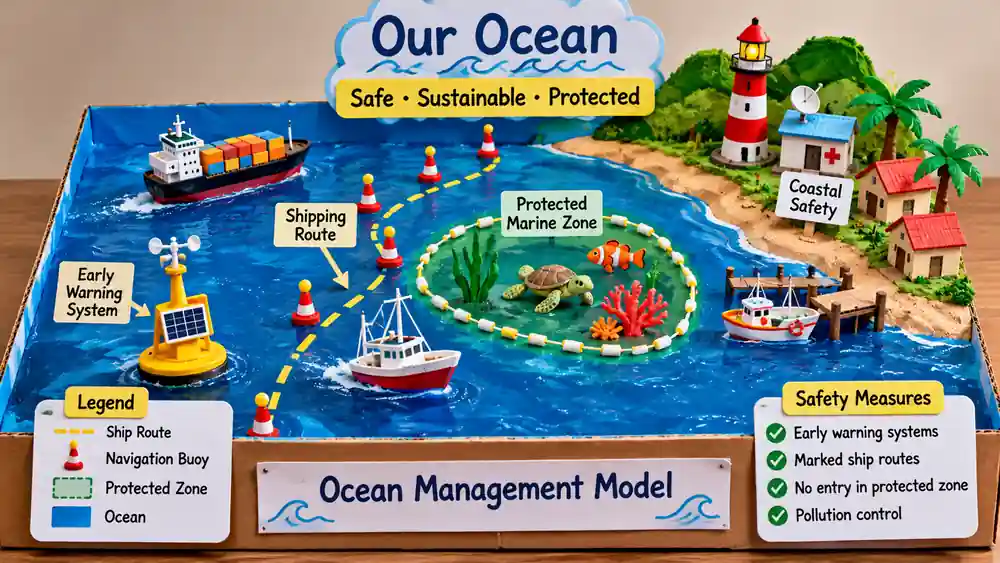
1. Scientists monitor weather and ocean activity to find possible cyclones and tsunamis
2. Warning systems predict and track the hazard
3. Authorities send warnings by satellite, SMS, email, and coastal display boards
4. People get time to move to safe places and follow safety instructions
5. Fishermen get marine weather warnings on the GEMINI device for safer decisions at sea
Topic: Cyclone and Tsunami Warning Systems – Page 9, paragraph 1.
Topic: Cyclone Warning Systems in India – Page 10, paragraphs 2–3.
Topic: GEMINI Device – Pages 10–11, relevant paragraphs.
Topic: Tsunami Warning System – Page 12, paragraph 1; Page 13, Figure 1.15.
Topic: Public Awareness and Warning Communication – Page 14, paragraph 1.
LET’S EXPLORE – Looking at Fig. 1.2
Page 3 | Chapter 1: Oceans and Life
Q1. How do you think these oceanic features would have been formed?
Answers:
Oceanic features are formed by movements within the Earth, volcanic activity and processes that shape the ocean floor over a long period.
Mid-ocean ridges form where molten material rises from below the Earth’s surface
Ocean trenches form in areas where one tectonic plate moves below another
Seamounts form from underwater volcanic activity
Topic – Ocean Relief, Pages 2–3.
Q1.Which part of the ocean floor appears deep and shallow?
Answers:
Shallow part: The continental shelf = submerged edge of a Continent
Deep part: The ocean trenches.
Abyssal plains are also deep areas of the ocean floor
Topic – Ocean Relief, Page 3, paragraphs describing the continental shelf, abyssal plain and ocean trenches.
Q1. How do you think these underwater features would have an effect on marine life and ocean movements?
Answers:
→ Continental shelves support rich marine life and provide important fishing grounds
→ Seamounts can provide habitats for different marine organisms
→ Ocean trenches create deep environments requiring marine life to adapt
Topic – Ocean Relief, Pages 2–3.
LET’S EXPLORE – Looking at Fig. 1.2
Page 5 | Chapter 1: Oceans and Life
Q1. Find out the names of some famous sea beaches in our country and locate them on the map of India.
Answers:
| # | Beach | State / UT |
|---|---|---|
| 1 | Marina Beach | Tamil Nadu |
| 2 | Kovalam Beach | Kerala |
| 3 | Baga Beach | Goa |
| 4 | Juhu Beach | Maharashtra |
| 5 | Puri Beach | Odisha |
| 6 | Radhanagar Beach | Andaman & Nicobar |
| 7 | Varkala Beach | Kerala |
| 8 | Gokarna Beach | Karnataka |
THINK ABOUT IT
Page 8 | Chapter 1: Oceans and Life
Question:
Observe the map carefully and note the movement patterns of cold and warm currents. Do you think these currents affect the temperature of nearby coastal regions?
Answers:
Yes, warm and cold ocean currents affect the temperature of nearby coastal regions.
Warm currents carry warm water from warmer regions towards colder regions. They increase the temperature of nearby coastal areas
Cold currents carry cold water from colder regions towards warmer regions. They lower the temperature of nearby coastal areas.
Topic: Ocean Currents
Page: 8, paragraph 1 – Explains how warm and cold currents affect the temperature of nearby coastal areas.
Page: 8, paragraph 2 – Examples of the Gulf Stream and Labrador Current
LET’S EXPLORE – Looking at Fig. 1.2
Page 8 | Chapter 1: Oceans and Life
Question:
Observe Fig. 1.9 and take a note on ocean currents along the coastline of India. What is the nature of ocean currents?
Answers:
The map shows that ocean currents flow along both the eastern and western coastlines of India.
→ Currents move along the Arabian Sea near India’s western coast.
→ Currents also move along the Bay of Bengal near India’s eastern coast.
→ Their direction of movement changes with the season
Nature of ocean currents?
Ocean currents are continuous streams of ocean water that flow in a particular direction.
They are influenced by:
→ Prevailing winds
→ Coriolis force
→ Differences in temperature and salinity
→ The shape of continents and ocean basins
Topic: Ocean Currents
Page: 8, paragraph 1 – Definition, causes and effects of ocean currents.
Figure: Fig. 1.9, Page 8 – Map showing ocean currents.
THINK ABOUT IT
Page 14 | Chapter 1: Oceans and Life
Question:
If you receive a tsunami or cyclone alert on your phone right now, do you know the five steps your family should take to stay safe?
Answers:
Yes. My family should follow these five safety steps:
1. Keep monitoring alerts: Follow updates through SMS, email, satellite-based alerts and other official communication systems
2. Stay informed: Read the official alert carefully and listen to further instructions
3. Move to safety: Move away from coastal areas and go to a safer place
4. Follow evacuation instructions: Take the recommended route and do not return until authorities give permission
5. Help family members: Keep children, elderly people and other family members together during evacuation.
Chapter End Questions Answers
Q1
How do different features of the ocean floor affect human activities such as fishing, transport, and underwater exploration?
Answers:
Different features of the ocean floor affect human activities in the following ways:
- Fishing: The continental shelf supports rich marine life and fishing grounds.
- Transport: Shallow areas in sea channels can restrict the movement of large ships. Ships wait for high tide to pass safely.
- Underwater exploration: Seamounts, ridges, and trenches affect seafloor exploration. Studying them helps map the seabed and find resources.
Topic: Ocean Relief – Important Submarine Relief Features; Tides
Pages: 2–3, 7
Paragraph: Page 2, Paragraph 1; Page 7, Paragraph 3 (under Tides).
Additional reference: Page 19, Before We Move On (second point)
Q2
How do waves, tides, and ocean currents influence climate, marine life, and human activities around the world?
Answers:
1. Waves: They shape coastlines through erosion and sediment transport. They support marine life but can cause coastal damage during storms. Tsunamis can cause severe destruction.
2. Tides: High tides help ships enter harbours and support fishing because fish move closer to the shore. Tidal movements also generate electricity.
3. Ocean currents: Warm and cold currents affect the temperature of nearby coastal regions. When these currents meet, they create nutrient-rich fishing grounds that support marine life and fishing activities.
- Topic: Movement of Ocean Water—Waves, Tides, and Currents.
- Pages: 4, 5, 7, 8–9.
- Paragraphs:
- Page 4: Paragraphs 1–3 (Waves).
- Page 5: Paragraph 2 (Tsunamis).
- Page 7: Paragraphs 1–3 (Tides).
- Page 8: Paragraphs 1–2 (Ocean Currents).
- Page 9: Paragraph 1 (Fishing Grounds).
Q3
Describe the importance of marine resources.
Answers:
Marine resources are important for the following reasons:
1. Food and livelihood: Fish provide protein. Fishing and aquaculture support industries and livelihoods.
2. Energy: Oceans provide oil, natural gas and renewable energy from tides and waves.
3. Minerals and materials: Oceans provide sand, gravel and deep-sea minerals.
4. Trade and tourism: Oceans support global trade and coastal tourism.
5. Environmental importance: Oceans support biodiversity and sustain many plant and animal species.
6. Cultural significance: Marine resources, such as conch and cowrie shells, have religious and cultural
Topic: Marine Resources and Their Significance
Page: 14–15
Paragraph: Page 14, Paragraph 2 (Significance of Marine Resources).
Figure: Page 15, Fig. 1.18 (Significance of Marine Resources).
Q4
Draw a poster that encourages people to protect marine resources. Include a slogan (like Save Our Seas or Fish for the Future) and explain your message in 2–3 sentences
Answers:
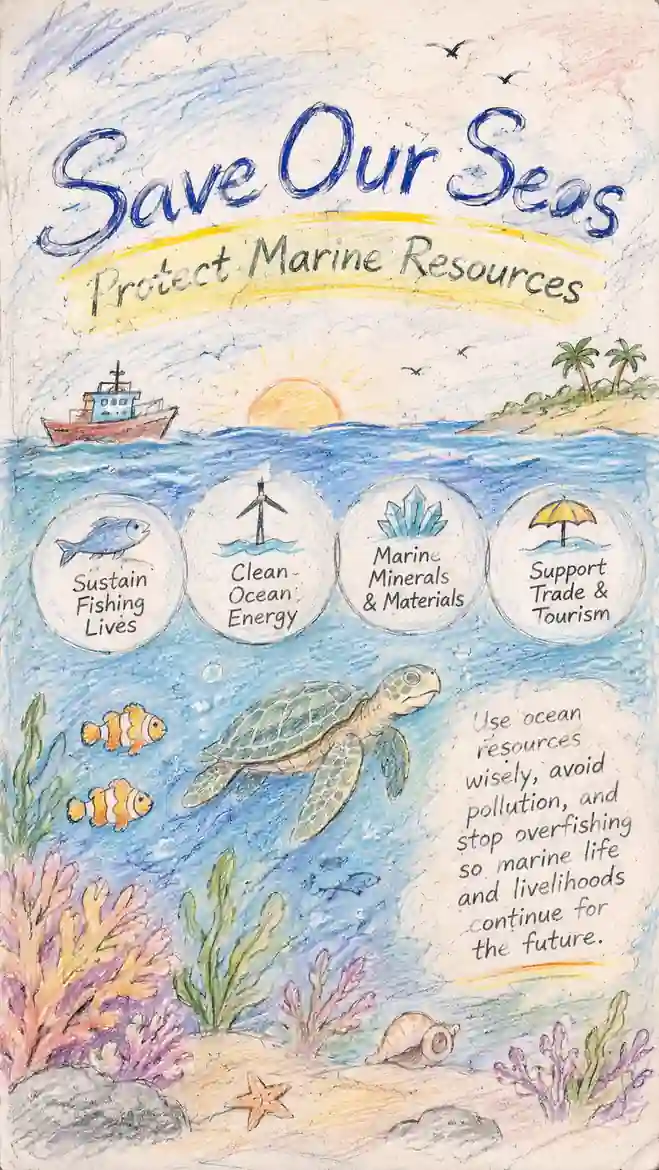
Q5
Using a map of India, mark at least five coastal states that might need tsunami warnings
Answers:
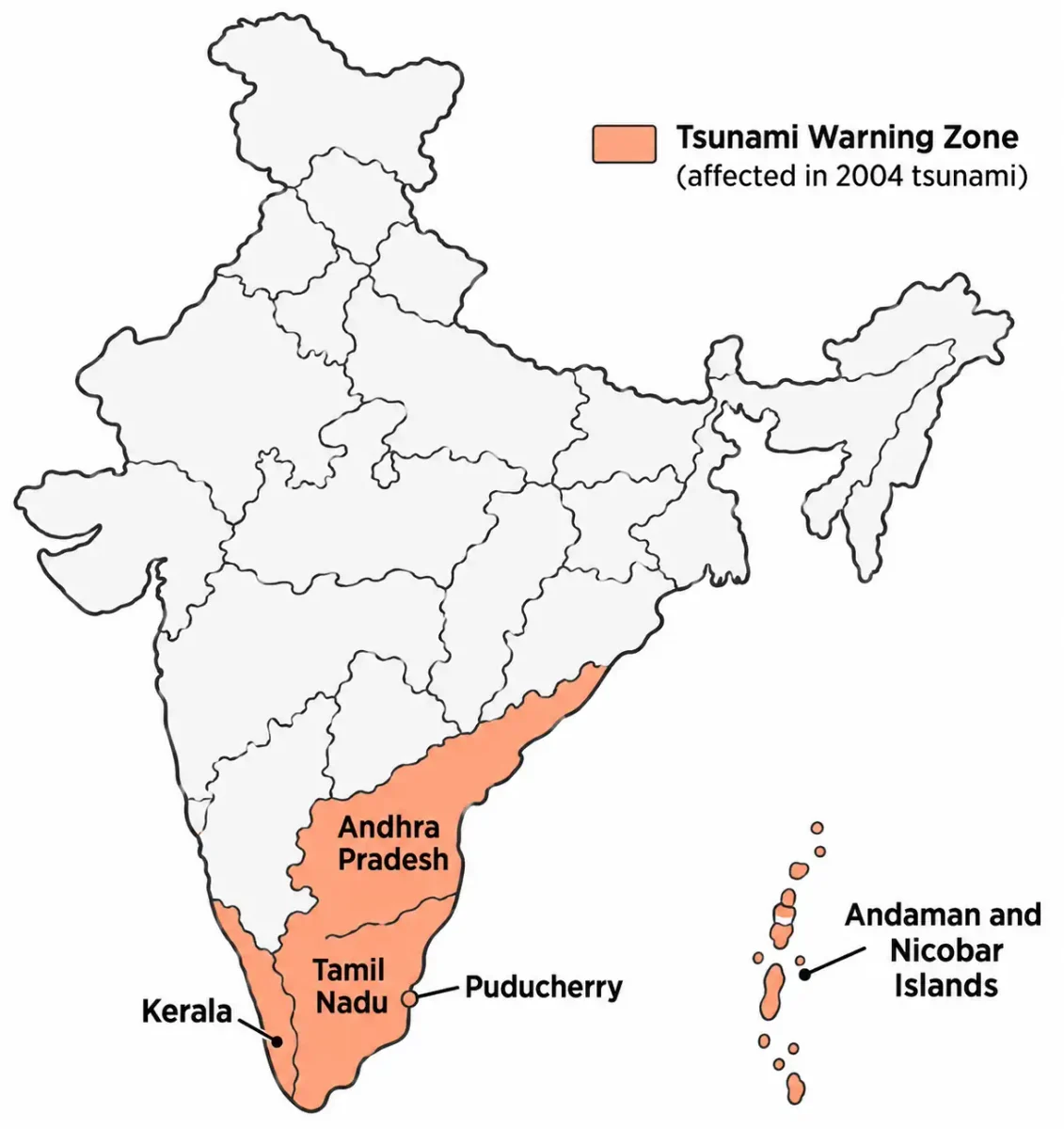
Topic: Cyclones and Tsunamis—Early Warning Systems
Page: 12
Paragraph: 1 (2004 Indian Ocean Tsunami).
Q6
Work in a group and act out what would happen when a cyclone warning is issued. Highlight what role different people, like scientists, officials, and coastal villagers, would play.
Answers:
Role Play: What Happens When a Cyclone Warning Is Issued?
Characters: Scientist, Government Official, Disaster Management Officer and Coastal Villagers.
1. Scientist: Monitors weather conditions using satellites and predicts the cyclone. Sends an early warning to the authorities.
2. Government Official: Receives the warning and informs coastal communities through communication systems.
3. Disaster Management Officer: Arranges cyclone shelters, coordinates emergency responses and helps people evacuate to safer places.
4. Coastal Villagers: Listen to official warnings, move to cyclone shelters. Fishermen avoid going to sea.
5. Scientist and Officials: Continue monitoring the cyclone and provide updated warnings until the danger passes.
Topic: Cyclones and Tsunamis—Early Warning Systems; Focus on Cyclones.
Pages: 9–10, 11 and 14.
Page 9, Paragraph 1: Role of early warning systems.
Page 10, Paragraphs 2–3: Warning services and government response.
Page 14, Paragraph 2: Public awareness and training programmes.
Q7
Suppose a foreign ship is sailing through India’s territorial sea. What principle allows the ship to pass through these waters, subject to certain conditions?
Answers:
The principle is called Innocent Passage. It allows foreign ships to pass through India’s territorial waters, provided they do not threaten the country’s peace, good order or security. Ships must move continuously and must not engage in activities such as fishing or military operations.
Topic: Maritime Zones – Innocent Passage
Page: 17
Paragraph: 1 (Innocent Passage, under “Don’t Miss Out”)
Q8
A country has an Exclusive Economic Zone (EEZ) extending up to 200 nautical miles from its baseline. What rights does the country have over the natural resources in this zone?
Answers:
A country has special rights to explore, use and manage natural resources within its Exclusive Economic Zone (EEZ), extending up to 200 nautical miles from its baseline.
These resources include fish, oil and natural gas. However, foreign ships can still pass through the zone peacefully.
Topic: Maritime Zones – Exclusive Economic Zone (EEZ)
Page: 17
Paragraph: 1 (Beginning with “Beyond the contiguous zone…”).
Q9
Answers: