
“MCQ Quiz Salt March and Civil Disobedience Movement” is the 10th of Topic wise series of MCQs and Quiz on Class 10 history chapter 2 Nationalism In India.
There are total 22 questions on Salt March and Civil Disobedience Movement| Nationalism In India . First we have provided you the actual questions in MCQ format and then the same questions are formated into MCQ Quiz for practice.
Also Read | Explanation – Nationalism In India Class 10
First go through the MCQ questions learn it and then practice the Quiz to check yourself.
MCQ The Salt March and Civil Disobedience Movement| Nationalism In India

Q1. Why did Gandhi choose salt as a symbol for the national movement?
A) Because salt was expensive and imported
B) Because it was consumed by rich and poor alike and revealed the oppressive face of British rule
C) Because salt production was controlled by Indian merchants
D) Because British soldiers disliked salt
Answer: B) Because it was consumed by rich and poor alike and revealed the oppressive face of British rule
Explanation: Salt united all classes, and the tax plus government monopoly showed British oppression.
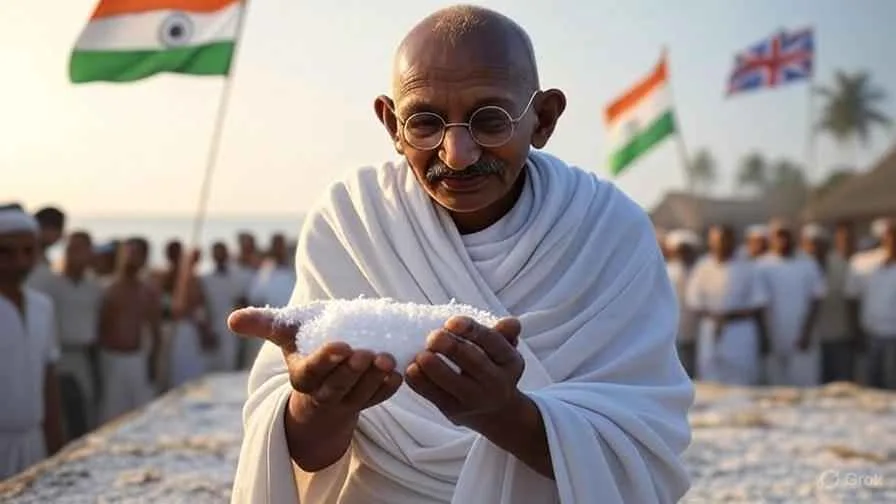
“With this, I am shaking the foundations of the British Empire.”
– Mahatma Gandhi (as he picked up a lump of salt at Dandi)
Q2. On what date did Gandhi send his letter of demands to Viceroy Irwin?
A) 15 August 1929
B) 26 January 1930
C) 31 January 1930
D) 11 March 1930
Answer: C) 31 January 1930
Explanation: The letter with eleven demands was sent on this date.
Q3.What was the purpose of making Gandhi’s demands wide-ranging?
A) To confuse the British government
B) So all classes in Indian society could identify with them and join a united campaign
C) To delay the start of the movement
D) To please foreign governments
Answer: B) So all classes in Indian society could identify with them and join a united campaign
Explanation: The goal was broad-based unity across different social and economic groups.
Q4. What was the most emotionally powerful demand in Gandhi’s letter?
A) Abolition of the salt tax
B) Abolition of income tax
C) Release of all prisoners
D) Return of seized lands
Answer: A) Abolition of the salt tax
Explanation: It was described as “the most stirring of all” because salt affected everyone.
“One has a moral responsibility to disobey unjust laws.”
– Martin Luther King Jr.
Q5. What did Gandhi declare would happen if demands weren’t met by 11 March?
A) He would leave India
B) He would start fasting unto death
C) He would support council elections
D) Congress would launch a civil disobedience campaign
Answer: D) Congress would launch a civil disobedience campaign
Explanation: The letter served as an ultimatum — failure to respond would trigger mass law-breaking.
Q6. How did Viceroy Irwin respond to Gandhi’s letter?
A) Accepted all demands
B) Agreed to negotiate after 1935
C) Was unwilling to negotiate
D) Arrested Gandhi immediately
Answer: C) Was unwilling to negotiate
Explanation: Irwin’s refusal led directly to the Salt March.
“We are entering upon a life and death struggle, a holy war.”
– (Gandhi’s words on the eve of the Dandi March.)
Q7. Where did the Salt March begin and end?
A) Delhi to Bombay
B) Calcutta to Dacca
C) Sabarmati Ashram to Dandi
D) Madras to Rangoon
Answer: C) Sabarmati Ashram to Dandi
Explanation: The 240-mile march started at Gandhi’s ashram and ended at the coastal town of Dandi.
“Napoleon’s march to Paris on his return from Elba.”
– Subhas Chandra Bose
Q8. How many volunteers accompanied Gandhi at the start of the Salt March?
A) 50
B) 78
C) 100
D) 150
Answer: B) 78
Explanation: He was joined by 78 trusted volunteers.
Q9. How long did the Salt March last, and how many miles per day did they walk?
A) 10 days, 20 miles per day
B) 15 days, 15 miles per day
C) 30 days, 8 miles per day
D) 24 days, about 10 miles per day
Answer: D) 24 days, about 10 miles per day
Explanation: The march covered 240 miles over 24 days at roughly 10 miles daily.
Q10. What did Gandhi do on 6 April 1930 at Dandi?
A) Gave a speech to world leaders
B) Signed a treaty with the British
C) Ceremonially violated the salt law by boiling seawater to make salt
D) Announced the end of British rule
Answer: C) Ceremonially violated the salt law by boiling seawater to make salt
Explanation: This symbolic act marked the official start of the Civil Disobedience Movement.
“Hail, Deliverer!”
– Sarojini Naidu, upon Gandhi’s breaking of salt law.
Q11. How was the Civil Disobedience Movement different from Non-Cooperation?
A) It focused only on students and lawyers
B) People were asked not only to refuse cooperation but also to break colonial laws
C) It avoided all forms of protest
D) It supported British institutions
Answer: B) People were asked not only to refuse cooperation but also to break colonial laws
Explanation: Unlike earlier, this movement involved deliberate violation of specific laws like the salt law.
Q12. What actions did people take during the Civil Disobedience Movement?
A) Broke salt law, boycotted foreign cloth, picketed liquor shops, refused taxes, resigned from village posts, violated forest laws
B) Paid extra taxes and joined British army
C) Built new schools and hospitals
D) Imported more British goods
Answer: A) Broke salt law, boycotted foreign cloth, picketed liquor shops, refused taxes, resigned from village posts, violated forest laws
Explanation: These were the widespread forms of protest across India.
“Civil disobedience becomes a sacred duty when the state has become lawless or corrupt. And a citizen who barters with such a state shares in its corruption and lawlessness.”
– Mahatma Gandhi
Q13. What happened after Congress leaders were arrested one by one?
A) People celebrated
B) Violent clashes broke out in many places
C) Movement became more peaceful
D) Foreign governments intervened
Answer: B) Violent clashes broke out in many places
Explanation: Arrests triggered public anger and violence, contrary to Gandhi’s principles.
Q14. What happened in Peshawar after Abdul Ghaffar Khan’s arrest in April 1930?
A) Peaceful prayers were held
B) Angry crowds faced armoured cars and police firing; many were killed
C) People welcomed the British
D) A new school was opened
Answer: B) Angry crowds faced armoured cars and police firing; many were killed
Explanation: His arrest led to violent repression and loss of lives in Peshawar.
Q15. What happened in Sholapur after Gandhi’s arrest?
A) People held silent vigils
B) A new factory was inaugurated
C) Shops closed for a week
D) Industrial workers attacked police posts, municipal buildings, law courts, and railway stations
Answer: D) Industrial workers attacked police posts, municipal buildings, law courts, and railway stations
Explanation: These structures symbolised British authority and were targeted in protest.
Q16. How did the British government respond to the protests?
A) By granting independence
B) With brutal repression — attacking peaceful satyagrahis, beating women and children, arresting ~100,000 people
C) By inviting Gandhi for tea
D) By reducing salt prices
Answer: B) With brutal repression — attacking peaceful satyagrahis, beating women and children, arresting ~100,000 people
Explanation: The state used extreme violence to crush the movement.
“An unjust law is itself a species of violence. Arrest for its breach is more so.”
– Mahatma Gandhi
Q17. Why did Gandhi call off the Civil Disobedience Movement in 1931?
A) Because the British left India
B) He signed the Gandhi-Irwin Pact, agreeing to attend the Round Table Conference in exchange for releasing prisoners
C) Because peasants refused to join
D) Due to lack of funds
Answer: B) He signed the Gandhi-Irwin Pact, agreeing to attend the Round Table Conference in exchange for releasing prisoners
Explanation: The pact paused the movement for negotiations.
Q18. What did the Gandhi-Irwin Pact agree to?
A) Gandhi to attend Round Table Conference; government to release political prisoners
B) Immediate independence
C) Abolition of all taxes
D) Partition of India
Answer: A) Gandhi to attend Round Table Conference; government to release political prisoners
Explanation: These were the two key terms of the March 1931 agreement.
Q19. What happened at the Round Table Conference in London (Dec 1931)?
A) India was granted dominion status
B) Gandhi signed a permanent peace treaty
C) Negotiations broke down; Gandhi returned disappointed
D) British agreed to leave within a year
Answer: C) Negotiations broke down; Gandhi returned disappointed
Explanation: No agreement was reached, and Gandhi came back empty-handed.
Q20. What did Gandhi find upon returning to India after the conference?
A) Peace and celebration
B) Government had started new repression: leaders jailed, Congress declared illegal, protests banned
C) British had left India
D) People had stopped supporting him
Answer: B) Government had started new repression: leaders jailed, Congress declared illegal, protests banned
Explanation: The state cracked down harder after the failed talks.
Q21. What did Gandhi do after discovering renewed repression?
A) Retired from politics
B) Started exporting salt
C) Joined the British council
D) Relaunched the Civil Disobedience Movement with great apprehension
Answer: D) Relaunched the Civil Disobedience Movement with great apprehension
Explanation: Despite risks, he restarted the movement in 1932.
Q22. Until when did the Civil Disobedience Movement continue?
A) Until 1932
B) Until mid-1933
C) Until 1934, when it gradually lost momentum
D) Until 1942
Answer: C) Until 1934, when it gradually lost momentum
Explanation: After being relaunched, it continued over a year but faded by 1934
Also Read | Short Notes – Nationalism In India Class 10
MCQ Quiz Salt March and Civil Disobedience Movement
The Salt March and the Civil Disobedience Movement
Keep honoring the struggle.
FAQs : MCQ Quiz Salt March and Civil Disobedience Movement
1. Why was salt chosen as the symbol for the protest? 🧂
Ans: Salt was a brilliant choice because it was a basic necessity for every person, regardless of their social status or religion. The British government’s monopoly and heavy tax on it affected everyone, especially the poor. By protesting the salt tax, Gandhi was able to unify a diverse population with a common, relatable grievance and make the abstract idea of “Swaraj” (self-rule) tangible for all Indians.
2. How did different social groups view the movement? 👥
- Rich Peasants: They joined the movement in hopes of a reduction in the high revenue demands from the British government.
- Business Class: They supported the movement to oppose colonial policies that restricted their business activities and to expand their trade.
- Women: For the first time, women participated in huge numbers, joining protest marches and picketing liquor and foreign cloth shops. Their involvement was seen as a patriotic duty and a step towards their own liberation.
3. Why did the movement ultimately lose its momentum? ⬇️
Ans: The movement lost its momentum due to several factors. After the failure of the Second Round Table Conference, the British government adopted a new, harsh policy of brutal repression against the satyagrahis. Gandhi and other leaders were arrested, and the Congress was declared illegal. And decline in mass participation.

![[2025] Federalism Explained! : Brilliant & Game-Changer – Master India’s Power-Sharing Secrets for Class 10](https://studyless.in/wp-content/uploads/2025/04/100-MCQs-ON_11zon-1024x576.avif)