Class 9 | Chapter 12 | Patterns in Life: Diversity and Classification
Revise, Reflect, Refine
Question Answer
Pages 249–251
In “Ch 12 Patterns in Life Diversity and Classification Question Answer”, we have included the page number, figure number and other details.
This will help you establish the correctness of the answers and get an idea of how the questions are actually framed.
This “Ch 12 Patterns in Life Diversity and Classification Question Answer” will serve you better if you prepare the chapter 12 short notes from us; the link is just below.
Q1
Meena and Hari observed an animal in their garden. Hari called it
an insect while Meena said it was an earthworm. Choose the correct
option which confirms that it is an insect.
(i) Bilateral symmetrical body
(ii) Body with jointed legs
(iii) Cylindrical body
(iv) Body with little segmentation
Answer:
(ii) Body with jointed legs
Jointed legs are the defining feature of Arthropoda, which includes all insects. Earthworms (Annelida) have no legs at all. Bilateral symmetry is found in both groups, so it cannot confirm the identity. Cylindrical body and little segmentation are features of earthworms, not insects.
| Option | Feature | Animal it describes | Correct? |
|---|---|---|---|
| (i) | Bilateral symmetry | Both insects and earthworms | ❌ Not unique |
| (ii) | Jointed legs | Insects (Arthropoda) only | ✅ Correct |
| (iii) | Cylindrical body | Earthworm | ❌ |
| (iv) | Little segmentation | Neither (earthworms are highly segmented) | ❌ |
Source: Page 242, Arthropoda section, Para 1 — “Arthropods … includes insects, crabs and spiders. They have segmented bodies with different segments specialised for different functions. A defining structural feature of arthropods is the development of a hard external skeleton…”
Q2
Sponges represent one of the simplest animal body plans. Their bodies
lack true tissues and organs. Which feature of sponge cells supports its
classification under the animal kingdom?
(i) Absence of mitochondria
(ii) Ability to photosynthesise
(iii) Presence of a cell membrane
(iv) Presence of a cell wall
Answers:
(iii) Presence of a cell membrane
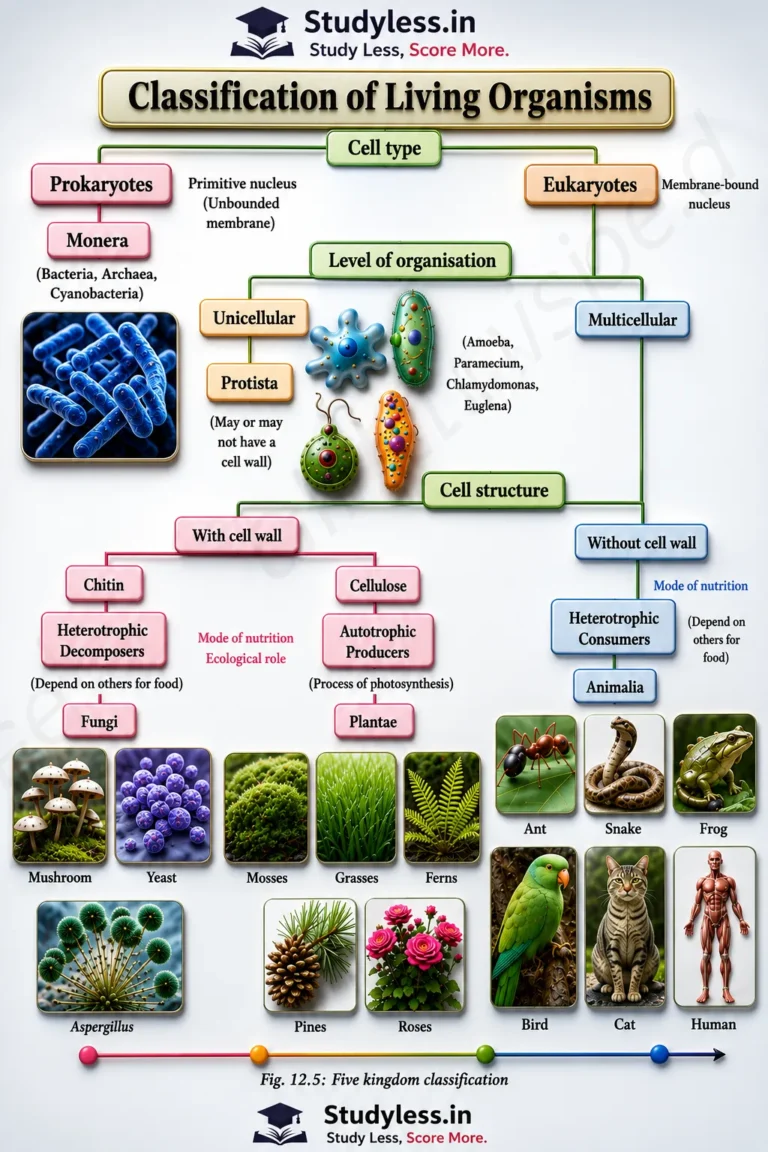
All animal cells, including sponge cells, have a cell membrane but no cell wall. The five-kingdom concept map (Fig. 12.5, Page 234) places Animalia under the “without cell wall” branch. All eukaryotes have mitochondria, so option (i) is wrong. Animals are heterotrophic, not autotrophic, so option (ii) is wrong. Cell walls are found in plants and fungi, not animals, so option (iv) is also incorrect.
Source: Page 240, Kingdom Animalia section; Page 234, Fig. 12.5 (concept map) — “Without cell wall … Heterotrophic consumers … Animalia”
Q3
Observe two different animals in your immediate environment. What
features help you distinguish between them? How do these features
help place them into different groups?
Answers:
Let’s take the two animals:
1. Butterfly
2. Earthworm
A butterfly has six jointed legs, three body parts (head, thorax, abdomen), wings, and an exoskeleton. An earthworm has no legs, a cylindrical body divided into many segments, and a moist, smooth skin.
These differences in external features, body organisation, and the presence or absence of a skeleton help place them in different groups. The butterfly belongs to Arthropoda, and the earthworm to Annelida.
There are 7 criteria scientists use for classification:
1. External features
2. Mode of nutrition,
3. Internal structures
4. Cell structure
5. Ecological role
6. Reproduction
7. Genetic similarity.
Visible external features like legs and body covering allow quick initial grouping, while deeper features confirm it.
Source: Page 231, Section 12.3.1 — “Scientists often look at broad and easily visible features, and then look at more detailed features. They use several characteristics to group living organisms…”
Q4
How would a scientist justify choosing cellular organisation as a more
fundamental characteristic for the basis of classification rather than
The presence of xylem and phloem?
Answers:
Cellular organisation (whether an organism is a prokaryote or eukaryote, unicellular or multicellular) applies to every living thing on Earth — bacteria, fungi, plants, animals, and protists. It is the very first division in the five-kingdom classification system (Fig. 12.5, Page 234).
Xylem and phloem, by contrast, appear only in some plants — specifically Pteridophyta, Gymnosperms, and Angiosperms. They do not exist in bacteria, fungi, protists, or animals at all.
Scientists work from broad features to specific ones.
Cell type is the broadest possible dividing line — it comes first in the classification hierarchy, and so it is more fundamental.
Source: Page 233–234, Section 12.5 and Fig. 12.5 — “Classification follows a step-by-step order, starting from very broad groups and moving towards smaller and more specific ones.”
Q5
You find an unlabelled slide of a single-celled organism that has a
well-defined nucleus and multiple cilia. Which group would it most
likely belong to? Give reasons.
Answers:
The organism most likely belongs to the Kingdom Protista.
Reasons:
- It is single-celled → rules out Plantae, Animalia, and most Fungi (all multicellular)
- It has a well-defined (membrane-bound) nucleus → it is a eukaryote, which rules out Monera (bacteria are prokaryotes)
- Multiple cilia are a typical locomotion structure in protists like Paramecium (shown in Fig. 12.7, Page 235)
Source: Page 235–236, Section 12.6.2 — “All single-celled eukaryotes without cell wall or with cell wall made up of cellulose are grouped under the kingdom Protista.”
Q6
How does the diversity of organisms contribute to the balance and
stability of an ecosystem?
Answers:
Every organism has a role in nature. Algae produce oxygen, fungi and bacteria recycle nutrients, and birds, bees, and bats help pollinate plants.
Plants form the base of most food chains, while predators help keep animal populations balanced.
When biodiversity is maintained, ecosystems stay healthy and resilient. If a species disappears, other dependent species may also decline. Places like the Western Ghats help support this balance.
Source: Page 228, Introduction, Para 2 — “Every organism plays a role in keeping nature stable and functioning… These interconnections help sustain ecosystems and make the Earth suitable for living organisms.”
Q7
If all unicellular organisms were grouped into a single kingdom, what
problems would arise?
Answers:
Not all unicellular organisms are alike. If they were grouped:
- Bacteria (prokaryotes with no true nucleus) and Amoeba (eukaryotes with a true nucleus) would be placed in the same group, hiding a fundamental biological difference that took billions of years of evolution to arise.
- Organisms with very different modes of nutrition, ecological roles, and cell structures would be grouped, making it impossible to study them meaningfully.
- It would cause practical problems. For example, antibiotics target bacterial cell walls — knowing bacteria are different from protists is essential for medicine.
- Yeast (Fungi) and Euglena (Protista) are both unicellular eukaryotes, but one has a chitin cell wall and absorbs dead matter, while the other moves using flagella and can photosynthesise. Grouping them would erase these critical differences.
Source: Page 233, Section 12.5 — “An amoeba has a true nucleus (membrane-bound) but bacteria do not. Since both are unicellular but very different, bacteria were placed in a separate kingdom.”
Q8
Viruses were studied in earlier classes. Why are they not placed in any
of the five kingdoms? Give reasons.
Answers:
The five-kingdom classification system is built entirely on the assumption that all life consists of cells. Viruses break this assumption at every point:
- They are acellular — they have no cells, no cell membrane, no cytoplasm, and no organelles.
- They have no independent metabolism — they cannot eat, respire, grow, or produce energy on their own.
- They cannot reproduce independently — they can only replicate inside a living host cell.
- They cannot be classified as prokaryotic or eukaryotic because both categories require cells.
- They contain genetic material (DNA or RNA), but this alone is not enough to place them in any kingdom.
Since all five kingdoms are defined by cellular features (cell type, cell wall, number of cells, mode of nutrition), viruses do not qualify for any of them.
Source: Page 234, Fig. 12.5; Page 231, Section 12.3.1 — The five-kingdom system is based on cellular organisation
Q9
If you were asked to revise the five kingdom classification, would
you create a separate category for viruses or keep them outside the
system? Justify your answer and explain what this indicates about
the evolving nature of scientific classification.
Answers:
A separate category — perhaps called “Acellular Entities” — would be more honest and scientifically accurate than either forcing viruses into the five kingdoms or simply ignoring them.
Viruses contain genetic material, interact with living organisms, and affect ecosystems. Acknowledging them in a separate group reflects the reality of what exists. Excluding them entirely from the system leaves a gap in our understanding of life.
The NCERT chapter 12 states: “Why do classification systems keep changing? … Yes, science evolves and progresses as we learn new things … biological classification (and science), thus, is an ongoing process of reasoning and change.”
Carl Woese revised the entire system in 1977 by proposing three domains (Bacteria, Archaea, Eukarya) based on DNA evidence.
Classification systems are human-made tools — they reflect current knowledge, not permanent truth. When new forms of life challenge old frameworks, science updates the framework.
Source: Page 247, Threads of Curiosity — “The biological classification (and science) thus, is an ongoing process of reasoning and change.” Page 246, Ready to Go Beyond (three-domain system by Carl Woese, 1977).
Q10
Viruses contain genetic material like living organisms but lack cellular
organisation. Which features prevent them from fitting into the
five-kingdom system? What does this tell us about the limitations of
classification systems?
Answers:
Features that prevent viruses from fitting into any kingdom:
- They are acellular — no cells at all. The entire five-kingdom system is built on cellular organisation.
- They have no independent metabolism and cannot carry out any life functions on their own.
- They cannot reproduce outside a host — they are “inactive outside a host cell” (as described in organism T, Page 250).
- They fit neither the prokaryotic nor the eukaryotic category because both require cells.
What this tells us about the limitations of classification:
Every classification system is based on the characteristics we know about at the time it is built.
The five-kingdom system assumes all life is cellular. Viruses exist in a grey zone — they have some properties of life (genetic material, ability to evolve) but not others (no cells, no independent metabolism).
This shows that nature does not always fit neatly into boxes that humans design. Classification systems are tools for understanding, not absolute truths.
Source: Page 234, Fig. 12.5 (five-kingdom concept map); Page 247, Threads of Curiosity.
Q11
Both pteridophytes and bryophytes lack flowers and seeds, yet they
are placed in different groups. Explain this classification using their
key features.
Answers:
Although both groups lack flowers and seeds, they differ in several important structural ways:
| Feature | Bryophyta (mosses) | Pteridophyta (ferns) |
|---|---|---|
| True roots, stems, leaves | No — only rhizoids | Yes — fully developed |
| Vascular tissue (xylem and phloem) | Absent | Present |
| Body organisation | Only slight differentiation | Well-differentiated body |
| Ability to transport water and food | Cannot — depends on diffusion | Can — transport throughout plant |
| Example | Marchantia, moss | Fern |
The key difference is vascular tissue. Pteridophytes evolved xylem and phloem, which allow them to transport water and nutrients to all parts of the plant.
This enables them to grow taller and survive in a wider range of habitats. Bryophytes have no such system and must stay close to moist ground.
This major structural advance is why they are classified in a higher, more evolved group.
Source: Page 237–238, Sections on Bryophyta and Pteridophyta — “Pteridophytes … possess true roots, stems and leaves … vascular tissues, xylem and phloem…”
Q12
In the classification hierarchy, which group — class or genus — has
fewer members but more features in common? Explain your answer.
Answers:
Genus has fewer members but more features in common.
The hierarchy runs:
Kingdom → Phylum → Class → Order → Family → Genus → Species. As you move down this hierarchy, each level contains fewer and fewer organisms, but the organisms at that level share more and more features.
Class (for example, Mammalia) includes all mammals — elephants, whales, tigers, and humans. They share only a few broad features: hair, warm-bloodedness, and mammary glands.
Genus (for example, Panthera) includes only lions, tigers, leopards, and jaguars. They share many detailed features: similar skull structure, the ability to roar, large body size, similar hunting behaviour, and closely related DNA.
So genus, being lower in the hierarchy, has far fewer members than class, but those members share far more features with each other.
Source: Page 244, Section 12.7.1 — “At each lower level, organisms share more common features. Every lower group is a part of the group above it.”
Q13
A scientist discovers a new organism with the characteristic features
of locomotion and autotrophic nutrition. Which character(s) would
help the scientist identify the organism belonging to Protista according
to the five kingdom classification?
Answers:
Locomotion and autotrophic nutrition alone are not enough to confirm Protista. Both some Monera (cyanobacteria) and Protista can be autotrophic.
The additional characters that specifically place an organism in the Kingdom Protista are:
- It must be unicellular (single-celled)
- It must be a eukaryote — it must have a true, membrane-bound nucleus
- Its cell wall, if present, must be made of cellulose (not chitin, not peptidoglycan)
- It typically lives in water or moist places
The organism Euglena (NCERT Page 235, Fig. 12.7) is an excellent example — it is autotrophic in light, heterotrophic in darkness, moves using flagella, and is a unicellular eukaryote.
It is classified as Protista because of the combination of unicellular + eukaryote + locomotion + autotrophic capability.
Source: Page 235–236, Section 12.6.2 — “Protista includes single-celled eukaryotic organisms that live in water or moist places. Some are autotrophic and others are heterotrophic.”
Q14
A researcher identified a unicellular eukaryotic organism as fungi.
What identification key would you suggest according to the five
kingdom classification to keep a unicellular organism in the Kingdom
Fungi?
Answers:
Normally, Fungi are described as multicellular. But Yeast is the famous exception. To classify a unicellular organism as Fungi, the identification key would be:
Step 1 — Is it eukaryotic (does it have a true nucleus)? → Yes
Step 2 — Does it have a cell wall? → Yes
Step 3 — Is the cell wall made of chitin? → Yes (this is the deciding factor)
Step 4 — Does it get nutrition by absorption from dead or decaying matter (heterotrophic/saprotrophic)? → Yes
If all four conditions are met, the organism belongs to Kingdom Fungi — even if unicellular. The chitin cell wall and heterotrophic nutrition by absorption are the two most critical markers.
These features are shown in Fig. 12.5 (Page 234) on the five-kingdom concept map.
Source: Page 236, Section 12.6.3 — “Yeast is a unicellular organism, since its cell wall is made up of chitin, it has been put under fungi.”
Q15
During a long-term ecological study, students examined organisms
collected from three different environments — a freshwater pond,
damp soil near decaying logs and the digestive tract of animals. Instead
of naming organisms directly, scientists recorded only structural,
cellular and nutritional features as given in the table below.
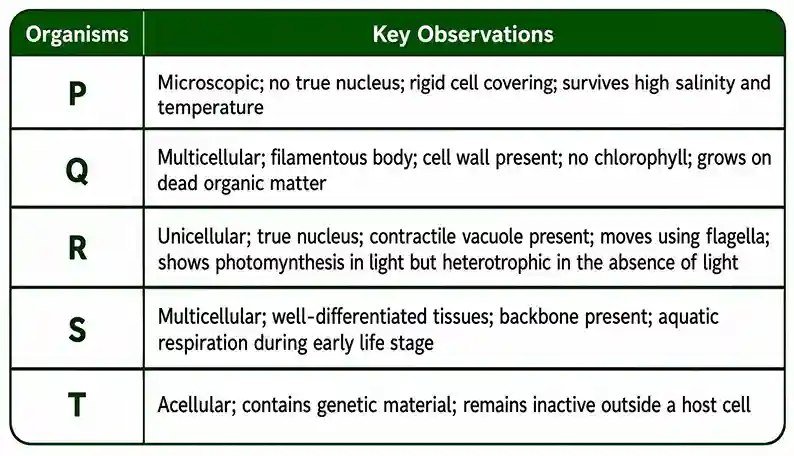
The students realised that some organisms fit neatly into Whittaker’s
five kingdom classification, while others challenged the very basis of
this classification.
Based on the case study, answer the following questions —
(i) Identify one organism that clearly belongs to the Kingdom Fungi.
State one observation that supports your answer.
(ii) Which organism would be placed in the Kingdom Monera?
Mention one characteristic that justifies this placement.
(iii) Organisms R and Q are both eukaryotic, yet they are placed in
different kingdoms. Analyse the criteria that separate them.
(iv) Explain why organism S cannot be classified using the mode of
nutrition alone.
(v) Organism T does not fit into any of the five kingdoms. Which
fundamental characteristic used in classification does it lack
and what does this reveal about the limitations of classification
systems?
(vi) If classification were based only on habitat, which organisms
might be incorrectly grouped together? Explain the scientific
consequences of such a classification.
(vii) Imagine scientists discover a new organism that is multicellular,
eukaryotic, lacks chlorophyll and absorbs nutrients from a host
externally. Should it be placed under fungi or animalia? Justify
your reasoning using classification criteria.
Answers:
(i) Identify one organism that clearly belongs to the Kingdom Fungi. State one observation that supports your answer.
Organism Q belongs to the Kingdom Fungi. It is multicellular with a filamentous body (mycelium), has a cell wall, has no chlorophyll, and grows on dead organic matter. The chapter states fungi “absorb nutrients from dead or decaying matter through fine filaments” (Page 236). Growing on dead organic matter through a filamentous body is the most clearly supporting observation.
(ii) Which organism would be placed in the Kingdom Monera? Mention one characteristic that justifies this placement.
Organism P belongs to the Kingdom Monera. It has no true nucleus, making it a prokaryote — the defining characteristic of Monera. The chapter states: “Bacteria … are single-celled prokaryotes… found everywhere, including … hot springs and other extreme environments” (Page 235). The absence of a true nucleus is the justifying characteristic.
(iii) Organisms R and Q are both eukaryotic, yet they are placed in different kingdoms. Analyse the criteria that separate them.
Both R and Q are eukaryotes, but they differ in several key ways:
R (Protista) is unicellular, can photosynthesise, moves using flagella, and has no chitin cell wall. Q (Fungi) is multicellular with a filamentous body, is entirely heterotrophic by absorption, does not move, and has a cell wall (chitin). The criteria that separate them are: level of organisation (unicellular vs. multicellular), mode of nutrition (autotrophic/mixed vs. heterotrophic by absorption), and cell wall composition.
(iv) Explain why organism S cannot be classified using the mode of nutrition alone.
Organism S is multicellular with a backbone and aquatic respiration during early life — it is a vertebrate (likely an amphibian or fish). It is heterotrophic. However, heterotrophic nutrition is also found in Fungi, Animalia, and many Protista.
The mode of nutrition alone cannot separate S from all these groups. S must be identified using additional features: multicellularity, well-differentiated tissues, presence of a backbone (vertebral column), and its life history (aquatic respiration in the early stage). The chapter lists seven criteria for classification (Page 231) — mode of nutrition is only one of them.
(v) Organism T does not fit into any of the five kingdoms. Which fundamental characteristic used in classification does it lack, and what does this reveal about the limitations of classification systems?
Organism T is acellular. It lacks cellular organisation — the most fundamental characteristic used in the five-kingdom system. All five kingdoms assume the presence of cells. T contains genetic material but cannot function or reproduce independently outside a host. This reveals that classification systems are human-made frameworks based on current knowledge. When something does not fit the assumptions of the system, the system shows its limits. As the chapter states, “biological classification (and science) thus, is an ongoing process of reasoning and change” (Page 247).
(vi) If classification were based only on habitat, which organisms might be incorrectly grouped? Explain the scientific consequences of such a classification.
Organisms living in the same habitat but belonging to entirely different kingdoms would be wrongly grouped.
For example, aquatic bacteria (Monera), Amoeba (Protista), algae (Protista/Plantae), and fish (Animalia) all live in water — but they differ completely in cell type, nutrition, and body organisation.
Aristotle’s early classification (Page 233) grouped animals by habitat and was criticised for this very reason. Consequences would include: hiding true evolutionary relationships, making it impossible to apply knowledge (such as knowing which organisms can cause disease, which can be used as medicines, and which need conservation), and producing a scientifically meaningless system.
(vii) A new organism is multicellular, eukaryotic, lacks chlorophyll, and absorbs nutrients from a host externally. Should it be placed under Fungi or Animalia? Justify using classification criteria.
It should be placed under Kingdom Fungi.
The critical feature is how it gets its nutrition — by external absorption from a host. The chapter states fungi “absorb nutrients from dead or decaying matter through fine filaments” (Page 236). Animals also lack chlorophyll and are heterotrophic, but they ingest food and digest it internally.
External absorption directly from a host is a fungal mode of nutrition (seen in parasitic fungi). Additionally, if the organism has a cell wall (likely chitin, as with fungi), that further confirms it belongs to Fungi — since Animalia have no cell wall at all (Fig. 12.5, Page 234).
Source: Pages 233–247, Sections 12.5 to 12.7
FAQs| Ch 12 Patterns in Life Diversity and Classification Question Answer
What is the difference between biodiversity and biological classification, and why does one need the other?
Biodiversity is the enormous variety of living organisms found on Earth — from microscopic bacteria in hot springs to giant trees in rainforests. Biological classification is the scientific system of grouping these organisms based on shared characteristics and evolutionary relationships.
The two concepts are deeply connected. The chapter opens with this relationship directly: “To study diversity systematically, scientists group and classify organisms based on their shared characteristics and evolutionary relationships.
Classification helps us understand how organisms are related, how they function and how we can use this knowledge in activities, such as ecosystem management, biodiversity conservation, sustainable farming, and so on.” (Page 229)
Without classification, biodiversity would be an overwhelming, unmanageable collection of millions of organisms. You could not study it, conserve it, or apply it practically. Think of it this way — biodiversity is the library, and classification is the system that organises the books so you can actually find and use them. The chapter uses exactly this analogy: “Imagine walking into a huge library where thousands of books are scattered all over the floor… In the same way, the Earth is home to millions of organisms.Therefore, classifying these organisms systematically helps us in understanding them better.” (Page 232)
So biodiversity gives classification its purpose, and classification gives biodiversity its structure. One without the other is incomplete.Why does the five-kingdom classification system keep getting revised, and what does that tell us about how science works?
The five-kingdom system (Monera, Protista, Fungi, Plantae, Animalia), proposed by Robert H. Whittaker in 1969, was itself a revision of earlier systems. Before it came the two-kingdom system (Plantae and Animalia), then the three-kingdom system (which added Protista), then the four-kingdom system (which added Monera). Each revision happened because new tools and discoveries revealed differences that the old system could not explain.
The chapter traces this entire history on Page 233: Aristotle grouped animals by habitat in the 4th century BCE. Linnaeus divided life into two kingdoms in 1758. Haeckel added a third in 1866. Copeland added a fourth in 1938. Whittaker proposed five in 1969. Then Carl Woese, using DNA evidence in 1977, proposed a three-domain system — Bacteria, Archaea, and Eukarya — showing that microscopic life is far more diverse than anyone had previously believed (Page 246).
This history reveals something fundamental about science itself. As the chapter states: “Why do classification systems keep changing? Does that indicate how science works? Yes, science evolves and progresses as we learn new things… The biological classification (and science), thus, is an ongoing process of reasoning and change.” (Page 247)
Each revision was not a failure of the previous system — it was science doing exactly what science is supposed to do: updating its understanding when new evidence demands it. The invention of the microscope revealed microorganisms.
Improvements in microscopy revealed the difference between prokaryotes and eukaryotes. DNA analysis revealed evolutionary relationships invisible to the naked eye. Better tools always lead to better classification.
For students, this means the “right” answer in classification is the best answer available today — not a permanent, unchangeable truth.
How is India specifically important to global biodiversity, and what makes a region a biodiversity hotspot?
India is one of the most biodiverse countries on Earth, and several of its regions qualify as global biodiversity hotspots. A biodiversity hotspot is specifically defined in the chapter as a region that supports a large number of endemic species — species found nowhere else in the world — and has also suffered significant habitat loss. Both conditions must be true: high endemism and habitat threat.
India qualifies on both counts. Its diverse landscape — Himalayan mountains in the north, desert in the west, rainforests in Northeast India, plateaus in the south, and coastlines along the Arabian Sea and the Bay of Bengal — creates distinct habitats with different soil types and climates, each supporting unique species (Page 229).
Examples of Indian endemic species include the Nilgiri tahr, the Lion-tailed macaque, the pitcher plant Nepenthes khasiana, and Neelakurinji — all found only in India (Page 229, Fig. 12.1). India’s biodiversity hotspots include the Western Ghats, the Indo-Burma region (including Northeast India), the Himalayas, and Sundaland (including the Nicobar Islands).
India also has ancient traditions of biodiversity awareness. The Rigveda and the Brihat Samhita classified animals by habitat, behaviour, and ecological role. The Sangam Tinai classification of landscapes and the protection of sacred groves effectively preserved diverse habitats long before modern ecology gave these practices a scientific name (Pages 230 and 233).
Protecting biodiversity hotspots matters not just for conservation but for human survival. Mangrove diversity in Odisha reduced destruction during the 1999 super cyclone.
Forest diversity in the Western Ghats acts as a biological barrier against Kyasanur Forest Disease. Diverse microorganisms in forest soils break down pollutants and improve water quality (Page 244).
What is binomial nomenclature, why was it introduced, and what are the rules for writing a scientific name correctly?
Binomial nomenclature is the universal system of giving every living organism a two-part scientific name. It was introduced by Carolus Linnaeus in the 18th century to solve a very practical problem: the same animal or plant was being called by completely different names in different countries and languages. The chapter gives a clear example — a tiger is called bagh in Hindi, puli in Tamil, tiger in English, and tigre in French.
“If people from different regions discuss this animal, confusion may arise.” (Page 245)Binomial nomenclature eliminates this confusion by giving every organism one universally accepted name, written in Latin or a Latinised form, that scientists everywhere use regardless of their native language.
The name has exactly two parts. The first part is the genus name, which groups closely related species together. The second part is the species name, which identifies the specific organism within that genus. Together, they form a unique name used worldwide.
For example, Panthera tigris (tiger) and Panthera leo (lion) share the genus Panthera — showing they are closely related. But tigris and leo are different species names — showing they are distinct organisms. Similarly, Mangifera indica is the scientific name for mango (Page 246).
The rules for writing scientific names correctly are:
The genus name always begins with a capital letter. The species name is always written entirely in lower case.When printed, the complete name is written in italics. When handwritten, it is underlined. These rules apply without exception.
What is the difference between a vertebrate and an invertebrate, and how does the notochord determine which group an animal belongs to?
The most fundamental division within the Kingdom Animalia is based on a single structural feature: the notochord. The notochord is a flexible, rod-shaped internal structure. Based on whether an animal possesses a notochord or not, all animals are divided into two broad groups: non-chordata (invertebrates) and chordata. (Page 240)
Invertebrates are animals that do not possess a notochord. They show an enormous range of body organisation — from the cellular-level simplicity of sponges (Porifera) to the organ-system complexity of starfish (Echinodermata). The chapter traces this progression through eight phyla: Porifera, Cnidaria, Platyhelminthes, Nematoda, Annelida, Arthropoda, Mollusca, and Echinodermata. Each successive group shows increasing complexity in body organisation — more specialised tissues, more efficient feeding, better locomotion, and better protection.
Chordates are animals that possess a notochord at some point in their life. Among chordates, Protochordates (like Amphioxus) have a notochord throughout or at least once during life. They are the bridge between invertebrates and vertebrates, helping scientists understand how the notochord-based body plan first appeared (Page 243).
Vertebrates are the most advanced chordates. In them, the notochord is replaced during development by a vertebral column — a backbone made of bone or cartilage. This internal framework supports a larger body, protects vital organs like the brain and spinal cord, allows more efficient movement, and permits the development of complex organ systems (Page 244).
Vertebrates are divided into five classes: fish, amphibians, reptiles, birds, and mammals — classified based on their habitat, body covering, and mode of reproduction.
The notochord, therefore, acts as the key dividing criterion because it represents a fundamental shift in body design — from external or no skeletal support (invertebrates) to internal skeletal support (chordates and vertebrates). This shift made possible the evolution of larger, more complex, and more mobile animals.