
Universal Franchise and India’s Electoral System is a 22-page, very lengthy chapter. Preparing it without short notes is a big task. And to help you out, we have created “Short Notes: Universal Franchise and India’s Electoral System.”
These Short notes are easy to learn, Easy to memorise, and easy to revise.
To get the maximum out of the short notes, read Chapter 5 from your NCERT textbook first.
Happy Learning!
Universal Adult Franchise
Means that – Every adult citizen gets ONE vote with EQUAL value
| Age | Can Vote? |
|---|---|
| Below 18 | ❌ |
| 18+ | ✅ |
“UNIVERSAL” means:
No discrimination
by:
- Caste
- Religion
- Gender
- Education
- Income
- Race/Creed
IMPORTANT RULES
✅CAN VOTE IF:
- Citizen of India
- 18 years or older
- Registered voter in your
constituency
❌ CANNOT VOTE IF:
Convicted of serious crimes
Remember: No one can vote on your behalf!
WHERE IS IT USED?
Universal Franchise
is used for elections in:
- Lok Sabha (Parliament)
- State Legislative Assemblies
- Local elections (villages & cities)
WHY IMPORTANT?
Cornerstone of
Indian democracy
- Everyone has a voice
- Equal rights for all
- Democratic participation
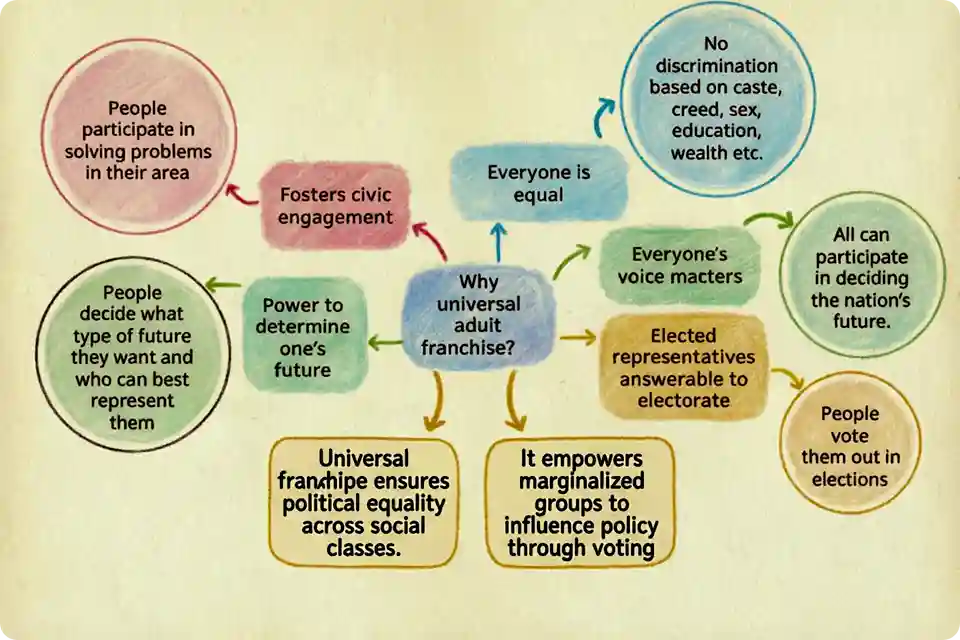
Bridging Barriers, Enabling Participation: Ensuring Universal Franchise
WHY DOES IT MATTER?
Democracy thrives when every eligible citizen can freely and fairly participate in voting
Voting = Expressing your will
THE CHALLENGE: India’s Size & Complexity
| Comparison | Size |
|---|---|
| Population of voters | 15x larger than UK |
| Geographic area | 6x larger than France |
| Diversity | High – diverse & complex |
Challenge: Organizing elections in such a large country! 😰
THE SOLUTION: Election Commission of India (ECI)
ECI’s Job: Organize elections fairly for everyone
ACCESSIBILITY MEASURES (Removing Barriers)
Rural Areas
- Electoral officials travel to remote locations
- Ensures every citizen can vote
Elderly & People with Disabilities
- Can cast votes from home
- Postal voting option available
Assistive Technologies
| Technology | Purpose |
|---|---|
| Braille-enabled voter cards | For visually impaired |
| App-based requests | Request help (wheelchairs, ramps) |
| Wheelchairs & ramps | For the visually impaired |
“No voter left behind.”
ECI ensures everyone can vote, no matter where they live or what challenges they face!
The Role of the Election Commission of India (ECI)
Election Commission of India —A brief introduction
WHAT IS ECI?
| Aspect | Details |
|---|---|
| Full Name | Election Commission of India |
| Established | 1950 |
| Nature | Independent constitutional body |
| Main Job | Conduct free & fair elections |
| First Election | 1951-52 (independent India) |
Structure of the Election Commission of India
conducts elections
manages voter list
Hierarchical Structure of Election Commission of India
ELECTIONS CONDUCTED BY ECI
Lok Sabha elections
Rajya Sabha elections
State Legislative Assemblies
President elections
Vice President elections
Managing the electoral process
A MASSIVE TASK
Example: Lok Sabha Elections
| Challenge | Scale |
|---|---|
| Constituencies | 543 |
| Area | Entire India (huge & diverse) |
| Voters | Millions eligible |
| Election Officials | Many deployed |
| Timeline | Every year, multiple polls in different regions |
Why? Elections happen at different times based on when they are due 🕐
Model Code of Conduct (MCC)
Purpose: Ensure free & fair elections ⚖️
RULES FOR
GOVERNMENT PARTIES:
- No new schemes announced during elections
- No projects announced that influence voters
- No government resources used for campaigning
RULES FOR VOTERS:
NO GIFTS for votes = PUNISHABLE
ECI = Referee
of Elections
- Makes sure everyone follows the rules
- Keeps elections fair for everyone
- Works for democracy! 🇮🇳
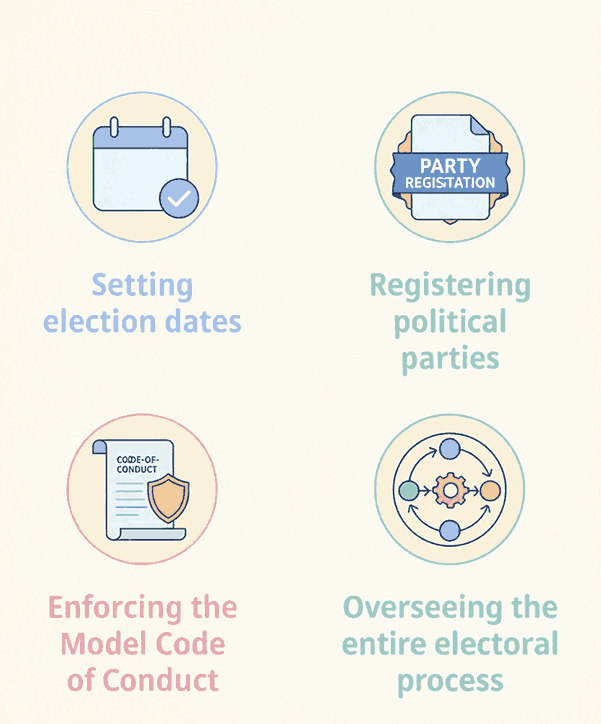
Understanding Elections in India —A Very Brief Overview
FESTIVAL OF DEMOCRACY
Citizens freely & fairly choose their representatives
INDIA’S ELECTION LEVELS
| Level | Name | Elected as |
|---|---|---|
| National | Lok Sabha | MP (Member of Parliament) |
| State | Legislative Assembly | MLA (Member of Legislative Assembly) |
| Local | City/Village bodies | Local representatives |
Election to the Lok Sabha and State Legislative Assemblies
HOW IT WORKS:
“First-Past-the-Post”
Winner = Candidate with the MOST votes
Important Point: Can win with even less than 50% of the votes!
FACTS
- 543 constituencies divide India
- State Election Commission conducts
local elections- works in consultation with the ECI
The political party or coalition winning
A majority of the seats in the Lok Sabha form the national
government.
Coalition
“A group of two or more parties working together”
Leader of the majority = Prime Minister.
At the state level,
The leader of the majority party = Chief minister.
Election to the Rajya Sabha
INDIRECT ELECTION (Not direct voting)
| Feature | Details |
|---|---|
| Total Members | 245 |
| Elected by | MLAs (233 members) |
| Nominated by | President (12 members) |
| Term Length | 6 years |
| Retirement | 1/3 retire every 2 years |
| Nickname | “Permanent House” (Never dissolved) |
Dissolution
“Expiry or termination due to the end of its term or other Constitutional reason”
SEAT ALLOCATION
- Based on the state population
- More people = More seats
- Example: Uttar Pradesh > Arunachal Pradesh
VOTING SYSTEM
Single Transferable Vote (STV)
Ensures Fair representation for smaller states
Election of the President of India
INDIRECT ELECTION (Electoral College)
WHO VOTES:
- All MPs (Lok Sabha + Rajya Sabha)
- All MLAs (States + Delhi & Puducherry)
WHO DOESN’T VOTE:
- Nominated Rajya Sabha members (12)
- Nominated State Legislative Assembly members
- Members of the Legislative Councils
- Nominated union territory members
Why? Only directly elected reps vote
Ans- To ensure Democratic Legitimacy
VOTING SYSTEM
Single Transferable Vote (STV)
More populous states = Greater say in the election.
Rajya Sabha – The Upper House of the Indian Parliament
Election of the Vice President of India
INDIRECT ELECTION
WHO VOTES:
- Elected members of
both Houses of Parliament - Nominated members of
both Houses of Parliament
ROLE OF VICE PRESIDENT
- Chairperson of the Rajya Sabha
- Steps in if the President can’t work
VOTING SYSTEM
Single Transferable Vote (STV)
QUICK COMPARISON TABLE
| Election | Who Votes? | Voting System | Winner is |
|---|---|---|---|
| Lok Sabha | All citizens 18+ | First-Past-the-Post | MP |
| Rajya Sabha | MLAs | STV | MP |
| President | Electoral College | STV | Head of State |
| Vice President | Parliament Members | STV | Chairperson of RS |
KEY DIFFERENCES
| Direct Election | Indirect Election |
|---|---|
| Citizens vote directly | Elected reps vote |
| Lok Sabha | Rajya Sabha |
| State Assembly | President |
| Vice President |
Challenges and The Road Ahead
INDIA’S ELECTORAL SYSTEM
Celebrated as: World’s LARGEST DEMOCRATIC EXERCISE 🎉
BUT… It faces challenges! 😟
MAJOR CHALLENGES
| Challenge | Problem |
|---|---|
| Money Power | Growing influence of money in elections |
| Criminal Records | Many candidates have criminal records |
| Voter Apathy | People don’t vote, esp. in cities |
Question raised: Is our democracy healthy? 🤔
THE SOLUTION:
Empower Voters with Information
What do voters need? → Right information to make thoughtful & responsible choices
WHO MUST WORK TOGETHER?
| Institution | Role |
|---|---|
| Media | Spread correct information |
| Education | Teach importance of voting |
| Awareness Campaigns | Guide people wisely |
Target: Especially YOUTH
THE STRONGEST SAFEGUARD
“An aware and vigilant voter is the strongest safeguard of democracy.”

![[New Book] Pressure, Winds, Storms, and Cyclones Short Notes Chapter 6 Science Class 8](https://studyless.in/wp-content/uploads/2026/03/New-Book-Pressure-Winds-Storms-and-Cyclones-Short-Notes-Chapter-6-Science-Class-8-2.jpg)