“Ch 9 Propositions And Their Converses Solutions“ is prepared on the basis on Ganita Manjari Part 2 class 9 NCERT. And also we have prepared it after teaching and solving the questions in the actual class.
Therefore “Ch 9 Propositions And Their Converses Solutions” already has the doubts and confusion addressed. The solutions are kept as brief as possible yet tried to bo not confusing.
If you have any doubt and difficulty understanding the questions or the solutions, please comment or mail us.
StudyLess will do everything to make you master the chapter 9 , Propositions And Their Converses Solutions.
For more chapter solutions | Class 9 Maths Solutions
Exercise Set 9.1
Q1.
If two lines are parallel, then the corresponding angles formed by a transversal are equal.
Q1. Solution
P = Two lines are parallel
Q = Corresponding angles are equal
P implies Q (P ⇒ Q)
In the figure,
L ∥ M, T is a transversal
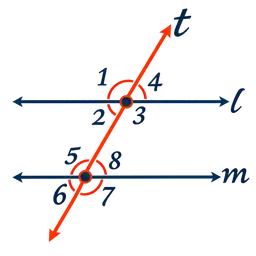
∴ ∠1 = ∠5 ; ∠4 = ∠8
∠2 = ∠6 ; ∠3 = ∠7
∴ Proposition, P ⇒ Q is true.
Now,
Q implies P (Q ⇒ P)
If corresponding angles are equal, then the lines are parallel.
This is true by the Converse of Corresponding Angles Theorem.
Q2.
If a quadrilateral is a square, then all its angles are equal.
Q2. Solution
P = A quadrilateral is a square
Q = All its angles are equal
P implies Q (P ⇒ Q)
By definition, a square has all four angles equal to 90°.
So whenever a quadrilateral is a square, all its angles are equal.
∴ Proposition, P ⇒ Q is true.
Now,
Q implies P (Q ⇒ P)
If all angles of a quadrilateral are equal, then it is a square.
Counterexample: A rectangle has all four angles equal (each 90°), but its adjacent sides are not equal, so it is not a square.
∴ Converse, Q ⇒ P is false.
Q3.
Given any △ABC, let us bisect the angles A at B and C. The bisectors meet at the incentre I of the triangle. Now extend the bisectors beyond I till they meet the opposite sides at E and F respectively, as shown.
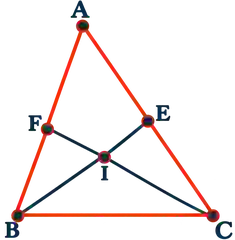
Proposition: If AB = AC, then IE = IF.
Q3. Solution
In △ABC, the bisectors (tap to see meaning) of ∠B and ∠C meet at the incentre (tap to see meaning) I.
These bisectors are extended beyond I to meet the opposite sides, the B-bisector meets AC at E, and the C-bisector meets AB at F.
P = AB = AC
Q = IE = IF
P implies Q (P ⇒ Q)
Since AB = AC, △ABC is isosceles, so it has a line of symmetry through A and the midpoint of BC.
Reflecting the triangle across this axis swaps B ↔ C, and hence swaps side AC ↔ AB.
The incentre I lies on this axis of symmetry, so I maps to itself under the reflection.
The bisector of ∠B maps to the bisector of ∠C, so point E (on AC) maps to point F (on AB).
Since reflection preserves distances, and I → I, E → F,
IE = IF
∴ Proposition, P ⇒ Q is true.
Now,
Q implies P (Q ⇒ P)
If IE = IF, then AB = AC.
This is also true ,it is closely related to a famous result in triangle geometry (the Steiner–Lehmus theorem), which shows that equal bisector-related lengths force a triangle to be isosceles.
Unlike the forward direction, this cannot be proved by a simple symmetry argument ,it needs an indirect proof (by contradiction), which is beyond this exercise.
∴ Converse, Q ⇒ P is true.
Q4.
If x = y, then a + x = a + y, where x, y and a are any three numbers.
This proposition and its converse are routinely used while solving equations.
Q4. Solution
P = x = y
Q = a + x = a + y
(where x, y and a are any three numbers)
P implies Q (P ⇒ Q)
Since x = y, adding the same number a to both sides,
a + x = a + y
This follows from the Addition Property of Equality.
∴ Proposition, P ⇒ Q is true.
Now,
Q implies P (Q ⇒ P)
If a + x = a + y, subtracting a from both sides,
x = y
This is true by the Subtraction Property of Equality (Cancellation Law of Addition).
Q5.
If a and b are perfect squares, then ab is a perfect square.
Q5. Solution
P = a and b are perfect squares
Q = ab is a perfect square
P implies Q (P ⇒ Q)
Let a = m² and b = n² for some integers m, n.
Then, ab = m²n² = (mn)²
So ab is also a perfect square.
∴ Proposition, P ⇒ Q is true.
Now,
Q implies P (Q ⇒ P)
If ab is a perfect square, then a and b are perfect squares.
Counterexample: Let a = 2 and b = 8. Then ab = 16 = 4², a perfect square ,but neither 2 nor 8 is itself a perfect square.
∴ Converse, Q ⇒ P is false.
In Questions 6 and 7, x and y are real numbers.
Q6.
If x = y, then x² = y²
Q6. Solution
P = x = y
Q = x² = y²
(where x, y are any real numbers)
P implies Q (P ⇒ Q)
Since x = y, squaring both sides,
x² = y²
∴ Proposition, P ⇒ Q is true.
Now,
Q implies P (Q ⇒ P)
If x² = y², then x = y.
Counterexample: Let x = 2 and y = −2. Then x² = 4 = y², but x ≠ y.
∴ Converse, Q ⇒ P is false.
Q7.
If x = y, then x³ = y³.
Q7. Solution
P = x = y
Q = x³ = y³
(where x, y are any real numbers)
P implies Q (P ⇒ Q)
Since x = y, cubing both sides,
x³ = y³
∴ Proposition, P ⇒ Q is true.
Now,
Q implies P (Q ⇒ P)
If x³ = y³, then x = y.
Unlike squaring, the cube of a real number is one-to-one ,unequal real numbers always give unequal cubes (a negative number cubed stays negative, so no sign-cancellation like x² is possible).
So x³ = y³ forces x = y.
∴ Converse, Q ⇒ P is true.
In Questions 8–12, n is a positive integer.
Q8.
If n is divisible by 24, then it is divisible by both 4 and 6.
Q8. Solution
P = n is divisible by 24
Q = n is divisible by both 4 and 6
(where n is a positive integer)
P implies Q (P ⇒ Q)
24 = 4 × 6, and both 4 and 6 divide 24.
So if n is divisible by 24, i.e. n = 24k,
n = 4(6k) and n = 6(4k)
Hence n is divisible by both 4 and 6.
∴ Proposition, P ⇒ Q is true.
Now,
Q implies P (Q ⇒ P)
If n is divisible by both 4 and 6, then n is divisible by 24.
The LCM(4, 6) = 12, not 24 ,so n need only be a multiple of 12.
Counterexample: Let n = 12. It is divisible by 4 (12÷4 = 3) and by 6 (12÷6 = 2), but 12 is not divisible by 24.
∴ Converse, Q ⇒ P is false.
Q9.
If n is divisible by 60, then it is divisible by both 5 and 12
Q9. Solution
P = n is divisible by 60
Q = n is divisible by both 5 and 12
(where n is a positive integer)
P implies Q (P ⇒ Q)
60 = 5 × 12, and both 5 and 12 divide 60.
So if n is divisible by 60, i.e. n = 60k,
n = 5(12k) and n = 12(5k)
Hence n is divisible by both 5 and 12.
∴ Proposition, P ⇒ Q is true.
Now,
Q implies P (Q ⇒ P)
If n is divisible by both 5 and 12, then n is divisible by 60.
Since HCF(5, 12) = 1 (they share no common factor), their LCM(5, 12) = 5 × 12 = 60.
So any n divisible by both 5 and 12 must be divisible by their LCM, which is 60.
∴ Converse, Q ⇒ P is true.
Q10.
If n is the square of a prime number, then it has exactly 3 factors.
Q10. Solution
P = n is the square of a prime number
Q = n has exactly 3 factors
(where n is a positive integer)
P implies Q (P ⇒ Q)
Let n = p², where p is prime.
The factors of n are 1, p and p² ,exactly 3 factors.
∴ Proposition, P ⇒ Q is true.
Now,
Q implies P (Q ⇒ P)
If n has exactly 3 factors, then n is the square of a prime.
For n = pa (a single prime raised to a power), the number of factors is (a + 1).
For exactly 3 factors, a + 1 = 3, so a = 2, giving n = p².
If n had two or more distinct prime factors (e.g. n = pq), it would have at least 4 factors.
So exactly 3 factors forces n to be the square of a prime.
∴ Converse, Q ⇒ P is true.
Q11.
If n is a product of two unequal prime numbers, then it has exactly 4 divisors.
Q11. Solution
P = n is a product of two unequal prime numbers
Q = n has exactly 4 divisors
(where n is a positive integer)
P implies Q (P ⇒ Q)
Let n = p × q, where p and q are unequal primes.
The divisors of n are 1, p, q and pq ,exactly 4 divisors.
∴ Proposition, P ⇒ Q is true.
Now,
Q implies P (Q ⇒ P)
If n has exactly 4 divisors, then n is a product of two unequal primes.
Counterexample: Let n = 8 = 2³. Its divisors are 1, 2, 4, 8 , exactly 4 divisors, but 8 is not a product of two unequal primes; it is the cube of a single prime.
∴ Converse, Q ⇒ P is false.
Q12.
If n and n + 3 have no factors in common, then n is not a multiple of 3.
Q12. Solution
P = n and n + 3 have no factors in common
Q = n is not a multiple of 3
(where n is a positive integer)
P implies Q (P ⇒ Q)
Note that HCF(n, n + 3) = HCF(n, 3), since (n + 3) − n = 3.
If n were a multiple of 3, then HCF(n, 3) = 3, so n and n + 3 would share the common factor 3.
So if n and n + 3 have no factor in common, n cannot be a multiple of 3.
∴ Proposition, P ⇒ Q is true.
Now,
Q implies P (Q ⇒ P)
If n is not a multiple of 3, then n and n + 3 have no factors in common.
Since n is not a multiple of 3, HCF(n, 3) = 1.
So HCF(n, n + 3) = HCF(n, 3) = 1 ,i.e. n and n + 3 share no common factor other than 1.
∴ Converse, Q ⇒ P is true.
Q13.
There are no known ‘neat’ expressions that generate only primes! Find counterexamples to the following claims.
(i) All numbers of the form 4n² + 1 are prime.
(ii) All numbers of the form n² + n + 11 are prime.
(iii) All numbers of the form 4n + 3 are prime.
Q13. Solution
Claim: All numbers of the form 4n² + 1 are prime.
| n | 1 | 2 | 3 | 4 |
|---|---|---|---|---|
| 4n² + 1 | 5 | 17 | 37 | 65 |
Counterexample: For n = 4, 4n² + 1 = 4(16) + 1 = 65 = 5 × 13, which is not prime.
Claim: All numbers of the form n² + n + 11 are prime.
This holds for n = 1 to 9 (giving 13, 17, 23, 31, 41, 53, 67, 83, 101 – all prime), but fails at n = 10.
Counterexample: For n = 10, n² + n + 11 = 100 + 10 + 11 = 121 = 11², which is not prime.
Claim: All numbers of the form 4n + 3 are prime.
| n | 1 | 2 | 3 | 4 |
|---|---|---|---|---|
| 4n + 3 | 7 | 19 | 67 | 259 |
Counterexample: For n = 4, 44 + 3 = 256 + 3 = 259 = 7 × 37, which is not prime.
Q14.
(i) If n is a prime number, then 2ⁿ − 1 is a prime number.
(ii) If n is an even number, then 2n + 1 is a prime number.
Q14. Solution
Claim: If n is a prime number, then 2n − 1 is a prime number.
| n (prime) | 2 | 3 | 5 | 7 | 11 |
|---|---|---|---|---|---|
| 2n − 1 | 3 | 7 | 31 | 127 | 2047 |
Counterexample: For n = 11 (prime), 211 − 1 = 2047 = 23 × 89, which is not prime.
Claim: If n is an even number, then 2n + 1 is a prime number.
| n (even) | 2 | 4 | 6 |
|---|---|---|---|
| 2n + 1 | 5 | 17 | 65 |
Counterexample: For n = 6 (even), 26 + 1 = 65 = 5 × 13, which is not prime.
Q.15
Consider the statement:
If a number is divisible by 8, then it is divisible by both 2 and 4.
(i) Justify the statement.
(ii) Recall the divisibility shortcuts that we have studied for different numbers. To check whether a given number is divisible by 8, is it enough to check whether it is divisible by 2 and 4? Why or why not?
Q15. Solution
P = n is divisible by 8
Q = n is divisible by both 2 and 4
(where n is a positive integer)
P implies Q (P ⇒ Q)
8 = 2 × 4, and both 2 and 4 divide 8.
So if n is divisible by 8, i.e. n = 8k,
n = 2(4k) and n = 4(2k)
Hence n is divisible by both 2 and 4.
∴ Statement, P ⇒ Q is true (justified).
This asks whether the converse holds:
Q implies P (Q ⇒ P)
If n is divisible by both 2 and 4, then n is divisible by 8.
The LCM(2, 4) = 4, not 8 – so being divisible by 2 and 4 only guarantees divisibility by 4.
Counterexample: Let n = 12. It is divisible by 2 and by 4, but 12 is not divisible by 8.
∴ No, checking divisibility by 2 and 4 is not enough to conclude divisibility by 8. There is no shortcut for 8 built from the 2 and 4 tests – one must check divisibility by 8 directly (e.g. by testing if the last three digits form a number divisible by 8).
Q16.
Recall that a shortcut to check whether a given number is divisible by 3 is to add the digits of the number and check if the sum is a multiple of 3.
Express the relationship between “a number is divisible by 3” and “sum of the digits is a multiple of 3” using “If-then” sentences.
Q16. Solution
P = A number is divisible by 3
Q = The sum of the digits of the number is a multiple of 3
P implies Q (P ⇒ Q)
If a number is divisible by 3, then the sum of its digits is a multiple of 3.
Since 10 = 3 × 3 + 1, every power of 10 leaves remainder 1 when divided by 3.
So a number and the sum of its digits always leave the same remainder on division by 3.
Hence if the number is divisible by 3 (remainder 0), its digit sum is too.
∴ Proposition, P ⇒ Q is true.
Now,
Q implies P (Q ⇒ P)
If the sum of the digits of a number is a multiple of 3, then the number is divisible by 3.
Using the same fact ,the number and its digit sum leave the same remainder on division by 3 ,
if the digit sum has remainder 0, the number itself must have remainder 0 too.
∴ Converse, Q ⇒ P is true.
Q17.
We have identified different types of quadrilaterals — squares, rectangles, parallelograms, rhombi, kites and trapezia. One can identify more types (e.g., we could create a category of quadrilaterals that have equal-length opposite sides).
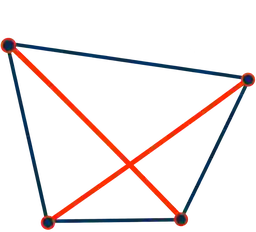
Suppose we have identified a category of quadrilaterals called Q, and we have to construct a quadrilateral of this type. For this, we are to use two thin sticks, put them together as diagonals so that the quadrilateral obtained by joining their endpoints is of type Q (see Fig. 9.2).
(i) Suppose Q satisfies the following property:
If a quadrilateral is of type Q, then it has equal-length diagonals.
(a) Should the two sticks be of equal length? Why or why not?
(b) Will it matter how the two sticks are put together?
(ii) Instead of the property mentioned above, suppose Q satisfies the following property:
If a quadrilateral has equal diagonals, then it is of type Q.
What will be your answers to (a) and (b) now?
Note: This is a particularly important question because it tests the direction of implication and converse from the chapter rather than just asking you to manipulate numbers.
Q17. Solution
Two thin sticks are placed as the diagonals of a quadrilateral. Joining the endpoints of the sticks gives a quadrilateral of category Q.
Type Q ⇒ Equal-length diagonals
(a) Should the two sticks be of equal length?
Yes. The property says: if a quadrilateral is of type Q, then its diagonals are equal.
The contrapositive of this is: if the diagonals are not equal, the quadrilateral is not of type Q.
So if the two sticks are of unequal length, the quadrilateral formed can never be of type Q.
Hence the sticks must be equal in length ,this is a necessary condition.
However, since only P ⇒ Q is given (not its converse), equal-length sticks alone do not guarantee the result is of type Q ,it is necessary, but we cannot say it is sufficient.
(b) Will it matter how the two sticks are put together?
The given property only fixes the lengths of the diagonals ,it says nothing about the angle between them or the point where they cross.
Since we are only told a necessary condition (not the full definition of Q), we cannot conclude that any arrangement of two equal sticks will produce a type Q quadrilateral.
So it may still matter how the sticks are arranged ,this property alone does not settle the question.
Equal-length diagonals ⇒ Type Q
(a) Should the two sticks be of equal length?
Yes. Here the property directly states that equal diagonals are sufficient to guarantee type Q.
So making the two sticks equal in length is enough ,whatever quadrilateral results is guaranteed to be of type Q.
(b) Will it matter how the two sticks are put together?
No. Since the property guarantees that any quadrilateral with equal diagonals is of type Q, the angle or the point at which the sticks cross does not matter.
As long as the two sticks used as diagonals are equal in length, the resulting quadrilateral will always be of type Q, regardless of how they are arranged.