“Ch 13 Our Home: Earth, A Unique Life Sustaining Planet Notes Class 8” has all the exam important concepts and points.
These notes are prepared from Curiosity — Textbook of Science for Grade 8 Chapter 13 , Our Home: Earth, A Unique Life Sustaining Planet.
Also Read| Class 8 Free Resources
Why Is Earth a Unique Planet?
Earth is the only known planet in the universe
where life exists and thrives in all its forms.
● All life (mountains, rivers, forests, animals, people) exists on a very thin layer of Earth’s surface — the crust.
● This thin, delicate, life-supporting layer is what makes Earth special.
Crust ➜ The thin outer layer of Earth’s surface where all known life exists, ranging from the tallest mountain to the deepest ocean trench.
What Do the Planets of Our Solar System Look Like?
Solar system has 8 planets around Sun; classified as rocky or gas planets;
greenhouse effect controls planet temperature.
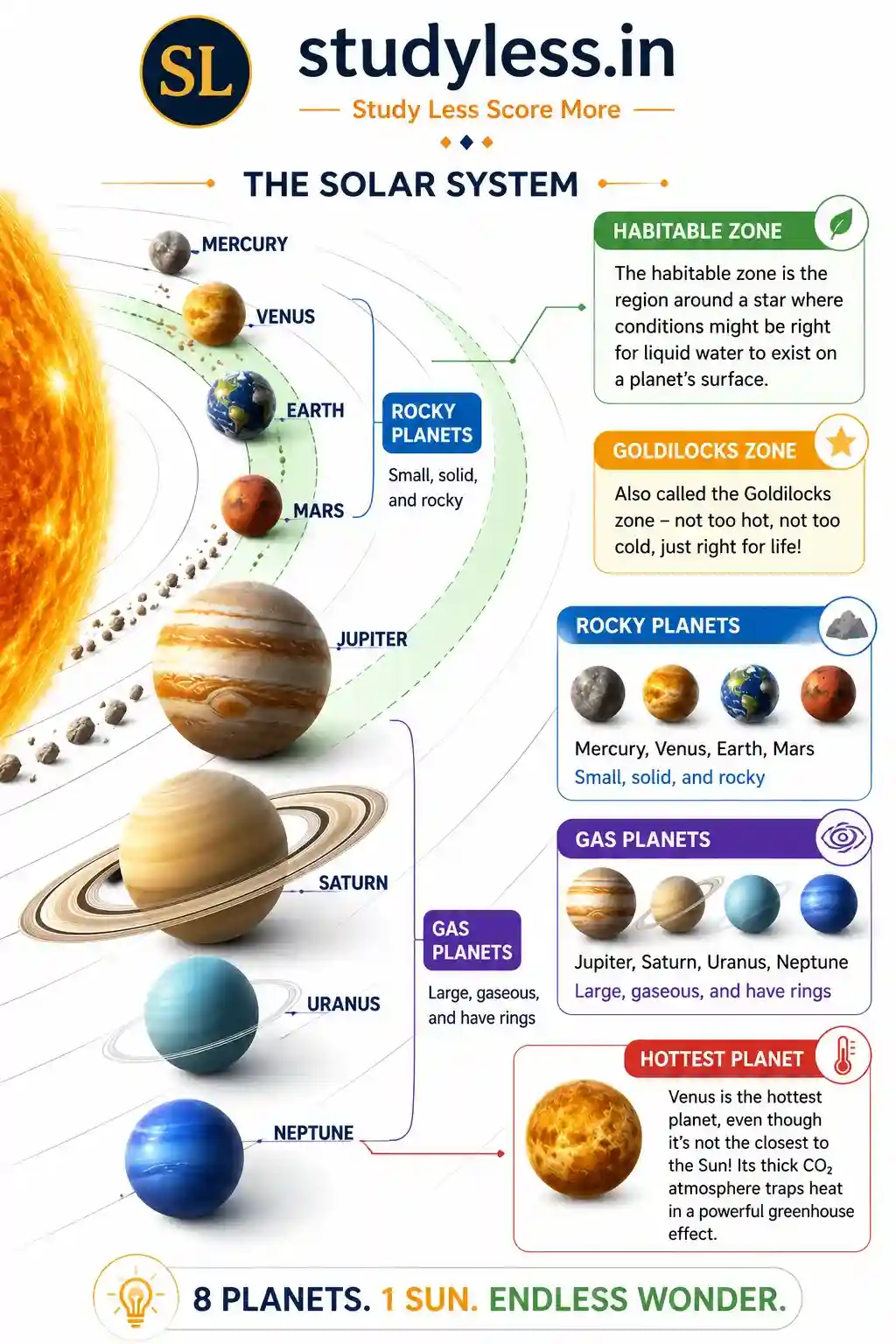
Planets of the Solar System
8 planets orbit the Sun.
- Mercury
- Venus
- Earth
- Mars
- Jupiter
- Saturn
- Uranus
- Neptune
Types of Planets
- Rocky: Mercury, Venus, Earth, Mars.
- Gas Giants: Jupiter, Saturn, Uranus, Neptune.
Venus
● Hottest planet.
● Thick CO₂ atmosphere traps heat.
● Strong greenhouse effect.
Earth
● CO₂ traps some heat.
● Helps maintain a suitable temperature.
Important Terms
Greenhouse Effect → Heat trapped by greenhouse gases such as CO₂ in the atmosphere. It is extreme on Venus but moderate and life-sustaining on Earth.
Rocky Planets → Mercury, Venus, Earth and Mars are small planets with solid rocky surfaces.
Gas Planets → Jupiter, Saturn, Uranus and Neptune are very large planets made mainly of gases.
What Makes the Earth Suitable for Life to Exist?
Earth supports life due to its
1. position (distance from Sun),
2. size (atmosphere-supporting gravity), and
3. magnetic field (protection from harmful particles).
1. Position from the Sun
● Earth is at the right distance from the Sun.
● Water remains liquid.
● Too close ➜ water evaporates.
● Too far ➜ water freezes.
Goldilocks Zone
● Region where liquid water can exist.
● Also called the Habitable Zone.
Blue Planet
● Earth has abundant water.
● Appears blue from space.
2. Size and Gravity
● Right size ➜ right gravity.
● Gravity holds the atmosphere.
● Small planets lose gases (e.g., Mars, Mercury).
Atmosphere
● Layer of gases around Earth.
● Essential for life.
● Contains oxygen for breathing.
Ozone Layer
● Oxygen forms ozone (O₃).
● Ozone creates the ozone layer.
● Blocks harmful UV rays.
● Protects living organisms.
Stable Conditions
● Nearly circular orbit.
● Receives fairly steady sunlight and heat.
3. Magnetic field of Earth
Earth acts like a giant magnet.
Created by molten iron in the core.
Harmful Particles
● Cosmic rays from space.
● Solar wind from the Sun.
● Can damage the atmosphere and ozone layer.
Importance
● Magnetic field blocks these particles.
● Protects the atmosphere and life.
Important Terms
Habitable (Goldilocks) Zone → The distance from a star where temperatures allow liquid water to exist on a planet.
Atmosphere → The layer of gases surrounding Earth that supports life and protects the planet.
Ozone Layer → A layer rich in ozone gas that blocks most harmful ultraviolet (UV) rays from the Sun.
Magnetic Field → The region around Earth where its magnetic force protects the planet from solar wind and many cosmic rays.
Cosmic Rays → Extremely high-energy particles that originate from outside the Solar System.
Solar Wind → A continuous stream of high-energy charged particles released by the Sun.
What Allows Life to Be Sustained on Earth?
Life on Earth is sustained through interaction between
Atmosphere Hydrosphere
Geosphere Biosphere.
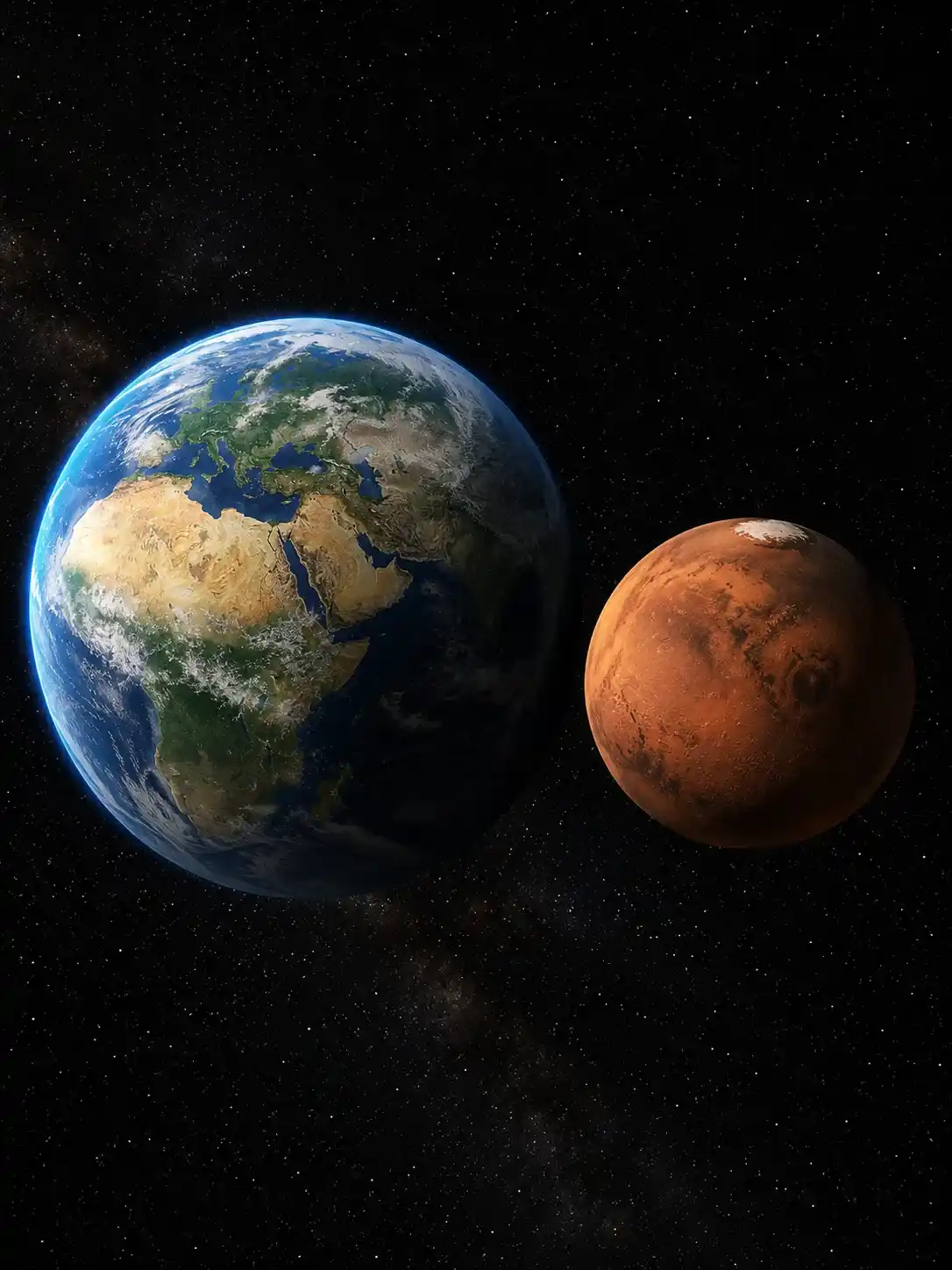
Air, Water, and Sunlight
Atmosphere
● Provides oxygen for life.
● Plants use sunlight + CO₂ + water to make food.
● Releases oxygen.
● Traps heat and keeps Earth warm enough for liquid water.
Hydrosphere
= All water on Earth:
Covers about 70% of Earth.
➢ Rivers
➢ Lakes
➢ Oceans
➢ Groundwater
Importance of Water
● Transports nutrients.
Regulates body temperature.
● Supports life.
● Home to millions of organisms.
Water Cycle
● Water vapour forms clouds.
● Causes rain and snow.
● Refills rivers, lakes, and groundwater.
● Supports plants, animals, and farming.
Soil, Rocks, and Minerals
Geosphere
● Earth’s solid part.
● Includes rocks, soil, and minerals
Importance
- Soil supports plant growth.
- Provides minerals like:
- Salt
- Coal
- Oil
- Iron
- Copper
Soil
● Rich in nutrients.
● Formed from weathered rocks and decayed organisms.
Geodiversity
● Variety of landforms, rocks, and soils.
● Creates different habitats.
Plants, Animals, and Microorganisms
● Biosphere ➜ all living beings + their habitats (land, water, air).
● Plants ➜ make food via photosynthesis.
● Animals ➜ eat plants/other animals.
● Decomposers ➜ break down dead matter ➜ return nutrients to so
Importance of Balance
● Earth = living system; land, air, water, living things support each other.
● Small changes (e.g., deforestation) ➜ affect rainfall, soil, air quality, animals.
● Balance among all elements keeps Earth habitable.
● Protecting air, water, soil, life forms ➜ essential for Earth’s future health.
Important Terms
Layer of gases around Earth that enables respiration and produces the greenhouse effect.
Heat trapped by the atmosphere that keeps Earth warm enough for liquid water and life.
All the water on Earth. Supports aquatic life, nutrient transport and the water cycle.
The solid Earth consisting of rocks, soil and minerals that provide nutrients and natural resources.
The variety of landforms, rocks, soils and geological processes that create different habitats.
All living organisms together with their environment including land, water and air.
What Keeps Life from Disappearing?
Reproduction
Ensures continuity of life and allows small changes (variation)
to help organisms adapt over generations.
Why Is Reproduction Important?
Importance
● Reproduction keeps life continuing.
● Genes pass traits from parents to offspring.
● Genes control body features like bones, muscles, and skin.
Variation
Small genetic changes help survival.
Examples:
- Camels ➜ humps.
- Bacteria ➜ antibiotic resistance.
Over time, new features and life forms evolve.
Types of Reproduction
1. Asexual
➜ exact copies.
2. Sexual
➜ mix of both parents’ traits.
1. Asexual Reproduction
● Single parent ➜ offspring exact copies (same genetic instructions).
● Vegetative propagation ➜ plant reproduces from a part (leaf/stem/root) planted in soil.
2. Sexual Reproduction
Parents
● Involves male and female.
● Occurs in animals, flowering plants, and some microorganisms.
Gametes
● Reproductive cells with half the parent’s genetic material.
● Male and female gametes fuse to form a new cell.
Result
● Offspring inherit genes from both parents.
● Each offspring is genetically unique.
Sexual Reproduction in Plants
Gametes
● Pollen (inside anther)➜ male gametes.
● Ovules(deep inside flower) ➜ female gametes.
Pollination & Fertilisation
● Pollination ➜ transfer of pollen to another flower (by wind, insects, animals).
● Fertilisation ➜ gametes fuse to form a zygote. Zygote develops into a seed.
Fruit & Seed Dispersal
● Ovary develops into a fruit.
● Animals and birds help spread seeds.
Germination
● Seed absorbs water.
● Stored food in the seed helps roots and shoots grow.
Sexual Reproduction in Animals
Gametes
● Sperm ➜ male gamete.
● Egg ➜ female gamete.
External Fertilisation
● Seen in fish and frogs.
● Gametes fuse in water.
● Zygote develops into an embryo.
Internal Fertilisation
● Seen in birds and mammals.
● Fertilisation occurs inside the female.
Development
Birds
● Fertilised egg is laid.
● Embryo grows using stored food.
Mammals
● Embryo develops inside the mother.
● Mother provides food and oxygen until birth.
Important Terms
Genes / Genetic Material → Instructions inside cells that guide an organism’s development and determine its traits.
Gametes → Reproductive cells carrying half the genetic material, such as sperm & egg or pollen & ovule.
Asexual Reproduction → Reproduction involving one parent, producing genetically identical offspring.
Sexual Reproduction → Reproduction involving two parents, producing offspring with a mixture of traits.
Vegetative Propagation → Asexual reproduction in plants using roots, stems or leaves instead of seeds.
Pollination → Transfer of pollen from the anther to the stigma of another flower.
Fertilisation → Fusion of male and female gametes to form a zygote.
Zygote → Cell formed after fertilisation that develops into an embryo.
What Are the Threats to Life on Earth?
Human actions disturb Earth’s delicate balance, leading to the
triple planetary crisis —
climate change, biodiversity loss, and pollution.
1. Climate Change
Long-term changes in temperature, rainfall, and weather.
Cause
● Burning coal and oil releases greenhouse gases.
● These gases trap extra heat.
Why It Happens
● Plants and oceans absorb CO₂.
● Excess CO₂ upsets this balance.
Effects Of Climate Change
Global warming.
Melting ice caps.
Rising sea levels.
Extreme weather.
Loss of species.
2. Biodiversity Loss
Cause
● Habitat destruction reduces biodiversity.
● Disturbs ecosystems.
Impact
● Fewer plants ➜ less food for herbivores.
● Fewer herbivores ➜ less food for predators.
Importance
● Every species has a role.
● Loss of species weakens nature’s balance.
3. Pollution
Air Pollution
● Caused by factories, vehicles, and fuel burning.
● Causes breathing problems, smog, and acid rain
Water Pollution
● Caused by industrial, farm, and plastic waste.
● Harms aquatic life.
● Makes water unsafe.
Soil Pollution
● Caused by excess fertilisers and poor waste disposal.
● Reduces crop yield.
● Harmful substances enter the food chain.
Interconnection
● Hydrosphere, biosphere, atmosphere, geosphere are connected
— damage to one affects others.
● Small changes in oxygen levels, temperature, or ozone layer can endanger life.
Solutions To All The Threats
I. Reduce Climate Change
● Use solar and wind energy.
● Save energy.
● Choose eco-friendly transport.
II. Protect Biodiversity
● Conserve natural habitats.
● Use resources sustainably.
III. Individual Actions
● Reuse, repair, recycle.
● Save water and electricity.
● Spread awareness.
IV. Reduce Pollution
● Improve waste management.
● Practice sustainable farming.
● Protect soil and water.
Important Terms
Triple Planetary Crisis → The combined global challenges of climate change, biodiversity loss, and pollution.
Greenhouse Gases → Gases such as carbon dioxide (CO₂) and methane (CH₄) that trap heat and cause global warming.
Climate Change → Long-term changes in Earth’s temperature, rainfall, and weather patterns.
Biodiversity Loss → The disappearance of species and habitats, disturbing the balance of ecosystems.
Pollution → Contamination of air, water, and soil that harms living organisms and the environment.
######## End Of Notes ########