
Ganita Prakash | Grade 8 | Part-II
In this post, “Ch 1 Fractions In Disguise NCERT Solutions Class 8” the solutions are provided in a easy to read and understand manner.
The solutions are strictly based on the Ncert textbook Chapter 1 of part 2 Fraction In Disguise
We have also followed the necessary steps to solve the questions.
Happy solving Mathematics!
Figure it Out Page 3-4
Express the following fractions as percentages.
(i) 35 (ii) 714 (iii) 920 (iv) 72150 (v) 13 (vi) 511
(i) 35 (ii) 714 (iii) 920 (iv) 72150 (v) 13 (vi) 511
Formula: Percentage = Fraction1 × 100 %
(i)
35 × 100
=
3005
= 60
60%
60%
(ii)
714
=
12
× 100 = 50
50%
50%
(iii)
920 × 100
=
90020
= 45
45%
45%
(iv)
72150 × 100
=
7200150
= 48
48%
48%
(v)
13 × 100
=
1003
= 33.33
33.33% (33⅓%)
33.33% (33⅓%)
(vi)
511 × 100
=
50011
= 45.45
45.45% (45 5⁄11%)
45.45% (45 5⁄11%)
Answers: (i) 60% (ii) 50% (iii) 45% (iv) 48% (v) 33.33% (vi) 45.45%
Nandini has 25 marbles, of which 15 are white. What percentage of her marbles are white?
Formula: Percentage = PartWhole × 100 %
- White marbles = 15, Total marbles = 25
- Percentage white = 1525 × 100
- = 150025
- = 60
Answer: 60% of Nandini’s marbles are white — option (iv).
In a school, 15 of the 80 students come to school by walking. What percentage of the students come by walking?
Formula: Percentage = PartWhole × 100 %
- Students who walk = 15, Total students = 80
- Percentage walking = 1580 × 100
- = 150080
- = 18.75
Answer: 18.75% of the students come to school by walking.
A group of friends is running a long-distance race. The picture shows the positions of A, B, C and D
after 15 minutes. Match, among the given options, what percentage of the race each has approximately completed.
Start
Finish
AA
BB
CC
DD
| Runner | A | B | C | D |
|---|---|---|---|---|
| Distance covered | 38% | 55% | 72% | 93% |
Estimated by comparing each dot’s distance from Start against the full Start–Finish length — 20% and 84% are left unused as distractor options.
Answer: A → 38%, B → 55%, C → 72%, D → 93%.
Identify and write the appropriate symbol ( >, <, = ) for each pair. Estimate — don’t calculate unless needed.
50%
>
5%
50 parts of 100 is far more than 5 parts of 100.
510
=
50%
5⁄10 is exactly half, and half = 50%.
311
<
61%
3⁄11 is close to 1⁄4 (≈27%), well below 61%.
30%
<
13
1⁄3 ≈ 33.3%, which is more than 30%.
Answers: (i) 50% > 5% (ii) 5⁄10 = 50% (iii) 3⁄11 < 61% (iv) 30% < 1⁄3
Figure it Out Page 12-14
Find the missing numbers. The bar is split into 5 equal boxes, so each box is 20% of the total. The first problem (i) has been worked out.
Formula: Value of one box = Total5 (each box = 20% of the total)
(i) — worked out
Total (100%) = 75
20% = 15
80% = 60
Each box = 75 ÷ 5 = 15 ✓ (matches the given 60 and 75)
(ii)
Total (100%) = 90
20% = 18
80% = 72
Each box = 90 ÷ 5 = 18
(iii)
Total (100%) = 140
20% = 28
80% = 112
Each box = 140 ÷ 5 = 28
Answers: (i) 20% = 15, 80% = 60, total = 75 (ii) 20% = 18, 80% = 72 (iii) 20% = 28, 80% = 112
Find the value of the following and also draw their bar models.
(i) 25% of 160 (ii) 16% of 250 (iii) 62% of 360 (iv) 140% of 40 (v) 1% of 1 hour (vi) 7% of 10 kg
(i) 25% of 160 (ii) 16% of 250 (iii) 62% of 360 (iv) 140% of 40 (v) 1% of 1 hour (vi) 7% of 10 kg
Formula: y% of a value = y100 × value
(i) 25% of 160
100%
25100 × 160 = 40
(ii) 16% of 250100%16100 × 250 = 40
100%
(iii) 62% of 360
100%
62100 × 360 = 223.2
(iv) 140% of 40
100%
140100 × 40 = 56
(v) 1% of 1 hour
100%
1 hour = 60 min → 1100 × 60 = 0.6 min (36 sec)
(vi) 7% of 10 kg
100%
7100 × 10 = 0.7 kg (700 g)
Answers: (i) 40 (ii) 40 (iii) 223.2 (iv) 56 (v) 0.6 min (vi) 0.7 kg
Surya made 60 ml of deep orange paint. How much red paint did he use if red paint made up 34 of the deep orange paint?
Formula: Red paint = 34 × Total mixture
3/4 of 60 ml
1/4 of 60 ml
- Total mixture = 60 ml, red fraction = 34
- Red paint = 34 × 60
- = 1804
- = 45
Answer: Surya used 45 ml of red paint (and 15 ml of yellow paint).
Identify and write the appropriate symbol ( >, <, = ). Visualise or estimate — compute only if necessary or to verify.
50% of 510
<
50% of 515
Same percentage, but 515 > 510, so its 50% is larger — 255 vs 257.5.
37% of 148
<
73% of 148
Same base, but 73% > 37% — 54.76 vs 108.04.
29% of 43
<
92% of 110
A small percent of a small number vs a large percent of a large number — 12.47 vs 101.2.
30% of 40
<
40% of 50
12 vs 20 — both the percent and the base are larger on the right.
45% of 200
>
10% of 490
90 vs 49 — 45% of 200 is nearly half of 200, well above 10% of 490.
30% of 80
>
24% of 64
24 vs 15.36.
Answers: (i) < (ii) < (iii) < (iv) < (v) > (vi) >
Fill in the blanks appropriately, using the given percentage as a stepping stone — no need to find k, m or n itself.
Idea: If 30% of k = 70, then 60% (double) = 140, 90% (triple) = 210 — scale the given percentage up or down.
(i) 30% of k is 70
| 60% of k | 90% of k | 120% of k |
|---|---|---|
| 140 | 210 | 280 |
(ii) 100% of m is 215
| 10% of m | 1% of m | 6% of m |
|---|---|---|
| 21.5 | 2.15 | 12.9 |
(iii) 90% of n is 270
| 9% of n | 18% of n | 100% of n |
|---|---|---|
| 27 | 54 | 300 |
(iv) Open task — make 2 more such questions for your peers, e.g. “25% of p is 40, find 50% of p and 100% of p” (answers: 80 and 160).
Answers: (i) 140, 210, 280 (ii) 21.5, 2.15, 12.9 (iii) 27, 54, 300
Fill in the blanks:
(i) 3 is ___% of 300. (ii) ___ is 40% of 4. (iii) 40 is 80% of ___.
(i) 3 is ___% of 300. (ii) ___ is 40% of 4. (iii) 40 is 80% of ___.
(i) 3 is ___% of 300
3300 × 100 = 1%(ii) ___ is 40% of 4
40100 × 4 = 1.6(iii) 40 is 80% of ___
40 ÷ 80 × 100 = 50
Answers: (i) 1% (ii) 1.6 (iii) 50
Is 10% of a day longer than 1% of a week?
10% of a day
1 day = 24 hours
10% of 24 = 2.4 hours
2.4 h = 144 min
10% of 24 = 2.4 hours
2.4 h = 144 min
1% of a week
1 week = 7 × 24 = 168 hours
1% of 168 = 1.68 hours
1.68 h = 100.8 min
1% of 168 = 1.68 hours
1.68 h = 100.8 min
Answer: Yes — 144 minutes > 100.8 minutes, so 10% of a day is longer than 1% of a week.
Mariam’s farm has a peculiar bull. Day 1: fed 2 units, ate 1 unit. Day 2: fed 3 units, ate 2 units. Day 3: fed 4 units, ate 3 units. This continues, and on Day 99: fed 100 units, ate 99 units. Represent these quantities as percentages. What do you observe?
Formula: On Day n, percentage eaten = nn + 1 × 100 %
| Day | Fed | Ate | % eaten |
|---|---|---|---|
| 1 | 2 | 1 | 50% |
| 2 | 3 | 2 | 66.67% |
| 3 | 4 | 3 | 75% |
| 10 | 11 | 10 | 90.9% |
| 99 | 100 | 99 | 99% |
Observe: the percentage eaten keeps rising day after day, getting closer and closer to 100% — but it never actually reaches 100%, since 1 unit is always left uneaten.
Answer: % eaten on Day n = n/(n+1) × 100 — this steadily increases towards, but never equals, 100%.
Workers in a coffee plantation take 18 days to pick coffee berries in 20% of the plantation. How many days will they take to complete the picking for the entire plantation, assuming the rate of work stays the same? Why is this assumption necessary?
Formula: Days for 100% = Days for 20% × 10020
- 20% of the plantation takes 18 days
- 100% ÷ 20% = 5 (i.e. the whole plantation is 5 times 20%)
- Days for 100% = 18 × 5
- = 90 days
Why the assumption matters: the multiplication only works if workers pick at the same steady speed throughout — no slowdowns from fatigue, weather, or harder-to-reach areas later on. Without a constant rate, days and percentage picked wouldn’t stay proportional.
Answer: They will take 90 days to pick the entire plantation, assuming a constant rate of work.
The badminton coach has planned training so that warm up : play : cool down = 10% : 80% : 10%. For a 90-minute session, how long should each activity be done?
Warm up
Play
Cool down
| Warm up (10%) | Play (80%) | Cool down (10%) |
|---|---|---|
| 9 min | 72 min | 9 min |
Answer: Warm up = 9 minutes, Play = 72 minutes, Cool down = 9 minutes (total = 90 minutes).
An estimated 90% of the world’s population lives in the Northern Hemisphere. Find the approximate number of people living in the Northern Hemisphere based on this year’s worldwide population.
Formula: Population in Northern Hemisphere = 90% × World population
- World population (2025, as given earlier in the chapter) ≈ 8.2 billion
- 90% of 8.2 billion = 0.90 × 8.2
- = 7.38 billion
Using this year’s own current world population figure in place of 8.2 billion will give a more up-to-date answer.
Answer: About 7.38 billion people live in the Northern Hemisphere.
A halwa recipe for 4 people uses Rava: 40%, Sugar: 40%, Ghee: 20%.
(i) For 8 people, what is the proportion of each ingredient?
(ii) If the total weight of ingredients is 2 kg, how much rava, sugar and ghee are present?
(i) For 8 people, what is the proportion of each ingredient?
(ii) If the total weight of ingredients is 2 kg, how much rava, sugar and ghee are present?
(i) Proportion for 8 people
| Rava | Sugar | Ghee |
|---|---|---|
| 40% | 40% | 20% |
Doubling the people doubles every ingredient’s amount by the same factor — so the percentages (the proportion) stay exactly the same.
(ii) Amounts in 2 kg total
| Rava (40%) | Sugar (40%) | Ghee (20%) |
|---|---|---|
| 0.8 kg | 0.8 kg | 0.4 kg |
Answer: (i) Still Rava 40%, Sugar 40%, Ghee 20% (ii) Rava = 800 g, Sugar = 800 g, Ghee = 400 g
Figure it Out Page 19-20
If a shopkeeper buys a geometry box for ₹75 and sells it for ₹110, what is his profit margin with respect to the cost?
Formula: Profit % = ProfitCost Price × 100
- Cost price = ₹75, Selling price = ₹110
- Profit = 110 − 75 = ₹35
- Profit % = 3575 × 100
- = 46.67
Answer: The profit margin is 46.67% with respect to the cost.
I am a carpenter and I make chairs. The cost of materials for a chair is ₹475 and I want to have a profit margin of 50%. At what price should I sell a chair?
Formula: Selling Price = Cost Price + (Profit % of Cost Price)
- Cost price = ₹475, Profit margin = 50%
- Profit = 50% of 475 = 50100 × 475 = 237.5
- Selling price = 475 + 237.5
- = 712.5
Answer: The chair should be sold for ₹712.5.
The total sales of a company (also called revenue) was ₹2.5 crore last year. They had a healthy profit margin of 25%. What was the total expenditure (costs) of the company last year?
Formula: Expenditure = Revenue − (Profit % of Revenue)
- Revenue = ₹2.5 crore, Profit margin = 25% of revenue
- Profit = 25100 × 2.5 = 0.625 crore
- Expenditure = 2.5 − 0.625
- = 1.875 crore
Answer: The total expenditure of the company last year was ₹1.875 crore.
A clothing shop offers a 25% discount on all shirts. If the original price of a shirt is ₹300, how much will Anwar have to pay to buy this shirt?
Formula: Selling Price = Marked Price − (Discount % of Marked Price)
- Marked price = ₹300, Discount = 25%
- Discount amount = 25100 × 300 = 75
- Price Anwar pays = 300 − 75
- = 225
Answer: Anwar will have to pay ₹225 for the shirt.
The petrol price in 2015 was ₹60 and ₹100 in 2025. What is the percentage increase in the price of petrol?
Formula: Percentage increase = Amount of increaseOriginal amount × 100
- Original price = ₹60, New price = ₹100
- Increase = 100 − 60 = 40
- Percentage increase = 4060 × 100
- = 66.67
Answer: 66.66% increase, option (iv).
Samson bought a car for ₹4,40,000 after getting a 15% discount from the car dealer. What was the original price of the car?
Formula: Selling price = (100 − Discount %) of Marked price → Marked price = Selling price ÷ (100 − Discount %) × 100
- Selling price = ₹4,40,000, Discount = 15%, so Selling price = 85% of Marked price
- Marked price = 4,40,00085 × 100
- = 4,40,00,00085
- = 5,17,647.06
Answer: The original price of the car was ₹5,17,647.06 (approximately).
1600 people voted in an election and the winner got 500 votes. What percent of the total votes did the winner get? Can you guess the minimum number of candidates who stood for the election?
Formula: Percentage = PartWhole × 100
Percentage of votes
- Winner’s votes = 500, Total votes = 1600
- Percentage = 5001600 × 100
- = 31.25
Minimum number of candidates
- Remaining votes = 1600 − 500 = 1100, and the winner must have more votes than every other candidate (each < 500)
- With only 2 other candidates, splitting 1100 votes forces at least one of them to have 550 votes, which is more than the winner’s 500
- With 3 other candidates, 1100 can be split as 400 + 400 + 300, each less than 500
- So the minimum total number of candidates = 1 (winner) + 3 (others) = 4
Answer: The winner got 31.25% of the votes; the minimum number of candidates is 4.
The price of 1 kg of rice was ₹38 in 2024. It is ₹42 in 2025. What is the rate of inflation? (Inflation is the percentage increase in prices.)
Formula: Percentage increase = Amount of increaseOriginal amount × 100
- Original price = ₹38, New price = ₹42
- Increase = 42 − 38 = 4
- Rate of inflation = 438 × 100
- = 10.53
Answer: The rate of inflation is 10.53%.
A number increased by 20% becomes 90. What is the number?
Formula: Number × (100% + 20%) = 90 → Number = 90 ÷ 1.20
- Let the number be n. n increased by 20% means n × 1.20
- n × 1.20 = 90
- n = 901.20
- = 75
Answer: The number is 75.
A milkman sold two buffaloes for ₹80,000 each. On one of them, he made a profit of 5% and on the other a loss of 10%. Find his overall profit or loss.
Formula: Cost Price = Selling Price ÷ (100% ± Profit/Loss %) × 100
Buffalo 1 — 5% profit
SP = 80,000 = 105% of CP
CP = 80,0001.05 = 76,190.48
CP = 80,0001.05 = 76,190.48
Buffalo 2 — 10% loss
SP = 80,000 = 90% of CP
CP = 80,0000.90 = 88,888.89
CP = 80,0000.90 = 88,888.89
- Total CP = 76,190.48 + 88,888.89 = 1,65,079.37
- Total SP = 80,000 + 80,000 = 1,60,000
- Loss = 1,65,079.37 − 1,60,000 = 5,079.37
- Loss % = 5,079.371,65,079.37 × 100 = 3.08
Answer: Overall, the milkman made a loss of ₹5,079.37, which is a loss of 3.08%.
The population of elephants in a national park increased by 5% in the last decade. If the population of the elephants last decade is p, the population now is:
Formula: New value = Old value + (Percentage increase % of Old value)
- Old population = p, increase = 5% of p = 0.05p
- New population = p + 0.05p
- = p × (1 + 0.05)
- = p × 1.05
Answer: The population now is p × 1.05, option (iv).
Which of the following statement(s) mean the same as → “The demand for cameras has fallen by 85% in the last decade”?
Idea: Fallen by 85% → only 100% − 85% = 15% of the old demand is left now.
| Statement | Verdict |
|---|---|
| (i) The demand now is 85% of the demand a decade ago. | False |
| (ii) The demand a decade ago was 85% of the demand now. | False |
| (iii) The demand now is 15% of the demand a decade ago. | True |
| (iv) The demand a decade ago was 15% of the demand now. | False |
| (v) The demand a decade ago was 185% of the demand now. | False |
| (vi) The demand now is 185% of the demand a decade ago. | False |
Answer: Only statement (iii) means the same thing.
Figure it Out Page 22 – 23
Bank of Yahapur offers an interest of 10% p.a. Compare how much one gets if they deposit ₹20,000 for a period of 2 years with compounding and without compounding annually.
Formula: Without compounding → Amount = p(1 + rt) → With compounding → Amount = p(1 + r)t
Without compounding
| Year | Interest returned (10%) | Amount in FD |
|---|---|---|
| Year 1 | 2000 | 20,000 |
| Year 2 | 2000 | 20,000 |
| Total amount received | 24,000 | |
With compounding
| Year | Interest added back (10%) | Amount in FD |
|---|---|---|
| Year 1 | 2000 | 22,000 |
| Year 2 | 2200 | 24,200 |
| Total amount received | 24,200 | |
Answer: Without compounding → ₹24,000. With compounding → ₹24,200. Compounding gives ₹200 more.
Bank of Wahapur offers an interest of 5% p.a. Compare how much one gets if one deposits ₹20,000 for a period of 4 years with compounding and without compounding annually.
Formula: Without compounding → Amount = p(1 + rt) → With compounding → Amount = p(1 + r)t
Without compounding
| Year | Interest returned (5%) | Amount in FD |
|---|---|---|
| Year 1 | 1000 | 20,000 |
| Year 2 | 1000 | 20,000 |
| Year 3 | 1000 | 20,000 |
| Year 4 | 1000 | 20,000 |
| Total amount received | 24,000 | |
With compounding
| Year | Interest added back (5%) | Amount in FD |
|---|---|---|
| Year 1 | 1000 | 21,000 |
| Year 2 | 1050 | 22,050 |
| Year 3 | 1102.5 | 23,152.5 |
| Year 4 | 1157.625 | 24,310.125 |
| Total amount received | 24,310.125 | |
Answer: Without compounding → ₹24,000. With compounding → ₹24,310.125. Compounding gives ₹310.125 more.
Do you observe anything interesting in the solutions of the two questions above? Share and discuss.
| Bank | r × t | Without compounding | With compounding |
|---|---|---|---|
| Yahapur (10%, 2 yr) | 0.20 | 24,000 | 24,200 |
| Wahapur (5%, 4 yr) | 0.20 | 24,000 | 24,310.125 |
- Both banks have the same rt (10% × 2 = 5% × 4 = 0.20), so the without-compounding amount is identical for both → ₹24,000
- With compounding, the amounts differ → ₹24,200 for Yahapur vs ₹24,310.125 for Wahapur
- Wahapur’s smaller rate applied over more years, compounded, gives a larger final amount than Yahapur’s larger rate over fewer years
Answer: Without compounding, the same rt gives the same amount in both cases. With compounding, spreading the same total rt over more years (a smaller rate compounded more times) gives a larger amount.
Figure it Out Page 24
Jasmine invests amount ‘p’ for 4 years at an interest of 6% p.a. Which of the following expression(s) describe the total amount she will get after 4 years when compounding is not done?
Formula: Total amount without compounding = p + (p × r × t), where r = 6% = 0.06 and t = 4
- Correct total amount = p + (p × 0.06 × 4)
- = p + 0.24p
- = 1.24p
- None of the other expressions simplify to 1.24p
Answer: Only expression (vii), p + (p × 0.06 × 4), correctly gives the total amount.
The post office offers an interest of 7% p.a. How much interest would one get if one invests ₹50,000 for 3 years without compounding? How much more would one get if it was compounded?
Formula: Without compounding → Interest = p × r × t → With compounding → Amount = p(1 + r)t
Without compounding
Interest = 50,000 × 0.07 × 3
₹10,500
₹10,500
With compounding
Amount = 50,000 × (1.07)³ = 50,000 × 1.225043
= 61,252.15
Interest = 61,252.15 − 50,000
₹11,252.15
= 61,252.15
Interest = 61,252.15 − 50,000
₹11,252.15
Answer: Without compounding, the interest is ₹10,500. With compounding, it is ₹11,252.15, which is ₹752.15 more.
Giridhar borrows a loan of ₹12,500 at 12% per annum for 3 years without compounding, and Raghava borrows the same amount for the same time period at 10% per annum, compounded annually. Who pays more interest and by how much?
Formula: Without compounding → Interest = p × r × t → With compounding → Amount = p(1 + r)t
Giridhar (12%, no compounding)
Interest = 12,500 × 0.12 × 3
₹4,500
₹4,500
Raghava (10%, compounded)
Amount = 12,500 × (1.10)³ = 12,500 × 1.331
= 16,637.5
Interest = 16,637.5 − 12,500
₹4,137.5
= 16,637.5
Interest = 16,637.5 − 12,500
₹4,137.5
Answer: Giridhar pays more interest, ₹4,500 compared to Raghava’s ₹4,137.5, a difference of ₹362.5.
Consider an amount ₹1000. If this grows at 10% p.a., how long will it take to double when compounding is done vs. when compounding is not done? Is compounding an example of exponential growth and not-compounding an example of linear growth?
Without compounding
1000(1 + 0.10t) = 2000
1 + 0.10t = 2
0.10t = 1
t = 10 years
1 + 0.10t = 2
0.10t = 1
t = 10 years
With compounding
1000(1.10)t = 2000
(1.10)t = 2
t ≈ 7.27 years
(1.10)t = 2
t ≈ 7.27 years
Answer: Without compounding, it takes 10 years to double; with compounding, about 7.27 years. Yes, compounding gives exponential growth (amount = p(1 + r)ᵗ), while not-compounding gives linear growth (amount = p(1 + rt)).
The population of a city is rising by about 3% every year. If the current population is 1.5 crore, what is the expected population after 3 years?
Formula: Population after t years = p × (1 + r)t
- p = 1.5 crore, r = 3% = 0.03, t = 3
- Population = 1.5 × (1.03)³
- (1.03)³ = 1.092727
- Population = 1.5 × 1.092727 = 1.639 crore
Answer: The expected population after 3 years is about 1.639 crore.
In a laboratory, the number of bacteria in a certain experiment increases at the rate of 2.5% per hour. Find the number of bacteria at the end of 2 hours if the initial count is 5,06,000.
Formula: Count after t hours = p × (1 + r)t
- p = 5,06,000, r = 2.5% = 0.025, t = 2
- Count = 5,06,000 × (1.025)²
- (1.025)² = 1.050625
- Count = 5,06,000 × 1.050625 = 5,31,616.25
Answer: The number of bacteria at the end of 2 hours is about 5,31,616.
Figure it Out Page 28 -30
The population of Bengaluru in 2025 is about 250% of its population in 2000. If the population in 2000 was 50 lakhs, what is the population in 2025?
Formula: 2025 population = 250% × 2000 population
- 2000 population = 50 lakhs
- 2025 population = 250% of 50 lakhs
- = 2.5 × 50
- = 125 lakhs
Answer: The population of Bengaluru in 2025 is 125 lakhs (1.25 crore).
The population of the world in 2025 is about 8.2 billion. Match each country’s population with its approximate percentage share of the worldwide population.
Formula: Share % = (Country population ÷ 8.2 billion) × 100
| Country | Population | Share of world |
|---|---|---|
| Germany | 83 million | 1% |
| India | 1.46 billion | 18% |
| Bangladesh | 175 million | 2% |
| USA | 347 million | 2% |
Answer: Germany → 1%, India → 18%, Bangladesh → 2%, USA → 2% (13%, 8%, 10%, 35%, 0.1% are left over).
The price of a mobile phone is ₹8,250. A GST of 18% is added to the price. Which of the following gives the final price of the phone including the GST?
Formula: Final price = Price + (GST % of Price) = Price × (1 + GST %)
- Price = ₹8,250, GST = 18%
- GST amount = 18100 × 8250 = 1,485
- Final price = 8,250 + 1,485
- = 9,735
Answer: ₹9,735 → expressions (iii), (v) and (vi) all give this correctly.
The monthly percentage change in population (compared to the previous month) of mice in a lab is given: Month 1 change was +5%, Month 2 change was −2%, and Month 3 change was −3%. Which of the following statement(s) are true? The initial population is p.
Formula: Population after 3 months = p × (1 + 0.05) × (1 − 0.02) × (1 − 0.03)
- Population after 3 months = p × 1.05 × 0.98 × 0.97
- 1.05 × 0.98 = 1.029
- 1.029 × 0.97 = 0.99813
- So population after 3 months = 0.99813p, which is less than p
| Statement | Verdict |
|---|---|
| (i) p × 0.05 × 0.02 × 0.03 | False |
| (ii) p × 1.05 × 0.98 × 0.97 | True |
| (iii) p + 0.05 − 0.02 − 0.03 | False |
| (iv) Population after 3 months was p | False |
| (v) Population after 3 months was more than p | False |
| (vi) Population after 3 months was less than p | True |
Answer: Statements (ii) and (vi) are true.
A shopkeeper initially set the price of a product with a 35% profit margin. Due to poor sales, he decided to offer a 30% discount on the selling price. Will he make a profit or a loss? Give reasons for your answer.
Formula: Let Cost Price = x. Selling Price (35% profit) = 1.35x. After 30% discount = 0.70 × 1.35x
- Selling price with 35% profit = 1.35x
- After a 30% discount on this = 0.70 × 1.35x
- = 0.945x
- Since 0.945x is less than the cost price x, this is a loss
- Loss = x − 0.945x = 0.055x, i.e. a 5.5% loss
Answer: He makes a loss of 5.5%, because the 30% discount is applied on the inflated selling price, and 70% of 135% of the cost is only 94.5% of the cost.
What percentage of area is occupied by the region marked ‘E’ in the figure?
Formula: Percentage of area = Area of region ETotal area of the figure × 100
On the dotted grid, count how many unit squares (or triangle-halves of a square, where the diagonal cuts a square into two equal parts) make up region E, and how many unit squares make up the whole figure (regions A + B + C + D + E together). Then apply the formula above.
Answer: Percentage of area of E = (grid-squares in E ÷ total grid-squares in the figure) × 100 → read the grid-square counts directly off the printed figure to get the exact value.
What is 5% of 40? What is 40% of 5? What is 25% of 12? What is 12% of 25? What is 15% of 60? What is 60% of 15? What do you notice? Can you make a general statement and justify it using algebra, comparing x% of y and y% of x?
| Pair | First value | Second value |
|---|---|---|
| 5% of 40, 40% of 5 | 2 | 2 |
| 25% of 12, 12% of 25 | 3 | 3 |
| 15% of 60, 60% of 15 | 9 | 9 |
Justification: x% of y = x100 × y = xy100 = y% of x = y100 × x = xy100
Answer: In each pair, both values are equal. x% of y always equals y% of x, since both simplify to xy/100.
A school is organising an excursion for its students. 40% of them are Grade 8 students and the rest are Grade 9 students. Among these Grade 8 students, 60% are girls.
(i) What percentage of the students going to the excursion are Grade 8 girls?
(ii) If the total number of students going to the excursion is 160, how many of them are Grade 8 girls?
(i) What percentage of the students going to the excursion are Grade 8 girls?
(ii) If the total number of students going to the excursion is 160, how many of them are Grade 8 girls?
- Grade 8 students = 40% of total; of these, 60% are girls
- Grade 8 girls (% of total) = 40% × 60% = 0.40 × 0.60 = 0.24 = 24%
- For 160 total students, Grade 8 students = 40% of 160 = 64
- Grade 8 girls = 60% of 64 = 38.4
Answer: (i) 24% of the excursion students are Grade 8 girls. (ii) With 160 total students, that is 38.4, i.e. about 38 Grade 8 girls.
A shopkeeper sells pencils at a price such that the selling price of 3 pencils is equal to the cost of 5 pencils. Does he make a profit or a loss? What is his profit or loss percentage?
Formula: Let cost of 1 pencil = c. Given: 3 × Selling Price = 5 × c
- 3 × SP = 5c → SP (per pencil) = 53c
- Since SP = 5c/3 > c, this is a profit
- Profit = 53c − c = 23c
- Profit % = 2/3 cc × 100 = 66.67
Answer: He makes a profit of 66.67%.
The bus fares were increased by 3% last year and by 4% this year. What is the overall percentage price increase in the last 2 years?
Formula: Overall multiplier = (1 + first % increase) × (1 + second % increase)
- Let original fare = p
- After last year’s 3% increase = p × 1.03
- After this year’s 4% increase = p × 1.03 × 1.04
- 1.03 × 1.04 = 1.0712
Answer: The overall percentage increase over the 2 years is 7.12%.
If the length of a rectangle is increased by 10% and the area is unchanged, by what percentage (exactly) does the breadth decrease by?
Formula: Length × Breadth = New Length × New Breadth
- Let length = L, breadth = B, area = LB
- New length = 1.1L, and new breadth = b, with 1.1L × b = LB
- b = B1.1 = 1011B
- Decrease in breadth = B − 1011B = 111B
- Percentage decrease = 111 × 100 = 10011
Answer: The breadth decreases by exactly 100/11 %, which is 9 1/11 % (about 9.09%).
The percentage of ingredients in a 65 g chips packet is shown in the picture (Potato 70%, Vegetable oil 24%, Salt 3%, Spices 3%). Find out the weight each ingredient makes up in this packet.
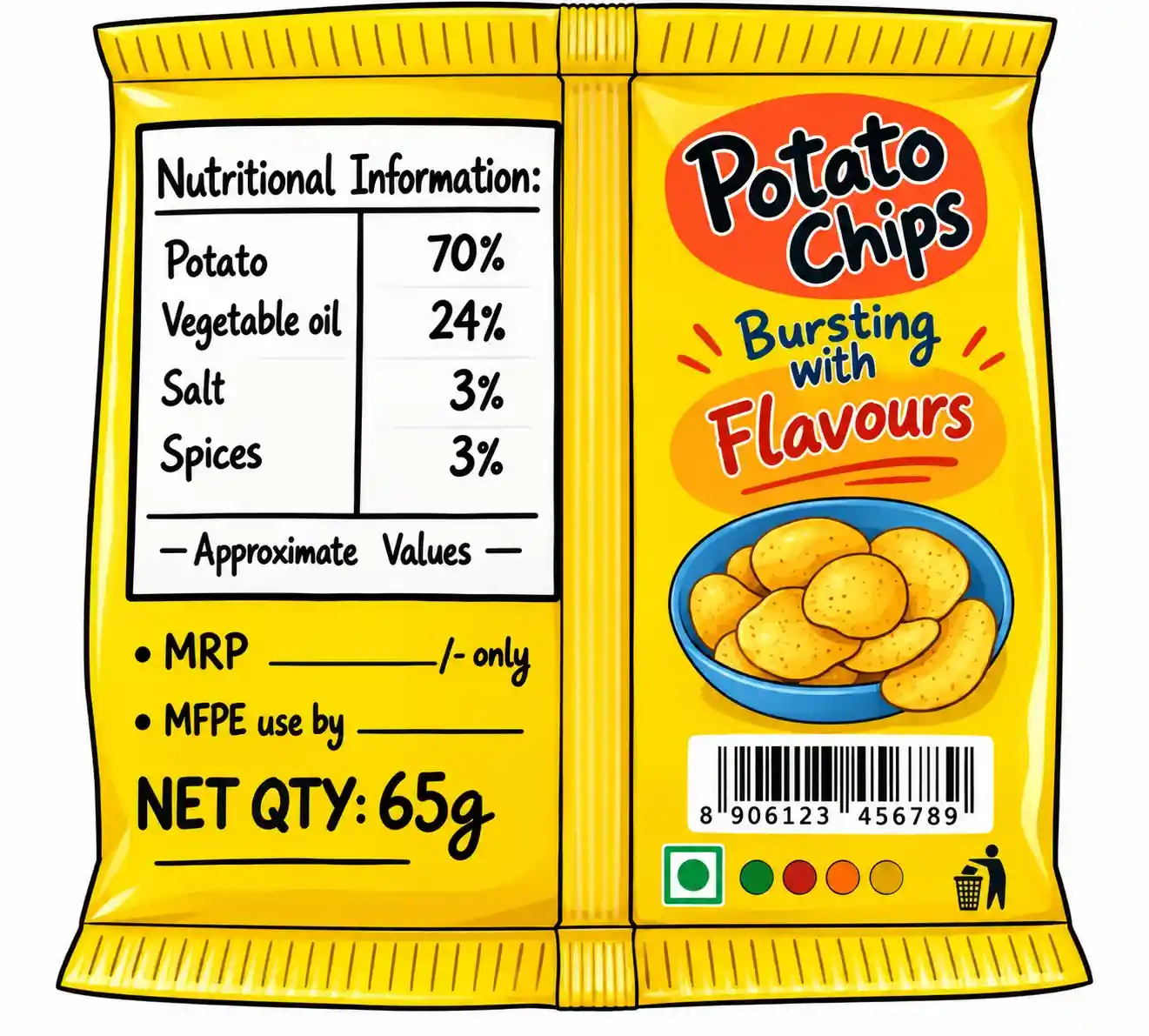
Formula: Weight of ingredient = Ingredient % × Total weight
| Potato (70%) | Vegetable oil (24%) | Salt (3%) | Spices (3%) |
|---|---|---|---|
| 45.5 g | 15.6 g | 1.95 g | 1.95 g |
Answer: Potato = 45.5 g, Vegetable oil = 15.6 g, Salt = 1.95 g, Spices = 1.95 g.
Three shops sell the same items at the same price. Shop A: “Buy 1 and get 1 free”. Shop B: “Buy 2 and get 1 free”. Shop C: “Buy 3 and get 1 free”.
(i) If the price of one item is ₹100, what is the effective price per item in each shop? Arrange the shops from cheapest to costliest.
(ii) For each shop, calculate the percentage discount on the items.
(iii) Suppose you need 4 items. Which shop would you choose? Why?
(i) If the price of one item is ₹100, what is the effective price per item in each shop? Arrange the shops from cheapest to costliest.
(ii) For each shop, calculate the percentage discount on the items.
(iii) Suppose you need 4 items. Which shop would you choose? Why?
Formula: Effective price per item = Amount paid ÷ Total items received → Discount % = (Free items ÷ Total items) × 100
(i) & (ii) Effective price and discount
| Shop | Pay for | Items received | Effective price/item | Discount % |
|---|---|---|---|---|
| A (buy 1 get 1 free) | ₹100 | 2 | ₹50 | 50% |
| B (buy 2 get 1 free) | ₹200 | 3 | ₹66.67 | 33.33% |
| C (buy 3 get 1 free) | ₹300 | 4 | ₹75 | 25% |
Cheapest to costliest: Shop A < Shop B < Shop C.
(iii) Buying exactly 4 items
| Shop | How to get 4 items | Total paid |
|---|---|---|
| A | Use the deal twice: pay for 2, get 4 | ₹200 |
| B | Use the deal once (pay for 2, get 3), then buy 1 more at full price | ₹300 |
| C | Use the deal once: pay for 3, get 4 | ₹300 |
Answer: (i) A → ₹50/item, B → ₹66.67/item, C → ₹75/item; cheapest to costliest is A, B, C. (ii) A → 50%, B → 33.33%, C → 25%. (iii) For 4 items, Shop A is the best choice, since it only costs ₹200 compared to ₹300 at Shop B or Shop C.
In a room of 100 people, 99% are left-handed. How many left-handed people have to leave the room to bring that percentage down to 98%?
Formula: If x left-handed people leave, remaining left-handed ÷ remaining total = 98%
- Total = 100, left-handed = 99, right-handed = 1
- Let x left-handed people leave: (99 − x) ÷ (100 − x) = 0.98
- 99 − x = 0.98 × (100 − x) = 98 − 0.98x
- 1 = x − 0.98x = 0.02x
- x = 50
Answer: 50 left-handed people must leave. Check: 49 left-handed out of 50 total = 98%.
Look at the graph “Ability to use computer by age and gender (2023)”. Based on the graph, which of the following statement(s) are valid?
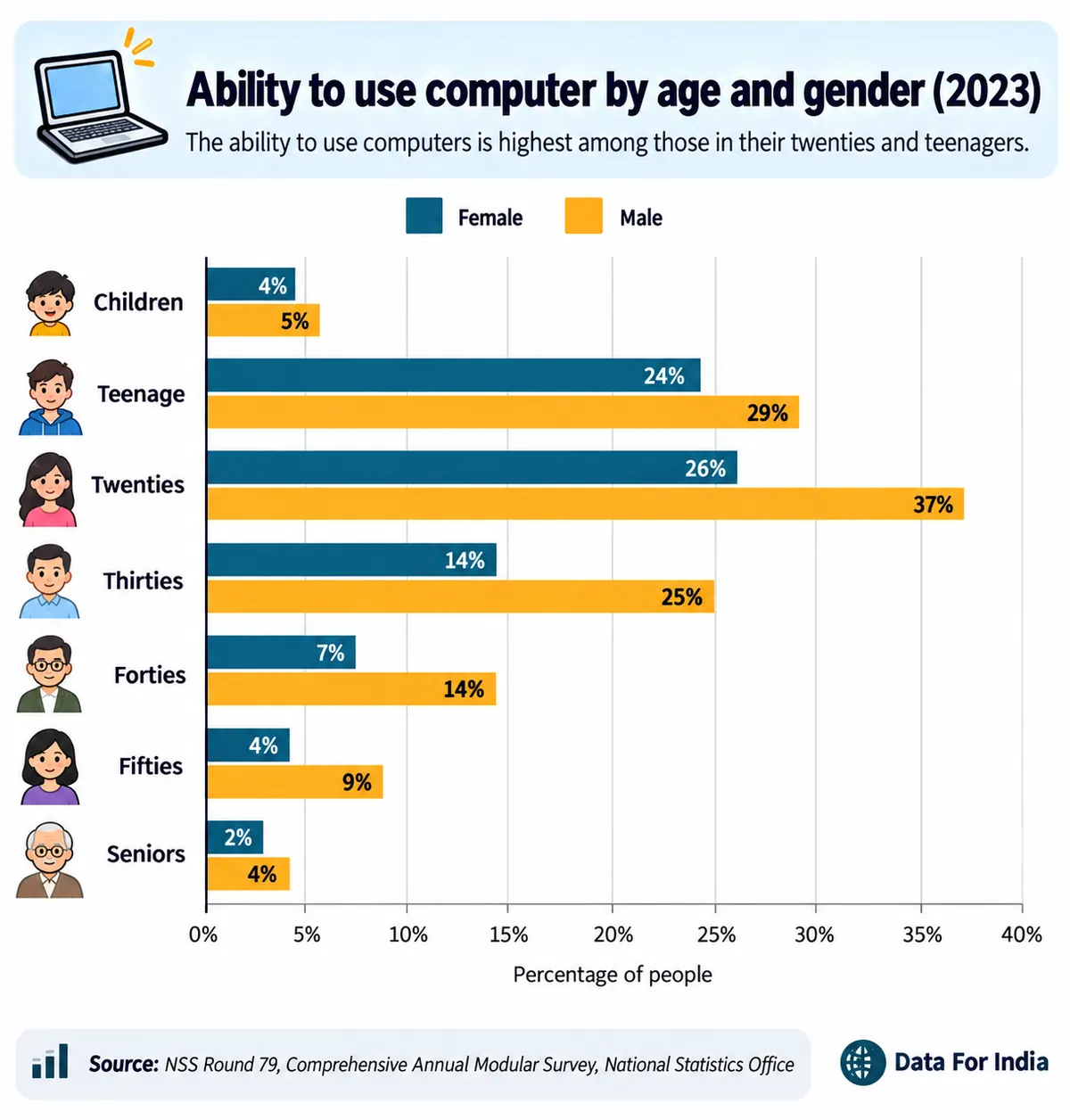
| Age group | Female | Male |
|---|---|---|
| Children | 4% | 4% |
| Teenage | 24% | 29% |
| Twenties | 26% | 37% |
| Thirties | 14% | 25% |
| Forties | 7% | 14% |
| Fifties | 4% | 9% |
| Seniors | 2% | 4% |
| Statement | Verdict |
|---|---|
| (i) People in their twenties are the most computer-literate among all age groups. | Valid |
| (ii) Women lag behind in the ability to use computers across age groups. | Not valid |
| (iii) There are more people in their twenties than teenagers. | Not valid |
| (iv) More than a quarter of people in their thirties can use computers. | Not valid |
| (v) Less than 1 in 10 aged 60 and above can use computers. | Valid |
| (vi) Half of the people in their twenties can use computers. | Not valid |
Answer: Statements (i) and (v) are valid. (ii) fails since Children shows an equal 4%/4% split, not a lag. (iii) is not valid since the graph shows percentages within each age group, not the actual number of people in each group. (iv) fails since only the male value (25%) touches a quarter, and the female value (14%) is well below it. (vi) fails since neither 26% nor 37% is half.