“Ch 2 Life On Earth Questions Answers Class 9“
Understanding Society: India And Beyond
Social Science Textbook
Grade 9| Part 2
Answers are provided from in-text to the end of the chapter.
Use the table of contents to jump to specific questions.
The Big Questions
Q1
How do physiography and climate shape life on Earth?
Answer:
Climate, landforms, and water decide which plants, animals, and human activities exist in a region.
● Climate creates biome: forest, grassland, desert, or tundra.
● Landforms and water shape where life lives and moves.
● Different environments support different forms of life.
● Humans adapt their lives to these conditions.
Therefore, Physiography and climate shape life. Life then shapes how humans live.
p. 21: The Big Questions; Introduction
p. 22: Types of Biomes
p. 27: Aquatic Biomes
p. 30: Geographical aspects of biodiversity conservation
Q2
How are humans and other life forms interconnected?
Answer:
Biomes and living beings are interconnected systems. They depend on one another to keep ecological balance and biodiversity.
● Living beings influence biomes:
▸▸▸Animals help in pollination and seed dispersal.
▸▸▸Microorganisms recycle nutrients.
▸▸▸Humans are dependent on forests.
▸▸▸Forest dwellers protect forests.
▸▸▸Energy flows from producers to consumers
Hence, humans and other life forms depend on each other.
p. 21: The Big Questions; Introduction
p. 28–29: Biome Pyramid
p. 29: Interconnectedness between Biomes and Living Beings
p. 33: Forests and Livelihoods
p. 35: Forest Dwellers
Q3
What is the importance of preserving various life forms, and how can we contribute to their conservation?
Answers:
Importance of Preserving Life Forms
● Biodiversity gives the natural balance that keeps ecosystems healthy.
● It supports human survival.
● Tropical rainforests are a gene bank.
● Forests maintain oxygen levels and balances Earth’s climate.
How We Can Contribute
● Protect hotspots such as the Himalaya and Western Ghats.
● Protect habitats: mangroves on coasts, afforestation in mountains.
● Prevent forest fires.
p. 21: The Big Questions
p. 23: Forest Biome
p. 29: Biodiversity
p. 30: Geographical aspects of biodiversity conservation
p. 38–39: Think About It (Forest fires)
Let’s Map (Page 22)
Q1
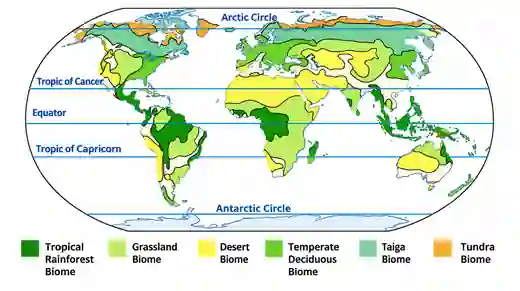
Which type of biome is found in smaller, separate regions, and why?
Answers:
Biome in smaller, separate regions
Temperate deciduous biome are found in smaller, separate regions. Because it needs moderate temperatures and distinct seasons
Q2
Which continent has the least number of biomes? What could be the reason for this?
Answers:
Antarctica continent has the least number of biomes It shows only one biome (tundra) on the map. Because the climate is extremely cold. Only mosses and lichens can grow in cold permafrost conditions.
Q3
Why are there areas that do not have any specific biomes?
Answers:
Biomes depend on temperature and rainfall. Some areas have mixed or changing climate, so no single biome fits. On the map, these areas are shown in white.
p. 21: Biome definition
p. 22: Fig. 2.2; Types of Biomes
p. 26: Tundra Biome
LET’S EXPLORE page 24
Q1
Look at the layers of vegetation in a rainforest. What do the yellow shapes in the figure indicate?
Answer:
The yellow shapes show the amount of sunlight that reaches each layer of the rainforest
● Emergent layer: a full circle. It gets maximum sunlight
● Forest floor: a small part of the circle. It gets least sunlight.
p. 24: Let’s Explore; Fig. 2.4 (Ideal structure of a rainforest biome)
Also check with your teacher
LET’S EXPLORE Page 25
Q1
Observe Fig. 2.5 and explore which of these animals you will find in the grasslands of India.
Answer:
Found in India’s Grasslands
● ● ● Elephant
● ● ●Lion
● ● ●Antelope/deer
Not Found in India
● ● ●Giraffe and zebra
p. 25: Grassland Biome; Let’s Explore
p. 24: Fig. 2.5 (Typical grassland landscape)
LET’S EXPLORE page 26
Q1
What types of activities do you think people in desert regions generally undertake to sustain their households and livelihood?
Answer:
Livelihood activities in deserts:
● Livestock rearing: camels are kept and used for transport
● Mining: deserts give minerals and oil
● Collecting water from far places
Q2
With the help of your teacher, explore how do people address issues related to the availability of water.
Answer:
● People store water in tanks and reservoirs
● Regions with seasonal rainfall manage water as a collective concern.
● Examples: keres (Karnataka), eri tanks (Tamil Nadu), ahar pynes (Bihar), katas (Gondwana)
Q3
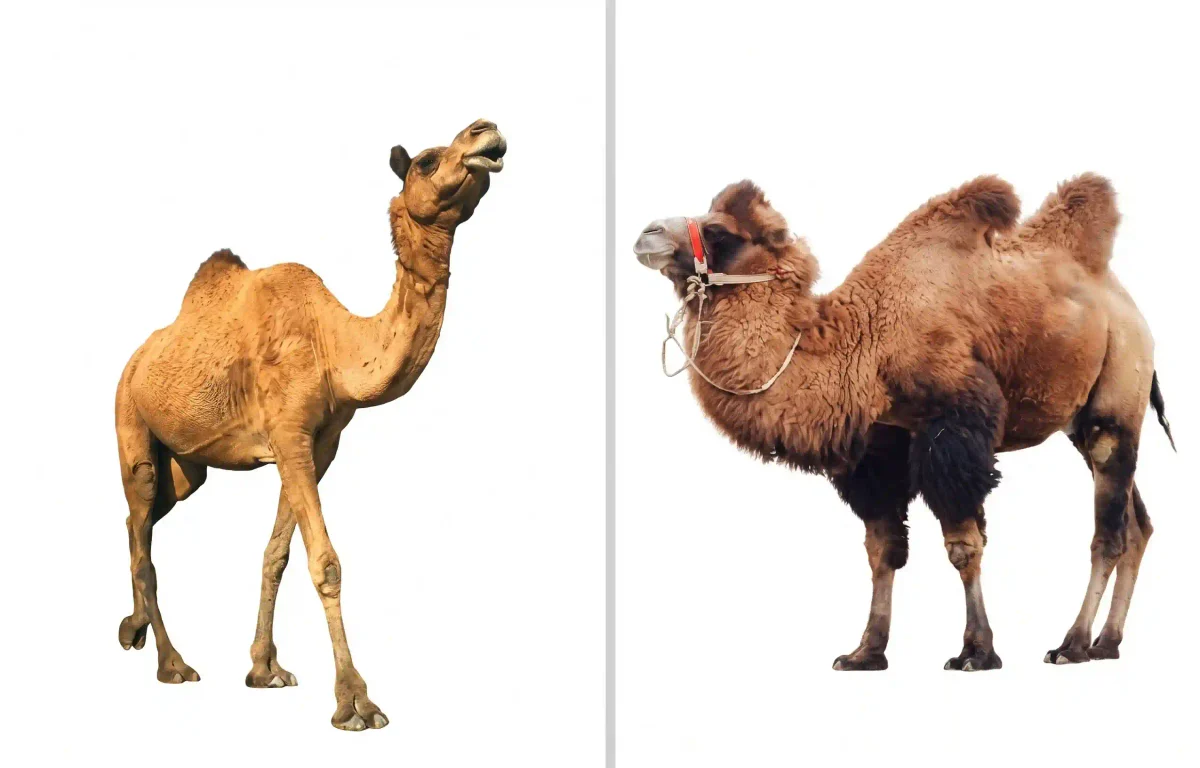
Compare the physical features of the Rajasthan camel (Fig. 2.7a) and the Nubra Valley (Ladakh) camel (Fig. 2.7b).
Answer:
Rajasthan camel vs Nubra Valley camel
| Feature | Rajasthan camel | Nubra Valley camel |
|---|---|---|
| Humps | One hump | Two humps |
| Fur | Thin, short | Thick, dense |
| Body | Taller, slim | Shorter, heavy |
Q4
Considering the climatic conditions, why do you think the Nubra Valley camel might have a different fur density than the Rajasthan camel?
Answer:
Fur density differs because of the following reasons:
● Nubra Valley is a cold desert. Thick fur gives warmth.
● Rajasthan is a hot desert. Thin fur keeps the body cool.
● Animals adapt to their climate.
p. 25: Desert Biome; Fig. 2.6
p. 26: Let’s Explore; Fig. 2.7
p. 42: Case Study of Water Tanks Built by the Gond Kings
THINK ABOUT IT Page 27
Q1
Tundra in polar regions has mosses, lichens, shrubs, etc., while the Himalaya, in the subtropics, is dominated by conifers. What could be the reason for this? What difference do you find in the animals found in these two regions? Which species are found only in the Himalaya? Discuss in class.
Answer:
Tundra: The climate is the coldest. Permafrost makes it difficult for trees to grow
Animals: Reindeer, arctic foxes, and polar bears.
Himalaya: It is in the subtropics. The temperature is less extreme. Trees can grow, and conifers dominate
Animals: Big Himalayan yak and Himalayan snowcock
Difference in animals :
Because each has its own climate and vegetation.
Species found only in the Himalaya
Himalayan snowcock and Big Himalayan yak
p. 22: Types of Biomes
p. 26: Tundra Biome
p. 27: Think About It; Fig. 2.8
p. 30: Hotspots of Biodiversity; Fig. 2.12
LET’S MAP Page 29
Q1
Answer:
| Region | Level | Biome (number) |
|---|---|---|
| Andaman & Nicobar Islands | Tropical, wet | Rainforest (7) |
| Keralam | Tropical, wet | Rainforest (7) |
| Meghalaya | Tropical, very wet | Rainforest (7) |
| Lakshadweep | Tropical, wet | Rainforest (7) |
| Chhattisgarh | Tropical, moderate | Tropical seasonal forest (9) |
| Odisha | Tropical, moderate | Tropical seasonal forest (9) |
| Ladakh | Cold and dry | Top levels (near tundra). It is a cold desert. |
My home
Find temperature and rainfall. My home will be where these two meet on the pyramid
Arrow on the third side
The arrow would point upwards.
p. 23: Forest Biome
p. 25–26: Desert Biome; Fig. 2.7
p. 28: Fig. 2.10 (Biome pyramid)
p. 29: Let’s Map
LET’S MAP Page 31
Mark and name the following regions on the map in Fig. 2.13. Also gather more information about these biodiversity regions from your teacher or other sources and discuss their features with
your peers.
- Namdapha National Park
- Rann of Kutch
- Gahirmatha beach
- Gulf of Mannar
- Pachmarhi
- Achanakmar–Amarkantak
Answer:
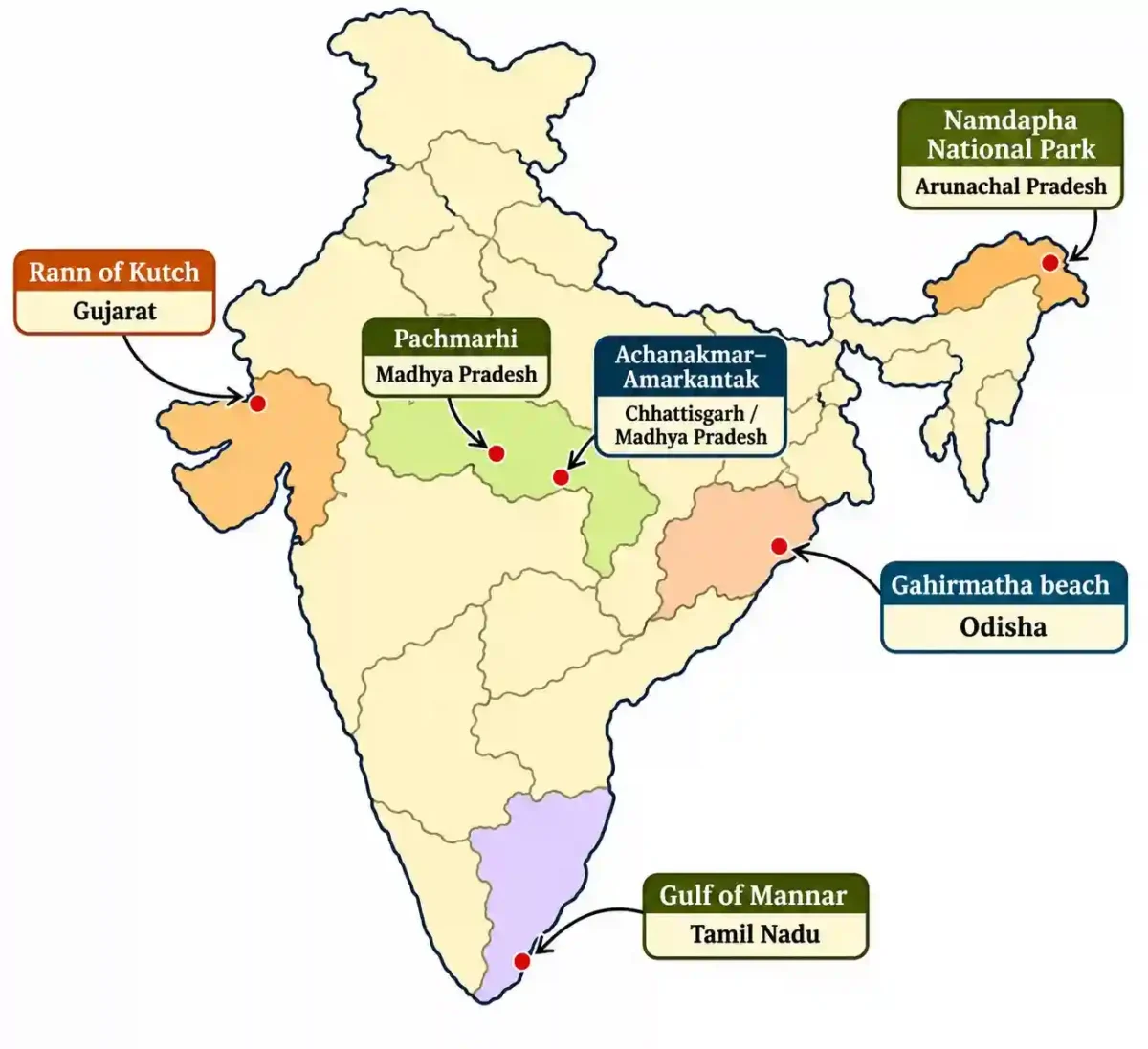
Features to discuss
| Region | Main feature | Biome type |
|---|---|---|
| Namdapha National Park | Rainforest in North-East India, a biodiversity hotspot | Forest |
| Rann of Kutch | Salt desert. It becomes a marshy wetland in the monsoon. | Desert |
| Gahirmatha beach | Coastal area on the Bay of Bengal. Sea turtles nest here. | Marine / coastal |
| Gulf of Mannar | Marine area with coral reefs | Marine |
| Pachmarhi | Biosphere reserve in central India | Forest |
| Achanakmar–Amarkantak | Biosphere reserve with forests | Forest |
p. 23: Forest Biome
p. 25: Desert Biome
p. 27: Aquatic Biomes (marine biomes, coral reefs)
p. 30: Hotspots of Biodiversity; Protected Areas
p. 31: Let’s Map; Fig. 2.13
THINK ABOUT IT Page 33
Sacred groves are small forest patches protected by local communities for religious and cultural purposes. Across India, there are over 1,00,000 sacred groves, though many are not
officially recorded. They are known by different names, such as Devrai, Devarakadu, Kavu, and Sarna. Why are these groves so special? Despite being small, they are rich biodiversity hotspots, often preserving rare plants, medicinal species, and wildlife that may not survive elsewhere. Some groves are even linked to water sources and help to maintain streams and groundwater.
Answer:
Sacred grooves are special because of the following reasons:
● Sacred groves are important for local communities for religious and cultural purposes.
● They are rich biodiversity hotspots
● They preserve rare plants, medicinal species, and wildlife.
● Some groves are linked to water sources.
p. 33: Think About It (Sacred groves)
p. 33: Forests and Livelihoods
Let’s Explore Page 38
Q1
Can you explain how GI tagging of the forest products mentioned above connects geography, cultural traditions, local governance, and rural economy?
Answer:
How GI tagging connects four areas
| Area | Connection | Example from chapter |
|---|---|---|
| Geography | A GI product gets its quality and uniqueness from its place of origin. | Tezpur Litchi grows in the forest-influenced soil and climate of Tezpur. |
| Cultural traditions | GI products are linked to traditional knowledge. GI tagging promotes cultural heritage. | Channapatna Toys use Wrightia tinctoria (‘Aale mara’). Kandhamal Haldi is grown by tribal communities. |
| Local governance | GI is an intellectual property right. It protects region-specific products and gives exclusive market recognition. | Only products from the named region can use the GI tag. |
| Rural economy | GI tagging generates economic benefits for local communities. | Kandhamal Haldi has high curcumin and medicinal value. Ramban Sulai Honey is highly nutritional. |
Q2
Can you name some GI-tagged forest products from your state or union territory?
Answer:
You have to answer it yourself as per your state or UT
LET’S EXPLORE Page 39
Q1
You may have heard about the Pradhan Mantri Ujjwala Yojana (PMUY). How are the benefits of this scheme impacting the health of women?
Answer:
PMUY gives clean cooking fuel (LPG) to households. This replaces firewood.
Health Benefits for Women:
● Cleaner air inside the house. Women breathe less smoke.
● Fewer breathing and eye problems.
● Women get more time for rest, work, and education.
p. 35: Forest Dwellers; Fig. 2.17
p. 38: Challenges Faced by People Living in Forests
p. 39: Let’s Explore (PMUY)
Questions and Activities| Chapter End Questions Answers
Q1
Why does India have diverse biomes? How does the local geography connect to the diversity?
Answer:
India has different climates and landforms, so it has different biomes.
Examples
● Freshwater: rivers, lakes, wetlands
● Rainforest: Andaman & Nicobar Islands, North-East
● Desert: Thar, Rann of Kutch
● Mountain forest: Himalaya
● Coastal and marine: mangroves, Western Ghats coast
p. 22: Types of Biomes
p. 23: Forest Biome
p. 25: Desert Biome
Q2
Make a list of economically valuable native plants in your region and comment on their abundance
Answer:
You have to write the valuable plants as per your own state. Here I have given few examples from Assam:
1. Tea
2. Areca Nut
3. Rubber and Jute
4. Bamboo
Q3
Prepare a map of your state or Union Territory showing national parks and sanctuaries
Answer:
Q4
Study the impact of forest fires on people dependent on forests. Try to include the causes, losses, and preventive measures.
Answer:
Causes of forest fires
● Climate change
● Human-induced factors
Losses due to forest fires
● It destroys homes and resources.
● It causes damage to human life and the environment.
● Forest dwellers lose forest produce (firewood, honey, bamboo, medicinal plants). Their livelihood suffers.
Preventive measures
● Human care and preventive measures stop many fires.
● Community action: Mendha Lekha prevents forest fires.
p. 38: Challenges Faced by People Living in Forests; Think About It
p. 39: Think About It (Forest fires)
p. 40: Mendha Lekha
Q5
Why are forests often called the ‘lungs of the Earth’?
Answer:
Forests often called the ‘lungs of the Earth because of the following reasons:
● Forests maintain oxygen levels.
● Forests balance the Earth’s climate.
● Plants are producers. They capture solar energy through photosynthesis.
● Tropical rainforests hold the world’s richest biodiversity.
p. 23: Forest Biome
p. 28: Biome Pyramid
Q6
If large forest areas continue to be destroyed, what do you think would be its long-term effect on the global climate?
Answer:
Following are the long-term effect of forest destruction on global climate
● Forests loss disturbs the Earth’s climate balance.
● Oxygen levels can fall.
● Biodiversity is lost. The gene bank is lost.
● People lose livelihoods. Human–wildlife conflict grows.
p. 23: Forest Biome
p. 29: Biodiversity
p. 39: Think About It (Forest fires)
p. 43: Before we move on…
Q7
Discuss some traditional forest conservation methods with your grandparents or an elderly person
Answer:
The traditional forest conservation methods are:
● Sacred groves: Communities protect small forest patches.
● Rituals: Gonds and Bhils honour forest deities before they collect resources.
● Forest protection movements: Bishnoi Movement (Amrita Devi) and Chipko Movement.
● Traditional knowledge of herbs and plants.
● Community rules: Mendha Lekha uses controlled grazing and regulated tree cutting.
p. 33: Forests and Livelihoods; Think About It (Sacred groves)
p. 35: Forest Dwellers; Fig. 2.17
p. 40: Mendha Lekha; Fig. 2.22
Q8
How do forest dwellers contribute to the protection and conservation of forests?
Answer:
Forest dwellers contribute to the protection and conservation of forests in the following ways
● Forest protection: They lead movements such as Bishnoi and Chipko.
● Community forest management and eco-restoration.
● Knowledge holders: They use traditional knowledge of herbs and plants. This helps biodiversity conservation.
Sustainable use: They perform rituals before they collect resources.
Joint Forest Management (JFM) lets communities protect forests and benefit from forest produce.
p. 33: Forests and Livelihoods
p. 35: Forest Dwellers; Fig. 2.17
p. 40: Government schemes (JFM); Mendha Lekha
Q9
What is a forest fire? Prepare a plan for prevention and mitigation of forest fires.
Answer:
A forest fire is an uncontrolled fire in a forest. It spreads through dense vegetation.
Prevention
● Do not light fires near forests.
● Raise awareness in communities.
● Use community rules
Mitigation
● Involve local communities through Joint Forest Management.
● Reduce climate and human causes.
● Support affected people with government schemes.
● Restore the forest after fire (eco-restoration)
p. 38: Challenges Faced by People Living in Forests
p. 39: Think About It (Forest fires)
p. 40: Joint Forest Management; Mendha Lekha
p. 35: Forest Protection (eco-restoration)