
“Ch 6 From Ideas to Startups Notes Class 9“
Understanding Society: India And Beyond
Social Science Textbook
Grade 9| Part 2
Find the textbook definitions in the FAQ section at the end of these notes
Entrepreneurship
Entrepreneurship is a process through which individuals or a group of individuals convert a potential idea into a business venture
An Entrepreneur
Identifies a problem and is resolute to solve it with an innovative solution.
Takes risks by investing money and time.
Makes key decisions regarding the operation and functioning of their business.
Combines various factors of production.
Contributes to the welfare of society with their innovation.
Fig. 6.2. Tasks performed by an entrepreneur
Origin of a Business
⦿ One of These:
● An idea
● A need
● A desire to innovate and meet the needs of society
The Entrepreneur
= a curious individual who sees opportunities where others see challenges
⦿ Characteristics of a Entrepreneur:
● Works hard
● Passion Driven
● Creates value for society
Elements of Entrepreneurship
Business Plan: A Road Map for the Business
⦿ Business plan:
Written document; a blueprint explaining the goals of the business and the steps to achieve them
Purpose of Business plan
● Guide ➜ from initial idea stage to starting and running the business
● Helps the entrepreneur to:
● ● ⁍ Work to grow the business
● ● ⁍ Stay organised
● ● ⁍ Set priorities
Components of a Business Plan
1. Needs and Idea
● What people need?
● Can it be produced?
● What problem it solves?
● Understand customer needs.
2. Potential Customers
● Young adults, children, and/or elderly?
● Know customers & decide what products to offer
3. Money and Cost
● How much money needed?
● Costs?
● Funding sources?
● Need robust financial start: Estimate the initial investment.
● Costs :
● ● ⁍Equipment
● ● ⁍Rent
● ● ⁍Staff salaries
● ● ⁍Ingredients
● ● ⁍Packaging
● Funding sources: savings, bank loans, friends, relatives, investors.
4.Location
● Production ?
● Selling : Store or online?
5. Human Resources (People and Skills)
● How many people needed?
● What skills are required?
6. Pricing and Profits
● What will the price be?
● How much profit can be made?
● Fix prices so that they:
● ● ⁍ Cover costs
● ● ⁍ Generate profit
● ● ⁍Stay affordable for customers
● ● ⁍A range of pricing options
7. Promotion or Marketing
● Advertisement: TV, social media or print ads?
● Spread awareness
● Related questions:
● ● ⁍ Packaging for appeal and shelf-life?
● ● ⁍ Customer service + retention ?
8. Challenges and Risks
● Disruption of operations or losses
● High competition
● Rising cost of raw materials
● Changing customer preferences
● Volatile cash flows
Functional Areas Of Business
= departments or groups within a company that focus on distinct tasks and shared skills
The Four Functional Areas
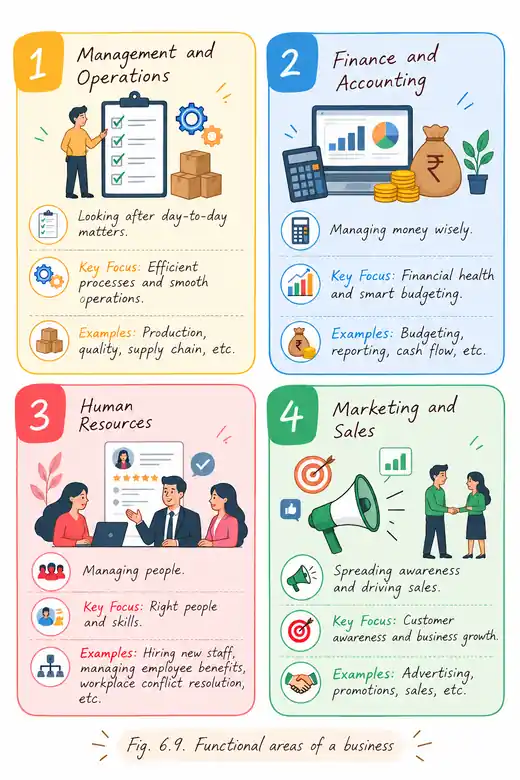
Management and Operations
Management:
● Planning, organising and guiding the use of resources to achieve business goals
Operations:
● Focuses on producing and delivering goods or services efficiently and on time
Finance and Accounting
Finance:
● Management of money in a business
● Involves planning, obtaining and using funds
● Purpose: help the business operate and grow
Also plan for:
● Managing profits and cash flow
● Investing in growth opportunities
| Type of Cost | Examples |
|---|---|
| Fixed costs | Rent, equipment costs (ovens, mixers, refrigerators) |
| Variable costs | Ingredients, salaries, packaging material |
Accounting:
● Process of recording, organising and reporting a business’s financial transactions
● It means:
● ● ⁍ Tracking revenue and expenses
● ● ⁍ Records or documents are correct
Profit and Loss Account (Income Statement)
● Shows profit or a loss over a period of time
● Significance: helps make informed decisions about spending and investment
Other Uses of Accounting
● What the business owns and borrowings
● Compliance with tax laws and regulations
Profit Formula
Profit = Total Revenue – Total Expenses
| Term | Meaning | Examples |
|---|---|---|
| Revenue | Total money earned from main operations or sale of goods and services | Sales made for Rs 200000 |
| Expenses | Money spent on running and maintaining a business | Salaries, electricity bills, raw materials; interest on a loan; taxes to the government |
Human Resources
= individuals employed by the entrepreneur who contribute to the business
Bakery Example:
Human resources department functions:
● Hiring bakers, helpers, cleaners and a cashier.
● Training staff in hygiene and baking standards
● Ensuring a comfortable and motivating workplace
Marketing and Sales
● Marketing and sales team:
● ● ⁍ Attracts customers
● ● ⁍ Convinces them to buy the products
Bakery examples:
● Choosing a catchy name
● Promoting the business on social media
● Offering discounts
Benefits of Functional Areas
● Improve decision making.
● Proper resource use
● ● ⁍ Structure + better coordination
● Business grows
Simple Strategies:
● Unique or seasonal items and customised desserts
● Discounts, deals or special offers
● Online ordering and delivery
● Using Social media
● Eco-friendly practices
Startups and Their Contribution to the Nation
Perseverance and Failure
● India’s startup ecosystem is built on innovation + perseverance
● ● ⁍ Some startups grow rapidly
● ● ⁍ Others struggle or close down
Failure → Entrepreneurial learning → Lessons from every unsuccessful attempt → Stronger ideas → Better businesses in the future
India’s Startup Ecosystem
● India is the third-largest startup ecosystem in the world.
● Drivers of growth:
● ● ⁍ Young and talented population
● ● ⁍ Creativity
● ● ⁍ Technological support
Unicorns: startups valued at over 1 billion dollars.
Fields of Work
| Field | Meaning |
|---|---|
| E-commerce | Online shopping |
| Fin-tech | Digital payments |
| Health-tech | Online healthcare |
| Agri-tech | Farming technology |
Major Startup Hubs
● Bengaluru
● Hyderabad
● Mumbai
● Delhi NCR
Contribution of Startups
● Creating jobs
● Supporting sustainability
● Driving economic growth
Government Support
Many schemes
Startup India: supports the vision of Atmanirbhar Bharat
Atmanirbhar Bharat: making India self-reliant through innovation and local solutions
Vision for the Future: Viksit Bharat 2047
● India is moving towards Viksit Bharat 2047
● Role of entrepreneurship:
● ● ⁍ Creating employment
● ● ⁍ Driving innovation
● ● ⁍ Empowering communities
● ● ⁍ Building a prosperous, self-reliant and sustainable nation
FAQs : Ch 6 From Ideas to Startups Notes Class 9
What is Profit
Money that is earned in trade or business after paying the costs of producing and selling goods and services.
What is Mortgage
A mortgage is a special type of loan used to buy a house or land with some collateral.
What is Inventory
The goods, materials, and assets a business holds for the purpose of manufacturing, production, or resale
What is Accounting
Recording and tracking all the money related to the business so the owner knows how it is performing.
What is Fixed cost
Business expenses that remain constant regardless of production volume or sales levels. They do not change with output in the short term and act as indirect or overhead costs, such as rent, salaries, or insurance
What is Variable cost
Expenses that change in direct proportion to the volume of goods or services a business produces or sells. They increase as production rises and decrease as production falls, covering raw materials, packaging, etc
What is Investment
The allocation of money or resources into an asset, venture, or project with the expectation of generating future income, profit, or value appreciation.
What is Startup
A young, earlystage company founded by entrepreneurs offering an innovative product or service
What is Atmanirbhar Bharat
A national policy framework launched by the government in 2020 to make the country self-sustaining, boost domestic manufacturing, and reduce import dependency.
Viksit Bharat 2047: The Government of India’s vision to transform India into a fully developed nation by 2047, marking 100 years of independence