
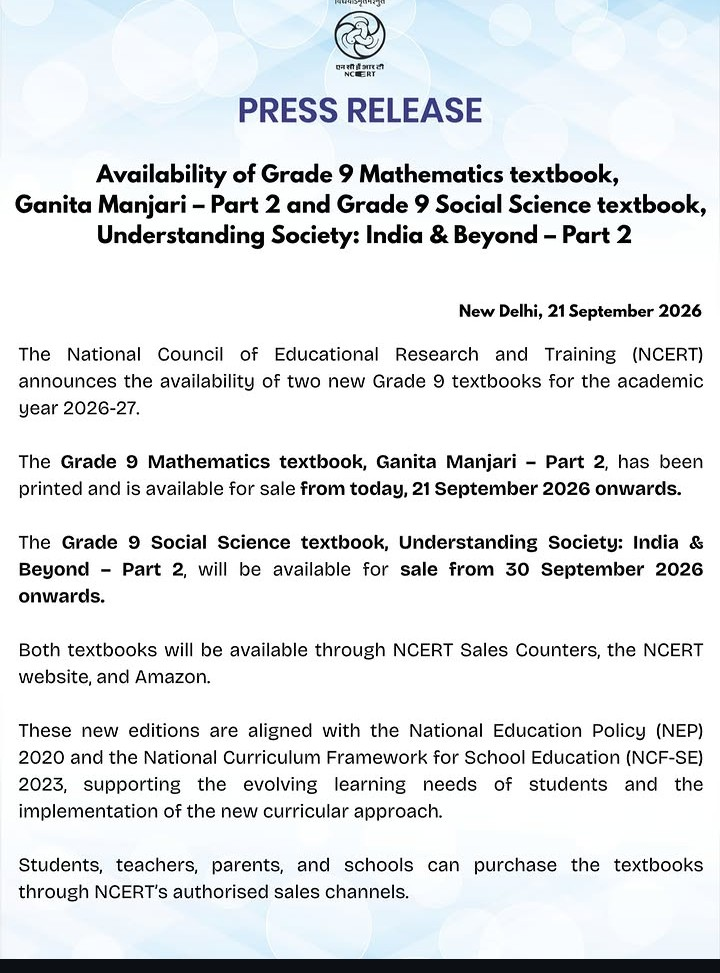
NCERT has released the Ganita Manjari Part 2 Class 9 PDF, but the book is not available on the NCERT website .
But we have arrange the same from our sources for you.
Please scroll down to download the “Ganita Manjari Part 2 Class 9 PDF “
Ganita Manjari Part 2 Class 9 has total 6 chapters as follows:
Chapter 9: Propositions and their Converses
Focuses on the logical distinction between proving a statement If X then Y and its converse Y then X. It explores these concepts through reasoning, justifications, and counterexamples drawn from geometry and number theory.
Chapter 10: How Quantities Combine: Understanding Data
Introduces the concept of weighted averages and explains how they differ from simple arithmetic means in practical contexts such as mixtures, ratings, and weighted scoring systems. It also explores data visualization using stacked and 100% stacked bar charts to compare totals versus relative proportions
Chapter 11: The World of Algorithms
Presents algorithms as systematic, step-by-step procedures for problem-solving. It explores how procedures are designed, justified, and optimised, moving from basic digit-by-digit addition and divisor listing to more efficient methods for computing the greatest common divisor (GCD), including Euclid’s subtraction method and the division algorithm.
Chapter 12: Quadrilaterals
Provides an exploratory study of four-sided figures, examining properties and recognition criteria for parallelograms, rhombuses, and rectangles. It covers the Midpoint Theorem, triangle medians and centroids, Varignon’s theorem, and explores how any arbitrary quadrilateral can tile a plane
Chapter 13: Two Variables, One Line
Introduces linear equations in two variables, the meaning of solutions as ordered pairs, line graphing, and the slope-intercept form
y = mx + c. It covers methods to solve simultaneous pairs of linear equations (graphical, substitution, and elimination) and examines conditions for unique, infinitely many, or no solutions.
Chapter 14: Math of Space: Surface Area and Volume
Covers the surface area and volume of three-dimensional solids, including cuboids, cubes, cylinders, cones, pyramids, spheres, and hemispheres. It emphasises geometric intuition, hands-on derivations, real-world modelling, and “guesstimate” estimation techniques.