Why These Notes Are Unique:
“Ch 8 Building Blocks in Economics: The Problem of Choice Notes Class 9“ simplify Chapter 8: Building Blocks in Economics : The Problem of Choice, by extracting key concepts and presenting them in a structured, exam-ready format.
1. Interactive Learning Tools: Features interactive elements—such as a dynamic Production Possibility Curve (PPC) visualizer
2. Scannable Layout: Key ideas are broken down using visual tables, bolded terms, and distinct Exam Fact callouts to highlight high-priority topics.
3. Easy to read and scan: Every topic is presented for on the go learning and fast revision.
Related: Class 9 Social Science Notes| Understanding Society: India and Beyond
Introduction
What is Economic Choice?
Definition
A decision individuals, enterprises, and governments make when resources are limited but needs/wants are many.
In Simple Words:
Choosing one option over another because you can’t have everything.
Example:
A farmer choosing which crop to grow based on soil, rainfall, and market demand.
Exam Fact
Economic choices happen at 3 levels: individual, enterprise, government.
Needs vs Wants
Definition
➽ Needs: Essentials required for survival (food, water, shelter).
➽ Wants: Desires beyond necessity (gadgets, vacations, luxury items).
In Simple Words:
Needs are must-haves; wants are nice-to-haves.
Remember
● Needs are limited and essential.
● Wants are unlimited and keep changing over time.
● Wants evolve: bicycle ➜ motorbike ➜ car.
Choices and Limited Resources
What are Resources?
Definition
Factors used for the production of goods and services.
In Simple Words:
Things needed to make goods/services — can be natural or human-made.
Types of Resources
➽ Natural resources: water, coal.
➽ Human-made resources: capital, technology.
Factors of Production
● Land
● Labour
● Capital
● Technology
Features of Resources
● Resources are limited.
● Resources have alternative uses.
● Example: Steel can be used for many purposes.
Exam Fact
Resources are scarce, but human wants are unlimited ➜ forces choice.
Opportunity Cost
Definition
The value of what is given up when one alternative is chosen over another.
In Simple Words:
What you sacrifice when you pick one option instead of another.
Remember
● Choosing one use of a resource means giving up its next best alternative use.
● Applies to households, enterprises, and governments.
Example:
Farmer growing more barley must sacrifice some wheat ➜ opportunity cost of barley.
Exam Fact
Every choice has an opportunity cost — a core concept in Economics.
Production Possibility Curve (PPC)
Definition
A curve showing different combinations of goods that can be produced using all available resources.
In Simple Words:
A graph showing the best possible combinations of two goods a producer can make.
Example:
Farmer choosing between barley and wheat with limited land, water, labour.
| Combination | Barley (kg) | Wheat (kg) |
|---|---|---|
| A | 0 | 100 |
| B | 25 | 90 |
| C | 50 | 70 |
| D | 75 | 40 |
| E | 100 | 0 |
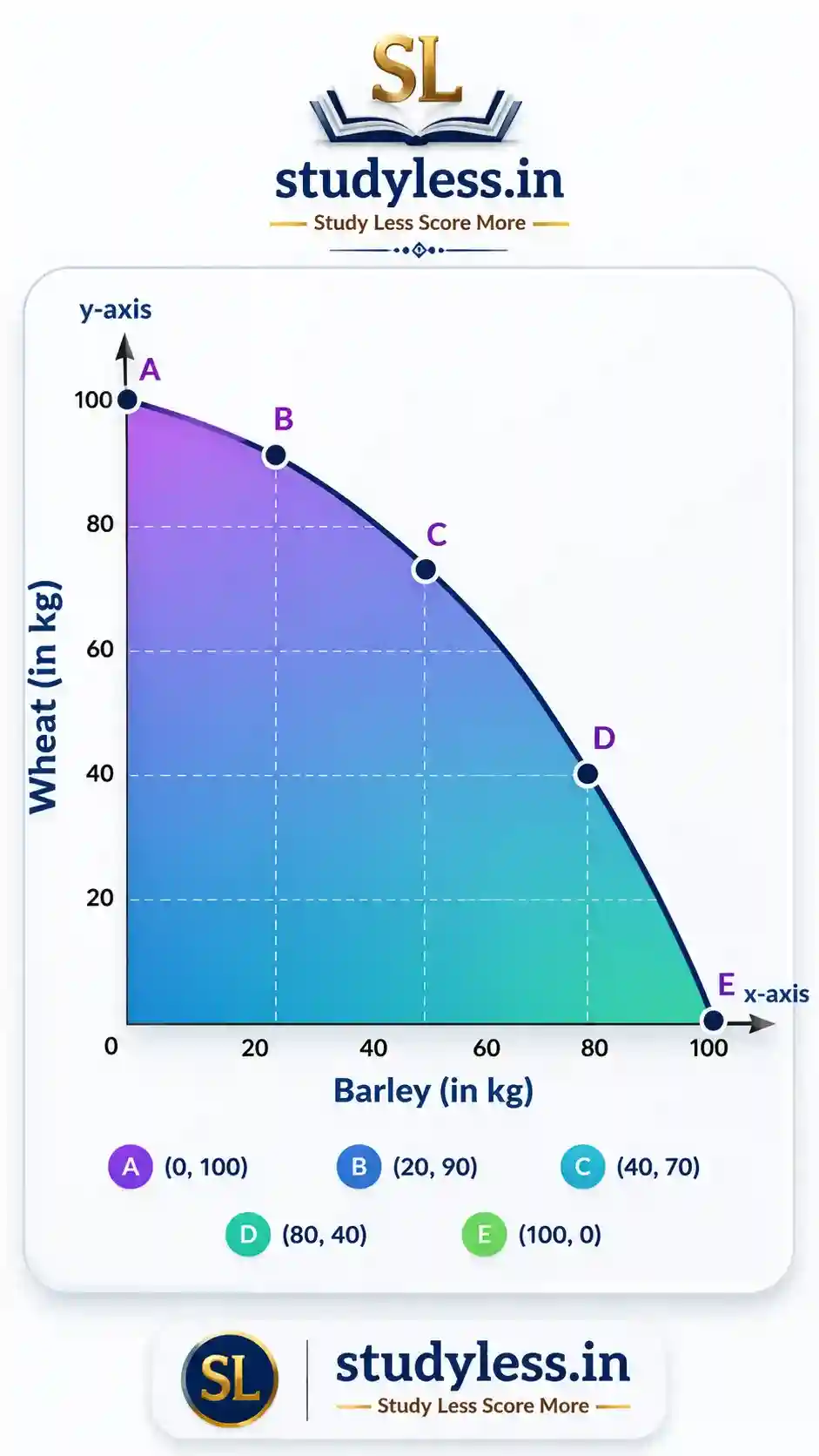
Play with the interactive PPC curve below
Move the slider to A-B-C-D-E
Production Possibility Curve (PPC)
Exam Fact
PPC helps in planning and decision-making for enterprises and governments
What does Economics Deal with?
What is Economics?
Definition
Economics is derived from the Greek word oikonomia (oikos = household + nemein = management), meaning household management.
In Simple Words:
Economics is about managing limited resources wisely — just like managing a household.
Resource Allocation & Choices
Resource Allocation
● Families, firms, and governments must use resources wisely.
● Resources have competing uses.
● Choices must be made about how to use them.
Study of Economics
● Economics studies how choices are made.
● Focuses on satisfying needs and wants with limited resources.
Economic Interactions
Studies interactions among:
● Consumers
● Producers
● Governments
● Financial institutions
Exam Fact
Economics = study of optimum use of limited resources to satisfy unlimited wants.
Areas Economics Explains
● How people work and earn wages.
● How wealth and resources are distributed.
● How prices are determined in the market.
● How education and technology drive investment.
● How government policies and trade affect prices, employment, etc.
Role of Data & Economists In Analyzing Choice
Importance of Data
● Good decisions need data, not guesswork.
● Data helps compare choices and outcomes.
Use of Data
- Families divide money into:
- Essentials (food, medicine)
- Non-essentials (jewellery, entertainment)
- Savings
- Governments use tax revenue for infrastructure and welfare.
- Enterprises study market trends to increase profits.
Role of Economists
- Study alternatives and opportunity costs.
- Analyse outcomes using:
- Economic surveys
- Financial statements
Scope of Economists’ Work
Policy-making:
Guiding governments on taxation or welfare spending.
Business consulting:
Helping firms plan growth or improve efficiency.
Research and education:
Studying economic trends and teaching others.
Finance:
Advising investors on where to invest.
Fig 8.4: Scope of work of Economists
Key Questions in Economics
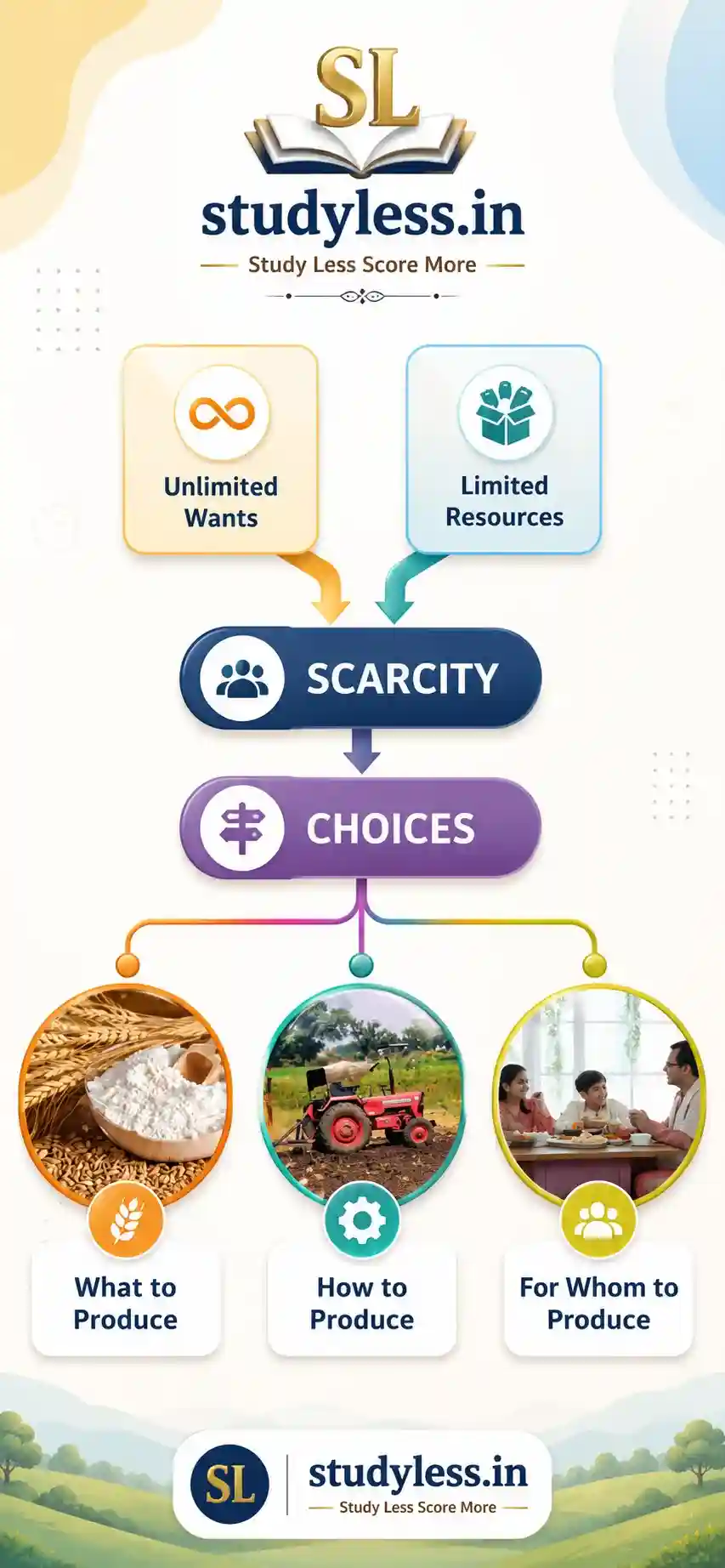
What to Produce and for Whom?
What to Produce?
Definition
The question of which goods/services, and in what quantities, should be produced to meet the economy’s needs.
In Simple Words:
Deciding what goods to make with limited resources.
Understanding Trade-Offs
Example of a Trade-Off
● Sugarcane/Paddy vs Millets/Pulses.
● Both use the same resources differently.
Sugarcane and Paddy
● Higher profits.
● Support many industries.
● Require more water.
Millets and Pulses
● Need less water.
● Improve soil health.
● More sustainable.
Example:
Opportunity cost of growing sugarcane = forgone water savings & soil health from millets
Exam Fact
“What to produce” decisions involve weighing opportunity costs of alternatives.
For Whom to Produce?
Definition
The question of who benefits from goods/services — based on purpose, production, and distribution.
In Simple Words:
Deciding which group of people a product is made for.
Target Consumers & Individual Needs
● Resources are limited; people differ in needs, income, tastes, lifestyle.
● Producers choose which consumer group to serve.
Example:
Shoes for different groups
| Shoe Type | Made For | Features |
|---|---|---|
| School shoes | Students | Simple, durable, affordable |
| Office-wear shoes | Professionals | Comfort, formal look, leather |
| Sports shoes | Athletes | Rubber soles, lightweight, grip |
| Casual shoes/slippers | Daily use | Comfortable, affordable |
● Materials depend on target group:
▸ leather ➜ office-goers/high-income;
▸ rubber/synthetic ➜ sports players, factory workers (affordable & durable).
● Producers study consumer preference, income, and demand before producing.
Exam Fact
“For whom to produce” ensures limited resources are used without wastage, matching production to consumer needs.
Economic Systems and How Choices are Made
What is an Economic System?
Definition
The system that defines the mechanisms for production, consumption, and distribution of goods, services, and resources.
In Simple Words:
The way a country organizes “what, how, and for whom” to produce.
Economic System Answers:
3 key questions (what, how, for whom) depend on:
▸How resources are organised.
▸Who controls decision-making.
Planned Economy
Definition
An economy where a central planning authority (government) makes all major economic decisions.
In Simple Words:
Government decides what, how, and for whom to produce — not the market.
Features of a Centrally Planned Economy
I. Central Decision-Making
Central authority decides:
1. What to produce
2. How much to produce
3. How to produce
4. Who gets it
5. At what price
II. Government Control
Government owns most resources:
▸ Land
▸ Factories
▸ Banks
▸ Transport
▸ Limited private ownership.
III. Production System
● Enterprises follow government targets.
● Not guided by market demand.
● Controlled through licenses and permits.
IV. Limitations
● Less competition.
● Lower incentive for quality improvement.
● Lower incentive for innovation.
Market Economy
What is a Market Economy?
Definition
An economic system where demand and supply decide what, how, and how much to produce, with little government intervention.
In Simple Words:
The market (buyers & sellers) decides everything, not the government
Features of a Market Economy
I. Market Decisions
Demand and supply answer:
▸What to produce
▸How much to produce
▸How to produce
II. Role of Government
● Acts as a referee.
● Maintains:
▸Law and order
▸Safety
● Does not directly control prices or production.
III. Private Ownership
● Most land, shops, and factories privately owned.
● Individuals and companies make production decisions.
IV. Competition
● Many producers sell similar goods.
● Leads to:
▸Better quality
▸Lower price
▸More innovation
Examples:
USA, Japan, Hong Kong.
Mixed Economy
What is a Mixed Economy?
Definition
An economic system that combines features of both market and planned economies.
In Simple Words:
Both private players and the government share control of the economy.
Features of a Mixed Economy
I. Shared Decision-Making
● Individuals, businesses, and government all make economic decisions.
● Both private and public sectors contribute to the economy.
II. Role of Public Sector
● Large public sector enterprises play an important role.
● Provide key goods and services.
III. Main Feature
● Combines private ownership with government regulation.
● Most countries follow a mixed economy.
Exam Fact
Mixed economy = private ownership + government regulation together
Examples:
India (post-1991), China (post-1978), Germany, Sweden.
Even market economies like USA and Singapore have significant government involvement.
Comparison: Economic Systems
| Feature | Planned Economy | Market Economy | Mixed Economy |
|---|---|---|---|
| Decision-maker | Government | Demand & Supply | Both government & market |
| Ownership | Mostly government | Mostly private | Private + public |
| Competition | Low | High | Moderate |
| Example | Soviet Union, North Korea, Cuba | USA, Japan, Hong Kong | India, China, Germany, Sweden |
FAQ| Ch 8 Building Blocks in Economics: The Problem of Choice Notes Class 9
How to use Ch 8 Building Blocks in Economics: The Problem of Choice Notes Class 9
First Read the chapter from the NCERT textbook and then prepare the chapter from our notes.
Is this notes sufficient
This notes are not a replacement or substitute for the NCERT textbook. NCERT textbooks are explanatory, not all information are exam worthy. “Ch 8 Building Blocks in Economics: The Problem of Choice Notes Class 9” is purely exam focused and has all the points that are asked in the exam, hence these notes are sufficient to score great marks!