
Chapter 10 | Class 9 | Exploration Textbook, Sound Waves: Characteristics and Applications.
Revise, Reflect, Refine (Pages 204–206) — All 15 Questions Solved.
The NCERT solutions – “Question Answer Ch 10 Sound Waves: Characteristics and Applications“, are strictly based on your class 9 new NCERT textbook, Exploration.
The Questions of chapter 10, Sound Waves: Characteristics and Applications, are conceptual and application-based.
Hence, we have structured it with texts, tables, flow charts and images for proper understanding.
“Each answer shows its source in the textbook, so you can see how questions are made.”

Quick Answer Table
| Q | Topic | Formula/Concept | Answer |
|---|---|---|---|
| 1 | Mechanical wave | Needs medium | (ii) |
| 2 | Frequency effect | v=λν, v constant | (iii) |
| 3 | Frequency calculation | ν = n/t | 5 Hz |
| 4 | Echo vs reverberation | 0.1s / 0.05s rule | Reverberation |
| 5 | Graph reading | λ = crest-to-crest | (a) longer λ, (b) smaller amp |
| 6 | Frequency vs wavelength | Higher ν = shorter λ | A=most crests, C=fewest |
| 7 | Graph drawing | Amplitude=3, λ=4cm | Sine wave plotted |
| 8 | Space explosion | Sound needs medium | Two errors identified |
| 9 | Time period | T=1/ν; ν=v/λ | 0.01 s |
| 10 | Sonar depth | d = v×t/2 | 3812.5 m |
| 11 | Parking sensor | t = 2d/v | ≈0.007 s |
| 12 | Temperature effect | Higher T = higher v | ≈0.2 s extra |
| 13 | Wavelength+frequency | ν = v/λ | 0.08m; 4250 Hz |
| 14 | Two waves | ν = v/λ | A:13800Hz, B:6900Hz |
| 15 | Speed ratio | v ∝ 1/t (same distance) | 1:4.5 (or 2:9) |
Q1
Which observation best supports the idea that sound is a mechanical wave?
(i) Sound shows reflection
(ii) Sound needs a medium to propagate
(iii) Sound has frequency
(iv) Sound carries energy
Answers:
(ii) Sound needs a medium to propagate
Why this is correct:
A mechanical wave is defined as a wave that requires a material medium to travel. The vacuum bell jar experiment proves that when air is removed, sound disappears — even though the bell keeps ringing.
Why the others are wrong:
| Option | Why Wrong |
|---|---|
| (i) Reflection | Light also reflects — not unique to mechanical waves |
| (iii) Has frequency | All waves have frequency |
| (iv) Carries energy | All waves carry energy |
Page 190, Para 3 — “Waves that require a material medium for propagation are called mechanical waves. A sound wave is a type of mechanical wave.”
Q2
For a sound wave propagating in a medium, increasing its frequency
will increase its
(i) wavelength
(ii) speed
(iii) number of compressions per second
(iv) time period
Answers:
(iii) Number of compressions per second
Why this is correct:
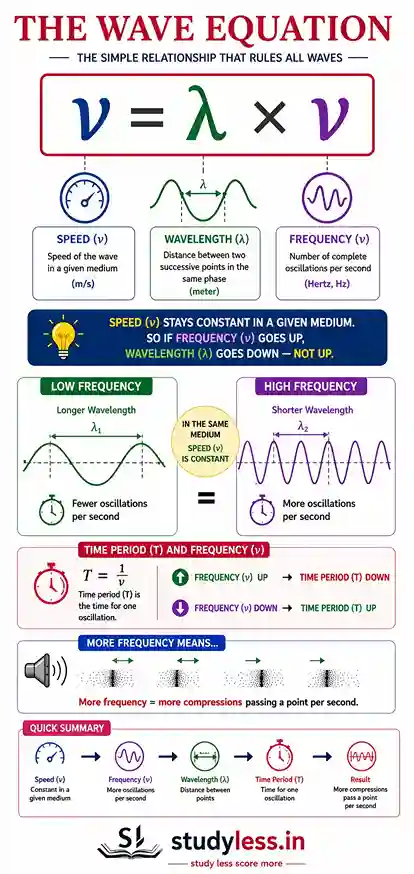
The wave equation is:
v = λ × ν (Page 196, Equation 10.2)
Speed (v) stays constant in a given medium.
➜ So if frequency (ν) goes up,
➜ wavelength (λ) goes down.
➜ Time period T = 1/ν,
➜ So T goes down.
More frequency = more oscillations per second = more compressions passing a point per second.
| Property | Effect of Increasing Frequency | Why |
|---|---|---|
| Speed | No change | Depends on medium only |
| Wavelength | Decreases | v = λν, v is constant |
| Time Period | Decreases | T = 1/ν |
| Compressions/sec | Increases | More oscillations per second |
Page 194, Para 3 — “The number of density oscillations at a fixed point per unit time is the frequency of the sound wave.”
Q3
If 20 compressions pass a point in 4 seconds, the frequency is
(i) 80 Hz
(ii) 5 Hz
(iii) 10 Hz
(iv) 0.2 Hz
Answers:
(ii) 5 Hz
Solution:
Frequency = Number of oscillations ÷ Time taken
ν = 20 ÷ 4 = 5 Hz
(Each compression = one complete oscillation)
Page 195, Example 10.1 — “Frequency of sound wave = number of oscillations/time taken = 10/2s = 5 Hz”
Q4
In a room, the reflected sound reaches the ear 0.05 s after its production.
Will it produce an echo or reverberation? Justify your answer.
Answers:
It will produce Reverberation, NOT an echo.
Justification:
Time gap = 0.05 s
↓
For ECHO: time gap must be ≥ 0.1 s
➜ NOT met
↓
For REVERBERATION: time gap < 0.05 s
➜ MET
↓
Result: REVERBERATION
Key rule:
- Echo requires the reflected sound to arrive at least 0.1 s after the original.
- Reverberation happens when reflections arrive with a time gap less than 0.05 s, making sound persist after the source stops.
Here, 0.05 s < 0.1 s, so the brain cannot separate the original from the reflected sound. The sounds merge → reverberation.
Page 201, Para 2 — “If the time gap between two sounds reaching us is at least 0.1 s, we can hear them as separate sounds.”
Page 201, Para 5 (Reverberation) — “This occurs when sound reflections from surfaces arrive with a time difference less than 0.05 s.”
Q5
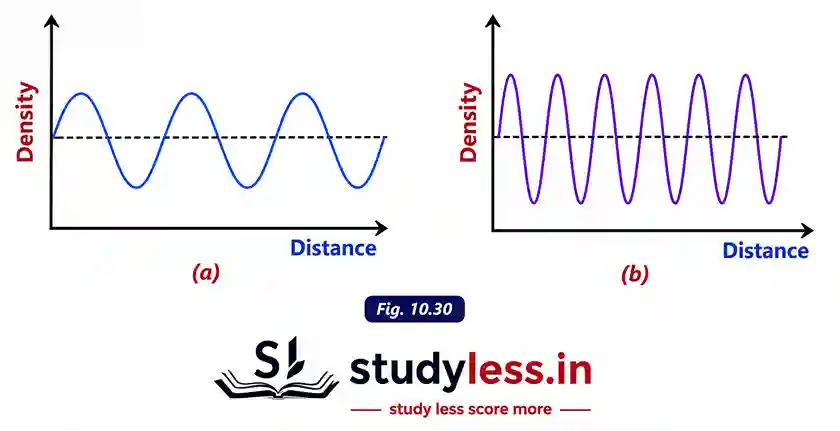
Graphs representing two sound waves are given in Fig. 10.30. If the
scales on the X and Y axes of the two graphs are the same,
Which of the two sound waves has
(i) greater wavelength, and
(ii) smaller amplitude?
Answers:
(i) Greater wavelength → Graph (a)
Wavelength = distance between two consecutive crests (or troughs). Graph (a) shows fewer, wider waves = longer wavelength.
(ii) Smaller amplitude → Graph (b)
Amplitude = maximum change in density from the average. Graph (b) shows waves that rise and fall less from the dashed average line = smaller amplitude.
Page 194, Para 1 — “The distance between the two consecutive crests or two consecutive troughs is called the wavelength of a wave.” Page 195, Para on Amplitude — “The amplitude of a sound wave is the maximum change in the density of air in a compression (or a rarefaction) compared to the average density.”
Q6
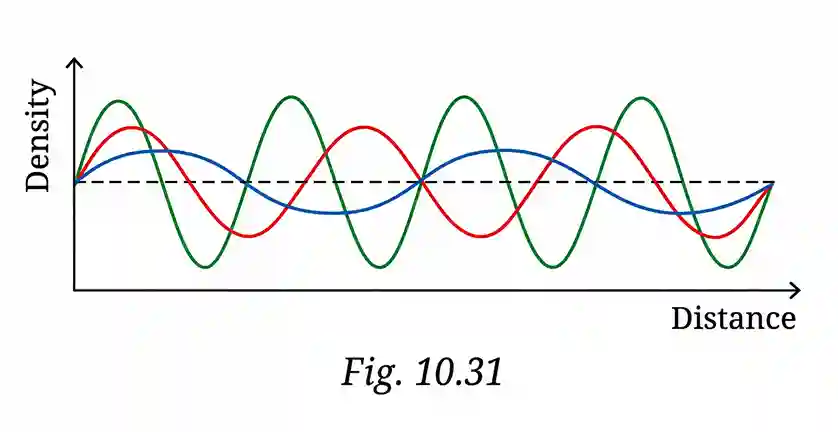
The sound waves emitted by three sources A, B and C are represented in Fig. 10.31. If the frequency of A is maximum and C is minimum, identify the corresponding curves, and mark A, B and C on them.
Answers:
Higher frequency = shorter wavelength (more waves packed in the same distance).
Frequency: A (max) > B (middle) > C (min)
Wavelength: A (min) < B (middle) < C (max)
| Source | Frequency | Wavelength | Identify as |
|---|---|---|---|
| A | Maximum | Shortest | Curve with most crests/troughs |
| B | Middle | Medium | Middle curve |
| C | Minimum | Longest | Curve with fewest crests/troughs |
Page 196, Para 3 — “The speed of sound depends on the medium through which it travels… If the frequency of the source changes, the wavelength of the sound wave in the medium changes, while the speed remains constant.”
Q7
Draw a graph to represent a sound wave for which the density.
The amplitude is 3 units, and the wavelength is 4 cm.
Answers:
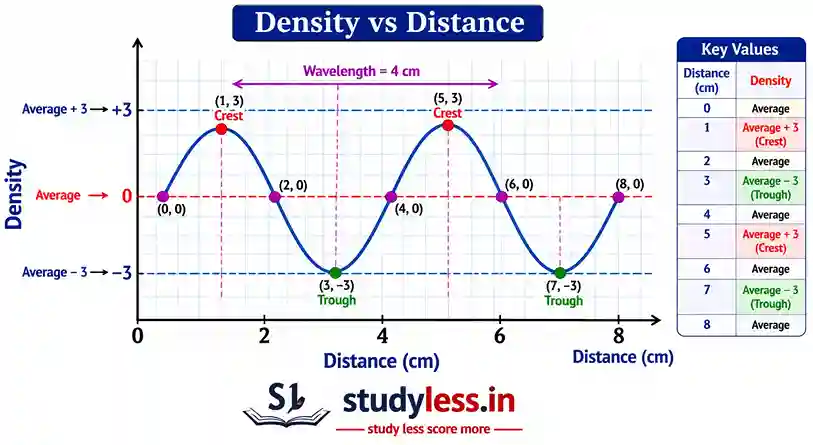
Page 193, Fig. 10.16 and description — “In the region of a compression, the density of the medium increases above the average density and the highest point represents the maximum density.”
Q8
In a movie, while showing the explosion of a spacecraft in space, aA A
flash of light is shown along with sound at the same time. What are the
errors in this depiction?
Answers:
Two errors:
Error 1 ➽ Sound cannot travel in space (main error)
Outer space is near-vacuum. Sound needs a material medium (solid, liquid, or gas) to travel. In a vacuum, there is no medium, so no sound can propagate. The explosion would be completely silent.
Error 2 ➽ Light and sound shown simultaneously
Even in a medium, light travels at 300,000 km/s, while sound travels at ~340 m/s in air. The flash would be seen almost instantly, but sound would take much longer to arrive. They cannot reach the observer at the same time.
Page 187, Para 4 — “In outer space, there is a near vacuum, and thus, sound cannot propagate.” Page 197, Example 10.3 — “lightning is seen before thunder is heard because sound travels much slower than light.”
Q9
A source produces a sound wave of wavelength 3.44 m. If the wave travels with a speed of 344 m s–1 find its time period.
Answers:
Given:
- Wavelength (λ) = 3.44 m
- Speed (v) = 344 m s⁻¹
Step 1: Find frequency using v = λ × ν
ν = v ÷ λ
= 344 ÷ 3.44
= 100 Hz
Step 2: Find the time period using T = 1/ν
T = 1 ÷ 100
= 0.01 s
Answer: Time period = 0.01 s
Page 194, Equation 10.1 — “Tν = 1” and Page 196, Equation 10.2 — “v = λ × ν”
Q10
A ship searching for a sunken ship sent a sonar signal and detected an echo after 5 s. If an ultrasonic wave travels at 1525 m s–1 in seawater, approximately how far down in the ocean is the wreckage of the sunken ship located?
Answers:
Given:
- Total time = 5 s (signal goes down AND comes back)
- Speed of sound in seawater = 1525 m s⁻¹
One-way time = 5 ÷ 2 = 2.5 s
Distance = Speed × Time
= 1525 × 2.5
= 3812.5 m
≈ 3812 m (≈ 3.81 km)
Answer: The wreckage is approximately 3812.5 m deep.
Page 203, Example 10.6 — “Time taken for the signal to reach the object and travel back = 0.90 s… distance = speed × time = 1530 m s⁻¹ × 0.45 s”
Q11
A vehicle is fitted with an ultrasonic distance sensor as part of parking assistance system which provides echolocation, while the driver is reversing the vehicle. It emits ultrasonic wave (about 40 kHz) which is reflected by the obstacle. When the warning beep starts sounding at a distance of 1.2 m from the obstacle, how much time is taken by ultrasonic wave to travel to the obstacle and come back? Assume the speed of ultrasonic wave in air to be 345 m s–1.
Answers:
Given:
- Distance to obstacle = 1.2 m
- Speed of ultrasound = 345 m s⁻¹
- Total distance travelled = 1.2 × 2 = 2.4 m (to obstacle and back)
Time = Distance ÷ Speed
t = 2.4 ÷ 345
= 0.00696 s
≈ 6.96 × 10⁻³ s
Answer: Time taken ≈ 0.007 s (approximately 7 milliseconds)
Source: Page 203, Example 10.6 — “In sonar, ultrasonic waves are sent into water and the reflected waves are analysed to determine the distance…”
Q12
The speed of sound in air is about 331 m s–1 at 0 ºC and nearly 344 m s–1 at 22 ºC. Roughly how much extra time will the sound of thunder take to travel a distance of 1720 m, if the air temperature changes from 22 ºC to 0 ºC? Assume that all other conditions remain unchanged.
Answers:
At 22°C:
Time = Distance ÷ Speed
= 1720 ÷ 344
= 5.0 s
At 0°C:
Time = Distance ÷ Speed
= 1720 ÷ 331
= 5.196 s (approx.)
Extra time = 5.196 − 5.0
= 0.196 s
≈ 0.2 s
Answer: Sound takes approximately 0.2 s longer at 0°C than at 22°C.
Why does this happen? Cold air = slower sound = more time needed for the same distance.
Source: Page 196, Para 5 — “The speed of sound in air also depends on the temperature and humidity. As we increase the temperature or humidity, the speed of sound increases. For example, the speed of sound in dry air is about 331 m s⁻¹ at 0ºC and nearly 344 m s⁻¹ at 22ºC.”
Q13
The variation of density of medium for a sound wave propagating with a speed of 340 m s–1 is shown in Fig. 10.32. Calculate the wavelength and frequency of the sound wave.
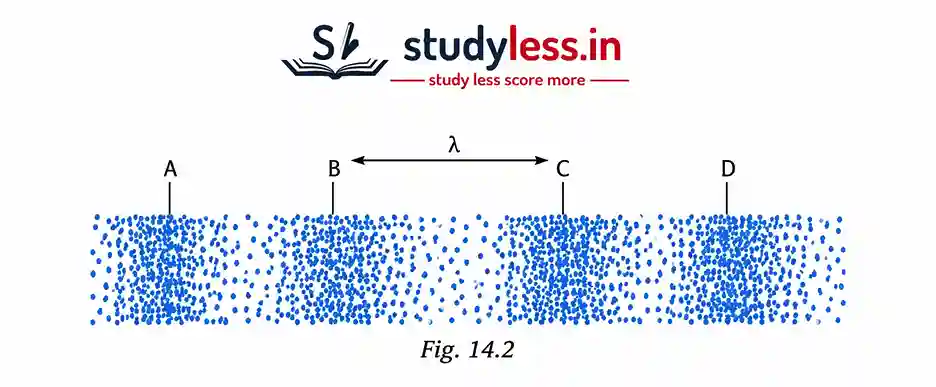
Answers:
From the figure: Wavelength (λ) = 8 cm = 0.08 m
Finding frequency:
Using v = λ × ν
ν = v ÷ λ
= 340 ÷ 0.08
= 4250 Hz
Final Answer:
- Wavelength = 0.08 m (8 cm)
- Frequency = 4250 Hz
Page 196, Equation 10.2 — “v = λ × ν, speed = wavelength × frequency”
Q14
The graphical representation of two sound waves A and B propagating
at the same speed of 345 m s–1 is shown in Fig. 10.33. What is the
wavelength of each of them? Also, calculate their frequencies
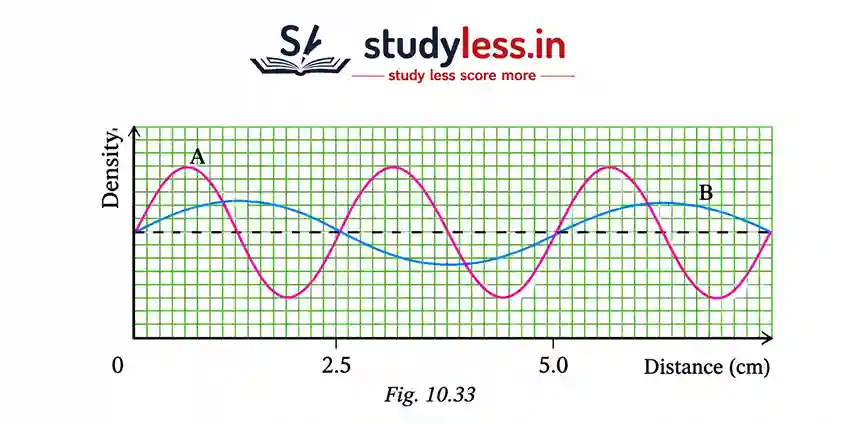
Answers:
Wave A completes one full cycle in 2.5 cm ➜ λ(A) = 2.5 cm = 0.025 m
Wave B completes one full cycle in 5.0 cm ➜ λ(B) = 5.0 cm = 0.05 m
Frequency of A: ν(A)
= v ÷ λ(A)
= 345 ÷ 0.025
= 13,800 Hz
Frequency of B:
ν(B) = v ÷ λ(B)
= 345 ÷ 0.05
= 6,900 Hz
Summary Table:
| Wave | Wavelength | Frequency |
|---|---|---|
| A | 0.025 m (2.5 cm) | 13,800 Hz |
| B | 0.050 m (5.0 cm) | 6,900 Hz |
Wave A has a shorter wavelength ➜ higher frequency ➜ higher pitch.
Page 196, Equation 10.2 and Page 194 — “The distance between the two consecutive crests or two consecutive troughs is called the wavelength of a wave.”
Q15
Two identical sound sources are placed at A and B — one in air and one submerged in water (Fig. 10.34). Both produce sounds at the same time, which travel horizontally to the vertical side of the cliff and come back. If the time taken by the sound to return to A is 4.5 times that of B, what is the ratio between the speeds of sound in air and water?
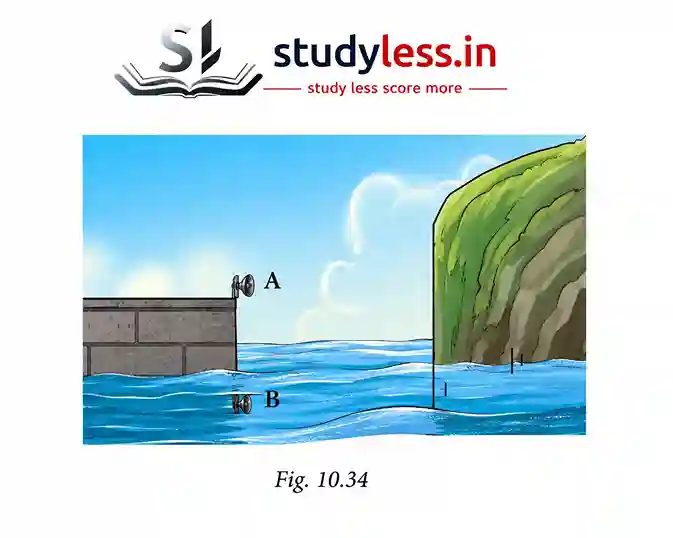
Answers:
Both A and B travel the same distance (to the same cliff and back). Let this distance = 2d.
Since distance is the same for both:
- Speed ∝ 1/Time (for same distance)
Let:
- Bt = time for sound in water
- At = time for sound in air = 4.5 × Bt
Speed of sound in air (vair):
Vair = 2d ÷At
Speed of sound in water (Vwater ):
Vwater = 2d ÷ Bt
Ratio:
Vair / Vwater
= (2d/At) ÷ (2d/Bt )
= Bt / At = 1 / 4.5
= 2/9Vair
Ratio:
Vair /Vwater
= (2d/At) ÷ (2d/Bt )
= Bt / At
= 1 / 4.5
= 2/9
Answer: Speed of sound in air: Speed of sound in water = 1: 4.5 = 2: 9
This matches the known fact that sound travels 4 to 5 times faster in water than in air.
Page 196, Para 3 — “The speed of sound depends on the medium through which it travels. It travels fastest in solids, slower in liquids, and slowest in gases. For example, sound travels about 4–5 times faster in water…”
FAQs| Question Answer Ch 10 Sound Waves: Characteristics and Applications
1. Why can’t astronauts hear each other in space without special devices, even if they shout very loudly?
Because space is a near-vacuum, there is no medium (air, liquid, or solid) for sound waves to travel through.
Full Explanation:
Sound is a mechanical wave. It travels by making particles of a medium vibrate and pass that vibration forward — like a chain of collisions. In outer space, there are almost no particles. No particles means no chain of collisions. No chain of collisions means no sound, no matter how loudly you shout.
This is not about the strength of the sound. Even the loudest explosion in space would be completely silent to someone standing nearby without a spacesuit communication device.
The vacuum bell jar experiment proves this:
An electric bell is ringing in a jar
↓
Air pumped out slowly
↓
Sound becomes fainter and fainter
↓
Near-vacuum reached → almost no sound heard
↓
Air let back in → sound returns
What astronauts do instead: Their spacesuits are fitted with special radio communication devices. Radio waves are electromagnetic waves — they do NOT need a medium and can travel through a vacuum. That is how astronauts talk to each other and to Mission Control.
Source: (Chapter 10, Page 187): “In outer space, there is a near vacuum, and thus, sound cannot propagate. Hence, astronauts in spacesuits doing spacewalks cannot directly hear each other speak…”
2. What is the difference between echo and reverberation — and why do you hear reverberation in a large hall but not in a small room?
Echo needs at least 0.1 s gap between the original and reflected sound. Reverberation happens when that gap is less than 0.05 s — the brain blends all the sounds into one prolonged sound.
The 0.1-second rule — why it matters:
The human brain needs a time gap of at least 0.1 seconds to hear two sounds as separate. If the reflected sound arrives before 0.1 s, the brain cannot separate it from the original — they merge.
Why does a small room give reverberation, not echo?
Sound travels at 340 m/s. In a small room (say 5 m wide), sound bounces back in: t = (5 × 2) ÷ 340 = 0.029 s — far less than 0.1 s → reverberation only
For an echo, the reflecting surface must be at least 17 m away
Calculation that explains it:
Minimum echo distance
= (speed of sound × minimum time) ÷ 2
= (340 m/s × 0.1 s) ÷ 2
= 34 ÷ 2
= 17 metres
Why are auditoriums specially designed?
Too much reverberation = garbled, unclear sound. Too little = sound feels dead and flat. Architects use soft materials (curtains, upholstered seats, acoustic panels) to absorb excess reflections and achieve the ideal reverberation for clear, pleasant sound.
Real-world example from India: The Whispering Gallery of Gol Gumbaz in Bijapur, Karnataka, is so well-designed that even a faint whisper is heard multiple times across the large dome — a brilliant example of controlled reverberation used by medieval architects.
Source (Chapter 10, Pages 201–202): “If the time gap between two sounds reaching us is at least 0.1 s, we can hear them as separate sounds… reverberation occurs when sound reflections from surfaces arrive with a time difference less than 0.05 s.”
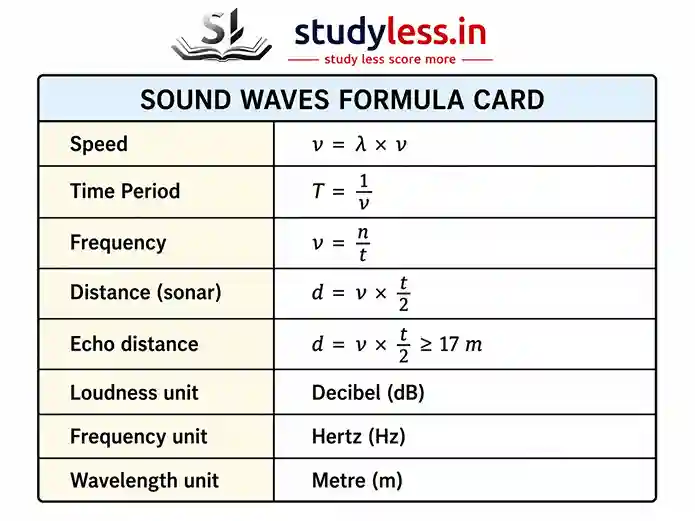
Side-by-side comparison:
| Feature | Echo | Reverberation |
|---|---|---|
| Time gap | ≥ 0.1 s | < 0.05 s |
| Where heard | Open spaces, cliffs, mountains, long corridors | Large halls, auditoriums, domes |
| Cause | Single clear reflection | Multiple rapid reflections |
| Brain’s response | Hears two distinct sounds | Hears one prolonged sound |
| Minimum distance needed | 17 m from reflecting surface | Any enclosed space |
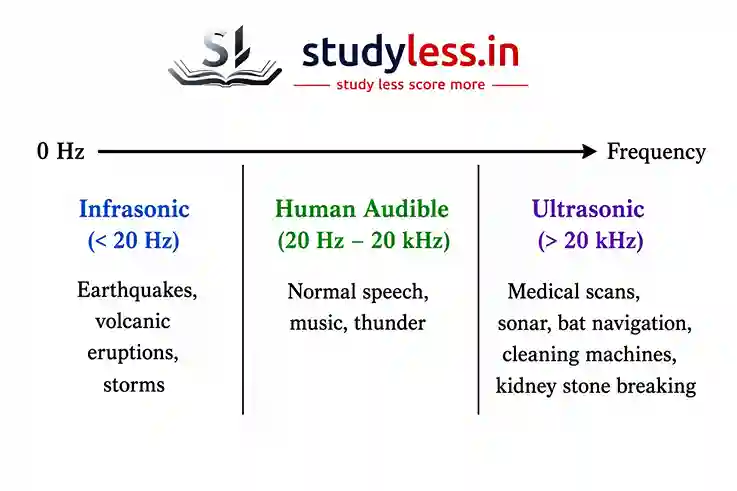
3. What is the difference between infrasonic, audible, and ultrasonic sound — and which animals can hear what humans cannot?
The complete frequency map of sound:
Which animals hear what:
| Animal | Can Detect | Why Useful |
|---|---|---|
| Bats | Ultrasound (> 20 kHz) | Navigate and hunt in darkness using echolocation |
| Dolphins | Ultrasound | Underwater navigation and hunting |
| Whales | Ultrasound | Communication across vast ocean distances |
| Dogs | Ultrasound | Hear dog whistles humans cannot |
| Cats | Ultrasound | Detect high-pitched prey sounds |
| Elephants | Infrasound | Communicate over long distances through ground vibrations |
3 most important medical and industrial uses of ultrasound:
- Ultrasonography — imaging internal organs without surgery or harmful radiation
- Breaking kidney stones — high-frequency ultrasound shatters stones into small pieces that pass out naturally
- Industrial testing — detecting hidden cracks or defects inside metal blocks without cutting them open
Why does human hearing decrease with age? The range narrows as we grow older, especially the ability to hear high frequencies. This is why older people often miss high-pitched sounds like certain ringtones or bird calls.
The pitch connection: Pitch is how humans perceive frequency. High frequency = high pitch (shrill whistle). Low frequency = low pitch (thunder rumble). Infrasound and ultrasound exist outside what we can perceive as pitch at all.
Source (Chapter 10, Page 199): “The audible range or the human hearing range is from 20 Hz to 20,000 Hz (20 kHz). However, this range varies from person to person and decreases with age. Sound waves with frequency below 20 Hz are called infrasonic waves, while sound waves with frequency above 20 kHz are called ultrasonic waves.”
4. What is the wave equation v = λν, and how do you use it to solve any problem on sound waves?
v = λ × ν connects three properties of a wave — speed, wavelength, and frequency. Know any two, and you can always find the third.
What each symbol means:
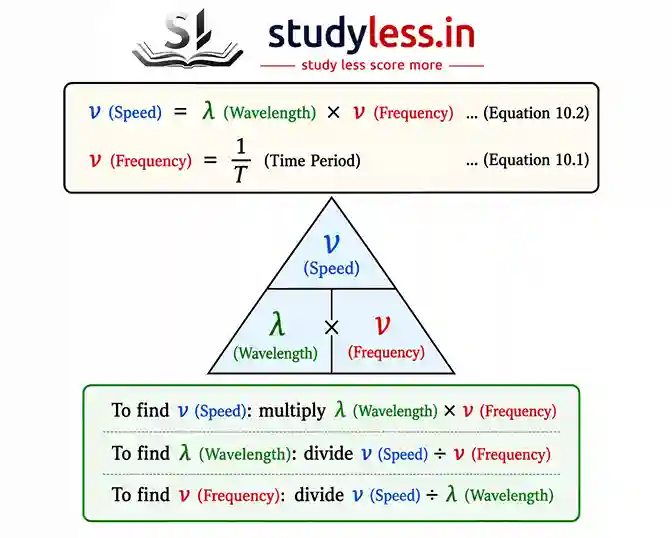
| Symbol | Name | Unit | What it measures |
|---|---|---|---|
| v | Speed of sound | m/s | How fast the wave moves through the medium |
| λ (lambda) | Wavelength | m | Distance between two consecutive crests (or troughs) |
| ν (nu) | Frequency | Hz (s⁻¹) | Number of complete oscillations per second |
| T | Time period | s | Time for one complete oscillation |
Worked examples using ONLY this formula:
Example A — Find wavelength of 20 Hz sound in air (v = 344 m/s): λ = v ÷ ν = 344 ÷ 20 = 17.2 m
Example B — Find wavelength of 20,000 Hz sound in air: λ = 344 ÷ 20,000 = 0.0172 m = 1.72 cm
Example C — Sound wave has λ = 50 m in steel (v = 5000 m/s). Find frequency: ν = v ÷ λ = 5000 ÷ 50 = 100 Hz
Example D — Find time period from Example C: T = 1 ÷ ν = 1 ÷ 100 = 0.01 s
The most important thing to remember about speed:
Speed stays constant for a given medium and temperature. If frequency changes, only the wavelength changes — speed does not. This is why all musical notes reach your ears at the same time, even though they have different frequencies. If speeds were different, music would sound distorted and unpleasant.
Speed in different media — always useful for MCQs:
| Medium | Speed (approx.) | Compared to air |
|---|---|---|
| Air (gas) | 340–344 m/s | 1× (baseline) |
| Water (liquid) | 1500 m/s | ~4–5× faster |
| Steel (solid) | 5000 m/s | ~15–20× faster |
Source (Chapter 10, Page 196): “v = λ × ν … speed = wavelength × frequency … The speed of sound depends on the medium through which it travels. It travels fastest in solids, slower in liquids, and slowest in gases.”
5. How does sonar work, and how do you calculate the depth of the ocean or the distance of an underwater object using it?
Sonar sends ultrasonic waves into water, measures the time taken for the echo to return, and uses the formula distance = (speed × time) ÷ 2 to find how far away the object is.
What SONAR stands for:
SOund Navigation And Ranging
How it works — step by step:
How does sonar work, and how do you calculate the depth of the ocean or the distance of an underwater object using it?
Sonar sends ultrasonic waves into water, measures the time taken for the echo to return, and uses the formula distance = (speed × time) ÷ 2 to find how far away the object is.
What SONAR stands for:
SOund Navigation And Ranging
How it works — step by step:
The ship sends an ultrasonic pulse downward / forward
↓
Pulse hits object (seabed, submarine, shipwreck)
↓
The echo bounces back to the ship
↓
Instrument records total time taken (t)
↓
Distance = (speed × t) ÷ 2
(÷2 because sound travels TO object AND BACK)
The formula :
Distance = (v × t) ÷ 2
v = speed of sound in seawater
t = total time for echo to return
Why divide by 2?
Because the recorded time includes the journey to the object AND the return journey back. We only want one-way distance.
Three fully solved sonar problems:
Problem 1 (from textbook Example 10.6):
Signal returns in 0.90 s. Speed = 1530 m/s.
d = (1530 × 0.90) ÷ 2 = 1377 ÷ 2 = 688.5 m
Problem 2 (Pause and Ponder Q13):
Signal returns in 4 s. Speed = 1500 m/s.
d = (1500 × 4) ÷ 2 = 6000 ÷ 2 = 3000 m
Problem 3 (Revise Q10):
Signal returns in 5 s. Speed = 1525 m/s.
d = (1525 × 5) ÷ 2 = 7625 ÷ 2 = 3812.5 m
Connection to echolocation in nature:
Sonar is a human technology inspired directly by how bats and dolphins navigate. Bats send out ultrasonic bursts and detect echoes to find prey in total darkness. Dolphins use the same principle underwater. Engineers studied this natural system and adapted it for military and ocean exploration.
Why is ultrasound (not an audible sound) used in sonar?
Ultrasound has very short wavelengths, which means it can detect smaller objects with greater precision. Audible sound waves (longer wavelength) would pass around small objects without reflecting clearly.
Real-world uses of sonar today:
Mapping the ocean floor, locating shipwrecks, tracking submarines, finding schools of fish, and measuring ocean depth for navigation charts — all use the same basic principle: send a pulse, time the echo, calculate the distance.
Source (Chapter 10, Page 203): “In sonar, ultrasonic waves are sent into water, and the reflected waves are analyzed to determine the distance, direction, and speed of underwater objects, such as submarines or shipwrecks.”
| System | Used by | Medium | Purpose |
|---|---|---|---|
| Echolocation | Bats, dolphins, whales | Air / Water | Find prey, navigate |
| Sonar | Ships, submarines | Water | Map ocean floor, find objects |
| Ultrasonic parking sensor | Cars | Air | Detect nearby obstacles |
| Ultrasonography | Doctors | Body tissue | Image internal organs |