
When the chapter is full with activites and experiments, then it is very difficult to provide accurate and relevant answers.
But do not worry, “Ch 9 Atomic Foundations of Matter Question Answer“ is the solution to your problem.
We have created the best possible answers to all 15 questions of Revise, Reflect, Refine . And we have also provided from where and how we picked those answers for you.
Each answer includes the source reference :
- Page
- Paragraph
- Opening words
To get the best out of Ch 9 Atomic Foundations of Matter Question Answer, you first must:
- Read Chapter 9 from the NCERT textbook
- Then master the short notes by studying less and revise it agian and again
We have also provided 5 FAQs that will take you more deeply into the concepts.
You can jump to the desired question clicking the question number in the table of contents.
Happy reading!
Q1
A particular element (A) has one electron in its third shell. There is another element (B) with six electrons in its second shell.
(i) How many electrons does A tend to give or take to become stable?
(ii) What kind of ion would it form?
(iii) How many electrons does B tend to give or take to become stable?
(iv) What kind of ion would it form?
(v) If A and B were to combine, what kind of bond would be formed?
(vi) What would be the formula for the compound thus formed?
Answers:
(i) Element A gives away 1 electron to become stable.
(ii) A forms a cation (positively charged ion), because it loses an electron and is left with more protons than electrons.
(iii) Element B gains 2 electrons to complete its octet (it has 6 valence electrons and needs 8).
(iv) B forms an anion (negatively charged ion), because it gains electrons.
(v) An ionic bond would form, because A transfers its electron to B.
(vi) A has a charge of 1+ and B has a charge of 2−. Using the criss-cross method:
A has a charge of 1+, and B has a charge of 2−. Using the criss-cross method:
| Element | Symbol | Charge |
|---|---|---|
| A (like Na) | A | 1+ |
| B (like O) | B | 2− |
Formula = A ₂ B
(i) Page 172, Para 2 — “Its valence shell contains only one electron, which can attain a stable electronic configuration after losing this valence electron.”
(ii) Page 172, Para 3 — “When sodium atom loses its valence electron, it becomes a positively charged species, called a sodium cation.”
(iii) Page 170, Para 2 — “Write down the electronic configuration of the oxygen atom… the number of electrons present in its valence shell is six, and it requires two more electrons to complete its octet.”
(iv) Page 173, Para 1 — “After gaining one extra electron, it acquires a negative charge and is called a chloride anion.”
(v) Page 173, Para 2 — “The electrostatic force of attraction between oppositely charged ions that holds them together is called an ionic bond.”
(vi) Page 176, Examples — “The formula for magnesium oxide… Mg²⁺ and O²⁻ gives MgO… criss-cross method.”
Q2
An element X has six electrons in its outer shell and forms a diatomic
molecule.
(i) Why would that be so?
(ii) What kind of bond would it form?
(iii) Draw the structure of the molecule it would form.
(iv) A certain other element Y has two electrons in its second shell.
Draw the structure of the molecule that X would form with Y.
Answers:
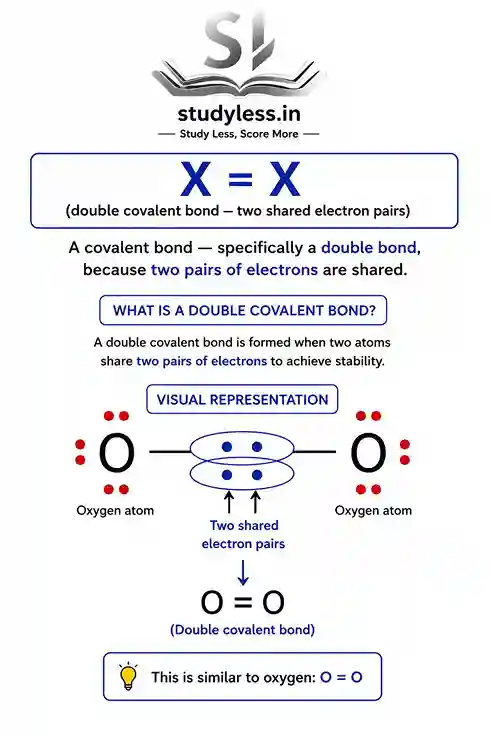
(i) X has 6 valence electrons and needs 2 more to complete its octet. Since it cannot get them from itself alone, two atoms of X share electrons with each other, forming a diatomic molecule.
(ii) A covalent bond — specifically a double bond, because two pairs of electrons are shared.
(iii) X = X (double covalent bond — two shared electron pairs)
This is similar to oxygen: O=O
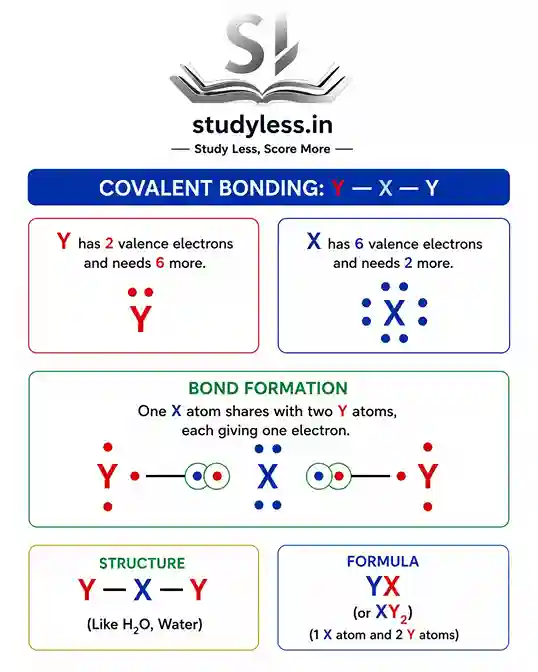
(iv) Y has 2 valence electrons and needs 6 more. X has 6 valence electrons and needs 2 more. So one X atom shares with two Y atoms, each giving one electron.
Structure: Y — X — Y (like H₂O, water)
Formula: YX (or XY₂, with 1 X and 2 Y atoms)
(i)Source: Page 170, Para 2 — “two oxygen atoms share two electrons each, forming an oxygen molecule (O₂).”
(ii) Source: Page 170, Para 3 — “the two atoms are joined by two pairs of shared electrons, and are held together by a double bond… O=O.”
(iii) Source: Page 170, Fig. 9.8 — “Formation of an oxygen molecule.”
(iv) Source: Page 171, Para 1 and Fig. 9.10 — “two hydrogen atoms sharing an electron each with an oxygen atom… water molecule formed is represented as H₂O.”
Q3
You want to design a new ionic compound, where the total positive
charge is 6+ and the total negative charge is 6 –. Which of the following
combinations gives the correct number of ions?
(i) 2 Al3+ and 3 Cl–
(ii) 3 Mg2+ and 1 PO43–
(iii) 2 Fe3+ and 3 O2-
(iv) 3 Ca2+ and 2 SO42-
Answers:
Checking each option:
| Option | Positive Charge | Negative Charge | Balanced? |
|---|---|---|---|
| (i) 2 Al³⁺, 3 Cl⁻ | 2×3 = 6+ | 3×1 = 3− | ✗ No |
| (ii) 3 Mg²⁺, 1 PO₄³⁻ | 3×2 = 6+ | 1×3 = 3− | ✗ No |
| (iii) 2 Fe³⁺, 3 O²⁻ | 2×3 = 6+ | 3×2 = 6− | ✓ Yes |
| (iv) 3 Ca²⁺, 2 SO₄²⁻ | 3×2 = 6+ | 2×2 = 4− | ✗ No |
Answer: (iii) 2 Fe³⁺ and 3 O²⁻
Source: Page 176, Para 1 — “The positive and negative charges must balance each other, and the overall structure must be neutral.”
Q4
Choose the correct statement(s) and correct the false statement(s).
(i) Elements are made up of molecules, and compounds are made up of
of atoms.
(ii) The molecule of a compound is always made up of two or more
atoms of the same kind.
(iii) One molecule of nitrogen gas contains three nitrogen atoms.
(iv) Water is made of two hydrogen atoms, covalently bonded with
one oxygen atom.
Answers:
(i) FALSE. Corrected: Elements are made up of atoms, and compounds are made up of molecules (formed by atoms of different elements).
(ii) FALSE. Corrected: A molecule of a compound is made up of atoms of different elements. (Two or more atoms of the same kind form a molecule of an element, not a compound.)
(iii) FALSE. Corrected: One molecule of nitrogen gas (N₂) contains two nitrogen atoms.
(vi) TRUE.
(i)Source: Page 169, Para 1 — “Atoms of an element can combine to form a molecule of that element… Atoms of different elements combine to form a molecule of a compound.”
(ii)Source: Page 169, Para 1 — “Atoms of different elements combine to form a molecule of a compound.”
(iii)Source: Page 170, Pause and Ponder Q8 — “Nitrogen has five valence electrons. Draw the structure of the nitrogen molecule (N₂).” (N₂ = diatomic, 2 atoms)
(iv)Source: Page 171, Para 2 — “two hydrogen atoms sharing an electron each with an oxygen atom… the water molecule formed is represented as H₂O.”
Q5
Write the chemical formulae for the following compounds.
(i) Aluminium nitrate
(ii) Calcium oxid
(iii) Ferric oxide
Answers:
(i) Aluminium nitrate
| Ion | Symbol | Charge |
|---|---|---|
| Aluminium | Al | 3+ |
| Nitrate | NO₃ | 1− |
Criss-cross → Al( NO₃ )₃
(ii)Calcium oxide
| Ion | Symbol | Charge |
|---|---|---|
| Calcium | Ca | 2+ |
| Oxide | O | 2− |
Equal charges → CaO
(iii) Ferric oxide
| Ion | Symbol | Charge |
|---|---|---|
| Iron (Ferric) | Fe | 3+ |
| Oxide | O | 2− |
Criss-cross → Fe₂O₃
(i)Source: Page 177, Example — “Al(OH)₃… bracket around OH with a subscript 3 indicates three ions.”
(ii)Source: Page 176, Example — “Here, the valencies of the two elements are the same… written as MgO.”
(iii)Source: Page 175–176, Criss-cross method examples — “Crossover the charges… write them as subscripts.”
Q6
Write the formulae of the compounds formed from the following pairs
of ions.
(i) Ca2+ and Br‒
(ii) Al3+ and CO32–
(iii) K+ and SO42–
(iv) NH4+and Cl–
Answers:
Q7
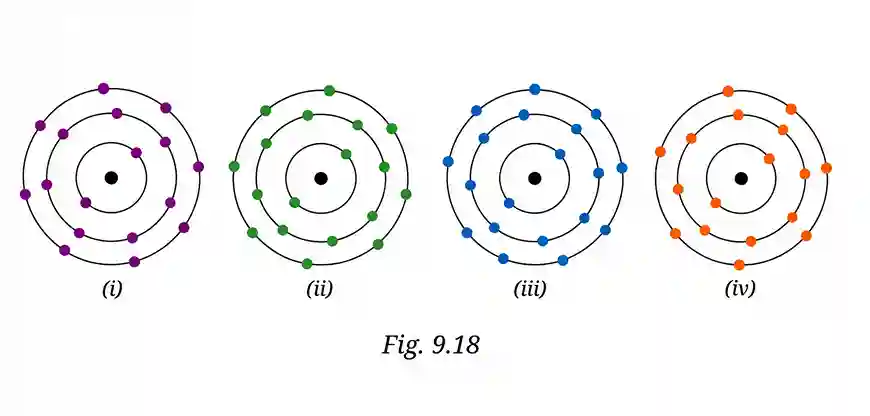
Which of the following, in Fig. 9.18, correctly represents Cl– ion (Atomic
number of chlorine = 17).
Answers:
Chlorine (atomic number 17) has the electronic configuration: 2, 8, 7
Cl⁻ gains 1 electron, so it has 18 electrons arranged as: 2, 8, 8
The correct diagram must show:
- 3 shells (K, L, M)
- 2 electrons in the K-shell
- 8 electrons in L-shell
- 8 electrons in M-shell (not 7)
Answer: Option (ii) — whichever figure shows a 2, 8, 8 arrangement.
Source: Page 173, Para 1 — “chlorine atom shows that it has seven valence electrons… After gaining one extra electron, it acquires a negative charge and is called a chloride anion, represented as Cl⁻.”
Q8
Determine the formula unit mass of the following substances.
(i) Ammonium nitrate (NH4NO3), used as a nitrogen fertiliser, which
is essential for plant growth.
(ii) Phosphoric acid (H3PO4), used to make phosphate fertiliser and
detergents.
(iii) Sodium hydrogencarbonate (NaHCO3), used to relieve acidity and
helps in digestion.
Answers:
Atomic masses used:
(i) Ammonium nitrate (NH₄NO₃)
NH₄⁺: N=14, H×4=4 → 18u
NO₃⁻: N=14, O×3=48 → 62u
Total = 18 + 62 = 80u
Formula unit mass = 80 u
(ii) Phosphoric acid (H₃PO₄)
H×3 = 3u
P×1 = 31u
O×4 = 64u
Total = 3+31+64 = 98u
Formula unit mass = 98 u
(iii) Sodium hydrogencarbonate (NaHCO₃)
Na = 23u
H = 1u
C = 12u
O×3 = 48u
Total = 23+1+12+48 = 84u
Formula unit mass = 84 u
Source: Page 179–180, Examples 9.6 and 9.7 — “Formula unit mass of sodium oxide… sum of atomic masses of all atoms present in a formula unit.”
Q9
Write the formulae for the compounds formed by the reaction of:
(i) Magnesium and nitrogen
(ii) Lithium and nitrogen
(iii) Sodium and sulfur
(iv) Aluminium and oxygen
Answers:
Using valencies from Table 9.1, page 174 of the textbook, exploration grade 9, and the criss-cross method:
| Reaction | Ions | Charges | Formula |
|---|---|---|---|
| (i) Magnesium + Nitrogen | Mg²⁺, N³⁻ | 2+, 3− | Mg₃N₂ |
| (ii) Lithium + Nitrogen | Li⁺, N³⁻ | 1+, 3− | Li₃N |
| (iii) Sodium + Sulfur | Na⁺, S²⁻ | 1+, 2− | Na₂S |
| (iv) Aluminium + Oxygen | Al³⁺, O²⁻ | 3+, 2− | Al₂O₃ |
Source: Page 174–176, Tables 9.1 and criss-cross examples — “Crossover the charges (only the numbers) as shown below to obtain the formula.”
Q10
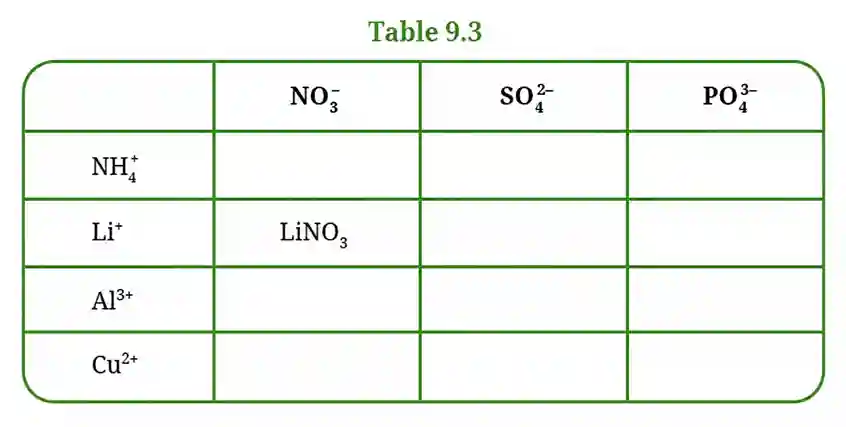
Complete the Table 9.3 by writing the formulae of the compounds
formed by the cations on the left and the anions at the top. LiNO3 is
given as an example.
Answers:
example.
| Anions → Cations ↓ | NO₃⁻ (1−) | SO₄²⁻ (2−) | PO₄³⁻ (3−) |
|---|---|---|---|
| NH₄⁺ (1+) | NH₄NO₃ | (NH₄)₂SO₄ | (NH₄)₃PO₄ |
| Li⁺ (1+) | LiNO₃ | Li₂SO₄ | Li₃PO₄ |
| Al³⁺ (3+) | Al(NO₃)₃ | Al₂(SO₄)₃ | AlPO₄ |
| Cu²⁺ (2+) | Cu(NO₃)₂ | CuSO₄ | Cu₃(PO₄)₂ |
Source: Page 175–177, Section 9.5.2 — “Write the symbol of the cation first… crossover the charges (only the numbers).”
Q11
5.3 g of sodium carbonate and 6.0 g of acetic acid react to produce 2.2 g
of carbon dioxide, 0.9 g of water, and 8.2 g of sodium acetate.
Verify whether the law of conservation of mass is valid.
Answers:
Total mass of REACTANTS:
● Sodium carbonate = 5.3 g
● Acetic acid = 6.0 g
TOTAL = 11.3 g
Total mass of PRODUCTS:
● Carbon dioxide = 2.2 g
● Water = 0.9 g
● Sodium acetate = 8.2 g
TOTAL = 11.3 g
Mass of reactants = Mass of products = 11.3 g ✓
Conclusion: The Law of Conservation of Mass is valid.
Source: Page 165, Section 9.1 — “matter can neither be created nor destroyed in a chemical reaction. This is known as the Law of Conservation of Mass, proposed by Antoine Lavoisier in 1789.”
Q12
If a species has 11 protons, 12 neutrons, and 10 electrons, then
(i) What is its atomic number and mass number?
(ii) Is it neutral, a cation, or an anion? Explain.
(iii) Write its electronic configuration.
(iv) Name the species.
Answers:
(i)Atomic number = Number of protons = 11
Mass number = Protons + Neutrons = 11 + 12 = 23
(ii) It is a cation. Protons (11) > Electrons (10) → net positive charge of 1+
(iii) 10 electrons arranged as: 2, 8
(K-shell = 2, L-shell = 8)
(iv) This is Na⁺ (Sodium cation / Sodium ion). Atomic number 11 = Sodium. It has lost one electron to become Na⁺.
(i)Source: Page 182, Q12 data — atomic number = protons.
(ii) Source: Page 172, Para 3 — “it would have 11 protons and 10 electrons… becomes a positively charged species, called a sodium cation, represented as Na⁺.”
(iii) 2n2
(iv)Source: Page 172, Para 3 — “sodium cation, represented as Na⁺.”
Q13
Two elements, A and B, have the following configurations —
A: 2, 8, 5 | B: 2, 8, 7
(i) Which element is more reactive?
(ii) Will A and B form ionic or covalent bonds when they combine?
Explain using electron transfer or sharing.
(iii) Predict the formula of the compound they would form.
Answers:
(i) B is more reactive. B has 7 valence electrons and needs only 1 more to complete its octet. It is very close to stability, making it highly reactive. A has 5 valence electrons and needs 3 more — harder to achieve.
(ii) They will form a covalent bond by sharing electrons. A needs 3 electrons; B needs 1 electron. Both have more than 4 valence electrons, so they tend to share, not transfer
(iii) A needs 3 electrons; B needs 1. So 1 atom of A shares with 3 atoms of B.
Formula: AB₃
(i) Source: Page 169, Para 2 — “If the number of electrons in a valence shell is less than eight, then they may share, gain or lose electrons to complete their valence shell and become stable.”
(ii) Source: Page 172, Para 1 — “Atoms with more than 4 valence electrons usually gain or share electrons to complete an octet.”
(iii) Source: Page 172, Examples — “PCl₃ is named as phosphorus trichloride, showing three chlorine atoms.”
Q14
Assertion (A): Copper sulfate conducts electricity in the molten state
but not in the solid state.
Reason (R): Copper and sulfate ions are fixed in the lattice in molten
state, while in solid state they can move freely.
Choose the correct option:
(i) Both A and R are true, and R is the correct explanation of A.
(ii) Both A and R are true, but R is not the correct explanation of A.
(iii) A is true, but R is false.
(iv) A is false, but R is true.
Answers:
(iii) A is true, but R is false.
Explanation:
- The Assertion is correct — ionic compounds like copper sulfate do conduct in the molten state but not in the solid state.
- The Reason is incorrectly stated — it has the states reversed. In the solid state, ions are fixed (cannot move). In the molten state, ions are free to move and carry current.
Source: Page 178–179 — “Ionic compounds do not conduct electricity in the solid state because their ions are held in fixed positions by strong forces. To conduct electricity, ions must be free to move.”
Q15
The species 27Al, 80Br– and 201Hg2+ have 13, 35, and 80 protons, respectively.
How many electrons and neutrons do they have?
Answers:
hey have?
| Species | Protons | Mass Number | Neutrons (Mass − Protons) | Charge | Electrons |
|---|---|---|---|---|---|
| ²⁷Al | 13 | 27 | 27−13 = 14 | Neutral | 13 |
| ⁸⁰Br⁻ | 35 | 80 | 80−35 = 45 | 1− (gained 1e) | 36 |
| ²⁰¹Hg²⁺ | 80 | 201 | 201−80 = 121 | 2+ (lost 2e) | 78 |
Source: Page 172–173 — “When a sodium atom loses its valence electron, it becomes a positively charged species… After gaining one extra electron, it acquires a negative charge.”
FAQs: Ch 9 Atomic Foundations of Matter Question Answer
What is the Law of Conservation of Mass, and does it apply to all chemical reactions?
The Law of Conservation of Mass states that mass can neither be created nor destroyed in a chemical reaction. The total mass of reactants always equals the total mass of products. It was proposed by Antoine Lavoisier in 1789 and applies to every chemical reaction — provided the system is closed (no gas escapes).
Example from the chapter (Page 165–166):
| Reactants | Mass |
|---|---|
| Calcium carbonate | 4.0 g |
| Hydrochloric acid | 2.92 g |
| Total | 6.92 g |
| Products | Mass |
|---|---|
| Carbon dioxide | 1.76 g |
| Water | 0.72 g |
| Calcium chloride | 4.44 g |
| Total | 6.92 g |
✔Mass of reactants = Mass of products = 6.92 g
“If I burn paper and nothing is left, does mass disappear?”
No. The paper converts to carbon dioxide and water vapour, which escape into the air. The system must be closed to observe mass conservation directly. In an open system, gases escape, and the reading appears to drop — but mass is still conserved across the entire universe.
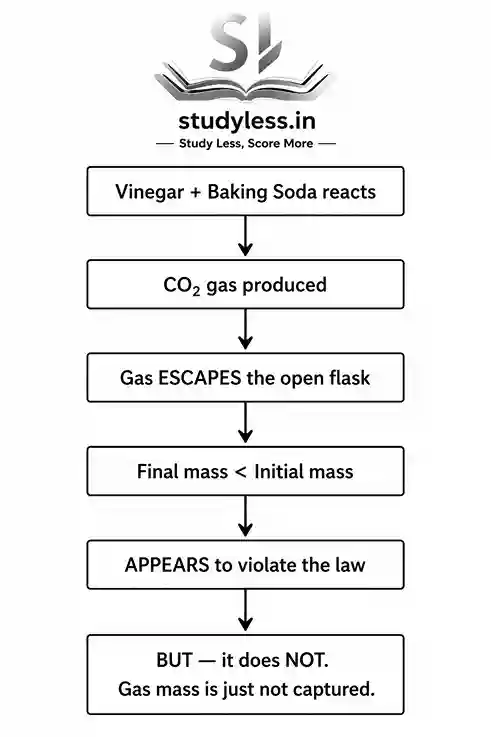
Experimental Set-up 2 fixed this by sealing the gas inside a balloon attached to the flask, and the mass remained constant. (Page 164–165)
| Question | Answer |
|---|---|
| Who proposed it? | Antoine Lavoisier, 1789 |
| What does it say? | Mass of reactants = Mass of products |
| Does it apply always? | Yes — in a closed system |
| What if gas escapes? | Mass seems to drop, but is conserved overall |
| Chapter reference | Page 165, Section 9.1 |
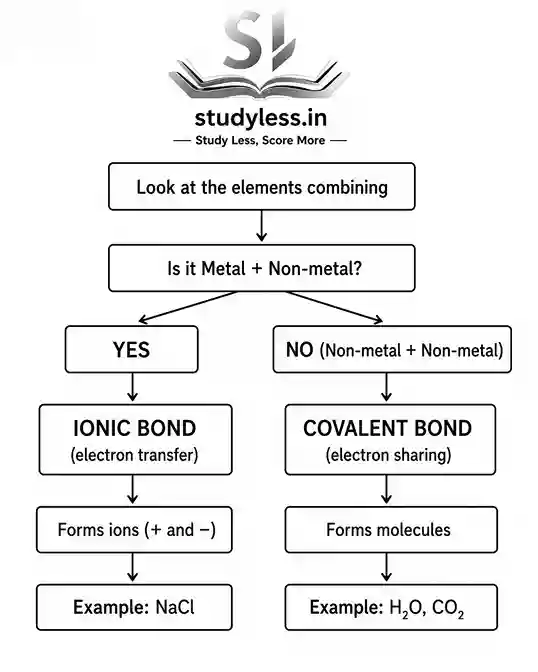
What is the difference between a covalent bond and an ionic bond — and how do you know which one a compound has?
A covalent bond forms when atoms share electrons. An ionic bond forms when one atom transfers electrons to another, creating oppositely charged ions that attract each other. The key rule: atoms with more than 4 valence electrons tend to share (covalent); atoms with fewer than 4 tend to transfer (ionic).
Comparison Table:
| Feature | Covalent Bond | Ionic Bond |
|---|---|---|
| How it forms | Sharing of electrons | Transfer of electrons |
| Who forms it | Non-metals + Non-metals | Metals + Non-metals |
| Example | H₂O, HCl, O₂ | NaCl, CaCl₂, MgO |
| Melting/Boiling point | Low | High |
| Solubility in water | Varies | Generally soluble |
| Solubility in kerosene/petrol | Generally soluble | Insoluble |
| Conducts electricity (solid)? | No | No |
| Conducts electricity (dissolved in water)? | No (mostly) | Yes |
| State at room temp | Often liquid/gas | Solid crystals |
(Source: Page 178–179, Section 9.6)
Real-Life examples:
| Compound | Bond Type | Where You Find It |
|---|---|---|
| Table salt (NaCl) | Ionic | Your kitchen |
| Water (H₂O) | Covalent | Everywhere |
| Sugar (C₁₂H₂₂O₁₁) | Covalent | Your tea/coffee |
| Copper sulfate | Ionic | School lab (blue crystals) |
| Naphthalene | Covalent | Old mothballs |
Why dissolved salt conducts electricity but sugar does not (from Think It Over, Page 162):
Answer: Salt (NaCl) breaks into free ions (Na⁺ and Cl⁻) in water — these ions carry electric current. Sugar dissolves in water but produces no ions — so no current flows.
How do you write chemical formulae of ionic and covalent compounds using the criss-cross method?
The criss-cross method swaps the valency (or charge) of each element and writes it as the subscript of the other element. For ionic compounds, use the ion charges. For covalent compounds, use the valencies. Always simplify subscripts by dividing by any common factor.
Step-by-Step: The Criss-Cross Method
STEP 1: Write symbols of both elements/ions
STEP 2: Write their charges/valencies below
STEP 3: Swap (criss-cross) the numbers
STEP 4: Write swapped numbers as subscripts
STEP 5: Simplify if both subscripts share a common factor
STEP 6: Use brackets for polyatomic ions appearing more than once
(Source: Page 175–177, Section 9.5)
Worked Examples Table:
| Compound | Ions/Elements | Charges | After Criss-Cross | Simplified Formula |
|---|---|---|---|---|
| Calcium chloride | Ca, Cl | 2+, 1− | Ca₁Cl₂ | CaCl₂ |
| Aluminium oxide | Al, O | 3+, 2− | Al₂O₃ | Al₂O₃ |
| Magnesium oxide | Mg, O | 2+, 2− | Mg₂O₂ | MgO |
| Magnesium hydroxide | Mg, OH | 2+, 1− | Mg₁(OH)₂ | Mg(OH)₂ |
| Aluminium sulfate | Al, SO₄ | 3+, 2− | Al₂(SO₄)₃ | Al₂(SO₄)₃ |
| Hydrogen sulfide | H, S | 1, 2 | H₂S₁ | H₂S |
Golden Rules — Never Forget:
- If subscript = 1, don’t write it (e.g., MgO, not Mg₁O₁)
- If both subscripts have a common factor, divide both (Mg₂O₂ → MgO)
- Use brackets only when a polyatomic ion appears more than once (e.g., Mg(OH)₂)
- Charges are not shown in the final formula
Naming Covalent Compounds — Prefix Quick Guide:
| Number of Atoms | Prefix | Example |
|---|---|---|
| 1 | mono- (omit for first element) | Carbon monoxide (CO) |
| 2 | di- | Carbon dioxide (CO₂) |
| 3 | tri- | Phosphorus trichloride (PCl₃) |
| 4 | tetra- | Carbon tetrachloride (CCl₄) |
| 5 | penta- | Dinitrogen pentoxide (N₂O₅) |
| 6 | hexa- | Sulfur hexafluoride (SF₆) |
(Source: Page 171–172, Section 9.4.1C)
What is the Law of Constant Proportions, and how is it different from the Law of Conservation of Mass?
The Law of Constant Proportions (proposed by Joseph Proust) states that a compound always contains the same elements in the same fixed mass ratio, regardless of its source or how it was made. The Law of Conservation of Mass (by Lavoisier) says mass is neither created nor destroyed in a reaction. One is about ratio of elements; the other is about total mass.
The Clearest Comparison:
| Feature | Law of Conservation of Mass | Law of Constant Proportions |
|---|---|---|
| Proposed by | Antoine Lavoisier (1789) | Joseph Proust |
| Also called | — | Law of Definite Proportions / Proust’s Law |
| What it says | Mass before = Mass after reaction | Elements in a compound are always in fixed mass ratio |
| About | Total mass of a reaction | Composition of a compound |
| Example | 6.92g reactants → 6.92g products | Water is always H:O = 1:8 by mass |
| Applies to | All chemical reactions | All pure compounds |
(Source: Page 165 Section 9.1; Page 167 Section 9.2)
Water — The Perfect Example (Page 167):
No matter where water comes from — a river, a borewell, the ocean, or a lab — when purified and analysed, it always contains:
Hydrogen : Oxygen = 1 : 8 (by mass)
9g of water always gives:
→ 1g Hydrogen
→ 8g Oxygen
This never changes. Ever. That is Proust’s Law in action.
Why This Matters in Real Life:
| Scenario | Which Law Applies? |
|---|---|
| A student burns magnesium in a closed container — mass stays the same | Conservation of Mass |
| Water from a river and water from a lab both have H:O = 1:8 | Constant Proportions |
| CO₂ formed from any source always has C:O = 12:32 (3:8) | Constant Proportions |
| Reactants weigh 50g → Products must weigh 50g | Conservation of Mass |
Fascinating Historical Insight from the Chapter (Page 167 — Threads of Curiosity):
The mineral cinnabar (called hingula in India) was used as red pigment in ancient civilisations. When heated, it always yielded mercury and sulfur in the ratio 86.22% : 13.78% — a perfect real-world demonstration of the Law of Constant Proportions, observed independently across cultures thousands of years ago.
How do you calculate molecular mass and formula unit mass — and what is the difference between the two?
Molecular mass is the total mass of one molecule of a covalent compound, found by adding the atomic masses of all atoms in it. Formula unit mass is used for ionic compounds (which don’t form individual molecules), and equals the sum of atomic masses in the simplest ion ratio (formula unit). Both are measured in atomic mass units (u).
The Core Difference:
| Feature | Molecular Mass | Formula Unit Mass |
|---|---|---|
| Used for | Covalent compounds | Ionic compounds |
| Why different? | Covalent compounds form distinct molecules | Ionic compounds form 3D crystal lattices — no single molecule exists |
| How to calculate | Add atomic masses of all atoms in formula | Add atomic masses of all atoms in formula unit |
| Unit | u (atomic mass units) | u (atomic mass units) |
| Example compound | H₂O, CO₂, CH₄ | NaCl, Na₂O, Ca(NO₃)₂ |
(Source: Page 179–180, Sections 9.7 and 9.8)
Step-by-Step Calculation Method:
Solved Examples — At a Glance:
| Compound | Formula | Calculation | Mass |
|---|---|---|---|
| Water | H₂O | (1×2) + (16×1) | 18 u |
| Carbon dioxide | CO₂ | (12×1) + (16×2) | 44 u |
| Sodium oxide | Na₂O | (23×2) + (16×1) | 62 u |
| Calcium nitrate | Ca(NO₃)₂ | (40×1) + [(14×1)+(16×3)]×2 | 164 u |
| Nitric acid | HNO₃ | (1×1)+(14×1)+(16×3) | 63 u |
| Methane | CH₄ | (12×1)+(1×4) | 16 u |
Atomic Mass Reference Card (Most Used):
| Element | Symbol | Atomic Mass |
|---|---|---|
| Hydrogen | H | 1 u |
| Carbon | C | 12 u |
| Nitrogen | N | 14 u |
| Oxygen | O | 16 u |
| Sodium | Na | 23 u |
| Magnesium | Mg | 24 u |
| Phosphorus | P | 31 u |
| Sulfur | S | 32 u |
| Chlorine | Cl | 35.5 u |
| Potassium | K | 39 u |
| Calcium | Ca | 40 u |
Why Ionic Compounds Don’t Have “Molecular Mass”:
Ionic compounds like NaCl do not exist as individual molecules. They form giant 3D crystal lattices where 6 Cl ions surround each Na, and 6 Na ions surround each Cl. There is no single “NaCl molecule” — just a repeating pattern extending in all directions.
This is why we use formula unit mass — it refers to the mass of just one formula unit (the simplest ratio: 1 Na⁺ and 1 Cl⁻), not a standalone molecule.
(Source: Page 173, Threads of Curiosity — “Ionic compounds usually do not remain as single units. They form three-dimensional (3-D) crystals.”)
Disclaimer:
All answers sourced exclusively from NCERT Class 9 Science — Exploration, Chapter 9: Atomic Foundations of Matter, Pages 162–183. This ensures that you get full marks for your answers
![Class 9 New NCERT Social Science[SST] Textbook 2026-2027](https://studyless.in/wp-content/uploads/2026/06/Class-9-New-NCERT-Social-ScienceSST-Textbook-2026-2027-2.webp)