
The answers to each of the questions presented here are strictly based on Chapter 8, Journey Inside The Atom, of the class 9 science textbook, Exploration.
Here is the text revised for clarity and easy reading:
We have prepared the “Ch 8: Journey Inside The Atom” question answers in a simple, easy-to-read, and easy-to-understand format.
You can prepare the chapter in the best way by:
- Reading the chapter from the textbook first
- Preparing the chapter with our short notes
- Solving the questions of Revise, Reflect, Refine
The source of each answer is also mentioned under the respective question’s answer. You can click the “View source of answer” to get the source of the answer in your NCERT textbook.
Q1.
Choose the correct options and explain the reason for the correct answer and incorrect options in the context of Ernest Rutherford’s gold foil experiment:
(i) The experiment clearly showed the existence of neutrons in the
nucleus.
(ii) The results disproved the plum pudding model and led to the idea
of a nucleus at the centre of the atom.
(iii) The large deflection of a few alpha particles indicated that most
of the mass of the atom and the positive charge are packed into a tiny
centre.
(iv) The way alpha particles were deflected showed that electrons
move around the nucleus.
Answers:
(i) INCORRECT. The gold foil experiment only showed that a positive charge is concentrated in a dense nucleus. Neutrons were discovered separately by James Chadwick in 1932.
(Page 147, Section 8.3.1, Para 1)
(ii) CORRECT. Thomson’s model said positive charge is spread evenly. But some alpha particles bounced back sharply — this proved positive charge is packed in a tiny, dense nucleus, not spread out.
(Page 143, last para; Page 144, Section A, Para 1)
(iii) CORRECT. Rutherford concluded: “The nucleus is dense, contains all the positive charge and most of the mass of an atom.”
(Page 144, Section A, bullet point 2)
(iv) INCORRECT. Alpha particle deflection told us about the nucleus, where the positive charge is. It gave no information about how electrons move. Electron behaviour was explained later by Bohr’s model.
(Page 146, Section 8.2.3)
Q2.
Which of the following statements are correct or incorrect according to the Bohr’s atomic model? Give a reason for each statement.
(i) Electrons lose energy while moving in fixed orbits and slowly fall
into the nucleus.
(ii) Electrons can exist anywhere around the nucleus with no fixed
energy.
(iii) Electrons revolve around the nucleus in orbits of fixed energy
without losing energy.
(iv) Electrons can be found between energy levels as they move
around the nucleus.
Answers:
(i) INCORRECT. Bohr specifically stated: “While moving in a fixed shell, an electron does not lose energy.” This was the key improvement over Rutherford’s model.
(Page 146, bullet point 3)
(ii) INCORRECT. Bohr said electrons follow “fixed circular paths called stationary states, orbits, or shells. In each shell, an electron has a definite amount of energy.”
(Page 146, bullet point 1)
(iii) CORRECT. “In a stationary state, the energy of an electron remains constant, even though it is in motion around the nucleus.”
(Page 146, last para of Section 8.2.3)
(iv) INCORRECT. “Electrons can revolve only in these allowed shells, and not in between them.”
(Page 146, bullet point 3)
Q3.
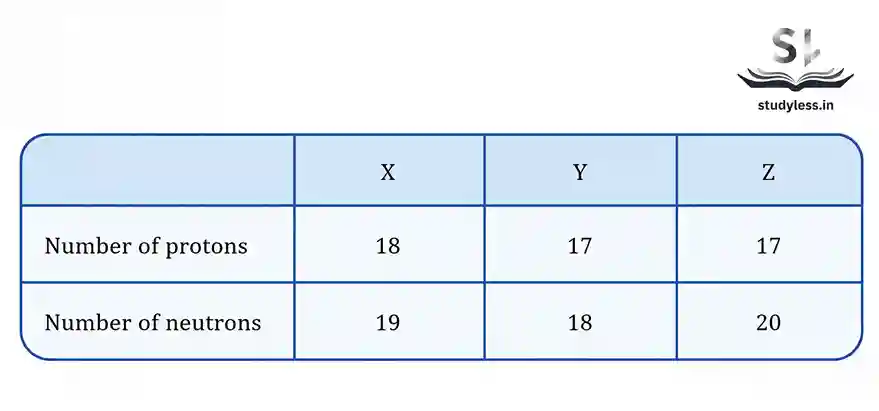
The composition of the nuclei of three atomic species X, Y, and Z are
given as follows.
Explain the relation between the following:
(i) Y and Z
(ii) Z and X
Answers:
The composition of the nuclei of three atomic species X, Y, and Z:
| Nuclear Composition | X | Y | Z |
|---|---|---|---|
| Protons | 18 | 17 | 17 |
| Neutrons | 19 | 18 | 20 |
| Mass Number (p+n) | 37 | 35 | 37 |
| Atomic Number | 18 | 17 | 17 |
(i) Relation between Y and Z:
Y and Z are Isotopes. Both have the same atomic number (17 = same element, Chlorine) but different mass numbers (Y = 35, Z = 37). “Atoms with the same atomic number but different mass numbers are called isotopes.”
(Page 154, Section 8.9.1, Para 1)
(ii) Relation between Z and X:
Z and X are Isobars. Both have the same mass number (37) but different atomic numbers (Z = 17, X = 18). “When atoms of different elements have the same mass number, but different atomic numbers, they are called isobars.”
(Page 156, Section 8.9.2, Para 1)
Q4.
What conclusion did Rutherford draw about the position and characteristics of the atom’s positively charged part based on the few alpha particles that bounced back or were deflected at large angles in the gold foil experiment?
Answers:
Rutherford drew these conclusions:
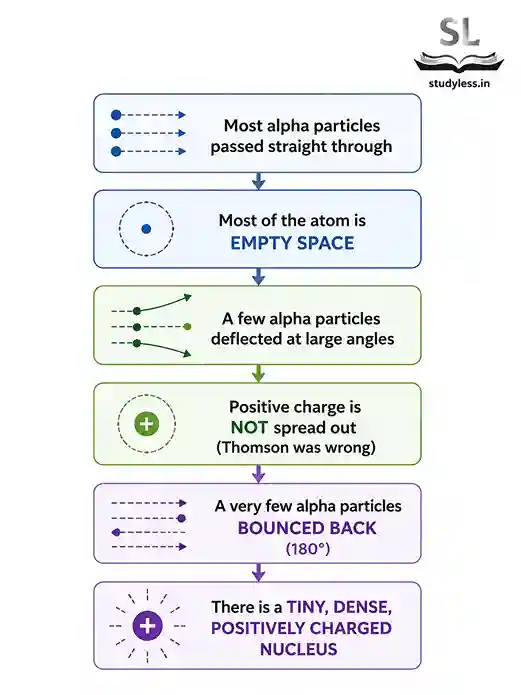
(Page 144, Section A — Rutherford’s model)
Key conclusions about the nucleus:
- It is extremely small — about 10⁵ times smaller than an atom
- Diameter of atom ≈ 10⁻¹⁰ m; Diameter of nucleus ≈ 10⁻¹⁵ m
- It contains all the positive charge and most of the mass
- Electrons revolve around it (planetary model)
(Page 144, Section A, all bullet points and Para 2)
Q5.
Explain and arrange the following statements in the correct chronological order to show how atomic models have evolved over time.
(i) Bohr’s model proposed that electrons move in fixed orbits around
the nucleus, each with a definite energy.
(ii) Thomson’s model depicted the atom as a ʻplum puddingʼ with
electrons embedded in a sphere of positive charge.
(iii) Rutherford’s model proposed that atoms have a dense central
nucleus.
(iv) Dalton’s model described atoms as indivisible particles.
Answers:
Correct Chronological Order:
| Step | Scientist | Key Idea |
|---|---|---|
| 1 | Dalton (1808) | Atoms are indivisible particles |
| 2 | Thomson (1897) | Plum pudding — electrons in positive sphere |
| 3 | Rutherford (1911) | Dense central nucleus; planetary model |
| 4 | Bohr (1913) | Electrons in fixed orbits with definite energy |
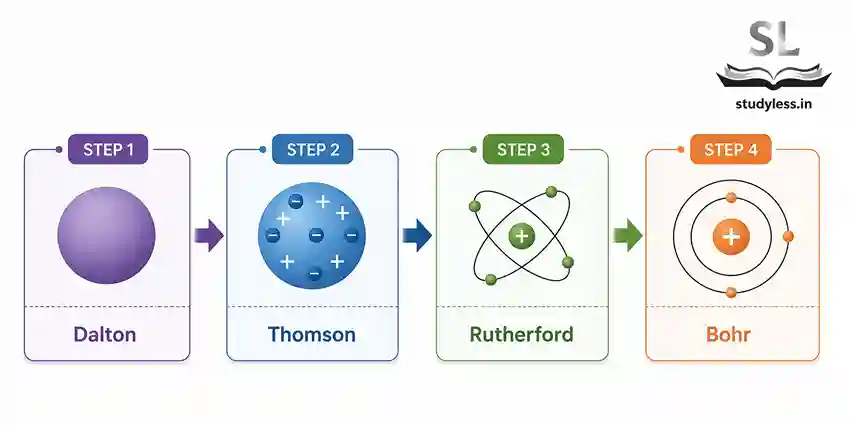
So the answer order is: (iv) → (ii) → (iii) → (i)
- Page 141, Section 8.1
- Page 142, Section 8.2.1
- Page 144, Section A
- Page 146, Section 8.2.3
Q6.
Electrons move around the nucleus in orbits. Why do they not fly away from the atom? Explain what keeps them attracted to the nucleus.
Answers:
Two forces are at work:
A. Why electrons don’t fly away:
- Electrons carry a negative charge (–1)
- The nucleus carries a positive charge from protons (+1 each)
- Opposite charges attract each other
- This electrostatic attraction pulls electrons toward the nucleus and keeps them in their orbits
(Page 145, Section C — Discovery of the proton)
B. Why electrons don’t fall INTO the nucleus (Bohr’s answer):
- This keeps them stable at a fixed distance from the nucleus
- Bohr proposed that electrons occupy fixed “stationary states”
- In these orbits, energy remains constant — electrons neither gain nor lose energy
(Page 145, Section B — Limitations of Rutherford’s model; Page 146, Section 8.2.3)
Q7.
Assertion (A): The discovery of subatomic particles helped in
understanding the atomic structure.
Reason (R): The number of electrons is equal to the number of protons
in an atom.
Choose the correct option:
(i) Both A and R are true, and R is the correct explanation of A.
(ii) Both A and R are true, but R is not the correct explanation of A.
(iii) A is true, but R is false.
(iv) A is false, but R is true.
Answers:
Option (ii) — Both A and R are true, but R is not the correct explanation of A.
Why A is true:
Each subatomic particle discovery improved our understanding — Thomson’s electron led to the plum pudding model, Rutherford’s proton led to the nuclear model, and Chadwick’s neutron explained atomic mass.
(Page 142, 144, 147)
Why R is true but NOT the explanation of A:
Yes, electrons = protons (making atoms neutral) — but this fact about charge balance does not explain why subatomic particles helped us understand atomic structure. R is a separate fact about electrical neutrality, not a cause-and-effect explanation. (Page 145, Section C, Para 2)
(Page 145, Section C, Para 2)
Q8.
Magnesium is essential for many biological processes, including muscle contraction. For an atom of magnesium with a mass number of 24 and atomic number 12, determine the number of :
(i) protons,
(ii) neutrons,
(iii) electrons,
and also illustrate the arrangement of electrons in a magnesium atom.
Answers:
| Property | Value | How calculated |
|---|---|---|
| Protons | 12 | = Atomic number |
| Electrons | 12 | = Protons (neutral atom) |
| Neutrons | 12 | = Mass number − Atomic number = 24 − 12 |
(Page 150, Section 8.6; Page 151, Section 8.7)
Electron Arrangement (Electronic Configuration):
Using the rule 2n²:
- K-shell (n=1): max 2 → filled with 2
- L-shell (n=2): max 8 → filled with 8
- M-shell (n=3): remaining = 12 − 10 = 2
Configuration: 2, 8, 2
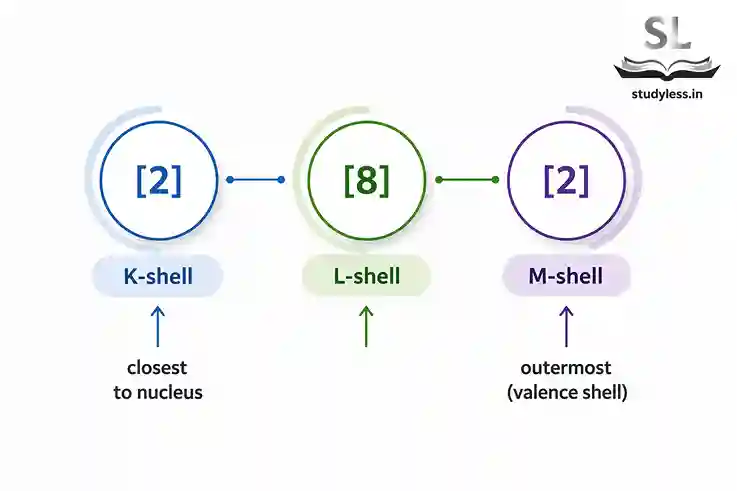
(Page 152, Table 8.4 — Magnesium row; Page 151, Section 8.7 rules)
Q9.
Find the following information for the elements shown in Fig. 8.17:
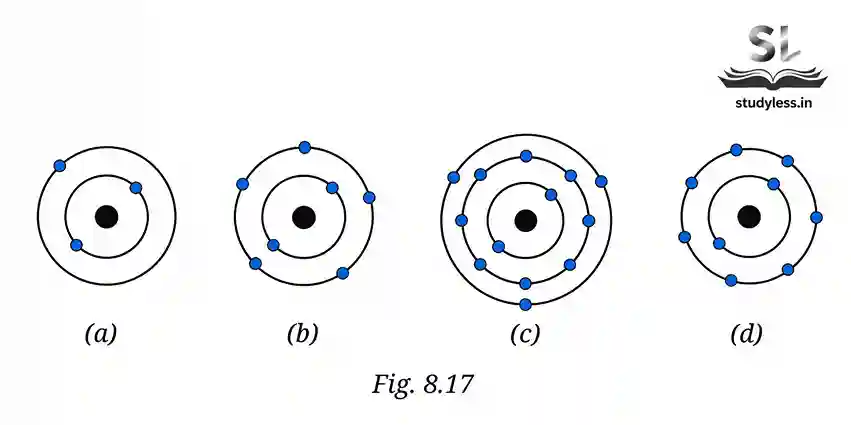
(i) Name of the element
(ii) Symbol
(iii) Total number of electrons
(iv) Number of valence electrons
(v) Valency of the element
(vi) Number of protons
(vii) Atomic number
As per Fig. 8.17
Step 1 — Count Electrons in Each Shell
| Shell | (a) | (b) | (c) | (d) |
|---|---|---|---|---|
| K (1st shell) | 2 | 2 | 2 | 2 |
| L (2nd shell) | — | 1 | 8 | 8 |
| M (3rd shell) | — | — | 1 | 6 |
| Total electrons | 2 | 3 | 11 | 16 |
Step 2 — Fill the Answer Table
| Question | (a) | (b) | (c) | (d) |
|---|---|---|---|---|
| (i) Name | Helium | Lithium | Sodium | Sulfur |
| (ii) Symbol | He | Li | Na | S |
| (iii) Total electrons | 2 | 3 | 11 | 16 |
| (iv) Valence electrons | 2 | 1 | 1 | 6 |
| (v) Valency | 0 | 1 | 1 | 2 |
| (vi) Protons | 2 | 3 | 11 | 16 |
| (vii) Atomic number | 2 | 3 | 11 | 16 |
(Page 149 Table 8.2; Page 152 Table 8.4; Page 153 Section 8.8)
Note on valency:
Step 3 — How Valency Was Decided
(Page 153, Section 8.8 — Valency rules)
Helium (a) → Valency = 0. Already has 2 electrons in its only shell. First shell is complete with 2. It is stable and does not need to gain or lose any electrons.
Lithium (b) → Valency = 1 Has 1 electron in its outermost shell. It loses that 1 electron to become stable. So valency = 1.
Sodium (c) → Valency = 1 Has 1 electron in its outermost shell. It loses that 1 electron to become stable. So valency = 1.
Sulfur (d) → Valency = 2 Has 6 electrons in its outermost shell. It needs 2 more to complete the octet of 8. So it gains 2 electrons. Valency = 2.
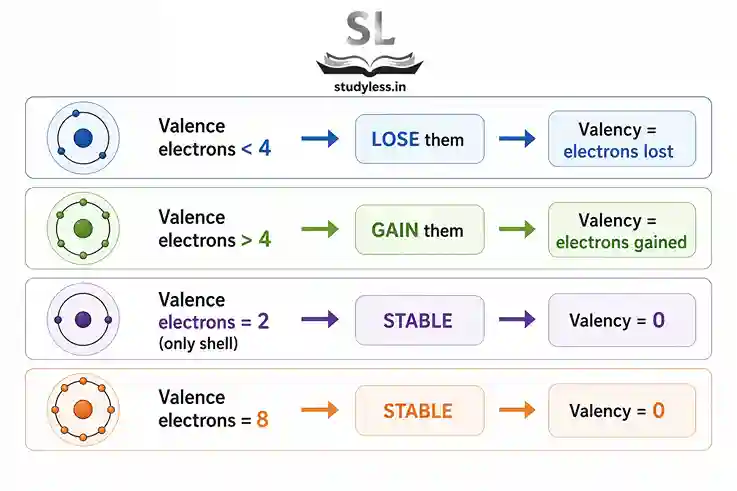
(Page 153, Section 8.8 — Valency rules)
Q10.
Both Rutherford’s and Bohr’s models have electrons orbiting the nucleus. Why did Rutherford’s model fail to explain atomic stability, while Bohr’s model succeeded?
Answers:
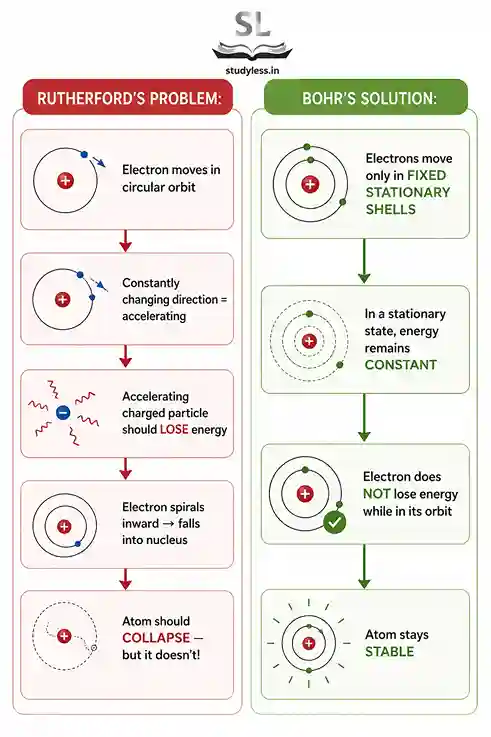
| Feature | Rutherford | Bohr |
|---|---|---|
| Electron path | Any circular orbit | Fixed energy shells (K, L, M, N) |
| Energy loss? | Yes — predicts collapse | No — stationary states |
| Explains stability? | NO | YES |
(Page 145, Section B; Page 146, Section 8.2.3)
Q11.
An atom 70 X has 31 electrons. How many neutrons are there in its
nucleus?
Answers:
Number of electrons = 31
Since an atom is neutral → number of protons = 31
Mass number = 70
Neutrons = Mass number − Protons = 70 − 31 = 39
39 neutrons Ans
(Page 150, Section 8.6)
Q12.
An atom has 79 protons and a mass number of 197.
Calculate
(i) the number of neutrons, and
(ii) the number of electrons.
Answers:
(i) Neutrons = Mass number − Protons = 197 − 79 = 118
(ii) Electrons = Protons (neutral atom) = 79
118 neutrons, 79 electrons Ans (This element is Gold — Au)
(Page 150, Section 8.6)
Q13.
Complete the Table 8.5:
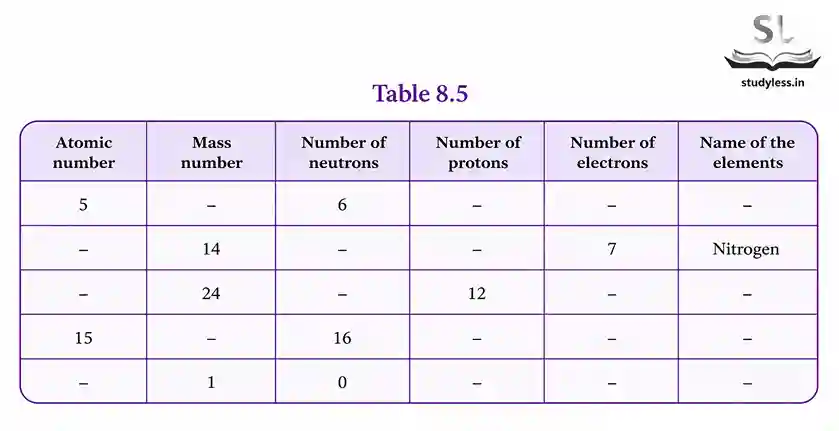
Answers:
Using: Atomic number (Z) = protons = electrons; Mass number (A) = protons + neutrons
| Atomic No. | Mass No. | Neutrons | Protons | Electrons | Element |
|---|---|---|---|---|---|
| 5 | 11 | 6 | 5 | 5 | Boron (B) |
| 7 | 14 | 7 | 7 | 7 | Nitrogen (N) |
| 12 | 24 | 12 | 12 | 12 | Magnesium (Mg) |
| 15 | 31 | 16 | 15 | 15 | Phosphorus (P) |
| 1 | 1 | 0 | 1 | 1 | Hydrogen (H) |
How each was calculated:
- Row 1: Z=5, n=6 → A=5+6=11; protons=electrons=5 → Boron
- Row 2: A=14, electrons=7 → Z=7; neutrons=14−7=7 → Nitrogen
- Row 3: A=24, protons=12 → Z=12; neutrons=24−12=12 → Magnesium
- Row 4: Z=15, neutrons=16 → A=15+16=31; electrons=15 → Phosphorus
- Row 5: A=1, neutrons=0 → protons=1; Z=1; electrons=1 → Hydrogen
(Page 150, Section 8.5 and 8.6; Page 152, Table 8.4)
Q14.
Aman was discussing the structure of atom with his classmates. During the discussion, he learnt that an element X has a mass number of 35 and contains 18 neutrons. Based on this information, answer the following questions:
(i) How many electrons and protons does element X have?
(ii) What is its atomic number?
(iii) Identify the element X.
(iv) Write its electronic configuration.
(v) How many valence electrons does it have?
(vi) What will be the mass number if two neutrons are added to its
nucleus?
(vii) What will be the relation of X with the new atom?
Answers:
Element X: Mass number = 35, Neutrons = 18.
(Page 149–153, Sections 8.5, 8.6, 8.7, 8.8)
Working:
- Protons = Mass number − Neutrons = 35 − 18 = 17
- Atomic number = 17
- Electrons = 17
(i) Electrons = 17, Protons = 17
(ii) Atomic number = 17
(iii) Element X = Chlorine (Cl)
(From Table 8.2, Page 149)
(iv) Electronic configuration:
- K-shell: 2, L-shell: 8, M-shell: 7
- Configuration: 2, 8, 7
(v) Valence electrons = 7 (electrons in outermost M-shell)
(vi) If 2 neutrons are added: New mass number = 35 + 2 = 37
(vii) Relation of X with new atom: X (mass number 35) and new atom (mass number 37) both have atomic number 17. They are Isotopes — same atomic number, different mass numbers.
(Page 154, Section 8.9.1)
Q15.
In an atom, there are 12 protons and 12 neutrons in the nucleus. Now, imagine that all the electrons are replaced with some hypothetical particles that have the same charge as electrons but are 500 times heavier. What effect will this replacement have on the atom’s:
(i) Atomic number
(ii) Atomic mass
(iii) Mass number
(iv) Overall charge
Answers:
| Property | Effect | Reason |
|---|---|---|
| (i) Atomic number | NO CHANGE — stays 12 | Atomic number = number of protons. Protons are untouched. |
| (ii) Atomic mass | INCREASES significantly | Atomic mass includes electron mass. Replacing with 500× heavier particles increases total mass. |
| (iii) Mass number | NO CHANGE — stays 24 | Mass number = protons + neutrons only. Electron mass is considered negligible. (Page 150: “The electron has almost negligible mass”) |
| (iv) Overall charge | NO CHANGE — stays neutral | The new particles have the same charge as electrons (−1 each). So, total negative charge still equals total positive charge. |
(Page 149–150, Sections 8.5, 8.6)
—End of Questions Answers of Revise, Reflect, Refine | Chapter 8 Journey Inside The Atom Class 9—
FAQs: Ch 8 Journey Inside The Atom Question Answers
What are the three subatomic particles of an atom, and where are they found?
An atom is made of three subatomic particles.
Key facts to remember:
Protons and neutrons together are called nucleons
Protons and neutrons contribute to the mass of the atom
Electrons have almost negligible mass
The number of protons always equals the number of electrons in a neutral atom
| Particle | Symbol | Charge | Location |
|---|---|---|---|
| Electron | e⁻ | −1 | Revolves around nucleus in shells |
| Proton | p⁺ | +1 | Inside the nucleus |
| Neutron | n⁰ | 0 | Inside the nucleus |
Source: (Page 147, Table 8.1; Page 150, Section 8.5)
What is the difference between atomic number and mass number?
These two numbers fully describe any atom.
| Property | Atomic Number (Z) | Mass Number (A) |
|---|---|---|
| Definition | Number of protons in nucleus | Total protons + neutrons in nucleus |
| What it tells | Identity of the element | Mass of the atom |
| Formula | Z = p = e⁻ | A = p + n |
| Example (Carbon) | Z = 6 | A = 12 |
Neutrons = Mass Number (A) − Atomic Number (Z)
Example using Sodium:
- Atomic number = 11
- Mass number = 23
- Neutrons = 23 − 11 = 12
Source:(Page 149–150, Sections 8.5 and 8.6)
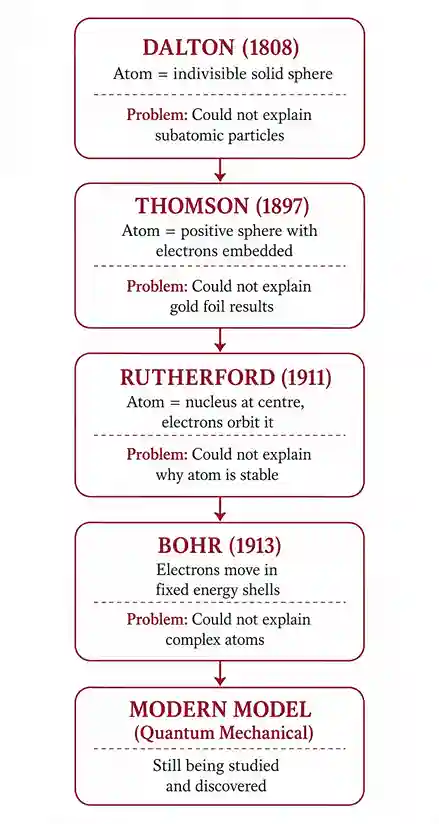
How did atomic models change from Dalton to Bohr, and why did each model get replaced?
Each model was replaced when a new experiment proved it incomplete.
| Scientist | Year | Key Contribution | Why Replaced |
|---|---|---|---|
| Dalton | 1808 | Atom is indivisible | Electrons & nucleus discovered |
| Thomson | 1897 | Plum pudding model | Gold foil experiment disproved it |
| Rutherford | 1911 | Nuclear model | Could not explain atomic stability |
| Bohr | 1913 | Fixed energy shells | Could not explain all observations |
Source: (Page 141–146, Sections 8.1 and 8.2; Page 157, Fig 8.16)
What are isotopes and isobars, and how are they different?
Students most commonly confuse these two. Here is the clearest possible comparison.
The one-line definitions:
Isotopes = Same element, different mass (same Z, different A)
Isobars = Different elements, same mass (different Z, same A)
| Property | Isotopes | Isobars |
|---|---|---|
| Atomic Number (Z) | Same | Different |
| Mass Number (A) | Different | Same |
| Are they same element? | Yes | No |
| Example | ¹H, ²H, ³H (Hydrogen) | ⁴⁰Ca, ⁴⁰K, ⁴⁰Ar |
| Chemical properties | Same | Different |
What is valency, and how do you find it from electronic configuration?
Simple definition: Valency is the combining capacity of an atom. It equals the number of electrons an atom loses, gains, or shares to complete its outermost shell.
source: (Page 153, Section 8.8)
The decision rule:
coming soon


![When Will The New Class 9 Social Science [SST] NCERT be available Online](https://studyless.in/wp-content/uploads/2026/05/When-Will-The-New-Class-9-Social-Science-SST-NCERT-be-available-Online-1200x675.webp)