
Chapter 10 of your science textbook is 24 page long and is conceptually dense.
Moreover, there are some concepts that are very similar sounding that students tends to mistake one for the other.
Hence,
we have created “Ch 10 Notes Sound Waves Characteristics And Applications” for you.
Read the chapter first from your NCERT textbook and then revise it from here again and agian to master the chapter and score good marks.
Happy reading!
Production of Sound
How is Sound Produced?
● Sound is produced by vibrations
● Vibration = periodic to and fro motion (oscillations) of an object
● When vibration stops, sound stops too
💡 In Simple Words
No vibration = No sound. It’s that simple.
Sound can be produced by vibrating:
● Strings (e.g., guitar, sitar)
● Membranes (e.g., drums)
● Air columns (e.g., flute/bansuri)
● Other vibrating objects (e.g., tuning fork)
The object that produces sound is called the source of sound
Tuning fork
● A tuning fork is a U-shaped metal bar with a stem
● Usually made of steel or aluminium
● The two arms of the U are called prongs or tines
● Prongs are struck on a pad to make them vibrate and produce sound
| Part | Description |
|---|---|
| Prongs / Tines | The two arms that vibrate to produce sound |
| Stem | The handle used to hold the tuning fork |
| Material | Steel or Aluminium |
Propagation of Sound
Sound needs a medium to propagate
● Sound travels from the source to our ears through a medium
● Medium = the material through which sound propagates (travels)
● Sound can travel through solids, liquids, and gases
💡 In Simple Words
Sound needs something to travel through. It cannot travel through empty space.
What is Vacuum?
● Vacuum = a space with no medium (no matter at all)
● Sound cannot travel through vacuum
● Outer space is a near vacuum ➜ sound cannot propagate there
Vacuum Bell Jar Experiment
This experiment proves that sound needs a medium.
| Step | Observation |
|---|---|
| Electric bell switched ON in bell jar | Sound is heard clearly |
| Air is slowly sucked out by vacuum pump | Sound becomes fainter |
| Near vacuum is reached | Almost no sound heard (bell still visible ringing) |
| Air is let back in | Sound gradually becomes loud again |
● The bell keeps ringing throughout — but sound disappears as air is removed
● This proves sound needs a medium (air) to travel — not just a vibrating source
Sound Waves
Sound Wave
A disturbance consisting of alternating compressions and rarefactions propagating through a medium, without actual flow of particles
How Does Sound Propagate Through a Medium?
● Sound propagates in multiple directions from a source
● The direction depends on the shape of the source
● For simplicity, we study sound moving in one direction
The Slinky Analogy
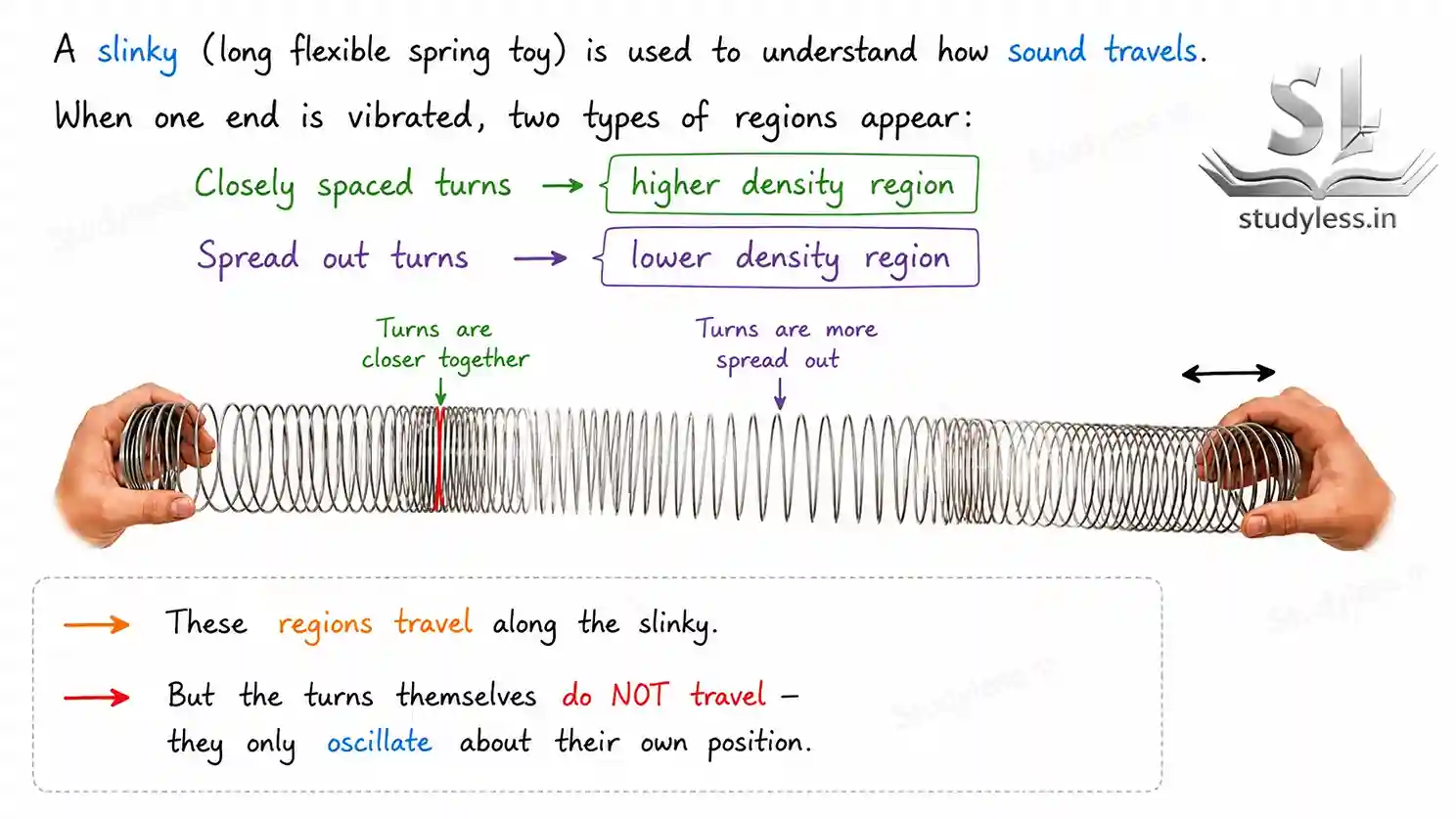
A slinky (long flexible spring toy) is used to understand how sound travels
When one end is vibrated, two types of regions appear:
● Closely spaced turns ➜ higher density region
● Spread out turns ➜ lower density region
● These regions travel along the slinky
● But the turns themselves do NOT travel — they only oscillate about their own position
💡 In Simple Words
The disturbance travels, not the particles.
How Sound Travels Through Air — Piston Model
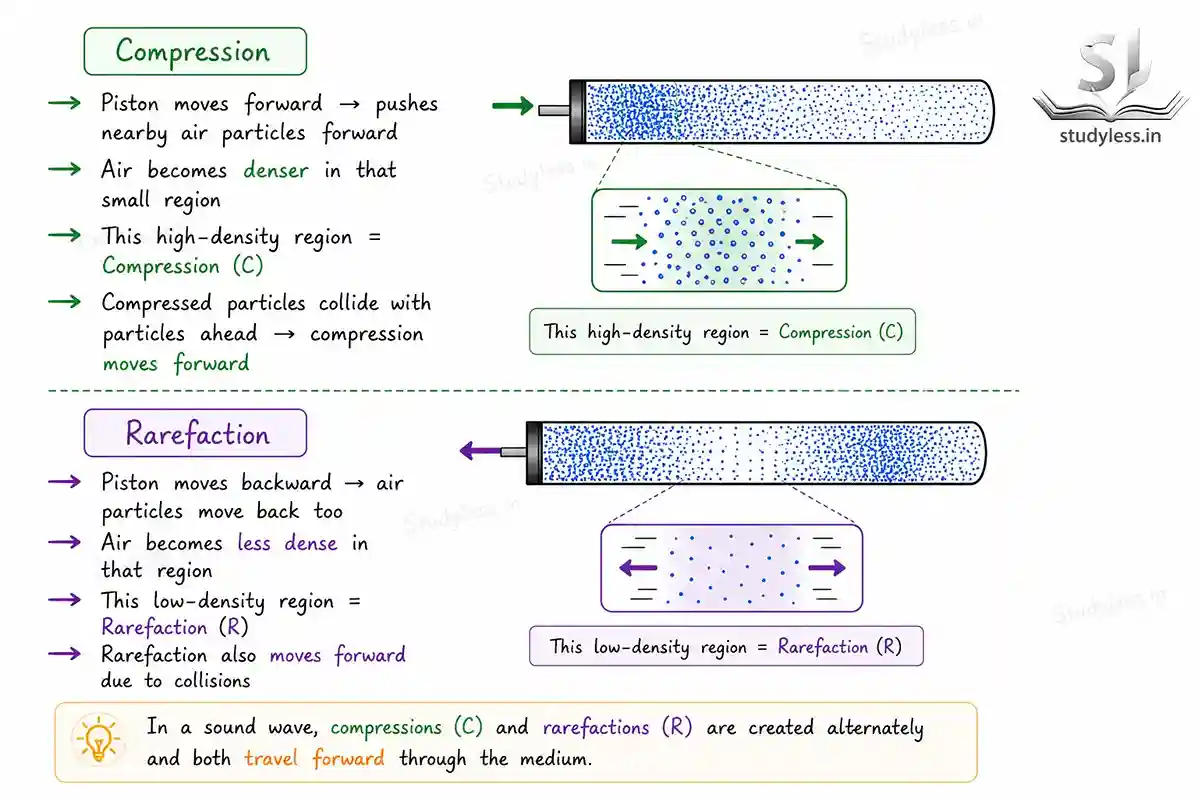
A piston oscillating in a tube filled with air is used as a model of a sound source
Compression
● Piston moves forward ➜ pushes nearby air particles forward
● Air becomes denser in that small region
● This high-density region = Compression (C)
● Compressed particles collide with particles ahead ➜ compression moves forward
Rarefaction
● Piston moves backward ➜ air particles move back too
● Air becomes less dense in that region
● This low-density region = Rarefaction (R)
vRarefaction also moves forward due to collisions
⚠️ Exam Alert
In both compression and rarefaction, the air particles do NOT travel with the wave. They only oscillate about their mean position.
● As piston oscillates, compressions and rarefactions are produced alternately
● This series travels away from the source through the medium
“A disturbance consisting of alternating compressions and rarefactions propagating through a medium, without actual flow of particles is called a sound waves”
Types of Waves
| Feature | Longitudinal Wave | Mechanical Wave |
|---|---|---|
| Particle vibration direction | Parallel to wave propagation | — |
| Medium required? | Yes | Yes |
| Example | Sound wave | Sound wave |
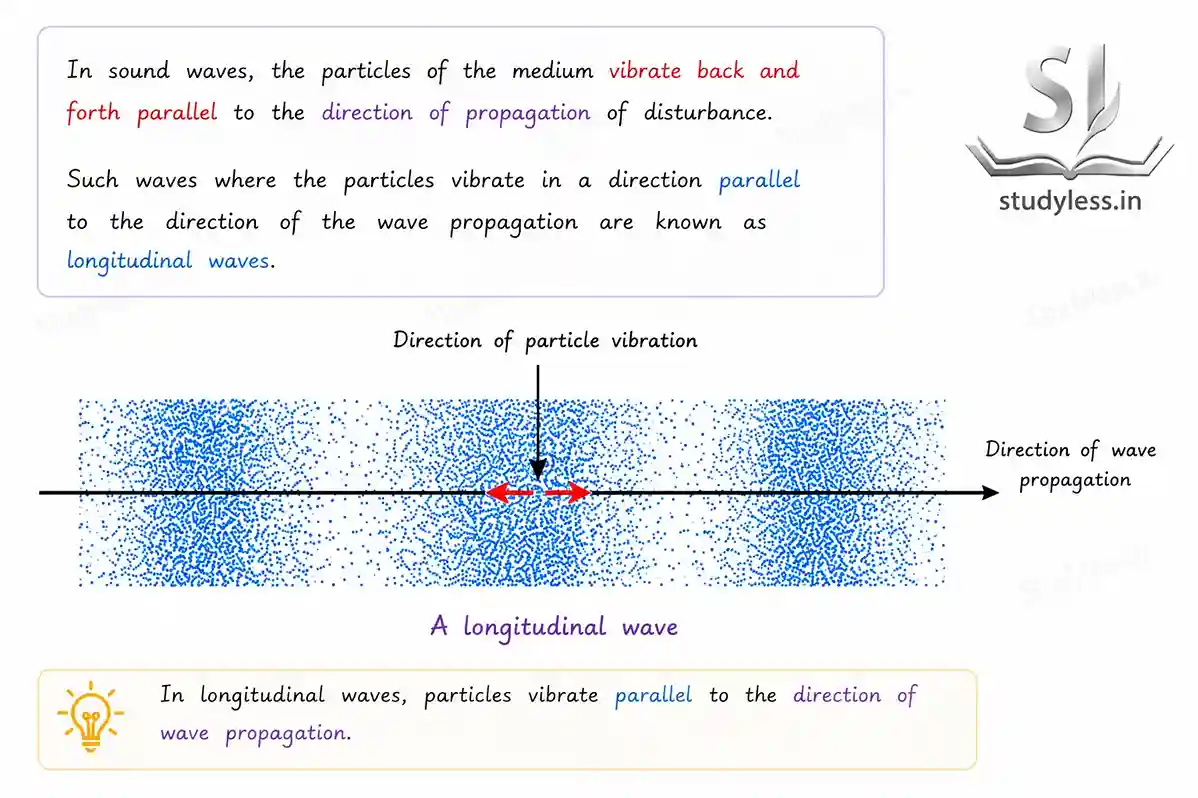
In sound waves,
● Particles vibrate parallel to the direction of wave propagation
● Such waves are called longitudinal waves
● Waves that need a medium to travel are called mechanical waves
∴ Sound is both a longitudinal wave and a mechanical wave
💡 In Simple Words
Sound waves are longitudinal because particles push and pull in the same direction the wave is moving.
Energy of Sound Waves
Sound is a Form of Energy
● When a sound source vibrates, it transfers energy to the surrounding medium
● This energy travels through the medium via sound waves
● As sound waves propagate, particles vibrate and collide with neighbouring particles ➜ energy is transferred forward
💡 In Simple Words
Sound carries energy with it. That energy is what makes objects near a loud sound vibrate, even without being touched.
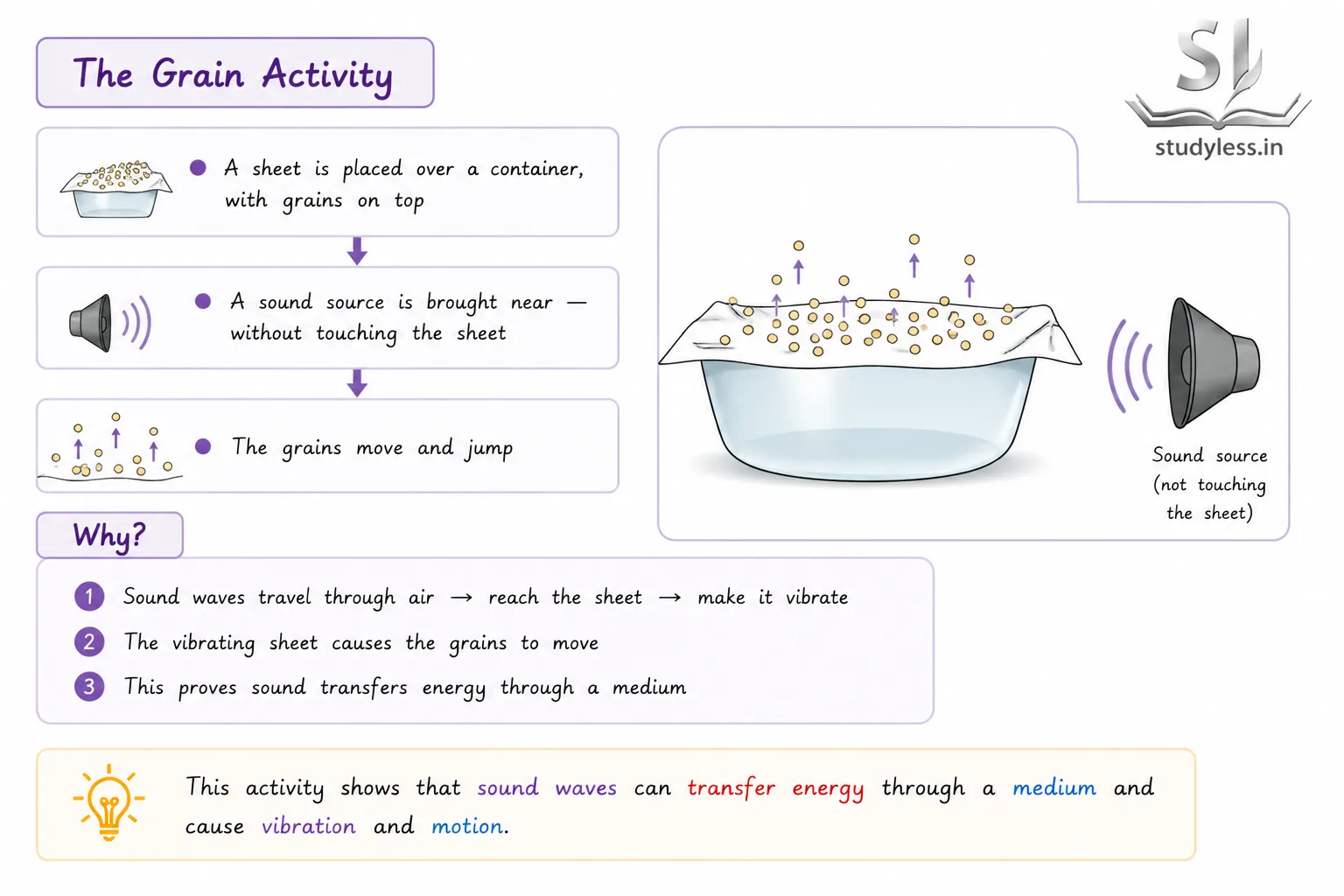
The Grain Activity
● A sheet is placed over a container, with grains on top
● A sound source is brought near — without touching the sheet
● The grains move and jump
Why?
Beacuse:
● Sound waves travel through air ➜ reach the sheet ➜ make it vibrate
● The vibrating sheet causes the grains to move
● This proves sound transfers energy through a medium
Graphical Representation of a Sound Wave
The Graph
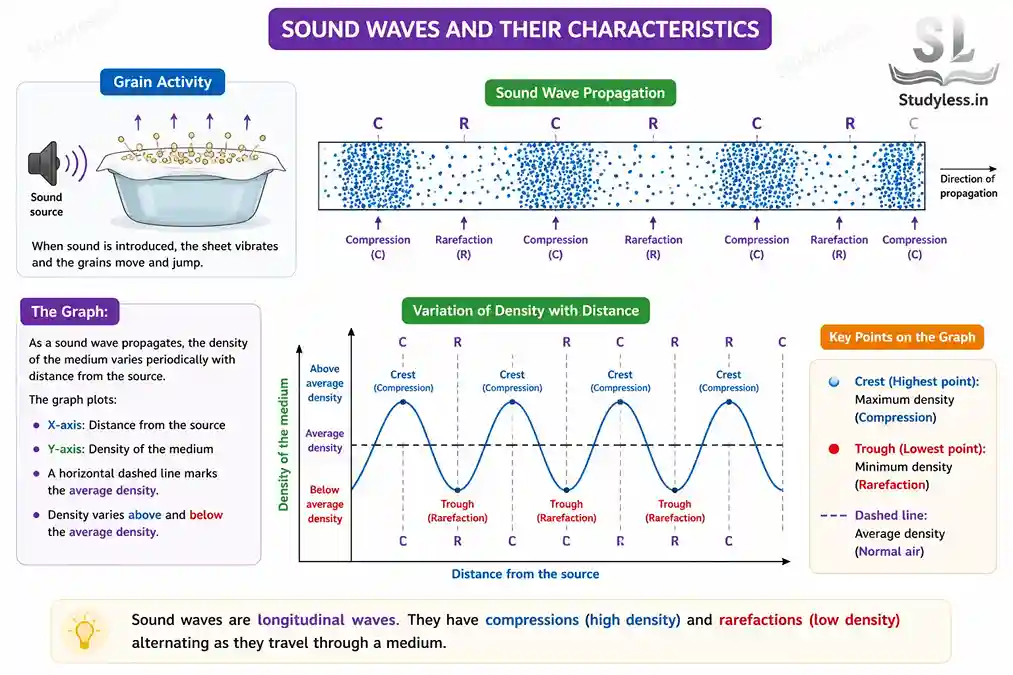
As a sound wave propagates, the density of the medium varies periodically with distance from the source
The graph plots:
Y-axis ➜
Density of the medium
X-axis ➜
Distance from the source
A horizontal dashed line marks the average density
Density varies above and below the average density
💡 In Simple Words
The graph is like a wave — it goes up where air is compressed and down where air is spread out.
Key Points on the Graph
Compression (C) ➜ density rises above average ➜ shown as a peak
Rarefaction (R) ➜ density falls below average ➜ shown as a trough
| Point on Graph | What it Represents | Region |
|---|---|---|
| Crest (highest point) | Maximum density | Compression |
| Trough (lowest point) | Minimum density | Rarefaction |
| Dashed line | Average density | Normal air |
Characteristics of a Sound Wave
Wavelength, frequency and time period
Wavelength (λ)
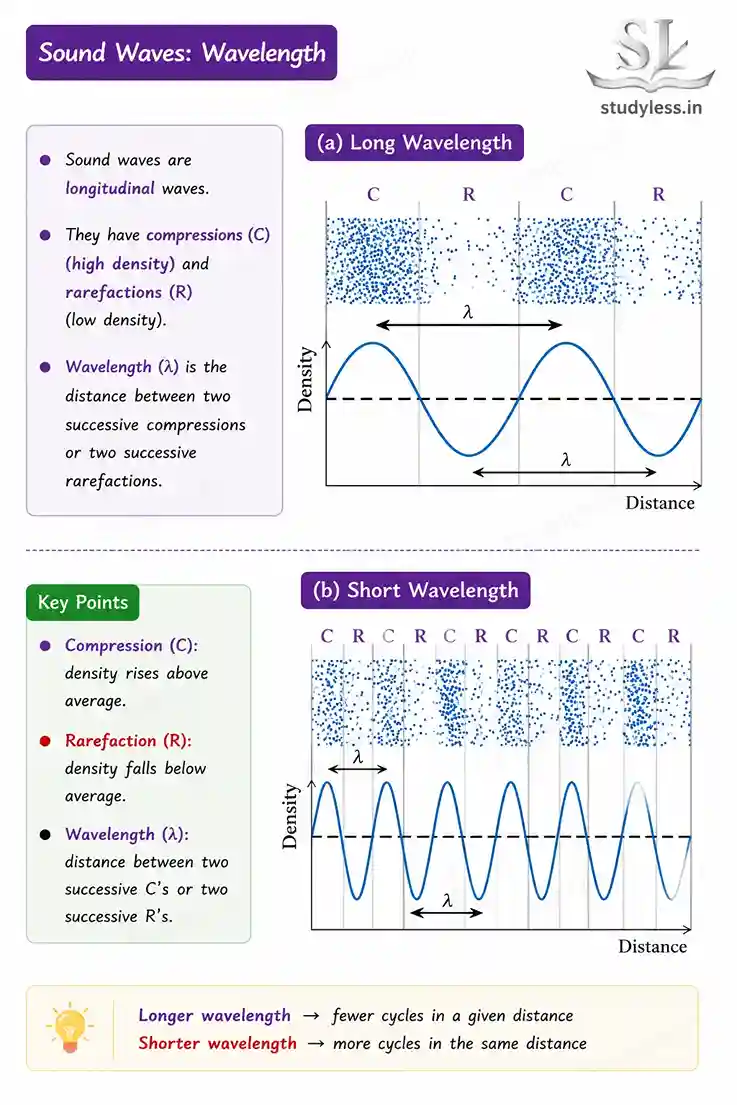
Wavelength = distance between two consecutive crests or two consecutive troughs
● Represented by λ (Greek letter lambda)
● SI unit ➜ metre (m)
● A longer wavelength = more spread out wave
● A shorter wavelength = more compressed wave
💡 In Simple Words
Wavelength is just the length of one complete “up-down” cycle of the wave.
Frequency (ν)
Frequency = number of complete density oscillations at a fixed point per unit time
● One complete oscillation = density goes from maximum ➜ minimum ➜ maximum (or vice versa)
● Represented by ν (Greek letter nu)
● SI unit ➜ per second (s⁻¹) also called hertz (Hz)
Time Period (T)
Time Period = time taken for one complete density oscillation at a fixed point
● Represented by T
● SI unit ➜ second (s)
Relationship Between Frequency and Time Period
● Frequency and time period are inversely related
● Higher frequency = shorter time period
➽ Formula:
| Quantity | Symbol | Definition | SI Unit |
|---|---|---|---|
| Wavelength | λ (lambda) | Distance between 2 consecutive crests or troughs | metre (m) |
| Frequency | ν (nu) | No. of oscillations per unit time | hertz (Hz) or s⁻¹ |
| Time Period | T | Time for one complete oscillation | second (s) |
Nearly Single Frequency Sounds
Everyday sounds contain a mixture of many frequencies
Nearly single frequency sounds are produced by:
● Striking a tuning fork
● Oral whistling
Amplitude and intensity of the sound waves
Amplitude
Amplitude = the maximum change in density of air in a compression or rarefaction, compared to the average density
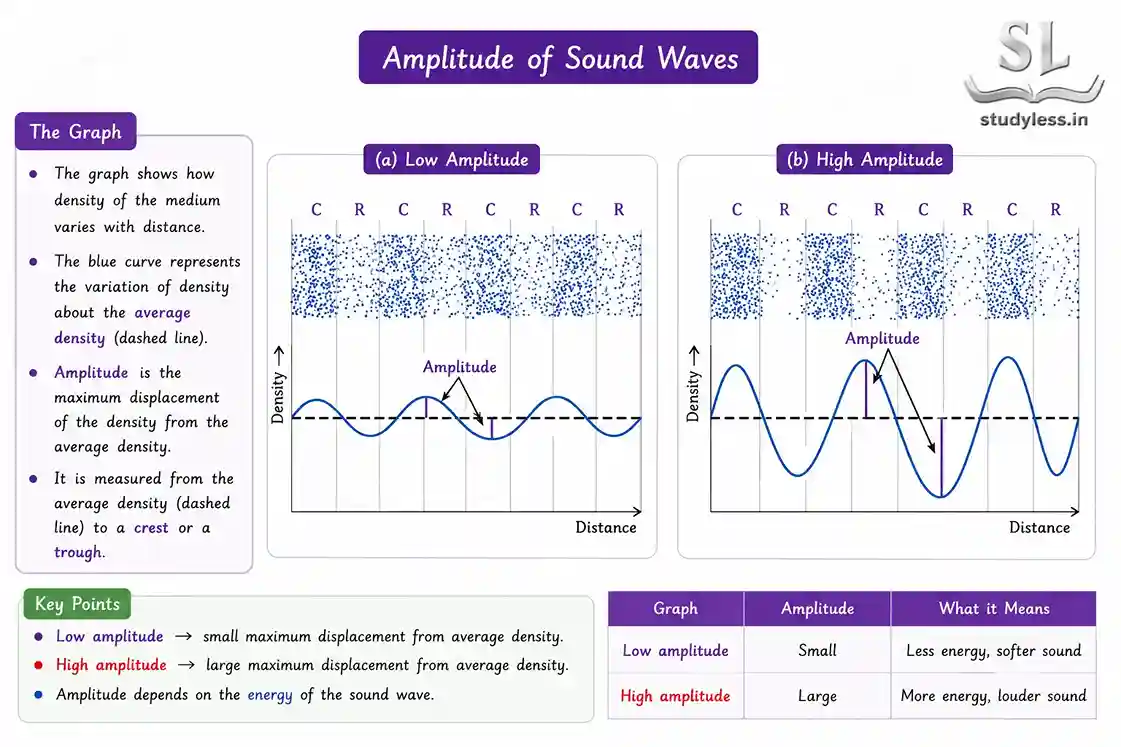
● Sound propagates as density oscillations via compressions and rarefactions
● Larger change in density = larger amplitude
● A wave with larger amplitude carries more energy
● A wave with smaller amplitude carries less energy
💡 In Simple Words
Amplitude is basically how “strong” the compression or rarefaction is. Louder sounds = bigger amplitude.
Amplitude and Energy — The Grain Activity
When a plate is struck harder:
● More energy is transferred to surrounding medium particles
● Particles undergo larger displacements from their mean positions
● The sheet vibrates more
● The grains jump higher
This proves ➜ larger amplitude = more energy
Intensity of Sound
Intensity = amount of sound energy passing through a unit area (perpendicular to direction of propagation) in a unit time
How Intensity Changes with Distance
● As sound travels away from the source, it spreads over a larger area
● The same energy is now spread over a larger area
● So, intensity decreases with increasing distance from the source
● Sounds with larger initial amplitude carry more energy ➜ travel a larger distance before intensity drops to zero
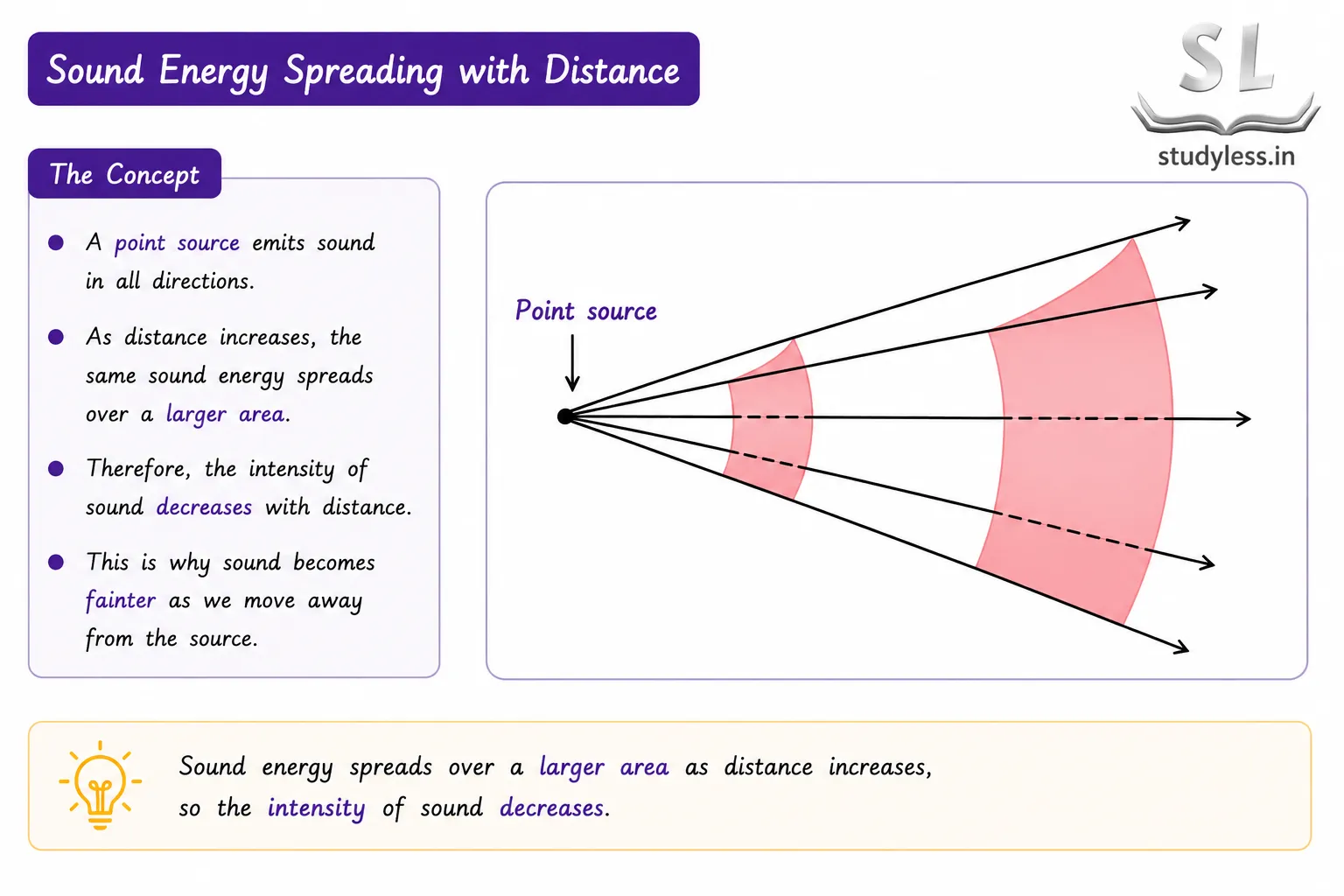
over a larger area with distance| Ch 10 Notes Sound Waves Characteristics And Applications
| Factor | Effect on Intensity |
|---|---|
| Increasing distance from source | Intensity decreases |
| Larger amplitude | Higher intensity, travels farther |
| Smaller amplitude | Lower intensity, travels shorter distance |
Speed of Sound
Speed of sound = how fast density disturbances (compressions and rarefactions) propagate through a medium
More precisely ➜ the distance a point on a wave (like a crest or trough) travels in unit time
Deriving the Formula
A sound wave covers one wavelength (λ) in one time period (T)
Using: speed = distance / time
Since ν = 1/T, substituting:
Speed = Wavelength × Frequency
Speed of Sound in Different Media
Speed of sound depends on the medium it travels through
Solids ➜ fastest, Liquids ➜ slower, Gases ➜ slowest
| Medium | Speed Compared to Air |
|---|---|
| Gases (e.g., air) | Slowest — base reference |
| Liquids (e.g., water) | ~4–5 times faster than air |
| Solids | ~15–20 times faster than air |
💡 In Simple Words
Denser and more rigid the medium, faster the sound. Particles in solids are closely packed, so they pass on the disturbance much quicker.
Speed of Sound in Air
● The speed of sound in air depends on temperature and humidity
● As temperature increases ➜ speed increases
● As humidity increases ➜ speed increases
Speed of sound in dry air:
At 0°C ➜ 331 m/s
At 22°C ➜ 344 m/s
Human perception of sound
Physical vs Perceived Sound
● Physical properties of sound (time period, wavelength, frequency, amplitude, speed) are measurable
● How we experience sound is subjective — described by loudness and pitch
Pitch
Pitch = how frequency is perceived by humans
● High pitch ➜ shrill sounds (e.g., whistle, siren) ➜ higher frequency
● Low pitch ➜ deep sounds (e.g., thunder, aircraft rumble) ➜ lower frequency
💡 In Simple Words
Pitch is just your brain’s way of sensing frequency. High frequency = sounds sharp and shrill.
⚠️ Exam Alert
Pitch depends on frequency — higher frequency = higher pitch
Human Hearing Range
- Humans can only hear sounds within a limited frequency range
- Audible range = 20 Hz to 20,000 Hz (20 kHz)
- This range varies person to person and decreases with age
| Type | Frequency Range | Heard by Humans? | Examples of Animals |
|---|---|---|---|
| Infrasonic waves | Below 20 Hz | ❌ No | Elephants |
| Audible sound | 20 Hz – 20 kHz | ✅ Yes | Humans |
| Ultrasonic waves | Above 20 kHz | ❌ No | Dogs, cats, bats, dolphins |
Loudness
Loudness = how humans perceive the amplitude of a sound wave
● Larger amplitude ➜ sound heard louder
● Smaller amplitude ➜ sound heard softer
● Loudness decreases as we move farther from the source
💡 In Simple Words
Loudness is your brain’s version of amplitude. More amplitude = louder sound.
Loudness vs Intensity
Often used interchangeably in everyday language — but they are different
| Intensity | Loudness | |
|---|---|---|
| Nature | Measurable physical quantity | Subjective — depends on listener |
| Depends on | Energy per unit area per unit time | Listener’s hearing ability |
Reflection of Sound
Sound waves bounce off solid or liquid obstacles — this is called reflection of sound
Sound follows the same laws of reflection as light:
Laws of Reflection of Sound
● The angle of incidence = angle of reflection
● The incident ray, reflected ray, and normal all lie in the same plane
Echo
Echo = hearing your own sound again after it reflects off a distant hard surface
Common examples: shouting near a mountain, cliff, or long corridor
Why Can’t We Hear Echoes Everywhere?
● The human brain can distinguish two sounds only if the time gap is at least 0.1 s
● If the gap is less than 0.1 s, the brain merges them ➜ no clear echo heard
● In a small room, reflections arrive too quickly ➜ no echo
Minimum Distance for an Echo
● Speed of sound = 340 m/s
● Distance sound travels in 0.1 s:
Distance = 340×0.1=34 m (total — to wall and back)
Minimum echo distance = 34 ÷ 2 = 17 m (from source to reflecting surface)
Surfaces and Echo
● Hard, smooth surfaces ➜ reflect sound well ➜ stronger echo
● Soft surfaces (e.g., curtains) ➜ absorb sound ➜ weaker echo
● Rough surfaces ➜ scatter sound in all directions ➜ echo not heard clearly
Reverberation
● In large halls, sound undergoes multiple reflections from walls
● These reflections make sound persist even after the source stops
● This phenomenon is called reverberation
● Occurs when reflections arrive with a time difference of less than 0.05 s
💡 In Simple Words
Reverberation is like many echoes blending together into a prolonged sound.
| Feature | Echo | Reverberation |
|---|---|---|
| Number of reflections | Single reflection | Multiple reflections |
| Time gap | At least 0.1 s | Less than 0.05 s |
| Where heard | Open spaces, cliffs | Large halls, auditoriums |
| Effect | Sound heard again clearly | Sound persists after source stops |
Controlling Reverberation in Auditorium
● Modern auditoriums are architecturally designed for desirable reverberation
● To reduce unwanted reverberation, they use:
Sound absorbing panels
Upholstered chairs
Curtains and soft, porous surfaces
Ultrasonic and Infrasonic Waves, and their Applications
Tap or Click to know more
Echolocation
Echolocation = the ability to locate objects using reflected sound waves
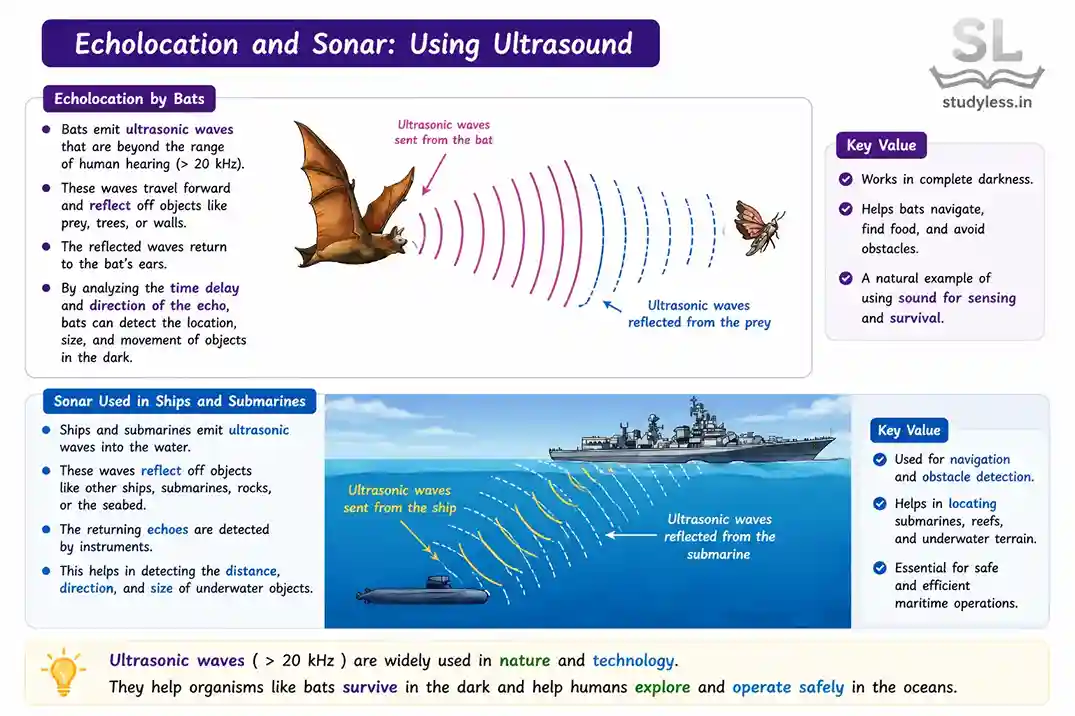
● Bats are nocturnal (active at night) — they fly and hunt in the dark
● Bats emit short bursts of ultrasonic waves
● These waves reflect off nearby objects ➜ echoes return to the bat
● By sensing the echoes, bats can determine the position of obstacles and prey
💡 In Simple Words
Bats use sound like a torch — they “shine” ultrasonic sound and “see” objects from the echoes that bounce back.
Other animals that use echolocation:
● Dolphins and whales ➜ navigation and hunting
● Some birds ➜ navigation
SONAR
SONAR = Sound Navigation And Ranging
Humans adapted the principle of echolocation for underwater exploration
Ultrasonic waves are sent into water
The reflected waves are analysed to find:
● Distance of underwater objects
● Direction of underwater objects
● Speed of underwater objects
Used to detect submarines, shipwrecks, and map the ocean floor
| Feature | Echolocation (Bats) | SONAR (Humans) |
|---|---|---|
| Used by | Bats, dolphins, whales | Ships, submarines |
| Type of wave | Ultrasonic | Ultrasonic |
| Medium | Air | Water |
| Purpose | Locate prey/obstacles | Detect underwater objects |
| Principle | Reflection of sound | Reflection of sound |
End Of Notes- Sound Waves: Characteristics and Applications
Conclusion: Ch 10 Notes Sound Waves Characteristics And Applications
1. Sound is a mechanical longitudinal wave that transfers energy through medium oscillations (compressions and rarefactions) rather than the physical travel of particles.
2. Physical properties like frequency and amplitude are the objective drivers behind our subjective perception of pitch and loudness, enabling technologies like SONAR through predictable reflection.

![When Will The New Class 9 Social Science [SST] NCERT be available Online](https://studyless.in/wp-content/uploads/2026/05/When-Will-The-New-Class-9-Social-Science-SST-NCERT-be-available-Online-1200x675.webp)

![Class 9 New NCERT Social Science[SST] Textbook 2026-2027](https://studyless.in/wp-content/uploads/2026/06/Class-9-New-NCERT-Social-ScienceSST-Textbook-2026-2027-2.webp)