Looking for a quick and easy way to revise your science chapter 12? Our How Nature Works In Harmony Notes Class 8 Biology revision provides a comprehensive yet simplified look at the interactions within our environment.
Covering essential topics like biotic and abiotic components, food webs, and the impact of the Green Revolution, How Nature Works In Harmony Notes Class 8 is perfect for school exams and competitive tests.
Master the concepts of coexistence and ecological balance with this expert-curated How Nature Works In Harmony Notes Class 8 quick revision guide.
How Do We Experience and Interpret Our Surroundings?
1. Habitat
A habitat is the place where an organism lives.
Living things interact with each other and adapt to survive in their surroundings
2. Components of a Habitat
| Component | Definition | Examples |
|---|---|---|
| Biotic | Living beings in a habitat | Fish, frogs, plants, birds |
| Abiotic | Non-living things in a habitat | Water, soil, air, sunlight, temperature |
3. Two Habitats Compared
| Point of comparison | Pond | Forest |
|---|---|---|
| Biotic [living] | Fish, frogs, turtles, snakes, dragonflies, mosquitoes, snails, ducks, algae, diatoms, duckweeds, lotus | Plants, trees, birds |
| Abiotic [non-living] | Water | Soil |
| Common Feature | Both have biotic + abiotic components | ← Same |
| Difference | Types of living beings and Non-living things vary | Fish, frogs, turtles, snakes, dragonflies, mosquitoes, snails, ducks, algae, diatoms, duckweeds, lotus |
4. How Organisms Get Their Needs from a Habitat
- A pond provides fish with:
- Biotic needs → Food (from small plants and animals)
- Abiotic needs → Oxygen (from water)
A habitat provides food, oxygen, shelter, and space to grow.
5. Coexistence in the Same Habitat
- Different organisms in the same habitat may use resources in different ways.
- Example: A snake (active at night) and a rodent (active during the day) both live in a forest but face different conditions.
- This is how living organisms coexist in harmony in the same habitat.
Who All Live Together in Nature?
Population
A group of organisms of the same kind living together in a habitat.
Example:
Many fish of the same kind in a pond = a population of that fish.
Community
Different populations sharing the same habitat.
Eg,
Fish + frogs + plants + microorganisms in a pond
- Includes all biotic components: plants + animals + microorganisms
- These organisms interact and depend on one another for survival.
Why can’t a habitat have only one type of organism?
- Same organisms → same needs (food, water, space) → competition → scarcity of resources
- Hence, different groups of organisms live together in a community.
Does Every Organism in a Community Matter?
Fish → Seed Production in Plants
| Variables | Pond A (With Fish) | Pond B (Without Fish) |
|---|---|---|
| Fish | Present | Absent |
| Dragonflies | Fewer | More |
| Bees/Butterflies | More | Fewer |
| Flowering Plants nearby | More | Fewer |
| Seed Production | Higher | Lower |
The Chain of Interactions:
Fish eat dragonfly larvae → Fewer dragonflies → Fewer bees/butterflies eaten → More pollinators → More pollination → More seeds produced
What This Study Shows:
- Every organism in a community matters — removing or adding one affects others.
- Biotic (fish, dragonflies, pollinators, plants) and abiotic (temperature, water, nutrients) components interact with and affect each other.
Human Impact:
Overfishing can disturb this balance → affects both living (dragonflies, pollinators, plants) and non-living parts of the habitat.
What Are the Different Types of Interactions Among Organisms and Their Surroundings?
Three Types of Interactions in a Habitat
1. Biotic and Abiotic
- Earthworms live in moist soil
- Fish need water
👉 Living things need non-living things
2. Abiotic and Abiotic
- Sunlight causes heat
- Sunlight causes evaporation
- Air forms waves
👉 Non-living things affect each other
3. Biotic and Biotic
- A frog eats insects
- Snake eats fish
- Frog and fish compete
👉 Living things eat or compete
Ecosystem
Biotic (plants, animals, microorganisms) + Abiotic (air, water, soil, sunlight, temperature) components interacting together in a habitat.
Ecosystems can be large or small and can overlap.
| Types of ecosystem | Examples |
|---|---|
| Aquatic | Ponds, rivers, lakes |
| Terrestrial | Forests, farms, large trees |
| Human-made | Farmland |
Biotic depends
on Abiotic:
- Sunlight + CO₂ + water → food production in plants
- Soil → nutrients + medium for plant growth
- Air → oxygen for respiration
- Water → essential for all living organisms
Abiotic depends
on Biotic:
- Plants release oxygen (photosynthesis)
- Roots hold soil, prevent erosion
- Plants retain moisture and cool the atmosphere
Producers & Consumers
Producer/Autotroph
Makes its own food via photosynthesis.
(auto = self, troph = food) → Plants
Consumer/Heterotroph
Cannot make its own food; depends on other organisms.
(hetero = other, troph = food)
| Type | Diet | Examples |
|---|---|---|
| Herbivore | Only plants | Deer, hare |
| Carnivore | Only animals | Leopard |
| Omnivore | Both plants & animals | Crow, fox, mice |
Who Eats Whom?
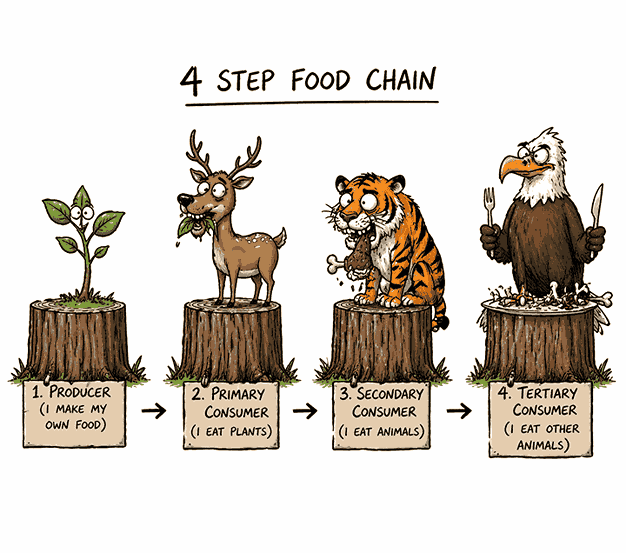
Food Chain
A simple sequence showing ‘who eats whom’ in an ecosystem.
example:
Grass → Grasshopper → Frog → Snake → Eagle
Arrows indicate the direction of energy flow.
Trophic Levels:
Each organism’s specific position in a food chain.
Pyramid of
Numbers:
- Base = Highest number of organisms (Producers)
- Top = Lowest number of organisms (Large carnivores)
- Example:
Millet (most) → Mouse → Eagle (least)
| Trophic Level | Organism Type | Example |
|---|---|---|
| 1st | Producers | Grass, green plants |
| 2nd | Herbivores | Hare, deer |
| 3rd | Small carnivores | Frog |
| 4th | Large carnivores | Tiger, vulture, eagle |
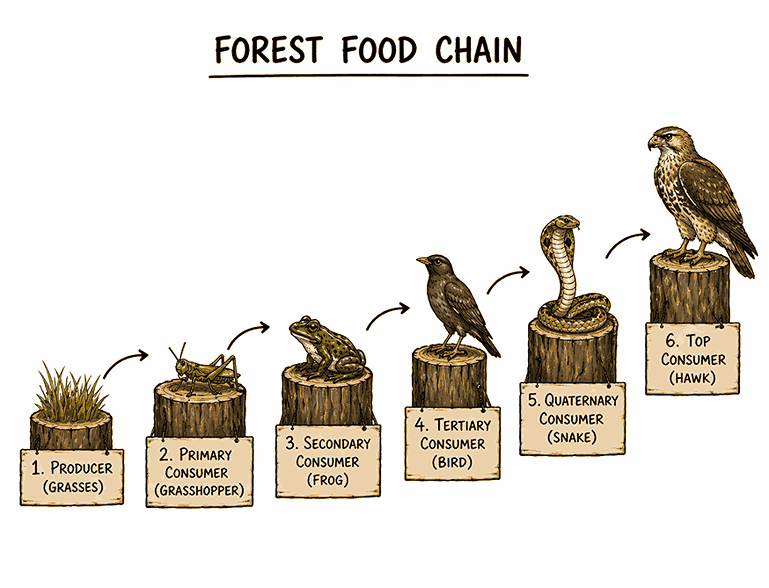
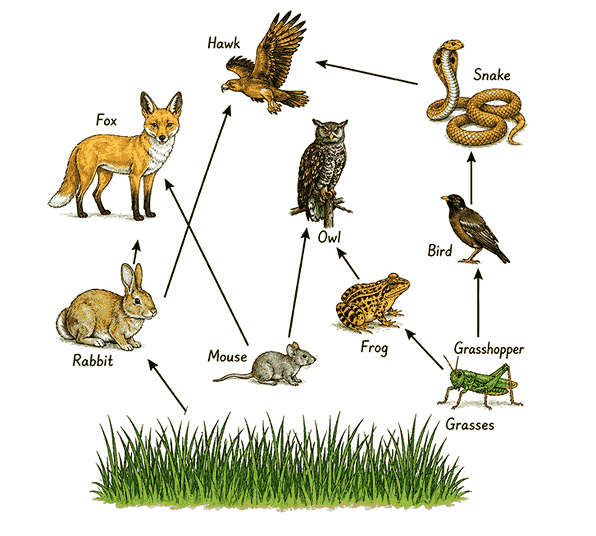
Food Web
▶ Multiple food chains are interlinked with each other, forming a network.
▶ Two or more organisms can eat one organism.
▶ More realistic representation of feeding relationships in an ecosystem.
▶ Food Chain = Linear | Food Web = Network of interlinked food chains
What Happens to Waste in Nature?
Decomposition
The process of breaking down complex substances in dead plants and animals into simpler ones, returning nutrients to the environment.
Decomposers/Saprotrophs
Organisms that carry out decomposition. (sapro = rotten, troph = food)
Examples of decomposers:
Fungi
(mushrooms)
Bacteria
Beetles
Flies
Work of Decomposers
| What Decomposers Do | Detail |
|---|---|
| What they break down | Dead plants, animals, animal droppings (e.g., elephant dung) |
| Where mushrooms grow | On dead plants/trees, especially during the rainy season |
| Result of decomposition | Nutrients recycled back into soil |
| Why soil is fertile | Nutrients recycled back into the soil |
Key Takeaway:
In nature, nothing is wasted — everything is reused.
Decomposers play a critical role in recycling nutrients in an ecosystem.
How Does One Change Lead to Another?
Cascading Effect
One change in an ecosystem triggers a chain of further changes.
Example (Pond Pollution):
Plants die ➔ Less oxygen ➔ Fish population drops ➔ Fewer consumers ➔ Insects increase ➔ Insects spread to farmland ➔ Farmers use pesticides ➔ Environment harmed
Case Study: Frog Export Ban (1980s India)
| The government banned frog leg exports | Effect |
|---|---|
| Large-scale export of Indian Bullfrog legs | Frog population declined |
| Fewer frogs | Insects/pests increased (frogs eat insects) |
| More pests | Farmers used more synthetic pesticides |
| More pesticides | Harmed soil, water, environment & human health |
| Government banned frog leg exports | To prevent further ecological damage |
Ecosystem Balance:
An ecosystem stays balanced when interactions keep populations and resources stable.
● This balance is dynamic (not fixed).
● Can be disrupted by natural or human-made changes.
● Key Principle: Every organism matters ➔ removing one can trigger a harmful chain reaction throughout the ecosystem.
How Do Interactions Maintain Balance in Ecosystems?
Competition
Organisms compete for common resources (food, water, space, sunlight).
- Controls population size → keeps ecosystem balanced.
- Without it → one species multiplies too much → imbalance.
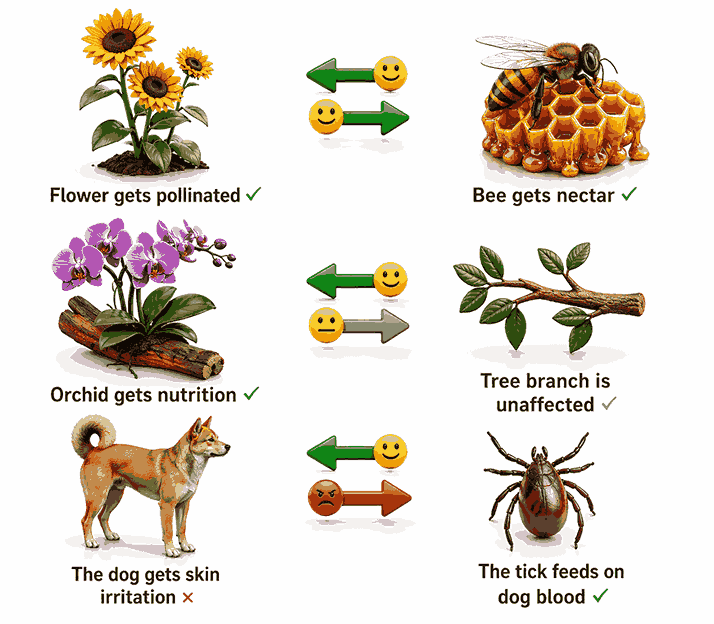
Types of Biological Interactions:
| Type | Who Benefits | Who is Harmed | Example |
|---|---|---|---|
| Mutualism | Both organisms | None | Honeybees & flowers |
| Commensalism | One organism | None (other unaffected) | Orchids on trees |
| Parasitism | One organism | Other is harmed | The other is harmed |
All these interactions together form the complex web of life in an ecosystem.
What Are the Benefits of an Ecosystem?
Benefits of Ecosystems to Humans:
| Ecosystem Type | Benefits |
|---|---|
| Forests | Fresh air, fertile soil, food, fibres, timber, medicines |
| Aquatic | Water, food |
| All ecosystems | Aesthetic & recreational value |
Overuse or misuse of natural resources ➔ disturbs the balance in nature
Sundarbans ➔ A Threatened Ecosystem:
- Location: Where the Ganges & Brahmaputra rivers meet
(India-Bangladesh border) - Significance: World’s largest mangrove forests;
UNESCO World Heritage Site (1987) - Role: Slows winds/waves during storms & floods; trees absorb CO₂ & release O₂
- Threats: Cutting mangroves for fuelwood & farming;
illegal hunting; pollution from industrial waste & untreated sewage
Threats to Other Indian Ecosystems:
Deforestation, overuse of resources, invasive species, unsustainable land use, and pollution ➔ damages forests, rivers, wetlands, grasslands, and coastal areas.
Green Revolution & Its Effects
Green Revolution (mid-20th century):
Use of tractors, machines, synthetic fertilisers & pesticides ➔ increased food production (solved India’s food crisis of 1950–1965).
Why is it now considered unsustainable?
- Overuse of synthetic chemicals
- Excessive groundwater extraction
- Monoculture (growing one crop repeatedly) ➔ reduces crop diversity, affects pollinators
Harmful Effects of Synthetic Fertilisers & Pesticides:
| Practice | Harm Caused |
|---|---|
| Overuse of synthetic fertilisers | Decreases friendly microorganisms & humus ➔ soil erosion |
| Pesticide overuse | Reduces natural predators ➔ pest population increases |
| Heavy irrigation & repeated ploughing | Disturbs earthworms & snails ➔ ecological imbalance |
| Monoculture | Reduces crop diversity; harms pollinators |
| Pesticide overuse (long term) | Pesticide overuse (long-term) |
Solution ➔
Sustainable Farming:
- Organic & natural farming methods
- Reduce synthetic fertilisers
- Minimal interference in natural ecosystems
- Protects soil, environment & food security
FAQs: How Nature Works In Harmony Notes Class 8
1. Why should I use these How Nature Works In Harmony Notes Class 8 for my exam preparation?
These notes are specifically designed for quick revision, condensing complex topics like ecosystem dynamics and food webs into easy-to-read points. They help you save time while ensuring you don’t miss out on any critical concepts from the Class 8 Science curriculum.
Do these notes cover the latest Class 8 Science syllabus?
Yes, our How Nature Works In Harmony Notes Class 8 have been updated to align with the current school syllabus. They include important case studies like the Indian Bullfrog export ban and the environmental impact of the Green Revolution.
3. How can these notes help me understand ecological balance?
The notes use simple examples, such as the interaction between fish and seed production, to explain how every organism plays a role in nature. By breaking down biotic and abiotic interactions, they make the concept of harmony in nature easy to grasp.
4. Are these notes suitable for last-minute revision?
Absolutely! We have included tables, bullet points, and clear definitions of terms like “Decomposers” and “Trophic Levels,” making them the perfect tool for a quick review the night before your exam.
5. Do these notes include information on sustainable practices?
Yes, these notes highlight the importance of sustainable farming and the conservation of threatened ecosystems like the Sundarbans. They explain why maintaining nature’s balance is crucial for our future.