The Rise of the Marathas Short Notes Class 8 is created from Chapter 3 of the NCERT textbook, Exploring Society: India and Beyond | Grade 8 Part 1.
These short notes are not in any sense a replacement for your textbook. It just complements it. To score good marks, you should read and understand the NCERT textbook as many times as possible.
Turn to these notes for quick revision and memorisation.
Who are the Marathas?
Identity & Geography
- Marathas: An ethnic group native to the Deccan plateau, specifically present-day Maharashtra
- Language: Marathi — rich, continuous literary tradition since the 12th century
- Cultural identity = Language + Bhakti traditions
Political Timeline (13th–14th Century)
- 13th Century: Yadava dynasty rules Maharashtra
- Capital: Devagiri (modern Daulatabad)
- Early 14th Century: Yadavas defeated by the Khilji Sultanate (Delhi)
- Key Fact: Political change ≠ , Cultural disruption; traditions continued uninterrupted
Bhakti Movement: Cultural Foundation (7th–17th Century)
- Bhakti: Path of personal devotion over ritualism; accessible to all castes
- Saints composed devotional poetry in local languages → mass appeal
- Impact in Maharashtra:
- ✅ Spiritual upliftment of common people
- ✅ Translation of Upaniṣhads & Bhagavad Gītā into Marathi
- ✅ Social organisation + political awareness (parallel to Sikh Gurus)
- ✅ Built unified cultural identity → later enabled political mobilisation
Key Saints & Contributions
| Saint | Key Contribution | Exam Keyword |
|---|---|---|
| Dnyaneshwar | First Marathi translation of Bhagavad Gītā; philosophical commentary | Dnyaneshwari |
| Namdev | Composed abhangas (devotional songs); preached equality | Varkari tradition |
| Tukaram | Popularised bhakti through simple Marathi poetry; social reform | Abhangas, Gatha |
| Ramdas | Spiritual mentor to Shivaji; emphasized duty, organisation, patriotism | Dasbodh |
Foundation of Maratha Power and the Rise of Shivaji
Shivaji: Birth and Early Life
Born
1630
Clan
Bhonsle
Father
Shahji
Mother
Jijabai
- Upbringing: Raised in Pune Jagir under Jijabai and trusted officials
- Education: Received strong moral values and a comprehensive education
Early Military Campaigns (Age 16 Onwards)
First objective: Consolidate control over the Pune region
- Strategy:
- Captured neglected/unoccupied forts; strengthened their defences
- Core vision: Swarājya — sovereign, self-ruled kingdom integrating political, economic, and cultural dimensions
Naval Strategy: A Revolutionary Initiative
Expansion:
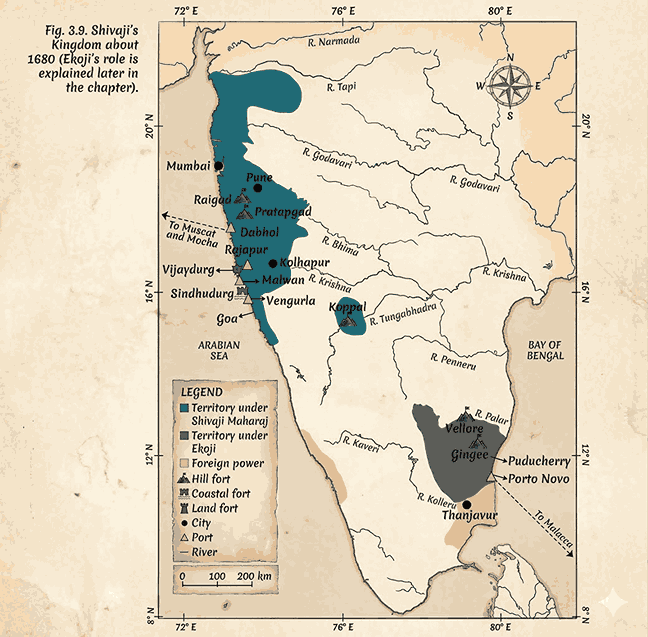
- Kingdom reached India’s west coast
- Naval initiative: Established a full-time Maratha Navy to secure coastal resources and enable trade protection
Comparison: Naval Capabilities in 17th Century India
| Power | Naval Status | Limitation |
|---|---|---|
| Marathas (Shivaji) | Full-time, dedicated naval force | None noted |
| Bijapur Sultanate | Merchant ships only; no standing navy | Could not protect coast effectively |
| Mughal Empire | Very limited naval use | Could not protect the coast effectively |
Guerrilla Warfare: Core Military Tactic
Definition:
Use of small, mobile groups employing speed, surprise, and terrain knowledge to defeat larger armies
- Purpose: Protect people from numerically superior enemies
- Key advantage: Leveraged the mountainous terrain of the Western Ghats for tactical superiority
Afzal Khan Episode: Decisive Victory
Threat: The Bijapur Sultanate sent veteran general Afzal Khan to eliminate Shivaji
• Shivaji’s counter-strategy:
- Convinced Afzal Khan to meet one-on-one at Pratapgad fort foothills (thick forest location)
- Killed Afzal Khan during the meeting
- Hidden Maratha forces launched coordinated guerrilla attacks
- Outcome:
- Afzal Khan’s army was routed; the Maratha military reputation was significantly enhanced
Shivaji’s Conflicts with the Mughals
Shaista Khan Campaign (1660s)
1. Shaista Khan:
Mughal nobleman; invaded Shivaji’s territories with a large army for three years
2. Shivaji’s counter-raid:
Night attack on Khan’s camp with a few soldiers
3. Outcome
Khan barely escaped, lost fingers, and left Maharashtra immediately
4. Significance:
Daring raid resembles modern surgical strike; it demonstrated Shivaji’s tactical brilliance
Sacking of Surat: Strategic Raids
First sack
Retaliatory action against the Mughal Empire for Shaista Khan’s attacks
Surat
Wealthy Mughal port city in present-day Gujarat
Treasure obtained: Approximately one crore rupees — an extremely large sum for the period
Conduct during the raid
- Did NOT attack religious places
- Spared the house of Mohandas Parekh (a known charitable man)
- Second sack: Conducted again after a few years
- International attention: Events reported in the London Gazette (English newspaper)
- Diplomatic message: Shivaji wrote to European agents in Surat demanding “immediate presents of money” or threatened to “return and ruin that city”
Treaty of Purandar (1665)
1. Mughal response
Sacking of Surat = major insult to imperial prestige
2. Aurangzeb’s action
Sent Jai Singh, distinguished Rajput general, to defeat Shivaji
3. Battle outcome
Shivaji conceded defeat at Purandar Fort (near Pune)
4. Treaty terms
- Shivaji surrendered a sizeable portion of his kingdom to the Mughals
- Son Sambhaji was required to enter Mughal service
Agra Visit and Dramatic Escape (1666)
Jai Singh persuaded Shivaji to visit the Mughal court at Agra
Humiliation at court:
- Made to stand before Aurangzeb and a Mughal general he had previously defeated
- Shivaji stormed out in protest
- Consequence: Placed under house arrest by Aurangzeb
- Escape strategy:
- Began distributing gifts (fruits and sweets in large baskets) to holy men and Mughal generals
- Guards initially inspected baskets, then stopped checking due to routine
- Shivaji and Sambhaji hid inside baskets and escaped undetected
- Outcome: Aurangzeb never captured Shivaji again
Shivaji’s Coronation, Southern Campaign, and Legacy
Coronation at Raigad (1674)
Year: 1674;
Location: Raigad fort
Ceremony
Conducted with full Vedic rites
Formal title:
Shri Raja Shiva Chhatrapati
New era:
Started Rājyābhiṣheka shaka
(royal coronation era)
Southern Conquest: Dakṣhiṇa-Digvijaya
Objective: Expansion into South India post-coronation
Regions targeted:
- Present-day northern Tamil Nadu (then ill-defended)
- Parts of Karnataka
- Strategic significance: Southern extension provided great strategic depth against future Mughal invasions
- Long-term impact: Enabled Marathas to sustain resistance and expand influence in Deccan and beyond
Death and Historical Assessment of Shivaji
Death: Died of fever at age fifty
Recognised as a master strategist and true visionary during his lifetime • Legacy scope: Exploits became legendary across India and beyond
Contemporary Recognition and Influence
| Source | Recognition/Action | Significance |
|---|---|---|
| Europeans | Compared Shivaji with Alexander the Great | Acknowledged military genius at the international level |
| Chhatrasal (Bundela prince) | Inspired by Shivaji’s anti-Mughal struggle; founded an independent Bundelkhand kingdom | Demonstrates Shivaji’s influence beyond Maharashtra |
| Poet Bhushan (Hindi) | An acknowledged military genius at the international level | Cultural impact; cross-regional admiration |
DON’T MISS OUT
- Shivaji banned the Dutch slave trade.
- Europeans sold Indians as slaves.
The Marathas after Shivaji
Succession and Immediate Aftermath
Shivaji’s sons: Sambhaji (elder) and Rajaram
- Sambhaji’s reign: Became Chhatrapati after Shivaji’s death
- Strategic position: Marathas = only obstacle to total Mughal control of the Deccan
Aurangzeb’s Deccan Campaign and Sambhaji’s Martyrdom
Aurangzeb’s actions
- Invaded Deccan; conquered Bijapur (Adil Shahi) and Golconda (Qutb Shahi) Sultanates
- Captured Sambhaji, subjected him to brutal torture, then executed him
- Captured Raigad, the Maratha capital
Outcome: Temporary Mughal advantage, but Maratha resistance continued
Rajaram’s Leadership and Southern Shift
- Rajaram’s accession: Became Chhatrapati after Sambhaji’s execution
- Strategic move: Fled to Gingee (= Tamil Nadu)
- Conflict expansion: The Mughal-Maratha war spread to South India
Military performance:
- Marathas staunchly defended fortresses
- Often gained the upper hand in battles and skirmishes
Aurangzeb’s stalemate:
- Unable to leave Deccan due to persistent Maratha resistance
- Died without subduing the Marathas
- Marathas emerged as strong contender to Mughal power
Tarabai’s Offensive Campaigns
Tarabai, queen of Rajaram
Marathas moved from a defensive to an offensive posture
Actions:
- Made large-scale inroads into Mughal territories
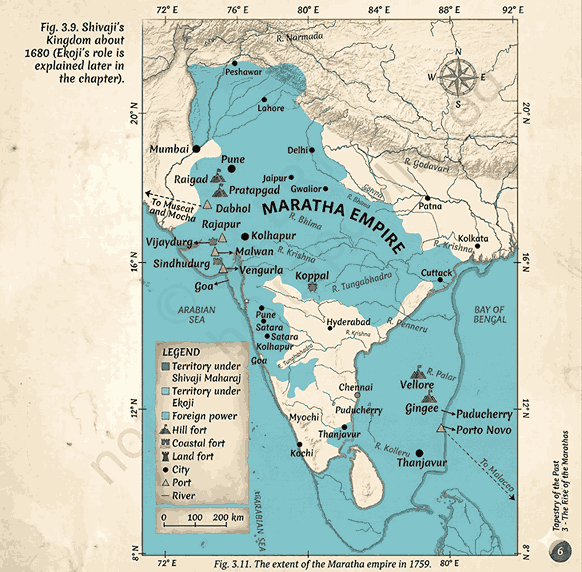
- Eventually, it conquered large parts of India
DON’T MISS OUT
- Nana Phadnavis – Peshwa official.
- Organised rganised the first pan-Indian anti-British alliance.
- United with Hyder Ali of Mysore and the Nizam of Hyderabad.
- They joined against the British.
Structural Transformation of Maratha Polity
- Shivaji’s era: Centralised state under Chhatrapati
- Post-Shivaji evolution: Shift to decentralised structure
- Regional chiefs wielded increased power
Rise of the Peshwa:
- Peshwa = Persian term for ‘prime minister.’
- Gained great influence, even over the Chhatrapati
- Became the de facto executive authority in the later period
Maratha Expansion and Decline
Governance and Administrative Challenges
• Decentralisation issue:
Regional chiefs acquired more power and autonomy
• Negative consequence:
Occasional indiscipline and abuse — stark contrast with Shivaji’s values
Example: Ten-year campaign in Bengal → inflicted cruelty and devastation on common people
Northward Expansion and Key Campaigns
• Territories controlled
Lahore, Attock, Peshawar (modern-day Pakistan)
• Conflict with Afghans
Ongoing military engagement in the northwest frontier
• Third Battle of Panipat (1761)
Disastrous defeat for Marathas
• Recovery
Quick resurgence under Peshwa Madhavrao I
• Delhi recaptured (1771)
Under Mahadji Shinde (also known as Mahadji Scindia)
• Delhi under Maratha control
From 1771 until British capture (~1803, three decades later)
Anglo-Maratha Wars: Final Phase
Marathas = chief rivals of the British in India
Three Anglo-Maratha Wars: Fought between 1775 and 1818
Factors in British Victory over Marathas
| Factor | Maratha Position | British Advantage |
|---|---|---|
| Internal unity | Increased disunity among regional chiefs | Centralised command and coordination |
| Organisation | Decentralised structure; less coordinated | Superior organisational abilities |
| Technology | Traditional military methods and equipment | Superior technological abilities |
- Outcome: The British succeeded in ending Maratha power by 1818
- Historical significance: The British acquired India more from the Marathas than from the Mughals or any other power
Also Read| Natural Resources and Their Use Short Notes
Maratha Administration
Civilian administration
• Centralised structure:
Shivaji instituted a relatively centralised administration for his kingdom
• Abolished hereditary posts:
Ended practice common under Sultans/Mughals; prevented power concentration
• Salary system:
All government officials are paid a fixed salary from the state treasury (not land assignments)
• Periodic transfers:
Officials regularly transferred to prevent the accumulation of local power
Welfare measures:
- Pensions provided to the widows of soldiers killed in battle
- Military posts were offered to the sons of deceased soldiers
- Demonstrated state care for military families
Ashta Pradhana Mandala: Council of Eight Ministers
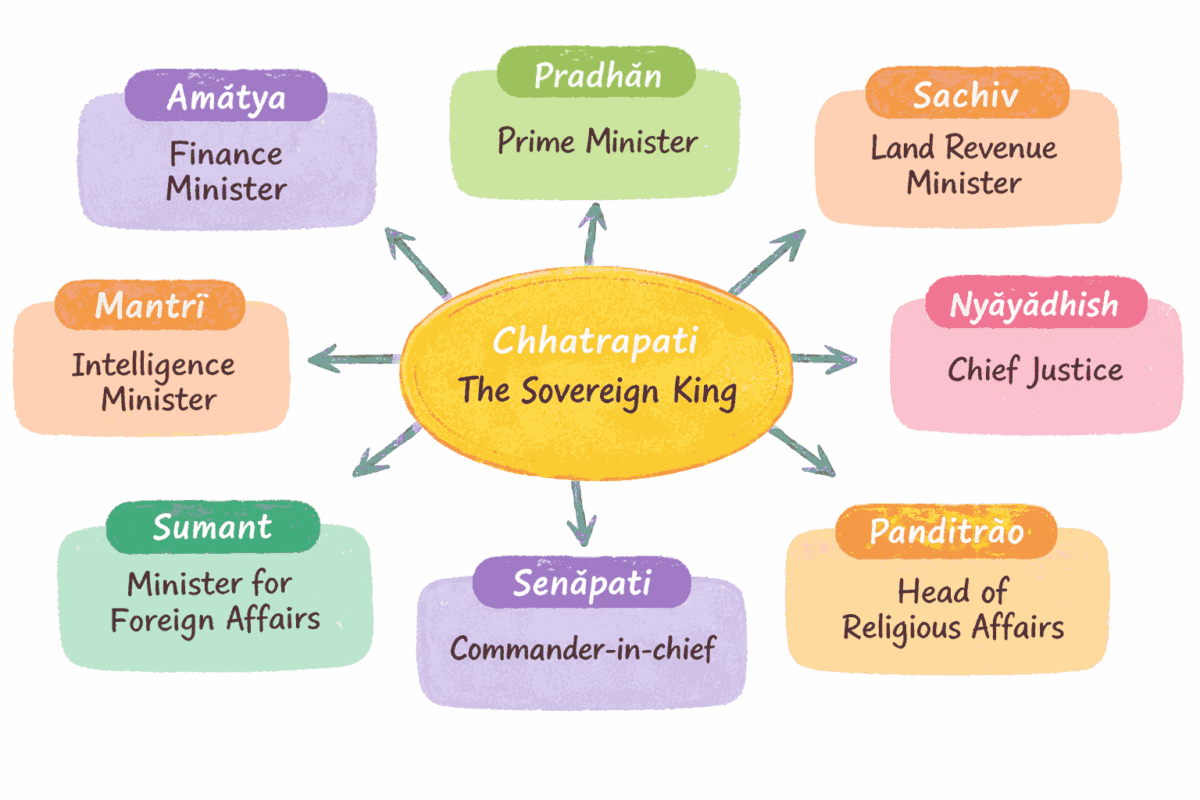
Aṣhṭa pradhāna manḍala = council of eight ministers assisting Shivaji
• Function:
Advised on administration, finance, military, foreign affairs, and justice
• Significance:
Early example of cabinet-style governance in the Indian polity
Taxation System: Chauth and Sardeshmukhi
• Chauth:
25 per cent tax levied on provinces not directly under Maratha control
• Sardeshmukhi:
An additional 10 per cent tax over chauth (total 35 per cent when combined)
These taxes were levied in the Deccan and north India regions outside direct Maratha rule
In return, Marathas provided:
- Protection from external aggression
- Non-interference in the internal administration of those provinces
- The Mughals approved arrangements through various treaties
- Some of the taxed provinces eventually integrated into the Maratha Empire
DON’T MISS OUT
Maratha Coinage — Cultural Synthesis
• Adoption of Mughal style: Marathas used Mughal-style coinage due to its popularity
• Cultural adaptation:
Added distinct Maratha symbols to the standard Mughal design — reflected political identity alongside administrative pragmatism
Gaṇapatī-Pantapradhān Rupee
- Minted by: Patwardhans — generals serving under the Peshwa
- Period: Early 19th century
- Scripts used: Bilingual inscription — Devanagari and Persian
- Obverse (front): Invocation to Gaṇapati (Gaṇeśha)
- Reverse (back): Declaration of loyalty to Peshwa, referred to as ‘Pantapradhān’ in Marathi — signified political authority
Military administration
Maratha armed forces are divided into three parts :
infantry, cavalry, navy
Cavalry Classification
• Bārgīrs: Horses and equipment paid for by the state
• Shiledārs: Horses and equipment paid for by soldiers themselves
European-Style Reforms
Marathas noted the superiority of European-style disciplined troops and artillery, so they attempted to raise them—Mahadji Shinde had a large European-style army.
Weapons and
Technology
• Preferred weapons: swords and lances
• Used guns
• Rockets used from Shivaji’s days
• By 1770, metal tube rockets were also used
Forts: Strategic
Foundation
• Forts – mainstay of Maratha power
• Shivaji built several forts
Forts were
essential to:
- Control important routes
- Shelter the army in guerrilla warfare
Administrative
Reference
• Ramachandrapant Amatya,
The finance minister of Shivaji
• Work: Ādnyāpatra (‘The Royal Edict’)
Maritime supremacy
Shivaji created a navy to secure the west coast
Kanhoji Angre’s Leadership (18th Century)
• Victory in many naval battles
• due to clever use of geography and battle tactics
•Achieved despite Maratha ships being less advanced than European ones.
European Naval Dominance and Cartaz System
• Main strength of Europeans in India = their navies
• Forced Indians to purchase naval trade passes (cartaz in Portuguese) at a price
• Ship without a pass was confiscated
Maratha Challenge to European Practice
• Marathas challenged the cartaz system
• Started demanding passes from Europeans
• Europeans labelled Kanhoji Angre a ‘pirate’
DON’T MISS OUT
Shivaji’s Naval Reach: Muscat Episode (1665)
• 1665: Four Maratha ships reached Muscat, Oman
• Omani ruler: Captured ships, arrested crew, prepared attack on Maratha coast
• Shivaji’s 100+ ships made the ruler retreat to the harbour.
Judicial system
Core Features
• Efficient system; moderation in capital punishment
Panchāyat
• Local gathering of officials + prominent men; main justice-delivery body
• Appeal: To the Maratha chief if the verdict is unsatisfactory
Urban Law Enforcement
• Kotwāl/police in prominent towns (Pune, Indore, etc.) for law and order
Trade networks
Maritime Trade
- Shivaji: Encouraged trade; active participation in maritime foreign trade
- Own ships (Shivaji + officials) sent to Mocha (Yemen), Muscat (Oman), Malacca (Malaysia)
- Cargo: Gold, textiles, etc.
Infrastructure
Roads: Constructed + maintained
Riverine transport: Ferry network in Odisha (18th century)
Bridges: Built over rivers + small streams
DON’T MISS OUT
- 1665: Four ships, Shivaji reached Muscat (Oman).
- Ruler captured ships and arrested the crew.
- He prepared ships to attack Shivaji’s coast.
- Hearing of Shivaji’s large navy, he retreated.
Cultural Revival
Shivaji’s Seal
• Sanskrit inscription (departure from Persian seals)
• Text: “Seal of Shivaji, son of Shahji, waxing like a new moon, revered by the world, reigns for the welfare of people”
Language Promotion
• Rājya-Vyavahāra-Koṣha: Treatise commissioned by Shivaji
• Provided Sanskrit equivalents for Persian words in diplomacy
• Result: Reduced foreign loanwords in Maratha diplomatic exchanges
Religious Policy
• Devout Hindu; respected other religions
• Saffron flag adopted by all Marathas
Cultural Actions
• Rebuilt desecrated temples
• Promoted Sanskrit + Marathi literature
• Supported religious institutions + traditional arts
Core Contribution
• Demonstrated mighty empires could be defeated
• Showed Marathas could maintain, expand, and administer their own empire
• Revived ancient Indian culture + values through practical example
The mighty Maratha women
Tarabai
- Role: Fearless warrior queen; ruled after her husband Rajaram‘s death
- Strategic insight: North India unprotected (Aurangzeb + Mughal army in Deccan)
- Action: Organised large Maratha armies; invaded Mughal territories in north
- Legacy: Architect of northward Maratha expansion
- Impact: Military strategy + tenacity outsmarted the Mughal Empire; preserved Maratha independence in a critical period
Ahilyabai Holkar
- Holkar dynasty: Chief family for Maratha expansion in north India; ruled central India (around Indore) in the 18th century
- Governance: Lost husband + son; ruled 30 years; wise administration; cared for common people
- Religious works: Built/restored hundreds of temples, ghats, wells, roads across India (Kedarnath to Rameswaram)
Key restorations:
- Kashi Vishwanath temple (Varanasi) — destroyed by Aurangzeb
- Somnath temple (Gujarat) — destroyed by Mahmud of Ghazni
• Economic contribution: Promoted the Maheshwar weaving industry (Madhya Pradesh); revitalised traditional handloom crafts
DON’T MISS OUT
Moḍī Script
• Moḍī script: Cursive form of Devanagari
• Use: Main script for Maratha correspondence
Bhonsles of Nagpur emerged as enthusiastic supporters of local culture + tradition
Revival of Jagannath Worship
• Jagannath worship at Puri (Odisha): Often interrupted during Mughal rule
• Revived with Maratha support
In focus: Thanjavur
Maratha Rule Establishment
• Ekoji (Shivaji’s half-brother): Conquered Thanjavur (Tamil Nadu) in the late 17th century
• Beginning of the Maratha rule in area
Cultural Contributions
• Thanjavur Marathas: Created a syncretic culture — rich + innovative
• Patronage of arts: Great supporters of music, dance, and literature
• Ruler-scholars: Many rulers were poets + dramatists themselves
Thanjavur: Multilingual Cultural Environment
• Multilingual setting: Mix of Tamil, Telugu, Marathi influences
• Tamil culture: Local tradition • Telugu culture: From former rulers
• Marathi culture: From current Maratha rulers
• Interaction: All three cultures interacted freely with each other
The Maratha legacy
• Challenged Mughal dominance; established the largest Indian empire before the British
• Controlled much of central + northern India
• Efficient administration: New governing model
• Cultural revival: Local Hindu traditions revived without religious discrimination
• Swarājya ideal: Fiery drive behind fight against oppressive/foreign rule
• Inspired self-governance belief among Indians
• Planted early seeds for India’s freedom movement