Federalism is a lengthy, conceptually dense chapter. There are lots of conceptual topics, difficult to learn, revise, and memorise.
Moreover, CBSE has started asking difficult questions and is checking the analytical and understanding skills of the students. And to excel on that, you need to have all the keywords of Chapter 2, Federalism, at your fingertips.
“Federalism Short Notes Class 10” is what you need to master Chapter 2 of Democratic Politics-II for class 10.
Happy Learning!
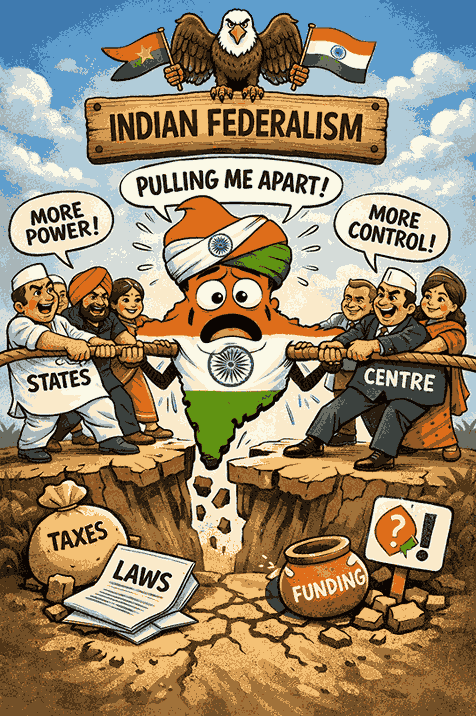
What is federalism?
Federal VS Unitary
Belgium → Federal
- Regional govt. got constitutional powers
- Shifted from a
unitary → federal system
Sri Lanka → Unitary
- National govt. – All powers
- Center can withdraw regional powers
- Tamil leaders demand a federal system
Federalism: Main Idea Definition
Power is divided between the central authority + constituent units
- Two levels of government:
- Central: sees common national interest
- State/Provincial: handles day-to-day state administration
- Both are independent; neither can order the other.
Both are separately answerable to the people.
Federal vs Unitary: At a Glance
| The centre cannot order the state | Federal | Unitary |
|---|---|---|
| Levels | Two independent | One or subordinate |
| Power source | Constitutional | Central-delegated |
| Control | Center cannot order state | The center cannot order the state |
Key Features Of Federalism
1. Two or more tiers of government
2. Same citizens, different jurisdictions: each tier has its own powers in legislation, taxation, and administration
3. Constitutionally specified jurisdictions: existence + authority of each tier guaranteed
4. No unilateral changes: fundamental provisions require consent of both levels
5. Courts as umpire: the highest court interprets the constitution + resolves inter-governmental disputes
6. Financial autonomy: revenue sources clearly assigned to each level
7. Dual objectives: promote national unity + accommodate regional diversity → requires mutual trust + power-sharing agreement
Two Federation Types
| Type | How Formed | Examples | Power Distribution |
|---|---|---|---|
| Coming Together | Independent states pool sovereignty, retain identity | USA, Switzerland, Australia | States equal + strong vs federal govt |
| Holding Together | Large country divides power between states + center | India, Spain, Belgium | Center more powerful; states may have unequal/special powers |
What makes India a federal country?
Constitutional
Foundation
- India – Union of States;
federal principles adopted. - Originally two-tier: Union + State governments
- Later added a third tier:
Panchayats + Municipalities - Each tier enjoys separate jurisdiction
Legislative Powers: Three-List System
Union List
(national importance)
Union Government alone makes laws
Subjects:
defence
foreign affairs
banking
communications
currency
State List
(state/local importance)
State Governments alone make laws
Subjects:
police
trade
commerce
agriculture
irrigation
Concurrent List
(common interest)
Both can make laws; Union law prevails in conflict
Subjects:
education
forest
trade unions
marriage
adoption
succession
Residuary subjects
(e.g., computer software)
Union Government has exclusive power
Subjects:
Anything not under the other three lists
Unequal Powers Among Units
- Special status states: Assam, Nagaland, Arunachal Pradesh, Mizoram (Article 371)
- Special powers for land rights, culture, preferential government employment
- Non-permanent residents cannot buy land/house
- Union Territories: Chandigarh, Lakshadweep, Delhi
- Very limited powers; Central Government administers directly
Safeguards for Federal Structure
- Rigid amendment process for power-sharing changes:
- Passed by both Houses of Parliament with two-thirds majority
- Ratified by legislatures of at least half the States
- Judiciary as umpire: High Courts + Supreme Court resolve disputes on power division
- Financial autonomy: Union + State Governments can levy taxes to fund assigned responsibilities
To be continued ……… more coming tomorrow