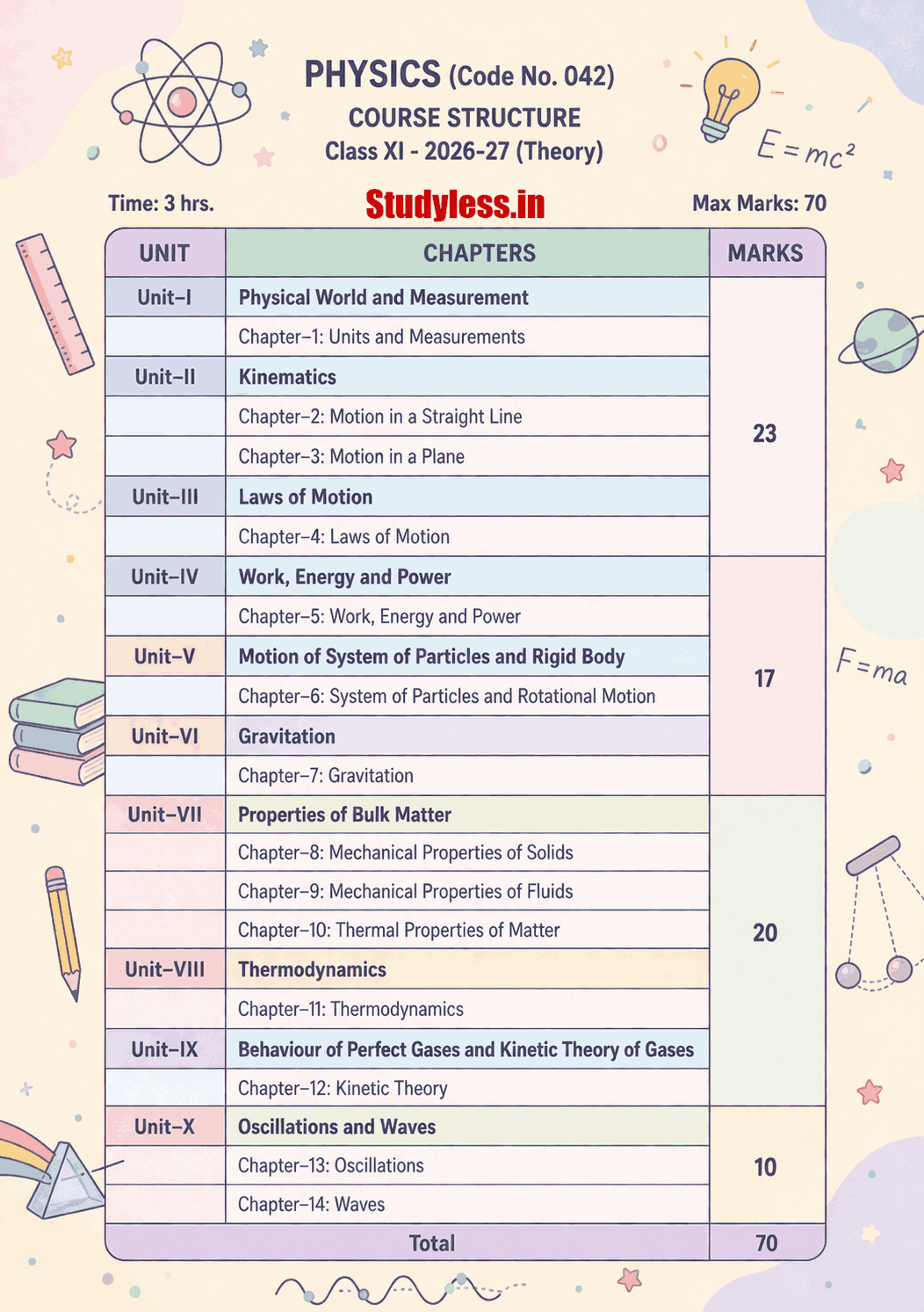
CBSE has released the Class 11 Physics Syllabus for the 2026–27 Session on 1st April 2026.
This syllabus is as per the new curriculum for the academic session 2026-2027.
We have listed the syllabus in an easy-to-read, scan and understand manner. We have arranged the syllabus in a unit-wise and then chapter-wise format for easy navigation.
Unit I
Physical World and Measurements
Chapter–1: Units and Measurements
1. Need for measurement
➜ Units of measurement
➜ Systems of units
➜ SI units
↦Fundamental units
↦Derived units
2. Significant figures
3.Determining the uncertainty in the result
4. Dimensions of physical quantities
5. Dimensional analysis
➜ Its applications
Unit II
Kinematics
Chapter–2: Motion in a Straight Line
1. Frame of reference
2. Motion in a straight line
3. Elementary concepts of differentiation and integration for describing motion
4. Uniform and non-uniform motion
5. Average speed and average velocity
6.Instantaneous velocity
7. Uniformly accelerated motion
8. Velocity–time and position–time graphs
9. Relations for uniformly accelerated motion
● Graphical treatment
● Calculus treatment
Chapter–3: Motion in a Plane
1. Scalar and vector quantities
2. Position and displacement vectors
3. General vectors and their notations
4. Equality of vectors
5.Multiplication of vectors by a real number
6. Addition and subtraction of vectors
7. Unit vector
8. Resolution of a vector in a plane
Rectangular components
9. Scalar product of vectors
10. Vector product of vectors
11. Motion in a plane
- Cases of uniform velocity
- Cases of uniform acceleration
- Projectile motion
- Uniform circular motion
Unit III
Laws of Motion
Chapter–4: Laws of Motion
1. Intuitive concept of force
2. Inertia
3. Newton’s first law of motion
4. Momentum
5. Newton’s second law of motion
6. Impulse
7. Newton’s third law of motion
8. Law of conservation of linear momentum
→Its applications
9. Equilibrium of concurrent forces
10. Static friction
11. Kinetic friction
12. Laws of friction
13. Rolling friction
14. Lubrication
15. Dynamics of uniform circular motion
→Centripetal force
→Examples of circular motion
↦Vehicle on a level circular road
↦Vehicle on a banked road
Unit IV
Work, Energy, and Power
Chapter– 5: Work, Energy, and Power
1. Work done by a constant force
2. Work done by a variable force
3. Kinetic energy
4. Work–energy theorem
5. Power
6. Notion of potential energy
7. Potential energy of a spring
8.Conservative forces
9. Non-conservative forces
10. Motion in a vertical circle
11. Elastic collisions
12. Inelastic collisions
→In one dimension
→In two dimensions
Unit V
Motion of Systems of Particles and Rigid Body
Chapter–6: System of Particles and Rotational Motion
1. Centre of mass of a two-particle system
2. Momentum conservation
3. Centre of mass motion
4. Centre of mass of a rigid body
5. Centre of mass of a uniform rod
6. Moment of a force
7. Torque
8. Angular momentum
9. Law of conservation of angular momentum
→Its applications
10.Equilibrium of rigid bodies
11. Rigid body rotation
12. Equations of rotational motion
13.Comparison of linear and rotational motions
14. Moment of inertia
15. Radius of gyration
16. Values of moments of inertia for simple geometrical objects
→ No derivation
Unit VI
Gravitation
Chapter – 7: Gravitation
1. Kepler’s laws of planetary motion
2. Universal law of gravitation
3. Acceleration due to gravity
→Its variation with altitude
→ Its variation with depth
4.Gravitational potential energy
5.Gravitational potential
6. Escape speed
7. Orbital velocity of a satellite
8. Energy of an orbiting satellite
Unit VII
Properties of Bulk Matter
Chapter–8: Mechanical Properties of Solids
1. Elasticity
2. Stress–strain relationship
3. Hooke’s law
4. Young’s modulus
5. Bulk modulus
6. Shear modulus of rigidity
→ Qualitative idea only
7. Poisson’s ratio
8. Elastic energy
9. Application of the elastic behaviour of materials
→ Qualitative idea only
Chapter–9: Mechanical Properties of Fluids
1. Pressure due to a fluid column
2. Pascal’s law
➜Applications:
→ Hydraulic lift
→ Hydraulic brakes
3. Effect of gravity on fluid pressure
4. Viscosity
5. Stokes’ law
6. Terminal velocity
7. Streamline flow
8. Turbulent flow
9. Critical velocity
10. Bernoulli’s theorem
➜Simple applications
→ Torricelli’s law
→ Dynamic lift
11. Surface energy
12. Surface tension
13. Angle of contact
14. Excess of pressure across a curved surface
15. Application of surface tension ideas
➜Drops
➜Bubbles
➜Capillary rise
Chapter–10: Thermal Properties of Matter
1. Heat
2.Temperature
➜Thermal expansion of solids
➜Thermal expansion of liquids
➜Thermal expansion of gases
➜Anomalous expansion
of water
4. Specific heat capacity
5. Cp, Cv
6. Calorimetry
7. Change of state
➜Latent heat capacity
8. Heat transfer
➜Conduction
➜Convection
➜Radiation
9. Thermal conductivity
10. Blackbody radiation
➜Qualitative ideas
11. Wein’s displacement law
12. Stefan’s law
Unit VIII
Thermodynamics
Chapter–11: Thermodynamics
1. Thermal equilibrium
2. Definition of temperature
3. Zeroth law of thermodynamics
4. Heat
5. Work
6. Internal energy
7. First law of thermodynamics
8. Second law of thermodynamics
9.Thermodynamic state variables
10. Equation of state
11. Change of condition of gaseous state
➜Isothermal process
➜Adiabatic process
➜Reversible process
➜Irreversible process
➜Cyclic process
Unit IX
Behavior of Perfect Gases and Kinetic Theory of Gases
Chapter–12: Kinetic Theory
1. Equation of state of a perfect gas
2. Work done in compressing a gas
3. Kinetic theory of gases
➜Assumptions
➜Concept
of pressure
4. Kinetic interpretation of temperature
5. RMS speed of gas molecules
6. Degrees of freedom
7. Law of equipartition of energy
➜Statement only
➜Application to specific heat capacities of gases
8. Concept of mean free path
9. Avogadro’s number
Unit X
Oscillations and Waves
Chapter–13: Oscillations
1. Periodic motion
➜Time period
➜Frequency
➜Displacement as a function of time
➜Periodic functions
➜Their applications
2. Simple harmonic motion (S.H.M)
3. Uniform circular motion
➜Its equations of motion
4. Phase
5. Oscillations of a loaded spring
➜Restoring force
➜Force constant
6. Energy in S.H.M
➜Kinetic energy
➜Potential energy
7. Simple pendulum
➜Derivation of the expression for its time period
Chapter–14: Waves
1. Wave motion
➜Transverse waves
➜Longitudinal waves
2. Speed of travelling wave
3. Displacement relation for a progressive wave
4. Principle of superposition of waves
5. Reflection of waves
6. Standing waves
➜In strings
➜In organ pipes
7. Fundamental mode and harmonics
8. Beats
Units, Chapters and marks for class 11 physics 2026-27