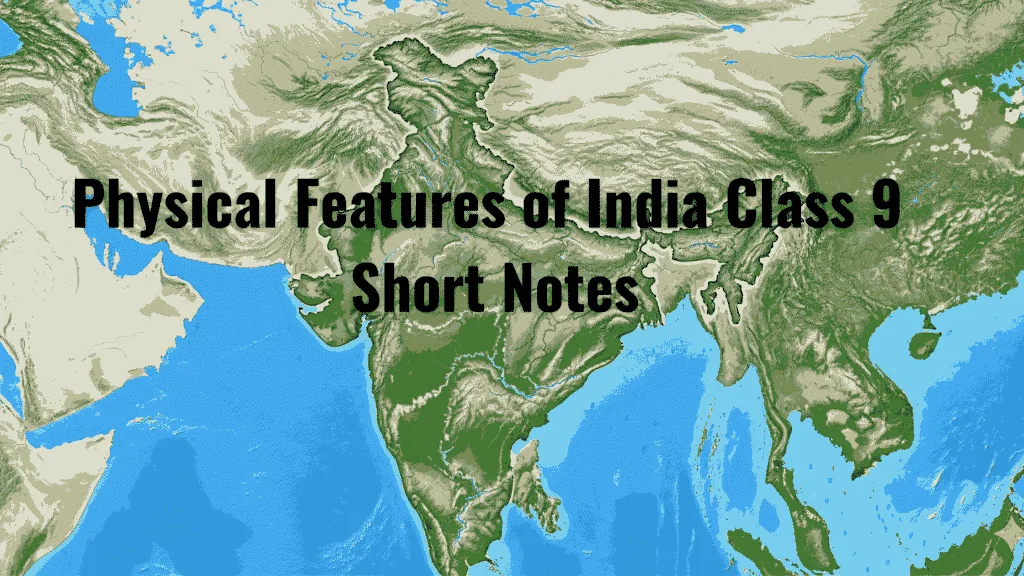
“Climate class 9 short notes” is an attempt from our side to help you memorize the key points of the chapter 4 from the examination point of view.
The get the best out of it read your NCERT text book chapter 4 first and then memorize the important points from the short notes.
Or, you can read a topic from your textbook and then read the key points of the topic from the topical short notes provided below.
Weather
- State of the atmosphere at a specific place & time
- Changes frequently, even within a day
Climate
- Average weather conditions over a large area
- Observed for more than 30 years
- Shows patterns: hot/cool, windy/calm, cloudy/bright, wet/dry
Elements – Weather and Climate
- Temperature
- Atmospheric Pressure
- Wind
- Humidity
- Precipitation
India’s Climate Type
- ‘monsoon’ type of climate.
- Found mainly in South & Southeast Asia
- Monsoon is derived from ‘mausim’, meaning season.
- Monsoon refers to the seasonal reversal in wind direction during a year.
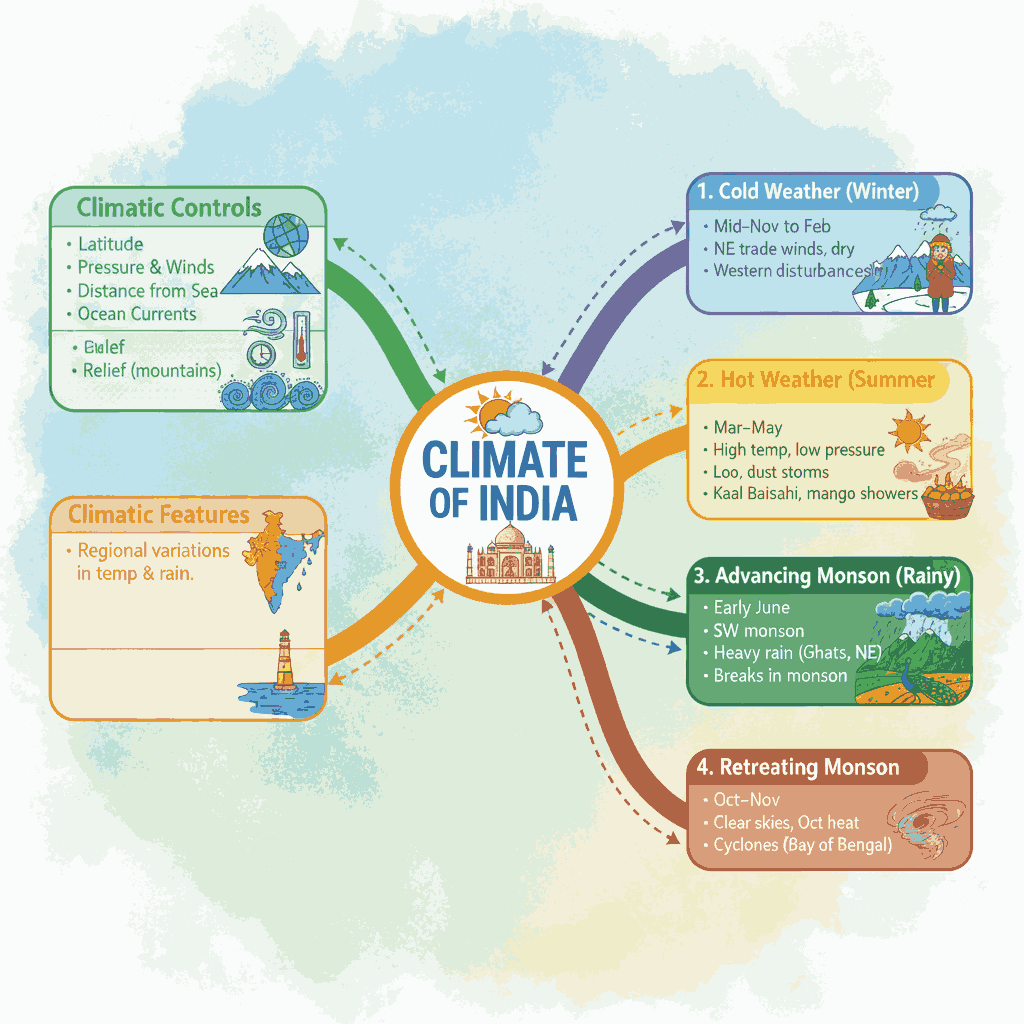
Temperature Variations
- Summer:
- 50°C in parts of Rajasthan desert.
- ~20°C in Pahalgam (Jammu & Kashmir).
- Winter:
- –45°C in Drass (Jammu & Kashmir).
- 22°C in Thiruvananthapuram.
- Diurnal Range:
- Wide: Thar Desert — day up to 50°C, night down to ~15°C.
- Minimal: Andaman & Nicobar Islands and Kerala — little difference between day and night temperatures.
Also Read | Population Class 9 Short Notes
💧 Precipitation Variations
- Form:
- Snowfall in upper Himalayas.
- Rainfall over the rest of India.
- Amount:
- >400 cm in Meghalaya.
- <10 cm in Ladakh and western Rajasthan.
- Seasonal Distribution:
- Most of India: Rainfall from June to September.
- Tamil Nadu: Receives rainfall during October–November (retreating monsoon).
- Pattern: Rainfall decreases from east to west in Northern Plains.
Human Adaptation to Climate - Rajasthan houses:
- Thick walls → insulate against extreme heat.
- Flat roofs → to collect rainwater (rare but vital).
- Tarai, Goa, Mangalore houses:
- Sloping roofs → to drain heavy rainfall.
- Assam houses: Built on stilts → to avoid flooding and wild animals.
Six Major Climatic Controls
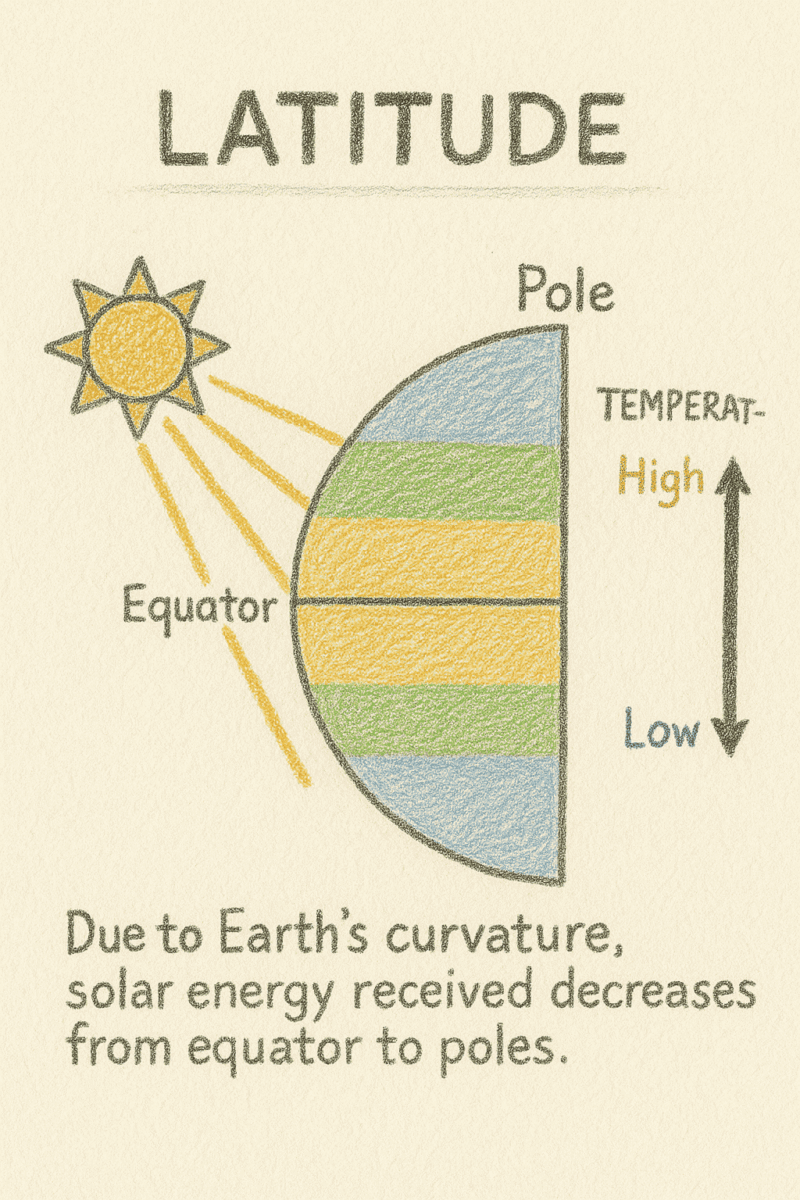
Latitude
- Due to earth’s curvature, solar energy received decreases from equator to poles.
- Temperature generally decreases from equator toward poles.
Altitude
- As height increases, air becomes less dense and temperature decreases.
- Hills are cooler in summer due to higher altitude.
Pressure and Wind System
- Depends on latitude and altitude.
- Influences temperature and rainfall patterns.
- Winds can bring moisture or dryness depending on origin.
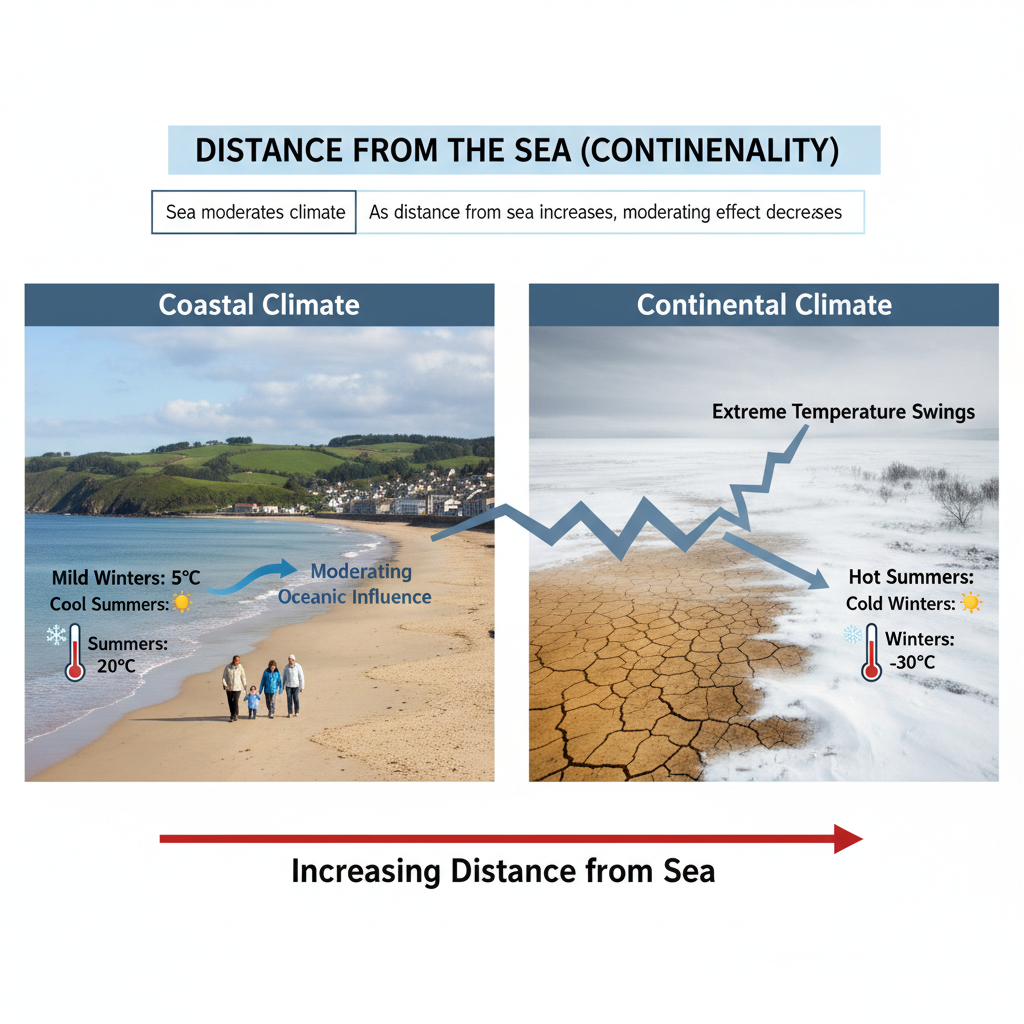
Distance from the Sea (Continentality)
- Sea moderates climate → mild winters, cool summers.
- As distance from sea increases, moderating effect decreases.
- Leads to extreme weather:
- very hot summers, very cold winters → known as continentality.
Ocean Currents
- Affect coastal areas when combined with onshore winds.
- Warm currents + onshore winds → warmer climate.
- Cold currents + onshore winds → cooler climate.

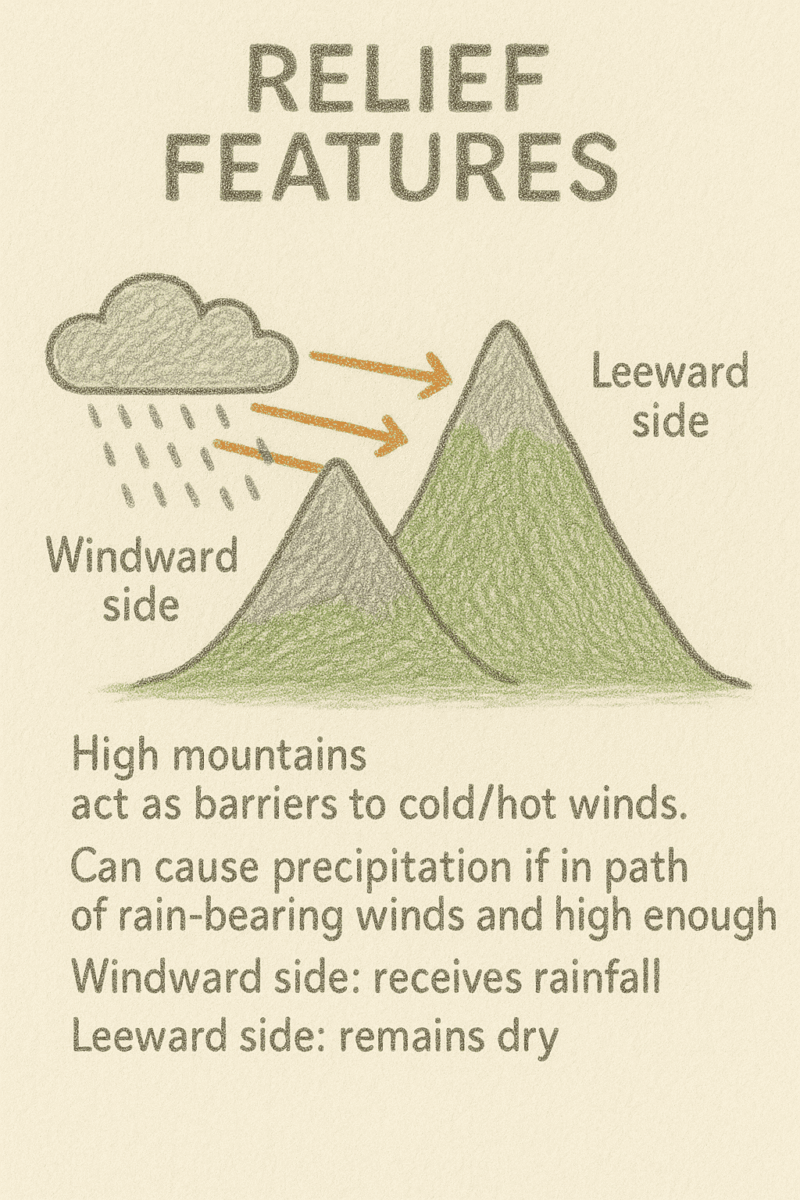
Relief Features
- High mountains act as barriers to cold/hot winds.
- Can cause precipitation if in path of rain-bearing winds and high enough.
- Windward side: receives rainfall.
- Leeward side: remains dry.
Key Exam Points
- Deserts in western margins of continents in subtropics?
Due to cold ocean currents and offshore winds reducing moisture → dry conditions. - Why coastal areas have moderate climate?
Due to proximity to sea → moderating influence. - Why leeward side is dry?
Because moisture is lost on windward side → rain shadow area.
FACTORS AFFECTING INDIA’S CLIMATE
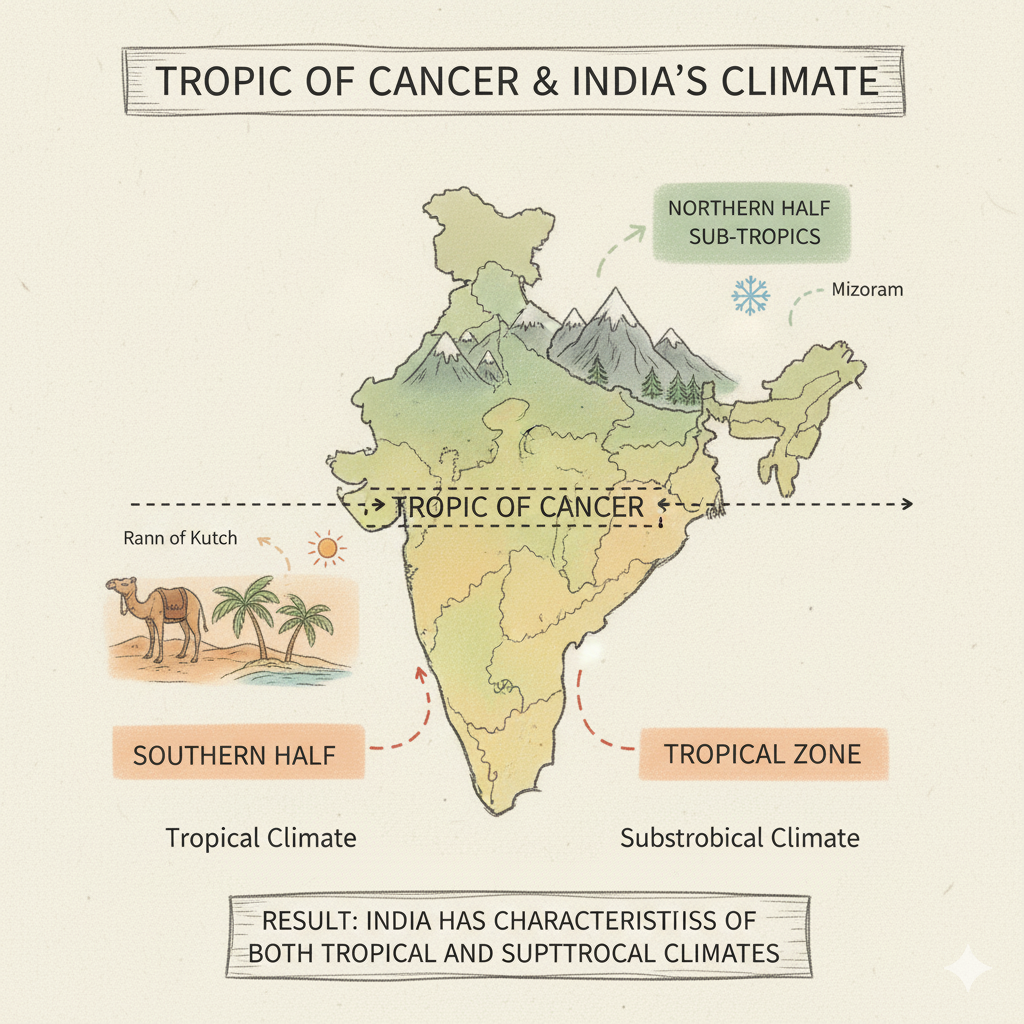
1. Latitude
- Tropic of Cancer passes through middle of India – from Rann of Kutch (west) to Mizoram (east).
- Southern half: Lies in tropical zone → experiences tropical climate.
- Northern half: Lies in sub-tropics → experiences subtropical climate.
- Result: India has characteristics of both tropical and subtropical climates.
2. Altitude
- Northern mountains (Himalayas): Average height ~6,000 metres.
- Coastal areas: Maximum elevation ~30 metres.
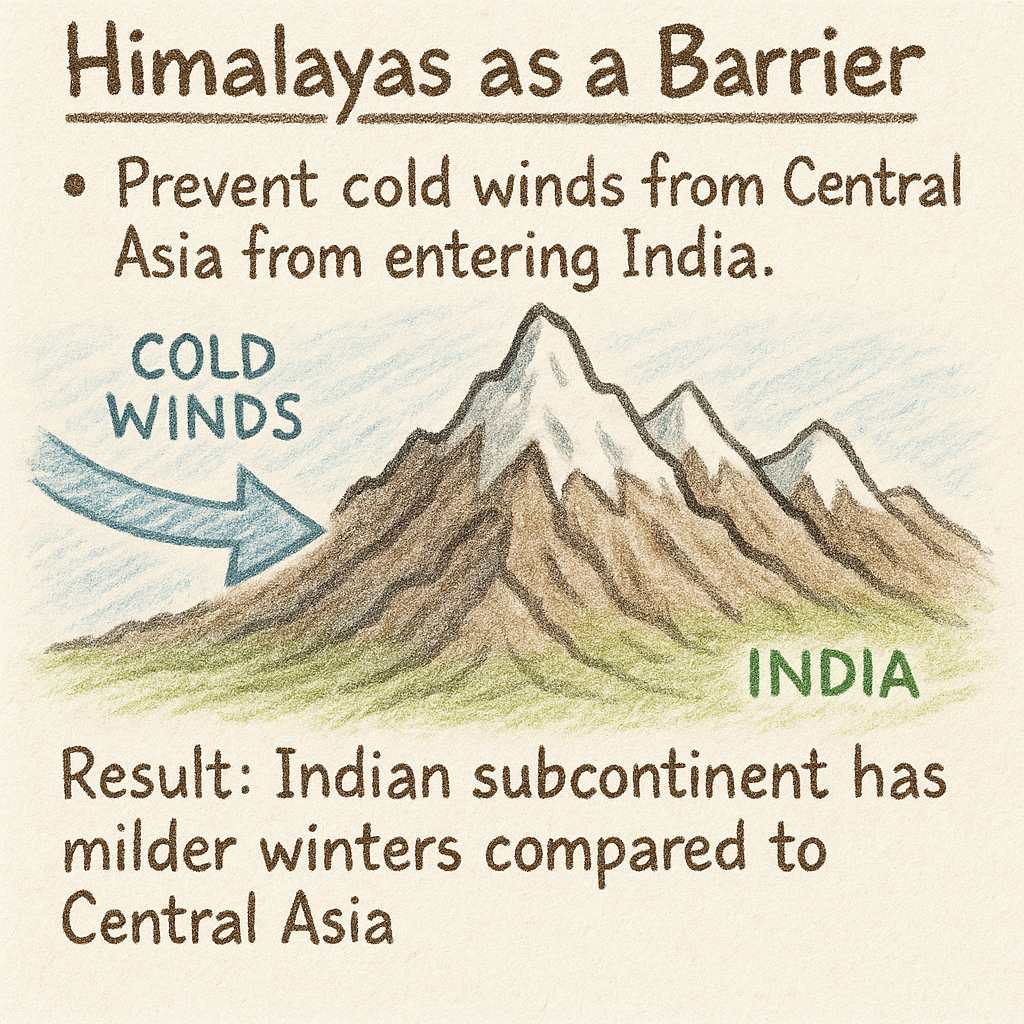
- Himalayas act as a barrier:
- Prevent cold winds from Central Asia from entering India.
- Result: Indian subcontinent has milder winters compared to Central Asia.
3. Pressure and Winds
India’s climate is governed by:
a) Pressure and Surface Winds
- India lies in the region of north-easterly winds.
- These winds originate from the subtropical high-pressure belt in the northern hemisphere.
- Deflected to the right due to Coriolis force → become northeast trade winds.
- Blow over land → carry little moisture → would result in arid conditions, but monsoon system overrides this.
Coriolis Force:
- Caused by earth’s rotation.
- Deflects winds to the right in northern hemisphere, left in southern hemisphere.
- Also known as Ferrel’s Law.
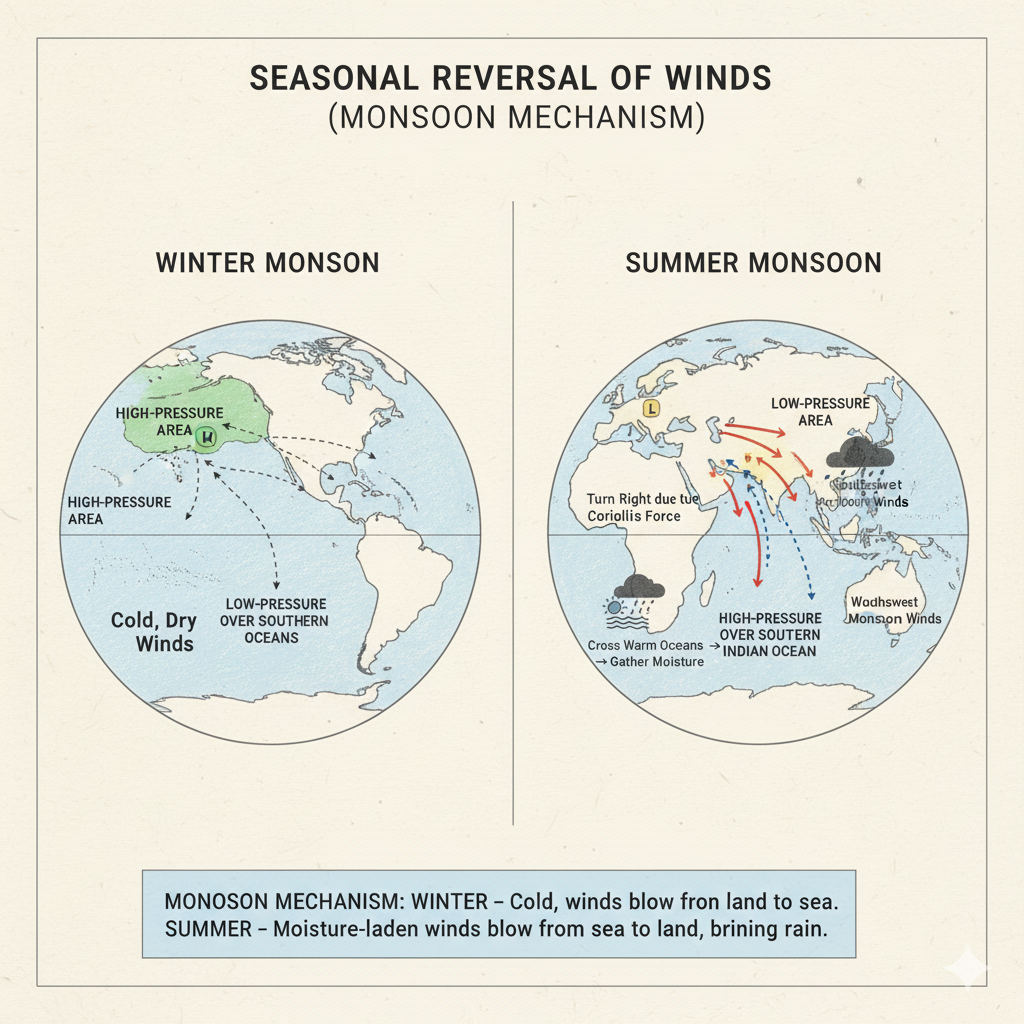
b) Seasonal Reversal of Winds (Monsoon Mechanism)
- Winter:
- High-pressure area north of Himalayas.
- Cold, dry winds blow from land to low-pressure over southern oceans.
- Summer:
- Low-pressure area develops over northwest India and interior Asia.
- Air moves from high-pressure over southern Indian Ocean.
- Winds blow south-easterly, cross equator, turn right (due to Coriolis force) → become southwest monsoon winds.
- These winds:
- Cross warm oceans → gather moisture.
- Bring widespread rainfall over mainland India.
These moisture-laden Southwest Monsoon winds are the reason India is not arid despite dry northeast winds.
Key Exam Points
- Why isn’t India a desert?
Due to southwest monsoon winds that bring heavy rainfall. - Role of Himalayas: Block cold Siberian winds → milder winters.
- Coriolis force causes wind deflection → crucial for monsoon wind direction.
- Seasonal pressure reversal drives monsoon cycle.
THE COLD WEATHER SEASON (WINTER)
1. Duration
- Begins from mid-November in northern India.
- Lasts till February.
- December and January: Coldest months in the north.
2. Temperature Pattern
- Decreases from south to north.
- Chennai (eastern coast): Average temperature = 24°C – 25°C.
- Northern plains: Range = 10°C – 15°C.
- Days: Warm
Nights: Cold - Frost common in northern regions.
- Snowfall on higher slopes of the Himalayas.
3. Winds and Rainfall
- Northeast trade winds dominate → blow from land to sea.
- Generally dry season over most of India.
- Exception: Tamil Nadu coast receives rainfall
as winds here blow from sea to land during this season.
4. Pressure and Wind System
- A feeble high-pressure region develops in the northern part.
- Light winds move outwards from this area.
- Due to relief, winds blow through the Ganga valley from west and northwest.
- Weather: Clear skies, low humidity, feeble and variable winds.
5. Western Disturbances
- Cyclonic disturbances enter from west and northwest.
- Originate over the Mediterranean Sea and western Asia.
- Move into India via westerly flow.
- Cause winter rains (known as ‘mahawat’) over the northern plains and snowfall in the mountains.
- Importance: Crucial for rabi crop cultivation.
6. Peninsular Region
- No well-defined winter season.
- Little seasonal change in temperature due to moderating influence of the sea.
Key Exam Points
- Why Tamil Nadu gets winter rain?
Because northeast winds blow from sea to land here. - Western disturbances: Bring winter rain (mahawat) → vital for rabi crops.
- Northern plains: Experience cold waves, frost, clear skies.
- Peninsula: No sharp winter due to maritime influence.
THE HOT WEATHER SEASON (SUMMER)
1. Duration
- March to May: Hot weather season in India.
- Caused by apparent northward movement
of the sun → global heat belt shifts northwards.
2. Temperature Trends
- March: Highest temp. ~38°C on the Deccan Plateau.
- April: Temp. in Gujarat and MP reach ~42°C.
- May: Northwestern India experiences temperatures up to 45°C.
- Peninsular India: Lower temperatures due to moderating influence of oceans.
3. Pressure and Wind System
- Rising temperature and falling air pressure in northern India.
- By end of May, an elongated low-pressure area forms:
- From Thar Desert (northwest) to Patna and Chotanagpur Plateau (east and southeast).
- Air circulation begins around this trough of low pressure.
4. Key Weather Phenomena
• Loo
- Strong, gusty, hot, dry winds blowing during the day.
- Affect north and northwestern India.
- May continue into the evening.
- Direct exposure can be fatal.
• Dust Storms
- Common in May in northern India.
- Bring temporary relief by lowering temperature.
- May bring light rain and cool breeze.
• Thunderstorms
(Kaal Baisakhi)
- Localised thunderstorms with:
- Violent winds
- Torrential downpours
- Hail
- In West Bengal, known as ‘Kaal Baisakhi’.
• Mango Showers
- Pre-monsoon showers towards end of summer.
- Occur in Kerala and Karnataka.
- Help in early ripening of mangoes.
- Popularly called ‘mango showers’.
Key Exam Points
- Why peninsular India is cooler?
Due to maritime influence of surrounding oceans. - Loo: Dangerous hot, dry winds in northwest India.
- Dust storms and thunderstorms provide temporary relief.
- Mango showers: Pre-monsoon rains in southern states.
- Low-pressure trough from Thar Desert to Chotanagpur drives summer weather.
ADVANCING MONSOON (THE RAINY SEASON)
1. Onset of Monsoon
- By early June, low-pressure over northern plains intensifies.
- Attracts southeast trade winds from the southern hemisphere.
- These winds:
- Originate over warm subtropical southern oceans.
- Cross equator → deflected to right → blow as southwest monsoon winds.
- Bring abundant moisture.
- Enter Indian peninsula with average speed of 30 km/h.
• Covers entire country in about one month (except extreme northwest).
2. Rainfall Distribution
- Western Ghats (windward side): Receives very heavy rainfall (> 250 cm).
- Deccan Plateau & parts of Madhya Pradesh: Receive some rain despite lying in rain shadow.
- Northeast India: Gets maximum rainfall.
- Mawsynram (Khasi Hills, Meghalaya): Highest average rainfall in the world.
- Ganga Valley: Rainfall decreases from east to west.
- Rajasthan and parts of Gujarat: Receive scanty rainfall.
3. Breaks in Monsoon
- Monsoon has wet and dry spells → rain occurs in bursts, not continuously.
- Caused by movement of the monsoon trough (low-pressure axis):
- When axis lies over the plains → good rainfall there.
- When axis shifts towards Himalayas → dry spells in plains, heavy rain in mountainous areas.
- Heavy rains in mountains → cause floods in plains due to river overflow.
4. Tropical Depressions
- Form at the head of the Bay of Bengal.
- Move along the axis of the monsoon trough.
- Influence amount, duration, and spatial distribution of rainfall.
5. Characteristics of Monsoon
- Highly irregular in:
- Arrival
- Retreat
- Rainfall intensity, frequency, and duration
- Causes floods in one region, droughts in another simultaneously.
- Can disrupt farming schedules for millions of farmers.
Key Exam Points
- Southwest monsoon: Moisture-laden winds from southern oceans.
- Mawsynram: Wettest place on Earth → located in Meghalaya.
- Breaks in monsoon = dry spells due to shift in monsoon trough.
- Tropical depressions from Bay of Bengal → bring widespread rain.
- Monsoon is unpredictable → major challenge for agriculture.
RETREATING/POST MONSOON (THE TRANSITION SEASON)
1. Duration
- October to November: Transition period from rainy season to dry winter.
2. Weather Changes
- Sun shifts southward → monsoon trough weakens over northern plains.
- Replaced by high-pressure system.
- Southwest monsoon winds weaken and gradually withdraw.
- By early October, monsoon retreats from Northern Plains.
• Marked by clear skies and rising temperatures (due to absence of clouds and moisture).
3. Cyclonic Depressions
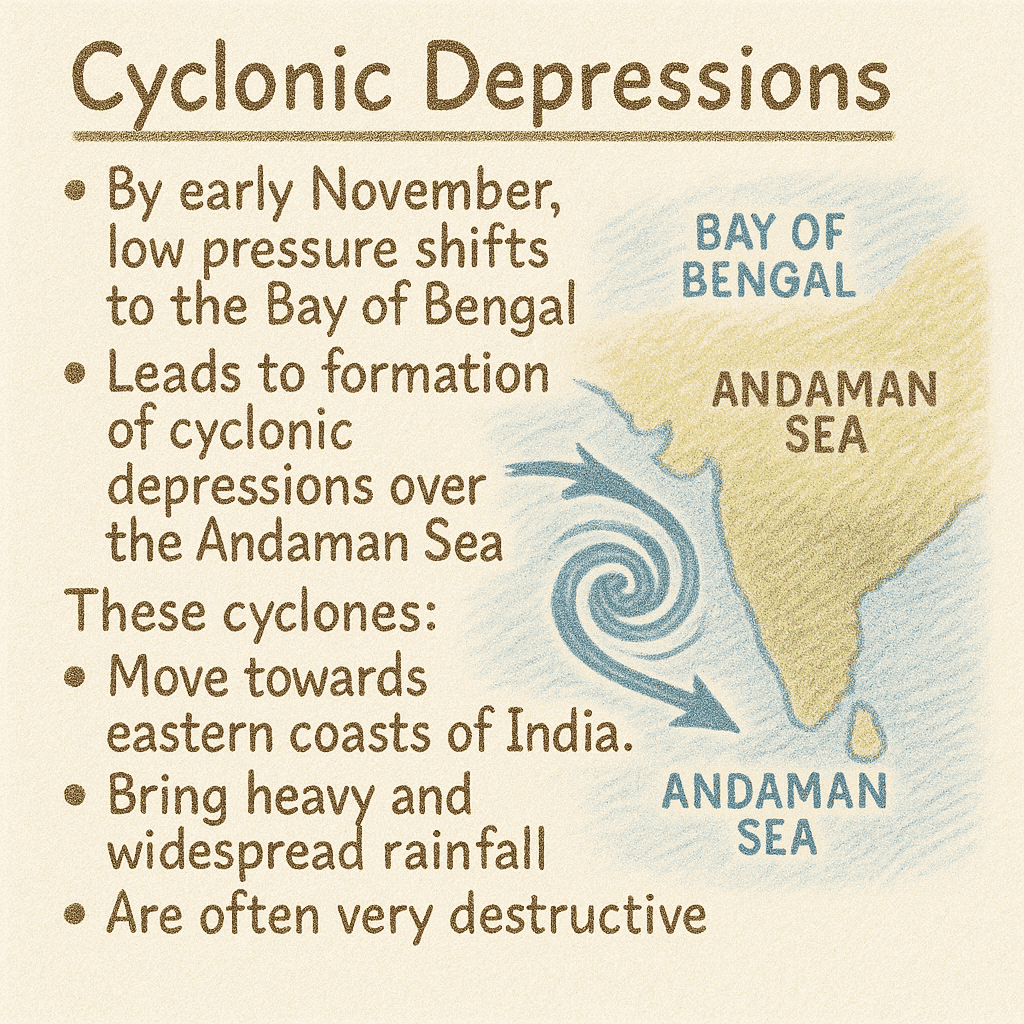
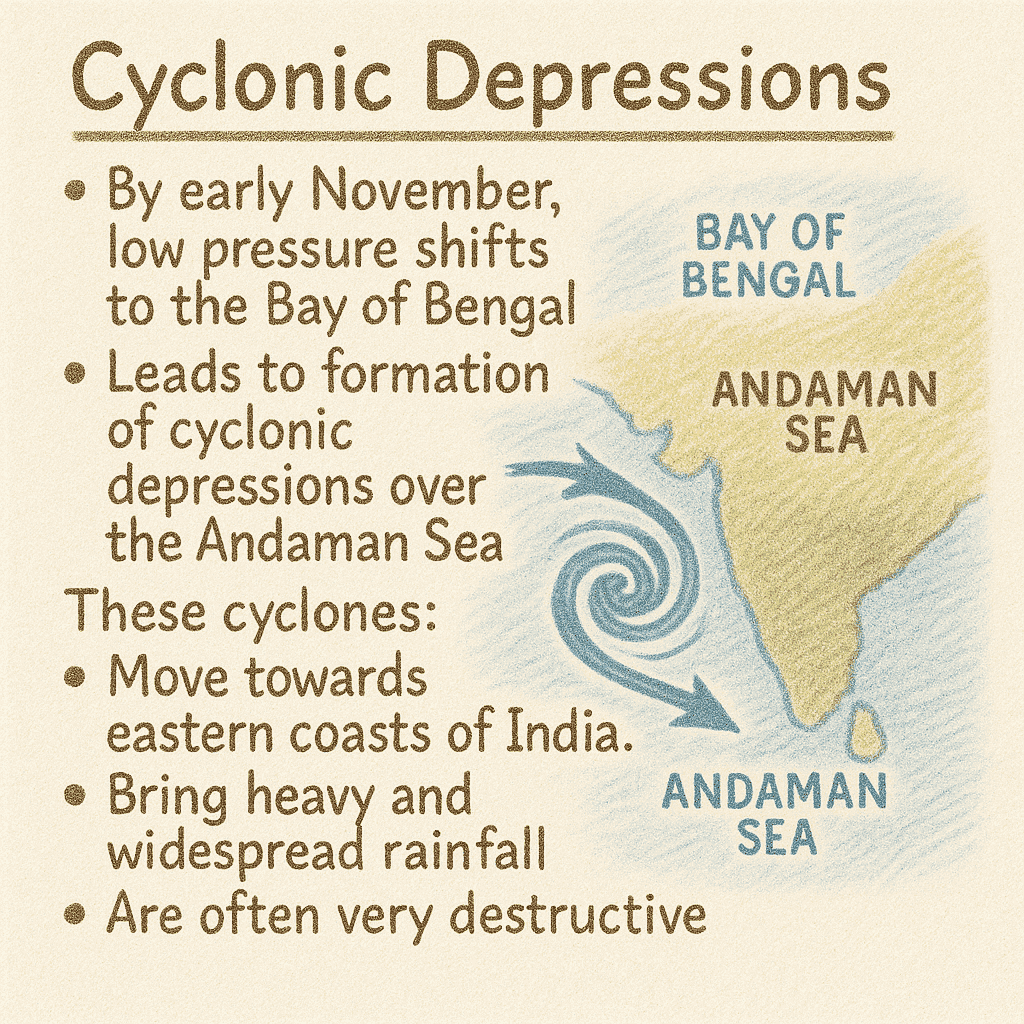
- By early November, low-pressure shifts to the Bay of Bengal.
- Leads to formation of cyclonic depressions over the Andaman Sea.
- These cyclones:
- Move towards eastern coasts of India.
- Bring heavy and widespread rainfall.
- Are often very destructive.
4. Impact of Cyclones
- Frequently strike deltas of:
- Godavari
- Krishna
- Kaveri
- Cause extensive damage to life and property due to:
- Strong winds
- Heavy rain
- Storm surges
- Also affect coasts of Odisha, West Bengal, and Bangladesh.
5. Rainfall on Coromandel Coast
- Tamil Nadu coast (Coromandel Coast) receives most of its rain during this season.
- Rainfall comes from cyclonic depressions and retreating monsoon conditions.
- Southwest monsoon fails here, but northeast winds pick up moisture from Bay of Bengal → bring rain.
Key Exam Points
- Post-monsoon = Retreating monsoon → transition to winter.
- Clear skies, rising temperature in early phase.
- Cyclones form in Bay of Bengal → hit eastern coast.
- Deltas are highly vulnerable to cyclones.
- Coromandel Coast gets rainfall mainly from cyclones and depressions in October–November.
Note: Mawsynram is the wettest place on Earth and known for stalactite and stalagmite caves.
DISTRIBUTION OF RAINFALL
1. High Rainfall Areas (>400 cm annually)
- Parts of western coast (e.g., Western Ghats windward side).
- Northeastern India (e.g., Meghalaya – home to Mawsynram, the world’s wettest place).
2. Low Rainfall Areas (<60 cm annually)
- Western Rajasthan and adjoining parts of:
- Gujarat
- Haryana
- Punjab
- Interior of Deccan Plateau
- East of Sahyadris (leeward side)
- Leh region in Jammu and Kashmir
• These regions lie in rain shadow areas or are far from moisture-laden winds.
3. Moderate Rainfall Areas
- Rest of the country receives moderate rainfall.
4. Snowfall
- Restricted to the Himalayan region.
5. Variability of Rainfall
- Due to monsoon nature, annual rainfall is highly variable year to year.
- High variability in:
- Western Rajasthan
- Gujarat
- Leeward side of Western Ghats
- Consequences:
- High rainfall areas → prone to floods.
- Low rainfall areas → drought-prone.
Key Exam Points
- Highest rain: Western coast & northeast India.
- Lowest rain: Western Rajasthan, interior Deccan, east of Sahyadris, Leh.
- Rain shadow effect causes low rainfall behind Western Ghats.
- Monsoon variability leads to floods in wet areas, droughts in dry areas.
- Snowfall only in Himalayas.
MONSOON AS A UNIFYING BOND
1. Unifying Role of Monsoon
- Despite regional variations in climate, the monsoon provides a unifying rhythm to the entire Indian subcontinent.
- Seasonal alternation of wind systems creates a predictable cycle of seasons.
2. Impact on Life and Landscape
- Agriculture: Entire farming calendar revolves around monsoon.
- Sowing, growth, and harvest depend on monsoon rains.
- Water Supply: Rivers fed by monsoon rains provide water for irrigation, drinking, and hydropower.
- River Valleys: Unified into a single river valley system through monsoon-fed flow.
- Plant and Animal Life: Growth cycles synchronized with rainy season.
- Festivals and Culture: Many festivals (e.g., Pongal, Baisakhi, Nuakhai) celebrate sowing or harvest linked to monsoon.
3. Regional Climate Contrasts
- Northern India:
- Protected by Himalayas → no cold Central Asian winds → milder winters.
- Higher temperatures than other regions at same latitude.
- Peninsular India:
- Surrounded by sea on three sides → moderate temperatures.
- Less seasonal variation due to maritime influence.
4. ‘October Heat’
- In early October, after monsoon retreats:
- High temperature + high humidity + moist land → weather feels oppressive.
- Known as ‘October heat’.
- By second half of October, temperature begins to fall rapidly, especially in northern India.
5. Acceptance of Monsoon Variability
- Uneven rainfall distribution and year-to-year variability are typical of monsoon.
- Yet, people across India — north, south, east, west — eagerly await the monsoon every year.
• Monsoon winds bind the country by initiating agricultural activities and sustaining water resources.
Key Exam Points
- Monsoon creates rhythmic cycle of seasons.
- It unites diverse climates through shared dependence on rains.
- Agriculture, rivers, culture, and festivals revolve around monsoon.
- Despite floods and droughts, monsoon is central to Indian life.
- ‘October heat’: Hot, humid, oppressive weather post-monsoon.
- Himalayas protect India from cold winds; peninsula has moderate climate.
Conclusion : Climate Class 9 Short Notes
Here is an improved and slightly longer closing line:
If these notes helped you, explore more Class 9 chapters on Studyless.in for quick revision, smart exam tips, and easy-to-understand explanations.
Keep visiting the site for updated notes, practice questions, and study tools that make learning faster and stress-free.