Chapter 6, “Parliamentary System, Legislature & Executive,” in the Class 8 book Exploring Society: India and Beyond, is a long chapter at 24 pages.
So, you need a reliable and easy-to-read set of short notes for it. And you are at the right place.
And “Short Notes – Parliamentary System Legislature & Executive” is the right fit.
After reading the chapter many times, the teaching experience we have in the class, and seeing the questions asked in various schools’ tests, we have created these short notes.
These short notes on Chapter 6, The Parliamentary System: Legislature and Executive, have all the important keywords and concepts on which all the questions are based.
Read your NCERT textbook and then revise the short notes here again and again to master the chapter.
Happy reading!
Introduction
India’s Constitution and Government
Constitution
- Drafted after independence
- Foundational principles for the nation
Universal Adult Franchise
All adult citizens can vote regardless of social/economic background, gender, race, or religion
Lok Sabha
- Members are directly elected by the people
- The majority group forms the government
Parliament
- Supreme legislative body
- Makes laws for the country
- Controls + guides the government
| Lok Sabhas | Details |
|---|---|
| 1st Lok Sabha | 1952 |
| 18th Lok Sabha | June 2024 |
| Total since 1952 | 18 |
Composition of the Parliament of India
Structure of the Indian Parliament
| Components | Details |
|---|---|
| President | Head of Parliament |
| Lok Sabha | House of the People (Lower House) |
| Rajya Sabha | Council of States (Upper House) |
Bicameral System
- Two houses/chambers
- ‘Bi’ = two, ‘Cameral’ = chamber/house
Why a Bicameral System?
- Single directly elected House => inadequate
- Council of States is needed in the spirit of federalism
Federalism
- Power is distributed between
the centre, states, and local governments - Keeps a balance between national
unity and local interests
Rajya Sabha
◾Different composition from the Lok Sabha
◾Different process of election from the Lok Sabha
Function Of Parliament
Presiding Officers
| House | Presiding Officer | Role |
|---|---|---|
| Lok Sabha | Speaker (elected by members) | Conducts sessions, allows members to speak, maintains discipline, ensures rules followed |
| Rajya Sabha | Vice President of India (Chairperson) | Conducts sessions, allows members to speak, maintains discipline, and ensures rules are followed |
Functions of Parliament
Legislative Function
- Making of laws
Executive Function
- Ensuring laws are implemented and enforced
Union Executive
Members of
the Union Executive
- The President
- The Vice President
- The Council of Ministers
(headed by Prime Minister)
Council of Ministers
◾Chosen from MPs of both houses
◾Collectively responsible to the Lok Sabha
Legislative Functions of the Parliament
Key Functions
| Function | Description |
|---|---|
| Constitutional Functions | Uphold the core values of Constitution |
| Lawmaking | Make laws |
| Executive Accountability | Uphold the core values of Constitution |
| Financial Accountability | Approve and monitor government spending |
1. Constitutional function
Parliament upholds:
- Parliamentary democracy through universal adult suffrage
- Separation of powers between the legislature, the executive, and the judiciary
- Federalism
- Fundamental Rights and Directive Principles of State Policy
2. Lawmaking
- A bill is a draft of a proposed law
- Bill is introduced in Parliament and goes through a long process
- After approval, the bill becomes an act and then a law
3. Executive Accountability
Prime Minister and Council of Ministers are :
- Responsible for implementing and enforcing laws
- Running of the government
- Oversee the running of the government
- Answer to Lok Sabha in :
- Question Hour
- Select period during the Parliamentary session
- Process – holds the Executive accountable
- MPs ask ministers questions about policies and activities
- Ministers must justify their actions and decisions
- Select period during the Parliamentary session
- Question Hour
Committees
- Hold meetings – ministries explain policies
- May include MPs from different parties
- Question ministries work
4. Financial Accountability
Parliament:
- Approves annual budget
- Monitors government expenditure
- Examines the distribution of funds to ministries
- The government must provide timely and accurate information
Executive Functions of Parliament
The President
| Role | Details |
|---|---|
| Position | Head of State and nominal head of Executive |
| Appoints | Prime Minister and other ministers |
| Powers | Summons Parliament, gives assent to bills |
| Advisory Support | Council of Ministers aids and advises President |
| Discretionary Powers | Council of Ministers aids and advises the President |
The Prime Minister
Position
- De facto executive authority in India’s Parliamentary system
- Appointed by the leader of the majority party/coalition in the Lok Sabha
- Serves with the support of the majority of MPs in the Lok Sabha
Key Functions
- Leads the Council of Ministers
- Advises the President
- Coordinates the work of different ministries
- Shapes national policies
Council of
Ministers
- Take decisions and run the government
- Collectively responsible to the Lok Sabha
- Initiate most bills that come to Parliament
Civil Servants
- Permanent group of officials
- Also called administrators or bureaucrats
- Help implement laws and policies
- Work under the direction of ministers
- Ensure government departments function smoothly
Differences Between Legislature and Executive
| Aspect | Legislature | Executive |
|---|---|---|
| Composition | President, Lok Sabha, Rajya Sabha | President, Vice-President, Council of Ministers (headed by PM) |
| Main Role | Making laws and overseeing Executive | Enforcing laws made by Legislature |
| Bills | Can introduce some bills | Introduces most bills in Parliament |
| Check on Activities | Asks questions and seeks explanations from Executive | Provides information and explanations to Legislature |
| Presidential Advice | Aids and advises President on important matters and calling sessions | Works under direction of President |
| Government Expenses | Sanctions all government-related expenses | Prepares and implements budget approved by Parliament |
| Consultation | Consults Parliamentary committees | Prepares and implements the budget approved by Parliament |
The Judiciary — Role of Checks and Balances
Role of Judiciary
- Interprets and applies laws of the land
- Resolves disputes
- Functions through the system of courts
- Maintains the democratic nature
of society and governance
Judiciary as Custodian of the Constitution
- Ensures all branches of government operate within Constitutional principles
- Keeps a check on the effective functioning of institutions
- Safeguards fundamental rights
Checks on the Legislature
- Ensures laws passed by Parliament do not violate the constitutional framework
- Can strike down unconstitutional laws
Checks on Executive
- Ensures laws are implemented in accordance with the Constitution
- Can intervene if the Executive violates the Constitution
Separation of Powers and Checks and Balances
| Branch | Function |
|---|---|
| Legislature | Makes laws |
| Executive | Enforces laws |
| Judiciary | Interprets laws and checks both the Legislature and the Executive |
Purpose of
Checks and Balances
- Prevent any one organ from
becoming too powerful - Ensure balanced governance
Legislative and Executive Functionsat the State Level
State Assembly
- Each state has its own legislature and executive
- Called the ‘State Assembly’
- Similar to the Union Government’s Parliament
Members of
Legislative Assembly
(MLAs)
- Make/formulate laws at state level
- Laws on ‘State List’ subjects
- Laws on ‘Concurrent List’ subjects
Structure of State Legislatures
Types
- Unicameral (one house)
- Bicameral (two houses)
Names of Houses
- Legislative Assembly = Vidhan Sabha
- Legislative Council (Upper House) = Vidhan Parishad
States with a Bicameral System
Structure of State Legislatures
Names of Houses
| House | Name | Type |
|---|---|---|
| Legislative Assembly | Vidhan Sabha | Lower House |
| Legislative Council | Vidhan Parishad | Upper House (in bicameral states) |
Types of State Legislatures
| Type | Houses | Feature |
|---|---|---|
| Unicameral | One | Only Vidhan Sabha |
| Bicameral | Two | Vidhan Sabha and Vidhan Parishad |
| States | Count |
|---|---|
| Andhra Pradesh, Bihar, Karnataka, Maharashtra, Telangana, Uttar Pradesh | 6 states |
Union List, State List, and Concurrent List
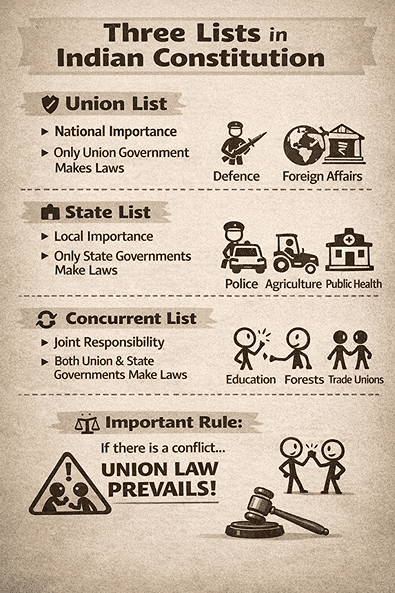
Three Lists in the Constitution
| List | Jurisdiction | Who Legislates |
|---|---|---|
| Union List | Both the Union and State governments | Union government only |
| State List | Specific matters exclusively | State governments only |
| Concurrent List | Subjects that require collaboration | Both Union and State governments |
Union Government vs State Government
| Feature | Union Government | State Government |
|---|---|---|
| Constitutional Head | President of India (elected by electoral college) | Governor of State (appointed by President) |
| Term of Office (Head) | 5 years | 5 years |
| Executive Head | Nominal: President; De facto: Prime Minister | Nominal: Governor; De facto: Chief Minister |
| Selection of Executive Leader | Leader of majority party/coalition in Lok Sabha | Leader of majority party/coalition in Vidhan Sabha |
| Council of Ministers | Selected by Prime Minister | Selected by Chief Minister |
| Responsibility | Term of the Lower House | Collectively responsible to Vidhan Sabha |
| Legislature Structure | Bicameral (Lok Sabha and Rajya Sabha) | Unicameral or Bicameral (Vidhan Sabha and/or Vidhan Parishad) |
| Lower House | Lok Sabha (House of the People) | Vidhan Sabha (Legislative Assembly) |
| Upper House | Rajya Sabha (Council of States) | Vidhan Parishad (Legislative Council) – in some states only |
| Term of Lower House | 5 years | 5 years |
| Presiding Officer (Lower House) | Speaker | Speaker |
| Legislative Powers | Makes laws on Union List and Concurrent List | Makes laws on State List and Concurrent List |
| Financial Powers | Money bills originate only in Lok Sabha | Governor of the State (appointed by the President) |
Challenges to the Effective Functioning of the Legislatures
Roles of Legislature
- Enacting laws
- Overseeing administrative processes
- Approving the budget
- Discussing national policies
and development plans - Addressing international relations
- Addressing public grievances
Challenges to Effective Functioning
1. Member-Related Challenges
- Regular absenteeism of members
- Non-cooperative conduct or communication
- Lack of serious engagement
2. Debate and Discussion Challenges
- Reduced the quality of important debates
- Disruptions of the Question Hour
- Angry or biased debates
- Sessions cut short
Legislative Process Challenges
- Some bills take years to be discussed and passed
Member Integrity Issues
- A substantial proportion of Lok Sabha representatives have criminal cases
Parliament Sessions
| Session | Frequency |
|---|---|
| Budget Session | Once a year |
| Monsoon Session | Once a year |
| Winter Session | Once a year |
| Total | Three times a year |
Sittings
- Parliament deliberates on proposed laws
- Discusses important matters of governance
- Seeks explanations from the Executive
- Usually sits for 6 hours a day
- Extended for urgent business
Solutions to Improve the Legislature
Citizens’ Role
- Stay informed on matters of importance
- Participate in public discussions
- Share views with representatives
- Engage in debates on digital platforms
- Constructively engage with
political representatives
Other Developments
- More young leaders are entering public life
- Diverse voices in public life
- Technology is making governance
- more accessible
- Future voters’ participation key
to strengthening Parliament