
The Pressure, Winds, Storms, and Cyclones Short Notes Chapter 6 Science Class 8 are designed to make learning fast, clear, and effective.
They simplify complex concepts into short, easy-to-read points, helping students revise quickly without confusion.
These notes combine exam-focused content with strong conceptual clarity, making them highly useful for both last-minute revision and deeper understanding.
They save time while ensuring that every important topic is covered in a smart, structured way.
6.1 Pressure
Definition & Formula
- Pressure: Force acting perpendicular to a surface per unit area
- Formula:
Pressure = Force / Area - SI Unit: Newton/metre² (N/m²) = Pascal (Pa)
- Key Relationship: Pressure ∝ 1/Area (inverse relationship)
- Area increases = Pressure decreases
- Area decreases = Pressure increases
Q. Given: Force = 100 N, Area = 2 m². Find the pressure
Solution:
Ans
| Factor | Effect on Pressure | Real-World Example |
|---|---|---|
| Smaller Area | Increases pressure | Sharp knife cuts easily; pointed nail penetrates |
| Larger Area | Decreases pressure | Broad bag straps; cloth under head-load |
| Greater Force | Increases pressure | Heavier bag → more shoulder pressure |
| Higher Liquid Column | Increases pressure | Overhead tank → stronger tap flow |
Solid Pressure: Applications
- Bag Straps: Broad straps spread weight over a larger shoulder area → lower pressure → more comfort
- Bucket Handles: Broad handle reduces pressure on the palm vs. the narrow wire handle
- Head Loads: Round cloth increases contact area → reduces pressure on head
- Cutting/Piercing: Sharp edges/points have minimal contact area → high pressure with less force
Liquid Pressure: Essential Principles

- Depends on Height: Pressure at the bottom ∝ height of the liquid column
- Higher water column → greater pressure
- Acts in All Directions:
- Downward pressure → bottom
- Sideways pressure → walls
- Explains water spurting from pipe leaks/joints
- Practical Application: Overhead tanks placed at a height
- Creates sufficient pressure for strong, consistent tap flow
- Lower floors receive higher pressure than upper floors
6.2 Pressure Exerted by Air
Definition & Concept
- Atmosphere: Envelope of air surrounding Earth; contains nitrogen, oxygen, argon, CO₂, and trace gases
- Atmospheric Pressure: Pressure exerted by air on all objects due to the weight of the air column above
- Key Principle: Air exerts pressure in all directions on every surface it contacts
| Sucker cup pressed on the surface | Observation | Inference |
|---|---|---|
| Paper plate + unfolded chart paper | More effort to lift vs. folded paper | Air exerts force; force ↑ with area → pressure acts on surface |
| Inflating a balloon | Balloon expands uniformly in all directions | Air inside exerts pressure on walls in all directions |
| Open inflated balloon | Air escapes rapidly | Air moves from high pressure (inside) to low pressure (outside) |
| Sucker cup pressed on surface | Sucker sticks firmly; hard to pull off | Air pushed out → lower pressure inside; higher external atmospheric pressure holds it |
Essential Properties of Air Pressure
- Acts Everywhere: Air pressure acts on all surfaces, from all directions
- Depends on Area: Force due to air pressure increases with surface area (
Force = Pressure × Area) - Pressure Difference Drives Flow: Air moves from regions of higher pressure to lower pressure (e.g., escaping balloon)
- Balanced Internally: Body fluids and gases maintain internal pressure equal to atmospheric pressure → prevents crushing
Magnitude & Real-World Context
- Scale of Atmospheric Pressure:
- Force on just a 15 cm × 15 cm area ≈ , with a weight of 225 kg, mass (~2250 N)
- Why We Don’t Feel It:
- Internal body pressure (from tissues, fluids, gases) balances external atmospheric pressure
- Net force on body ≈ zero → no sensation of crushing weight
- Practical Implication:
- Sucker cups, syringes, and straws work due to pressure differences created by manipulating air volume
6.3 Formation of Wind
The Golden Rule of Air Movement
- Core Principle: Air always moves from a region of high pressure to a region of low pressure.
- Equilibrium: Air flow continues until the pressure in both regions becomes equal.
- Result: This movement of air is what we experience as Wind.
Experimental Evidence
| Observation | Inference |
|---|---|
| Open Balloon / Punctured Tube | Air escapes rapidly from inside (High Pressure) to outside (Low Pressure). |
| Connected Balloons | Air moves from inflated balloon (High Pressure) to uninflated balloon (Low Pressure). |
| Final State | Both balloons become same size; flow stops when pressures equalize. |
Natural Phenomenon: Sea & Land Breeze
Wind formation is mainly due to pressure differences caused by uneven heating.
| Time | Heating Pattern | Pressure Zone | Wind Direction | Name |
|---|---|---|---|---|
| Day | Land heats faster than water | Low Pressure over Land | Sea → Land | Sea Breeze |
| Night | Water is warmer than land | Low Pressure over Sea | Land → Sea | Land Breeze |
- Mechanism: Warm air becomes lighter and rises → Creates Low Pressure → Cooler air from the High Pressure region rushes in to fill the gap.
Wind Speed Factor
- Relationship: Wind Speed ∗ Pressure Difference
- Rule: The higher the pressure difference between two regions, the higher the speed of the moving air.
- Impact: Strong pressure differences can cause damaging winds (storms/cyclones).
6.4 High-Speed Winds Result in Lowering
of Air Pressure
Core Principle
- Bernoulli’s Effect (Simplified): High-speed winds are accompanied by reduced air pressure
- Key Relationship: Wind Speed ↑ → Air Pressure ↓
Demonstration: Balloons Activity
| Action | Observation | Explanation |
|---|---|---|
| Blow air between two suspended balloons | Balloons move towards each other | Blowing creates low pressure between them; higher surrounding pressure pushes them inward |
| Blow harder (increase speed) | Balloons approach faster | Greater wind speed → Lower pressure between balloons → Larger pressure difference → Stronger push |
Real-World Application: Roofs During Storms
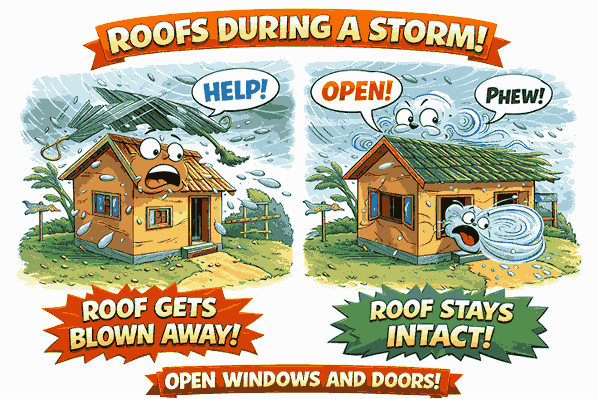
Problem Scenario:
- High-speed winds blow over the roof → Low pressure created above the roof
- Air pressure below the roof (inside the house) remains higher
- Result: Upward pressure difference can lift/blow away weak roofs
Safety Measure:
- Keep doors/windows open during high-speed windstorms
- Allows wind to pass through the house
- Reduces the pressure difference between inside and outside
- Prevents roofs from being blown off
Pressure Difference Comparison
| Condition | Pressure Above Roof | Pressure Inside House | Risk to Roof |
|---|---|---|---|
| Windows/Doors Closed | Low (due to high-speed wind) | High (still air) | High – Roof may lift |
| Windows/Doors Open | Low | Reduced (wind flows through) | Low – Pressure balanced |
6.5 Storms, Thunderstorms, and Lightning
Storm Formation Process
- Storm Definition: Strong winds accompanied by rain = Storm
- Frequency: More common in hot, humid, tropical regions like India
1. Heating: Land heats up → warm, moist air becomes lighter and rises
2. Low Pressure: Rising air creates a low-pressure area at the surface
3. Air Circulation: Cooler air from high-pressure surroundings flows in → continuous wind cycle
4. Cloud Formation: Rising air expands and cools → moisture condenses into water droplets → clouds form
5. Cloud Formation: Rising air expands and cools → moisture condenses into water droplets → clouds form
Thunderstorm & Lightning Mechanism
| Negatively charged cloud base nears the ground | Process | Result |
|---|---|---|
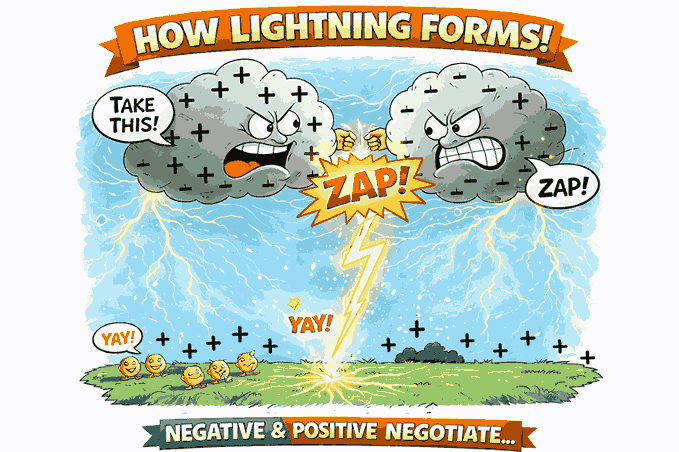
| 1. Updrafts | Warm air rises to great heights | Water droplets freeze into ice particles |
| 2. Air Motion | Strong winds blow upwards and downwards | Rubbing between water droplets and ice particles |
| 3. Charging | Friction from rubbing (like objects rubbed together) | Static electric charges develop in clouds |
| 4. Separation | Lighter +ve charges move up; Heavier -ve charges settle down | Charge separation within cloud |
| 5. Induction | Negatively charged cloud base nears ground | Ground/objects become positively charged |
| 6. Breakdown | Charge buildup overcomes air’s insulating property | Sudden flow of charges = Lightning flash |
Lightning Types & Thunder
- Lightning Paths:
- Within a single cloud
- Between two clouds
- Between cloud and ground
- Thunder Formation:
- Lightning rapidly heats the surrounding air
- Air expands suddenly → produces loud sound = Thunder
- Thunderstorm Definition: A storm accompanied by lightning and thunder
Safety Precautions During Lightning
| Stay inside the bus or car (comparatively safer) | Don’t ❌ |
|---|---|
| Stay away from tall objects (trees, poles) | Do not lie flat on ground |
| Find low-lying open area and crouch down | Avoid umbrellas with metallic rods |
| Minimise contact with ground (feet together) | Do not stay in water – get out immediately |
| Stay inside bus or car (comparatively safer) | Avoid open fields, hilltops, isolated structures |
- Why crouch, not lie down?: Reduces the body’s contact area with the ground → lowers risk of current passing through the body
- Why are vehicles safer?: Metal body acts as a shield; charge flows around exterior, not through occupants
6.6 Cyclone
Cyclone Formation: Step-by-Step
1. Warm Ocean Water → Heats the air above → Warm, moist air rises
2. Condensation: Water vapour condenses → forms raindrops → releases heat
3. Feedback Loop: Released heat warms ascending air → air rises further → creates even lower pressure
4. Air Rush: Surrounding air rushes in → also rises → cycle repeats
5. Earth’s Rotation: Causes moving air to spin → forms a rotating system
6. Result: Very low-pressure centre + high-speed revolving winds + clouds + rain = Cyclone
Cyclone Structure
| Part | Characteristics |
|---|---|
| Eye (Centre) | Lowest pressure; calm winds; clear or lightly cloudy |
| Surrounding Region | Strongest winds; heavy rainfall; most destructive zone |
| Outer Bands | Spiralling clouds; moderate winds; rain showers |
Cyclone Movement & Strength
- Over Ocean: Gains strength from warm, moist air source → wind speeds increase
- Over Land: Moist air source cut off → gradually loses strength
- Key Fact: Cyclones generate higher wind speeds than regular thunderstorms
Destructive Effects of Cyclones
| Effect | Consequence |
|---|---|
| High-Speed Winds (e.g., Amphan: 270 km/h) | Damage to buildings, trees, power lines |
| Storm Surge (3–12 m water wall) | Coastal flooding; inundation of inland areas |
| Heavy Rainfall | River overflow; landslides; waterlogging |
| Seawater Intrusion | Contaminates drinking water; reduces soil fertility; damages crops |
| Debris & Blockages | Roads blocked; delays emergency response |
| Power Outages | Damage to buildings, trees, and power lines |
Safety & Preparedness Measures
- Before Cyclone:
- Monitor weather reports/alerts from the India Meteorological Department (IMD)
- Keep an emergency kit ready (essentials: water, food, medicines, documents)
- Identify the nearest designated cyclone shelter
- During Cyclone:
- Move quickly to a cyclone shelter or a safe indoor location
- Technology Aid: Weather satellites enable tracking and path prediction → reduces impact on life/property
![[New Book] Pressure, Winds, Storms, and Cyclones Short Notes Chapter 6 Science Class 8](https://studyless.in/wp-content/uploads/2026/03/Gemini_Generated_Image_wwvm0mwwvm0mwwvm_11zon.png)