
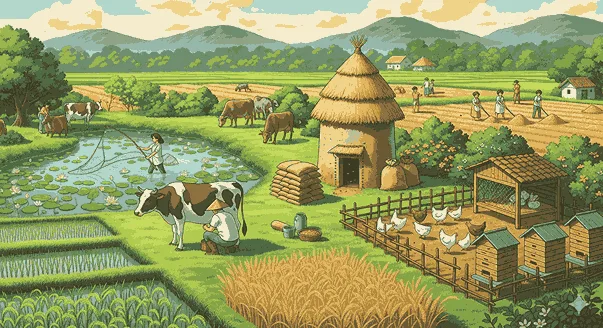
Struggling to revise Improvement in Food Resources before exams? You’re not alone. But what if you could cover the entire Class 9 NCERT Science Chapter 12 — from crop yields to poultry farming — in clear, bite-sized notes that are easy to scan, and memorize.
These exam-focused Improvement In Food Resources Short Notes Class 9 is 100% based on NCERT Class 9 Science Chapter 12 – Improvement in Food Resources. Every keyword, insight, and concept is preserved — no additions, no omissions. Just pure, distilled knowledge for fast revision and full marks.
Want deeper understanding? 💡 Read our detailed explanation of the same chapter on this website — where every topic is broken down with real-life examples and exam tips.
Introduction
Why Do Living Organisms Need Food?
All living organisms need food
- Food supplies essential nutrients :
- Proteins
- Carbohydrates
- Fats
- Vitamins
- Minerals
Functions of Food
- Required for :
- Body development
- Growth
- Health
Sources of Food
- Major sources :
- Plants
- Animals
- We obtain food through:
- Agriculture
- Animal husbandry
Need for Increased Food Production
- India is a very populous country
- Population is over one billion and still growing
- Soon, we will need more than 250 million tonnes of grain every year
Limited Cultivable Land
- Farming on more land is not a long-term solution
- India is already intensively cultivated
- There is no major scope to increase the area of land under cultivation
Solution : Improve Production Efficiency
- Must increase production efficiency
- Needed for both :
- Crops
- Livestock
Successes in Food Production
Green Revolution
- Result: increased food-grain production
White Revolution
- The White Revolution improved :
- Milk availability
- Efficiency in milk production and distribution
Environmental Concerns
Intensive Use of Natural Resources
- Green and White Revolutions use natural resources more intensively
- Increased risk of :
- Environmental damage
- Destruction of ecological balance
Need for Sustainable
Practices
- Must increase food production without
- Degrading the environment
- Disturbing natural balances
- Therefore, sustainable practices are essential in
- Agriculture
- Animal husbandry
Food Security and Hunger
Grain Storage Is Not Enough
- Simply increasing grain production and storing in warehouses cannot solve :
- Malnutrition
- Hunger
What Is Food Security?
- Food security depends on :
- Availability of food
- Access to food (people must have money to buy it)
Role of Agriculture in Livelihood
- The majority of the population depends on agriculture for their livelihood
- To combat hunger, we must :
- Increase the incomes of people working in agriculture
Scientific and Integrated Farming Practices
Scientific Management
- Scientific management practices should be used
- Goal : obtain high yields from farms
Sustainable Livelihood Practices
Mixed Farming
- Combine crop farming with animal farming
Intercropping
- Grow two or more crops together in the same field
Integrated Farming
- Combine agriculture with :
- Livestock
- Poultry
- Fisheries
- Bee-keeping
Summary Table : Integrated Farming Approaches
| Practice | Components Involved |
|---|---|
| Mixed farming | Crops + Animals |
| Intercropping | Two or more crops together |
| Integrated farming | Agriculture + Livestock / Poultry / Fisheries / Bee-keeping |
Improvements in Crop Yields
Food Crops and Their Nutritional Contributions
Cereals
- Provide carbohydrates for energy
- Examples: wheat, rice, maize, millet, sorghum
Pulses
- Provide protein
- Examples :
- Gram (chana)
- Pea (matar)
- Black gram (urad)
- Green gram (moong)
- Pigeon pea (arhar)
- Lentil (masoor)
Oil Seeds
- Provide fats
- Examples :
- Soyabean
- Ground nut
- Sesame
- Castor
- Mustard
- Linseed
- Sunflower
Vegetables, Spices, and Fruits
- Provide vitamins and minerals
- Also contains small amounts of :
- Proteins
- Carbohydrates
- Fats
Fodder Crops
- Grown as food for livestock
- Examples: berseem, oats, sudan grass
Factors Affecting Crop Growth
Climatic Requirements
- Different crops need different :
- Climatic conditions
- Temperature
- Photoperiods
Photoperiods
- Refers to the duration of sunlight
- Sunlight is essential for :
- Plant growth
- Flowering
- Photosynthesis (food manufacturing in plants)
Crop Seasons in India
Kharif Season
- Grown in rainy season: June to October
- Examples of kharif crops :
- Paddy
- Soyabean
- Pigeon pea
- Maize
- Cotton
- Green gram
- Black gram
Rabi Season
- Grown in winter season: November to April
- Examples of rabi crops :
- Wheat
- Gram
- Peas
- Mustard
- Linseed
Increase in Food Grain Production
Production Growth (1952–2010)
- Four times increase in food grain production
- Only 25% increase in cultivable land area
- Increase achieved through improved farming practices
Key Activities for Improving Crop Yields
Crop Variety Improvement
- Focus: Selecting best seeds for planting
- Goal: Better yield, disease resistance, adaptability
Crop Productio Improvement
- Focus: Nurturing crop plants
- Includes : Proper use of irrigation, fertilizers, manures, and farming practices
Crop Protection Management
- Focus : Protecting crops
- During growth
- After harvest
- Prevents losses due to pests, diseases, and storage issues
Summary of Crop Improvement Strategies
| Strategy | Purpose |
|---|---|
| Crop variety improvement | Better seeds for higher and resilient yield |
| Crop production improvement | Efficient nurturing of crops |
| Crop protection management | Prevent loss in field and storage |
Crop Variety Improvement
Goal of Crop Variety Improvement
- To develop crop varieties that give high yields
- Must perform well under different growing conditions
Selection and Breeding of Varieties
Crop varieties are selected
by breeding for
useful characteristics :
- Disease resistance
- Response to fertilisers
- Product quality
- High yield
Hybridization
- Method: Crossing between genetically dissimilar plants
- Types of hybridisation :
- Intervarietal: Between different varieties of the same species
- Interspecific: Between two different species of the same genus
- Intergeneric: Between different genera
Genetically Modified Crops (GM Crops)
- A gene for a desired trait is introduced into the crop
- Results in genetically modified crops with improved characteristics
Seed Quality and Uniformity
Farmers need good quality seeds of improved varieties
Seeds must be :
- Of the same variety
- Capable of uniform germination under similar conditions
Relation Between Cultivation and Environment
Crop yield depends on :
- Weather
- Soil quality
- Water availability
- Since weather events like drought and flood are unpredictable
- Therefore, varieties that grow in diverse climates are essential
Development of Tolerant Varieties
- Varieties have been developed to tolerate :
- High soil salinity
- Other harsh abiotic conditions
Main Objectives of Variety Improvement
Higher Yield
- Increase productivity per acre
Improved Quality (Varies by crop) :
- Baking quality in wheat
- Protein quality in pulses
- Oil quality in oilseeds
- Preserving quality in fruits and vegetables
Biotic and Abiotic Resistance
Biotic stresses
- Diseases
- Insects
- Nematodes
Abiotic stresses
- Drought
- Salinity
- Water logging
- Heat
- Cold
- Frost
Resistant varieties help maintain and improve crop production
Change in Maturity Duration
Shorter duration from sowing to harvesting is more economical
Benefits
- Allows multiple cropping cycles per year
- Reduces production cost
- Enables uniform maturity
- Makes harvesting easier
- Reduces losses during harvest
Wider Adaptability
- Varieties that can grow in different environmental conditions
- Helps stabilise crop production across regions
- One variety can be grown in multiple climatic zones
Desirable Agronomic Characteristics
Traits selected based on crop use :
- Tallness and profuse branching → desirable in fodder crops
- Dwarfness → desired in cereals
- Uses fewer nutrients
- Supports higher productivity
Summary Table: Objectives of Crop Variety Improvement
| Objective | Purpose |
|---|---|
| Higher yield | Increase production per acre |
| Improved quality | Better baking, protein, oil, or storage quality |
| Biotic and abiotic resistance | Withstand pests, diseases, drought, salinity, etc. |
| Shorter maturity duration | Enable multiple crops, reduce cost, ease harvest |
| Wider adaptability | Grow in diverse climates and regions |
| Desirable agronomic traits | Tall/branching (fodder), dwarf (cereals) for higher yield |
Crop Production Management
Farming in India : Scale and Resources
- Farming ranges from small to very large farms
Farmers differ in :
- Land size
- Financial resources
- Access to information and technology
Purchasing capacity determines :
- Choice of cropping system
- Use of agricultural technologies
- Higher input → higher yield
Production practices
classified as
- No cost
- Low cost
- High cost
Nutrient Management
Why Nutrients Are Needed
Plants, like humans, need nutrients for :
- Growth
- Development
- Well-being
Sources of Nutrients
- Air: supplies carbon, oxygen
- Water: supplies hydrogen, oxygen
- Soil: supplies 13 essential nutrients
Types of Nutrients
- Macronutrients: needed in large quantities
- Nitrogen, phosphorus, potassium
- Calcium, magnesium, sulphur
- Micronutrients: needed in small quantities
- Iron, manganese, boron, zinc
- Copper, molybdenum, chlorine
Effects of Nutrient Deficiency
Affects physiological processes
- Reduces :
- Growth
- Reproduction
- Disease resistance
Enriching Soil with Nutrients
Done using :
- Manure
- Fertilizers
Manure
What Is Manure?
- Made from decomposed animal excreta and plant waste
- Supplies small amounts of nutrients
- Rich in organic matter
Benefits of Manure
- Improves soil fertility
- Enriches soil with nutrients and organic matter
- Improves soil structure
- In sandy soils : increases water holding capacity
- In clayey soils : improves drainage, prevents waterlogging
- Helps recycle farm waste
- Environmentally friendly – reduces fertilizer overuse
Types of Manure
- Compost:
- Made by decomposing farm waste (cow dung, vegetable waste, straw, weeds, etc.) in pits
- Rich in nutrients and organic matter
- Vermi-compost:
- Compost prepared using earthworms to speed up decomposition
- Green manure:
- Plants like sun hemp or guar grown and ploughed into soil before sowing
- Enriches soil in nitrogen and phosphorus
Fertilizers
What Are Fertilizers?
- Commercially produced plant nutrients
- Supply nitrogen, phosphorus, potassium
Role in Farming
- Promote vegetative growth (leaves, branches, flowers)
- Support healthy plant development
- Key to high yields in high-cost farming
Proper Use of Fertilizers
- Must be applied with care :
- Correct dose
- Correct timing
- Follow pre- and post-application precautions
- Excessive irrigation can wash away fertilizers
- Leads to nutrient loss and water pollution
Negative Effects of Overuse
- Continuous use reduces soil fertility
- Organic matter not replenished
- Soil microorganisms harmed
- Short-term gain, but long-term damage
Manure vs Fertilizers
- Fertilizers : short-term yield boost
- Manure : long-term soil health and sustainability
Organic Farming
Definition
- Farming system with minimal or no use of:
- Chemical fertilizers
- Chemical pesticides
- Chemical herbicides
Key Components
- Maximum use of :
- Organic manures
- Recycled farm waste (e.g., straw, livestock excreta)
- Use of bio-agents :
- Blue-green algae for biofertilizers
- Neem leaves and turmeric as natural pesticides in grain storage
- Adoption of healthy cropping systems :
- Mixed cropping
- Intercropping
- Crop rotation
Benefits
- Controls insects, pests, and weeds
- Maintains soil fertility
- Environmentally sustainable
Irrigation
Importance of Irrigation
- Most Indian agriculture is rain-fed
- Crop success depends on timely monsoon and adequate rainfall
- Poor monsoon → crop failure
- Proper irrigation at right growth stages → higher yields
Goal
- Expand area under irrigation to ensure water supply
Irrigation Systems in India
- Varies based on water resources and climate
| System | Description |
|---|---|
| Wells | – Dug wells: collect water from shallow water-bearing layers – Tube wells: tap deeper water layers – Water lifted by pumps |
| Canals | – Elaborate network from reservoirs or rivers – Main canal → branch canals → distributaries → fields |
| River Lift Systems | – Used where canal flow is low or irregular – Water drawn directly from rivers for nearby fields |
| Tanks | – Small reservoirs – Store run-off from small catchment areas |
Water Conservation Initiatives
- Rainwater harvesting
- Watershed management
- Involves building small check-dams
- Increases groundwater levels
- Prevents run-off and soil erosion
Cropping Patterns
Purpose
- Maximize benefits from land use
- Reduce risk, improve yield, and maintain soil health
Mixed Cropping
- Growing two or more crops together on same land
- Examples :
- Wheat + gram
- Wheat + mustard
- Groundnut + sunflower
- Benefit :
- Reduces risk of total crop failure
- Acts as insurance if one crop fails
Intercropping
- Growing two or more crops together in a definite pattern
- Example :
- Soyabean + maize
- Bajra (fingermillet) + cowpea (lobia)
- Pattern: few rows of one crop alternate with few rows of another
- Crops chosen with different nutrient needs
- Benefits :
- Maximizes nutrient use
- Prevents spread of pests and diseases
- Better returns from both crops
Crop Rotation
- Growing different crops in succession on same land
- Choice depends on :
- Moisture availability
- Irrigation facilities
- Proper rotation allows :
- 2–3 crops per year
- Good harvests
- Maintains soil fertility and reduces pest buildup
CROP PROTECTION MANAGEMENT
Threats to Field Crops
Major threats :
- Weeds
- Insect pests
- Diseases
- If not controlled on time → major crop loss or complete failure
Weeds
What Are Weeds?
- Unwanted plants in cultivated fields
- Examples :
- Xanthium (gokhroo)
- Parthenium (gajar ghas)
- Cyperus rotundus (motha)
How Weeds Harm Crops
- Compete with crops for :
- Nutrients (food)
- Space
- Sunlight (light)
- Absorb nutrients meant for crops
- Reduce crop growth and yield
Weed Control
- Must be removed during early crop growth
- Methods :
- Mechanical removal (manual or tools)
- Herbicides (chemicals that kill weeds)
- Preventive methods:
- Proper seed bed preparation
- Timely sowing of crops
- Intercropping
- Crop rotation
Insect Pests
Causes of Diseases
Caused by pathogens :
- Bacteria
- Fungi
- Viruses
Pathogens spread through :
- Soil
- Water
- Air
Impact
- Reduce crop health
- Lower yield and quality
Disease Control
- Fungicides: kill fungal pathogens
- Resistant varieties
- Crop rotation and field hygiene
Chemical Use and Environmental Concerns
Common Chemicals Used
- Herbicides – control weeds
- Insecticides – kill insect pests
- Fungicides – control fungal diseases
- Collectively known as pesticides
Problems with Excessive Use
- Toxic to plants, animals, and humans
- Causes environmental pollution
- Harms beneficial organisms
- Can contaminate soil and water
Storage of Grains
Why Storage Is Important
- Prevent post-harvest losses
- Ensure food availability throughout the year
Causes of Storage Losses
| Type | Factors | Effects |
|---|---|---|
| Biotic | Insects, rodents, fungi, mites, bacteria | Infestation, consumption, spoilage |
| Abiotic | High moisture, unsuitable temperature | Poor germination, mold, weight loss, discoloration |
Effects of Poor Storage
- Reduced quality
- Weight loss
- Poor germinability
- Discoloration
- Low market value
Preventive and Control Measures
- Before Storage :
- Clean the produce thoroughly
- Dry properly :
- First in sunlight
- Then in shade
- Fumigation :
- Use chemicals to kill pests in stored grains
- During Storage :
- Maintain low moisture
- Control temperature
- Use sealed, clean, and dry storage spaces
- Regular monitoring for pests and spoilage
Summary Table : Crop Protection and Storage
| Area | Key Methods | Purpose |
|---|---|---|
| Weed control | Manual removal, herbicides, crop rotation, timely sowing | Prevent nutrient competition |
| Pest control | Insecticides, resistant varieties, summer ploughing | Reduce plant damage |
| Disease control | Fungicides, resistant crops, field hygiene | Prevent pathogen spread |
| Storage | Drying, cleaning, fumigation, moisture control | Minimize biotic and abiotic losses |
Animal Husbandry
What Is Animal Husbandry?
- Scientific management of animal livestock
- Includes :
- Feeding
- Breeding
- Disease control
Types of Animal-Based Farming
- Cattle farming
- Goat farming
- Sheep farming
- Poultry farming
- Fish farming
Why Improve Livestock Production?
- Rising population and living standards → higher demand for :
- Milk
- Eggs
- Meat
- Growing awareness of humane treatment of animals
- Need for improved and sustainable livestock production
Cattle Farming
Purpose of Cattle Farming
- Two main purposes :
- Milk production
- Draught labour for agricultural work like :
- Tilling
- Irrigation
- Carting
Cattle Species in India
- Bos indicus – Indian cows
- Bos bubalis – Buffaloes
Types of Cattle
- Milch animals:
- Milk-producing females
- Also called dairy animals
- Draught animals:
- Used for farm labour
Lactation Period
- Time of milk production after calf birth
- Longer lactation period = more milk
- Milk production increases with longer lactation
Breeding Strategies
- Exotic (foreign) breeds (e.g., Jersey, Brown Swiss)
- Selected for long lactation periods
- Local breeds (e.g., Red Sindhi, Sahiwal )
- Show high disease resistance
- Cross-breeding local and exotic breeds
- Combines long lactation + disease resistance
Shelter and Care
Shelter Requirements
- Clean, well-ventilated, roofed sheds
- Protection from :
- Rain
- Heat
- Cold
- Floor should be sloping to :
- Stay dry
- Allow easy cleaning
Animal Hygiene
- Regular brushing to remove :
- Dirt
- Loose hair
Feeding of Dairy Animals
Two Types of Nutritional Needs
- Maintenance requirement :
- Food to keep animal healthy and alive
- Milk-producing requirement :
- Extra nutrients needed during lactation
Types of Animal Feed
- Roughage:
- High in fibre
- Includes: hay, silage, fodder
- Concentrates:
- Low in fibre
- High in proteins and nutrients
- Includes : grains, oil cakes
Balanced Diet :
- Cattle need balanced rations
- All nutrients in correct proportions
- Feed additives with micronutrients
- Improve health and milk output
Diseases in Cattle
Effects of Diseases
- Can cause death
- Reduce milk production
Signs of a Healthy Animal :
- Eats regularly
- Normal posture
Types of Parasites
- External parasites:
- Live on skin
- Cause skin diseases
- Internal parasites :
- Worms: affect stomach and intestine
- Flukes : damage liver
Infectious Diseases
- Caused by :
- Bacteria
- Viruses
Disease Prevention
- Vaccinations against major viral and bacterial diseases
- Regular health check-ups
- Clean and dry shelter
- Proper nutrition
Summary Table : Cattle Farming Essentials
| Aspect | Key Points |
|---|---|
| Purpose | Milk + draught labour |
| Species | Bos indicus (cows), Bos bubalis (buffaloes) |
| Breeding | Cross local (disease-resistant) + exotic (long lactation) |
| Lactation | Longer period = higher milk yield |
| Shelter | Roofed, ventilated, sloping floor, clean |
| Hygiene | Regular brushing, cleaning |
| Feed | Roughage (fibre), concentrates (proteins), balanced diet |
| Additives | Micronutrients to boost health and milk |
| Diseases | External/ internal parasites, bacteria, viruses |
| Prevention | Vaccination, clean environment, good nutrition |
Poultry Farming
Purpose of Poultry Farming
- Raising domestic fowl for :
- Egg production
- Chicken meat
Types of Poultry Birds
- Layers :
- Bred for egg production
- Broilers :
- Bred for meat production
Breeding in Poultry
Cross-Breeding Programmes
- Between :
- Indian (indigenous) breeds (e.g., Aseel)
- Foreign (exotic) breeds (e.g., Leghorn)
- Aim : Develop new varieties with desirable traits
Desirable Traits in Improved Breeds
- High number and good quality of chicks
- Dwarf broiler parent → reduces feeding cost in commercial chick production
- Summer adaptation/heat tolerance → performs well in high temperatures
- Low maintenance requirements → economical to rear
- Smaller egg-laying bird that can :
- Utilise fibrous, cheaper diets
- Use agricultural by-products in feed
Egg and Broiler Production
Broiler Chickens
- Fed vitamin-rich supplementary feed
- Goals :
- Good growth rate
- Better feed efficiency
- Care taken to :
- Reduce mortality
- Maintain feathering and carcass quality
Management Practices for Good Production
- Essential for both layers and broilers
- Include :
- Proper temperature control
- Hygienic housing and feed
- Disease and pest prevention
- Regular cleaning and sanitation
Nutritional and Environmental Needs
Broilers vs Layers – Key Differences
| Requirement | Broilers (Meat) | Layers (Eggs) |
|---|---|---|
| Ration (daily feed) | Protein-rich with adequate fat | High in calcium and vitamin D |
| Vitamins | High vitamin A and K | Balanced vitamins for egg formation |
| Housing | Warm, clean, well-ventilated | Clean, safe nesting spaces |
| Environment | Focus on fast, healthy growth | Focus on regular egg laying |
Diseases in Poultry
Causes of Diseases
- Viruses
- Bacteria
- Fungi
- Parasites
- Nutritional deficiencies
Disease Prevention
- Regular cleaning and sanitation
- Spraying disinfectants in sheds
- Vaccination to prevent infectious diseases
- Reduces losses during disease outbreaks
Summary Table : Poultry Farming Essentials
| Aspect | Key Points |
|---|---|
| Purpose | Egg (layers) and meat (broilers) production |
| Breeding | Cross Indian (Aseel) + exotic (Leghorn) |
| Desirable Traits | More chicks, heat tolerance, low cost, fibrous diet use |
| Broiler Feed | Protein-rich, high fat, high vitamin A & K |
| Layer Feed | Calcium-rich for strong eggshells |
| Housing | Temperature control, hygiene, ventilation |
| Health | Disinfection, vaccination, cleanliness |
| Disease Causes | Viruses, bacteria, fungi, parasites, poor nutrition |
| Prevention | Vaccination, sanitation, proper feed |
Fish Production
Importance of Fish
- Cheap source of animal protein
- Includes :
- Finned fish (true fish)
- Shellfish: prawns, molluscs
Two Ways of Obtaining Fish
- Capture fishing :
- From natural water bodies (rivers, seas, lakes)
- Culture fishery (fish farming) :
- Rearing and breeding fish in controlled conditions
Water Sources for Fish Production
- Marine water (seawater)
- Freshwater (rivers, ponds, reservoirs)
- Brackish water (mix of seawater and freshwater – e.g., estuaries, lagoons)
Marine Fisheries
India’s Marine Resources
- 7500 km coastline
- Includes deep seas
Common Marine Fish
- Pomphret
- Mackerel
- Tuna
- Sardines
- Bombay duck
Fishing Methods
- Use of fishing nets from fishing boats
- Satellites and echo-sounders used to locate large schools of fish → increases yield
Mariculture
- Farming of marine fish in seawater
- Done due to depletion of natural fish stocks
- High-value species farmed :
- Finned fish: mullets, bhetki, pearl spots
- Shellfish: prawns, mussels, oysters
- Seaweed
- Oysters also cultivated for pearl production
Inland Fisheries
Water Sources
- Freshwater: canals, ponds, reservoirs, rivers
- Brackish water: estuaries, lagoons
Fish Production Methods
- Capture fishing: limited yield
- Aquaculture: main source of inland fish production
Integrated Fish Farming
- Fish grown in paddy fields during rice cultivation
- Water in fields used for fish culture
Composite Fish Culture
- Most intensive form of fish farming
- Uses 5–6 fish species in a single pond
Selection of Species
- Based on different food habits → no competition
- Ensures complete use of pond food resources
Common Species and Their Feeding Zones
| Fish | Feeding Zone | Food Habit |
|---|---|---|
| Catla | Surface | Feeds on surface |
| Rohu | Middle zone | Feeds in water column |
| Mrigal, Common Carp | Bottom | Bottom feeders |
| Grass Carp | Vegetation | Feeds on weeds |
- Together, they use all food in the pond → higher fish yield
Challenges in Fish Farming
Problem : Lack of Good-Quality Seed
- Many fish breed only during monsoon
- Wild fish seed often mixed with other species
Solution : Controlled Breeding
- Hormonal stimulation used to induce breeding in ponds
- Ensures supply of :
- Pure fish seed
- Desired quantity when needed
Summary Table : Fish Production Methods
| Type | Source | Method | Key Species | Notes |
|---|---|---|---|---|
| Marine Fisheries | Seawater | Capture + Mariculture | Pomphret, tuna, mackerel, oysters | Use echo-sounders; mariculture for high-value fish |
| Inland Fisheries | Fresh/brackish water | Aquaculture, capture | Catla, Rohu, Mrigal, Grass Carp | Composite culture increases yield |
| Composite Culture | Ponds | Multi-species farming | 5–6 species together | No food competition; full pond use |
| Integrated Farming | Paddy fields | Fish + rice | Common carp, tilapia | Dual crop benefit |
Bee-Keeping
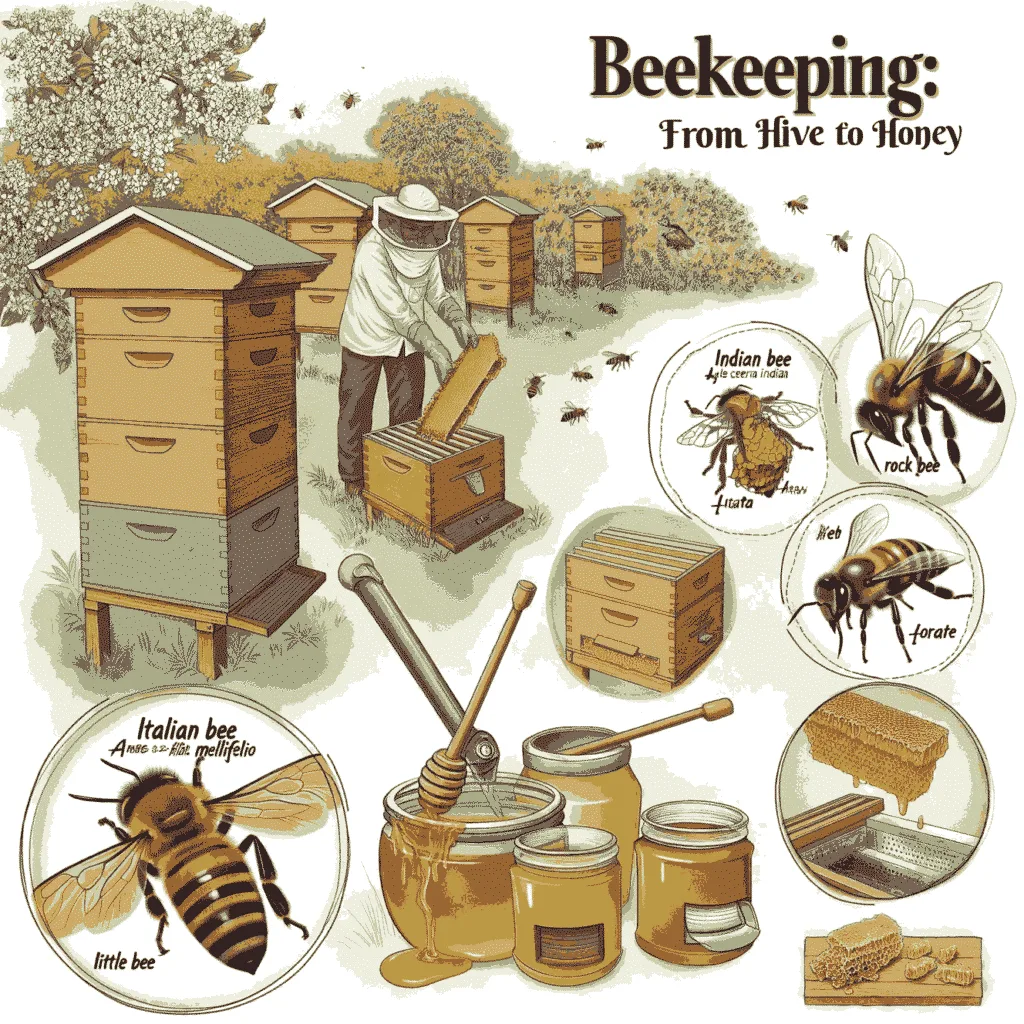
Purpose of Bee-Keeping
- Primarily for honey production
- Has become an agricultural enterprise
- Also provides bee wax
- Used in medicinal preparations
Advantages for Farmers
- Low investment required
- Used as additional income-generating activity
Bee Varieties Used in Honey Production
| Bee Species | Common Name | Use |
|---|---|---|
| Apis cerana indica | Indian bee | Local variety, used in traditional bee-keeping |
| A. dorsata | Rock bee | Wild, high yield but difficult to domesticate |
| A. florae | Little bee | Small hives, limited honey production |
| A. mellifera | Italian bee | Preferred for commercial production |
Why Italian Bees Are Preferred
- High honey collection capacity
- Sting less → safer for handling
- Stay in beehive for long periods
- Breed well under managed conditions
Establishment of Bee Farms
- Apiaries (bee farms) are set up for commercial honey production
- Location and management are crucial for high yield
Factors Affecting Honey Quality
Pasturage
- Refers to flowers available to bees
- Source of nectar and pollen
Two Key Aspects
Quantity of pasturage :
- More flowers → more nectar → higher honey yield
Type of flowers:
- Determines the taste and quality of honey
Summary Table: Bee-Keeping Essentials
| Aspect | Details |
|---|---|
| Main product | Honey |
| By-product | Bee wax (used in medicines) |
| Commercial use | Low-cost, additional income for farmers |
| Common bee species | Apis cerana indica, A. dorsata, A. florae, A. mellifera |
| Best for production | A. mellifera (Italian bee) |
| Apiaries | Bee farms for commercial honey |
| Honey quality depends on | Pasturage – type and amount of flowers |
Conclusion: Improvement In Food Resources Short Notes Class 9
These short notes on Improvement in Food Resources are your ultimate revision companion — scientifically structured for clarity, retention, and confidence. Whether you’re preparing for class tests or board exams, all important keyword-included , and NCERT-aligned summary that covers everything and misses nothing.
Use them wisely. Revise daily. Stay stress-free.
And remember — smart notes lead to smarter results. 🌟
FAQs: Improvement In Food Resources
Short Notes Class 9
Q1. Are these short notes reliable for exam preparation?
A : Yes. These notes are 100% based on your original text — no external information added. Every concept, keyword, and example from your content is included, making them accurate, trustworthy, and exam-focused.
Q2. How do I know no important keyword is missing?
A : Each note is created with strict keyword preservation. Every term from your text — like lactation period, composite fish culture, hybridisation, rabi crops — is bolded and included exactly as it appears. Nothing is skipped.
Q3. Can I rely on these notes instead of reading the full chapter?
A : Yes — if your goal is revision and quick recall. These notes are designed to replace long textbook reading during last-minute prep. They contain all key ideas in a scannable format, so you can revise faster and remember longer. But reading textbook is important. You Can read our Explanantion to the chapter 12 Here.
Q4. Are these notes too simplified? Will they help in scoring full marks?
A : No, they’re not oversimplified — they’re smartly condensed. Every point is complete and exam-ready, with tables, comparisons, and definitions exactly as needed. Use them to revise efficiently and write precise answers in exams.
Q5. How are these notes better than regular summaries?
A : These notes are :
- Mobile-friendly (easy to read on phones)
- One concept per line (no overload)
- Logically structured
- Visual and scannable (tables, spacing, bold terms)
- Built for maximum retention, not just reading
- Most summaries are dense. These are designed to stick in your memory.
Q6. Will I miss out on details if I only study these?
A : You won’t miss exam-relevant details. The notes include all definitions, examples, comparisons, and diagrams (described) from your text. They remove only repetition and filler — not content. Ideal for final revision and quick confidence-building.
Q7. Are these notes updated with the latest syllabus?
A : These notes are not syllabus-dependent — they are based entirely on the text you provided. So, as long as your text is from your current syllabus (e.g., NCERT Class 9 Science Chapter 12 – Improvement in Food Resources), these notes are 100% relevant and up-to-date.
Q8. What if I need deeper explanations later?
A : For that Click Here.
Q9. Why should I trust these notes over others online?
A : Because:
✅ No keyword skipping – Every term is preserved
✅ No fluff or filler – Only what’s necessary
✅ Mobile-first design – Easy to study anywhere
✅ Made for memory – Not just reading
These are study tools, not just summaries.
✅ Final Tip: Use these notes for active recall — read a heading, close your eyes, and say everything you remember. You’ll be surprised how much you retain.
Let these notes reduce your fear, save your time, and boost your confidence — exactly what good study material should do.