Exploring Forces Short Notes Chapter 5 Class 8 is a complete set of short notes created from Chapter 5 of the new NCERT book, Curiosity — Textbook of Science for Grade 8.
First, you should read the chapter from your textbook and understand the concepts.
Use these short notes to quickly revise the chapter and strengthen your memory, so you can prepare effectively for your exams or tests.
Happy learning!
5.1 What Is a Force?
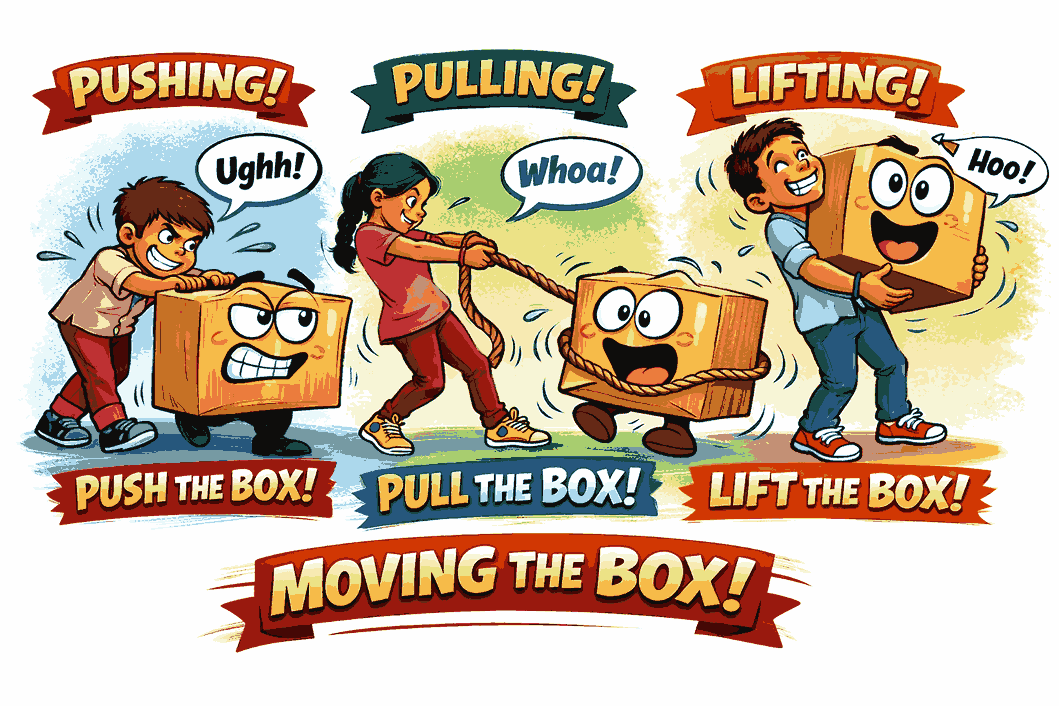
Definition
- Force = Push or Pull applied on an object
5.2 What Can a Force Do to the Bodies on Which It Is Applied?
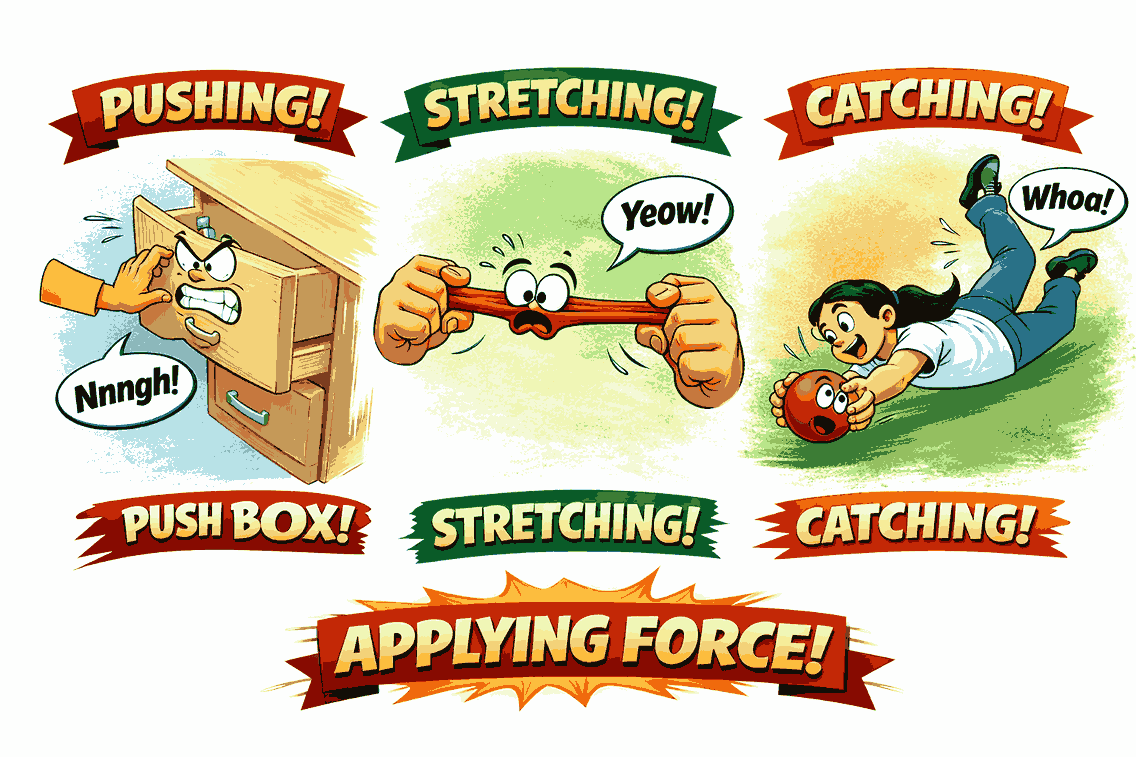
Five Effects of Force
1. Move the object from rest
2. Change speed
3. Change the shape of the object
4. Change direction of motion
5. Cause one or more effects together
Actions & Effects
| Actions | Push/Pull | Effect |
|---|---|---|
| Holding a moving bicycle | Pull | Stops/slows down |
| Hitting ball with bat | Push | Changes direction |
| Pressing inflated balloon | Push | Hitting the ball with a bat |
Everyday Examples → Effect Mapping
Kicking football → Change speed + direction
Stretching a rubber band → Change shape
Fielder stopping ball → Stop motion
Opening drawer → Move from rest
Applying brakes → Decrease speed
Rolling chapati → Change shape
Turning steering → Change direction
5.3 Are Forces an Interaction Between Two Or More Objects?
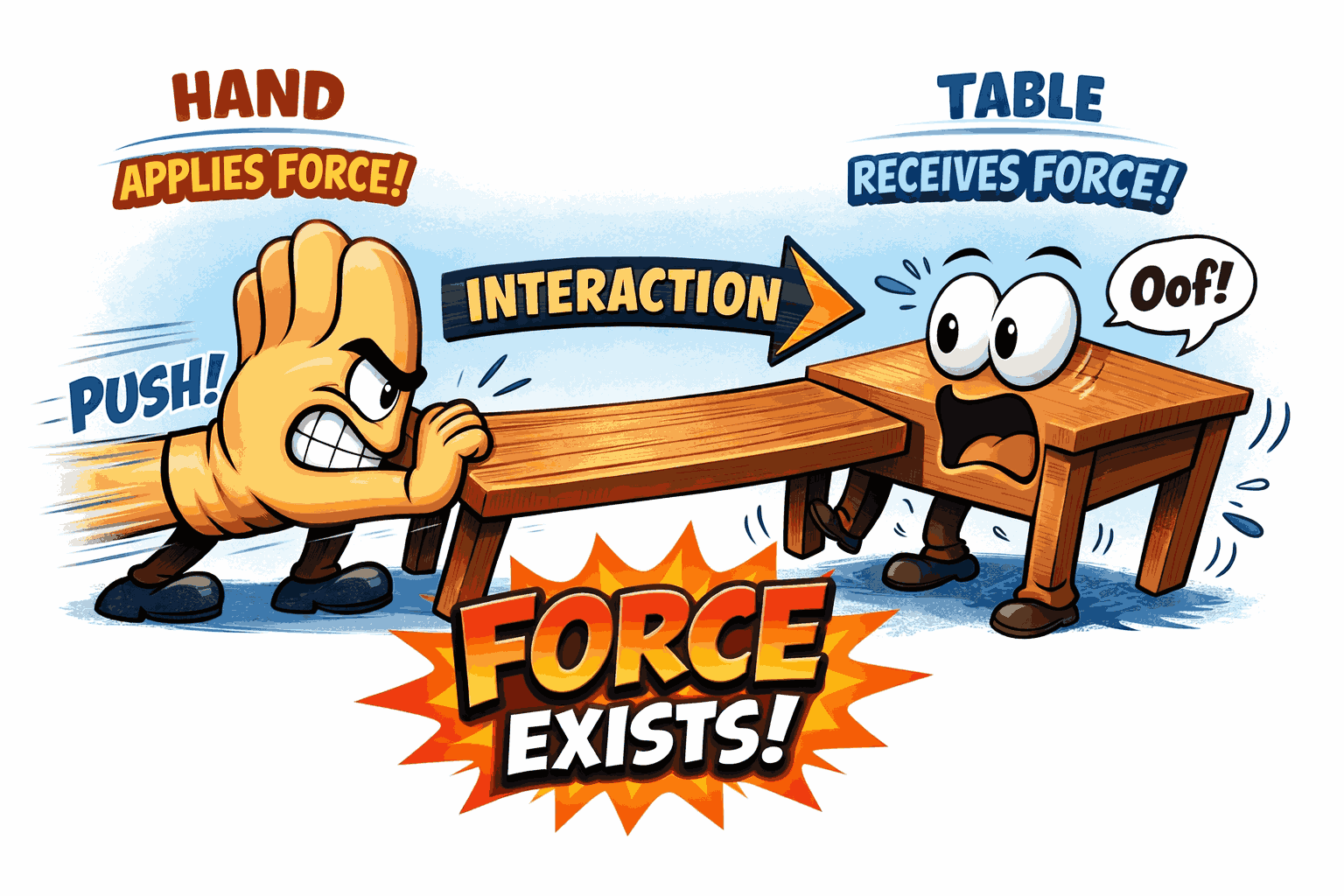
Core Concept
- Force = Interaction between ≥2 objects
- No interaction → No force
How Interaction Works
- Example: Pushing a table
- Object 1: Hand (applies force)
- Object 2: Table (receives force)
- Result: Interaction → Force exists
Therefore, at least two objects must interact for a force to come into play
Force Definition
- Force = Push or pull on an object resulting from its interaction with another object
SI Unit of Force:
Newton ‘N‘
5.4 What Are the Different Types of Forces?
Contact forces
Non-contact forces
Contact Forces
Require physical contact between objects
- Contact can be:
- Direct: hands, body parts
- Indirect: stick, rope, tool
- Act only when objects touch
Types of Contact Forces
Muscular Force
- Force produced by muscles (contract/relax).
- Used in walking, running, lifting, and pushing.
- Used by animals for movement.
- No muscle action → No muscular force. 💪
Friction
- Opposes motion between surfaces in contact
- Acts opposite to the direction of motion
- Causes moving objects to slow down and stop
- Rough → more friction; smooth → less friction
Non-Contact Forces
- Act without physical contact between objects
- Force experienced from a distance
Magnetic Force
- Exerted by a magnet on another magnet
or magnetic material - Like poles (N–N, S–S) → Repel
- Unlike poles (N–S) → Attract
N = North pole
S = South Pole
Electrostatic
Force
- Exerted by a charged object on charged/uncharged objects
- Static charges form when objects are rubbed together
- Like charges (+/+ or –/–) → Repel
- Unlike charges (+/–) → Attract
- Example: A plastic scale rubbed on hair attracts paper pieces
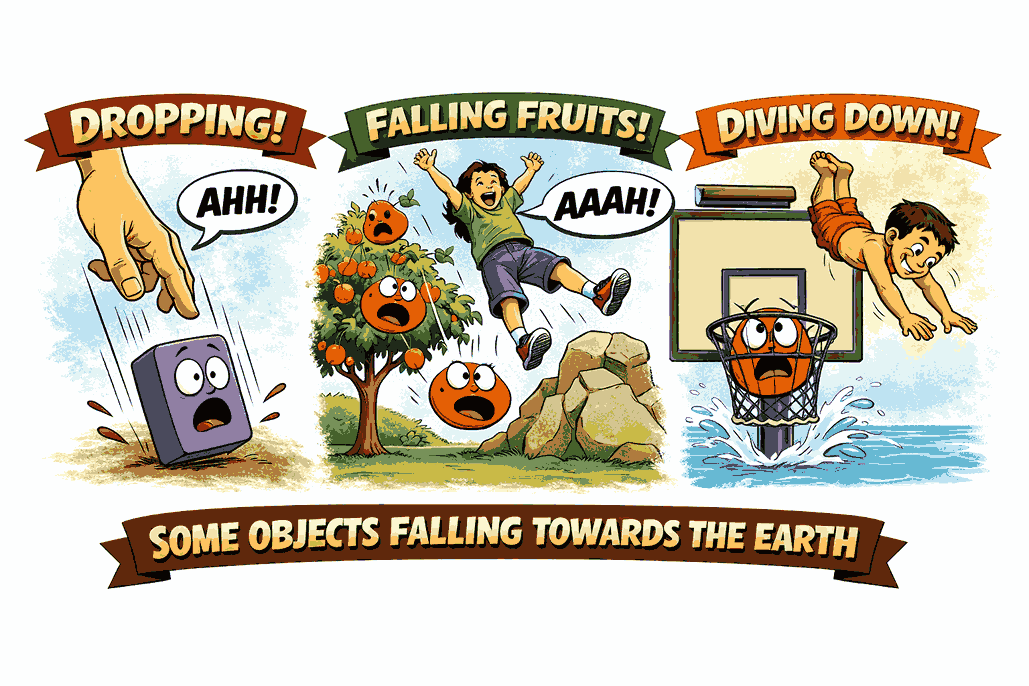
Gravitational Force
- The force with which the Earth pulls objects toward itself
- Also called gravity or the force of gravity
- Always attractive
- Causes:
- Objects fall downward
- Vertical motion: speed ↓ while going up, speed ↑ while coming down
- Acts on all objects with mass, from any distance
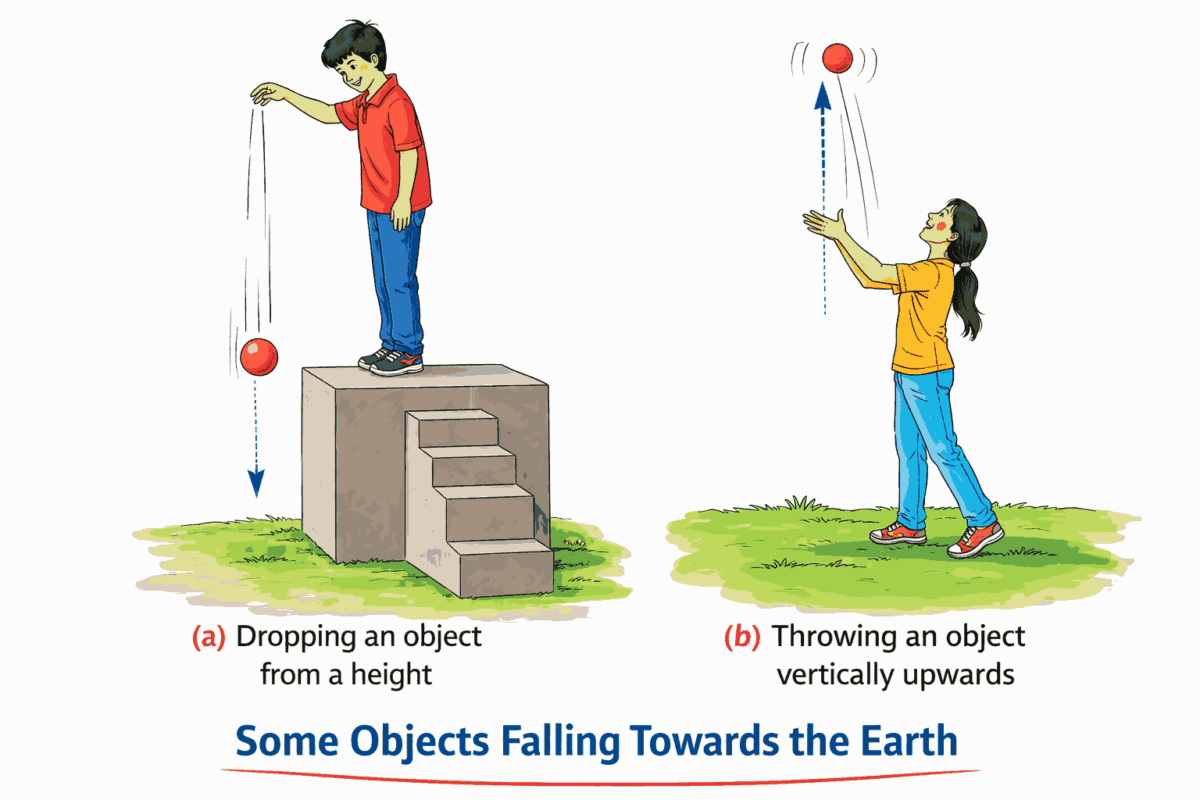
5.5 Weight and Its Measurement
Definition of Weight
- Weight = the gravitational force with which the Earth pulls an object
- Measures how strongly Earth pulls the object
- Since weight is a force → SI unit = newton (N)
Measuring Weight with a Spring
- Hanging object on a spring → spring stretches
- Different objects → different stretch → different weights
- Principle: More weight = More stretch
- Spring-based devices (spring balances) can measure weight
Quick Facts
- Mass = intrinsic property; Weight = force due to gravity
- On Moon: mass same, weight less (weaker gravity)
- Weight can change; mass never changes for a given object
5.6 Floating and Sinking
Upthrust or Buoyant Force
Definition
- Upthrust/Buoyant force = Upward force applied by a liquid on an object placed in it
- Acts only when the object is in a liquid
Direction of Forces on an Object in a Liquid
| Force | Direction | Source |
|---|---|---|
| Gravitational force | Downward | Earth |
| Buoyant force | Upward | Liquid |
Sink or Float?
- Gravitational force > Buoyant force → Object sinks
- Gravitational force = Buoyant force → Object floats
- Buoyant force > Gravitational force → Object rises to the surface
Key Factor Affecting
Buoyant Force
- Depends on the density of the liquid
- Higher density → Greater upthrust
- (Density topic covered in a later chapter)
Everyday Observation
- Pushing the bottle into the water → feel the upward push → bottle bounces back
- Reason: Water applies a buoyant force upward