This line-by-line explanation is from chapter 1, “Electric Charges and Fields.” Class 12th Physics.
This is an evolving Post, so keep visiting for a better experience
1.1 INTRODUCTION
📌 Exact NCERT Line:
All of us have the experience of seeing a spark or hearing a crackle when
We take off our synthetic clothes or sweater, particularly in dry weather.
💡 Explanation:
When you remove synthetic clothes, friction causes electric charges to build up. When these charges suddenly move (discharge), you see a spark or hear a crackle.
✅ Main Point:
👉 Rubbing → Charge buildup → Sudden discharge → Spark/crackle
Another common example of electric discharge is the lightning that we see in the sky during thunderstorms.
💡 Explanation:
Lightning is a massive discharge of electric charge between clouds or between cloud and Earth.
✅ Main Point:
👉 Lightning = Large-scale electric discharge
📌 Exact Line:
We also experience a sensation of an electric shock, either while opening the door of a car or holding the iron bar of a bus after sliding from our seat.
💡 Explanation:
Friction (like sliding on a seat) creates a charge on your body. When you touch metal, the charge flows suddenly → you feel a shock.
✅ Main Point:
👉 Body gets charged → Touch metal → Sudden discharge → Shock
🔹 Why Do These Phenomena Occur?
📌 Exact Point:
The reason for these experiences is the discharge of electric charges through our body, which were accumulated due to the rubbing of insulating surfaces.
💡 Explanation:
Insulators (like clothes, seats) do not allow charges to move easily, so charges accumulate. When a path is available, they discharge quickly.
✅ Main Point:
👉 Rubbing insulators → Charge accumulation → Discharge through body
🔹 What is Static Electricity?
📌 Exact Point:
You might have also heard that this is due to the generation of static electricity.
💡 Explanation:
Static electricity means charges at rest (not moving continuously).
✅ Main Point:
👉 Static electricity = Charges at rest
🔹 Meaning of “Static.”
📌 Exact Point:
Static means anything that does not move or change with time.
💡 Explanation:
In physics, “static” means no motion or change — here it refers to charges staying in one place.
✅ Main Point:
👉 Static = No movement / no change
🔹 What is Electrostatics? (MOST IMPORTANT)
📌 Exact Point:
Electrostatics deals with the study of forces, fields, and potentials arising from static charges.
💡 Explanation:
Electrostatics studies:
- Forces between charges
- Electric fields (region of influence)
- Electric potential (energy aspect)
—all due to charges at rest
✅ Main Point:
👉 Electrostatics = Study of effects of charges at rest
Q. If rubbing creates charge build-up, then how is it built up in clouds and on Earth that causes lightning?
Ans: Because the same idea of rubbing (friction) is still happening…
Let’s start from the basics:
- All matter has electrons (– charge) and protons (+ charge)
- Normally → everything is neutral (balanced)
- To create a charge:
👉 electrons must move from one place to another
So the real question is:
👉 What causes electrons to move in clouds?
Inside a thundercloud:
- There are water droplets + ice particles
- Strong winds make them collide constantly
👉 These collisions act like rubbing your sweater
Result:
- Some particles lose electrons → become +
- Others gain electrons → become –
💡 So yes — clouds are basically rubbing internally!
Now something interesting happens:
- Top of cloud → mostly + charge
- Bottom of cloud → mostly – charge
Why?
- Light particles go up, heavy ones go down (due to air currents)
Meanwhile:
- The ground below gets a + charge induced
Now we have:
👉 Cloud bottom (–)
👉 Ground (+)
This creates a huge electric attraction
When the charge becomes too large:
- Air (normally an insulator) breaks down
- A conducting path forms
- Charges suddenly rush → ⚡ LIGHTNING
This is the same as a spark when removing a sweater…
just millions of times stronger
Q. Why does rubbing create charge build-up, and why only in insulators, and why does discharge happen?
Ans:
- Everything is made of atoms
- Atoms contain:
- Protons (+) → tightly fixed
- Electrons (–) → can move
👉 Important idea:
Only electrons move in solids
So:
👉 Charging = movement of electrons, not creation of charge
Why rubbing creates charge buildup
When two materials rub:
- Their surfaces touch + scrape
- Electrons get pulled from one surface to another
👉 One object:
- loses electrons → becomes positive (+)
👉 Other object:
- gains electrons → becomes negative (–)
Different materials hold electrons with different strengths:
- Some give up electrons easily
- Some grab electrons strongly
At the microscopic level:
- Surfaces are rough → lots of tiny contact points
- Electron transfer depends on:
- surface energy
- material properties
👉 No new charge is created — only transferred
(Conservation of charge)
{If 10 electrons move:
- One object = +10e
- Other = –10e
👉 Total charge = 0 (still balanced)}
Why are insulators mainly charged
Conductors (metals) → electrons move freely
Insulators (plastic, rubber) → electrons are stuck
What happens after rubbing?
👉 In conductors:
- Charge spreads and quickly leaks away
- Often goes to your body or ground
👉 In insulators:
- The charge cannot move
- So it stays in one place → builds up
Why discharge happens
When charge builds up:
- There is an electric pressure (potential difference)
Nature doesn’t like imbalance!
👉 So charges try to move and balance out
When the difference becomes large:
- Air (normally an insulator) breaks down
- Path forms → charges suddenly move
👉 This is called discharge
Electric field becomes very strong:
- Large voltage (V) → strong field
- When field > threshold → air ionises
👉 electrons rush → spark or lightning
Q. Why does dry weather increase static shocks?
Air can behave in two ways:
- Dry air → good insulator
- Moist air → slightly conducting
👉 That’s the whole game!
What happens in DRY weather?
- Air has very little water vapour
- So air becomes a strong insulator
- Charges cannot leak away easily
👉 Result:
- The charge keeps building on your body
Then suddenly:
- You touch metal → ⚡ shock!
What happens in HUMID weather?
- Air has water molecules
- Water allows the tiny movement of charges
👉 So:
- Charges slowly leak into the air
- No big buildup happens
👉 Result:
- No sudden shock
Electric field idea:
- In dry air → Q builds up → E becomes large → spark
- In humid air → Q leaks → E stays small → no spark
In dry air:
- Charge builds → very high electric field
- When it exceeds the limit → sudden discharge
In humid air:
- The field never becomes large enough
👉 because the charge keeps leaking
1.2 ELECTRIC CHARGE
1.3 CONDUCTORS AND INSULATORS
1.4 BASIC PROPERTIES OF ELECTRIC
CHARGE
1.5 COULOMB’S LAW
Have you ever noticed how:
- A balloon sticks to a wall?
- Or do two charged objects either push each other away or pull each other toward each other?
👉 But how strong is that push or pull?
👉 Can we calculate it like we calculate distance or speed?
That’s exactly what Coulomb figured out!
📌 Exact Line:
Coulomb’s law is a quantitative statement about the force between two point charges.
💡 Explanation:
This means:
- It doesn’t just say “charges attract or repel.”
- It tells how much force there is (with numbers!)
👉 “Quantitative” = gives exact value
✅ Main Point:
👉 Coulomb’s Law tells how strong the force is between charges
📌 Exact NCERT Line:
When the linear size of charged bodies is much smaller than the distance separating them, the size may be ignored, and the charged bodies are treated as point charges.
💡 Explanation:
Imagine:
- Two tiny balls very far apart
👉 Their size doesn’t matter much
So we simplify:
- Treat them like dots (points)
This makes calculations easier.
✅ Main Point:
👉 Small objects far apart → treat as point charges
📌 Exact NCERT Line:
Coulomb measured the force between two point charges and found that it varied inversely as the square of the distance between the charges, was directly proportional to the product of the magnitude of the two charges, and acted along the line joining the two charges
💡 Explanation:
This is the most important idea!
👉 If distance increases → force decreases very fast
Example:
- Distance = 1 → Force = 1
- Distance = 2 → Force = 1/4
- Distance = 3 → Force = 1/9
👉 That’s why it’s called the inverse square law
If charges are bigger → force is bigger
Example:
- q₁ = 2, q₂ = 3 → product = 6
- Larger product → stronger force
Think:
👉 More charge = more “electric power.”
The force is not random
👉 It acts:
- Straight between the charges
- Like pulling or pushing along a straight line
✅ Main Points:
👉 Force ∝ 1 / distance²
👉 Force ∝ (q₁ × q₂)
👉 Force acts along the line joining charges
Thus, if two point charges q₁, q₂ are separated by a distance r in vacuum, the magnitude of the force (F) between them is given by
📌 ExactNCERT Point:
Coulomb’s law… has also been established down to the subatomic level.
💡 Explanation:
This law works:
- For big objects ✔️
- For atoms ✔️
- Even for electrons and protons ✔️
👉 That’s why it’s a universal law
✅ Main Point:
👉 Works from large scale → atomic scale
📌 Exact NCERT line :
In SI units, the value of k is about 9 × 10⁹ Nm²/C².
💡 Explanation:
This number is HUGE!
👉 Meaning:
The electric force is very strong compared to gravity
Example:
- Even small charges → big forces
✅ Main Point:
👉 k = 9 × 10⁹ (very large → strong force)
💡 Explanation:
This number is HUGE!
👉 Meaning:
The electric force is very strong compared to gravity
Example:
- Even small charges → big forces
✅ Main Point:
👉 k = 9 × 10⁹ (very large → strong force)
📌 Exact NCERT line:
The constant k in Eq. (1.1) is usually put as
k = 1/4πϵ₀ for later convenience, so that Coulomb’s
law is written as
F = (1 / 4πϵ₀) × (q₁q₂ / r²) (1.2)
ϵ₀ is called the permittivity of free space. The value
of ϵ₀ in SI units is
ϵ₀ = 8.854 × 10⁻¹² C² N⁻¹ m⁻²
💡 Explanation:
👉 F = k (q₁q₂ / r²) But scientists thought:
👉 “Let’s express k in a more meaningful way.”
So they rewrote:
👉 k = 1 / (4πϵ₀)
What is ϵ₀ (epsilon naught)?
Think of this:
👉 Space is not truly empty
👉 It has a property that affects the electric force
That property is called:
👉 Permittivity of free space (ϵ₀)
Simple Analogy
Imagine:
- Moving in air → easy
- Moving in water → harder
👉 Medium changes how things move
Similarly:
👉 ϵ₀ tells how easily electric force “works” in space
- Charges create force
- Space resists or allows that force
👉 ϵ₀ measures that “resistance.”
Coulomb’s law becomes:
👉 F = (1 / 4πϵ₀) × (q₁q₂ / r²)
Here:
- 4π comes from geometry (sphere spreading)
- ϵ₀ comes from the nature of space
Q. WHY 4π appears in the formula of Coulomb’s law
Ans:
Have you ever noticed:
👉 When you spray perfume, the smell spreads in all directions
👉 The farther you go, the weaker it becomes
But WHY exactly does it weaken like that?
👉 Why not half? Why not 1/r?
This is where 4π secretly enters the Picture.
Imagine a single charge sitting alone in space.
👉 It sends out its influence (electric field) in every direction
👉 Not just left or right — in 3D space
So the field spreads like:
👉 A growing balloon (sphere)
🎈 Visualize This
Near the charge:
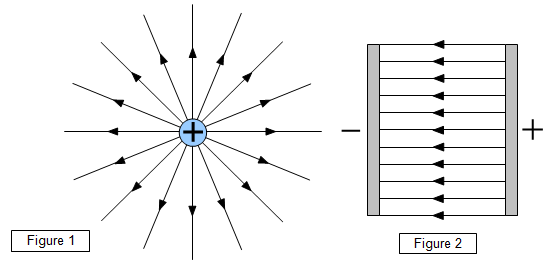
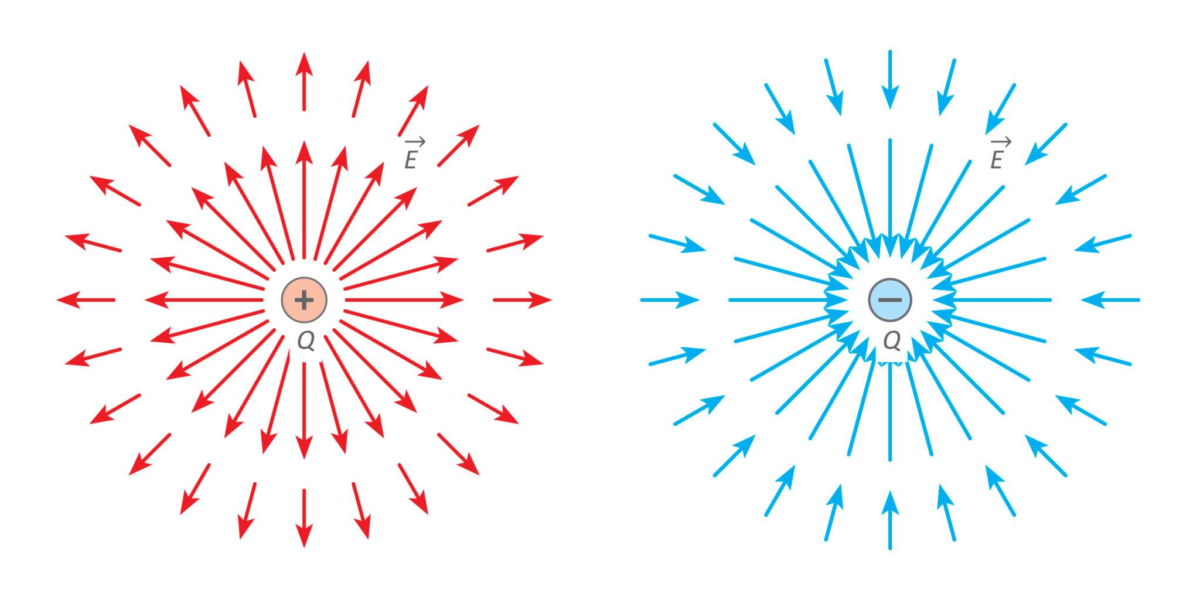
- Field lines are dense
- Force is strong
Move away
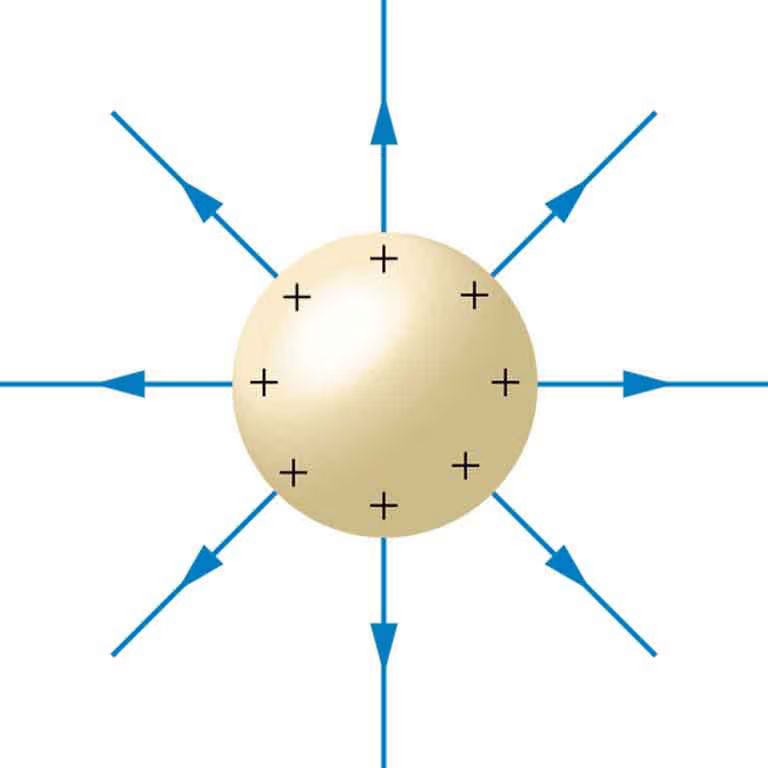
👉 The charge sends influence equally in all directions
👉 That influence spreads over a sphere
Surface area of a sphere:
👉 This is the MOST important step.
Now think:
- Same “amount of field” spreads over an area
- Bigger sphere → field spreads thinner
So:
👉 Field ∝ 1 / (4πr²)
This is why:
👉 Coulomb’s law becomes:
👉 That 4π comes from spherical geometry
Think like this:
👉 Total “field effect” is constant
But it spreads over:
- Radius = r
- Area = 4πr²
So:
👉 Field strength = (total effect) / (area)
👉 = 1 / (4πr²)
👉 The inverse square law (1/r²)
👉 Comes directly from surface area of a sphere
👉 And the 4π comes from:
“How big the surface of that sphere is”
Q. Why 1 / r² in Coulomb’s law? Why not 1 / r
Ans:
Let’s imagine:
👉 A single charge sitting in space
👉 It sends its influence in ALL directions
Not just left-right, but:
👉 Up, down, front, back → 3D spread
🎈 What actually spreads?
Think of it like this:
👉 The charge sends out “influence lines” (field lines)
Important fact:
👉 Number of lines = constant
They don’t disappear — they just spread out.
At distance r, those same lines are spread over a surface.
But what surface?
👉 A sphere
Surface area of sphere:
Now think carefully:
👉 Same number of field lines
👉 Bigger area → fewer lines per unit area
So:
👉 Field strength ∝ 1 / area
👉 Field ∝ 1 / r²
❌ Why NOT 1/r?
Let’s test your idea:
If it were:
👉 Field ∝ 1/r
That would mean:
- Area should grow like r
- But the real area grows like r²
👉 So 1/r would break geometry of space!
At distance r:
- Area = 4πr²
- Same “effect” spreads over that area
So:
👉 Field = constant / (4πr²)
👉 That’s why:Beacuse 4π is a constant.
👉 Because electric force spreads in 3D space, Of sphere
👉 and the surface area grows as r²,
👉 so force must decrease as 1/r²
The Direction Of Force
- → force on q₂ due to q₁
- → distance between charges
- → unit vector from q₁ to q₂
- → constant
You already know:
👉 Charges attract or repel
But here’s the deeper question:
👉 In which direction does the force act?
👉 How do we describe that direction mathematically?
That’s why we need vector form.
📌 Exact Point:
Since force is a vector, it is better to write Coulomb’s law in the vector notation.
💡 Explanation:
Force is not just a number — it has:
- magnitude ✔️
- direction ✔️
So instead of just writing “how much force”, we must also say:
👉 which way it acts
✅ Main Point:
👉 Force needs vector form (magnitude + direction)
📌 Exact Point:
Let the position vectors of charges q₁ and q₂ be r₁ and r₂, respectively.
💡 Explanation:
Each charge has a position in space:
- q₁ → located at r₁
- q₂ → located at r₂
👉 These are like coordinates (location arrows from origin)
✅ Main Point:
👉 r₁, r₂ = positions of charges
📌 Exact Point:
We denote force on q₁ due to q₂ by F₁₂ and force on q₂ due to q₁ by F₂₁.
💡 Explanation:
Careful naming:
- F₁₂ → force on q₁ due to q₂
- F₂₁ → force on q₂ due to q₁
👉 Order matters!
✅ Main Point:
👉 F₁₂ ≠ F₂₁ (different directions, same magnitude)
📌 Exact Point:
The vector leading from 1 to 2 is denoted by r₂₁:
r₂₁ = r₂ – r₁
💡 Explanation:
This is very important.
👉 r₂₁ means:
“Go from charge 1 → charge 2”
So:
👉 Start at r₁
👉 End at r₂
Hence:
👉 r₂₁ = r₂ – r₁
✅ Main Point:
👉 r₂₁ = displacement from q₁ to q₂
📌 Exact Point:
r₁₂ = r₁ – r₂ = – r₂₁
💡 Explanation:
Now reverse direction:
👉 From charge 2 → charge 1
So:
👉 r₁₂ = r₁ – r₂
And clearly:
👉 r₁₂ = – r₂₁
(opposite direction)
✅ Main Point:
👉 r₁₂ and r₂₁ are opposite vectors
📌 Exact Point:
The magnitude of the vectors r₂₁ and r₁₂ is same.
💡 Explanation:
Even though directions differ:
👉 Distance between charges is same
So:
👉 |r₁₂| = |r₂₁| = r
✅ Main Point:
👉 Distance is same, direction changes
📌 Exact Point:
The direction of a vector is specified by a unit vector.
💡 Explanation:
A unit vector:
- has length = 1
- shows only direction
Example:
👉 ˆr₂₁ = direction from q₁ to q₂
Formula idea:
👉 unit vector = vector / magnitude
✅ Main Point:
👉 Unit vector = direction only
📌 Exact Point:
Coulomb’s force law in vector form is
💡 Explanation:
This equation tells EVERYTHING:
- magnitude → (q₁q₂ / r²)
- direction → along ˆr₂₁
👉 So force is:
- along line joining charges
- with correct direction
✅ Main Point:
👉 Vector form = magnitude × direction
📌 Exact Point:
If q₁ and q₂ are same sign → force is along ˆr₂₁ (repulsion).
💡 Explanation:
Same charges push away:
👉 Force direction = away from other charge
So:
👉 along ˆr₂₁
✅ Main Point:
👉 Same charges → repulsion
📌 Exact Point:
If charges are opposite → force is along –ˆr₂₁ (attraction).
💡 Explanation:
Opposite charges pull:
👉 Force direction reverses
👉 along –ˆr₂₁
✅ Main Point:
👉 Opposite charges → attraction
📌 Exact Point:
We do not need separate equations for attraction and repulsion.
💡 Explanation:
Because:
👉 Sign of q₁q₂ automatically decides direction
- positive → repulsion
- negative → attraction
✅ Main Point:
👉 One formula handles both cases
📌 Exact Point:
F₁₂ = –F₂₁ → agrees with Newton’s third law
💡 Explanation:
👉 Action = Reaction
- Same magnitude
- Opposite direction
So:
👉 F₁₂ = –F₂₁
✅ Main Point:
👉 Coulomb’s law obeys Newton’s 3rd law
📌 Exact Point:
Coulomb’s law gives force in vacuum; in matter it becomes more complex.
💡 Explanation:
In vacuum:
👉 simple formula works
In materials:
👉 other charges interfere
👉 Force changes
✅ Main Point:
👉 Medium affects electric force