Solutions to questions under Figure it out page 10 and 11, Chapter 1: A SQUARE AND A CUBE, Ganita Prakash | Grade 8
Here we are with “A SQUARE AND A CUBE NCERT Solutions Math Chapter 1“. The solutions are expert-checked and are strictly based on the New NCERT Book Curiosity.
1.1 Square Numbers
- Which of the following numbers are not perfect squares?
(i) 2032 (ii) 2048 (iii) 1027 (iv) 1089
Solution:
Perfect squares can only end in digits 0,1,4,5,6,9.
- Check units digit:
- 2032 → units digit 2 ⇒ cannot be a perfect square.
- 2048 → units digit 8 ⇒ cannot be a perfect square.
- 1027 → units digit 7 ⇒ cannot be a perfect square.
- 1089 → units digit 9 ⇒ possibly a square — test further.
- For 1089 check known squares (page 8–9): . So 1089 is a perfect square.
2. Which one among has last digit 4?
The last digit of a square depends only on the last digit of the base:
- If base ends with 2 → 22=4 ⇒ square ends with 4.
- If base ends with 8 → 82=64 ⇒ square ends with 4.
- If base ends with 4 or 6 → square ends with 6 (since ).
Check endings:
- — base ends 4 ⇒ square ends 6 (NOT 4).
- — base ends 8 ⇒ square ends 4.
- — base ends 2 ⇒ square ends 4.
- — base ends 6 ⇒ square ends 6 (NOT 4).
3. Given . What is ?
(i) 15625 + 126 (ii) 15625 + 262 (iii) 15625 + 253
(iv) 15625 + 251 (v) 15625 + 512
Solution:
- Use
- Here .
- So
4. Find the length of the side of a square whose area is 441 m2.
Solution :
441 is a known perfect square: . So side m.
- Find the smallest square number that is divisible by each of the
following numbers: 4, 9, and 10.
Solution:
- Find .
- Prime factors:
2. LCM takes highest powers:
So any number divisible by 4,9,10 must be a multiple of 180.
To be a perfect square, every prime exponent in factorisation must be even.
Factorise 180:
Exponents are — the 5 has an odd exponent 1.
4. Multiply by the smallest number that makes all exponents even:
Multiply by another to make the exponent of 5 equal 2.
Product .
Check:
- Find the smallest number by which 9408 must be multiplied so that
The product is a perfect square. Find the square root of the product
Solution:
Step-by-step factorisation (showing the divisions):
So we divided by 2 six times ⇒ factor.
Now
Therefore.
Logic to make a square:
Exponents must be even. Current exponents: (even), (odd), (even).
Only 3 is unpaired. Multiply by one more to get
- Smallest multiplier = 3.
- Product
Find the square root:
After multiplying by 3, prime powers become 26×32×72. Group into pairs of primes
(taking one of each pair for the root):
- How many numbers lie between the squares of the following
numbers?
(i) 16 and 17 (ii) 99 and 100
Solution:
The number of integers strictly between and equals
Calculate:
- For n=16: numbers between =
- For n=99: numbers between =
8. In the following pattern, fill in the missing numbers:
Solution:
Discover Pattern:
- For the first line :
- third term . RHS .
- For second line :
- third RHS
- So general identity: for natural ,
Apply:
- For
- third term
RHS .
So ,
- third term
- For the last line with
- third term RHS
So,
- third term RHS
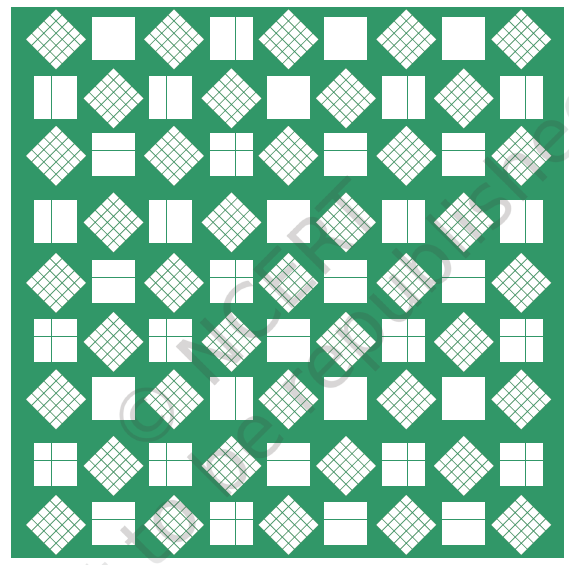
- How many tiny squares are there in the following picture? Write the
prime factorisation of the number of tiny squares
Please refer to the image by clicking here
Solution:
Look at the picture, you will observe:
- There are 5 small blocks along one side.
- Each block contains 5 tiny squares along its side.
So total tiny squares per side:
Now the entire big square is:
Which gives:
Prime factorisation:
1.2 Cubic Numbers
- Find the cube roots of 27000 and 10648.
1. Cube root of 27000
First, we find the prime factorisation of 27000 by the long division method:
The prime factorisation of 27000 is:
Now, applying the rule:
If , then is the cube root of .
This is denoted by
2. Cube root of 10648
First, we find the prime factorisation of 10648 by the long division method:
The prime factorisation of 10648 is:
Now, applying the rule:
If , then
Therefore,
2. What number will you multiply by 1323 to make it a cube number?
First, we find the prime factorisation of 1323 using the long division method:
So, we can write 1323 as the product of its prime factors:
To make a number a perfect cube, the powers (exponents) of all its prime factors must be multiples of 3.
Let’s check our factors:
- Power of 3 = 3 ✔
- Power of 7 = 2 ✘
We need one more 7.
So multiply by 7.
Hence, the required number is: 7
- State true or false. Explain your reasoning.
(i) The cube of any odd number is even.
(ii) There is no perfect cube that ends with 8.
(iii) The cube of a 2-digit number may be a 3-digit number.
(iv) The cube of a 2-digit number may have seven or more digits.
(v) Cube numbers have an odd number of factors.
Solutions:
(i) The cube of any odd number is even.
Example:
27 is odd. Therefore, the statement is False.
(ii) There is no perfect cube that ends with 8.
So a cube can end with 8. Therefore, the statement is False.
(iii) The cube of a 2-digit number may be a 3-digit number.
Smallest 2-digit number = 10
1000 is a 4-digit number. Therefore, the statement is False.
(iv) The cube of a 2-digit number may have seven or more digits.
Largest 2-digit number = 99
970299 has 6 digits. Therefore, the statement is False.
(v) Cube numbers have an odd number of factors.
Example:
Factors of 8 are: 1, 2, 4, 8
Total = 4 factors (even).
Therefore, the statement is False.
- You are told that 1331 is a perfect cube. Can you guess without
factorisation what is its cube root? Similarly, guess the cube roots of
4913, 12167, and 32768.
Solution:
(i) Cube root of 1331
Step 1: Make groups of three from the right
1331 → 1 | 331
Step 2: Look at the last digit (1)
- Only ends in 1.
So, the unit digit of the cube root = 1
Step 3: Look at the first group (1)
Largest cube ≤ 1 is:
So the tens digit = 1
ii) Cube root of 4913
4913 → 4 | 913
Step 2: Last digit is 3
From cube table:
- ends in 3.
So, the unit digit of the cube root = 7
Step 3: First group (4)
Largest cube ≤ 4 is:
So tens digit = 1
(iii) Cube root of 12167
Step 1: Group digits
12167 → 12 | 167
Step 2: Last digit is 7
From cube table:
- ends in 7.
So unit digit = 3
Step 3: First group (12)
Largest cube ≤ 12 is:
So tens digit = 2
(iv) Cube root of 32768
Step 1: Group digits
32768 → 32 | 768
Step 2: Last digit is 8
From cube table:
- ends in 8.
So unit digit = 2
Step 3: First group (32)
Largest cube ≤ 32 is:
So tens digit = 3