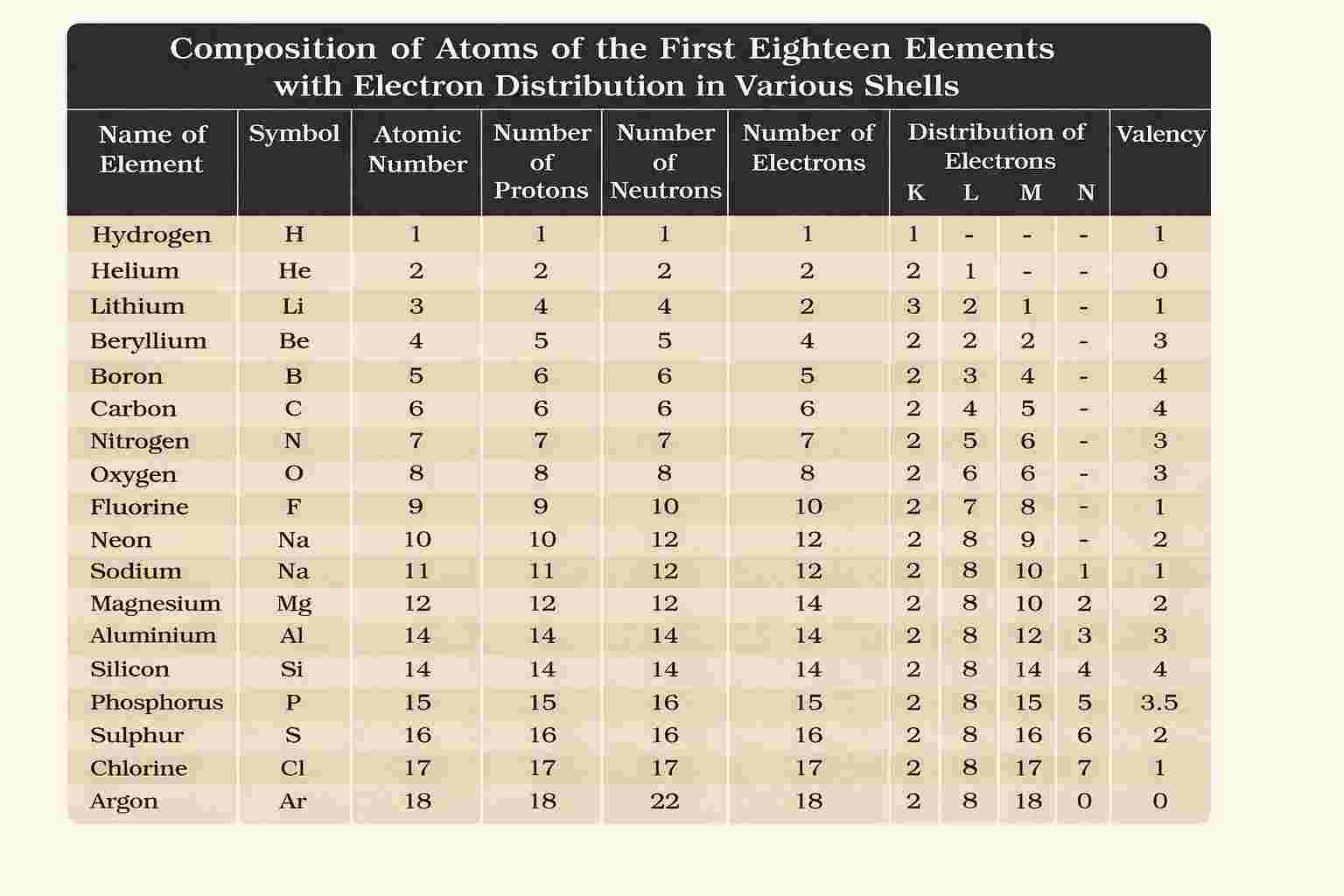
Atoms react to fill outer shell to 8 (or 2 for He)
Comparison: How Valency is Determined
Situation
Action
Valency Calculation
Example
Few outer electrons (1–3)
Lose e⁻
= number of e⁻
Na → 1
Many outer electrons (5–7)
Gain e⁻
= 8 – number of e⁻
Cl → 1
Half-full shell (4)
Share e⁻
= 4
C → 4
Full shell (8 or 2 for He)
No reaction
= 0
Ar → 0
Atomic Number and Mass Number
ATOMIC NUMBER
Atomic number = number of protons in the nucleus.
Denoted by the symbol ‘Z’.
Unique for each element – defines the element itself.
Key Facts
All atoms of the same element have the same atomic number (Z).
Change protons → change the element.
Hydrogen: Z = 1 (1 proton).
Carbon: Z = 6 (6 protons).
Neutral atom: Number of protons (Z) = Number of electrons.
Why It Matters
Determines element identity.
Never changes for a given element.
MASS NUMBER
Mass number = protons + neutrons in the nucleus.
Denoted by the symbol ‘A’.
Electrons have negligible mass → not counted.
Why Only Protons & Neutrons?
Both particles are heavy (~1 u each).
Together called nucleons (reside in the nucleus).
Electrons are ~2000× lighter → ignored for mass.
Examples
Carbon: 6 protons + 6 neutrons → A = 12
Aluminium: 13 protons + 14 neutrons → A = 27
Nitrogen: 7 protons + 7 neutrons → A = 14
Atomic Notation
Written as:
Example: → Nitrogen with A=14, Z=7
Key Rule
A = Z + number of neutrons
Neutrons = A – Z
Keyword Table
Keyword
Meaning
Mass number
Total protons + neutrons in nucleus (symbol A)
Nucleons
Collective name for protons and neutrons
Atomic mass unit (u)
Unit for atomic mass; proton/neutron ≈ 1 u
Neutron
Neutral particle in nucleus; adds mass but no charge
Nucleus
Central core holding protons and neutrons (99.9% of atom’s mass)
Isotopes
What Are Isotopes?
Atoms of the same element (same atomic number Z).
Have different mass numbers (A) due to different neutrons.
Same protons → same chemical behavior.
Different neutrons → different physical properties.
Key Properties
Chemical properties: Same (same electrons → same reactions).
Physical properties: Different (mass, density, boiling point).
Average atomic mass: Weighted average of all isotopes.
Chlorine example: (75% × 35 u) + (25% × 37 u) = 35.5 u → Not the mass of one atom, but the average of a large sample.
Hydrogen Isotopes (Best Example)
Isotope
Symbol
Protons
Neutrons
Mass (A)
Common Name
Protium
¹H₁
1
0
1
Ordinary H
Deuterium
²H₁ or D
1
1
2
Heavy H
Tritium
³H₁ or T
1
2
3
Radioactive H
Other Examples
Carbon: ¹²C₆ (6n) and ¹⁴C₆ (8n) → used in carbon dating.
Chlorine: ³⁵Cl₁₇ (18n) and ³⁷Cl₁₇ (20n) → occur in 3:1 ratio.
Real-World Applications
Uranium-235: Nuclear reactor fuel.
Cobalt-60: Cancer radiation therapy.
Iodine-131: Treats thyroid disorders (goitre).
Keyword Table
Keyword
Meaning
Isotopes
Atoms of same element with same protons but different neutrons
Atomic number (Z)
Number of protons (defines the element)
Mass number (A)
Protons + neutrons in nucleus
Nucleons
Protons + neutrons (particles in nucleus)
Average atomic mass
Weighted mean mass of all natural isotopes
Protium
Lightest hydrogen isotope (no neutrons)
Deuterium
Heavy hydrogen (1 neutron); used in heavy water
Tritium
Atoms of the same element with the same protons but different neutrons
Isobars
What Are Isobars?
Atoms of different elements (different atomic numbers Z).
Have the same mass number (A).
Same total nucleons (protons + neutrons), but different proton/neutron split.
Key Properties
Chemical properties: Different (different elements → different reactions).
Physical properties: Different (mass distribution varies).
Nucleon count: Same total (A), but protons ≠ and neutrons in each.
Why They Exist
Different combinations of protons/neutrons can give the same total mass.
Example: 20p+20n = 40 and 18p+22n = 40 → both have A=40.
Example: Calcium & Argon
Element
Symbol
Protons (Z)
Neutrons
Mass Number (A)
Calcium
⁴⁰Ca₂₀
20
20
40
Argon
⁴⁰Ar₁₈
18
22
40
→ Same A = 40, but different elements (Z = 20 vs 18).
Keyword Table
Keyword
Meaning
Isobars
Atoms of different elements with same mass number (A) but different atomic number (Z)
Mass number (A)
Total protons + neutrons in nucleus
Atomic number (Z)
Number of protons (defines the element)
Nucleons
Protons + neutrons (particles in nucleus)
Different elements
Atoms with different Z → different chemical identity
↔️ Comparison: Isotopes vs Isobars
Feature
Isotopes
Isobars
Atomic number (Z)
Same (same element)
Different (different elements)
Mass number (A)
Different
Same
Protons
Same
Different
Neutrons
Different
Different (adjusted to keep A same)
Chemical properties
Same (same electrons)
Different (different elements)
Example
¹²C₆ and ¹⁴C₆ (both carbon)
⁴⁰Ca₂₀ and ⁴⁰Ar₁₈ (calcium & argon)
💡 Quick Memory Trick: Isotopes → same top (protons/Z) Isobars → same weight (mass/A)
Conclusion : Structure Of Atoms Short Notes Class 9
I hope the notes have been a valuable resource for you. To truly master the material, regular revision is the key to making the knowledge stick.
Furthermore, we believe the best resources are built on collaboration. If you have any suggestions, ideas, or even spot an area that could be improved, please don’t hesitate to reach out. Your feedback is incredibly important to us