“Power Sharing Short Notes Class 10 Ch 1” presents before you the most important points and concepts of the chapter.
The syllabus of Class 10 political science(civics)- Democratic politics – II is conceptually dense. Hence, you need well-structured, short, and concise notes to prepare well for the exam.
And we have ensured that here in our short notes for you.
Going through the notes, you will find how easy it is to master the chapter.
Every topic is broken down to its most basic parts, and then the short notes are created.
The link to download the PDF is at the end of the short notes.
Belgium and Sri Lanka
Belgium
Belgium
Europe; borders: France, Netherlands, Germany, Luxembourg
Language Distribution
- Dutch: 59% (Flemish region)
- French: 40% (Wallonia region)
- German: 1%
- Brussels: 80% French,
20% Dutch
Social Facts
- French-speaking minority: historically rich/powerful
- Dutch-speaking community: gained economic development/education later
- Result: Tensions between communities (1950s–1960s)
- Dutch majority nationally, minority in the capital
Sri Lanka
Ethnic-Linguistic Groups
- Sinhala-speakers: 74% (mostly Buddhist)
- Tamil-speakers: 18%
- Sri Lankan Tamils: 13% (natives; concentrated north/east)
- Indian Tamils: 5% (forefathers from India; colonial-era plantation workers)
- Christians: ~7% (both Sinhala & Tamil)
- Tamil religions: Mostly Hindu/Muslim
Majoritarianism in Sri Lanka
Post-Independence (1948)
- Sinhala leaders wanted
government dominance via numeric majority - Democratic government adopted majoritarian measures for Sinhala supremacy
Majoritarian Measures Implemented
- 1956 Official Language Act: Recognised Sinhala as the only official language; disregarded Tamil
- Preferential policies:
University positions and govt. Jobs – Sinhala Favoured - Constitutional provision:
State – protect and foster Buddhism
Impact on Sri Lankan Tamils
- Feeling of alienation
- Insensitivity – toward Tamil language/culture
- Denial of equal political rights
- Discrimination in jobs and opportunities; interests ignored
- Strained relations between the Sinhala and Tamil communities
Tamil Political Response
- Launched parties/struggles demanding:
- Recognition of Tamil as the official language
- Regional autonomy
- Equality of opportunity in education and jobs
- Demands for provincial autonomy – repeatedly denied
By the 1980s, Political organisations demanded an independent Tamil Eelam (state) in northern/eastern Sri Lanka
Civil War
- Distrust → widespread conflict → civil war
- Thousands were killed from both communities
- Many families were forced to leave as
refugees; many lost livelihoods - Terrible setback to social, cultural, and economic
life of the country - The civil war ended in 2009
Accommodation in Belgium
Recognised regional differences + cultural diversities
Constitution
- amended 4 times
- to enable all communities to
live together in one country
Central Government
- Dutch and French-speaking ministers are equal
- Special laws: majority from each linguistic group
- No single community can make decisions unilaterally
State Governments
- Powers of the Central Government given to the State Governments
- State Govts are not subordinate to the Central Govt.
Brussels
- Separate government; both communities equal representation
- French accepted Brussels equality ↔ the Dutch accepted Central equality
Community Government
- Elected by the
language community: Dutch, French, and German-speaking - Power: cultural, educational, language-related issues
Lessons: Belgium vs Sri Lanka
Belgium
- Respecting diverse communities’ interests enables unity
- Power shared through mutual agreement
Sri Lanka
- The majority imposes dominance; power is not shared
- Undermines national unity
Idea Of Power Sharing
Power Sharing
- Opposes undivided political power
- Rejects concentration of power in one person/group/place
Democracy Principle
- People = source of political power
- Rule through institutions of self-government
- Respect – diverse groups and views
- Everyone – voice in public policy
- Distributes power among the maximum number of citizens
Forms of power-sharing
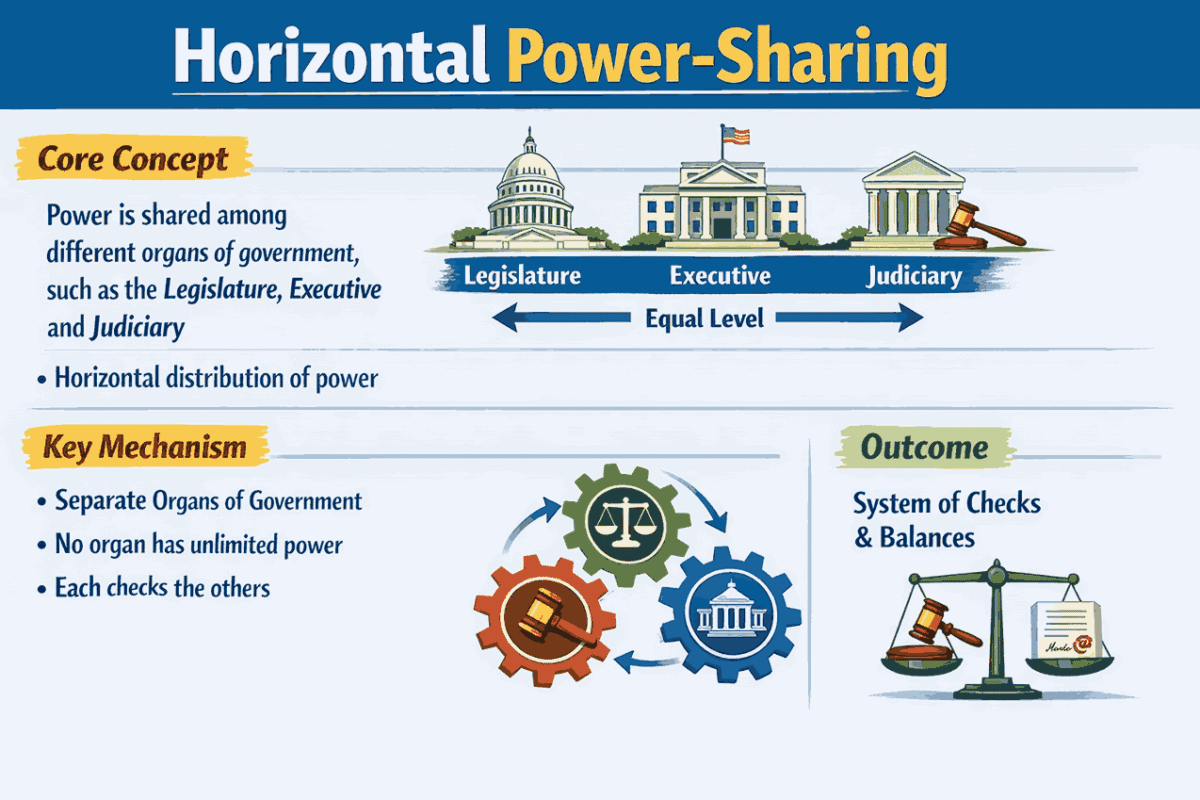
1. Horizontal Power-Sharing
Power is shared among the Legislature, the Executive, and the Judiciary
Mechanism
- Different organs of govt ↦ same levels
- Each has separate powers
- No unlimited power
- Balance of power
Outcome
system of checks and balances
2. Vertical Power-Sharing
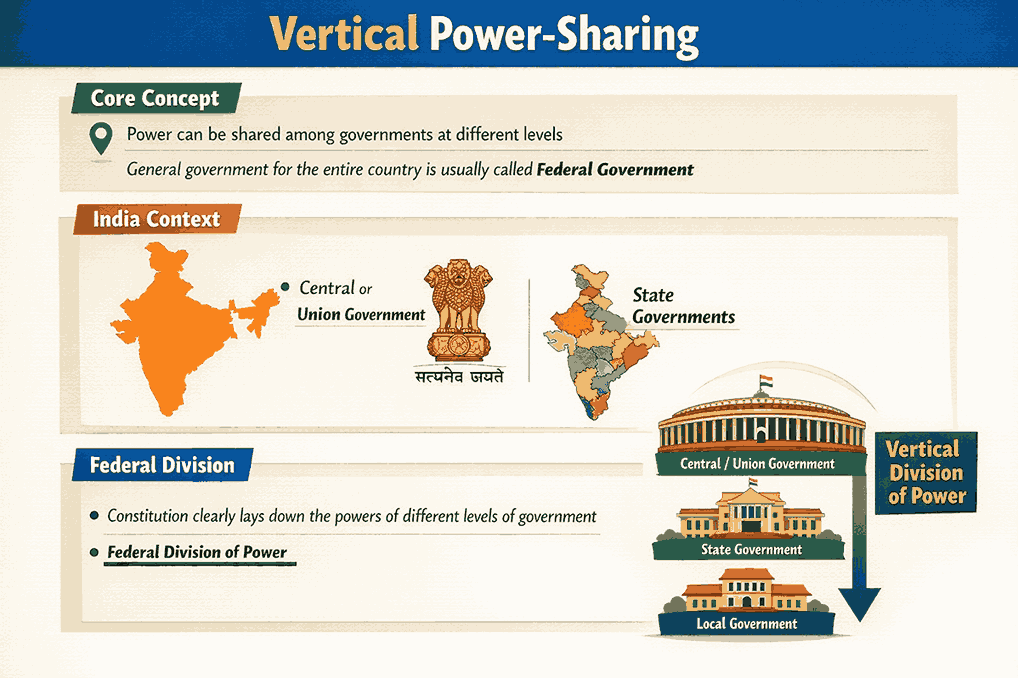
Power is shared among different levels of government
Federal government = general government for the entire country
India
- Central/Union Government (national level)
- State Govts
Federal Division
Constitution divides powers between levels = federal division of power
Vertical Division
Power is split between the higher & lower levels
Result
👉 Federal Structure
3. Social Group Power-Sharing
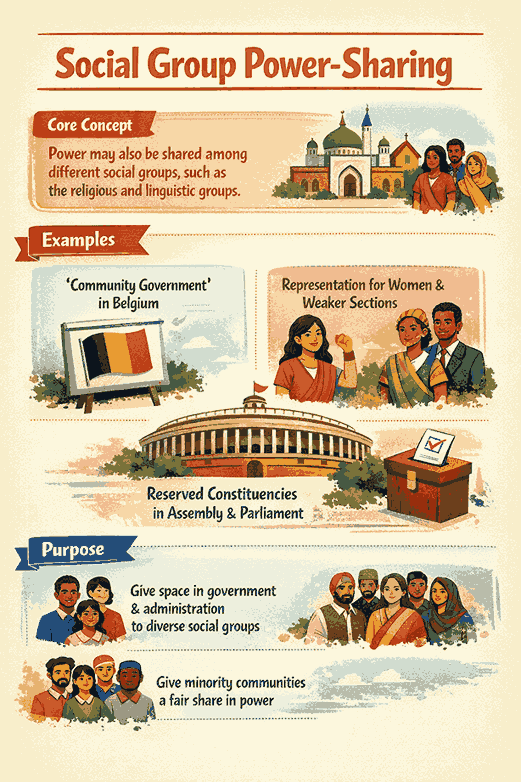
Power may also be shared among different social groups, such as the religious and linguistic groups
Examples
●‘Community govt.’ in Belgium
●Reserved constituencies (India)
●Representation of weaker sections & women
Purpose
●Give space to diverse groups
●Ensure a fair share for minorities
4. Political Parties & Pressure Groups
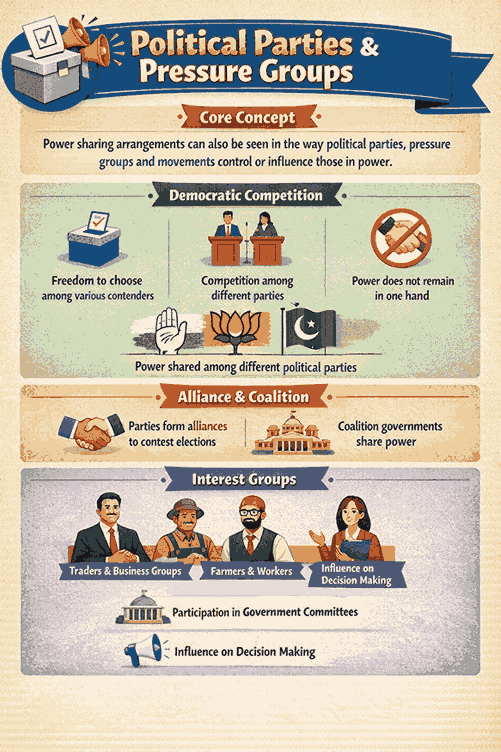
Power is shared via parties, pressure groups & movements in the way they control or influence those in power
Democratic Competition
●Freedom to choose leaders
●Multiple parties compete
●Power is not concentrated in one hand
●Power is shared among parties of different ideologies & groups
Alliance & Coalition
●Parties form alliances
●Create a coalition government = share power
Interest Groups
- Traders, farmers, workers, etc.
- Influence decisions by:
- participation in governmental committees
- influencing the decision-making process