
“Sound Class 9 Short Notes” is prepared from the Chapter 10 sound. Here only the main points are covered that are repeatedly asked in your examinations.
Go through your NCERT textbook and then memorize the notes provided below.
Sound
Sound is a form of energy which produces a sensation of hearing in our ears.
Energy Point
- Energy cannot be created or destroyed.
- It only changes form (example: clapping → mechanical energy → sound energy).
How Sound Is Produced
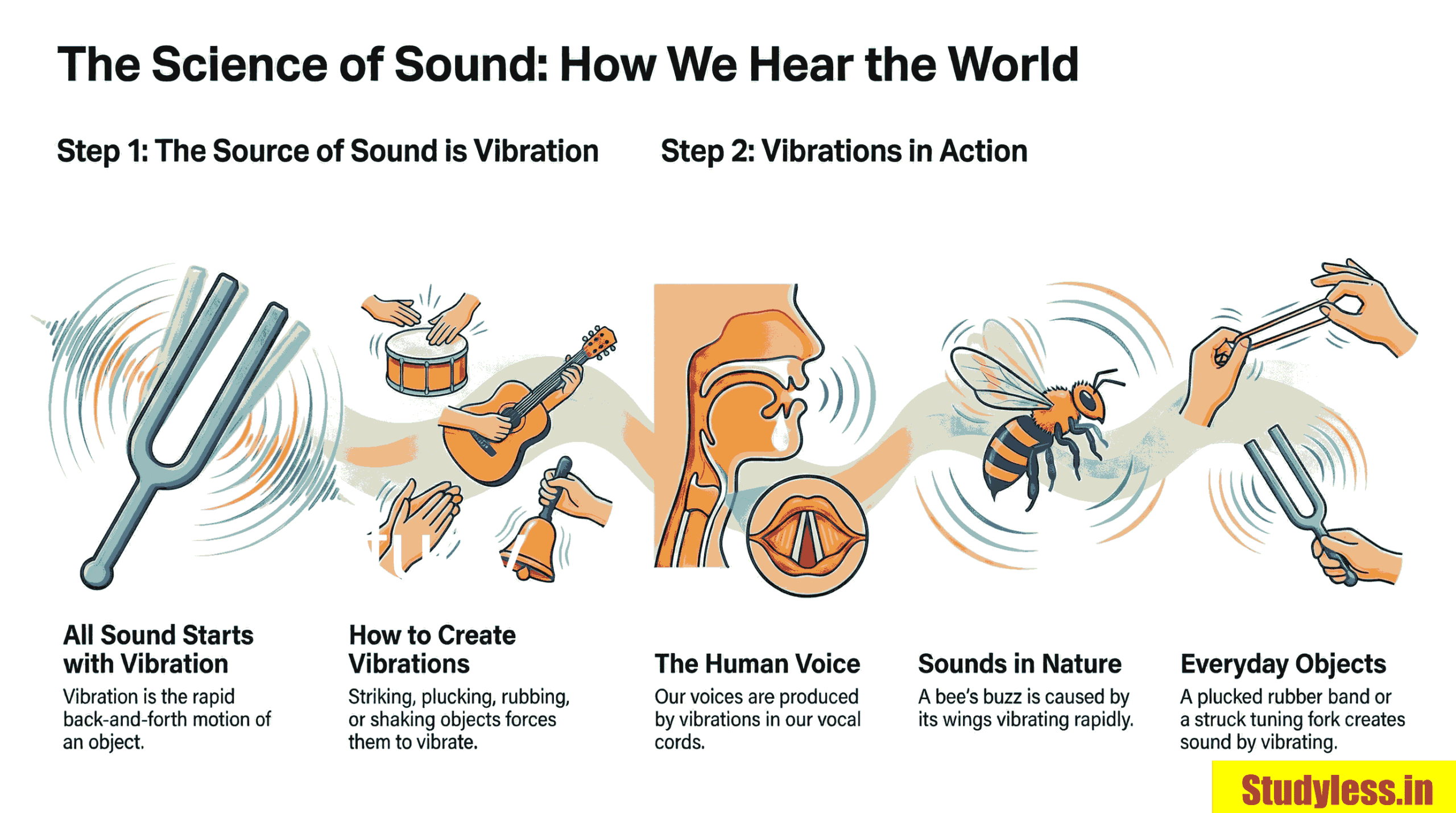
- Sound is produced by a vibrating object.
- Vibration = rapid to and fro motion of an object.
Propagation of Sound
Nature of Sound
- Sound is produced by vibrating objects.
- Requires a medium (solid, liquid, or gas) for propagation.
- Does not travel through vacuum.
Propagation of Sound
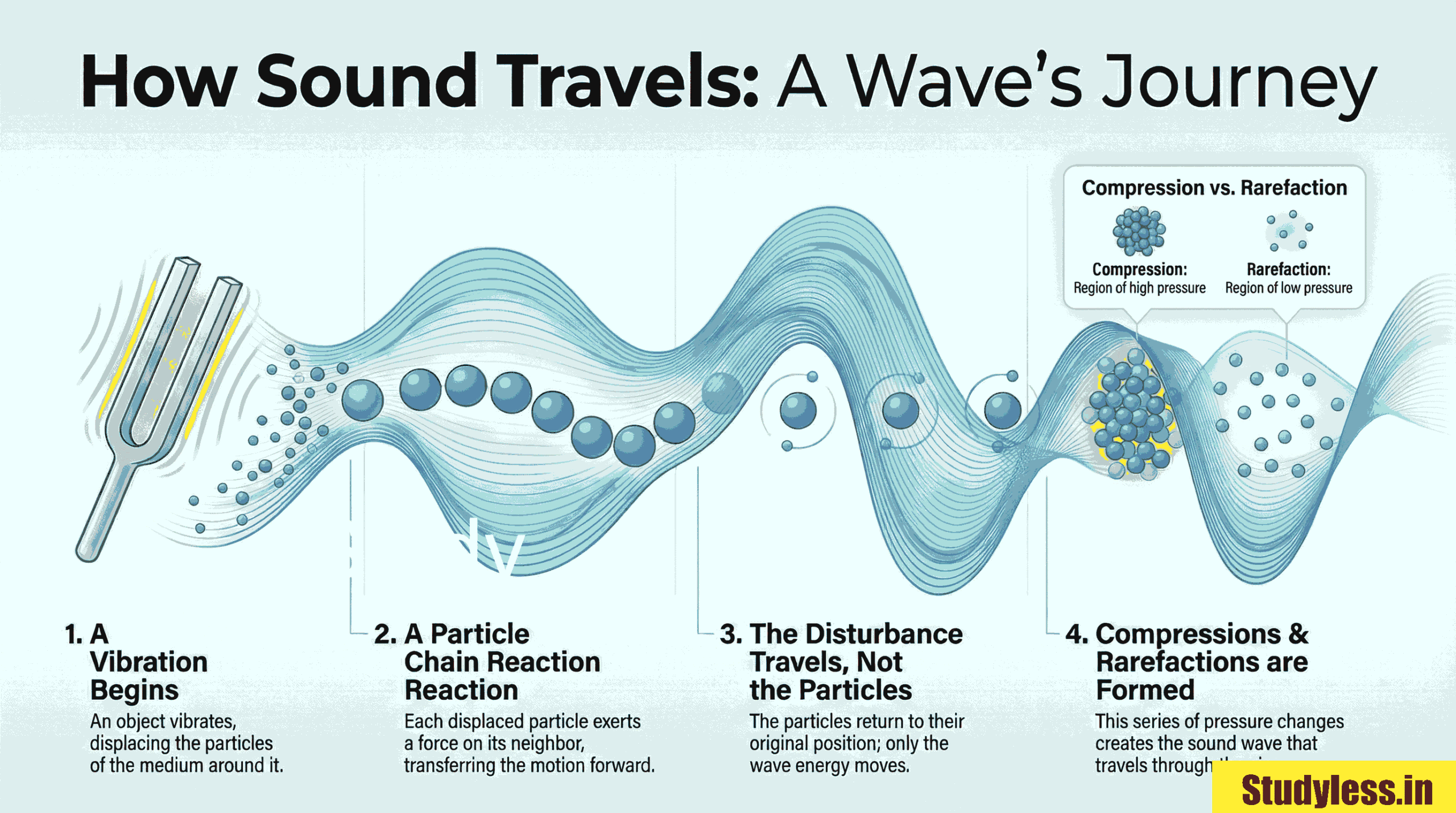
- When an object vibrates, it disturbs nearby particles of the medium.
- Particles do not travel from source to ear; only the disturbance moves.
- Each particle:
- Gets displaced from its equilibrium position.
- Exerts force on adjacent particle.
- Returns to original position after displacement.
- This sequential disturbance propagates as a wave.
Sound as a Mechanical Wave
- Sound is a mechanical wave.
- Requires particles of a medium to propagate.
- Particles oscillate but do not move forward with the wave.
- Disturbance (energy) travels through the medium.
Sound in Air – Compression & Rarefaction
- Air is the most common medium for sound.
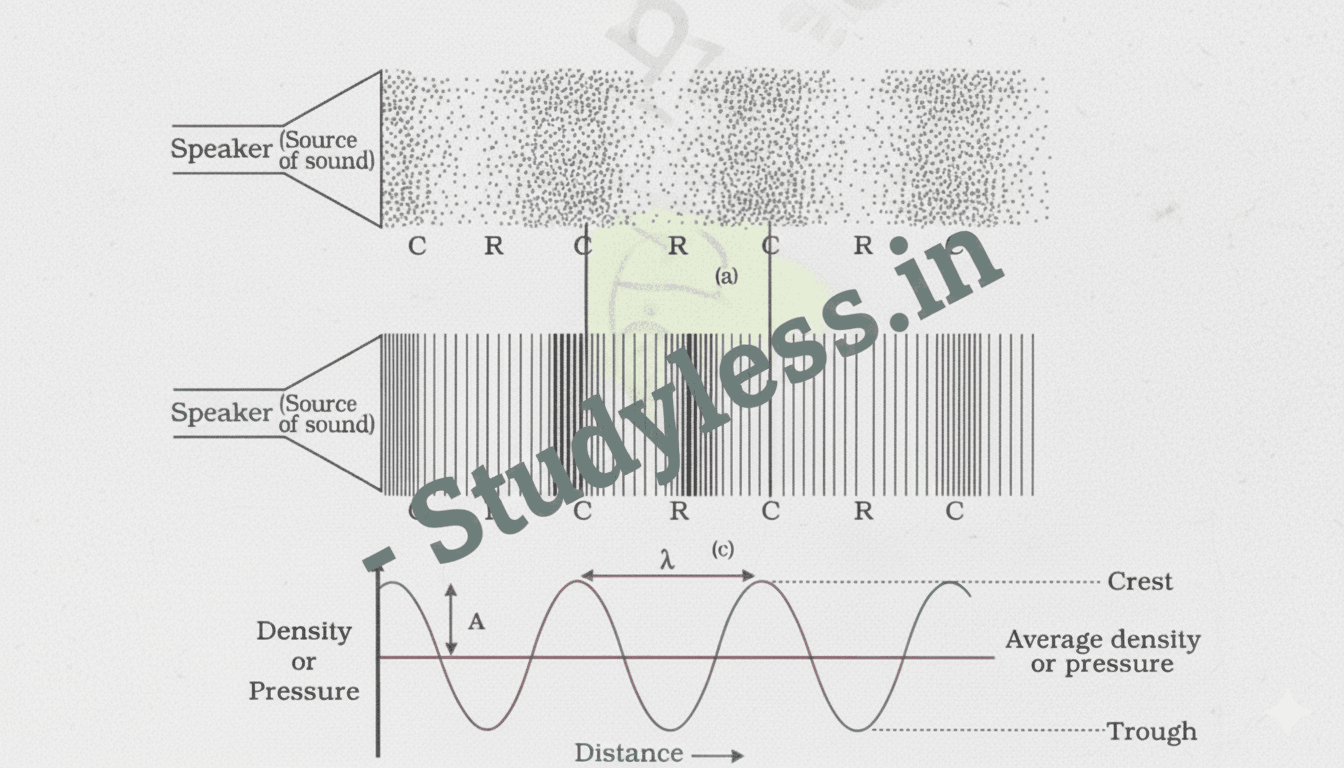
- Compression (C):
- Region of high pressure.
- Created when vibrating object moves forward, pushing air particles together.
- Rarefaction (R):
- Region of low pressure.
- Created when vibrating object moves backward, spreading air particles apart.
- Rapid back-and-forth motion creates alternating compressions and rarefactions → forms sound wave
Pressure and Density Variations
- Compression = high particle density → high pressure.
- Rarefaction = low particle density → low pressure.
- Sound propagation = propagation of pressure or density variations in the medium.
Sound Waves Are Longitudinal Waves

Longitudinal Waves
- Sound travels as longitudinal waves.
- Particles oscillate parallel to wave direction → creates compressions (high pressure) and rarefactions (low pressure).
- Compression = high particle density; Rarefaction = low particle density.
Transverse Waves (Contrast)
- Particles oscillate perpendicular to wave direction (e.g., water waves).
- Light is transverse but not mechanical (no medium needed).
- Sound is NOT transverse — it is longitudinal in air and liquids.
Characteristics Of A Sound Wave
Wave Parameters
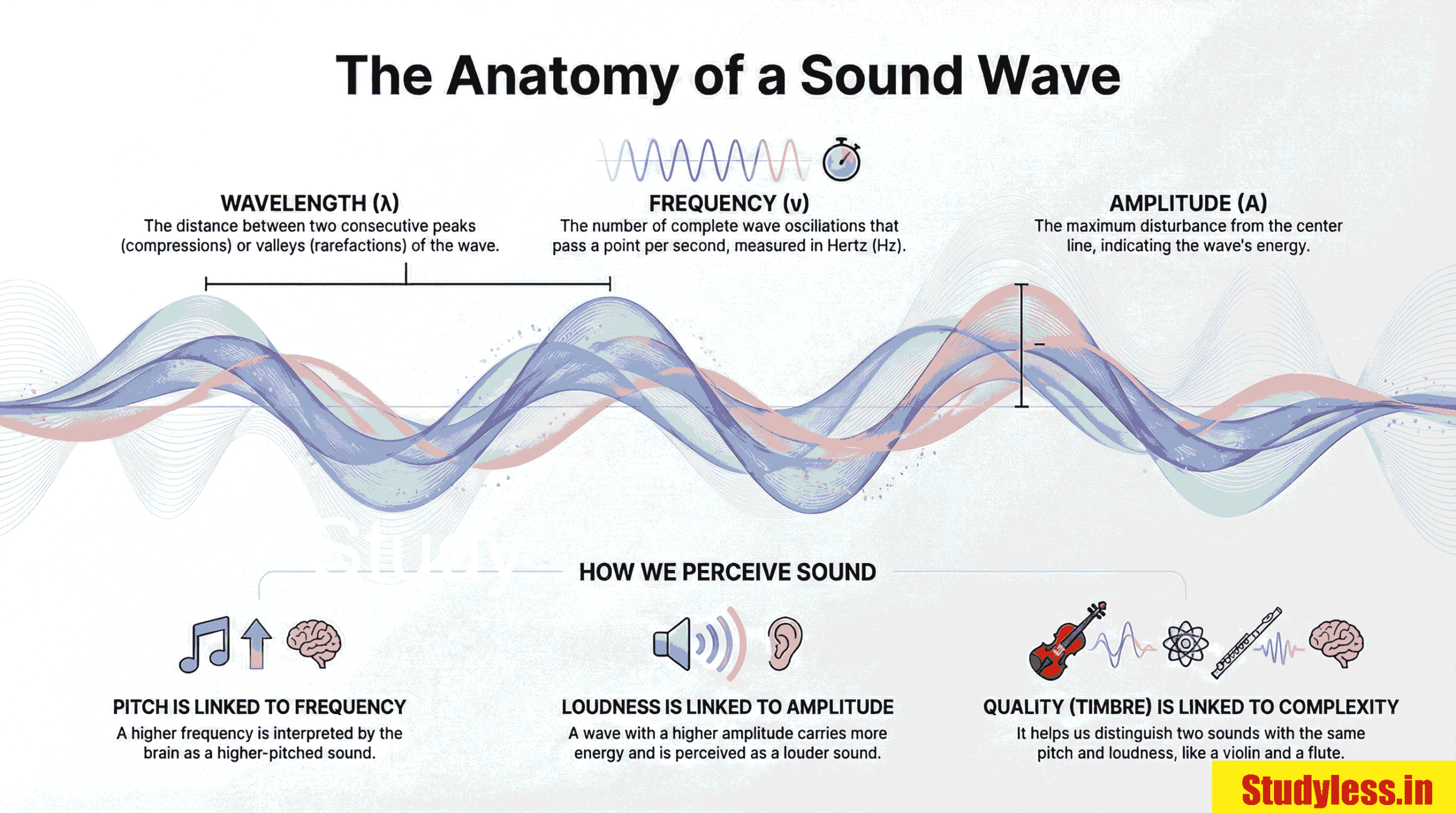
- Wavelength (λ): Distance between two consecutive compressions or rarefactions (unit: metre, m).
- Frequency (ν): Number of oscillations (or compressions/rarefactions passing a point) per second (unit: hertz, Hz).
- Time period (T): Time for one complete oscillation (unit: second, s).
- Relation: ν = 1/T
- Speed of sound (v): Distance travelled by a compression/rarefaction per unit time.
- Formula: v = λν
- Same for all frequencies in a given medium under same conditions.
Characteristics of Sound
1. Pitch
- Determined by frequency.
- Higher frequency → higher pitch.
- Depends on vibration rate of source.
2. Loudness
- Determined by amplitude (A) of wave.
- Greater amplitude → louder sound.
- Amplitude depends on force of vibration.
- Decreases with distance from source.
- Not the same as intensity – loudness is subjective (ear’s response); intensity is objective (energy per unit area per second).
3. Quality (Timbre)
- Enables distinction between sounds of same pitch and loudness.
- Tone: Sound of single frequency.
- Note: Pleasing sound with mixture of frequencies.
- Noise: Unpleasant sound.
- Music: Pleasant, rich-quality sound.
Note:
- Crest = peak (max compression)
- Trough = valley (max rarefaction)
- Sound wave graph shows pressure/density variation vs. distance.
Speed Of Sound In Different Media
General Facts
- Sound travels at a finite speed — much slower than light (e.g., thunder heard after lightning flash).
- Speed depends on:
- Nature of the medium (solid, liquid, gas)
- Temperature of the medium
Dependence on Medium
- Solids > Liquids > Gases
- Speed decreases from solid to gas due to particle spacing and elasticity.
Dependence on Temperature
- Higher temperature → higher speed (in the same medium).
- In air:
- 331 m/s at 0°C
- 344 m/s at 22°C
Reflection of Sound
Laws of Reflection
- Sound reflects off solid or liquid surfaces (like light).
- Angle of incidence = Angle of reflection.
- Incident sound, reflected sound, and normal all lie in the same plane.
- Requires a large obstacle (polished or rough).

Echo
- Reflected sound heard after original sound (e.g., from a building or mountain).
- Human ear retains sound for 0.1 s.
- To hear a distinct echo, time gap ≥ 0.1 s.
- At 22°C (speed of sound = 344 m/s):
- Total distance (to obstacle + back) ≥ 34.4 m
- Minimum distance to obstacle = 17.2 m
- Distance varies with temperature.
- Multiple echoes possible due to successive reflections (e.g., rolling thunder).
Reverberation
- Persistence of sound in a large hall due to repeated reflections.
- Excessive reverberation is undesirable (e.g., in auditoriums).
- Reduced by using sound-absorbing materials:
- Compressed fibreboard
- Rough plaster
- Draperies
- Sound-absorbent seating
Uses Of Multiple Reflections Of Sound
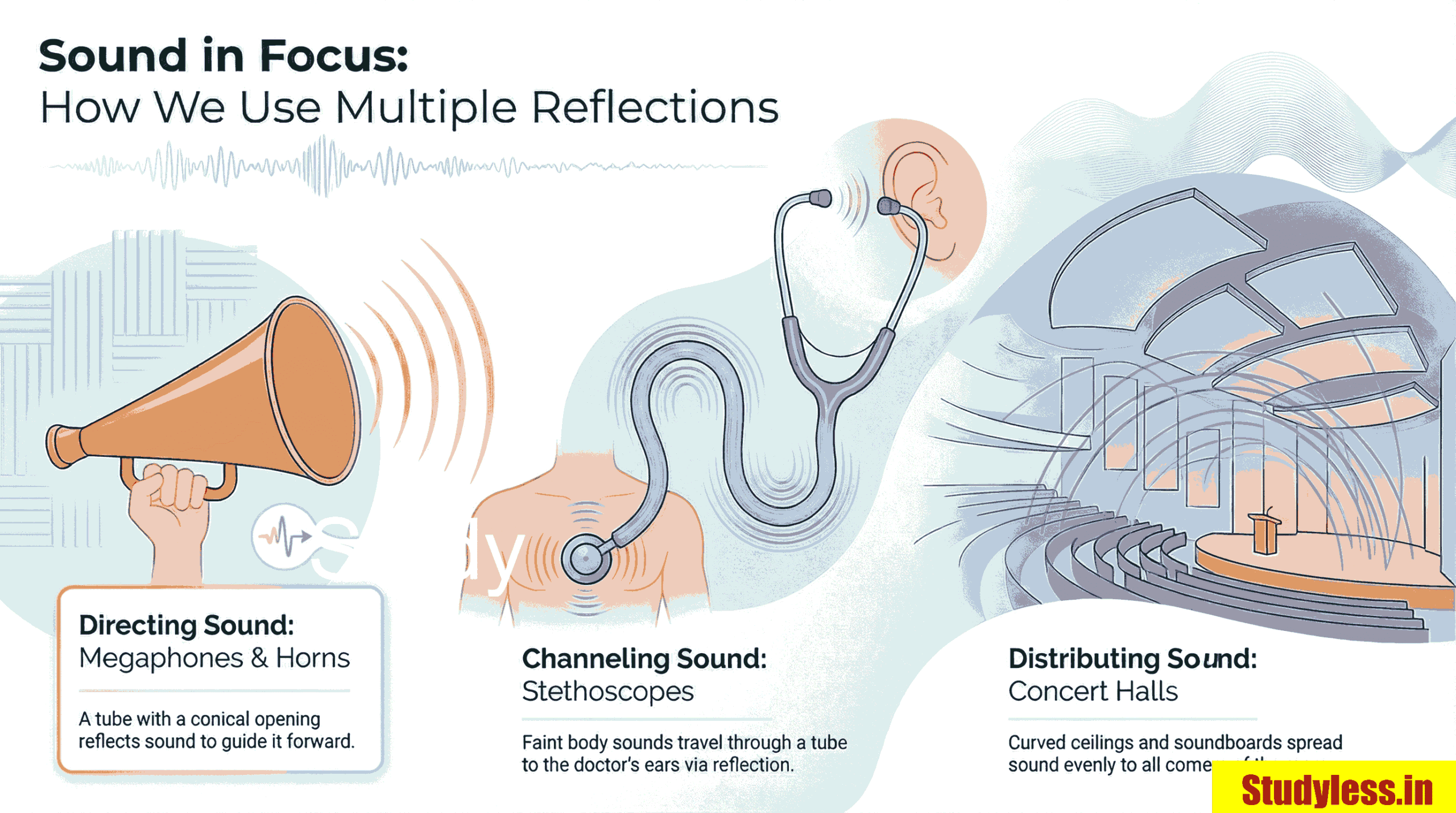
Megaphones, Loudhailers & Musical Instruments (e.g., trumpet, shehnai)
- Use conical tubes to reflect sound successively.
- Direct sound forward without spreading in all directions.
Stethoscope
- Allows doctor to hear internal body sounds (heart, lungs).
- Sound reaches ears through multiple reflections inside the tube.
Curved Ceilings & Soundboards (in concert halls, cinema halls, auditoriums)
- Curved ceilings reflect sound to all corners of the hall.
- Soundboards behind stage reflect sound evenly across the audience.
Range Of Hearing
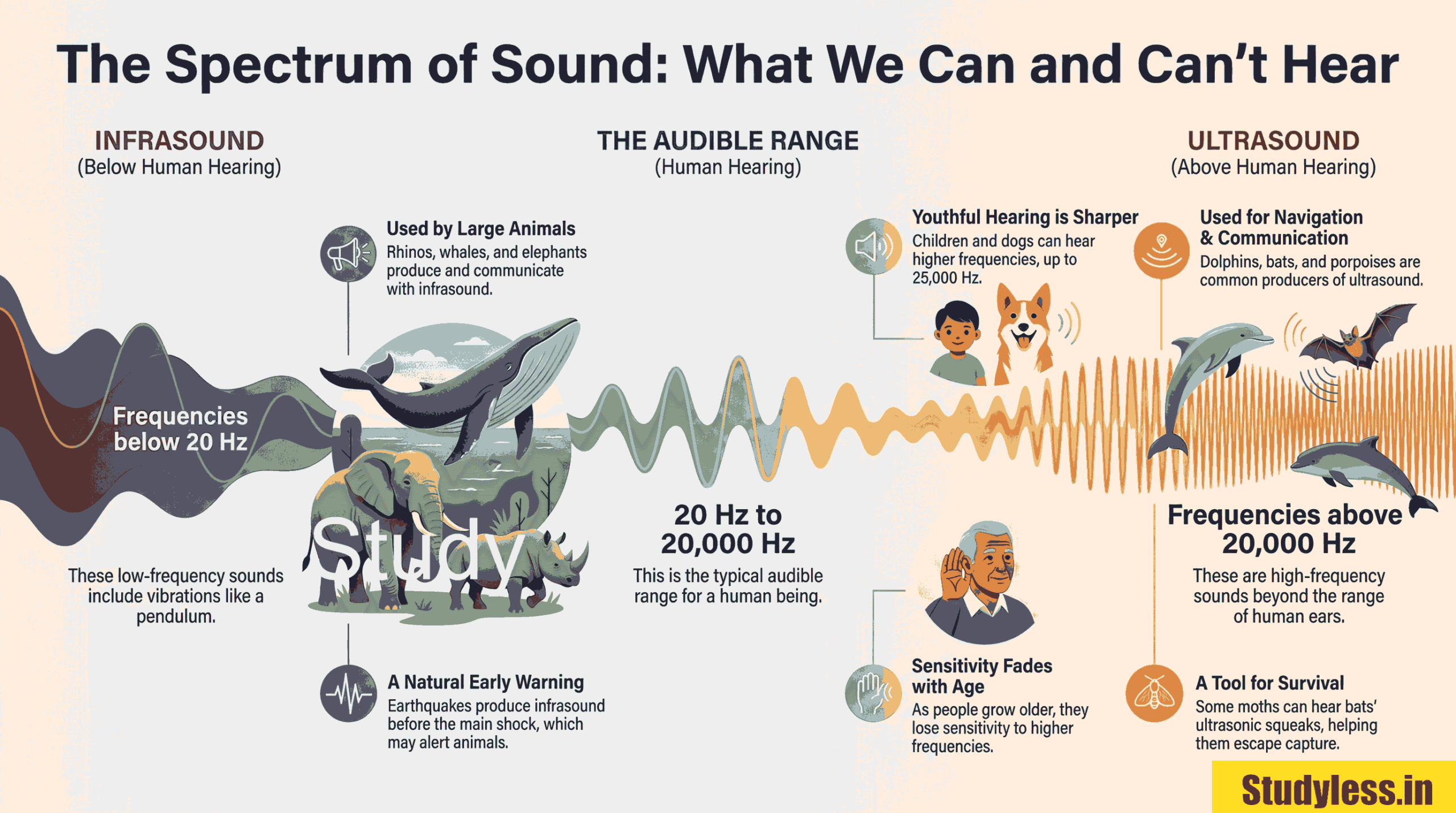
Human Audible Range
- 20 Hz to 20,000 Hz (20 kHz)
- Children (< 5 years) can hear up to 25 kHz.
- Sensitivity to high frequencies decreases with age.
Infrasound
- Below 20 Hz
- Examples:
- Pendulum vibrations
- Rhinoceroses (as low as 5 Hz)
- Elephants, whales
- Earthquakes produce infrasound before main shock → may alert animals.
Ultrasound
- Above 20 kHz
- Produced/used by:
- Bats, dolphins, porpoises (for echolocation)
- Moths: detect bat squeaks → escape predation
- Rats: produce ultrasound during play
Note:
- 1 kHz = 1000 Hz
- Humans cannot hear infrasound or ultrasound.
Applications of Ultrasound
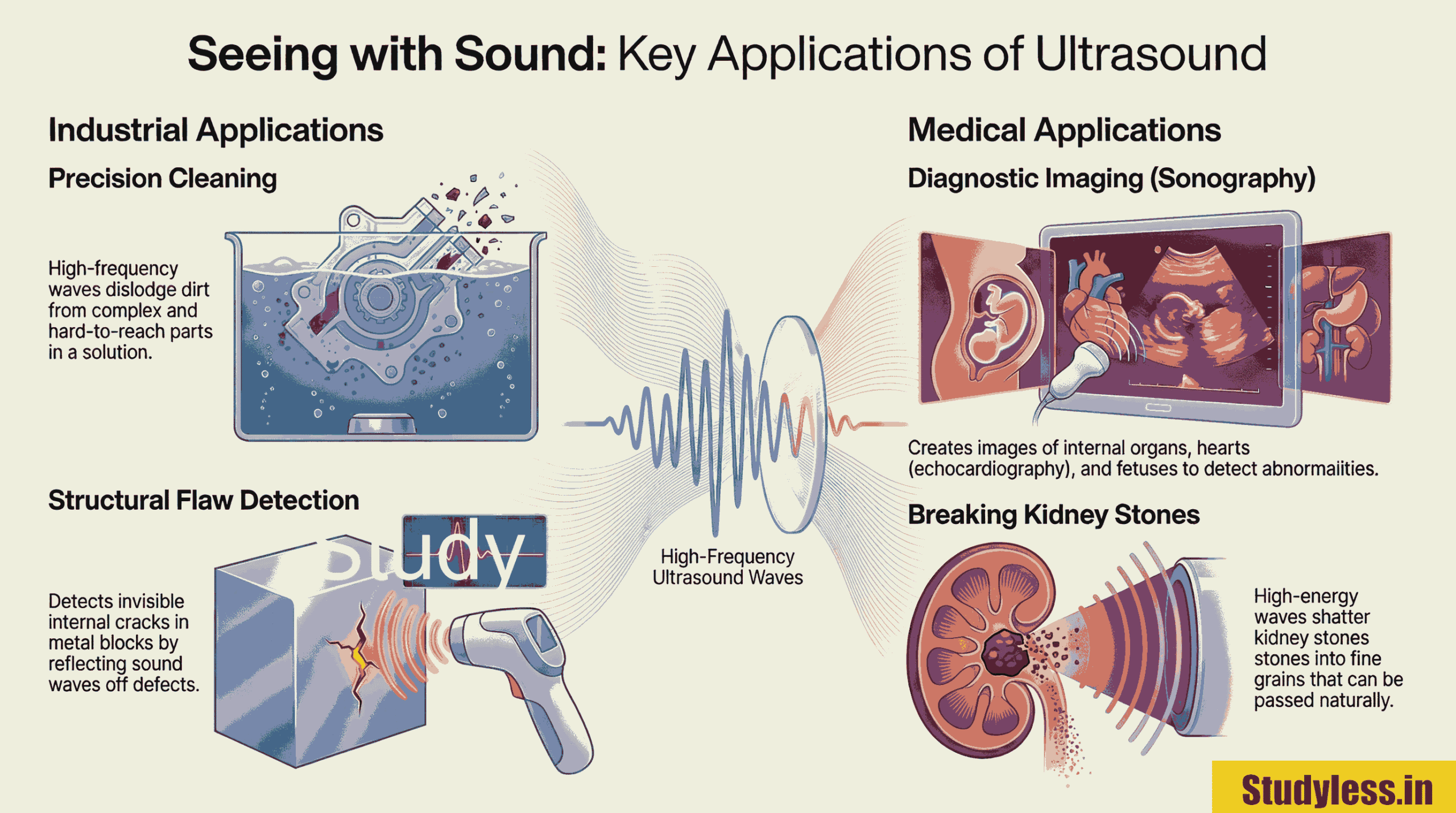
1. Cleaning
- Used to clean hard-to-reach parts:
spiral tubes, electronic components, odd-shaped objects. - Objects placed in cleaning solution;
ultrasonic waves detach dust, grease, and dirt.
2. Detecting Flaws in Metals
- Used in buildings, bridges, machines, scientific equipment.
- Ultrasound passed through metal blocks; detectors check for transmitted/reflected waves.
- Defects (cracks/holes) reflect ultrasound → reveal flaws.
- Ordinary sound not suitable – longer wavelengths diffract around defects
3. Medical Imaging
- Echocardiography:
- Ultrasound reflects from heart parts → forms image of the heart.
- Ultrasonography:
- Produces images of internal organs (liver, kidney, gall bladder, uterus, etc.).
- Detects stones, tumours, tissue abnormalities.
- Also used in prenatal care to check foetal development and detect congenital defects.
- Works by detecting reflections at tissue density boundaries → converted to images on monitor or film.
4. Kidney Stone Treatment
- Ultrasound breaks kidney stones into fine grains → expelled naturally with urine.