
Animal Tissue Short Notes Class 9 Tissue Chapter 6 is a keyword based short notes.
This means you will learn or memorize the exact key word as per NCERT textbook chapter 6. This will help you avoiding memorizing the grammar words.
But before you start cramming the short notes, make sure you have ✔understood the chapter thoroughly and only the memorizing part is left for the test or the examination.
IMP- this is a evolving post we will add some more items for you to master the chapter.
😊Happy Learning !
Related | MCQ Quiz on Animal Tissue Class 9
Introduction to Tissues
All living organisms are made of cells.
unicellular organisms (e.g., Amoeba), one cell performs all basic functions:
1. Movement.
2. Intake of food.
3.Gaseous exchange.
4. Excretion.
multicellular organisms:
Millions of cells
1. Most cells are specialised for specific functions.
2. Specialised cells perform their tasks very efficiently.
Examples of specialised cells
- Muscle cells: contract and relax → cause movement
- Nerve cells: carry messages
- Blood: transports oxygen, food, hormones, waste
- In plants, vascular tissues: conduct food and water
Division of labour: different groups of cells perform different functions
Tissue
– A group of cells
– Similar in structure and/or work together for a particular function
– Arranged to give highest efficiency
Examples of tissues
blood
phloem
muscle
Animal Tissue
| Tissue | Job | Made of |
|---|---|---|
| Epithelial | Cover & protect surfaces | Thin sheets of cells |
| Connective | Link / support / transport | Blood, bone, cartilage |
| Muscular | Move body parts | Muscle cells (contract & relax) |
| Nervous | Carry messages | Neurons |
- Movement
– Contraction and relaxation of muscle cells → movement - Oxygen inhaled → absorbed in lungs → transported to all body cells via blood
– Cells need oxygen for mitochondrial functions (energy production)
- Blood functions:
– Transports oxygen and food to cells
– Collects wastes → carries to liver and kidney for disposal - Blood and muscle are examples of tissues
Four main types of animal tissues
(based on function)
- Epithelial tissue
- Connective tissue (e.g., blood)
- Muscular tissue (e.g., muscle)
- Nervous tissue
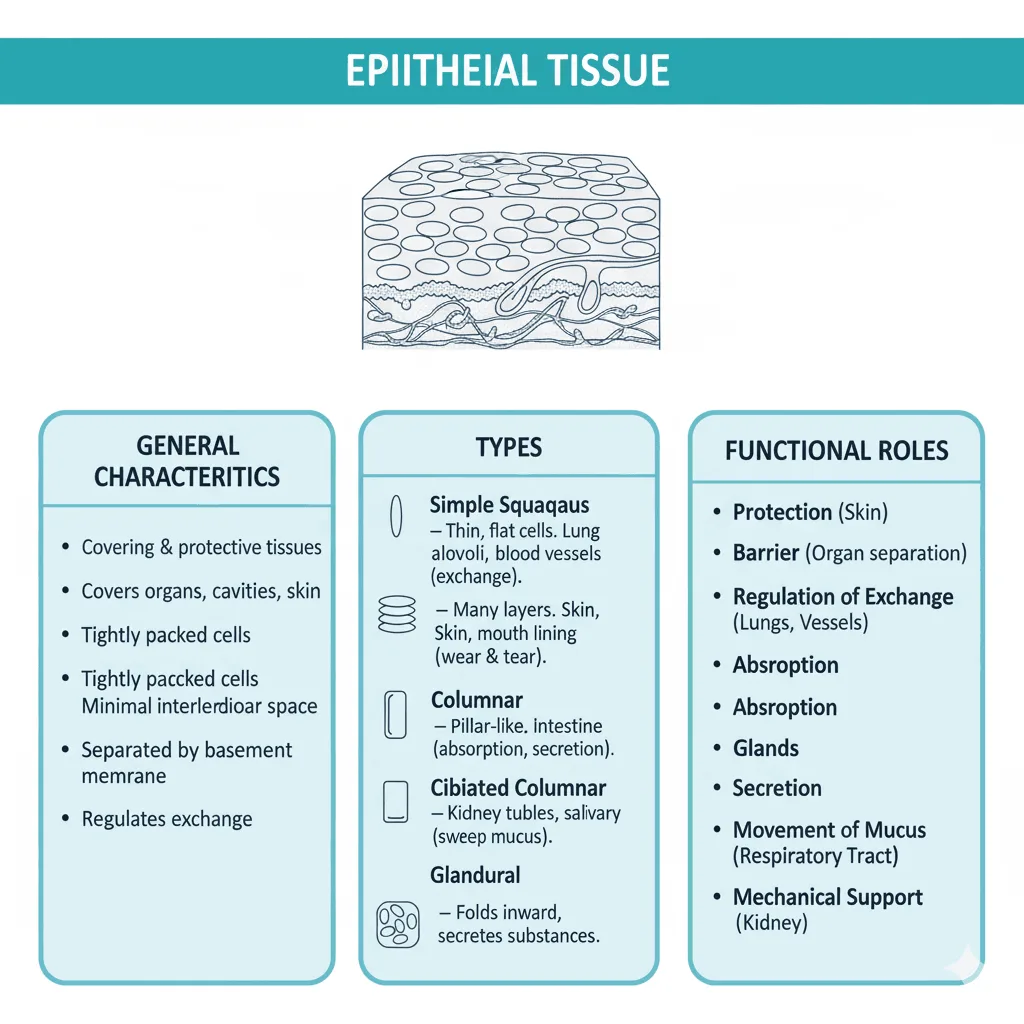
Epithelial Tissue
| Type | Shape / Feature | Where found | Job |
|---|---|---|---|
| Simple squamous | Flat, thin | Blood vessels, lung alveoli, mouth, oesophagus | Quick exchange |
| Stratified squamous | Many layers | Skin | Wear-tear protection |
| Columnar | Tall, pillar-like | Intestine (absorb), respiratory (with cilia) | Absorb / secrete + sweep mucus |
| Cuboidal | Cube-shaped | Kidney tubules, salivary ducts | Support |
| Glandular | Folded in | Glands | Secrete substances |
Function
Covering / protective tissue
– Covers organs and body cavities
– Forms a barrier between body systems
Locations
– Skin
– Lining of the mouth
– Lining of blood vessels
– Lung alveoli
– Kidney tubules
Structure
– Cells tightly packed, form continuous sheet
– Very little cementing material
– Almost no intercellular spaces
– Rests on basement membrane (separates from underlying tissue)
Role
– All substances entering/leaving the body cross epithelium
– Permeability regulates exchange between:
• Body ↔ external environment
• Different body parts
Types of Epithelial Tissue
Simple Squamous Epithelium
– Flat, thin cells
– Found in:
• Blood vessels
• Lung alveoli
• Lining of mouth
• Oesophagus
– Allows easy diffusion / transport
Stratified Squamous Epithelium
– Many layers of squamous cells
– Found in skin
– Prevents wear and tear
Columnar Epithelium
– Tall, pillar-like cells
– Found in inner lining of intestine
– Aids absorption & secretion
Ciliated Columnar Epithelium
– Columnar cells with cilia (hair-like projections)
– Found in respiratory tract
– Cilia move mucus forward for clearance
Cuboidal Epithelium
– Cube-shaped cells
– Found in:
• Kidney tubules
• Salivary gland ducts
– Provides mechanical support
Glandular Epithelium
– Epithelial cells specialised as gland cells
– Secrete substances at surface
– Formed when epithelium folds inward → multicellular gland
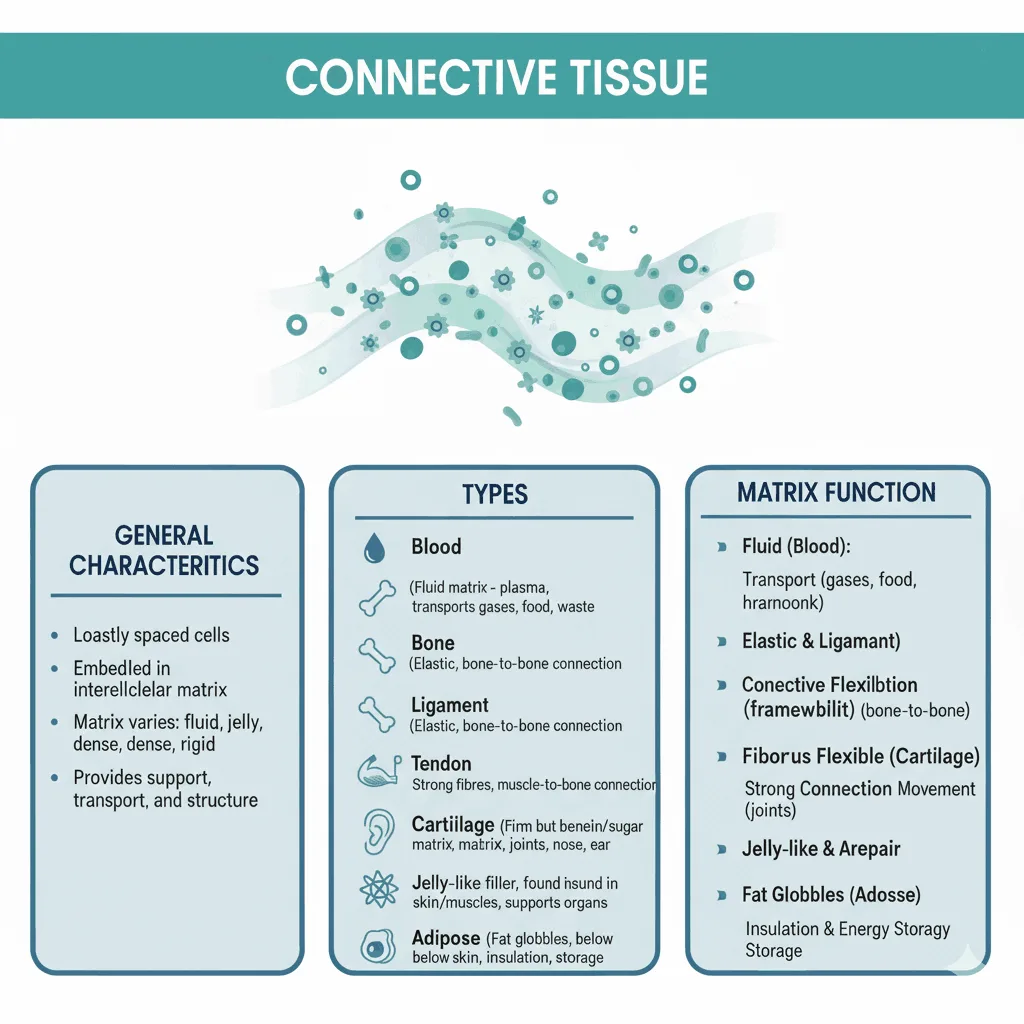
Connective Tissue
| Tissue | Matrix | Key Cells / Fibres | Main Job |
|---|---|---|---|
| Blood | Fluid (plasma) | RBC, WBC, platelets | Transport gases, food, hormones, waste |
| Bone | Hard (Ca + P salts) | Osteocytes | Support body, anchor muscles, protect organs |
| Ligament | Elastic, little matrix | Strong fibres | Bone-to-bone (flexible link) |
| Tendon | Fibrous, low stretch | Collagen bundles | Muscle-to-bone (strong pull) |
| Cartilage | Firm (protein + sugar) | Chondrocytes | Smooth joint surfaces; nose, ear, trachea, larynx |
| Areolar | – | Fibroblasts | Fills spaces, supports organs, repairs |
| Adipose | Fat-filled cells | Adipocytes | Store fat, insulate, cushion |
- Called connective because it connects different body parts
- Cells loosely spaced, embedded in intercellular matrix
- Matrix varies: jelly-like, fluid, dense, or rigid → matches tissue function
Types of Connective Tissue
Blood
– Fluid matrix = plasma
– Contains: RBCs, WBCs, platelets
– Plasma has proteins, salts, hormones
– Transports: gases, digested food, hormones, waste
Bone
– Hard, rigid, nonflexible matrix
– Matrix made of calcium & phosphorus compounds
– Supports body, anchors muscles, protects organs
Ligament
– Connects bone to bone
– Elastic, strong, very little matrix
Tendon
– Connects muscle to bone
– Fibrous, strong, limited flexibility
Cartilage
– Widely spaced cells
– Solid matrix of proteins & sugars
– Found in: joints, nose, ear, trachea, larynx
– Smoothens joint surfaces; flexible (e.g., ear)
Areolar Tissue
– Found: between skin & muscles, around blood vessels & nerves,
in bone marrow
– Fills spaces, supports organs, aids tissue repair
Adipose Tissue
– Stores fat below skin & between organs
– Cells filled with fat globules
– Acts as insulator
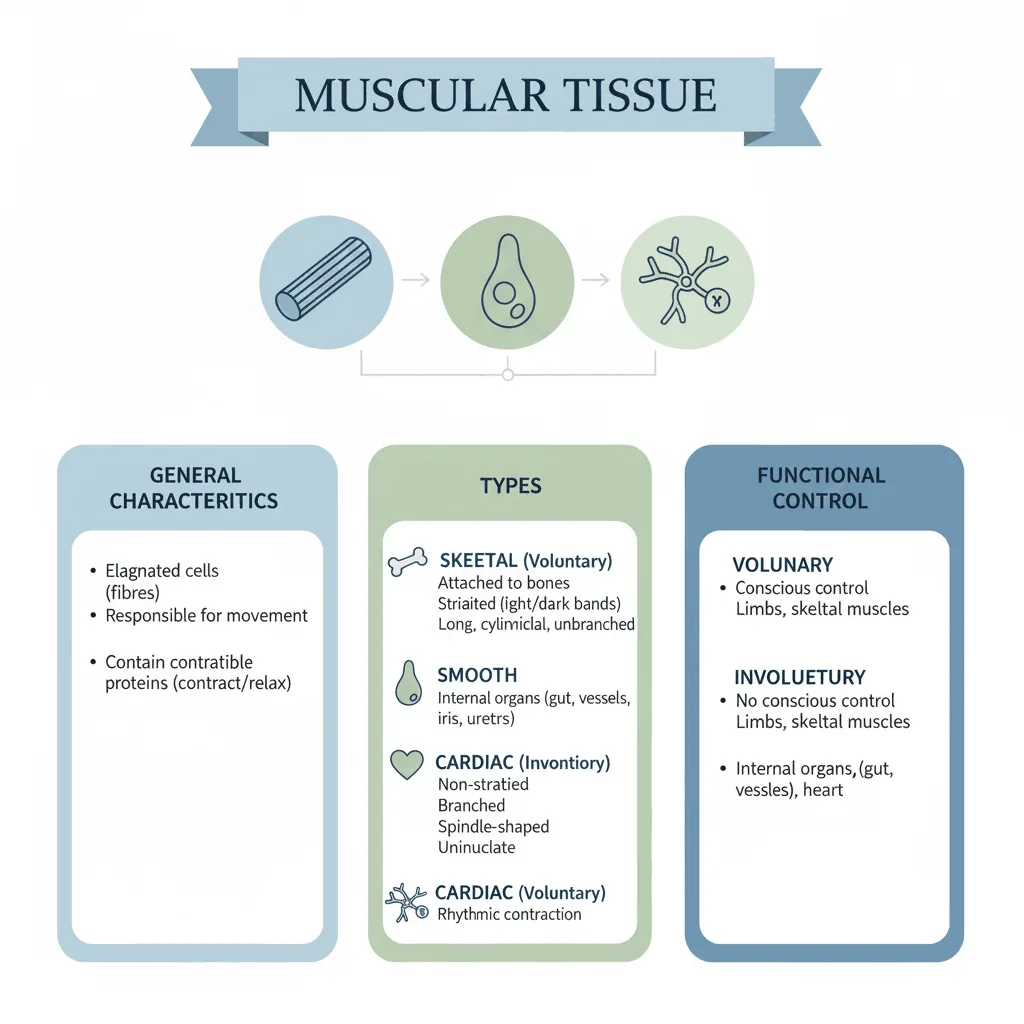
Muscular Tissue
| Type | Control | Striations | Shape & Nuclei | Where found | Job |
|---|---|---|---|---|---|
| Skeletal / Striated / Voluntary | Yes (by will) | Yes (bands) | Long, cylindrical, unbranched, many nuclei | Limbs, bones | Body movement |
| Smooth / Unstriated / Involuntary | No | None | Spindle-shaped, pointed ends, 1 nucleus | Gut, vessels, iris, ureters, bronchi | Slow, steady inner movements |
| Cardiac | No (rhythmic) | Faint | Cylindrical, branched, 1 nucleus | Heart wall | Pump blood lifelong |
- Made of elongated cells = muscle fibres
- Contains contractile proteins → contract & relax → cause movement
Types of Muscular Tissue
Skeletal (Voluntary / Striated) Muscle
– Moved by conscious will (e.g., limbs)
– Attached to bones → aids body movement
– Striations (light & dark bands) visible under microscope.
– Cells:
long, cylindrical, unbranched, multinucleate
Smooth (Involuntary / Unstriated) Muscle
– Not under conscious control
– Controls:
• Food movement in alimentary canal
• Contraction/relaxation of blood vessels
• Iris of eye, ureters, bronchi
– Cells:
spindle-shaped, pointed ends, uninucleate
– No striations → called unstriated
Cardiac Muscle
– Found only in heart
– Involuntary, rhythmic contraction for life.
– Cells:
cylindrical, branched, uninucleate
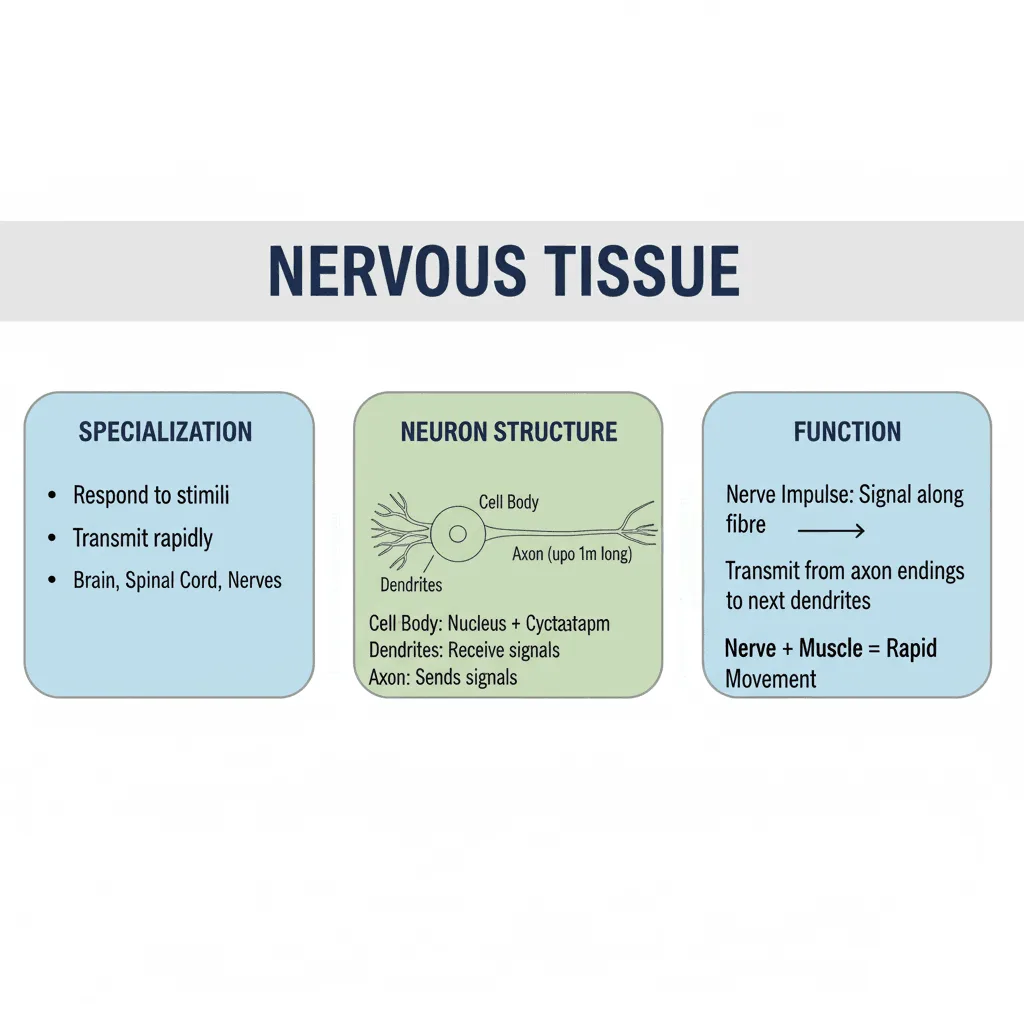
Nervous Tissue
| Part | What it is | Job |
|---|---|---|
| Neuron (nerve cell) | Cell body + nucleus + cytoplasm | Receive & send signals |
| Dendrites | Many short branches | Collect stimulus / impulse |
| Axon | One long fibre (up to 1 m) | Carry impulse away |
| Nerve | Bundle of axons + connective tissue | Fast message highway |
– Highly specialised to receive stimuli and transmit signals rapidly
– Found in: brain, spinal cord, nerves
– Basic unit = neuron (nerve cell)
Structure of a Neuron
- Cell Body : contains nucleus and cytoplasm
- Dendrites: short, branched processes → receive signals
- Axon: single, long, thin fibre → carries nerve impulse away
Neuron can be up to 1 metre long
Function Nerve impulse:
- Electrical signal passing along axon .
- Impulse moves from axon of one neuron → dendrites of next neuron.
- Enables voluntary muscle movement.
Nerve + muscle tissue → allows rapid response to stimuli
Related | Plant Tissue Short Notes
FAQ : Animal Tissue Short Notes Class 9 Tissue Chapter 6
Q1. The short notes are in tabular format, does it has all the important points?
Ans- Yes! I have been teaching for more than decades and I know how much you need to write great answers. Trust me it is sufficient.
Q2. How to use the above short notes?
Ans- Primarily it is for memorization of key ideas and concepts
Q3. I am finding difficulty learning it ?
Ans- just read 5 to 10 times and your are good to go.
![[2026] The Rise of Nationalism in Europe Short Notes , Topic Wise, Flow Chart And Infographics| Quick Memorisation And Revision!](https://studyless.in/wp-content/uploads/2025/06/ChatGPT-Image-Jun-8-2025-01_31_20-PM_11zon-1024x683.avif)